

A sheet of still water does what no planting scheme can: it doubles the sky, cools the eye and persuades every bird in the neighbourhood to visit. The smallest pond changes a garden’s whole temperament.
These seventy-five pond ideas run from shape and siting to planting, moving water and the living balance — the full attribute map of a garden pond, with safety and upkeep stated plainly throughout.
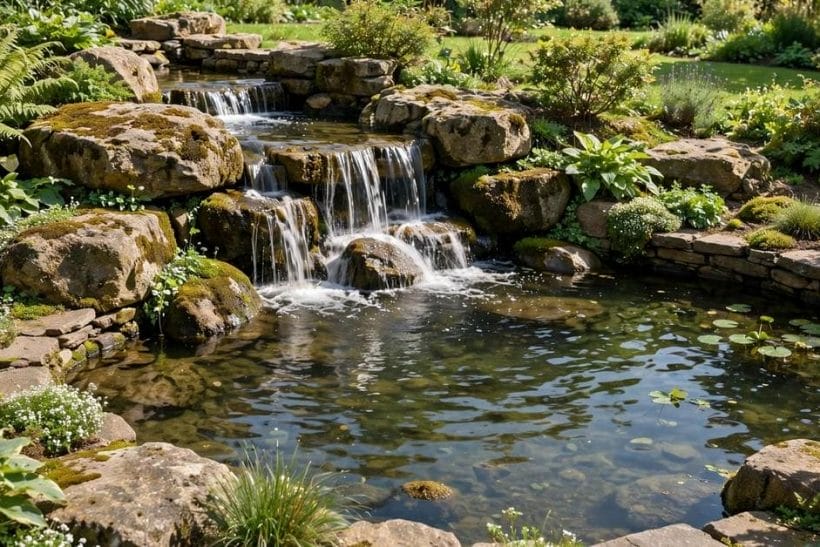
1. Pond Ideas at a Glance
A garden pond is a managed miniature ecosystem built around one central entity — the water body itself — and its attributes are shape, siting, construction, planting, movement, wildlife and the sitting places that make it part of daily life. It belongs to the same outdoor-water family as the site’s above-ground pool and swimming posts, but its purpose is different: habitat, reflection and calm rather than bathing, and its design rewards restraint at every stage.
| Question | Short answer |
|---|---|
| What is the best shape for a garden pond? | The shape your garden already suggests — formal geometry beside terraces and clipped planting, a wandering natural outline in informal ground. Shape is a style decision first and an engineering one second. |
| How much sun does a pond need? | Flowering plants and lilies want sun for much of the day; a shaded pond stays a reflective, green place and should be planted accordingly. Match the planting to the light the site honestly offers. |
| Does a pond need a pump and filter? | Moving water and fish raise the need; a still, well-planted wildlife pond can thrive without either. The decision follows the fish question and the fall question, not the catalogue. |
| Is a pond safe with young children? | Only with a deliberate safety layer: a rigid grille below the surface, secure fencing, or a raised design, with local rules checked. Supervision alone is never the plan. |
| What keeps pond water clear? | Balance: enough plants to out-compete algae, modest fish stocking, leaves kept out and patience in spring. Clarity is an ecology outcome, not a chemical one. |
| What does a pond cost to run? | A still planted pond costs little beyond time; pumps, lighting and fish raise the running cost in proportion to their scale. Costs are discussed in general terms in the closing section — nothing here needs invented figures. |
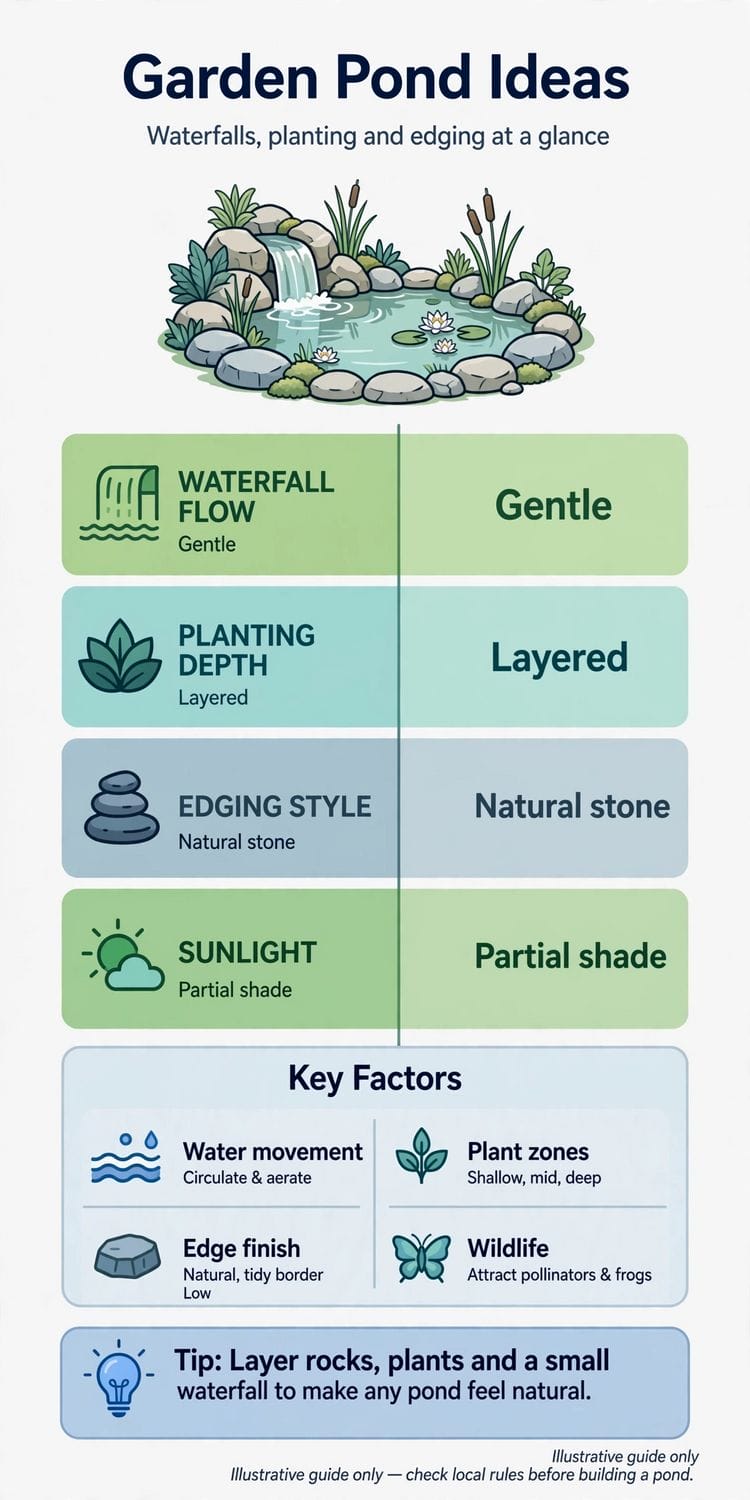
2. Shapes and Styles: The Pond Itself
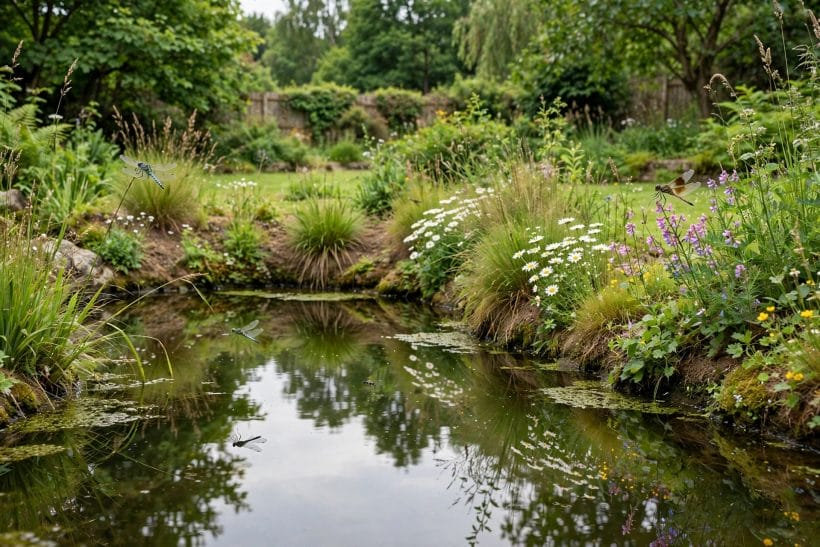
A garden pond succeeds first as a shape on the ground and only then as water. Formal or wild, raised or sunken, the outline decides how the garden reads from the house — so this section treats the pond itself as a piece of design, before plants, fish or falls enter the picture.
1. Choose a formal geometry for a structured garden
Circles, rectangles and clean ovals belong beside terraces, lawns with crisp edges and clipped planting. A formal pond reads as architecture: its rim is a line the whole garden can organise around, and its still surface mirrors the sky like a second, quieter window.
2. Let a naturalistic outline wander like a woodland pool
Soft, irregular edges suit informal gardens where beds curve and paths meander. The trick is intention: vary the curve gently, hide the rim under planting and stone, and the pond reads as something the landscape always contained rather than something recently dug.
3. Raise the pond when sitting beside the water matters
A raised pond brings the surface to chair height, which changes everything: fish come closer, planting is easier to tend, and the rim doubles as a seat.
4. Sink the pond flush for a mirror at ground level
A sunken pond set level with lawn or paving gives the purest reflections and the strongest sense of discovery on approach.
5. Fit a courtyard pond into the smallest paved corner
Even a paved courtyard can hold water: a modest rectangle or square against a wall, planted sparingly and edged in the same stone as the floor.
6. Run a stream-fed pond down a gentle slope
Where the garden falls, a short stream linking two small pools turns a problem gradient into the garden’s best feature.
7. Add a bog garden at the pond’s wet edge
A bog garden is a permanently damp bed beside the pond, filled with moisture-loving plants that would sulk in ordinary soil.
8. Use a reflecting pond where the view deserves doubling
Some ponds exist mainly to hold the sky: dark-lined, unplanted in the centre, and placed where a tree, a gable or a sunset can double itself.
9. Build a container pond for a balcony or tiny terrace
A watertight half-barrel, stone trough or glazed pot with a dwarf lily and a few oxygenating plants is a true pond in miniature.
10. Terrace two small ponds instead of digging one large one
On uneven ground, two modest pools at different heights, linked by a spillway, are easier to build and far more interesting than one big excavation.
11. Tuck a corner pond into the garden’s forgotten triangle
Most gardens own an awkward corner where nothing thrives. A small triangular or quarter-circle pond claims it completely, and a bench angled across the corner turns the garden’s dead spot into the seat everyone quietly competes for.
3. Siting the Pond: Sun, Shade and Safety
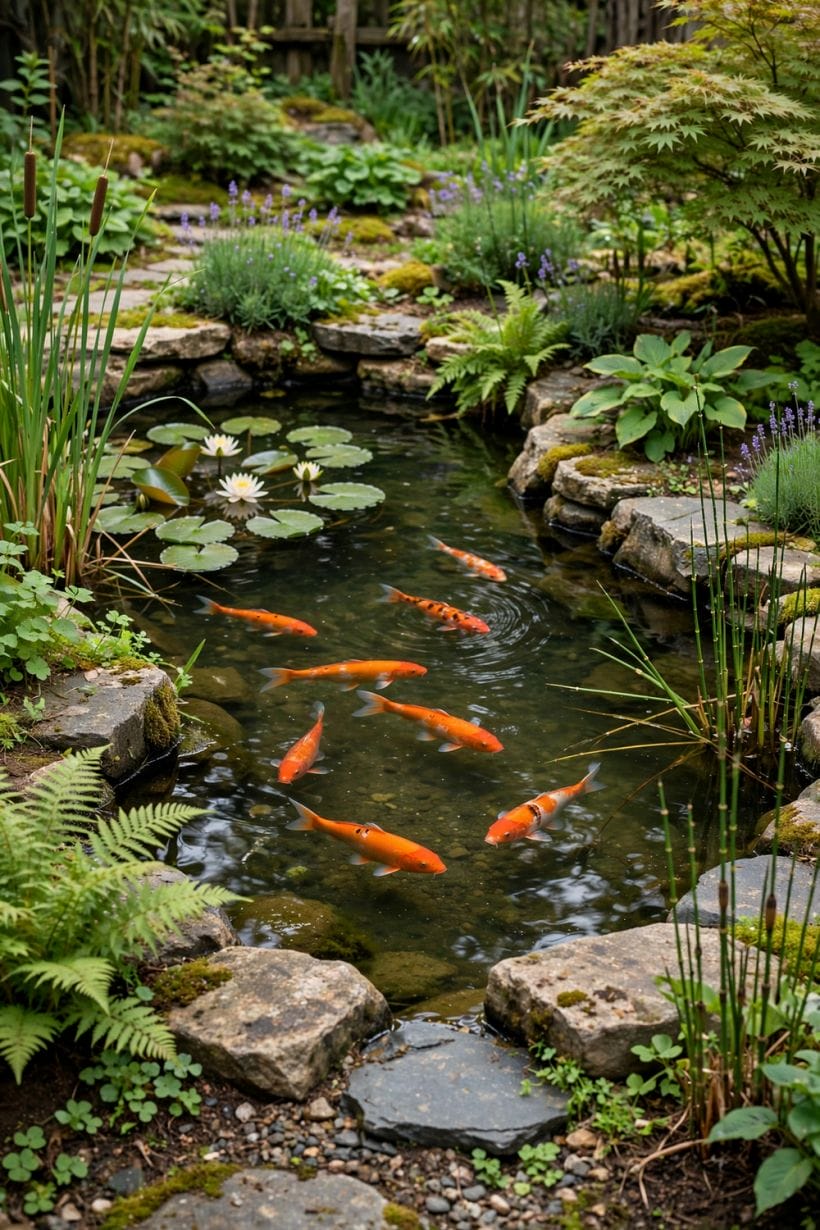
Where the pond sits decides how it lives: sun grows the lilies, shade keeps the water clear, and every route to it should be safe in the dark and the wet. The wider water survey in pool ideas makes the same point for swimming water — position is always the first design decision.
12. Give flowering water plants the sun they ask for
Water lilies and most flowering marginals bloom in proportion to the light they receive. A pond in open sun for much of the day will flower generously; one under dense canopy will stay a green, reflective place — beautiful, but plan the planting to match the light you actually have.
13. Keep clear of heavy leaf fall where you can
A pond directly beneath a large deciduous tree inherits every leaf it drops, and decaying leaves feed algae and sludge.
14. Place the pond where the house can see it
Water earns its keep when it is watched: from the kitchen window, the sitting room, the desk.
15. Read the slope before you dig a single spadeful
Ponds want the level ground or the foot of a slope, never the path of run-off.
16. Keep access safe, lit and slip-free
You will visit the pond in the wet, at dusk, carrying things. A firm path, a step where the level changes, and low lighting on the route are not luxuries — they are the difference between a pond that is tended and one that is avoided.
17. Treat child safety as a design layer, not an afterthought
Where young children play, the pond needs a real answer: a rigid grille just under the surface, a fence with a self-closing gate, or a raised design that small hands cannot topple into.
18. Give wildlife a shallow way in and out
A gently sloping beach of gravel or stone at one edge lets birds bathe, frogs climb out and hedgehogs escape.
19. Plan the power route before the planting hides it
Pumps and lights need electricity, and cables are far easier to lay before edges are planted and stones are set.
20. Avoid the frost pocket at the garden’s lowest dip
Cold air pools in hollows, and a pond in the frost pocket freezes harder and longer than one a little higher.
21. Keep some distance from the house walls and drains
A pond hard against the house complicates damp courses, foundations and buried services. A comfortable margin of ground between water and wall protects both, and the gap makes a fine place for the path, the bench and the best marginal planting.
22. Listen before you build: the sound carries
Falling water is louder across a still garden than most people expect, and it travels to neighbours as readily as to you.
4. Liners, Shells and the Build
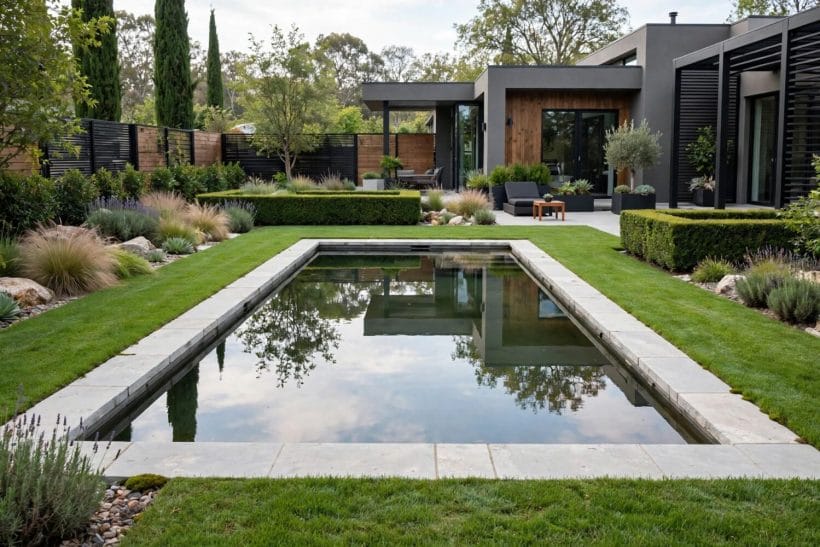
Under every beautiful pond is an unglamorous decision about what holds the water. Liners, shells and rigid builds each have their place; the craft lies in the preparation beneath them and in shelves, beaches and edges planned before the water goes in — not wished for afterwards.
23. Choose a flexible liner for any shape you can imagine
A quality flexible liner follows curves, shelves and beaches that no rigid shell can match, which is why most naturalistic ponds use one.
24. Pick a preformed shell when the pond is small and simple
Rigid shells suit modest, regular ponds and impatient timelines: dig, level, bed on sand, fill. Their fixed shelves dictate the planting, so choose a profile whose ledges sit where your plants will want to stand, not merely the shape that caught your eye.
25. Build in masonry where the pond is raised and formal
A raised formal pond can be built like a low wall — block or brick rendered and sealed, with a liner inside for insurance.
26. Never skip the underlay beneath a liner
Underlay fabric or a layer of soft sand cushions the liner against stones, roots and the slow shifting of the ground itself.
27. Dig planting shelves at more than one depth
Pond plants live at different depths: marginals in the shallows, lilies further down. Shelves cut at varied levels around the edge let each basket stand at its proper height, and they double as steps that make the pond’s profile safer and more natural.
28. Form one edge as a beach, not a cliff
A single shallow slope, surfaced in gravel over the liner, serves wildlife, softens the rim and gives the pond a shoreline to read against.
29. Hide the liner’s edge as if the pond depended on it
It does, visually. A visible band of black liner at the waterline undoes every other effort; overhang stone, turf or planting so the water appears to meet the garden directly, and top up the level so the disguise is never exposed by evaporation.
30. Keep the deepest zone modest and central
A deeper pocket in the middle gives fish a refuge in heat and frost and keeps the water’s temperature steadier.
31. Plan the waterfall feed before the liner is placed
A fall or stream needs its own liner run, overlapped into the pond so water cannot escape sideways at the join.
32. Settle edging stones on firm ground, not on the liner’s lip
Rim stones carry feet, mowers and frost. Bed them on compacted soil or a shallow footing outside the liner’s edge so their weight never drags the liner down or tears it, and leave the liner a hidden, protected margin beneath them.
33. Fill slowly, and let the liner settle as you do
Water is the liner’s final fitting tool: filling in stages lets it ease into shelves and corners without stretching or bridging.
5. Planting the Pond and Its Edges
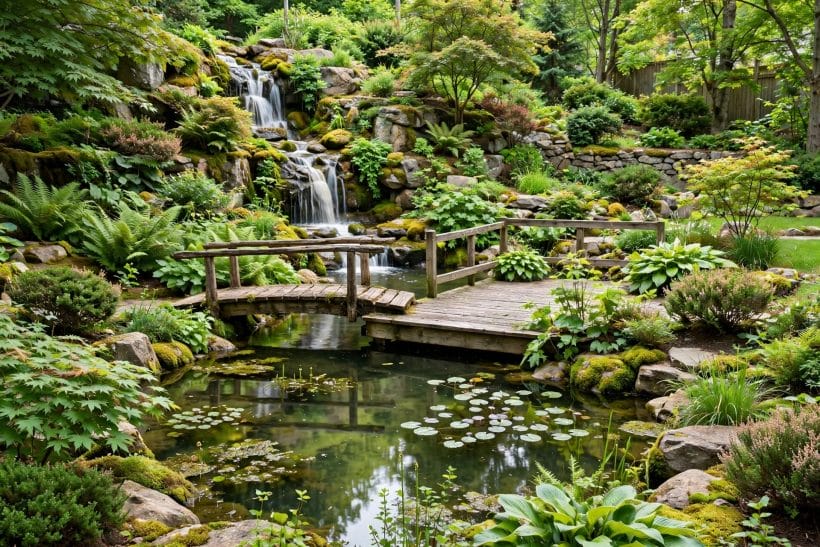
Plants are not the pond’s decoration; they are its engine room and its frame. The planting runs in layers — below the surface, at the margin, and on the bank behind — and the most useful planning tool is the planting-led approach collected in the site’s home design ideas hub: start from the effect, then choose the plants that deliver it.
34. Start with oxygenators, the pond’s invisible workforce
Submerged oxygenating plants compete with algae for nutrients, shelter fry and keep the water’s chemistry steadier through the season.
35. Stand marginals in baskets on the shelves you built
Marginal plants — irises, rushes, marsh marigolds and their kin — live with wet feet at the pond’s edge.
36. Give lilies the still, sunny centre they demand
Water lilies hate moving water on their leaves and need sun to flower. Place them away from the fall’s splash zone, in the deepest calm area, and accept their bargain: in exchange for the pond’s best flowers, they will shade a good share of its surface.
37. Float a few plants for shade that moves with the season
Floating plants shade the water in high summer, when algae pressure peaks, and their roots dangle as shelter for small creatures.
38. Plant the bank behind the pond as a second act
The ground behind the water matters as much as the margin: moisture-tolerant grasses, ferns and bold foliage plants make the pond look sprung from the garden rather than set into it.
39. Use grasses and rushes to draw the vertical line
Upright foliage — rushes, iris blades, slender grasses — gives a flat sheet of water its contrast and its movement in wind.
40. Plan a succession, not a single season
A pond planted only for midsummer looks tired by autumn. Layer the calendar: early marsh flowers, midsummer lilies, late grasses and seed heads, and evergreen structure at the rim — so the water has a costume for every month it can be seen.
41. Favour wildlife-friendly planting over pure ornament
Native and near-native pond plants feed and shelter far more life than exotic novelties: insects at the flowers, cover at the stems, egg-laying sites underneath.
42. Keep vigorous spreaders in their baskets, always
Some excellent pond plants are thugs in open soil. Basket culture is the difference between a reed that accents the margin and a reed that evicts everything else within two seasons; check each plant’s reputation before it earns an unconfined place.
43. Be cautious with anything labelled invasive in your region
Pond plants escape: over the rim in flood, on birds’ feet, in carelessly dumped clippings. Several once-popular kinds are now restricted in many regions for good reason.
44. Leave some margin bare for the creatures that need it
A short stretch of open gravel beach, unplanted and sunny, is habitat too — a basking, bathing and drinking place.
6. Water Movement: Falls, Streams and Fountains
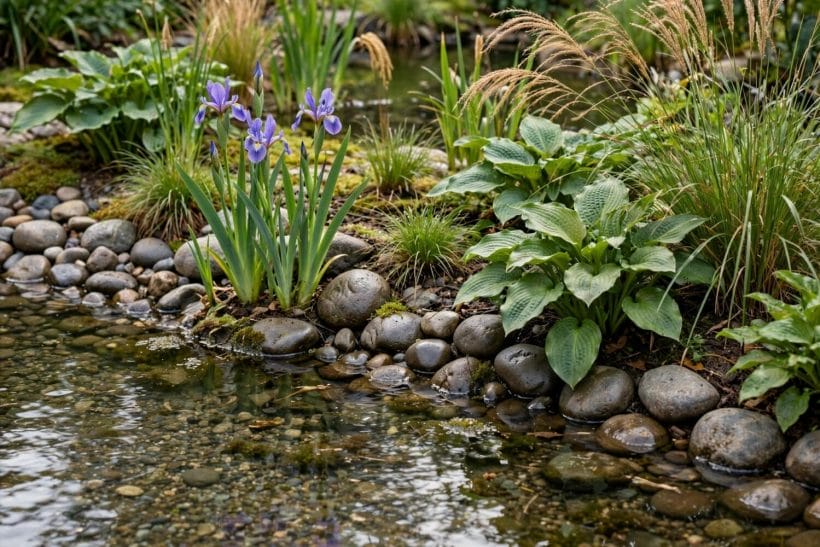
Still water reflects; moving water performs. A fall, a stream or a simple jet changes the pond’s sound, its oxygen and its mood — and the fall built for the waterfall post in this series, the backyard pond waterfall, shows how much of the effect is proportion rather than power.
45. Size the fall to the pond, not to your imagination
A modest pond with a theatrical cascade looks like a plumbing accident. The fall’s width, drop and flow should rhyme with the pond’s scale: a gentle sheet or a rocky trickle suits most garden ponds better than a torrent, and it costs less to run.
46. Build a stream in steps, with pools between the drops
A stream that descends in shallow steps, resting in small pools, sounds varied, loses less water to splash, and gives birds a staircase of bathing places.
47. Choose a fountain jet for formal water and small spaces
A single jet or a small bell of water suits formal and courtyard ponds: it aerates, animates and needs no extra excavation.
48. Let still water be the design where reflection is the point
Not every pond wants movement. A reflecting pond with a hidden, gentle circulation — or none at all beyond a small filter return — keeps its mirror unbroken.
49. House the pump where you can reach it without wading
Pumps need cleaning and occasional replacement, usually at the least convenient moment. Set the pump in a accessible spot near the edge, in a chamber or basket that keeps debris off it, with a cable run you can trace without draining the pond.
50. Consider solar movement for a small, sunny pond
A small solar pump can run a gentle fountain or trickle in a container or courtyard pond without any cable at all.
51. Tune the sound before the stones are finally set
The difference between music and noise is often one stone’s position under the falling sheet. Run the water during the build, stand where you will sit, and adjust the drop and the landing stones while everything is still movable and dry-handed.
52. Watch splash and drift, the quiet water thieves
Wind takes fountain spray; a badly aimed fall creeps sideways over stones and out of the system. On a small pond these losses empty inches surprisingly fast.
53. Keep an eye on winter behaviour
Moving water resists freezing a little longer than still water, and a small clear patch matters for fish and for gases escaping the pond.
54. Give the fall a planted, rocky disguise
A waterfall that erupts from bare liner convinces nobody. Stone set into the slope, planting tucked at its shoulders and moss encouraged in the splash zone make the fall read as a spring the garden always had — the plumbing simply persuaded it to perform.
55. Remember that movement is also maintenance
Falls and fountains earn their keep but ask for theirs: filters clog faster, algae grow on wet stone, pumps wear.
7. Fish, Wildlife and the Living Pond
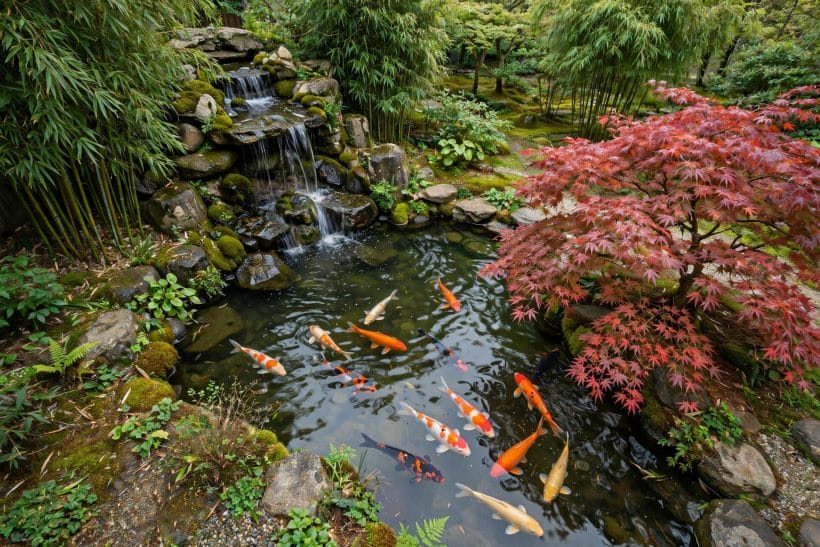
A pond is a small ecosystem wearing a garden’s clothes. Whether it holds fish or deliberately does not is its biggest ecological fork — the koi specialists have their own dedicated post, the modern koi pond, while this section keeps to the general balance that suits most garden water.
56. Decide fish or no fish before anything else
Fish change everything downstream: planting must survive nibbling, filtration becomes serious, and herons take an interest.
57. Keep fish stocking modest and the water will stay kind
Most troubled garden ponds are simply overstocked: too many fish, too much food, too much waste for the plants to process.
58. Plant for frogs and newts if you want the garden’s allies
Amphibians want shallow edges, undisturbed planting and no fish in their nursery. In return they patrol the garden for slugs and fill spring evenings with quiet industry.
59. Build a bird-bathing shelf at the sunny edge
Birds bathe where the water is shallow, the footing grippy and the view of approaching cats is clear.
60. Discourage herons with edges, not warfare
Herons wade in from shallow margins and dislike deep, straight edges, overhanging planting and interrupted sightlines.
61. Feed the pond’s residents less than they ask for
Fish beg convincingly and need far less than they claim; uneaten food is algae fertiliser delivered by hand.
62. Watch the balance in spring, when everything wakes unevenly
Plants wake slowly; algae wake fast. The green spring flush that alarms new pond keepers usually clears as the oxygenators and lilies take hold.
63. Keep a simple cleaning rhythm rather than rare purges
Little and often wins: net out leaves, thin the oxygenators, clear the pump intake, top up the level.
64. Think twice before adding chemicals to fix the water
Cloudiness and algae are symptoms — of light, nutrients, stocking or planting out of balance. Treating the cause is slower and works; treating only the symptom teaches the pond nothing.
65. Leave the pond’s winter quiet mostly undisturbed
Under ice and in cold mud, the pond is resting, not broken. Keep a small ice-free patch where fish overwinter, leave the seed heads standing for insects and birds, and postpone tidying until the water warms and its residents are active again.
8. Lighting, Decking and Sitting Beside the Water
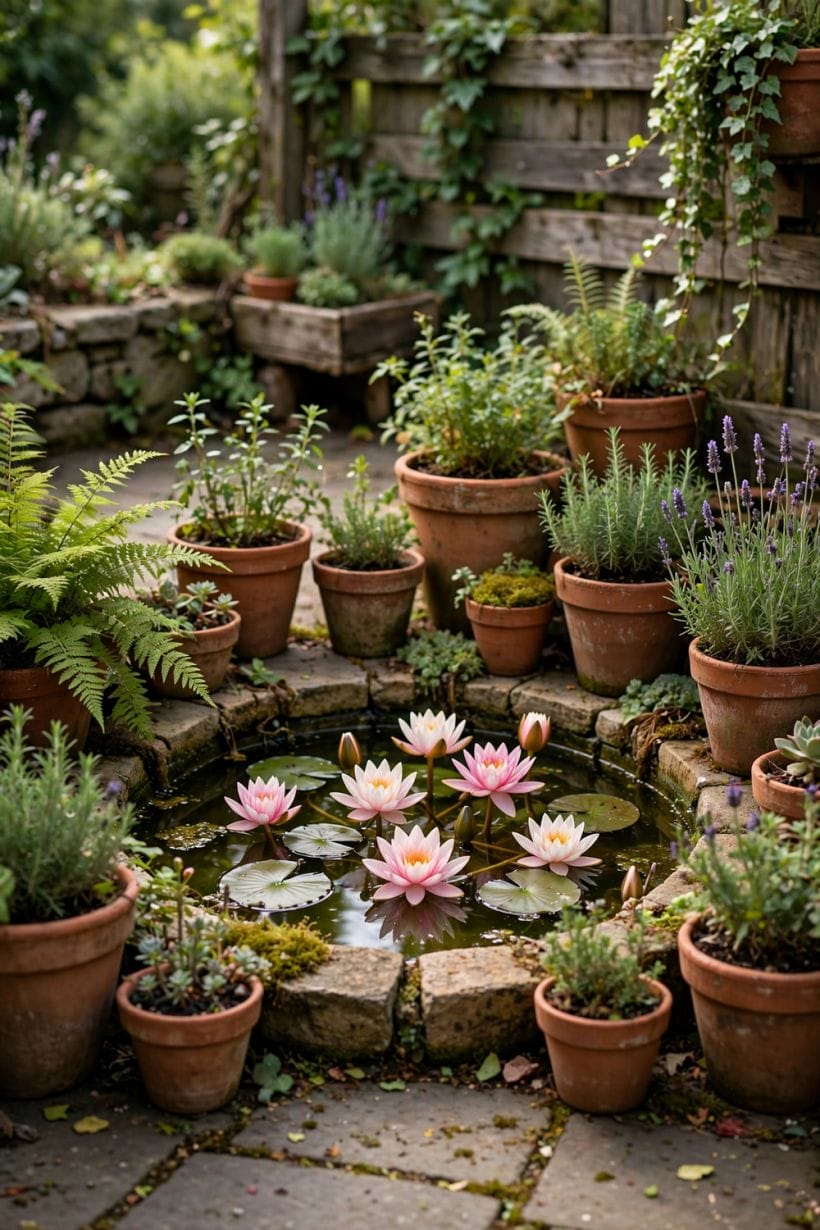
A pond is visited as much as it is viewed, and the furniture of visiting — a deck edge, a bench, a stepping stone, a light for the evening — decides whether it becomes the garden’s favourite room. Compact-pond thinking from small pool ideas applies here directly: small water, generously appointed, gets used the most.
66. Run a deck edge along one side for feet-over-water sitting
A short run of decking at the pond’s edge puts chairs at the perfect height and distance: close enough to watch fish rise, dry enough underfoot in any weather.
67. Place stepping stones for the gardener, not the photograph
A couple of well-set stones at the maintenance points — the pump side, the lily side — save a hundred muddy improvisations.
68. Face the bench at the pond’s best hour
Every pond has a time of day when it performs: morning dragonflies, evening reflections, the sunset doubling itself.
69. Light the water from within for the evening show
A submerged light turns the pond into the garden’s lamp after dark: fish glide through the beam, and the fall, if lit, becomes a curtain of sparks.
70. Use path lighting to make the visit safe and tempting
Two or three low lights along the route from the house make the evening pond an easy habit rather than an expedition.
71. Keep a working corner honest and unsentimental
Nets, buckets, the spare basket, the plant feed: pond keeping has kit, and kit left lying about spoils the scene it serves.
72. Choose materials that forgive permanent damp
Anything stationed at the water’s edge lives wet: decking, bench feet, stone and metal all weather faster there.
73. Frame one perfect view and stop there
A pergola end, a gap in the hedge, a bench positioned just so — one composed view of the water is worth more than the pond visible from everywhere.
74. Plan for the pond in winter’s composition
When the planting dies back, the pond’s bones remain: rim stones, the bench, seed heads left standing, ice patterns on still water.
75. Let the sitting place invite staying, not just looking
A side table for a drink, a cushion box, a little shade for noon — the difference between a viewpoint and a destination.
9. Checks and Mistakes: Before the First Purchase or the First Fitting
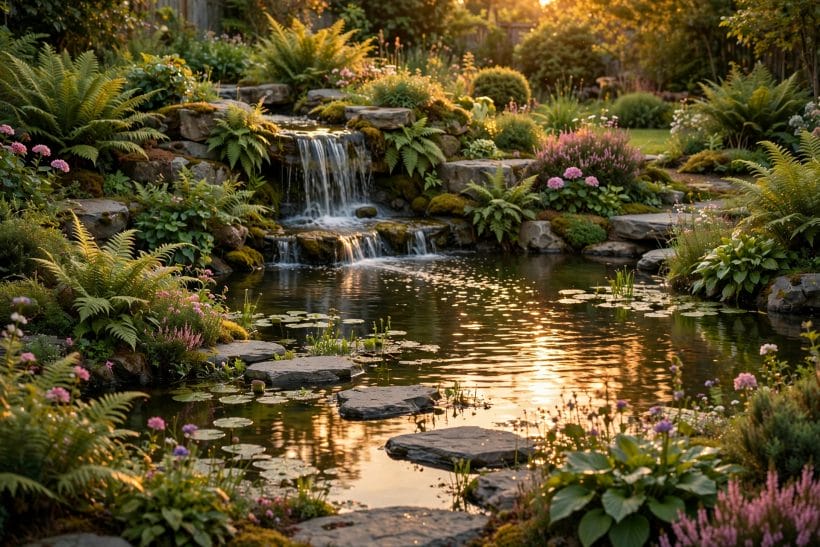
Check the site against the water table and buried services before digging; striking a pipe or cable turns a weekend project into an emergency, and a pond dug into a high water table can lift its own liner after heavy rain.
Check local rules on fencing, water features and protected species before the build, not after it — requirements differ by area, and a pond near a boundary or a public path carries more obligations than one in a private back garden.
Never use a container that has held chemicals as a pond or a pond planter without being certain of its history: residues leach into water and poison exactly the life the pond exists to host. Food-grade and known-history vessels only.
The commonest building mistake is the exposed liner edge — a black band at the waterline that no planting can later hide. Allow extra liner, overhang the edging, and keep the level topped up so the disguise holds in dry weather.
The commonest keeping mistake is kindness: too many fish, too much food, too much intervention. Most ponds that fail were loved in the wrong direction; the corrections are nearly always subtractions.
Finally, check the electricity plan with the same seriousness as the digging: water and power are unforgiving neighbours, outdoor sockets and cables belong in conduit, and the installation or inspection of the circuit is work for a qualified electrician.
10. Costs and Pulling It Together
A pond’s costs gather in predictable places whatever its size: excavation and disposal, the liner or shell and its underlay, edging stone, the pump and any lighting, plants and baskets, and the path and seat that make it visitable. Stated generally — as with the site’s wider backyard pool ideas — the honest pattern is that the build is a single outlay while the keeping is a small, steady one, and both grow with movement and fish rather than with water area alone.
Pulling it together, the sequence that rarely disappoints runs: choose the shape the garden suggests, site it for the house’s sightlines and the plants’ sun, build the edges and shelves with the liner hidden, plant in layers from oxygenators up, and only then decide how much movement and livestock the finished water should carry.
Do those in order and the pond stops being a project and becomes a place — the one the garden’s wildlife finds first, and the one its people drift toward last thing in the evening.
Final Considerations
A garden pond is the rare feature that improves every year it is kept: planting thickens, wildlife learns the address, and the water settles into its own clear habits. The seventy-five ideas above are variations on a single discipline — design the water’s container honestly, plant it generously, stock it lightly and sit beside it often.
Start with the shape, respect the site, and let the pond be a little wilder than your first instinct. The reflection is free, the dragonflies are punctual, and the best seat in the garden is the one at the water’s edge.

0 Comments