

January separates the brochures from the buildings. When the temperature stays below freezing for a week and the wind finds every gap, rv vs tiny house winter living stops being a lifestyle debate and becomes a physics test: how much insulation surrounds you, where your water lines run, and what it costs to stay warm until spring. Both homes are small, towable and marketed with four-season promises. They behave very differently at ten below, and the difference is written into how each one is built.
This cold-climate test compares the two across the five dimensions winter actually cares about — insulation, pipe freezing, heating cost, snow mobility and storm comfort — with condensation, snow load and winterising effort in support. No laboratory and no invented figures: just how each home is constructed, how those construction choices play out in real cold, and what experienced owners do to close the gap. By the end you will know which home suits a mild-winter wanderer, and which one a stationary northern winter demands.
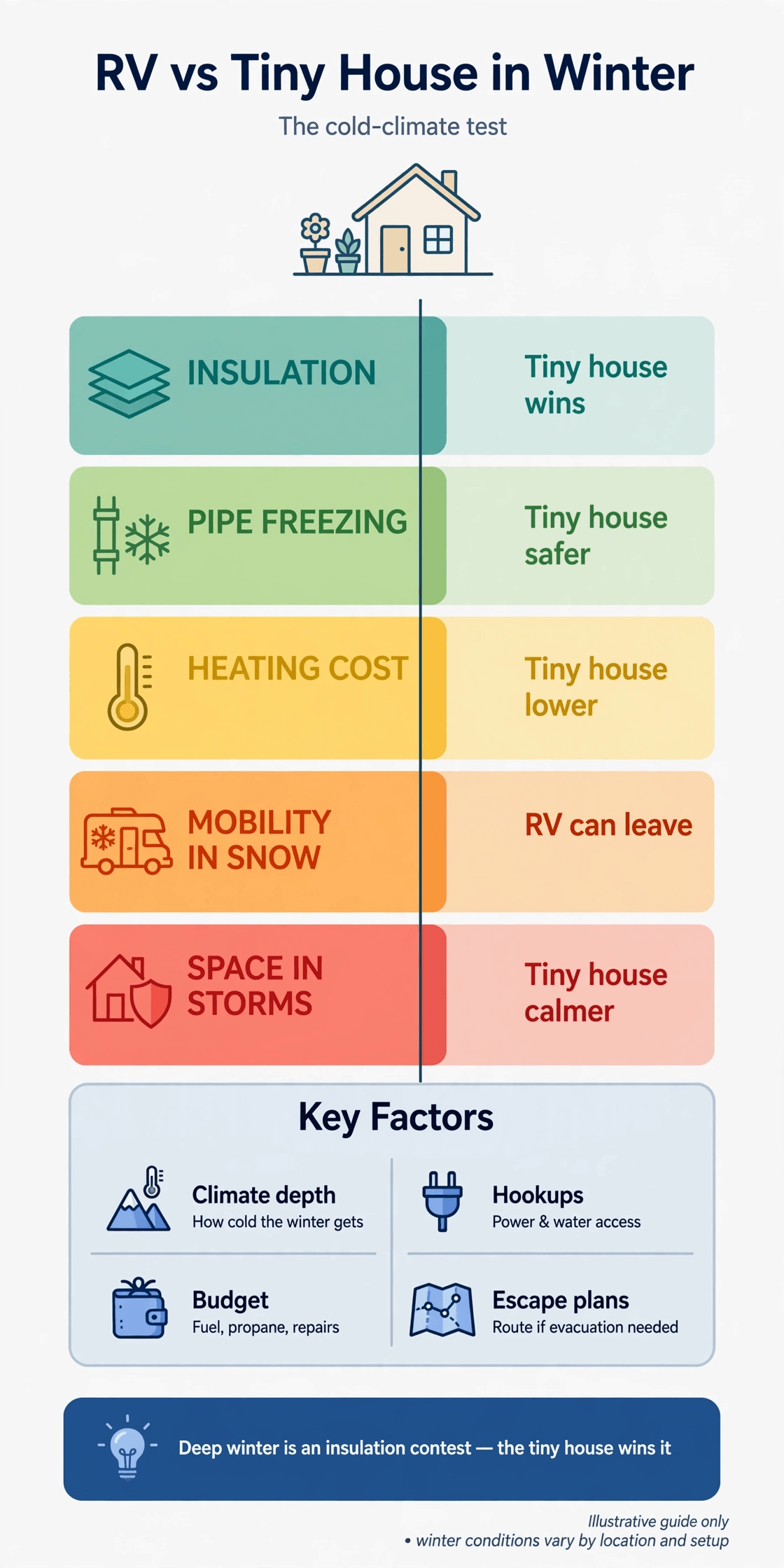
Rv vs Tiny House Winter Living at a Glance
The short version first. Winter rewards thick walls, protected plumbing and boring predictability — and punishes thin shells and exposed pipework, whichever badge is on the door.
| Criterion | RV | Tiny House |
|---|---|---|
| Insulation | Thin walls and cold spots; varies hugely by model | Deeper wall cavities allow house-style insulation |
| Pipe freezing | Tanks and lines often exposed beneath the floor | Lines usually inside the envelope or a skirted space |
| Heating cost | Furnace works hard against heat loss; fuel use climbs fast | Less heat loss means steadier, cheaper warmth |
| Snow load | Roofs designed around travel weight limits; clear them | Roof can be built for local snow loads like a small house |
| Mobility in snow | Built to move, but towing on winter roads stays risky | Movable, yet happiest staying put until roads clear |
| Storm comfort | Rocking, noise and draughts in high wind | Heavier, planted feel; quieter through a storm |
| Winter prep | Skirting, heat tape and tank heaters usually added by owner | Skirting and checks; most protection designed in |
| Condensation | A constant battle in a small, thin-walled volume | Still a risk, but ventilation systems are easier to fit |
1. Insulation: Wall Build-Up, Floors and the Gaps That Matter
Start with the shell, because everything else in this test is downstream of it. Most RVs are built to a weight budget before anything else: thin wall panels, modest insulation and windows chosen for travel, not for January. Some models are genuinely prepared for cold — better insulation packages, enclosed and heated underbellies, dual-pane glass — but they are the exception you must shop for, not the standard you can assume. Ask any seller claiming four-season capability exactly what was added to earn the badge; vague answers usually mean very little was.
A tiny house is usually framed like a small house that happens to sit on a trailer, so its walls have room for the insulation depths a cold climate expects. The material matters as much as the thickness — our comparison of how tiny house insulation materials compare works through foam, rockwool and wool in detail. Floors and ceilings count double in both homes, because heat escapes upward and cold radiates up through an uninsulated floor. Whichever you choose, the honest winter question is not the headline rating; it is whether the whole envelope is covered — corners, wheel arches, slide-outs, hatches — because the cold only needs one gap.
2. Heating Systems and Running Cost Through a Cold Snap
Heating cost in winter is really a report card on section one. The RV furnace burns fuel to replace heat the shell keeps losing, and in a hard cold snap it can run near-constantly, chewing through propane and battery charge — the furnace fan is an electrical load too — while the corners of the home stay stubbornly cold. Owners feel it as a rhythm: warm blast, cool drift, warm blast. It works, and many people winter this way happily, but the fuel deliveries become a standing appointment.
The tiny house, losing less heat, asks far less of its heater. A small propane heater, a cold-climate mini-split working within its rated range, or a small wood stove can hold a steady temperature without heroics — the overview of how to heat a tiny house compares those options fairly. Judge running cost against your local fuel and electricity prices rather than national averages, and hold onto the qualitative rule: every unit of heat you do not lose is a unit you do not have to buy, whatever the tariff. Insulation is the cheapest heating fuel there is.
3. Pipe Freezing: Where Water Lines Run and How They Are Protected
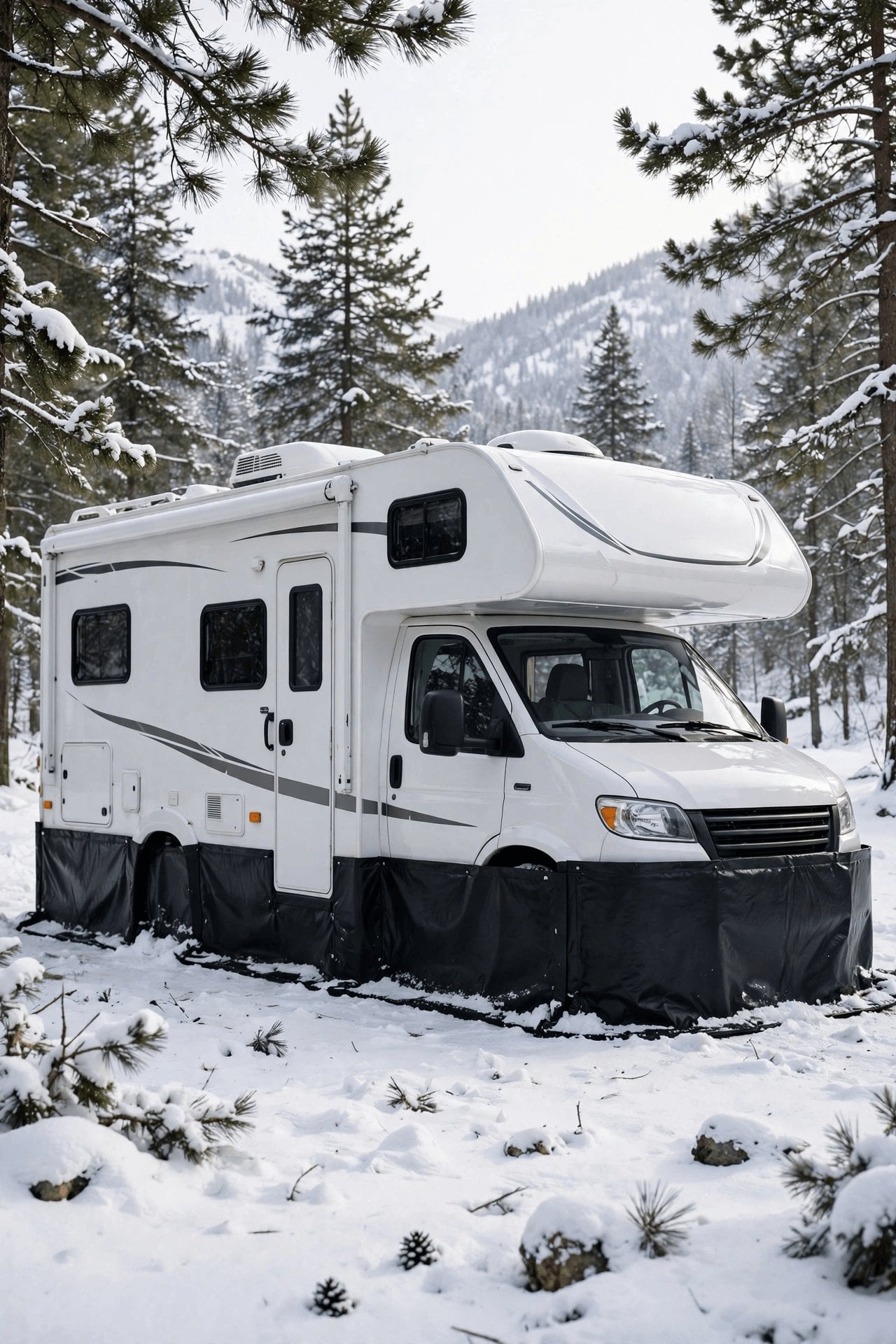
Frozen pipes are winter’s most expensive party trick, and exposure is the whole story. In many RVs, water lines and tanks live in or under an underbelly that sits outside the warm interior, protected — if at all — by a thin cover and whatever spare warmth the furnace spills. In deep cold that margin disappears: lines freeze at the points farthest from heat, fittings crack quietly, and the damage announces itself at the thaw. Heated hoses, tank pads and heat tape exist precisely because this is the RV’s known winter weakness.
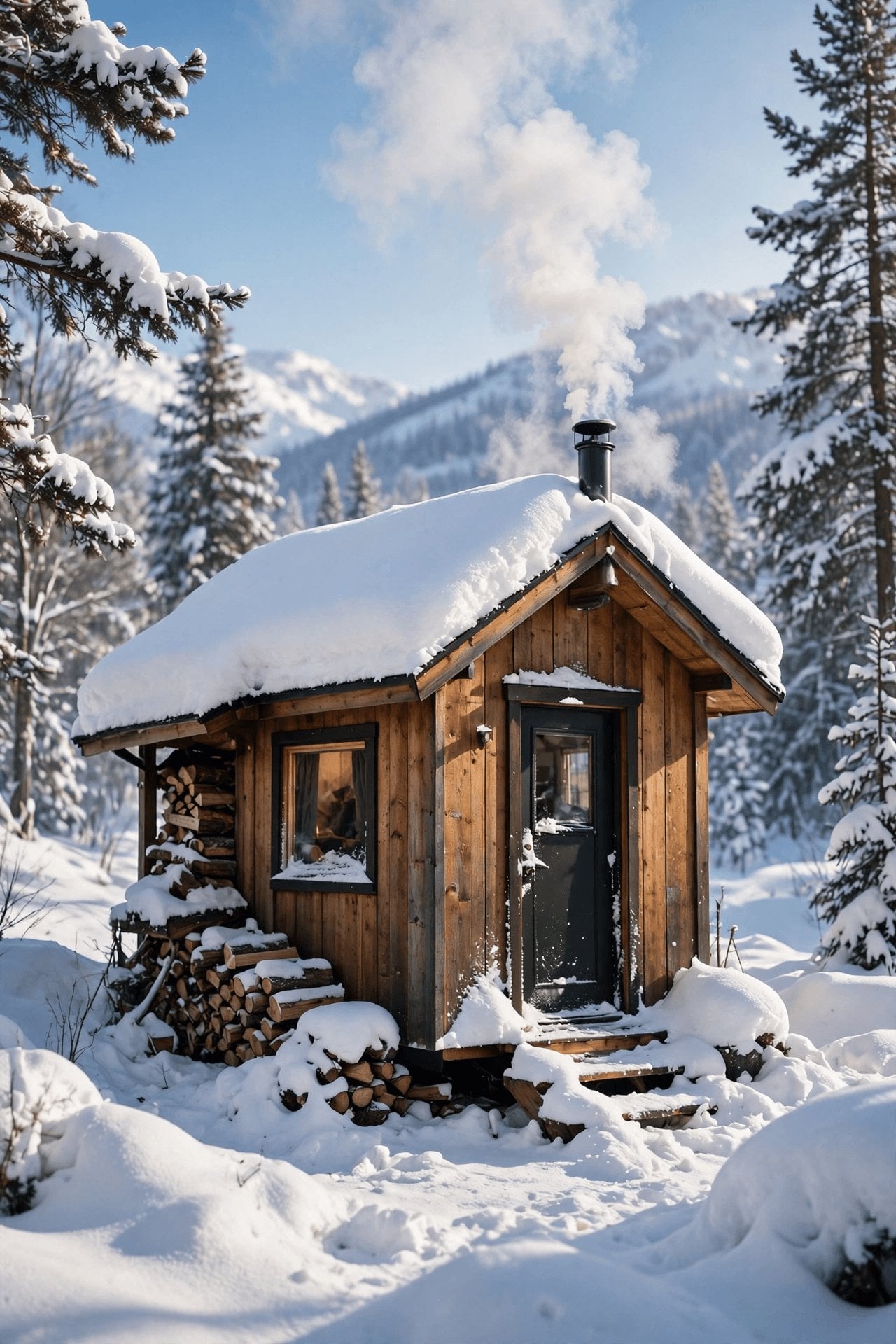
A tiny house usually keeps its plumbing inside the insulated envelope or within a skirted, still-air space beneath the floor — and tiny house skirting options that protect pipes and improve insulation make that underfloor zone dramatically calmer in wind. Pipe material plays a supporting role: the flexibility discussed in PEX vs copper plumbing for tiny houses is one reason PEX is popular where freezes are possible, since it tolerates expansion better — though no pipe should be asked to freeze as a design strategy. On either home the winning move is identical: keep water on the warm side, drain what you cannot protect, and learn where your drain-down points are before the first hard frost, not during it.
4. Condensation and Indoor Air: Breathing Inside a Sealed Box
Seal a small box against the cold, then cook, shower and breathe inside it, and the moisture has to go somewhere. In winter it heads for the coldest surfaces: window glass first, then corners, cupboard backs and any thermal bridge in the frame. RVs, with their thin walls and many cold surfaces, can run with condensation daily. Left alone it feeds mould in wardrobes and quietly rots what it touches, which is why experienced winter travellers treat ventilation as part of the heating budget — you crack a vent and pay a little warmth to save the home.
Tiny houses fight the same physics with better tools. Thicker walls mean warmer interior surfaces, so moisture is slower to condense, and house-like construction makes balanced ventilation easier to fit — the case for HRV and ERV ventilation in tiny houses is really a winter case. Our field notes on tiny house living in cold climates return to the same trio: ventilate deliberately, wipe what forms, and never dry laundry unvented inside a sealed small home in January. Whichever badge your home wears, an inexpensive hygrometer on the wall will tell you more about your winter than any brochure.
5. Snow Load and Roof Behaviour When the Sky Delivers
Snow is weight, and it tests how a roof was designed. RV roofs are engineered within strict travel weight limits and are generally expected to be cleared, sheltered or driven out from under accumulation; slide-outs add seams and flat spots where meltwater pools and refreezes into dams. A tiny house roof, framed like a small building, can be specified for the snow loads of the region it will sit in — a steeper pitch that sheds, stronger rafters, and no slide-out mechanics to freeze halfway through a journey.
In practice the stationary winter favours the tiny house once more: it is positioned once, oriented for sun and shelter, and roofed for the climate it will actually meet. The RV owner in snow country adopts a routine instead — clearing the roof after storms, watching slide-out seals, and treating a heavy forecast as a maintenance alarm rather than a surprise. Neither home should ever carry a deep, uncleared load while you guess at its rating. If you do not know what your roof was built to hold, the only safe assumption is that you should be out there, carefully, with a roof rake.
6. Snow Mobility: Moving, Access and Getting Out in Winter
Mobility is the RV’s founding promise, and winter edits it heavily. Yes, an RV can leave — that remains its superpower when a storm, a cold snap or simply a better climate calls. But towing on icy roads, in crosswinds, on tyres chosen for summer, is a risk calculation that changes with every forecast, and many winter travellers conclude the sane options are to leave well before the weather or stay until it has well passed. Mobility in January is a narrowing window, not an open door.
A tiny house can also move — that is the whole idea behind tiny houses on wheels — but it moves like a building, not a vehicle: planned, slow, behind a suitable tow vehicle, on a route checked for access. Parked for winter on blocks, skirted and connected, it behaves like a small cottage, and most owners treat a mid-winter move as an emergency measure only. The honest summary: the RV gives you a realistic escape option early in a storm cycle; the tiny house gives you a better place to sit the storm out. Choose according to which of those your winters actually demand.
7. Water and Waste in Freezing Weather: Tanks, Hoses and Dumps
Winter rewrites the daily logistics of both homes around one fact: exposed water freezes. Fresh hoses become heated hoses, or get drained after every fill. Grey and black tanks that discharge happily in July need protected valves and patient timing in January, and dump points can be frozen, distant or closed for the season. RV systems are at least designed to be drained and winterised quickly, which is a genuine advantage if the home will sit empty — the whole water system can be made safe in an afternoon.
A stationary tiny house usually solves the same problems permanently instead: a buried or insulated supply line, a frost-protected connection, and waste plumbing that behaves like a small house’s. That set-up cost is paid once, in autumn, rather than at every frost. If your tiny house connects and disconnects often, though, it inherits the RV’s chores without the RV’s quick-drain design. Match the plumbing lifestyle to your real pattern of use — parked all winter, or moving monthly? The answer decides which set of compromises you will actually enjoy living with.
8. Storm Comfort: Wind, Noise and Sleeping Through a Gale
Comfort in a storm is partly engineering and partly theatre: how much the home moves, how loud the weather sounds, and whether you feel sheltered or merely parked. An RV is a light vehicle shell, and wind works on it audibly — rocking on its suspension, drumming on the roof, sighing around slide-out seals. Many owners describe storm nights as exciting exactly once, then merely tiring. Levelling jacks down, a wind-sheltered pitch and a lower profile all help, but lightness is the RV’s nature and winter exposes it.
A tiny house feels like what it is: a small, heavy building. It sits stiller, sounds quieter and holds its temperature through a windy night with far less heating drama, and that planted feeling is a large part of why people choose one for a stationary northern winter. Storm preparation still applies — our notes on keeping a tiny house safe with anchors and smart security cover the tie-down side — but the baseline is calmer. If winter storms are your region’s signature and sleep quality matters to you, this section alone may settle the whole comparison.
9. Winterising Checklists: Preparing Each Home for the Cold
Both homes reward one autumn weekend of preparation far more than a January of repairs. For the RV: skirt or shield the underbelly, fit the heated hose, test the tank heaters, service the furnace, check every seal, and stock propane before the cold makes deliveries interesting. For the tiny house: fit or repair the skirting, confirm the frost-protected water connection, service the heater, check the roof seams, and make sure ventilation is balanced before you seal the home up tight for the season.
The shared list is longer than the differing one: clear gutters and roof valleys, trim the branch that hangs over the roof, photograph your drain-down points, keep a small store of water for outages, and put the torch, spare fuses and pipe repair kit where you can reach them in the dark. Winterising is the least glamorous section of this test and the one that most separates a comfortable February from a miserable one. Neither home fails winter suddenly. Both fail it gradually, one skipped autumn job at a time.
10. The Cost of a Winter: The Season-Long View
Add a whole winter up and the pattern of the earlier sections repeats at the scale of a season. The RV typically spends more on fuel and on winter accessories — skirting, heated hoses, tank protection, dehumidifying — and asks for more weekly attention. The tiny house typically spends more up front, inside its build specification, and then runs the season quietly. Neither total can be known in exact figures for your case until you price your own climate, fuel and parking; anyone quoting a precise season cost for either home, sight unseen, is guessing with confidence.
There is also a cost paid in flexibility rather than money. The RV’s winter compromises buy the standing option to drive towards better weather; the tiny house’s winter strengths assume that you stay. If your life might move mid-winter — work, family, wanderlust — that option has real value no fuel bill captures. If your winter is fixed to one northern valley, paying for mobility you will never use is its own kind of waste. Price the season in the currency you actually spend: money, attention, and freedom to leave.
Final Considerations
So, who should pick which? Choose the RV if your winters are mild, short or optional — if the plan is to chase tolerable weather, winterise quickly when you park, and accept higher fuel use and storm noise as the price of a home that can always leave. A genuinely cold-rated model, carefully shopped for and properly skirted, will winter far better than its reputation suggests.
Choose the tiny house if your winter is a fixed address in real cold: deep insulation, protected plumbing and a planted, quiet shell will pay you back every single night from November to March. And whichever you pick, respect the physics this test kept returning to — insulation first, water protected, ventilation deliberate. Winter does not care which badge is on the door. It only reads the build.


0 Comments