
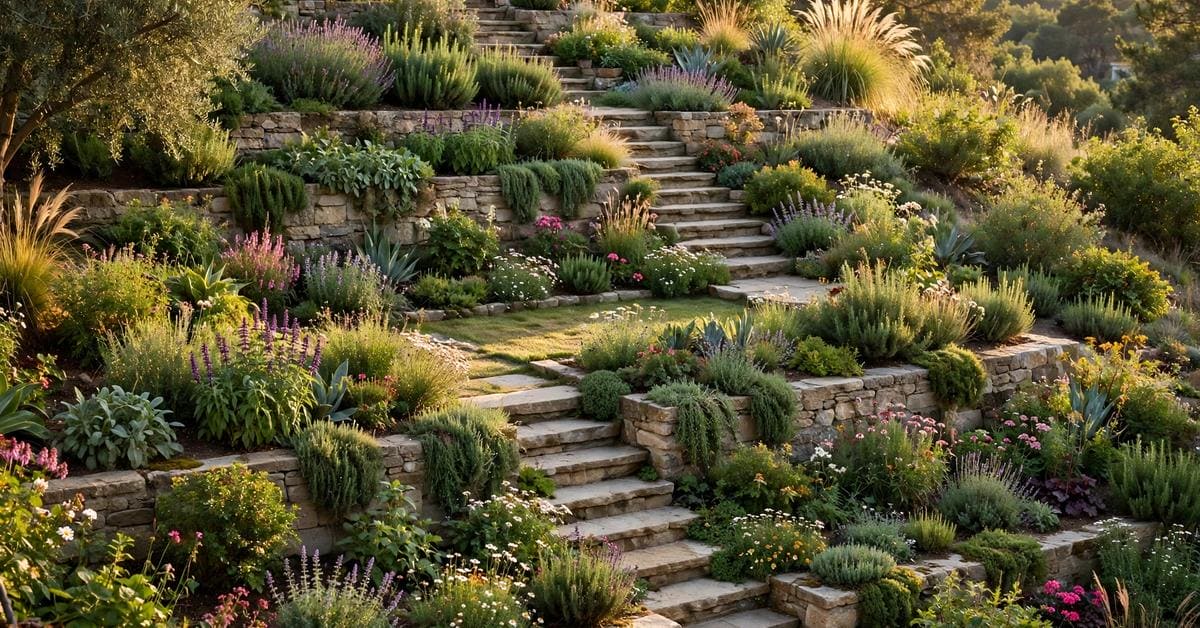
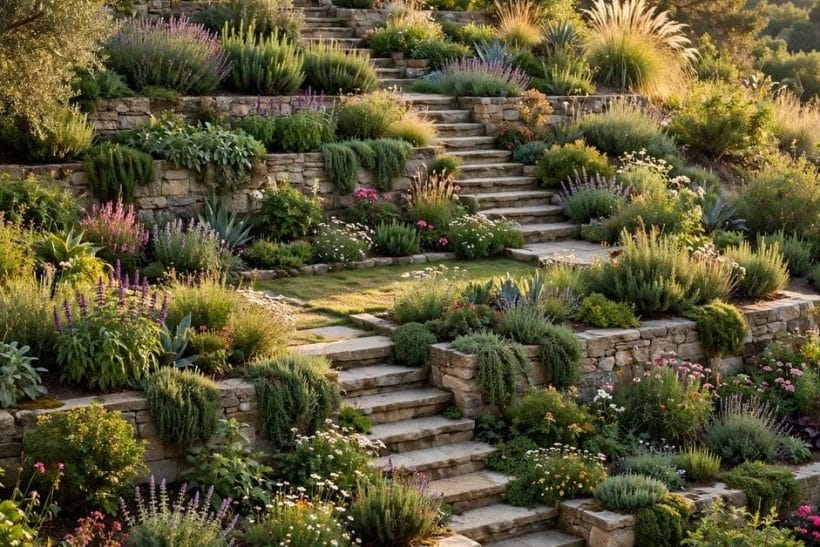
A sloping garden that falls away from the house can feel like a problem looking for an answer. Seen differently, it is a garden with rooms already half made, each level waiting for its own job.
Here are eleven design solutions that work with the fall instead of fighting it, from low terraces and broad steps to planting that binds a bank and water that is slowed and spread.
1. Read the Fall Before You Shape Anything
Every good garden on a fall starts the same way, not with a spade but with a walk. Walk the ground after rain and watch where water runs, where it gathers, and where it leaves the garden. Stand at the top and look down, then stand at the bottom and look up, because a slope reads very differently from each end. Notice where the sun falls through the day, where the wind bites, and which view deserves a seat pointed at it.
A sloping garden is best understood before it is shaped. What matters is the shape of the ground itself: a gentle even fall behaves differently from a sharp bank, and a garden that falls away from the house behaves differently from one that rises toward the back fence. A professional survey of levels, soil and drainage gives the design its honest starting point, and anything structural that follows belongs to qualified people, not to weekend guesswork.
Solution 1: Work in low levels, not one big cut
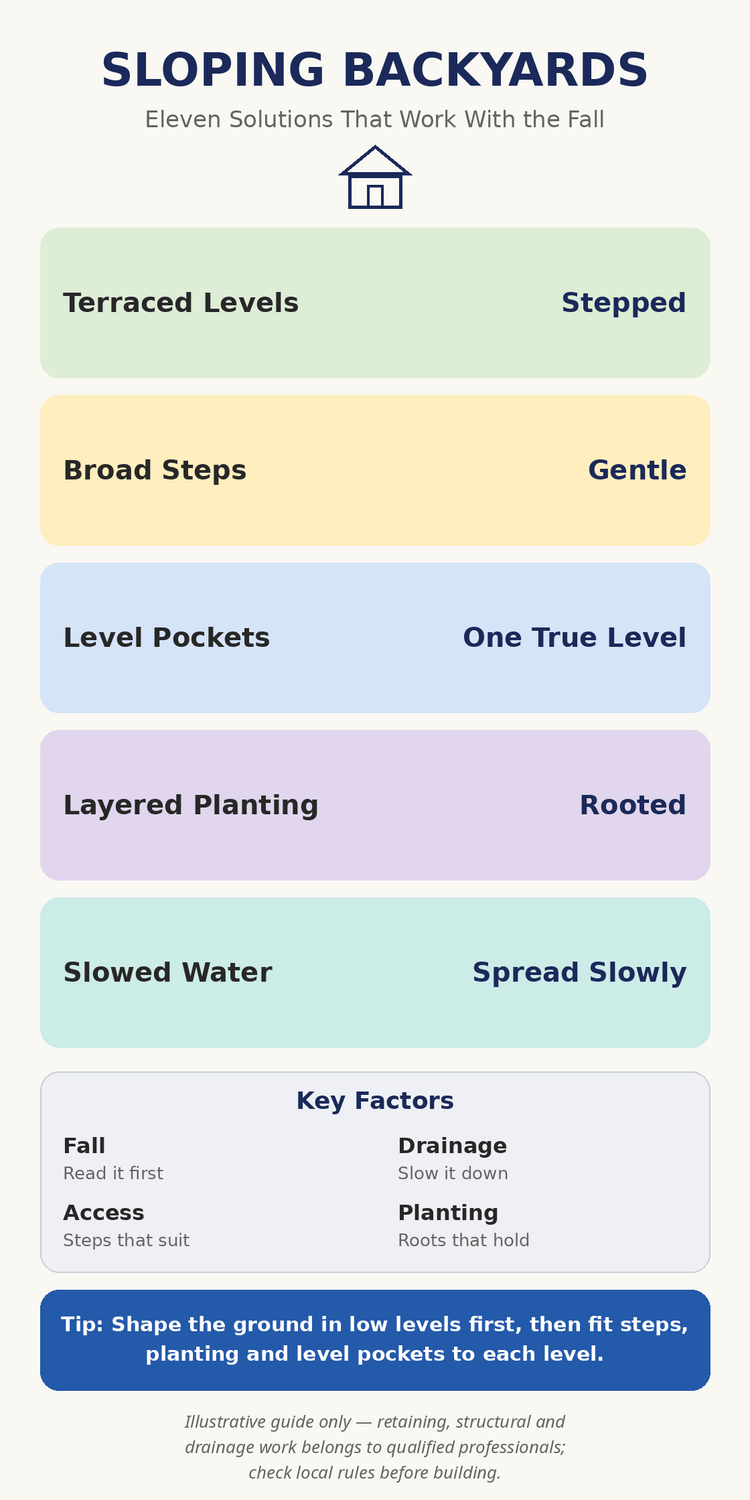
The single most useful move on falling ground is to think in levels. Rather than flattening the whole garden, which fights the site and usually needs heavy structure, break the fall into a series of low, comfortable levels. Each level gets its own purpose, its own surface and its own planting, and the change between levels becomes a feature instead of an obstacle.
| Design move | What it gives |
|---|---|
| Terraced Levels | Stepped |
| Broad Steps | Gentle |
| Level Pockets | One True Level |
| Layered Planting | Rooted |
| Slowed Water | Spread Slowly |
Low levels also keep the garden feeling human in scale. A terrace you can step onto, plant by hand and sit beside will be used far more than a grand structure that dwarfs the house. For the wider picture of shaping a whole outdoor space, backyard landscaping ideas show how levels, planting and surfaces sit together.
2. Low Stepped Terraces
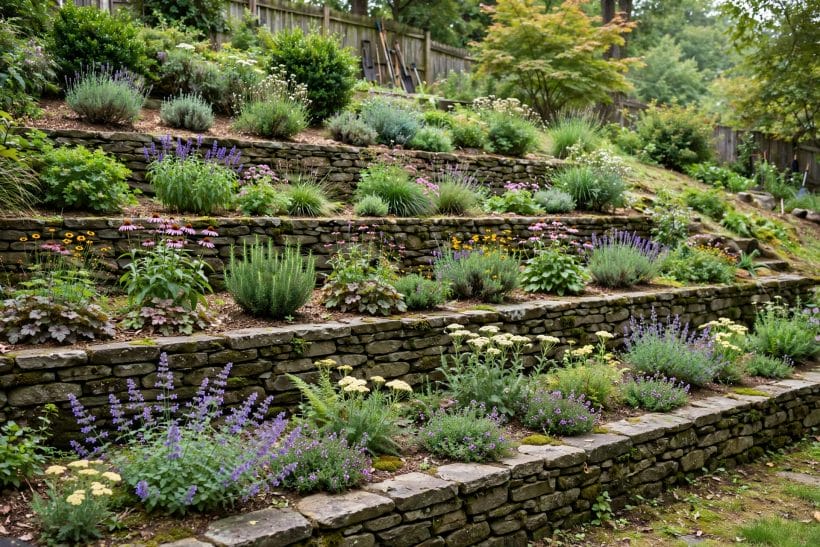
Solution 2: Build low stepped terraces
Terraces turn one awkward bank into a staircase of garden rooms. Each terrace is a flat strip held by a low edge, wide enough to plant, to walk beside, or to place a chair. Because each terrace is low, the garden keeps an open, planted feel rather than a walled one, and every level can be reached and tended without special equipment.
Stone suits terraces beautifully, and the character of the stone sets the mood of the whole garden, from rough fieldstone that feels rural to cut blocks that feel formal. Rock landscaping ideas show how stone can carry a garden from wild to refined. Keep terrace edges low and let planting soften them, so the structure reads as part of the garden rather than as engineering on display. Where a terrace edge must hold back real weight or height, that is professional work, designed and built by people qualified to judge soil, load and drainage.
Plant each terrace as its own small garden rather than repeating one planting scheme up the whole bank. A sunny upper terrace may suit herbs and sun-loving perennials, while a lower terrace that catches shade and moisture may suit ferns and leafy shade plants, and the change between them adds variety to every climb. Repeat one or two plants along the whole run to tie the levels together, and let the rest change with the conditions of each terrace, so the garden feels designed without feeling uniform.
3. Broad Steps and Generous Landings
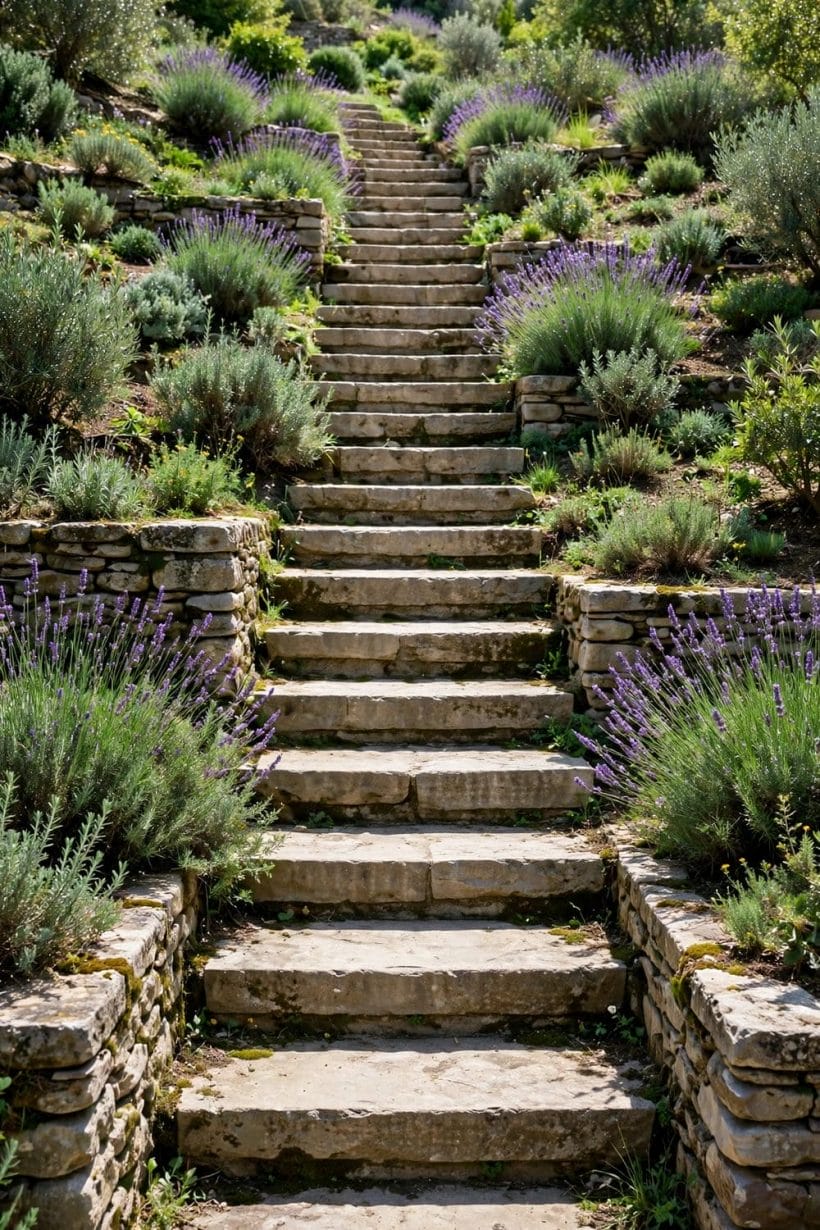
Solution 3: Make steps broad, with landings to pause on
Steps are where a garden on a fall succeeds or fails, because they are used every single day. Narrow, steep steps turn a garden into an obstacle course, while broad, shallow steps with a landing every so often make the climb feel easy and even pleasant. A landing is simply a flat pause, wide enough to stand on comfortably, and it changes a long climb into a short stroll with rests built in.
Give steps a surface that grips in wet weather and an edge that is easy to see in low light. Flank them with planting rather than bare walls, so the climb feels like a walk through the garden instead of a march up a staircase. A handrail that suits the garden, timber beside planting or metal beside stone, adds confidence for every age, and it is worth planning handrails from the start rather than adding them as an afterthought.
4. One True Level Pocket
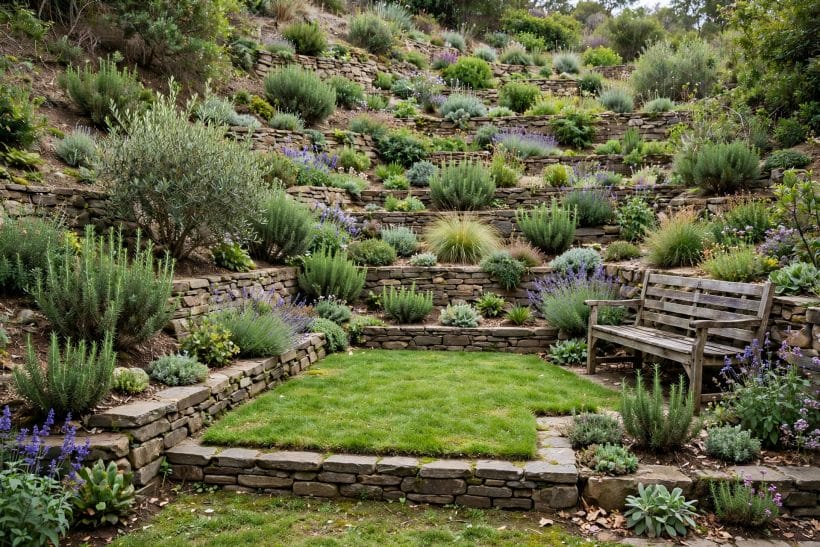
Solution 4: Carve out one true level pocket
Even the most terraced garden needs one genuinely flat place. A level pocket, a small lawn, a paved circle, or a timber platform, gives the garden its living room: somewhere for a table and chairs, for children to play, or for simply lying back and looking at the sky. Without one flat place, every activity happens on a tilt, and the garden never quite relaxes.
The pocket does not need to be large. A modest flat area, well placed for sun and shelter, will be used far more than a grand lawn that nobody reaches. In a compact plot the same thinking applies at smaller scale, as tiny backyard ideas demonstrate, where one well-chosen flat place anchors the whole design. Put the level pocket where it is easy to reach from the house, and the garden will feel like an extension of the home rather than a separate expedition.
5. Layered Planting That Binds the Bank
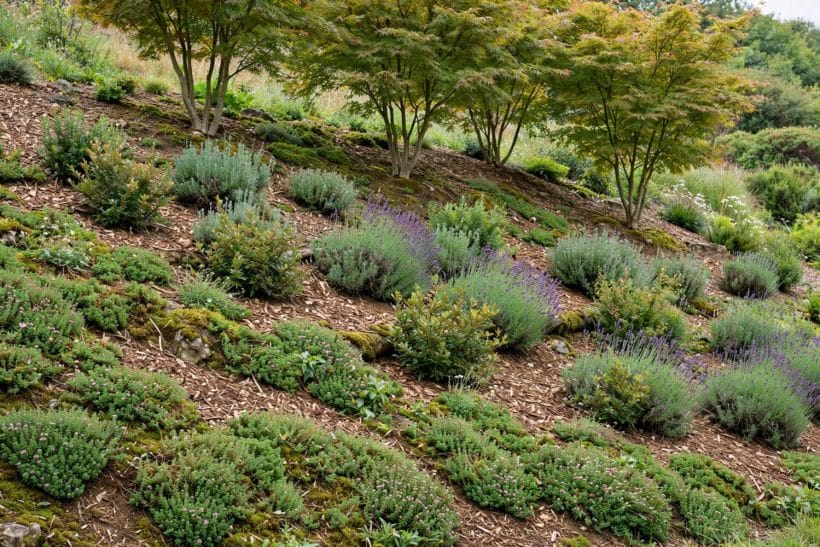
Solution 5: Plant in layers that cover and hold the bank
Planting is the soft answer to a hard slope. Groundcover knits the surface, shrubs give body through the seasons, and small trees give height and shade, and together the layers protect the soil beneath them while making the bank beautiful. Plant in drifts that follow the contours rather than in straight lines that fight them, and let plants spill gently over terrace edges so hard lines melt into green.
Choose plants for the conditions they will actually face, sun or shade, wind or shelter, damp hollow or dry crest, and be patient with them. Planting hedged honestly: no planting scheme can promise to hold a bank on its own, and steep or unstable ground needs professional assessment before planting is asked to do structural work. Where rock and planting meet, rock gardens on slopes, erosion and stone terracing show how stone and roots can work as partners, each doing what the other cannot.
6. Retaining Walls, Designed by Professionals
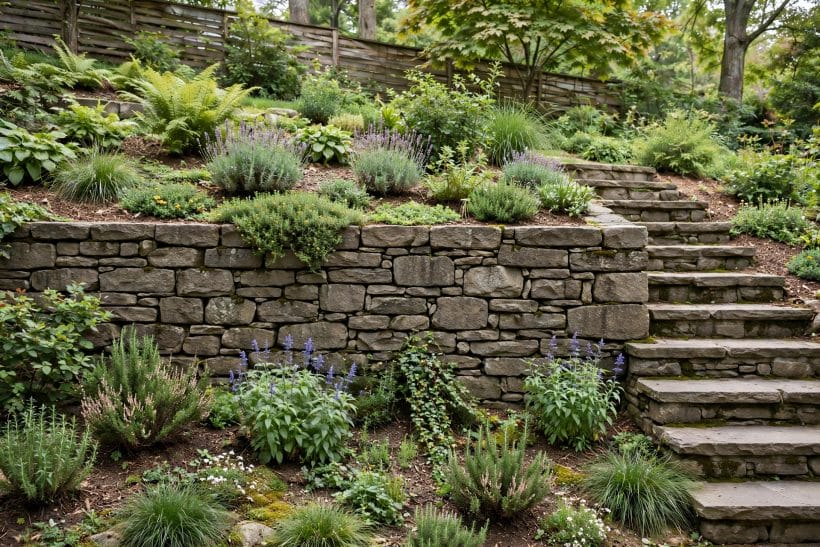
Solution 6: Let professionals design and build retaining walls
Some falls need a wall, and a wall is where good intentions must hand over to qualified hands. A retaining wall holds back soil and water as well as its own weight, and getting it wrong can damage the garden, the house, or a neighbour’s ground. The design decisions, footing, drainage behind the wall, and the choice between mortared and dry construction, all belong to structural and landscape professionals working to local rules.
What the gardener decides is the look and the role: a wall that doubles as a seat, a wall that carries a planted bed on top, or a wall that simply disappears behind planting. Natural rock retaining walls, mortared versus dry stack compare the two traditions in general terms, which helps in talking to a professional about the character wanted. Never present a retaining wall as a do-it-yourself weekend build, and never let a wall go up without its drainage planned, because water trapped behind a wall is what shortens its life.
7. Paths That Cross the Fall Gently
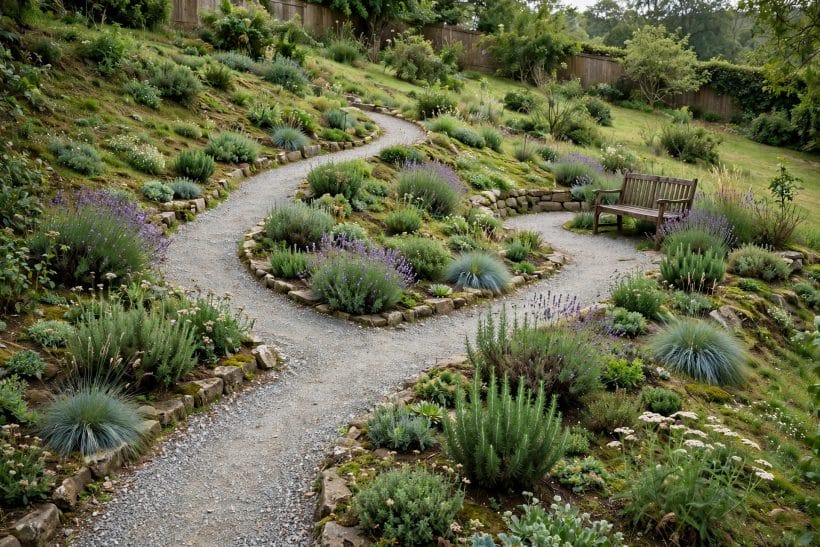
Solution 7: Let paths traverse the fall instead of charging down it
A path that runs straight down a slope invites rushing water and hurried feet. A path that crosses the fall at a gentle angle, bending from terrace to terrace, is kinder to walk and kinder to the garden. Each bend can hold a small moment, a bench, a scented shrub, or a view framed by planting, so the journey through the garden becomes part of its pleasure.
Surfaces matter on a traverse. Gravel, stone flags and other textured finishes give grip and let rain soak in rather than sheet off, while edging keeps the surface where it belongs. Keep the path wide enough for two people to walk side by side where the garden allows, and light it from the start, because a path that is lovely by day and dark by night is only half a path.
Where a path crosses a terrace edge, a small planted channel beside it can catch the water that follows the path downhill and guide it gently into planting instead of letting it gather at the bottom. This is not a substitute for a designed drainage system where one is needed, but as part of a garden that already slows and spreads its water, a planted edge turns a path from a watercourse back into a walkway.
8. Slow and Spread the Water
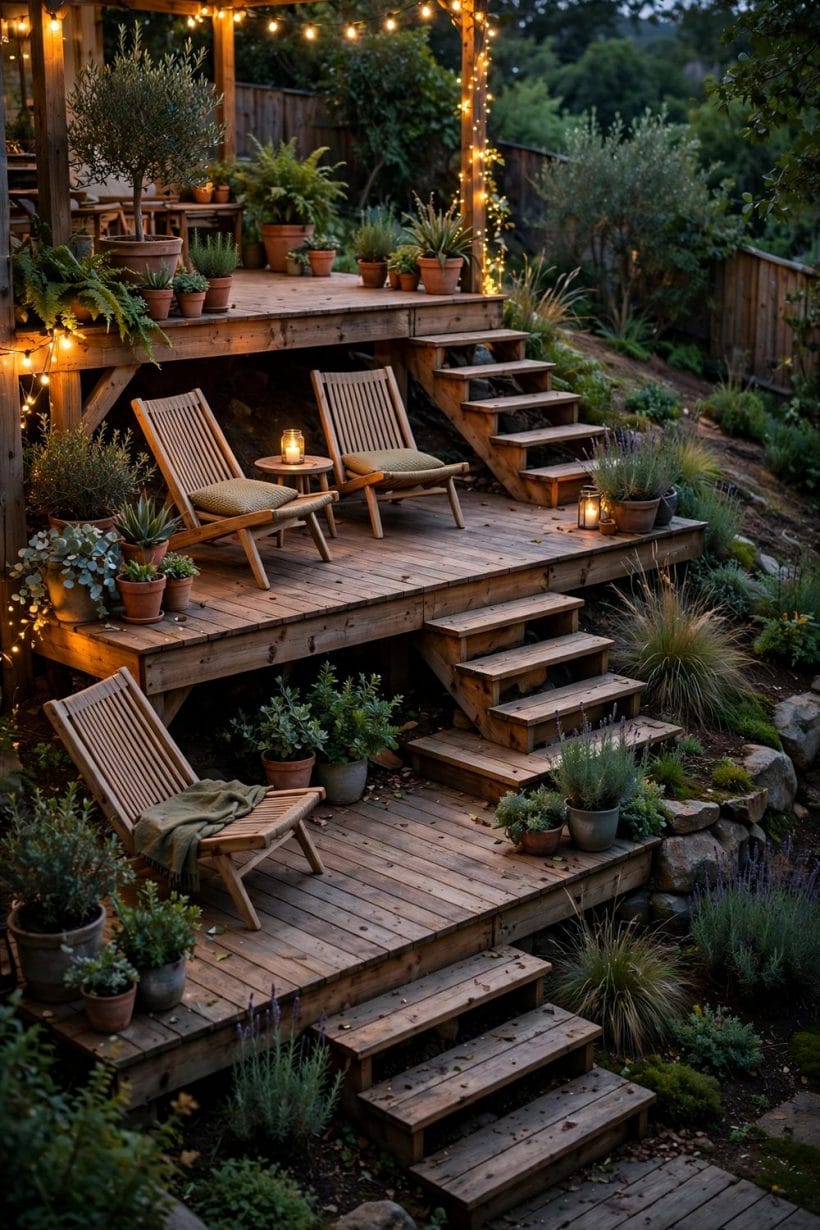
Solution 8: Slow water down and spread it out
Water is the quiet force that shapes every garden on a fall, and the aim is always the same: slow it, spread it, and let it soak in where it can do good. Shallow planted channels, rain gardens of moisture-loving planting, and permeable surfaces all help rain linger in the garden instead of racing to the lowest corner. Mulch and groundcover protect bare soil from heavy rain, and every level in the garden gives water another chance to pause.
Drainage design, like retaining design, is professional territory wherever water could reach buildings, boundaries or neighbours. A drainage professional can read the whole site, the roofs and paving that feed it as well as the slope itself, and plan a system that protects the garden for years. The gardener’s part is to keep that system clear, to watch how water behaves after storms, and to raise problems early rather than after damage appears.
9. Decks, Platforms and Rooms on Different Levels
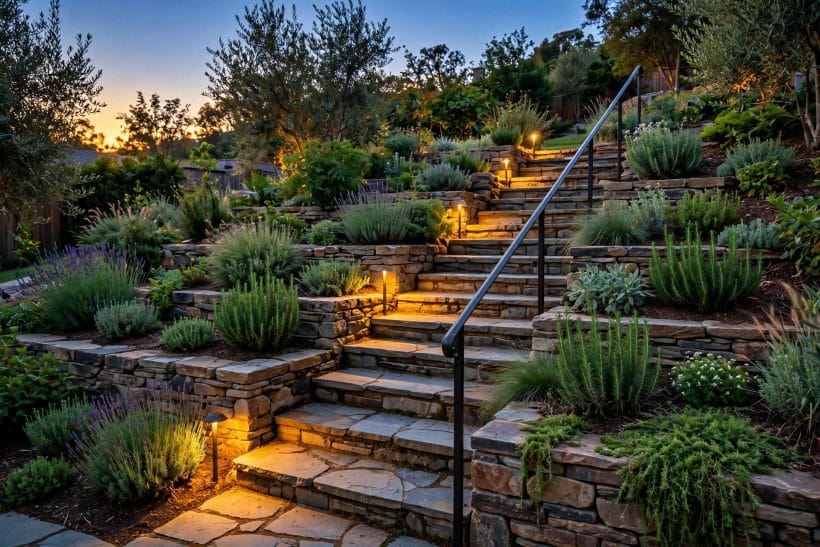
Solution 9: Step decks and platforms down the fall
Timber decks and platforms suit falling ground because they can step down the slope in stages, each platform level and comfortable while the structure beneath follows the ground. A deck near the house gives easy outdoor living, a lower platform gives a quieter retreat, and the steps between them become part of the design. Tiny house deck ideas show how even compact decks can feel generous when their levels are well planned.
Solution 10: Give each level its own room and purpose
The most satisfying gardens on a fall feel like a small collection of outdoor rooms. Dining near the house where carrying food is easy, a lounge lower down where the view opens, a play corner on the flat pocket, and a quiet seat at the far end for morning coffee. Tiny house patio ideas show how a paved room can anchor one level beautifully. When each level has a clear purpose, the garden is used all over rather than only near the back door, and the slope stops being a drawback and becomes the reason the garden feels rich.
Decks, platforms and any raised structure need professional design and sound footings, planned with the same care as the retaining and drainage work. Balustrades, steps and lighting belong in the original plan, not bolted on later, and local rules govern heights and boundaries throughout.
10. Light the Route and Keep It With Ease
Solution 11: Light every step and keep the garden walkable
A garden on a fall earns its keep after dark only if its routes are lit. Low lights along steps, soft light at landings, and a lit handrail or path edge turn an evening garden from a hazard into a pleasure. Solar and low-voltage fittings suit most gardens, and warm light flatters planting far better than harsh glare. Light the route a visitor would actually walk, not the whole garden at once, and the garden will feel both safe and calm.
Keeping a garden on a fall is mostly a matter of small regular jobs: clearing leaves from steps and drains, cutting back planting that crowds a path, and checking that handrails and surfaces stay firm. Do the little jobs often and the garden stays welcoming, while a neglected slope quickly grows awkward. A garden that is easy to walk, easy to sit in and easy to tend is a garden that will be loved, whatever its fall.
Final Considerations
Eleven solutions sound like a lot, but most gardens on a fall need only a handful of them, chosen to suit the particular fall, soil and household. Start with levels and one flat pocket, add broad steps and layered planting, and bring in professionals for anything that holds back earth or manages water. Let the garden grow into its levels over seasons rather than demanding instant perfection, and judge each change by a simple test: is the garden easier to walk, easier to sit in, and easier to love than before.
A slope is not a flaw to hide. Shaped in low levels, planted in layers, lit at night and cared for little and often, it becomes the most interesting garden on the street, a place with views, variety and rooms that a flat plot can only dream of.
Finally, let the seasons teach the garden. The first wet season will show where water truly runs, the first summer will show which terraces bake and which stay cool, and the first winter will show which steps stay sure underfoot. Adjust planting, mulch and lighting in light of what each season reveals, and the garden will settle into itself, level by level, year by year.




0 Comments