
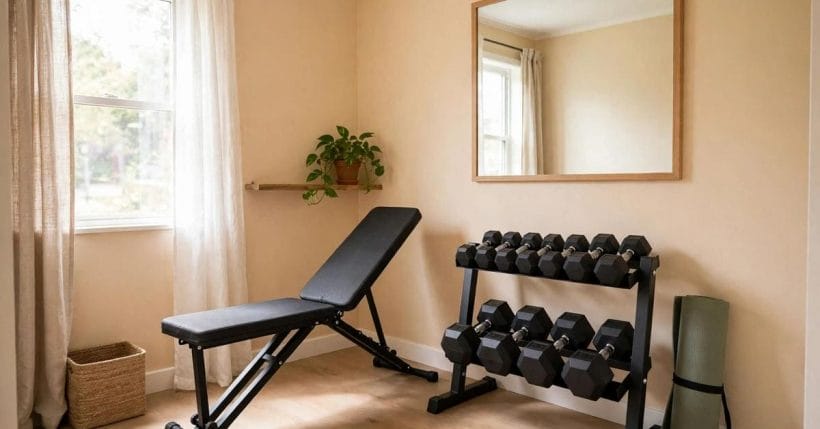
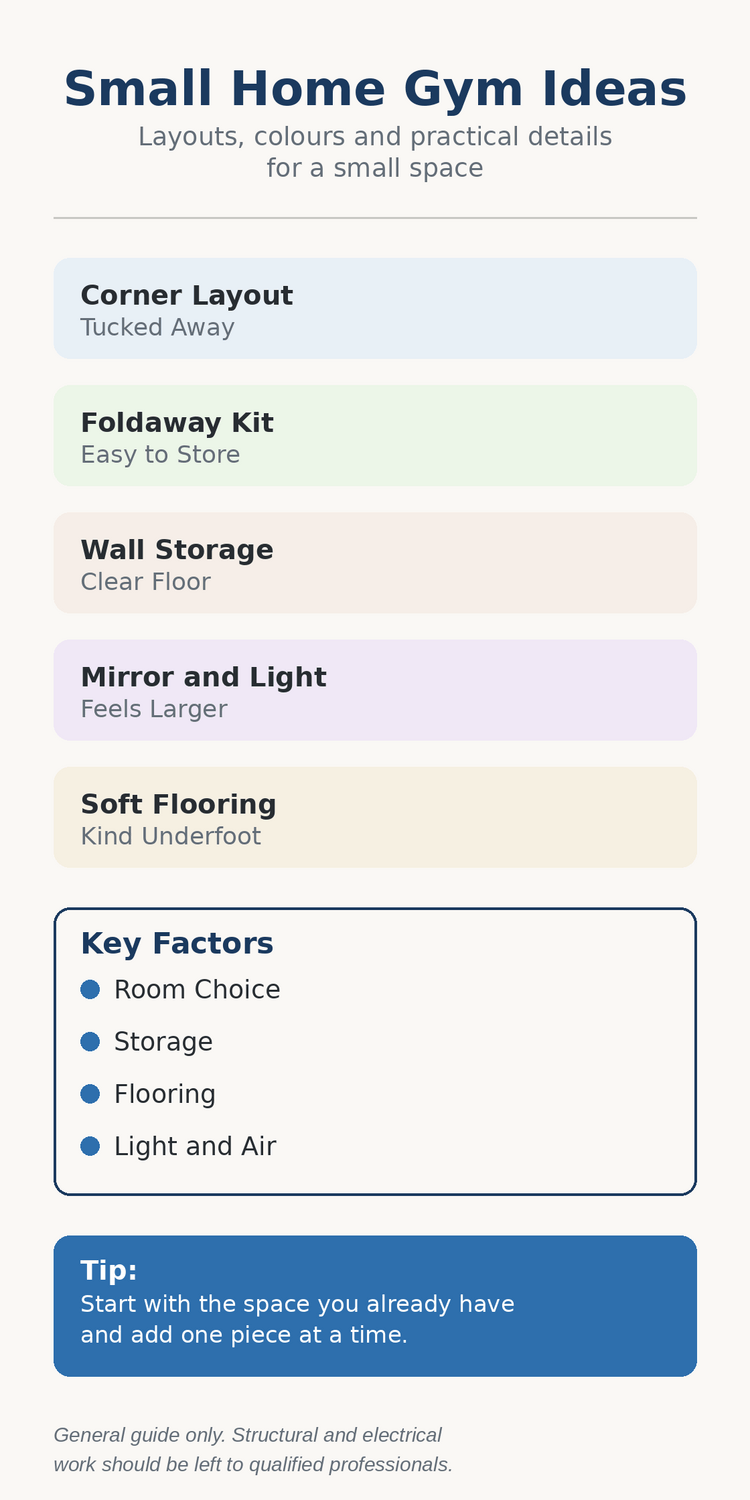
A small home gym does not need a large room, a long kit list, or a dedicated building. It needs a corner that is easy to reach, kit that can be put away without a struggle, and a layout that leaves the rest of the home alone. This collection stays firmly with small spaces: spare corners, shared rooms, tiny studios, and rooms that must still work as bedrooms, living rooms, or offices when the session ends. It does not try to re-teach the general home gym, which is a different subject with its own scale; every idea here is judged by whether it fits a small footprint and disappears gracefully afterwards.
Browse the full set, note the ideas that suit your room, and mix them to fit the space you have. Every idea below stands on its own, and together they build a gym that is used often because it is easy to start and easy to tidy. Think of this as home gym ideas small space planning at its most practical: the room comes first, the kit second, and anything that needs fixing to a wall, changing the structure, or touching the wiring is left to a qualified professional.
1. Claim a Corner First
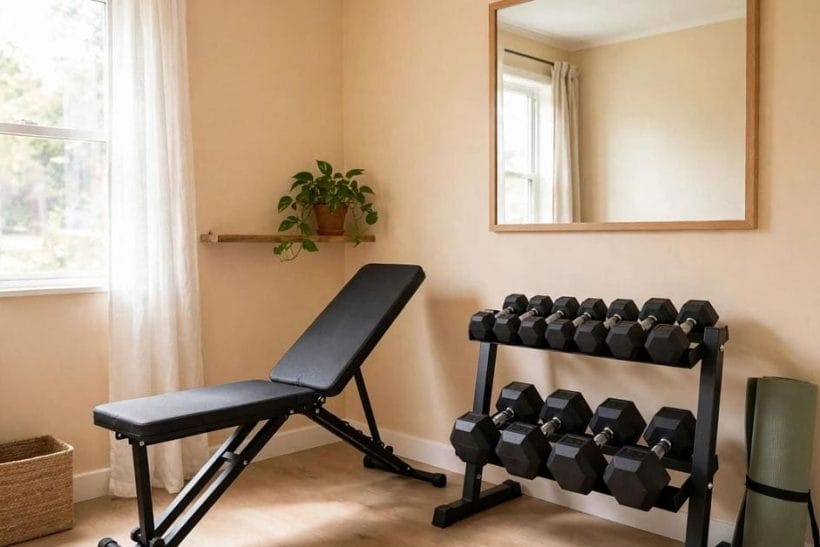
Start with the shape of the room you already have, not the room you wish you had. A good small gym begins as a corner: somewhere with a little daylight, a clear patch of floor, and a wall nearby for storage. Planning sense borrowed from tiny house floor plans helps here, because in a tiny home every wall and corner must earn its place, and the same discipline keeps a small gym from sprawling across a whole room.
| Item | What it is |
|---|---|
| Take the corner by the window | A corner near a window gives daylight, fresh air, and a view to rest the eyes on between efforts, and it keeps the middle of the room free for everyday life. |
| Use the corner beside the door | The corner beside a door is often overlooked because it feels like passage space, yet a slim bench or a rolled mat can sit there without blocking the way in or out. |
| Fill the gap between wardrobe and wall | Many bedrooms hold a narrow gap between a wardrobe and a wall, and that gap can become a tidy gym nook with a mat, a basket of soft kit, and a hook for bands. |
| Put a mirror on the adjoining wall | A mirror on the wall beside a corner gym lets you check posture without turning the whole room into a studio, and it bounces light back into a dim corner. |
| Let a mat define the gym | When floor space is scarce, a mat can be the whole gym: unroll it and the session has begun, roll it away and the room is a room again. |
| Add one small shelf for small kit | A single shelf above a corner gym holds bands, a towel, and a water bottle within reach, and it stops small kit from drifting across the room. |
| Face the corner away from seating | A gym corner that faces away from the sofa or the dining table feels more private, even in a shared room, because the session does not become a performance for everyone nearby. |
| Mark the corner with a rug | A rug under a corner gym marks the boundary of the session without building anything, and it warms a cold floor underfoot. |
| Dedicate the spare bedroom properly | If a bedroom stands empty for most of the year, dedicating it to a gym gives the session a real home, with a door that closes and a floor that stays clear. |
| Keep a foldaway bed for guests | A spare room can still welcome guests if the bed folds away against a wall or into a cabinet, leaving the floor free for a gym on ordinary days. |
| Line a box room with wall storage | A very small spare room, sometimes called a box room, works best when its walls carry the storage and its floor stays nearly empty. |
| Give the room a calm, pale scheme | Pale walls, light wood, and soft textiles make a small spare-room gym feel airy rather than cramped, and they show dust and clutter early so the room stays tidy. |
| Hang a full mirror wall | A mirror across one wall of a spare-room gym doubles the sense of space and lets posture be checked from several angles. |
| Lay soft flooring wall to wall | Soft flooring across a spare-room gym cushions the feet, quiets movement, and protects the floor beneath from heavy kit. |
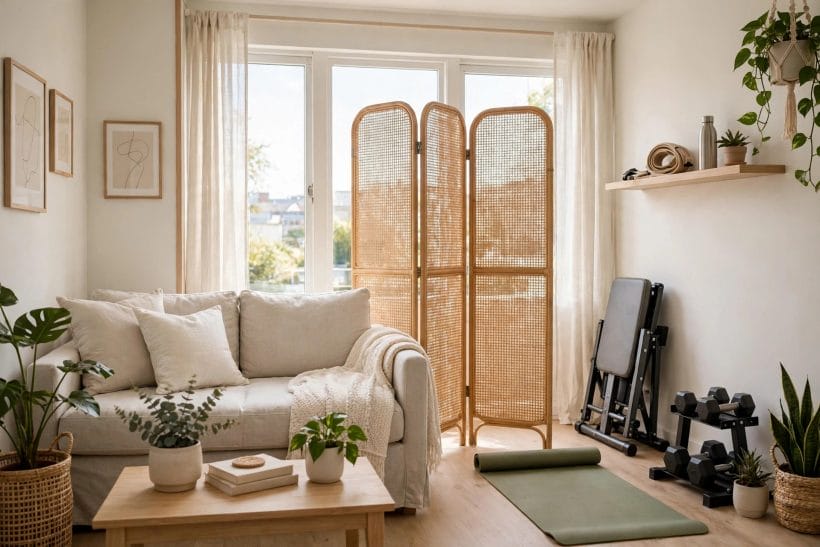
| Keep the room for gym kit only | A spare-room gym stays useful only while it holds gym kit and nothing else, so set a simple rule that boxes, ironing, and outgrown furniture do not move in. |
| Add a chair for resting and changing | A single sturdy chair in a spare-room gym gives somewhere to sit, change shoes, and rest between efforts, and it stops kit from being used as a seat. |
| Tuck the gym beside the sofa | A gym zone beside a sofa uses the quiet end of a living room, with a bench that slides behind the sofa arm and a mat stored upright nearby. |
| Build the gym into a bedroom corner | A bedroom corner gym suits a morning session, because the kit is steps from where the day begins and the room is already private. |
| Share the room with a home office | A room shared between work and exercise suits many small homes, because both uses need only a modest footprint and neither needs the room all day. |
| Screen the zone with a curtain or divider | A curtain on a rail or a folding divider gives a shared-room gym a soft boundary that can be drawn for a session and opened afterwards. |
| Hide kit inside a closed cabinet | A closed cabinet is the simplest way to share a room, because the gym vanishes behind doors when the session ends and the room returns to its main purpose. |
| Agree quiet hours for shared rooms | A shared-room gym works best when everyone in the home agrees which hours suit a session and which hours suit quiet, so no one is surprised by movement overhead or next door. |
| End every session with a quick tidy | A shared room stays shared only if the gym is tidied after every session, with the mat rolled, the bands hung, and the floor left clear. |
| Define the zone by colour, not by walls | When walls cannot be moved, colour can still mark a gym zone: a mat, a basket, and a towel in one accent tone tell the eye where the gym lives. |
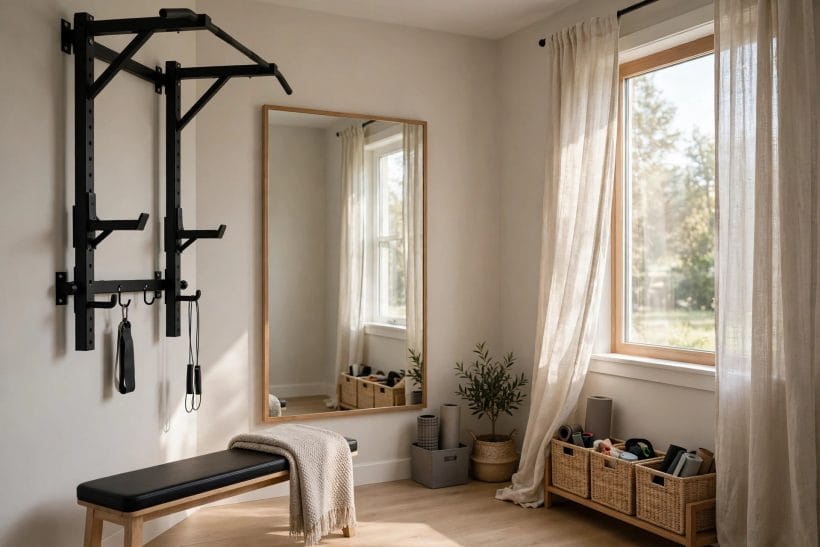
| Hang bands and ropes on wall hooks | Wall hooks turn bands, ropes, and straps into a neat row that can be seen and grabbed in a moment, and they free the floor entirely. |
| Keep small kit in one cabinet | One cabinet for all small gym kit beats several scattered baskets, because everything is found in one place and the room keeps only one gym frontage. |
| Use a basket for soft kit | A basket suits towels, straps, and soft kit that would otherwise drift across a room, and it can be carried to the gym corner and back again. |
| Take storage up to a high shelf | A high shelf above a door or a cabinet holds kit that is used less often, such as a spare mat or seasonal items, without taking floor space at all. |
| Slide a rolling cart under a bench | A low rolling cart under a bench or a table holds small kit out of sight and wheels out when a session begins. |
| Choose a storage bench that seats too | A storage bench gives a seat for resting and a box for kit in a single piece of furniture, which is a fine bargain in a small room. |
| Label boxes so kit is found fast | Labels on storage boxes sound fussy, yet they save a small gym from the slow drift into mystery boxes that no one opens. |
| Rotate kit with the seasons | Rotating kit through the year keeps a small gym fresh without growing the kit list: items used less often move to higher storage, and favourites return to the front. |
| Pick a bench that folds flat | A bench that folds flat can lean against a wall, slide under a bed, or stand behind a door, and it turns a corner into a gym in moments. |
| Prefer weights that adjust in place | Weights that adjust in place replace a whole rack of fixed weights with a single pair that can be changed without moving across the room. |
| Rely on resistance bands for variety | Resistance bands weigh almost nothing, hang from a single hook, and add variety to a session without adding furniture. |
| Choose a mat that rolls slim | A mat that rolls slim stores upright in a corner, behind a door, or inside a cabinet, and it unrolls into a full session space in seconds. |
| Stack a step platform away | A step platform that stacks or folds gives height for stepping and seating without a permanent footprint, and it can live under a bench or against a wall. |
| Use a suspension trainer with care | A suspension trainer hangs from a fixed point and gives a full session from straps alone, yet its fixing must be judged by someone qualified to assess the anchor, since a poor fixing risks both the user and the wall. |
| Hang a skipping rope on its own hook | A skipping rope needs only a hook and a clear patch of floor, which makes it ideal kit for a small home, provided the ceiling and the neighbours allow it. |
| Keep the kit list short on purpose | A short kit list, reviewed often, keeps a small gym usable: when a new piece arrives, an old piece that is no longer used should leave. |
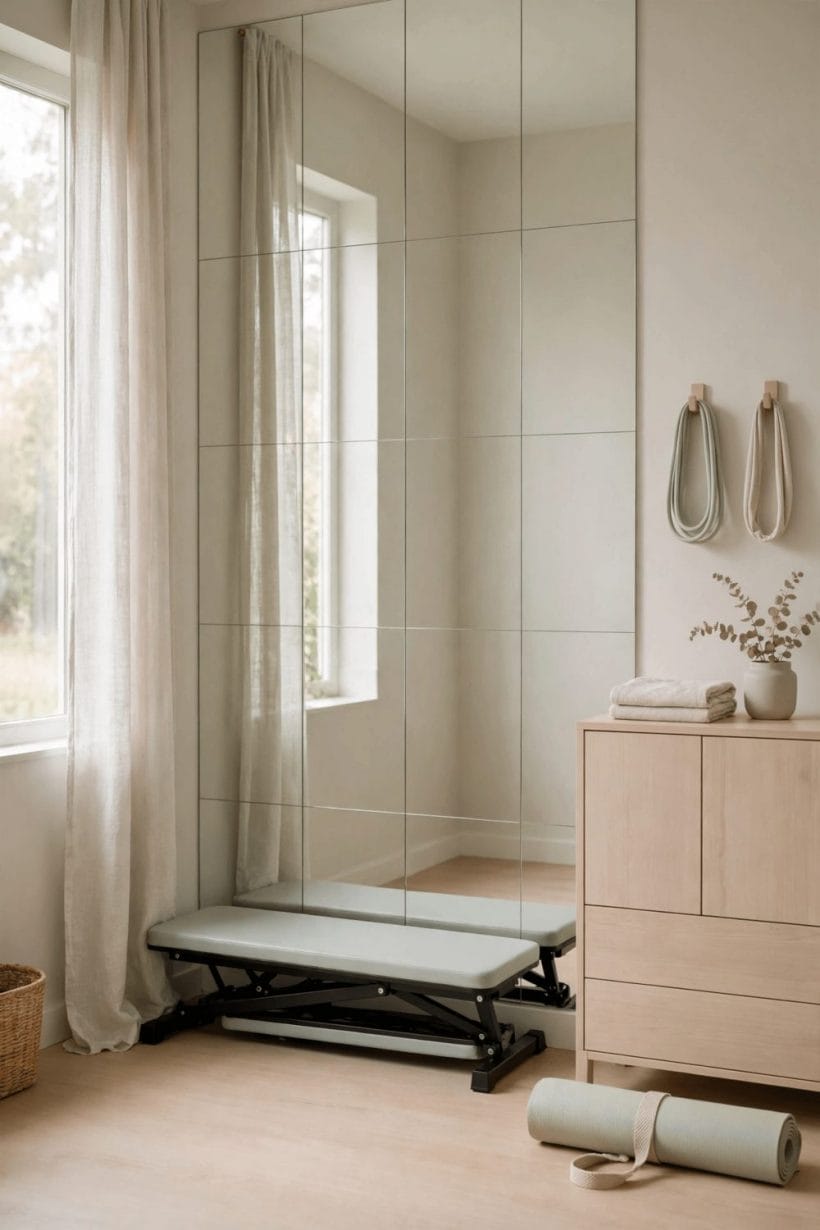
| Mirror one wall to open the room | A mirrored wall makes a small gym feel twice its size, reflects daylight into corners, and lets posture be checked without extra equipment. |
| Fix a wall rack through a professional | A wall rack holds kit off the floor and within reach, yet it is only as sound as its fixing, so the wall type and the load must be judged by someone qualified before anything is hung. |
| Peg small kit on a wall board | A wall board with pegs and hooks organises small kit where it can be seen, from bands to towels to a skipping rope, and it turns a blank wall into working storage. |
| Keep plans on a wall board | A board for session plans, kept on the gym wall, gives the room a sense of purpose and keeps paper off tables and chairs. |
| Paint the gym walls pale | Pale walls make a small gym feel open, reflect daylight well, and show the room's true size rather than shrinking it with dark tones. |
| Add one deep accent wall | One deep accent wall behind a gym corner can give the space energy and identity without darkening the whole room, especially when the other walls stay pale. |
| Hang framed prints for motivation | Framed prints on a gym wall give the corner character and make it feel like a chosen place rather than a leftover space. |
| Let a professional wire any fixed fan | A fixed wall fan cools a small gym well, yet any fan that is wired into the home's electrics must be installed by a qualified electrician, who can judge the circuit, the fitting, and the safety of the position. |
| Layer ceiling light with a lamp | Layered light suits a small gym, because a ceiling light gives general brightness while a lamp gives a softer glow for stretching and cooling down. |
| Put daylight first where possible | Daylight is the kindest light for a small gym, so place the mat near a window when the room allows it, and keep curtains light enough to admit the day. |
| Warm the evening session | An evening session suits warm, soft light rather than harsh brightness, which can make a small room feel clinical and keep the household awake. |
| Keep the palette pale and quiet | A pale, quiet palette across walls, flooring, and storage makes a small gym feel spacious and restful, and it lets the eye settle rather than dart between competing colours. |
| Add a deep tone for energy | A deep tone in a mat, a basket, or a single wall can give a small gym a lift of energy without overwhelming it, provided the deep tone stays an accent and never takes over. |
| Set a mirror opposite the window | A mirror opposite a window doubles the daylight in a small gym and gives the room a sense of depth that no paint can match. |
| Use mirror panels on a narrow wall | Mirror panels on a narrow wall suit a gym squeezed into a hallway-like space, where a single large mirror would be hard to fix and harder to live with. |
| Colour-code zones by kit colour | Colour-coding a small gym by kit colour — one tone for mats, another for bands, another for towels — helps everyone in the home find and return kit without thinking. |
| Lay interlocking mats for cushioning | Interlocking mats cushion the feet, protect the floor beneath, and can be laid across a corner or a whole small room in minutes. |
| Warm a cold floor with a rug | A rug under a gym mat warms a cold floor and softens a bare room, especially in a bedroom or a living-room corner where bare flooring feels harsh underfoot. |
| Choose mats that lift for cleaning | Mats that lift in sections make cleaning a small gym simple, because dust and sweat can be dealt with beneath them rather than building up unseen. |
| Protect floors beneath heavy kit | Heavy kit deserves a protective layer beneath it, whether a thick mat or a sturdy board, so floors are not dented or scratched over time. |
| Keep sessions quiet for neighbours | A small gym in a flat or a shared home should be kind to neighbours, with soft mats, quiet kit, and sessions timed with consideration for those nearby. |
| Pick an easy-clean surface for dusty rooms | A garage or utility corner gym needs a surface that sweeps and wipes clean, since dust arrives daily in such rooms. |
| Keep the floor clear of trip hazards | A clear floor is the simplest safety rule in a small gym: cords, straps, and loose kit belong hung, boxed, or rolled, never left where a foot can catch them. |
| Open a window for fresh air | Fresh air makes a small gym far more pleasant, so open a window before a session when the weather allows, and let the room breathe afterwards too. |
| Cool the room with a freestanding fan | A freestanding fan cools a small gym without any wiring work, moves with the session, and stores in a corner when it is not needed. |
| Agree sound limits with the household | Sound limits agreed with the household keep a small gym welcome: soft kit, gentle sessions at quiet hours, and consideration for rooms below or beside the gym. |
| Choose quiet kit for shared homes | Quiet kit suits shared homes best, and much of the best small-gym kit is quiet by nature: bands, mats, and bodyweight work make little noise, while dropping heavy kit does not. |
| Anchor the session to a time of day | A session anchored to a regular time of day — morning, lunch, or evening — becomes a habit far more reliably than one fitted in whenever a gap appears. |
| Keep water and a towel within reach | Water and a towel within reach of the gym corner turn a session from a chore into a comfortable routine, and they stop trips across the house mid-session. |
| Reset the corner once a week | A weekly reset of the gym corner — mats lifted and cleaned, kit returned to its hooks, the floor swept, the shelf cleared — keeps a small gym feeling fresh rather than slowly cluttered. |
| Start with a mat and bands only | A first stage of a mat and bands gives a full session from two pieces that store in a corner and cost the room almost nothing. |
| Consider pre-loved kit checked first | Pre-loved kit can suit a small gym well, provided it is checked before use for wear, damage, and missing parts, and provided it fits the room rather than merely filling it. |
1. Take the corner by the window
A corner near a window gives daylight, fresh air, and a view to rest the eyes on between efforts, and it keeps the middle of the room free for everyday life. Place a mat in the corner, keep the kit close to the wall, and let the window do the work of making the space feel open. If the sun falls hard on the spot at some hour, a light curtain softens it without shutting the daylight out.
2. Use the corner beside the door
The corner beside a door is often overlooked because it feels like passage space, yet a slim bench or a rolled mat can sit there without blocking the way in or out. Keep the walking line clear, store nothing across the doorway, and choose kit that can be moved in a moment. A corner like this suits a short session, because everything is visible the moment you enter the room.
3. Fill the gap between wardrobe and wall
Many bedrooms hold a narrow gap between a wardrobe and a wall, and that gap can become a tidy gym nook with a mat, a basket of soft kit, and a hook for bands. The wardrobe itself becomes one wall of the gym, which saves the cost and clutter of new furniture. Keep the gap ventilated and dust-free, and avoid pushing kit so deep into it that it is never reached.
4. Put a mirror on the adjoining wall
A mirror on the wall beside a corner gym lets you check posture without turning the whole room into a studio, and it bounces light back into a dim corner. Choose a mirror that suits the wall it hangs on, have heavy mirrors fixed by someone qualified to judge the fixing, and keep the glass clean so the reflection stays honest. A mirror that is too large for the corner will dominate the room, so let the corner set the size.
5. Let a mat define the gym
When floor space is scarce, a mat can be the whole gym: unroll it and the session has begun, roll it away and the room is a room again. Store the mat upright in a corner or flat under a bench, and choose a colour that pleases you enough to leave out if company calls. A mat that is easy to reach will be used far more often than one buried behind other things.
6. Add one small shelf for small kit
A single shelf above a corner gym holds bands, a towel, and a water bottle within reach, and it stops small kit from drifting across the room. Keep the shelf shallow so nothing falls behind it, and put the most-used items at hand height. A shelf that fills up with unrelated things has stopped being gym storage, so clear it whenever it starts to collect strays.
7. Face the corner away from seating
A gym corner that faces away from the sofa or the dining table feels more private, even in a shared room, because the session does not become a performance for everyone nearby. Turn the bench or mat toward the wall or the window, and let the back of a chair or a screen mark the boundary. Privacy of this quiet kind makes regular use easier, especially in a home shared with others.
8. Mark the corner with a rug
A rug under a corner gym marks the boundary of the session without building anything, and it warms a cold floor underfoot. Choose a rug that stays flat, sits well under a mat, and can be lifted for cleaning, and keep its edges clear of the walking line. When the rug is rolled away, the corner returns to the room, which is exactly the flexibility a small home needs.
2. Turn a Spare Room into a Gym
A spare room is the kindest gift a small home can give a gym, because the session never has to be packed away before guests arrive. The trick is to keep the room honest: a spare room that slowly fills with boxes stops being a gym at all. Ideas borrowed from tiny bedroom ideas help here, since a small bedroom and a small gym share the same discipline of choosing only what earns its floor space.
9. Dedicate the spare bedroom properly
If a bedroom stands empty for most of the year, dedicating it to a gym gives the session a real home, with a door that closes and a floor that stays clear. Keep the room simple, with a mat, a bench, and wall storage, and resist filling the corners with overflow from other rooms. A dedicated room is used more because starting a session costs nothing but opening a door.
10. Keep a foldaway bed for guests
A spare room can still welcome guests if the bed folds away against a wall or into a cabinet, leaving the floor free for a gym on ordinary days. Choose a folding arrangement that one person can manage without strain, and keep bedding stored nearby so a guest night stays easy. The room then serves two purposes without either one spoiling the other.
11. Line a box room with wall storage
A very small spare room, sometimes called a box room, works best when its walls carry the storage and its floor stays nearly empty. Hooks, a slim rail, and a narrow shelf hold the kit, while the mat lives upright in a corner. With the floor clear, even a modest room feels roomy enough for a full session, and cleaning it takes only a few minutes.
12. Give the room a calm, pale scheme
Pale walls, light wood, and soft textiles make a small spare-room gym feel airy rather than cramped, and they show dust and clutter early so the room stays tidy. Keep the palette to a few quiet tones, and let one deeper colour appear only in the mat or a basket. A calm scheme also helps the room settle back into a guest room when it is needed as one.
13. Hang a full mirror wall
A mirror across one wall of a spare-room gym doubles the sense of space and lets posture be checked from several angles. Have the mirror fixed by someone qualified to judge the wall and the fixing, especially where panels are large, and keep the lower edge clear of kit so nothing knocks against the glass. A mirror wall suits a dedicated room better than a shared one, where it may dominate the decor.
14. Lay soft flooring wall to wall
Soft flooring across a spare-room gym cushions the feet, quiets movement, and protects the floor beneath from heavy kit. Choose a surface that can be lifted in sections for cleaning, and keep a spare section stored flat so a worn piece can be swapped without redoing the whole room. Wall-to-wall softness also makes the room welcoming for stretching and floor work.
15. Keep the room for gym kit only
A spare-room gym stays useful only while it holds gym kit and nothing else, so set a simple rule that boxes, ironing, and outgrown furniture do not move in. When something else needs a home, find it one elsewhere rather than letting the gym become the overflow room. The discipline sounds strict, yet it is what keeps the room ready on a busy morning.
16. Add a chair for resting and changing
A single sturdy chair in a spare-room gym gives somewhere to sit, change shoes, and rest between efforts, and it stops kit from being used as a seat. Place the chair near the door so it does not eat into the exercise floor, and keep a towel and water within reach of it. Small comforts like this turn a bare room into a place that is actually pleasant to use.
3. Share a Room Without Losing It
Most small homes cannot spare a whole room, so the gym must share with a living room, a bedroom, or a workspace, and still leave that room feeling like itself. The sharing works when the gym has a clear edge and a quick tidy, not when kit spreads across every surface. Planning help comes from small living room ideas, where a room that serves several purposes stays calm only because each purpose has its own place.
17. Tuck the gym beside the sofa
A gym zone beside a sofa uses the quiet end of a living room, with a bench that slides behind the sofa arm and a mat stored upright nearby. Keep the zone narrow, so the living room keeps its seating and its walking lines, and choose kit in colours that sit comfortably beside soft furnishings. When the session ends, the zone should read as part of the room, not as an intrusion into it.
18. Build the gym into a bedroom corner
A bedroom corner gym suits a morning session, because the kit is steps from where the day begins and the room is already private. Place the mat where it does not block wardrobe doors or the path to the bed, and store bands and small kit in a basket that matches the bedroom. A bedroom gym should be quiet in look as well as in use, so the room still invites rest at night.
19. Share the room with a home office
A room shared between work and exercise suits many small homes, because both uses need only a modest footprint and neither needs the room all day. Guidance for the work half of such a room can be found among home office ideas, while the gym half needs a mat, a bench, and storage that closes. Keep the desk clear of kit and the gym clear of papers, so each use starts tidy.
20. Screen the zone with a curtain or divider
A curtain on a rail or a folding divider gives a shared-room gym a soft boundary that can be drawn for a session and opened afterwards. Choose a screen that stands steady, folds flat for storage, and lets light through rather than blocking it, and keep the floor beneath it clear. A screen also shields the rest of the room from the sight of kit, which matters when guests visit.
21. Hide kit inside a closed cabinet
A closed cabinet is the simplest way to share a room, because the gym vanishes behind doors when the session ends and the room returns to its main purpose. Fit the cabinet with hooks and baskets inside so small kit does not pile at the bottom, and keep the doors easy to open with one hand. A cabinet that looks like ordinary furniture keeps the room feeling like a room.
22. Agree quiet hours for shared rooms
A shared-room gym works best when everyone in the home agrees which hours suit a session and which hours suit quiet, so no one is surprised by movement overhead or next door. Write the agreement down if it helps, keep it generous on both sides, and review it when routines change. A little agreement prevents far more friction than any amount of soundproofing after the fact.
23. End every session with a quick tidy
A shared room stays shared only if the gym is tidied after every session, with the mat rolled, the bands hung, and the floor left clear. Make the tidy part of the session rather than an afterthought, and keep storage close enough that tidying takes moments rather than effort. A room that is left ready for its next use is a room that stays welcoming to everyone.
24. Define the zone by colour, not by walls
When walls cannot be moved, colour can still mark a gym zone: a mat, a basket, and a towel in one accent tone tell the eye where the gym lives. Keep the accent restrained so it complements the room rather than competing with it, and repeat the tone only in gym items, never across the whole room. Colour boundaries cost nothing to move when the layout changes.
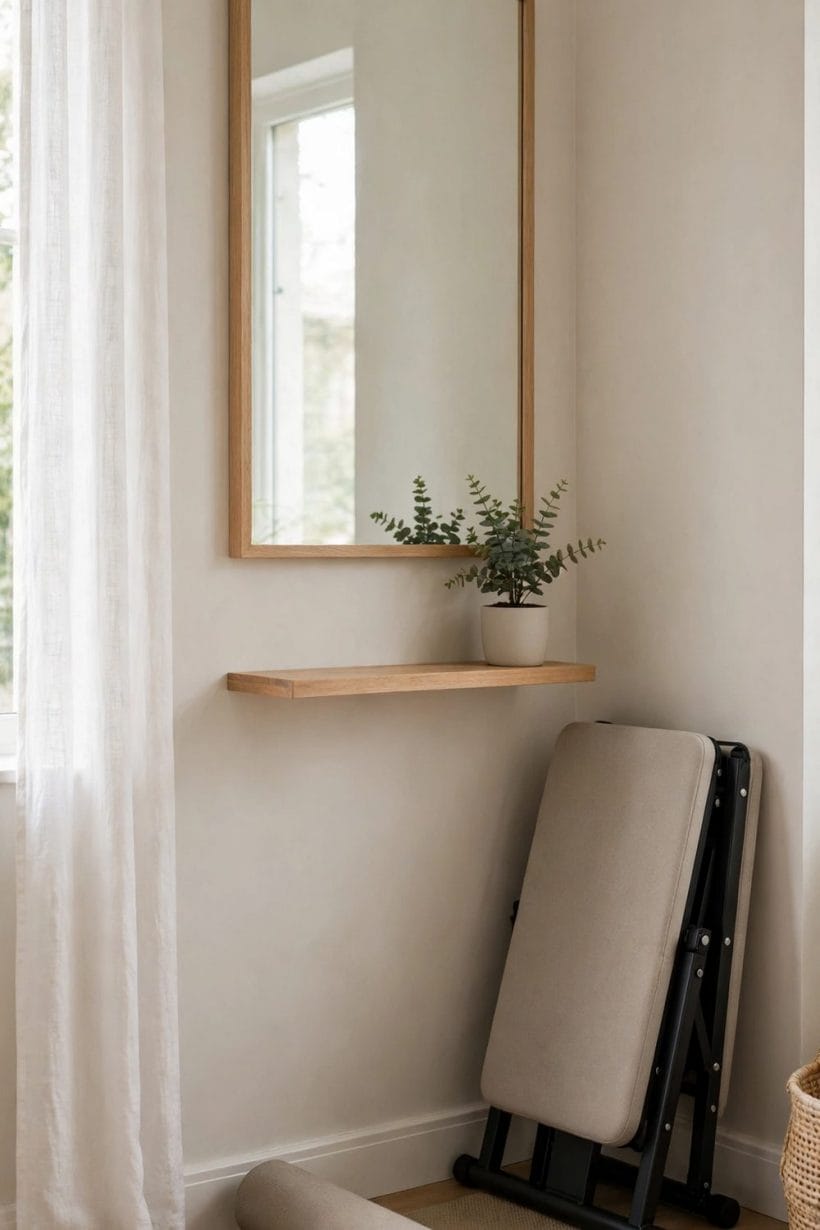
4. Store Everything Out of Sight
Storage is what makes a small gym possible, because kit that has no home ends up on chairs, floors, and stairs. The best storage in a small home is close, closed, and easy to reach, so putting kit away feels easier than leaving it out. Ideas from tiny house storage ideas translate directly, since a tiny home survives by giving every object a place and keeping that place within arm’s reach.
25. Hang bands and ropes on wall hooks
Wall hooks turn bands, ropes, and straps into a neat row that can be seen and grabbed in a moment, and they free the floor entirely. Fix hooks into a sound wall, have heavy loads judged by someone qualified to assess the fixing, and hang each item on its own hook so nothing tangles. A row of hooks by the gym corner is often all the storage a small kit list needs.
26. Keep small kit in one cabinet
One cabinet for all small gym kit beats several scattered baskets, because everything is found in one place and the room keeps only one gym frontage. Arrange the inside with a basket for soft items and a tray for hard ones, and keep the most-used kit at the front. When the cabinet doors close, the gym is tidied, which is a strong reason to choose a cabinet over open shelves.
27. Use a basket for soft kit
A basket suits towels, straps, and soft kit that would otherwise drift across a room, and it can be carried to the gym corner and back again. Choose a basket with handles, a size that fits its shelf or corner, and a colour that suits the room, and empty it now and then so it does not become a hiding place for unrelated things. Baskets work best when they hold one kind of kit only.
28. Take storage up to a high shelf
A high shelf above a door or a cabinet holds kit that is used less often, such as a spare mat or seasonal items, without taking floor space at all. Keep the shelf shallow, keep heavy items low instead, and store only things that can be lifted down safely. High storage suits light, bulky kit; anything heavy belongs where it can be reached without stretching or climbing.
29. Slide a rolling cart under a bench
A low rolling cart under a bench or a table holds small kit out of sight and wheels out when a session begins. Keep the cart shallow enough to slide freely, load it so nothing rattles or rolls off, and return it to its place as part of tidying. A cart suits shared rooms well, because the gym can travel a short distance and then disappear again.
30. Choose a storage bench that seats too
A storage bench gives a seat for resting and a box for kit in a single piece of furniture, which is a fine bargain in a small room. Place it against a wall near the gym corner, keep its lid easy to lift, and store only gym kit inside so the seat stays usable. A bench that doubles as storage earns its floor space twice over, unlike a bench that only holds things on top.
31. Label boxes so kit is found fast
Labels on storage boxes sound fussy, yet they save a small gym from the slow drift into mystery boxes that no one opens. Label by use rather than by brand or type, keep the labels short and honest, and rewrite them when the contents change. A labelled box is used, while an unlabelled one is merely stored, and the difference matters in a small home.
32. Rotate kit with the seasons
Rotating kit through the year keeps a small gym fresh without growing the kit list: items used less often move to higher storage, and favourites return to the front. Review the kit when the weather changes, set aside anything unused for a long while, and let the rotation be guided by what is actually used. A small gym that is curated stays inviting, while one that only accumulates becomes a cupboard.
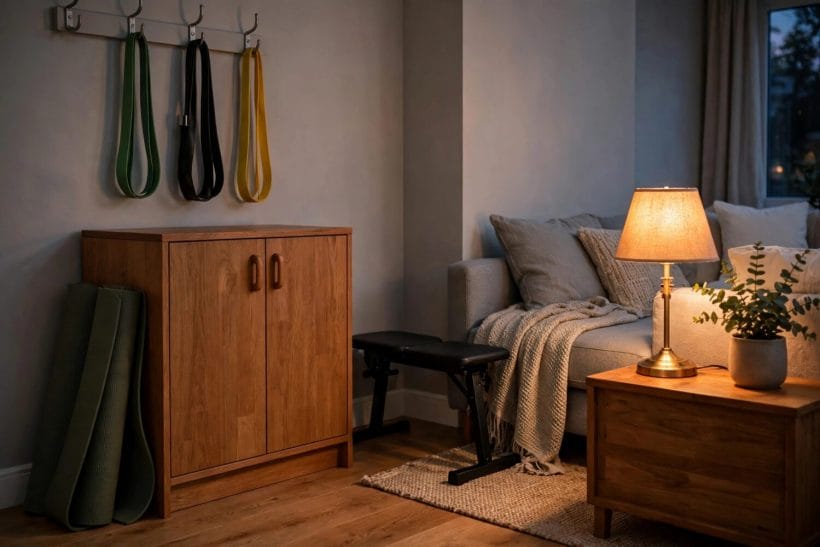
5. Choose Compact Equipment
Compact kit is the heart of a small gym, because every piece must justify the space it takes when it is not in use. The rule is simple: prefer kit that folds, hangs, rolls, or stacks, and resist kit that stands idle and large. A short list of well-chosen pieces, used often, serves a small home far better than a long list that crowds the room and gathers dust.
33. Pick a bench that folds flat
A bench that folds flat can lean against a wall, slide under a bed, or stand behind a door, and it turns a corner into a gym in moments. Test the folding action before choosing, keep the bench light enough to move without strain, and store it where it cannot topple onto passers-by. A folding bench is the single most useful piece in many small gyms, because it adds seating and support without claiming a room.
34. Prefer weights that adjust in place
Weights that adjust in place replace a whole rack of fixed weights with a single pair that can be changed without moving across the room. Keep them on a mat or a low tray, store them where they cannot roll, and handle them with care on hard floors. Adjustable weights suit a small gym precisely because they shrink the kit list while keeping the session varied.
35. Rely on resistance bands for variety
Resistance bands weigh almost nothing, hang from a single hook, and add variety to a session without adding furniture. Keep bands of different strengths in one basket or on one row of hooks, check them for wear before use, and replace any band that shows damage. Bands are also quiet kit, which matters in a shared home or a flat where neighbours live close by.
36. Choose a mat that rolls slim
A mat that rolls slim stores upright in a corner, behind a door, or inside a cabinet, and it unrolls into a full session space in seconds. Look for a mat that stays flat when unrolled, cleans easily, and suits the floor beneath it, and keep it rolled loosely rather than crushed under other things. A slim-rolling mat is the gym itself for many small homes, and it deserves a proper home of its own.
37. Stack a step platform away
A step platform that stacks or folds gives height for stepping and seating without a permanent footprint, and it can live under a bench or against a wall. Choose a platform with a steady, non-slip top, keep it dry, and store it where it will not become a trip hazard in a hallway. Stacking kit suits small gyms because it grows only while it is being used.
38. Use a suspension trainer with care
A suspension trainer hangs from a fixed point and gives a full session from straps alone, yet its fixing must be judged by someone qualified to assess the anchor, since a poor fixing risks both the user and the wall. Follow the maker’s guidance, inspect straps and anchors before each use, and store the trainer coiled on a hook afterwards. Used with a sound fixing, it is among the most space-efficient kit a small gym can hold.
39. Hang a skipping rope on its own hook
A skipping rope needs only a hook and a clear patch of floor, which makes it ideal kit for a small home, provided the ceiling and the neighbours allow it. Coil the rope loosely so it does not kink, hang it away from bands and straps, and keep the jumping area free of rugs that could slip. A rope is a reminder that a small gym need not be a large investment to be a real one.
40. Keep the kit list short on purpose
A short kit list, reviewed often, keeps a small gym usable: when a new piece arrives, an old piece that is no longer used should leave. Write the list down, note which pieces are used most, and let use, not novelty, decide what stays. A gym with a short, loved kit list is tidier, cheaper to keep, and far more likely to be used than one that has grown without a plan.
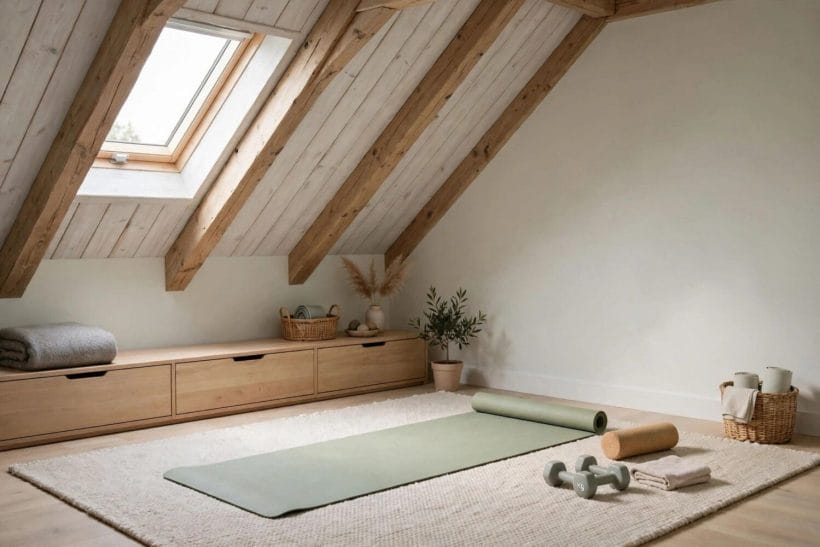
6. Make the Walls Work Hard
Walls are the most underused asset in a small gym, because they can hold storage, mirrors, colour, and light without taking a single step of floor. The discipline is to use walls deliberately and to fix things properly: a wall that is overloaded or poorly fixed becomes a hazard rather than a help. Heavy fixings, new sockets, and any change to the structure itself belong to qualified professionals, never to guesswork.
41. Mirror one wall to open the room
A mirrored wall makes a small gym feel twice its size, reflects daylight into corners, and lets posture be checked without extra equipment. Keep the mirror clean, keep kit from leaning against it, and have large panels fixed by someone qualified to judge the wall. A mirror suits a gym corner even in a shared room, provided its size respects the room around it.
42. Fix a wall rack through a professional
A wall rack holds kit off the floor and within reach, yet it is only as sound as its fixing, so the wall type and the load must be judged by someone qualified before anything is hung. Once fixed, a rack keeps bands, mats, and small kit in a tidy row, and it frees the floor for the session itself. Never overload a rack beyond what its fixing was judged to carry, and check the fixing now and then for any loosening.
43. Peg small kit on a wall board
A wall board with pegs and hooks organises small kit where it can be seen, from bands to towels to a skipping rope, and it turns a blank wall into working storage. Keep the board within easy reach, hang each item on its own peg, and leave a few pegs empty for kit that arrives later. A board that is full to overflowing has stopped organising and started cluttering, so prune it when it fills.
44. Keep plans on a wall board
A board for session plans, kept on the gym wall, gives the room a sense of purpose and keeps paper off tables and chairs. Write the plan in a few short lines, change it when routines change, and keep it encouraging rather than demanding. A plan board suits a dedicated corner best, where it can stay up without spoiling the look of a shared room.
45. Paint the gym walls pale
Pale walls make a small gym feel open, reflect daylight well, and show the room’s true size rather than shrinking it with dark tones. Choose a washable finish for walls near kit, keep the ceiling paler still, and let colour arrive through the mat and baskets instead. Pale walls also make a shared-room gym easier to live with, because they match the rest of the home.
46. Add one deep accent wall
One deep accent wall behind a gym corner can give the space energy and identity without darkening the whole room, especially when the other walls stay pale. Paint the wall that holds the mirror or the rack, keep the accent to that single wall, and repeat its tone only in small gym items. An accent wall suits a dedicated gym corner better than a whole shared room, where it may fight the existing decor.
47. Hang framed prints for motivation
Framed prints on a gym wall give the corner character and make it feel like a chosen place rather than a leftover space. Choose images that please you, hang them securely and clear of swinging kit, and keep the frames few so the wall stays calm. Prints that are loved will be looked at daily, which is a quiet kind of motivation that costs the room nothing.
48. Let a professional wire any fixed fan
A fixed wall fan cools a small gym well, yet any fan that is wired into the home’s electrics must be installed by a qualified electrician, who can judge the circuit, the fitting, and the safety of the position. A freestanding fan, by contrast, needs only a socket and a stable floor, and it can move with the session. Either way, keep cords clear of the exercise floor and out of walking lines.
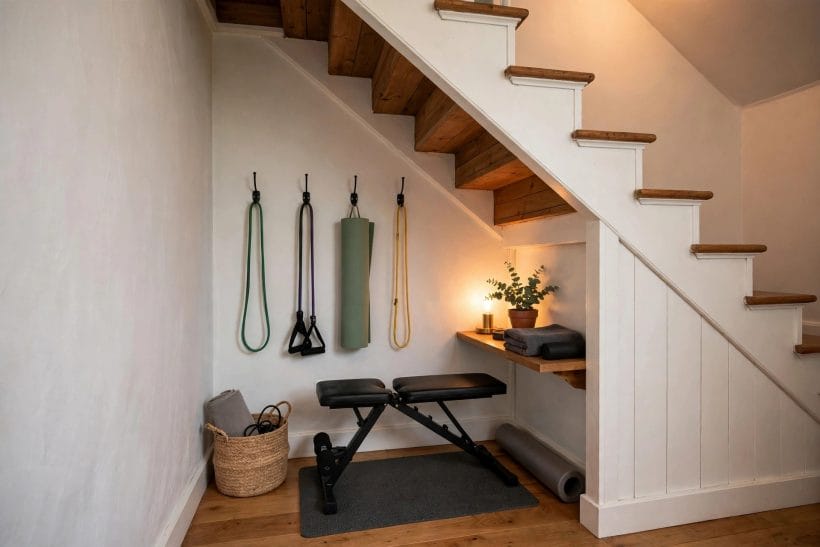
7. Light, Colour and Mirrors for Small Rooms
Light and colour decide whether a small gym feels like a cupboard or a studio, and they cost far less attention than new kit. Daylight first, a warm lamp for evenings, pale tones for openness, and a mirror to double what light there is: these four moves transform a corner without moving a wall. A gym zone inside a living room can borrow ideas from tiny house living room ideas, where light and colour are planned for rooms that must feel generous on a small footprint.
49. Layer ceiling light with a lamp
Layered light suits a small gym, because a ceiling light gives general brightness while a lamp gives a softer glow for stretching and cooling down. Keep both lights clear of swinging kit, choose warm tones for the evening layer, and switch layers with the session rather than leaving everything blazing. Layering also lets one small room serve a bright session and a calm wind-down without changing a fitting.
50. Put daylight first where possible
Daylight is the kindest light for a small gym, so place the mat near a window when the room allows it, and keep curtains light enough to admit the day. Daylight shows true colours, lifts mood, and makes a small room feel larger, and it costs nothing to use. Where daylight is scarce, a bright lamp near the mirror can stand in, though it rarely matches the openness of a window.
51. Warm the evening session
An evening session suits warm, soft light rather than harsh brightness, which can make a small room feel clinical and keep the household awake. Use a lamp with a warm tone, dim the ceiling light if a dimmer is fitted by a qualified electrician, and let the room settle into a calm glow. Warm evening light also helps a shared room return to restful use once the session ends.
52. Keep the palette pale and quiet
A pale, quiet palette across walls, flooring, and storage makes a small gym feel spacious and restful, and it lets the eye settle rather than dart between competing colours. Limit the palette to a few tones, keep the largest surfaces palest, and let one accent tone appear only in small items. A quiet palette ages well, because it does not tire the eye after months of daily use.
53. Add a deep tone for energy
A deep tone in a mat, a basket, or a single wall can give a small gym a lift of energy without overwhelming it, provided the deep tone stays an accent and never takes over. Deep greens, blues, and warm earth tones all suit a gym corner, and the right choice is the one that pleases the user daily. Energy in a small room comes from contrast used sparingly, not from colour used loudly everywhere.
54. Set a mirror opposite the window
A mirror opposite a window doubles the daylight in a small gym and gives the room a sense of depth that no paint can match. Keep the mirror clean, keep the window dressing light so the reflection stays bright, and avoid placing the mirror where it reflects clutter from elsewhere in the home. A well-placed mirror is the cheapest way to make a small gym feel like a larger one.
55. Use mirror panels on a narrow wall
Mirror panels on a narrow wall suit a gym squeezed into a hallway-like space, where a single large mirror would be hard to fix and harder to live with. Panels can be arranged to suit the wall’s shape, fixed by someone qualified to judge them, and cleaned one at a time. Panels also survive a move better than a single sheet, since one damaged panel can be replaced alone.
56. Colour-code zones by kit colour
Colour-coding a small gym by kit colour — one tone for mats, another for bands, another for towels — helps everyone in the home find and return kit without thinking. Keep the code simple, with only a few tones, and apply it consistently across baskets and hooks. A code that is too elaborate will be ignored, while a simple one becomes habit within days.
8. Floors That Protect the Room
Floors take the hardest wear in a small gym, from dropped kit to moving feet to dust from outside, and the right floor protects both the user and the room beneath. The choice depends on the room: a bedroom needs quiet softness, a garage needs toughness, and a shared living room needs something that can vanish after the session. Whatever the surface, keep it clean, flat, and free of edges that could catch a foot.
57. Lay interlocking mats for cushioning
Interlocking mats cushion the feet, protect the floor beneath, and can be laid across a corner or a whole small room in minutes. Choose mats that lock firmly, stay flat at the edges, and lift easily for cleaning, and keep a spare mat stored flat for replacements. Mats that curl at the corners should be replaced, since a curled edge is a trip hazard in a small space.
58. Warm a cold floor with a rug
A rug under a gym mat warms a cold floor and softens a bare room, especially in a bedroom or a living-room corner where bare flooring feels harsh underfoot. Choose a rug that stays flat, does not slide, and can be lifted for washing, and keep it smaller than the exercise area so its edges stay clear. A rug that is loved will also make the corner feel like a proper room rather than a workout strip.
59. Choose mats that lift for cleaning
Mats that lift in sections make cleaning a small gym simple, because dust and sweat can be dealt with beneath them rather than building up unseen. Lift the mats regularly, clean beneath them, and let them dry fully before relaying, so damp never sits against the floor. A gym that is easy to clean will be cleaned, while one that fights cleaning will slowly be neglected.
60. Protect floors beneath heavy kit
Heavy kit deserves a protective layer beneath it, whether a thick mat or a sturdy board, so floors are not dented or scratched over time. Place the protection before the kit, keep it slightly larger than the kit’s footprint, and check beneath it now and then for trapped grit. Floor protection is a quiet investment: it preserves the room for its next use, whatever that use may be.
61. Keep sessions quiet for neighbours
A small gym in a flat or a shared home should be kind to neighbours, with soft mats, quiet kit, and sessions timed with consideration for those nearby. Bands, mats, and bodyweight work suit shared buildings well, while jumping and dropping heavy kit suit a ground-floor or detached space better. Kindness to neighbours is part of keeping a small gym welcome in the home long term.
62. Pick an easy-clean surface for dusty rooms
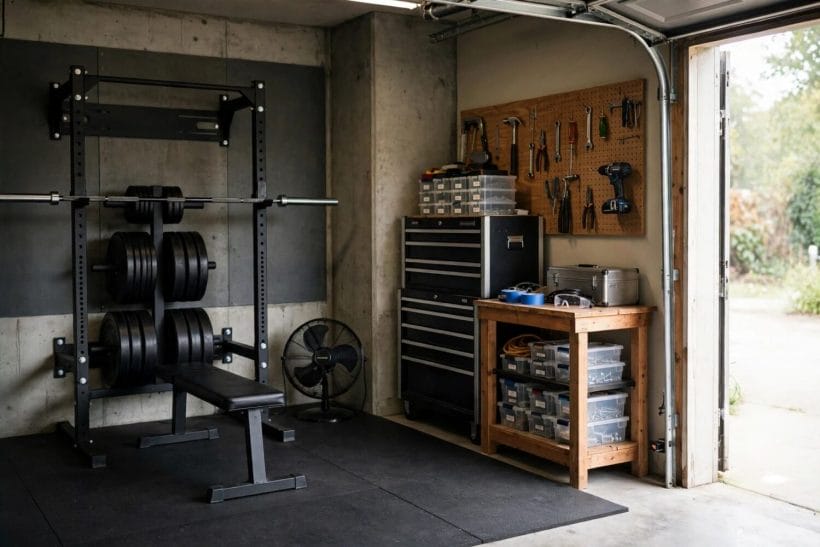
A garage or utility corner gym needs a surface that sweeps and wipes clean, since dust arrives daily in such rooms. Choose mats or flooring that tolerate sweeping, keep the gym corner swept as part of tidying, and store soft kit in closed baskets so it stays dust-free. An easy-clean surface keeps a dusty room usable, while a fussy one soon looks tired.
63. Keep the floor clear of trip hazards
A clear floor is the simplest safety rule in a small gym: cords, straps, and loose kit belong hung, boxed, or rolled, never left where a foot can catch them. Walk the exercise area before each session, move anything stray to its home, and keep the path to the door clear at all times. A tidy floor is not fussiness; it is the habit that keeps a small gym safe.
9. Keep Air, Sound and Routine Steady
A small gym lives or dies by its routine, because a room that is stuffy, noisy, or awkward to use will quietly be abandoned. Fresh air, considerate sound, a steady time of day, and a place to rest all help a session become a habit rather than a chore. The ideas below cost little, yet they decide whether the gym corner is used in a year’s time or merely remembered.
64. Open a window for fresh air
Fresh air makes a small gym far more pleasant, so open a window before a session when the weather allows, and let the room breathe afterwards too. A window habit also clears the stuffiness that builds in a small, closed room, and it costs nothing. Where opening a window is not possible, a freestanding fan and a door left ajar can give a similar sense of airiness.
65. Cool the room with a freestanding fan
A freestanding fan cools a small gym without any wiring work, moves with the session, and stores in a corner when it is not needed. Place it where its cord cannot cross the exercise floor, keep it stable and clear of swinging kit, and clean its blades now and then so it keeps moving clean air. A fan that is easy to place will be used, while a fixed fitting that needs professional work should be planned, not improvised.
66. Agree sound limits with the household
Sound limits agreed with the household keep a small gym welcome: soft kit, gentle sessions at quiet hours, and consideration for rooms below or beside the gym. Talk the limits through, keep them fair on both sides, and revisit them when routines change or new neighbours arrive. A gym that respects the household stays a pleasure, while one that ignores it becomes a source of friction.
67. Choose quiet kit for shared homes
Quiet kit suits shared homes best, and much of the best small-gym kit is quiet by nature: bands, mats, and bodyweight work make little noise, while dropping heavy kit does not. Build the kit list around quiet pieces where the home demands it, and save louder work for a space that can take it. Quiet kit is not lesser kit; it is kit chosen with the home in mind.
68. Anchor the session to a time of day
A session anchored to a regular time of day — morning, lunch, or evening — becomes a habit far more reliably than one fitted in whenever a gap appears. Pick a time that the room is free, keep the kit ready for that time, and protect the habit gently when busy days press. A steady time also helps a shared room, because others in the home learn when the gym corner is in use.
69. Keep water and a towel within reach
Water and a towel within reach of the gym corner turn a session from a chore into a comfortable routine, and they stop trips across the house mid-session. Keep a bottle and a towel on the shelf or in the cabinet, refill and refresh them as part of tidying, and choose a towel colour that matches the gym’s accent. Small comforts, kept ready, make the difference between a session started and a session postponed.
70. Reset the corner once a week
A weekly reset of the gym corner — mats lifted and cleaned, kit returned to its hooks, the floor swept, the shelf cleared — keeps a small gym feeling fresh rather than slowly cluttered. Fold the reset into an existing weekly tidy so it does not become a separate chore, and use it to notice worn bands, curling mats, or loosening fixings before they become problems. A corner that is reset weekly stays inviting all year.
10. Plan the Cost in Stages
Cost in a small gym is best planned in stages, because the room, the flooring, the storage, and the kit each carry their own share, and buying everything at once often buys things that are never used. A staged plan lets each stage prove itself before the next begins, and it keeps the gym affordable in spirit as well as in fact. No stage here carries a price, because prices change and rooms differ; what matters is the order and the reasoning behind it.
71. Start with a mat and bands only
A first stage of a mat and bands gives a full session from two pieces that store in a corner and cost the room almost nothing. Use that stage for a while, learn which sessions suit the room, and only then decide what else the gym truly needs. A modest start also teaches the room’s limits honestly, before larger kit arrives to test them.
72. Know what drives the cost
The main drivers of cost in a small gym are the flooring, the storage, the kit list, and any professional work, such as fixing heavy racks or wiring fixed fittings. Flooring and storage are one-time choices that shape the room for years, while kit can grow gradually, and professional work should be budgeted as skilled help, not improvised. Understanding the drivers lets each stage be planned rather than guessed.
73. Consider pre-loved kit checked first
Pre-loved kit can suit a small gym well, provided it is checked before use for wear, damage, and missing parts, and provided it fits the room rather than merely filling it. Inspect bands for wear, check benches for steadiness, and pass on anything that feels unsafe or oversized for the corner. Pre-loved kit chosen carefully extends the gym’s range without extending its footprint.
74. Stage spending by room phase
Staging spending by room phase — first the floor, then the storage, then the kit — keeps each change useful on its own, even if later phases wait. A good floor improves every session, good storage improves every tidy, and good kit improves only the sessions that use it, so the order matters. Phased spending also lets the gym grow with the household’s routines rather than ahead of them.
75. Review the kit list before adding more
Before adding any new piece, review the kit list and ask whether the new piece earns its space, whether an old piece should leave, and whether the room will still tidy easily afterwards. A review habit keeps the gym small in the best sense: curated, used, and loved, rather than crowded with good intentions. The smallest gym that is used daily beats the largest gym that is merely stored.
Final Considerations
A small home gym succeeds when it fits the home first and the ambition second. Choose a corner that is easy to reach, store kit where it can be found and returned without effort, let light and pale colour open the room, and protect the floor beneath everything. These home gym ideas small space collections gather into one principle: the gym should make the home better, not busier, and it should be as easy to tidy as it is to start.
Plan the work honestly, too. Anything that changes the structure, fixes heavy kit to a wall, or touches the wiring belongs to a qualified professional, and the rest of the gym — mats, bands, baskets, and folding kit — can be arranged by the household with care. If a room must also serve as a bedroom, a living room, or an office, let that purpose set the limits, and let the gym earn its place inside them rather than pushing them aside.
For a broader sense of how small rooms are planned, tiny house interiors show the same discipline applied across a whole home: every wall earning its place, every object with a home, and every room kept ready for its next use. Start with one corner, one mat, and one tidy habit, and let the gym grow only as fast as the habit does. A small gym built that way is not a compromise; it is a room that finally works as hard as the home around it.



0 Comments