
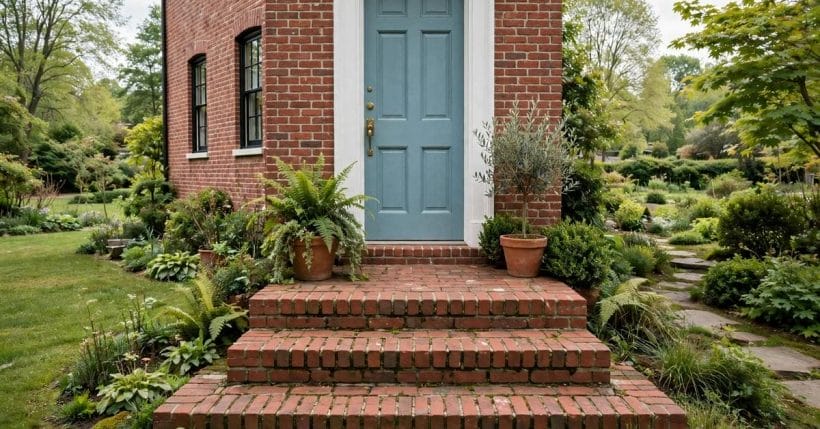
A front stoop is the smallest entrance a house can have, and that is exactly why it deserves attention. It is the platform and the few steps that carry you from the path to the front door, nothing more, and when the form is right, the whole entrance feels settled and welcoming. When the form is wrong, the door feels awkward to approach, the landing feels cramped, and the entrance never quite looks finished, however pretty the door itself may be.
This guide looks at the front stoop as a form in its own right. It covers the shapes a stoop can take, the materials that suit each shape, the colours that sit well against a house, and the practical details that make a stoop pleasant to use every day. It does not try to be a guide to porches in general, and it does not repeat the steps-and-landing redo angle: a redo of an existing porch landing is a different project from choosing a stoop form, and a portico, with its roof and columns, is a different structure again. Here, the stoop itself is the subject.
Read through the forms below with your own entrance in mind. Notice which shapes match the height of your door, which materials echo your house, and which details you would actually use. A stoop is used in passing, several times a day, so the best form is usually the one that feels obvious once you see it, rather than the most elaborate one on the page.
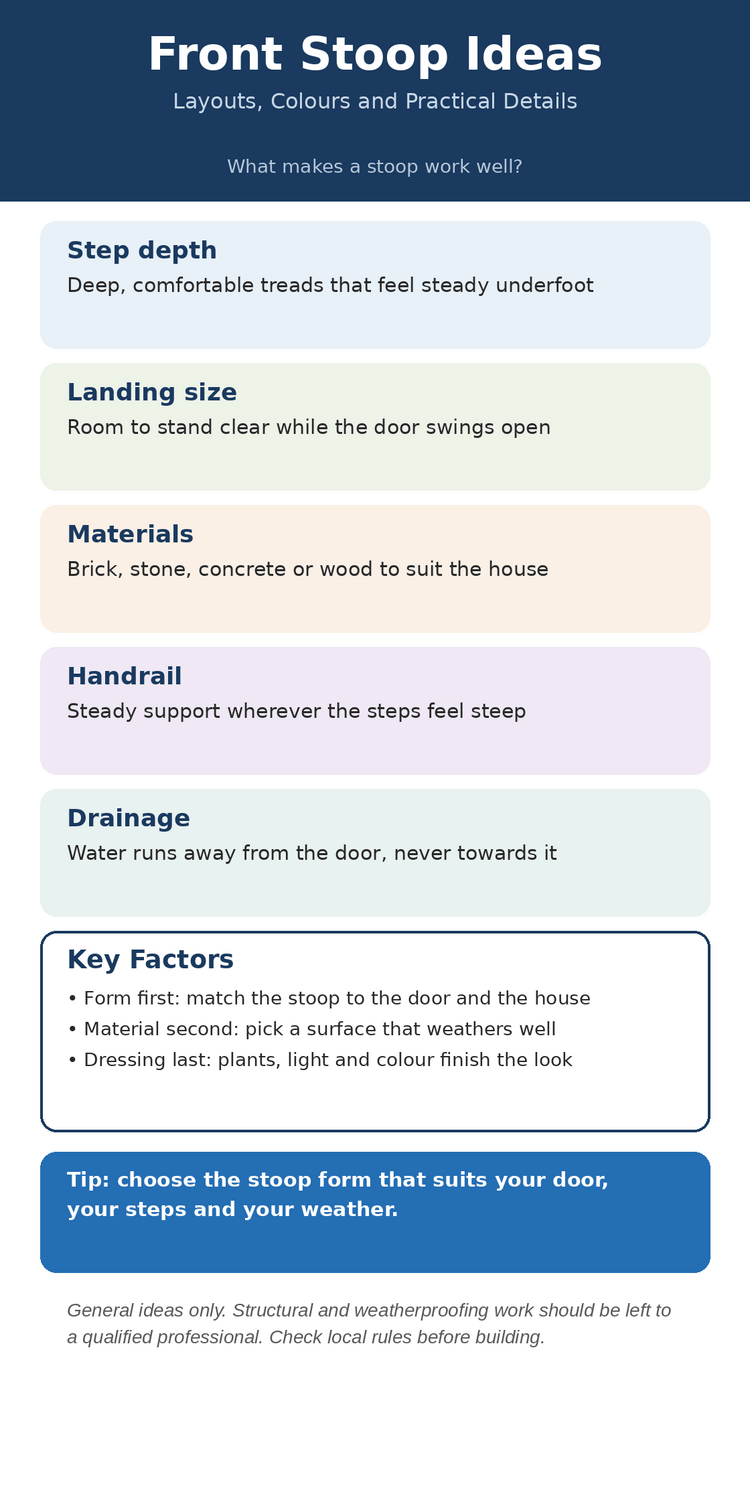
| Item | What it is |
|---|---|
| What a Front Stoop Is, and What It Is Not | A stoop is a raised platform at the front door, reached by a short flight of steps. |
| The Classic Single-Step Stoop | The simplest stoop of all is a single step up to a landing at door level. |
| The Wide Landing Stoop | Where the door sits higher above the path, or where the entrance is used by several people at once, a wide landing stoop earns its keep. |
| The Brick Stoop | Brick is the natural stoop material for a brick house, and it is forgiving in the best sense: its colour varies gently from brick to brick, its surface grips well underfoot, and it ages with the house rather than against it. |
| The Stone Stoop | Stone gives a stoop a sense of permanence that few other materials can match. |
| The Wooden Stoop | A wooden stoop has a warmth that masonry cannot quite offer, and it suits timber houses, cottages and cabins particularly well. |
| The Compact Stoop for a Small House | Small houses need stoops that know their scale. |
| Stoop Colours That Suit the House | Colour is where a stoop stops being just a structure and starts being part of the picture of the house. |
| Dressing a Stoop Without Crowding It | A dressed stoop feels welcoming; a crowded stoop feels like an obstacle course. |
| Stoops in Wet Weather | A stoop is used in all weathers, so its form should be judged in the rain as well as in the sunshine. |
1. What a Front Stoop Is, and What It Is Not
A stoop is a raised platform at the front door, reached by a short flight of steps. In its simplest form it is a single step and a landing just deep enough to stand on while you open the door. In grander forms it may be several steps wide, with room for planters and a bench, but it never grows into a roofed sitting space. That restraint is the point: a stoop announces the door and gives you a safe place to stand, and then it steps aside.
It helps to keep the neighbours of the stoop straight. A full porch is a larger, usually roofed area where people sit out; a portico is a roofed shelter over the door, carried on columns or brackets. A stoop has no roof of its own beyond whatever overhang the house already provides, and no columns to consider. Confusing the three leads to mismatched expectations, so it is worth naming the form you actually want before you start looking at pictures. If your entrance already has a roofed porch, you are looking at a porch project, not a stoop, and the ideas here will still help you judge the steps and landing, but they will not describe the whole structure.
The other distinction that matters is between choosing a form and redoing an existing one. Reworking worn steps and a tired landing, re-laying a surface or rebuilding a landing, is repair work with its own considerations, and it is not the subject of this guide. This guide is about the form itself: the shape, the material and the dressing that make a stoop look as though it belongs to the house it serves.
2. The Classic Single-Step Stoop
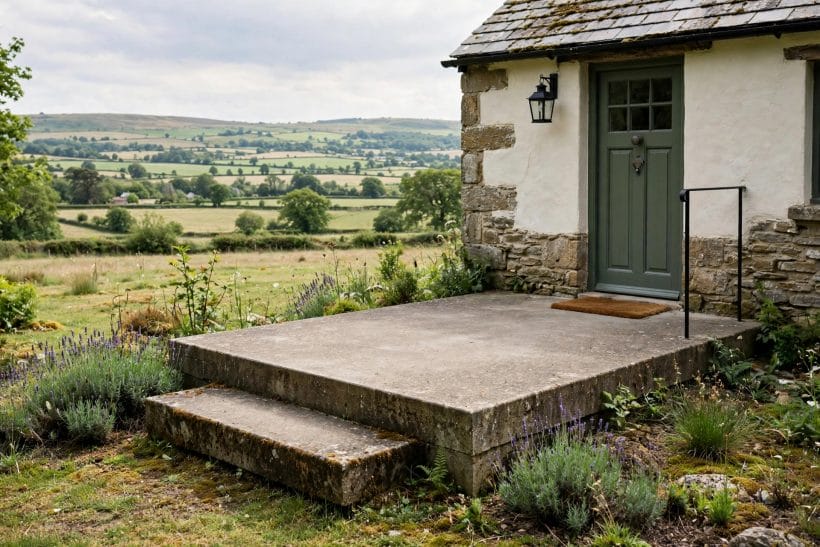
The simplest stoop of all is a single step up to a landing at door level. It suits houses where the door sits only a little above the path, and it has a quiet dignity that busier entrances often lack. One broad step, made generously deep, feels far more welcoming than a narrow step that forces you to watch your feet, and a landing that lets you stand comfortably clear of the door swing makes every arrival easier, especially with arms full of shopping.
The danger with a single-step stoop is making it too small. A landing that only just fits the door swing leaves a visitor standing on the step itself while the door opens towards them, which is awkward and can feel unsafe. Give the landing room, keep the step deep, and let the simplicity of the form speak. A plain concrete or stone step, a tidy door, and a single planter are often all this form needs, and adding more can spoil the very plainness that makes it attractive.
Colour plays a gentle role here. Because there is so little stoop to look at, the colour of the door and the tone of the step material carry the whole entrance. A painted door against a neutral step, or a natural stone step against a painted house, gives the eye something to rest on without any extra ornament. The single-step stoop rewards restraint, and it is a good place to start if you are unsure which form suits your house.
3. The Wide Landing Stoop
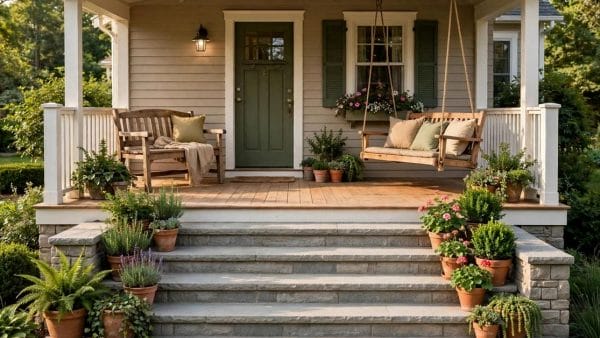
Where the door sits higher above the path, or where the entrance is used by several people at once, a wide landing stoop earns its keep. The landing stretches across the front of the door, sometimes across the full width of the entrance bay, giving everyone room to stand, greet each other, and wait without crowding the steps. Steps can then run straight ahead, or wrap around the sides of the landing, depending on how the path approaches the house.
A wide landing also changes how the entrance is dressed. There is room for a pair of planters flanking the door, a bench for setting down bags, or a lantern beside the entrance, without any of it blocking the way in. The trick is to keep the walking line clear: dress the edges of the landing, not the middle of it, so that the route from the steps to the door stays open and obvious even in poor light or bad weather.
Wide landings suit houses with a generous frontage, and they pair naturally with a porch-led entrance where the outdoor space is part of daily life. On a small house, though, a landing that is too wide can overwhelm the facade, so the width should be judged against the house itself rather than copied from a larger property. The landing should look like it belongs to the house, not borrowed from another one.
4. The Brick Stoop
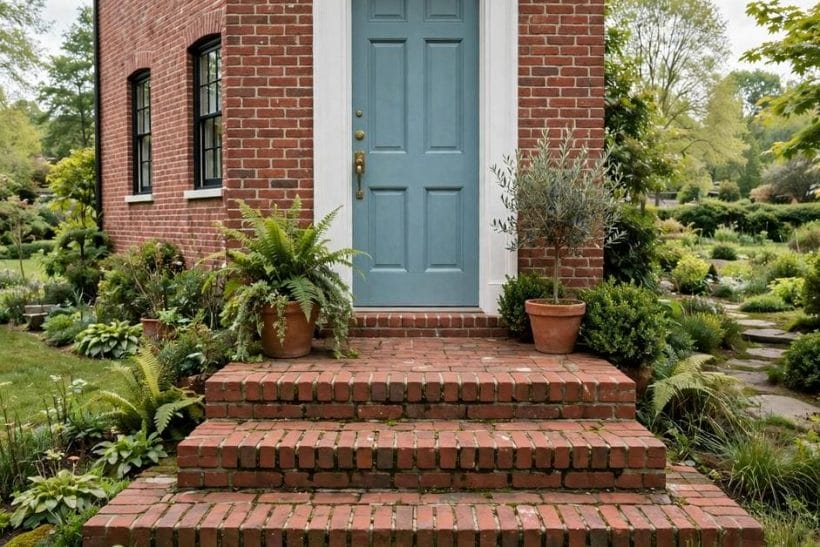
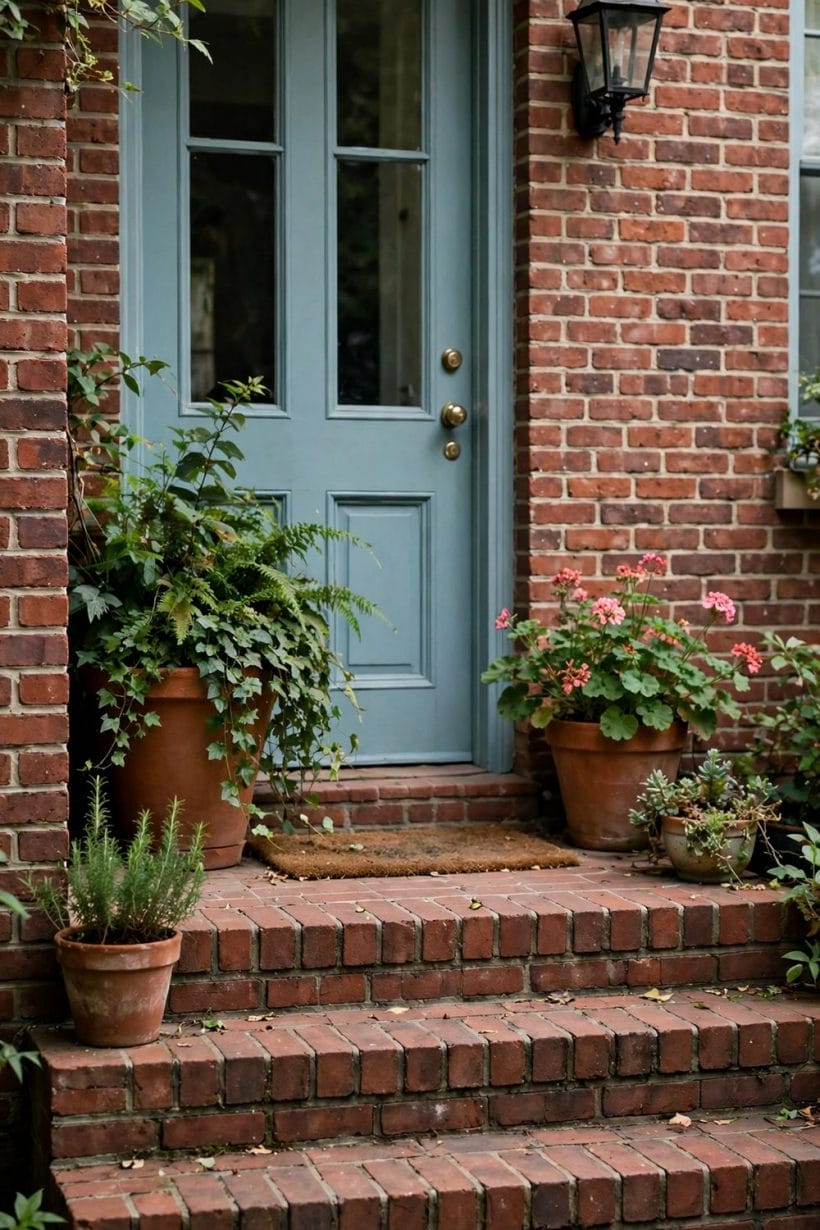
Brick is the natural stoop material for a brick house, and it is forgiving in the best sense: its colour varies gently from brick to brick, its surface grips well underfoot, and it ages with the house rather than against it. A brick stoop can be a simple stack of broad steps, or a landing edged with brick and topped with a contrasting stone or concrete slab. Either way, the stoop reads as part of the house, not as an addition to it.
The detail that makes or breaks a brick stoop is the edge of each step. A clean, even edge, with bricks laid so the pattern looks deliberate rather than accidental, gives the whole entrance a finished air. Where brick meets another material, at the path or at the door threshold, a tidy junction matters more than any decoration. Mortar joints should look even and cared for, and any planting should be kept clear of the joints, where roots and damp can quietly do damage over time.
Brick also offers a warm range of colours, from soft reds to muted browns, and the choice should echo the house rather than compete with it. A brick stoop that matches the house brickwork closely looks calm and settled; one that contrasts sharply can look striking, but it needs the door colour and the planting to hold the composition together. Look at the house in daylight before deciding, and trust the combination that looks quiet rather than the one that shouts.
5. The Stone Stoop
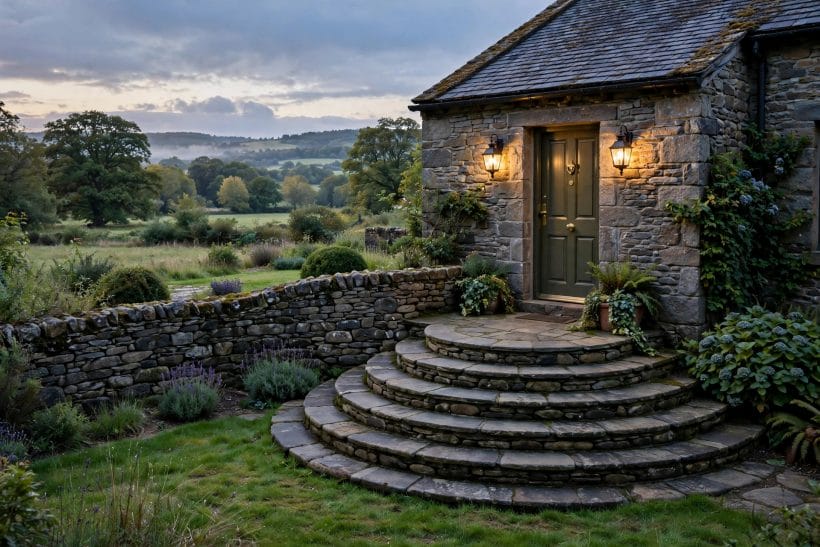
Stone gives a stoop a sense of permanence that few other materials can match. A stone stoop may be built from broad slabs, each step a single piece, or from smaller stones laid in courses, and both approaches suit traditional houses particularly well. Stone weathers gracefully, developing a patina that suits an older property, and its natural variation means no two stoops look quite alike.
Curved stone steps are a special case, and a lovely one. Where the path approaches from an angle, or where the entrance sits on a corner, a fan of curved steps can turn an awkward approach into a graceful one, guiding visitors towards the door instead of forcing a sharp turn. Curved work is skilled work, and the setting out matters: the curve should feel generous and even, not pinched at one end. This is the kind of stoop where professional help pays for itself, since a curve that is slightly wrong is visible every single day.
Stone needs a little ongoing attention, but of a gentle kind. Leaves and soil should be swept clear so the surface stays clean and the joints stay visible, and any green growth that makes the surface slippery should be dealt with before it becomes a hazard. Beyond that, stone mostly asks to be left alone, which is part of its appeal: a stone stoop looks after itself in a way that more delicate materials do not.
6. The Wooden Stoop
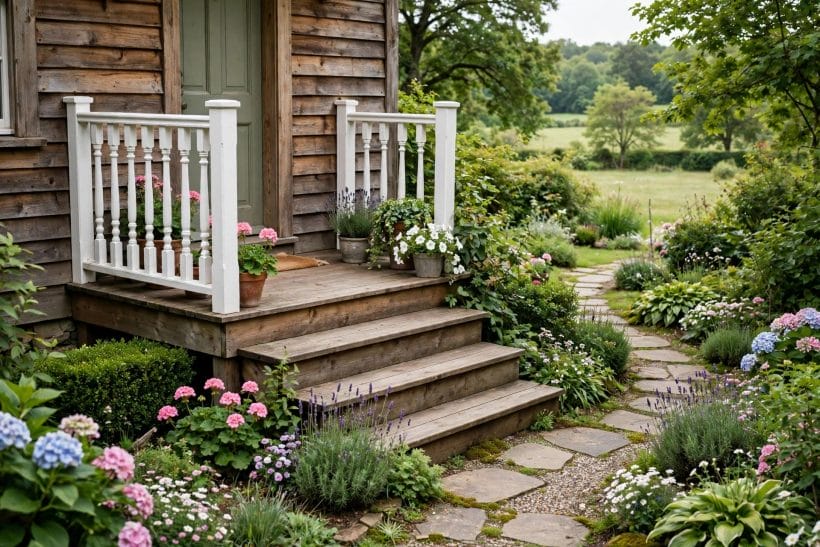
A wooden stoop has a warmth that masonry cannot quite offer, and it suits timber houses, cottages and cabins particularly well. The classic form is a small landing platform with steps down to the path, edged with simple railings, and the whole structure reads as light and welcoming rather than monumental. Wood can be painted to match the house, or left in a natural finish that silvers gently with age, and either choice gives the entrance a distinct character.
The practical consideration with wood is exposure. A wooden stoop lives outdoors in all weathers, so the timber, the fixings and the finish all need to suit that life, and the structure needs to stay sound and level over time. Boards should be laid so water does not sit on them, and the junction where the stoop meets the house deserves attention, since trapped damp there can cause trouble that is easy to miss. These are matters for a qualified professional to judge, not details to improvise: the form you choose should be one that a professional can build and maintain soundly.
Dressing a wooden stoop is a pleasure, because the material itself invites it. Potted flowers on the landing, a lantern by the door, and a simple railing that is pleasant to hold all suit wood well. Keep the dressing light, though: a wooden landing is usually smaller than a masonry one, and clutter will crowd it faster. A few well-chosen pieces, kept clear of the walking line, will do more for the entrance than a crowd of ornaments.
7. The Compact Stoop for a Small House
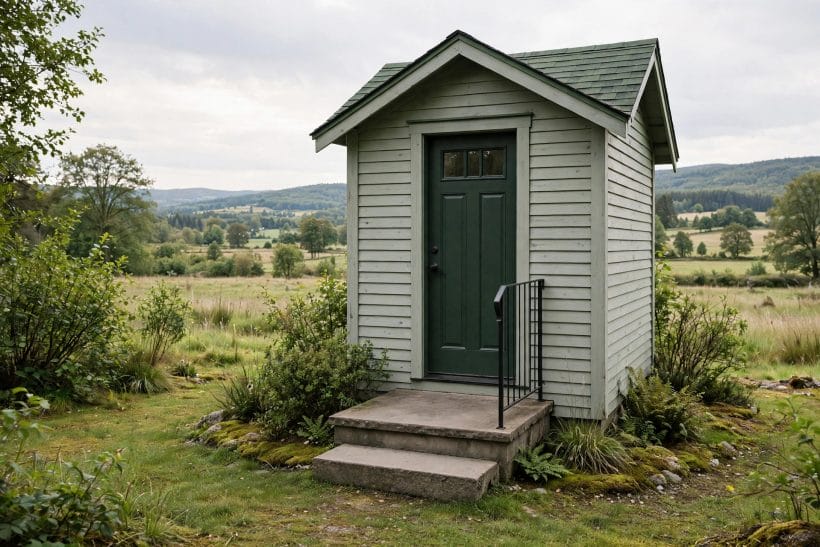
Small houses need stoops that know their scale. A compact stoop is a single wide step and a landing just deep enough for the door swing, with nothing extra: no sprawling platform, no grand sweep of steps, just a tidy entrance that respects the size of the house. Done well, it looks intentional rather than mean, and it leaves the garden and the path to do their own work.
The key to a compact stoop is proportion. The step should be wide enough to feel generous even though the stoop is small, the landing should be deep enough to stand on comfortably, and the railing, if one is needed, should be slim and unobtrusive rather than heavy. A slim railing that is there when you need it and unnoticed when you do not is the right model. Anything chunkier will dominate a small facade and make the entrance feel smaller, not larger.
Compact stoops are a natural fit for small-home living, where every part of the house is judged on how well it works rather than how grand it looks. The same discipline that shapes a small interior, keeping only what is used and loved, shapes a good compact stoop. If a detail does not help you arrive, wait, or leave in comfort, a small stoop is better without it.
8. Stoop Colours That Suit the House
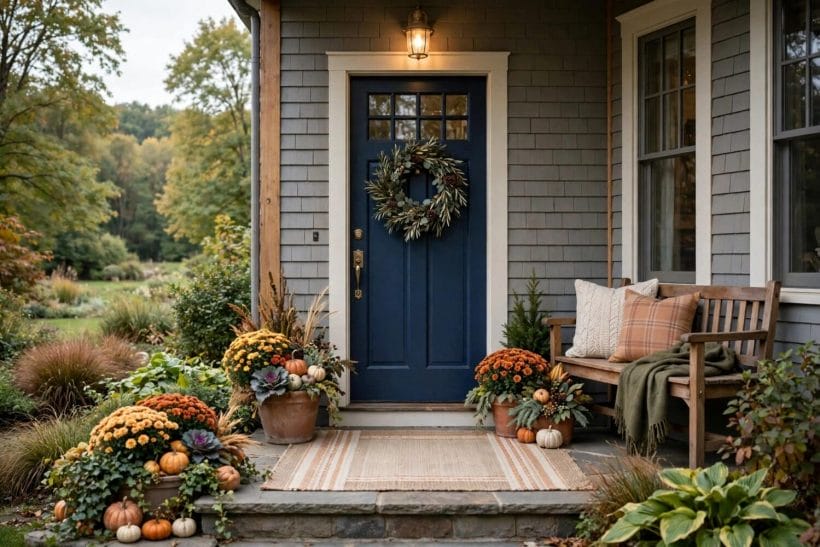
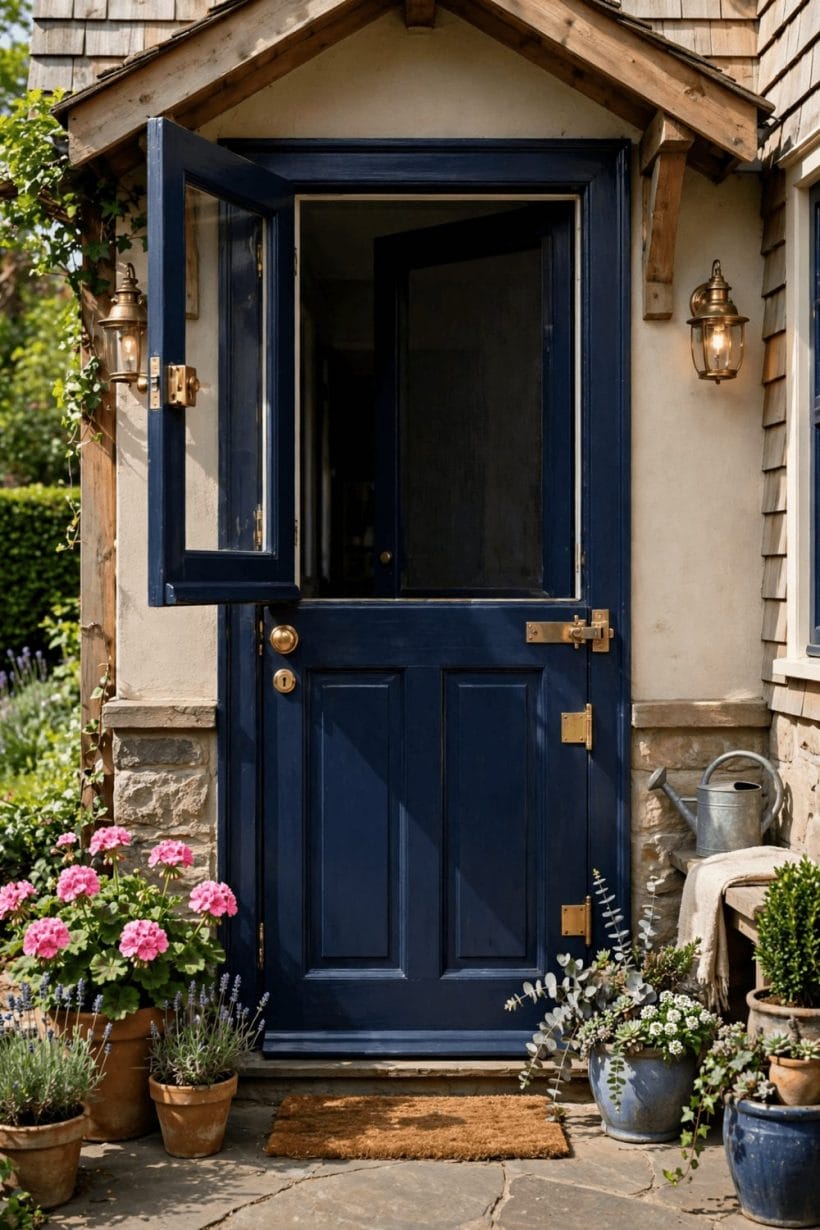
Colour is where a stoop stops being just a structure and starts being part of the picture of the house. The stoop itself is usually a neutral material, brick, stone, concrete or wood, so the colour story is told by the door, the planters, and the planting, with the stoop as the quiet stage. A door colour that repeats somewhere else on the house, in the window frames or the garden gate, will tie the entrance together without any effort.
There are no invented colour codes to follow here, and no single pairing that suits every house. The honest approach is to look at what is already there: the tone of the brick or render, the colour of the roof, the planting in the garden, and the light the front of the house receives. A north-facing entrance in soft light will carry a bolder door colour than a sun-drenched one, where strong colours can glare. Test a colour in place, in daylight, before committing, and live with the test for a few days if you can.
Planting is the easiest colour to change, and the most forgiving. Seasonal planters on a stoop let the entrance change through the year without any structural work at all, and they soften the hard lines of steps and landings. Choose plants that suit the light and shelter of your entrance, keep them watered and trimmed, and let them do the work of colour while the stoop itself stays calm and neutral underneath.
9. Dressing a Stoop Without Crowding It
A dressed stoop feels welcoming; a crowded stoop feels like an obstacle course. The difference is usually a matter of leaving the walking line clear and dressing the edges instead. Planters flanking the door, a lantern fixed beside the entrance, and a doormat that sits flat and stays put are the classic dressings, and they work because none of them stands where a visitor needs to walk.
Seasonal dressing is the most enjoyable kind. Spring bulbs in pots, summer flowers, autumn leaves in a planter, and a simple wreath in winter each give the entrance a moment in the year, and each is easy to change when the season moves on. The stoop itself does not change; only its dressing does, which is exactly as it should be. A stoop that needs redecorating to look good is a stoop whose form is not doing its job.
Storage has no place on a stoop, however tempting it may be. Boots, parcels, tools and toys left on the landing quickly turn a welcoming entrance into a cluttered one, and they can make the steps unsafe in poor light. If the house needs a place for such things, it should be found inside or in a proper store, and the stoop kept for arriving, waiting and leaving. For ideas on keeping the rest of a small home orderly, see these storage ideas for small homes, and for the rooms just inside the door, these small living room ideas may help the entrance and the interior feel like one home.
10. Stoops in Wet Weather
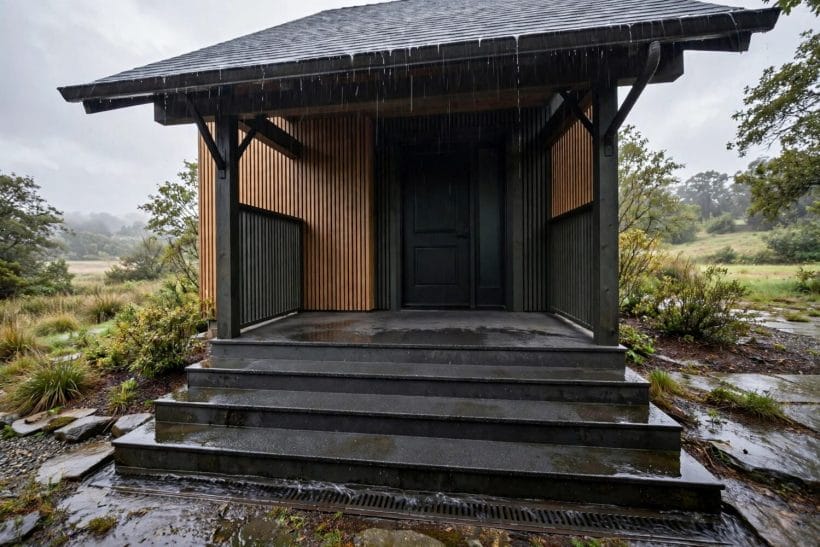
A stoop is used in all weathers, so its form should be judged in the rain as well as in the sunshine. The practical details that matter most are drainage, surface grip, and shelter: water should run away from the door rather than towards it, the step surface should stay sure underfoot when wet, and whatever overhang the house provides should keep the landing usable while you find your keys. These are not decorations; they are the difference between a stoop that works all year and one that only works in fine weather.
Weatherproofing and drainage are professional matters, not weekend improvisations. Where a stoop meets the house wall, where water is directed, and how the threshold stays dry all depend on the construction of the house itself, and getting them wrong can cause damp that is expensive to put right. If your stoop holds water, directs it towards the door, or shows signs of damp at the threshold, ask a qualified professional to look at it before trying any remedy yourself. The form ideas in this guide will help you describe what you want; they are not a substitute for professional advice on how it should be built.
Lighting matters more in wet weather than in dry, because the days are shorter and the light is poorer just when the steps are at their least forgiving. A lantern beside the door, or a light over the entrance, that comes on as you approach turns a wet evening arrival from a cautious shuffle into a normal walk. Keep the light warm and soft rather than harsh, position it so it lights the steps rather than shining in a visitor’s eyes, and the whole entrance will feel safer for it. The layout of the home as a whole, and the rooms beyond the entrance, matter too, but the stoop is where the house first meets the weather, and it should meet it well.
Final Considerations
Choosing a stoop form comes down to three questions, asked in order. What shape suits the height of your door and the approach of your path? What material suits your house and your climate? And what dressing will you actually maintain through the year? Answer those honestly, and the right form usually presents itself, whether it is a single brick step, a wide stone landing, or a compact wooden platform.
Two cautions are worth carrying with you. First, do not borrow a form from a house unlike your own: a wide landing that suits a generous facade will overwhelm a small cottage, and a compact stoop that suits a cottage will look lost against a large house. Second, leave structural and weatherproofing work to a qualified professional, and check local rules before building anything new. A stoop is a small structure, but it sits at the junction of house, path and weather, and that junction deserves proper care. Before any building work begins, it is worth reading a building checklist so the entrance is planned as part of the home, not as an afterthought.
A good front stoop is easy to overlook precisely because it works. You step up, you open the door, you are home, and nothing about the entrance asked for your attention along the way. That quiet success is the aim of every form in this guide, and it is well worth choosing carefully.


0 Comments