
Insulation is the one building layer you can never easily revisit, which is why the spray foam vs rigid foam tiny house decision deserves more care than almost any other material choice in the build. Both are foam, both insulate well, and both have passionate defenders. Yet they behave like opposites in practice: one is sprayed into the wall cavity as a liquid that expands, hardens, and glues itself to everything it touches, while the other arrives as factory-made boards that you measure, cut, fit, and seal by hand. One forgives sloppy framing and punishes future changes. The other demands precision up front and rewards you with a wall you can open, repair, and rework for decades.
This comparison works through the two systems on the measures that decide real builds: R-value per inch and the wall thickness each demands, how well each one seals air leaks in a small, vibration-prone house on wheels, how each handles moisture and condensation inside the wall, what each really costs once kits, boards, tape, and labour are counted, how realistic each is as a DIY job, and how much each adds to towing weight. If you want the wider picture first, read our guide to how to insulate a tiny house, which sets both foams alongside the fibre options. Then come back here, because when the choice narrows to foam against foam, the details below are the ones that tip it.
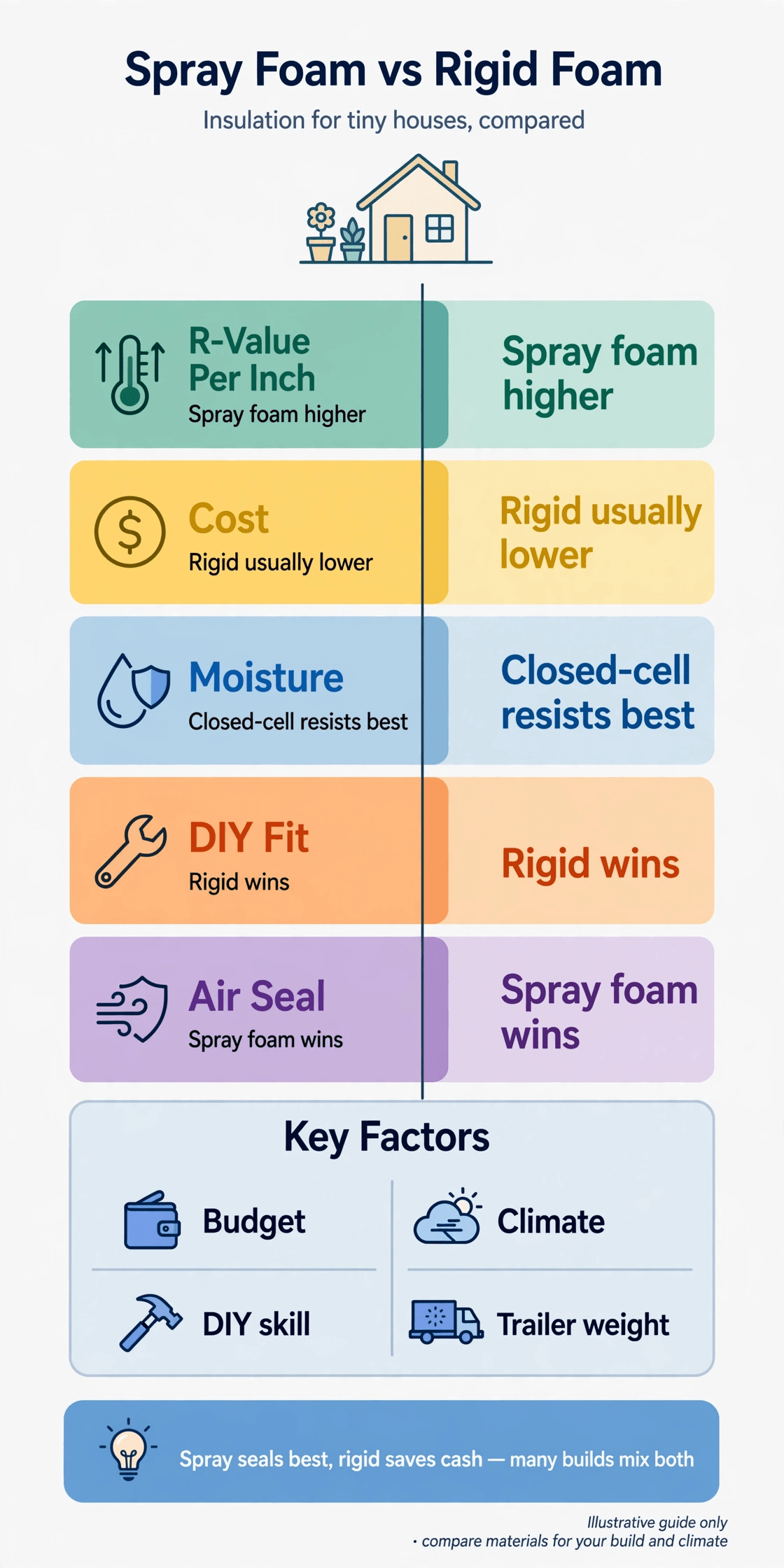
At a Glance: Spray Foam vs Rigid Foam Tiny House Head-to-Head
The short version: spray foam buys you the highest R-value per inch and a built-in air seal at the highest cost and the lowest tolerance for mistakes, while rigid foam buys you control, removability, and a friendlier DIY path at the price of painstaking seam work. The table sums it up before the sections unpack each row.
| Criterion | Spray Foam | Rigid Foam Boards |
|---|---|---|
| R-value per inch | Closed-cell is commonly rated highest of the two options per inch; open-cell is much lower and rarely the tiny house choice. Always check the product’s printed rating | Depends on board type: EPS at the lower end, XPS in the middle, foil-faced polyiso at the higher end. Check the printed rating on the board you buy |
| Air sealing | Excellent by nature — the expanding foam fills cracks, gaps, and odd shapes as it cures | Only as good as your taping and foaming of every seam, edge, and penetration |
| Moisture behaviour | Closed-cell resists vapour movement and adds a moisture-tolerant layer; open-cell lets vapour pass and can hide leaks above it | Boards themselves resist water, but joints and cut edges are the weak points; assembly design decides everything |
| Cost shape | Highest material cost, especially professionally installed; DIY kits reduce labour but not material cost much | Lower material cost, more of your own hours; offcuts and mistakes are cheap to redo |
| DIY fit | Possible with two-part kits, but unforgiving: respirator work, temperature-sensitive chemistry, and no undo once sprayed | Very DIY-friendly: a knife, a straightedge, tape, and patience are the whole toolkit |
| Weight | Closed-cell adds noticeable density in deep fills, but total added weight stays modest in a small shell | Among the lightest insulation options per wall; board choice and thickness decide the total |
| Repairability | Poor — removing cured foam for wiring or plumbing changes is slow, messy work | Excellent — boards can be cut out, lifted, and replaced section by section |
| Wall thickness | Thinnest path to a high total R-value, which protects interior width | May need more depth for the same total R-value unless you add an exterior continuous layer |
| Best suited to | Cold climates, thin walls, professional budgets, builds that will not change | DIY builders, tight budgets, phased builds, and anyone who values being able to open the wall later |
1. How Spray Foam and Rigid Boards Each Stop Heat Flow
All insulation works by trapping still air or gas in small pockets, and both foams do this well — the difference is how the material arrives in your wall. Spray foam begins as two liquid components that react the instant they mix at the spray gun. The liquid hits the cavity, expands many times over, and cures into a solid that is bonded to studs, sheathing, and itself. Closed-cell foam cures dense and hard, strong enough to noticeably stiffen a wall panel. Open-cell cures soft and spongy, more like a firm cushion. In tiny houses, closed-cell is the version usually meant when owners say spray foam, because its performance per inch suits thin walls and its moisture behaviour suits small, humid interiors.
Rigid foam boards — EPS, the white beaded board; XPS, the familiar blue, pink, or green extruded board; and foil-faced polyisocyanurate — are manufactured under factory control, so the board you buy has a consistent, printed performance. You cut it to fit between studs, in layers over the sheathing outside, under the floor, or in some combination. Where spray foam creates one monolithic layer, rigid foam creates an assembly: boards plus joints, and the joints are where its real-world performance is won or lost.
Think of it as the difference between casting something in place and building it from parts. Cast in place is seamless and fast once the crew starts, but the result is whatever the chemistry and the applicator did that day. Built from parts is inspectable at every step — you can see every gap before you close the wall — but the assembly only performs if every part was fitted with care. Neither philosophy is wrong. They simply suit different builders, budgets, and appetites for permanence.
2. R-Value Per Inch and the Wall Thickness You Can Spare
Tiny house walls are thin for a reason: every inch of wall depth is an inch subtracted from a room that may only be eight feet wide, and on a trailer build the legal road width caps the total. That is why R-value per inch matters here more than in any conventional house. Manufacturers print the rated R-value for each product, and you should always work from the label of the exact board or foam you are buying, but the general ordering is consistent: closed-cell spray foam is commonly rated at the top of this comparison, foil-faced polyiso boards rate high but can lose some performance in very cold weather, XPS sits in the middle, EPS rates lower per inch, and open-cell spray foam rates lowest of the group.
In practice, that ordering translates into centimetres of living space. To reach the same total wall R-value, an EPS build needs noticeably more thickness than a closed-cell spray foam build, with XPS and polyiso in between. On a fixed trailer width, those centimetres come out of your kitchen walkway, your shower, and your storage. Builders claw space back by putting rigid foam outside the sheathing as a continuous layer — keeping cavity depth for other insulation or services — or by accepting a slightly lower total R-value in a mild climate where it costs little in comfort.
If interior width is truly desperate, the extreme end of this logic is the vacuum panel approach explored in our piece on vacuum insulated panels for tiny houses, which trades cost and fragility for astonishing thinness. Most builders stay in the foam world this article compares, and the honest takeaway is simple: price your wall build-up in both money and millimetres. Spray foam usually wins the millimetres. Rigid foam usually wins the money. Your wall design has to declare which currency is scarcer.
3. Air Sealing: Sprayed Continuity vs Cut-and-Taped Seams
In a small house, air leakage can waste as much heat as thin insulation does, and it carries moisture into the wall where it can condense out of sight. This is spray foam’s strongest card. Because it is applied as an expanding liquid, it flows around wires, into corners, and across the little gaps that framing always leaves, then cures into a continuous air barrier as well as an insulating layer. The irregular geometry of a tiny house — wheel-well boxes, lofts, angled roof junctions — is exactly where that gap-filling talent earns its price.
Rigid foam can air-seal just as completely, but only through labour. Every board edge, seam, and penetration must be taped with the right tape or sealed with a compatible foam or sealant, and every cut around an outlet, pipe, or brace is a small opportunity for a leak. The work is not difficult; it is simply relentless, and it must be done before the wall closes, because none of it can be checked afterwards. The encouraging news is that the same discipline protects any tiny build: our notes on sealing and weatherproofing sill plates and corners walk through the junctions where tiny houses leak most, whichever insulation you choose.
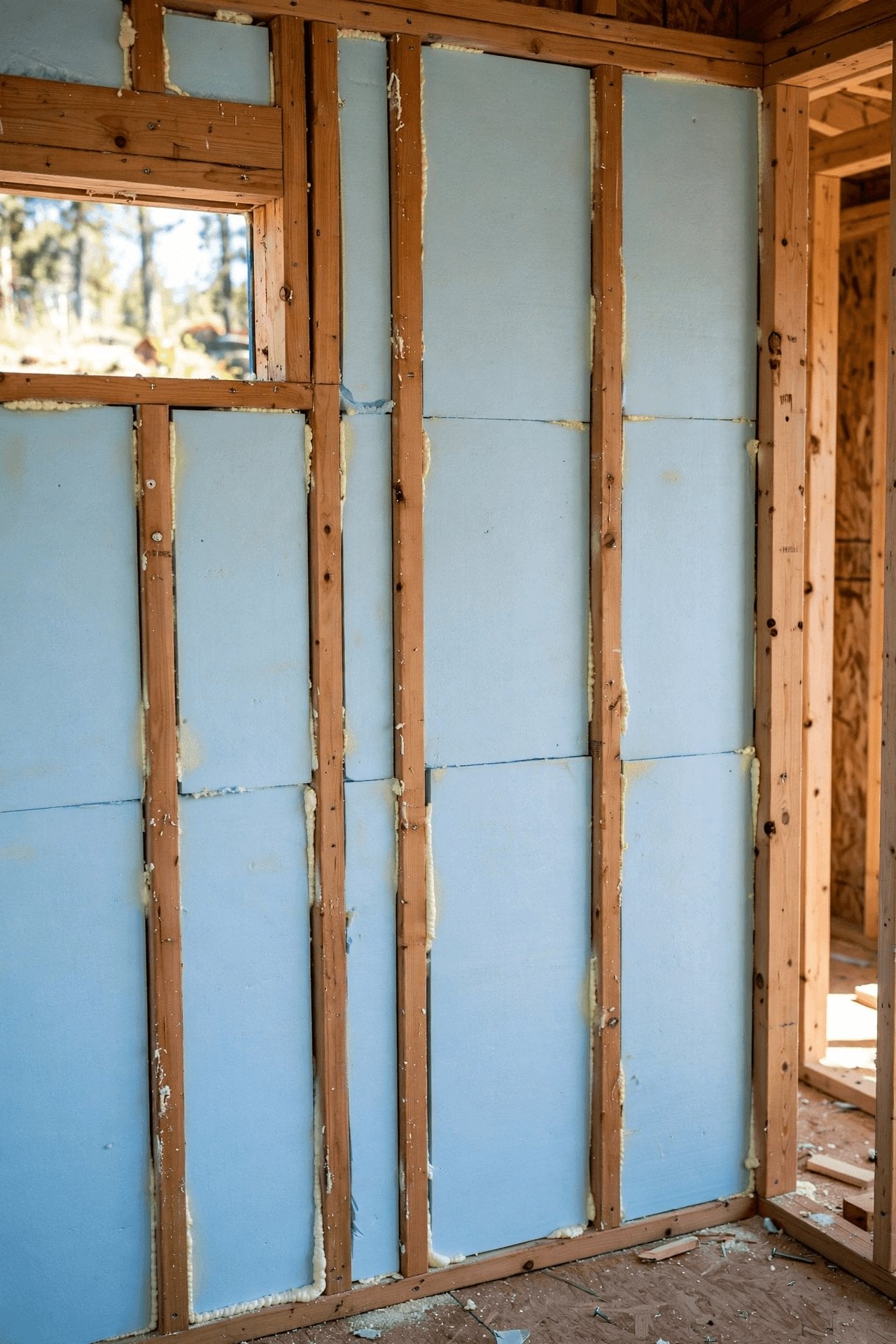
One small-house twist favours the meticulous board installer: a house on wheels vibrates in transit and flexes a little over its life. A rigid assembly’s taped joints can be inspected and renewed at any remodel, and a joint that lets go is repairable with fresh tape. Spray foam’s monolith moves with the structure it is bonded to and rarely gives trouble, but if a crack ever opens in a foam-filled cavity, finding and fixing it means opening the wall. Air sealing, in short, is free with spray foam and earned with rigid foam — and in both cases it is worth more than an extra inch of R-value.
4. Moisture Behaviour: Vapour Drive, Condensation, and Drying Paths
Tiny houses produce a lot of moisture in a small volume: showers, cooking, breathing, and drying clothes all load the indoor air, and that warm, wet air pushes outward through the walls all winter. What it meets inside the wall assembly decides whether you get harmless drying or hidden rot. Closed-cell spray foam is itself a strong vapour retarder at typical tiny house thicknesses, so vapour slows dramatically at the foam face, and the foam’s bonding leaves few air paths for moisture to ride into the assembly. That is a forgiving arrangement in cold climates, as long as the foam is thick enough that its inner surface stays warm — a ratio your foam supplier or designer should confirm for your climate rather than a number to guess.
Rigid boards also resist vapour to varying degrees — foil-faced polyiso the most, EPS the least — but the assembly’s behaviour is decided at the joints. Unsealed seams let moist indoor air bypass the boards entirely and condense on cold sheathing, which is why the taping in section 3 is a moisture detail as much as an air detail. The compensating virtue of board assemblies is that they can be designed to dry: choose the layer order deliberately, and moisture that does enter has a path out instead of being sealed against a surface it can damage.
Either way, insulation never excuses a tiny house from ventilation. Moisture you remove at the source never tests the wall at all, which is why our guide to HRV and ERV ventilation for tiny houses belongs on the reading list of every builder in this comparison. Honest summary: closed-cell spray foam is the more forgiving moisture strategy for an owner who will never open the wall again, while rigid foam rewards the builder who thinks in assemblies — and punishes, quietly and invisibly, the one who treats boards as a fit-and-forget product.
5. Cost: Kits, Board Stock, and Professional Crews
Keep the honesty rule in view here: prices for foam vary by region, season, and supplier, so compare quotes rather than anchoring on anyone’s per-square-foot figure, including ours. The shape of the costs, though, is stable. Spray foam is the premium option. Professional installation prices in the equipment, the crew’s training and protective gear, and the speed of a job that can insulate a whole tiny shell in a day. DIY two-part foam kits lower the labour bill, but the material itself is the expensive part, and a kit’s advertised coverage assumes steady technique — first-timers learning the gun’s rhythm on their real walls commonly use more than the box suggests, and the overspend is theirs.
Rigid foam reverses the shape: material is comparatively cheap and sold in standard sheets you can price at any building supplier today, while the cost moves into your own hours. Cutting and fitting boards around tiny house framing is slow, fiddly work measured in evenings, not afternoons, and you will also budget for the tapes, sealants, and can foam that make the assembly honest. Offcuts, however, can be layered into the floor or roof build-up rather than wasted, and a mistake costs you a re-cut board, not a chiselled-out cavity.
One more line belongs in both budgets: the cost of everything the insulation touches. Spray foam day is also respirator day, masking day, and ventilation-after-curing time when nobody should live in the shell — schedule and possibly accommodation costs. Rigid foam needs no such exile but may run your build calendar longer, which costs money on some sites. Add the resale angle as well: a documented professional foam job reassures some buyers, while others actively prefer a board-built wall they can open. Neither effect is a number; both are real.
6. DIY Fit: Skills, Safety, and the Learning Curve
Rigid foam is one of the most approachable build tasks in a tiny house. The tools are a long knife or fine saw, a straightedge, a tape measure, and a marker. The skill is measuring honestly and cutting patiently, and it visibly improves board by board — do the least-seen wall first and your technique is respectable by the time you reach the kitchen. There is no meaningful chemical exposure, work can stop and start around a day job, and a partner or friend can be taught the workflow in an hour. For a self-builder counting professional call-outs carefully, this section often settles the whole argument.
Spray foam kits are sold to DIYers and many succeed, but the honest description is “doable and unforgiving.” The components must be at the right temperature, the spray pattern develops with practice you do not get before the real wall, and under-sprayed areas, voids, and off-ratio foam that cures badly are problems you fix by removal, not adjustment. Full respiratory protection is mandatory, overspray bonds to everything unmasked — wiring, windows, skin, the floor you meant to keep clean — and the cured result is effectively permanent. None of this is said to frighten anyone off; it is said so the decision is made with open eyes: the kit price buys material, not the applicator’s thousand hours of muscle memory.
Professional spray foam sits at the other end of the spectrum: fastest route to a sealed shell, no learning curve for you at all, and a result you inspect at the end of a single day. Many tiny builders split the difference across the whole house — professional foam in the roof and floor where geometry is worst and access is hardest, hand-fitted boards in the simple stud walls where their own labour is efficient. Hybrid strategies like that are not indecision. They are the mark of a builder pricing each wall on its own merits.
7. Weight and Towing: What Each System Adds to the Trailer
Every kilogram in a house on wheels is a kilogram the trailer, axles, and tow vehicle must carry, so insulation weight is a design input, not trivia. Both foams are light compared with the structure, finishes, and water systems of a finished tiny house, but they are not identical. Closed-cell spray foam cures at a noticeably higher density than board foams, and in deep fills — a thick roof build-up, for example — that density adds up across the whole shell. Rigid boards are among the lightest insulation choices available, with EPS the lightest of the three board types at a given thickness, which is one reason weight-obsessed builders lean toward board assemblies.
Context keeps this section honest, though. The difference between the two systems across an entire tiny house is real but modest — comparable to a modest change in interior fit-out, and far less than the weight swing of tile versus vinyl in a bathroom or a full versus empty water tank. Where it matters most is the build that is already close to its trailer’s rated limit, where every system must justify its kilograms, and where placement matters too: weight added high in a roof build-up raises the centre of gravity slightly more than the same weight in the floor.
Do not forget the floor itself, whichever system wins the walls. The trailer floor is the coldest surface in most tiny houses and the one owners most regret under-insulating; the skirting options that protect pipes and cut underfloor wind help, but they complement rather than replace insulation in the floor build-up. Both foams serve well under a floor — spray foam seals the maze of steel cross-members beautifully, boards fit cleanly between them — so let the wall decision be made on wall merits, and simply budget the floor its fair share of whichever material is on site.
8. Repairs, Changes, and End-of-Life Honesty
Houses change. A circuit gets added, a pipe run moves, a window is resized, a mystery leak demands investigation. This is where rigid foam’s personality shines: a board can be cut out cleanly, the cavity opened, the work done, and a fresh board fitted the same afternoon. Electricians and plumbers asked to work in a board-insulated wall will simply get on with it. The wall remains a maintainable assembly for the life of the house, and the owner who insulated it understands exactly what is inside it, because their own hands put it there.
Spray foam makes the same jobs slower and messier. Cured closed-cell foam must be cut and pried out in chunks, it clings to wiring and studs, and tradespeople price that friction into quotes — or decline foam-filled walls for small jobs altogether. Running a new cable through a foam-locked cavity can mean opening a long channel rather than fishing a wire through empty stud bays. None of this matters in a house that genuinely never changes, and plenty never do. But tiny houses get remodelled, repaired after leaks, and adapted to new owners at a healthy rate, and the foam decision quietly taxes or subsidises every one of those future days.
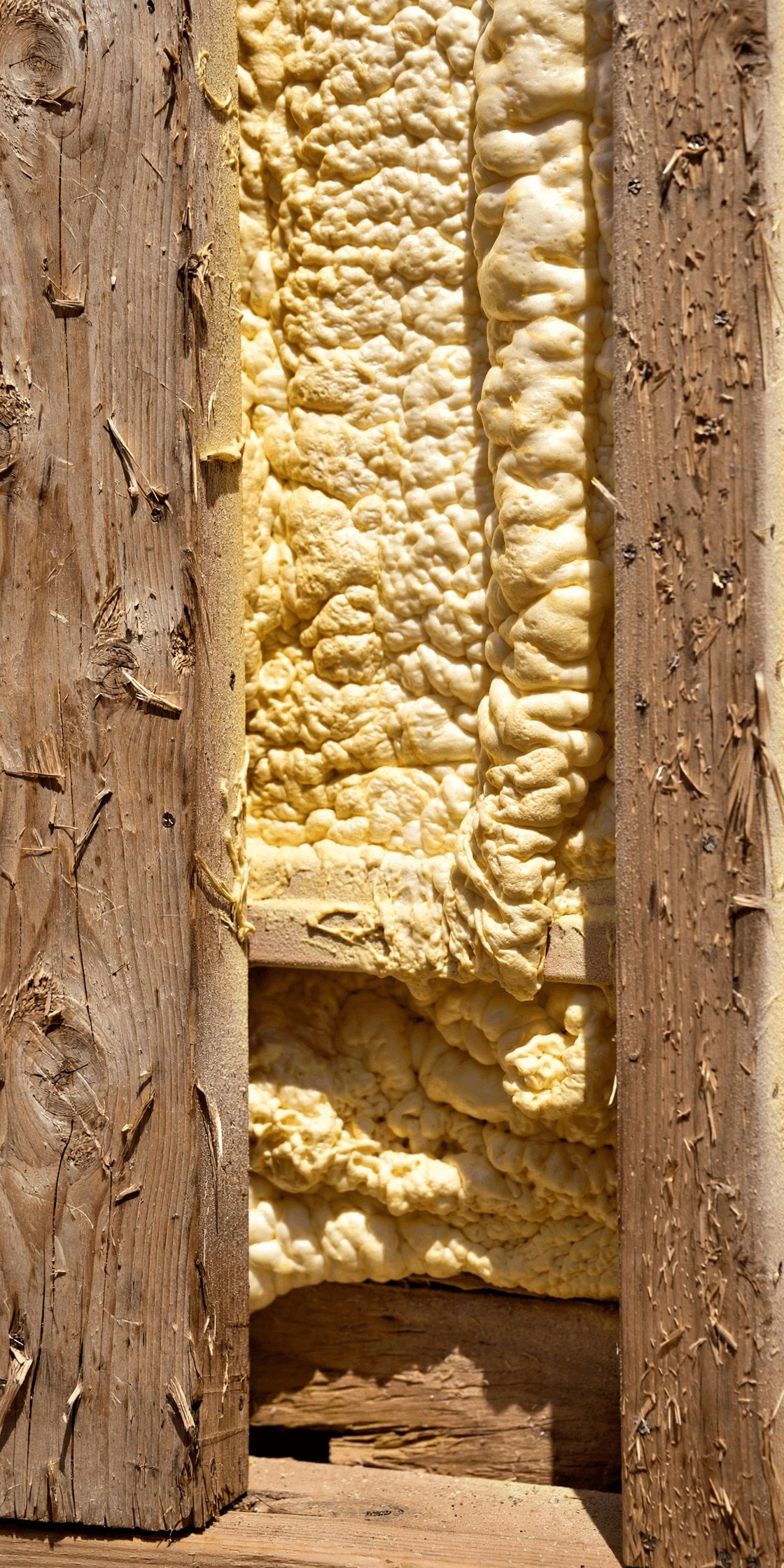
End-of-life deserves the same honesty. Rigid boards can, in principle, be removed intact, and clean offcuts are reusable in sheds, cold frames, and the next project, even if local recycling options for foam boards are limited in many areas. Spray foam leaves the building bonded to the framing it insulates, so demolition separates the two poorly and most of the assembly is destined for landfill together. If the long arc of the materials matters to you, that asymmetry is a genuine point for boards; if performance per inch matters more, it is a cost you may consciously accept. What neither system deserves is greenwashing — both are plastic foams, and the eco-argument in this comparison is about degree, not innocence.
9. Comfort, Sound, and How the House Feels Day to Day
Comfort is the sum of small things: no cold stripe radiating from a badly filled bay, no draught at ankle height finding the seating, no wall that feels chilly to lean a bed against. Both foams, installed well, deliver the still, even warmth that makes a tiny house feel solid in winter. Spray foam’s bonded continuity gives it an edge in houses with complex geometry, where board fitters must work hardest to avoid the one gap that becomes the cold spot everyone notices. Its density also adds a feeling of solidity — doors close against a stiffer, quieter shell.
Sound divides the two in an interesting way. Closed-cell spray foam insulates thermally more than acoustically; it does not absorb much sound within the wall. Rigid boards vary: EPS and XPS transmit sound fairly readily, while the softer character of some board-and-batten assemblies depends on the whole build-up. Neither foam matches the sound-soaking quality of fibrous insulation, so a noise-sensitive build — a tiny house parked near a road or under a flight path — should treat acoustics as an assembly question, looking at interior finishes alongside insulation. Our survey of lightweight interior wall finishes for tiny houses is a useful companion here, because the lining you choose changes both the sound and the feel of the room the insulation serves.
Summer comfort closes the section. The same airtightness that keeps January heat in also keeps July heat out during the day, and both foams support a house that cools down quickly with evening ventilation or a small air conditioner. Where owners report real differences, it is usually the air sealing talking, not the foam chemistry: the house whose envelope was sealed — by spray, or by disciplined taping — is the house that feels calm in both seasons. Buy the sealing, by whichever route suits you, and the comfort follows.
10. Fire, Codes, and Inspection Realities
Foam plastics and building codes have a long, specific relationship, and a tiny house does not exempt you from it. Both spray foam and rigid boards are combustible materials that codes typically require to be covered by a thermal or ignition barrier — in practice, your interior lining — and product-specific rules govern where exposed foam is permitted, how thick it may be, and what must protect it. The exact requirements depend on your jurisdiction and on whether the house is inspected as an RV, a manufactured unit, or a dwelling, so treat this section as a prompt to ask your inspector or certifier early, not as the answer itself.
The practical difference is paperwork texture. Professional spray foam arrives with product data, ignition-barrier specifications, and an installer who has answered inspectors’ questions before. Board assemblies answer the same questions with labels, listing documents, and visible layers an inspector can see and measure before lining — some inspectors visibly relax when they can inspect the insulation itself rather than a cured surface. Either route passes in countless builds; the failures come from assumptions, like leaving foam exposed in a utility bay because a forum post said it was fine.
Fire behaviour during a real incident also deserves plain words. A lined, code-compliant wall of either type performs as the assembly was tested; exposed foam in a storage nook or under a loft is the scenario to avoid in both systems. Keep foam covered, keep heat-producing appliances and their clearances respected, fit smoke and carbon monoxide alarms, and remember that the tiny house advantage — small volume, short escape distances — only helps occupants who are alerted early. Insulation choice does not change your alarm discipline one bit.
Final Considerations
Reduce this comparison to its essence and it is a choice about where you want to spend: money on material and expertise, or hours on precision and patience. Spray foam concentrates cost into a fast, professional, nearly irreversible event that leaves you with the thinnest, best-sealed wall of the two. Rigid foam spreads cost across your own evenings and leaves you with a wall you understand completely, can repair in an afternoon, and can adapt when — not if — the house’s life changes its mind about something.
So, who should pick which? Choose spray foam if your climate is cold, your walls must stay thin, your budget can carry the premium, and your design is truly finished — no planned wiring changes, no maybes about a different window. Choose rigid foam if you are building it yourself, if the budget is tight enough that your labour is the cheapest material on site, if the build will happen in phases, or if you simply want a house whose walls you can open without a demolition session. The many builders who mix the two — foam sprayed in the roof and floor, boards fitted in the walls — are not hedging; they are correctly pricing each surface separately.
Whichever you choose, the surrounding decisions carry as much weight as the foam itself: seal the junctions, ventilate the moisture away, insulate the floor properly, and check the product’s printed ratings and your inspector’s requirements before money moves. Builders in cold regions should stress-test the whole assembly against the realities in our notes on living in a tiny house in cold climates, because the best foam in the world cannot rescue a wall that was never designed as a system. Decide like an owner, install like an inspector is watching, and either of these foams will keep a tiny house warm for a very long time.


0 Comments