
Heating is the decision that quietly shapes everyday life in a tiny house, and the hardest version of that decision is the mini split vs wood stove tiny house debate. One option is a wall-mounted heat pump that heats and cools at the press of a remote. The other is a small steel or cast-iron stove that asks for split logs, a morning routine, and respect for clearances. Both can keep a small, well-insulated space genuinely comfortable. They simply ask for completely different things from you in return: one draws on your electrical system, the other on your time, your storage space, and your tolerance for ash.
This comparison works through the two systems the way owners actually live with them: how each one performs when temperatures stay below freezing for weeks, what each really costs to run once you count sourcing fuel or paying for power, how much daily work is involved, and what happens when you park off-grid, in a cold valley, or in a community with rules about smoke and open flame. If you are still mapping out your heating strategy in general, start with our guide to how to heat a tiny house, then come back here for the head-to-head. By the end, you should know which system fits your climate, your land, and your habits — because the right heater is the one whose trade-offs you are happy to live with every single day.
At a Glance: Mini Split vs Wood Stove Tiny House Head-to-Head
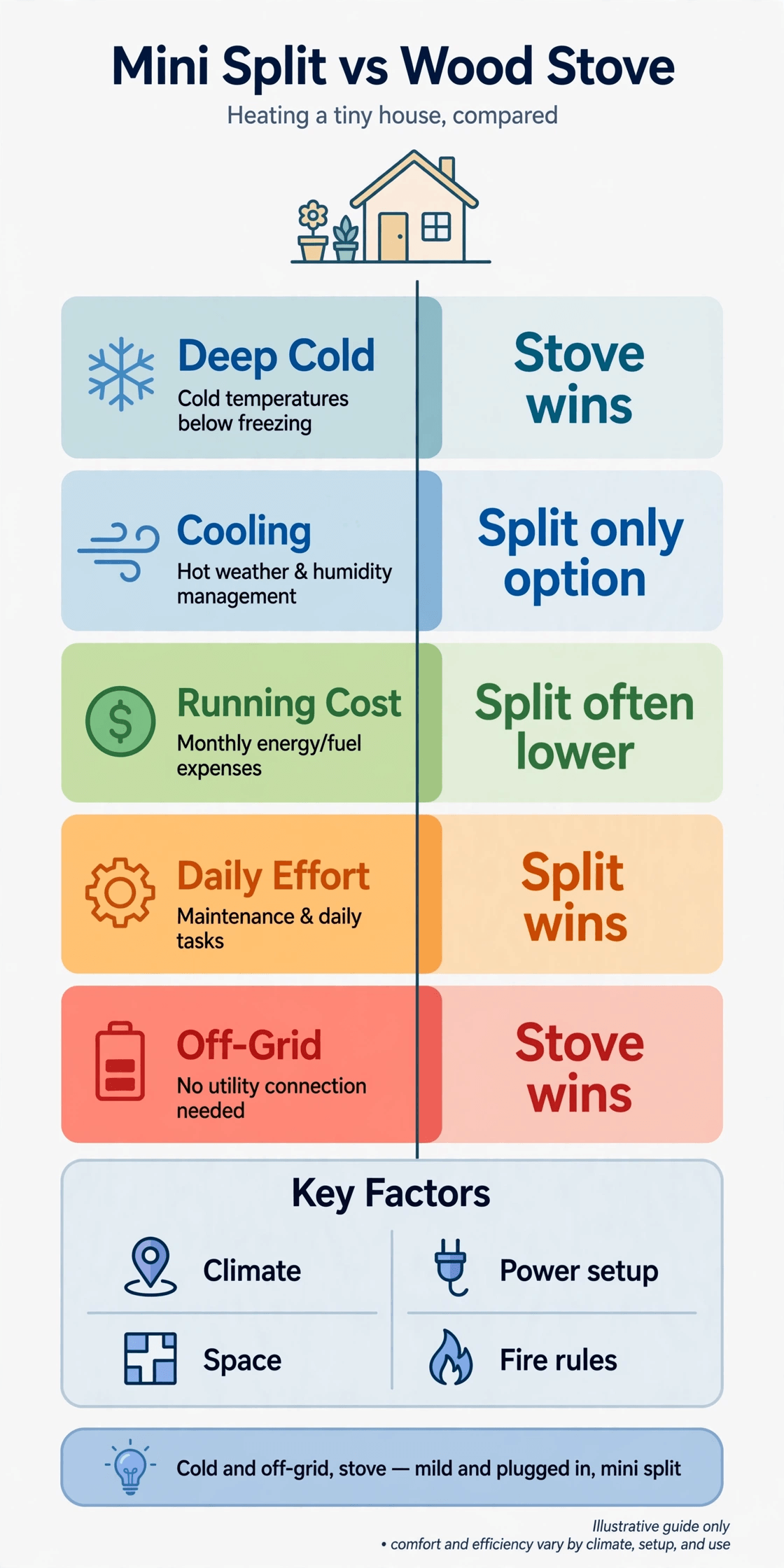
The short version: a mini split is the low-effort, multi-season option that depends entirely on electricity, while a wood stove is the independent, high-heat option that depends entirely on you. The table below sums up the comparison before the detailed sections unpack each row.
| Criterion | Mini Split (Heat Pump) | Wood Stove |
|---|---|---|
| Deep-cold performance | Cold-climate models keep heating well below freezing, but output and efficiency fall as temperatures drop; check the low-ambient rating | Output does not depend on outdoor temperature; a well-fed stove runs at full strength on the coldest night |
| Cooling | Yes — air conditioning and dehumidifying are built in | None — you need a separate plan for hot weather |
| Running cost drivers | Electricity use and your rate per kilowatt-hour; very efficient in mild weather, less so in deep cold | Firewood you buy, split, or gather, plus chimney sweeping and gaskets; low cash cost if you have access to wood |
| Daily effort | Almost none — set the temperature and clean a filter now and then | Daily in the heating season: lighting, feeding, ash removal, and wood hauling |
| Off-grid fit | Needs a generously sized solar array and battery bank, or a generator backup, especially in winter | Excellent — works with no electricity at all apart from an optional small fan |
| Fire safety and clearances | No combustion in the living space; main concerns are correct electrical installation and drainage | Needs listed clearances to walls and furniture, a hearth, safe flue routing, and a carbon monoxide alarm |
| Space used | A wall-mounted head unit and an outdoor compressor; keeps the floor clear | Takes a floor footprint plus protected clear space around it, and room to store wood indoors and out |
| Heat feel | Even, gentle, thermostat-controlled warmth that circulates air | Intense radiant heat near the stove, cooler corners, and bigger temperature swings between feeds |
| Maintenance rhythm | Filter cleaning, an occasional coil clean, and professional servicing when something faults | Chimney sweeping, ash disposal, door gaskets, and glass cleaning on a seasonal rhythm |
| Best suited to | Grid-connected or well-powered homes, hot summers, set-and-forget living | Cold climates, off-grid land, owners who enjoy the ritual and want heat during power cuts |
1. How a Heat Pump and a Wood Stove Each Warm a Small Space
A mini split does not create heat in the way most people picture. Its outdoor unit extracts heat from the outside air — even cold air contains usable heat — and a refrigerant circuit concentrates that heat and releases it indoors through a slim wall-mounted head. Because it moves heat rather than generating it from a flame or a heating element, it can deliver more warmth than the electricity it consumes would suggest, which is the whole reason heat pumps have become the default recommendation for small, efficient homes. One remote controls temperature, fan speed, and mode, and the system quietly cycles to hold the set point.
A wood stove is the oldest heating technology in this comparison and the most direct: you burn seasoned hardwood or softwood in a firebox, and heat radiates from the stove body and flue while convection currents slowly turn the room over. Modern small stoves made for tiny houses, boats, and cabins burn far cleaner than old pot-bellied stoves, with secondary combustion that reburns smoke gases, but the experience is unchanged — real flame, radiant warmth that soaks into furniture and floors, and heat that rises and falls with each load of wood. In a tiny house, where the whole living volume may be smaller than a single room in a conventional home, even the smallest stove is powerful relative to the space, which is both the appeal and the management challenge.
Practically speaking, the mini split treats the whole house as one zone and delivers steady, background comfort, while the stove creates a warm centre with cooler edges — lovely if your seating clusters near the stove, less lovely for a loft or bathroom at the far end. Owners who go the heat-pump route often follow the kind of planning in our guide to installing a mini split in a tiny house, because placement of the head unit decides how well that single zone actually reaches the sleeping loft and the kitchen end of the house.
2. Deep-Cold Performance When Temperatures Stay Below Freezing
This is the section that decides the argument in northern climates. A standard heat pump loses capacity as the outdoor temperature falls: the colder the air, the less heat there is to extract, and the harder the compressor works for every degree of warmth. Cold-climate models are engineered to keep producing useful heat far below freezing, and manufacturers publish a lowest operating temperature for each model — checking that rating against your region’s realistic cold snaps is the single most important specification check in this whole comparison. Even a cold-climate unit will typically deliver less heat, less efficiently, during the coldest week of the year, which is exactly when your tiny house needs the most.
A wood stove simply does not care about the outdoor temperature. Dry wood, a clean flue, and a decent draft produce full output at minus twenty as happily as at freezing, and many owners oversize slightly so a single evening load carries the house through the night. The stove’s deep-cold weakness is not output but continuity: nobody feeds it while you are at work or asleep, so indoor temperatures drift down between loads, and a house that sits empty for a January weekend can cool enough to threaten plumbing.
Your envelope decides how much any of this matters. A tight, well-insulated shell shrinks the cold-weather gap between the two systems, which is why our notes on tiny house living in cold climates stress insulation and draft control before heater choice. Floor comfort is part of the same picture: cold floors make any heater feel inadequate, and the tiny house skirting options that protect pipes also cut the wind washing under a trailer-mounted home. Honest summary: for steady, unattended warmth in serious cold, plan either a cold-climate-rated heat pump with a backup heat source, or a stove you are genuinely home to feed.
3. Cooling, Dehumidifying, and Shoulder-Season Comfort
Here the mini split wins a whole season uncontested. The same unit that heats in January air-conditions in July, and in a tiny house — where cooking, showers, and two adults can push indoor humidity up quickly — its dry mode pulls moisture from the air on muggy shoulder-season days when you want neither heating nor full cooling. That humidity control is not a luxury in a small space. Persistent condensation on windows and in cupboard corners is the early warning sign of mould, and a heat pump quietly works against it for much of the year.
The wood stove offers nothing in summer except a small black box you walk around. Owners pair it with window fans, a ceiling fan, or a small portable or window air conditioner — all workable, all additional purchases, storage problems, and power draws that the stove itself was supposed to simplify away. In fairness, many stove owners live in mountain or northern locations where a handful of hot afternoons are handled by shade, ventilation, and open windows, and the stove’s silence on cooling never becomes a real issue.

Shoulder seasons flatter the heat pump too. Spring and autumn days that swing between chilly mornings and warm afternoons suit a thermostat perfectly: a little heat at dawn, nothing at midday, a touch of dehumidifying after rain. A stove in the same weather tempts you into lighting a small fire for a cold morning and then sweltering by noon, because a stove cannot be turned down to a whisper and cannot be turned off once lit. Experienced stove owners learn the one-log fire and the open-window correction; everyone else just gets too warm. If your climate has long, changeable shoulder seasons and real summers, count this section heavily.
4. Running Costs: Metered Electricity vs Firewood You Source
Honest cost talk starts with a refusal: nobody can quote your running costs, because both systems bill you in currencies that vary by place and habit. The mini split bills in kilowatt-hours at your local rate, and its efficiency is highest in mild weather and lowest in deep cold, so two owners with identical units can see very different winter bills. What can be said is that heat pumps are among the most efficient electric heating options available, that your insulation level matters more than your unit choice, and that time-of-use tariffs and rooftop solar can tilt the maths again.
The wood stove bills in cords, effort, and chimney care. Firewood you cut and split from your own land can make winter heat close to free in cash terms, which is why the stove is beloved off-grid. Firewood you buy by the cord, delivered, in a region where everyone heats with wood, is a real and recurring expense — and you pay it in a lump before winter, store it under cover for months, and lose heat value if it is not properly seasoned. Add a chimney sweep’s visit, replacement door gaskets and fire bricks over the years, and the stove’s running cost is best described as low but never zero.
The trap to avoid is comparing the heat pump’s worst winter month with the stove’s cheapest imaginable cord. Compare like with like: your actual electricity rate against your actual firewood source, your actual climate against both systems’ behaviour in it. Owners who already run a generous solar setup often find the heat pump’s marginal cost small in spring and autumn and painful only in mid-winter, while stove owners near cheap or free wood wonder what the fuss is about. Both are telling the truth about their own situations — which is why this decision is personal rather than universal.
5. Daily Effort: Filters, Ash, Kindling, and Routine
The mini split asks for almost nothing daily. You set a temperature and live your life. Every few weeks you rinse or vacuum the head unit’s filters, a five-minute job that owners genuinely forget because the system never reminds them by failing. Once in a while you check that the outdoor unit is clear of leaves, snow, or a curious garden hose. That is the entire routine, and for people working long hours, travelling for work, or simply not wanting a chore-based home, it is the strongest argument in this comparison.
The wood stove asks for something every day of the heating season. Someone lays and lights the fire, judges the load, adjusts the air control, and reads the flue temperature. Ash builds up and must be emptied into a metal container and stored outside until it is truly cold. Wood must be carried in, stacked by the stove, and restocked from the outdoor pile in the rain, in the dark, in February. Kindling must be split and kept dry. None of this is hard, and many owners describe it as the best part of tiny living — a rhythm that connects you to the season. But it is non-negotiable labour: skip it and the house is cold, and ask someone to do it for you while you travel and you are asking a real favour.
Air quality sits inside the effort question too. A stove adds fine particles to indoor air when the door opens for reloading, and its appetite for combustion air interacts with a tightly sealed small house. Balanced ventilation — the subject of our guide to tiny house ventilation with HRV and ERV systems — matters with either heater, but it is near-essential with a stove in a very tight build, both for the fire’s draft and for your lungs. The heat pump, moving no combustion air at all, is gentler on this front, though its habit of stirring dust means those filters earn their cleaning.
6. Off-Grid Fit: Electrical Draw vs Fuel You Can Gather
Off-grid is where the wood stove’s independence stops being charming and starts being structural. It needs no electricity to produce heat — a small optional fan improves circulation but is not required — so a winter power failure, a flat battery bank, or a week of storms changes nothing about your warmth. For a house on land with trees, the fuel literally grows around you, and your heating security depends on a woodshed you filled in summer rather than on equipment you cannot repair yourself.
The mini split off-grid is possible but must be designed, not assumed. Heating is one of the largest continuous electrical loads a tiny house can present, and it peaks in winter when solar generation is at its lowest and battery banks are at their most miserly. Owners who make it work usually combine a cold-climate unit with a big array, a large battery bank, excellent insulation, and a backup heat source for the darkest weeks. If you are sizing a system now, work through our walkthrough of solar panel kits and sizing an off-grid battery bank with your heater’s winter draw written at the top of the page, not added as an afterthought.
Hybrid setups deserve an honourable mention because so many real owners land there: a mini split as the primary system for its cooling, dehumidifying, and unattended warmth, with a small wood stove as backup and cold-snap insurance. It costs more, takes both wall and floor space, and duplicates maintenance — but it removes the single point of failure that each system has alone. If your budget and footprint allow only one, choose by your power reality: reliable grid or generous solar points to the heat pump; limited power and available wood points firmly to the stove.
7. Fire Safety, Clearances, and Insurance in a Tight Footprint
A wood stove concentrates open flame, hot surfaces, and a flue full of creosote chemistry into the smallest possible house, and it must be installed like the serious appliance it is. Every stove carries a manufacturer’s listed clearances to combustible walls, floors, and furniture, and in a tiny house those distances can consume a surprising share of your main room — heat shields on walls and a proper hearth can reduce required clearances on many models, but they never reduce them to zero. The flue must exit through roof or wall with listed components, maintain clearance where it passes structure, and rise high enough to draft properly and clear the roof ridge turbulence.
Ongoing safety is a rhythm rather than a one-off: seasoned wood and hot, clean burns slow creosote build-up; regular sweeping removes what does form; a carbon monoxide alarm and a smoke alarm are non-negotiable, as is an extinguisher you can reach without passing the stove. Insurance and certification deserve a check before you buy, not after you install — some insurers, parks, and lenders treat a wood stove in a tiny house on wheels as a higher-risk feature and may ask for a certified installation or decline cover. Ask the question early, in writing, because retrofitting paperwork is far harder than choosing a listed stove and installer at the start.
The mini split’s safety profile is refreshingly dull. There is no combustion, no flue, and no hot surface a child or a curtain can meet. Its risks are the ordinary electrical ones — correct circuit sizing, a proper disconnect, sound refrigerant line work, and a condensate drain that cannot quietly leak into a wall. That dullness has real value in a house where a sofa might sit a metre from the heater and bedding is stored in every corner. Nobody has ever been kept awake by a heat pump’s fire risk, and in the tightest floor plans, the stove’s clearance zone is often the deciding practical objection.
8. Installation, Footprint, and Layout Around the Heater
Installing a mini split is a defined project: mount the indoor head high on a wall, place the outdoor unit on a pad or brackets, run the line set and drain through a single cored hole, and have the electrical connection completed and the system commissioned. Many owners self-install the physical work and bring in a professional for the refrigerant and electrical stages, and the whole footprint inside the house is a rectangle on the wall above head height. Nothing touches the floor, nothing dictates where furniture may go, and the loft — the hardest place to heat evenly — sits naturally in the unit’s rising warm air path if the head is placed with the layout in mind.
Installing a wood stove is a layout commitment. The stove needs its footprint, its hearth, and its clearance envelope, and the flue’s vertical run decides where in the room that envelope sits. Put the stove centrally and the heat spreads beautifully but the room arranges itself around a hot iron box for a decade. Put it in a corner with shields and you save space but warm the centre less evenly. Wood storage joins the plan too: a day box by the stove, a serious covered stack outside, and a route between them that you will walk in all weather. On a trailer build, add the flue’s roof exit to your transport thinking — most owners remove or cap sections for travel, and a stove must be cold, empty, and secured before the house moves.

Weight and balance round out the practical picture. A stove, hearth materials, shielding, and a stocked indoor wood supply add concentrated weight that a trailer build should account for on the correct side of the axle. A mini split’s weight is modest and split between the wall and the outdoor unit, which can even ride on a tongue-mounted bracket on some builds. Neither is prohibitive; both reward planning at the design stage rather than improvisation in a finished house, where new flue holes and new circuits are equally unwelcome surprises.
9. Maintenance, Breakdowns, and Service Life
Heat pumps are appliances: reliable for years, opaque when they fail. Routine care is filters, keeping the outdoor coil clear, and an occasional professional clean and check. When something does go wrong — a sensor, a board, a refrigerant leak — the fix is a technician’s visit with parts that may need ordering, and mid-winter breakdowns test both your backup plan and your patience. Manufacturers’ warranties typically cover parts for a defined period, and a well-installed unit in a small house works less hard than the same unit in a large, leaky one, which counts in its favour for longevity.
Wood stoves are machinery you can understand with your eyes open. The wear items are known and owner-serviceable: door and glass gaskets flatten and get replaced, fire bricks crack and get swapped, ash is emptied, the flue is swept, and the stove body itself can last for decades. There is no control board to obsolete and no refrigerant to phase out. The corresponding honesty is that a neglected stove degrades into a hazard rather than an inconvenience — creosote and perished gaskets are safety items, not cosmetic ones, and the maintenance is genuinely part of the ownership contract.
Either way, the envelope is your silent third appliance. A heater in a tight house runs less, costs less, and lasts longer, so the checks in our tiny house insulation guide comparing spray foam, rockwool, and sheep’s wool repay attention before you spend on heating capacity you may not need. Buy the insulation first, size the heater second, and both of these systems look better on paper and in the house.
10. Rules, Resale, and Where Each Heater Is Welcome
Not every heater is welcome everywhere your tiny house might go. Some RV parks, tiny house communities, and municipalities restrict wood burning during air-quality alerts or ban it in certain zones outright; some campgrounds and short-stay sites will not accept a smoking flue at any time of year. A mini split raises no such issues — at most, a park has opinions about the appearance or placement of the outdoor unit. If your plan involves moving between communities, renting the house out, or parking in urban backyards, the heat pump travels through those rulebooks with far less friction.
Resale cuts both ways. A professionally installed mini split reads to most buyers as modern, efficient, all-season infrastructure and broadens your market to people who want a tiny house that behaves like a small apartment. A quality wood stove reads to a smaller but passionate segment as exactly what they were searching for — off-grid readiness, independence, and character — and those buyers may pay happily for a house that a stove-averse buyer would discount. What neither market rewards is an uncertified, undocumented installation, so whatever you choose, keep the paperwork: invoices, listings, manuals, and inspection notes travel with the house.
Finally, think about who else will live with your choice. Houseguests, housesitters, tenants, children, and pets all interact with a heater. A remote control is learnable in a minute; a stove’s lighting procedure, safe clearances, and ash routine are a responsibility you hand to anyone who stays. For a house that will host often or rent occasionally, that difference is not a detail — it can be the deciding line in the whole comparison.
Final Considerations
Strip the comparison back to first principles and it is a choice between dependence on a system and dependence on a routine. The mini split depends on electricity, refrigerant, and electronics, and in exchange asks almost nothing of your days while also cooling and drying your air. The wood stove depends on seasoned fuel, safe clearances, and a person who shows up morning and evening, and in exchange gives fierce, independent heat that no power cut, cold snap, or failed circuit board can take away. Neither dependence is a flaw. Both become flaws only when they mismatch the life you actually live.
So, who should pick which? Choose the mini split if you are grid-connected or have a generously sized solar setup, if summers are hot or humid where you will park, if you travel for work or keep irregular hours, or if your floor plan simply cannot spare a clearance zone around a stove. Choose the wood stove if you live in a genuinely cold climate, park on your own land with access to firewood, run a modest off-grid electrical system, and honestly enjoy — or at least willingly accept — the daily rhythm of fire tending through the heating season. Choose both, if budget and space allow, when winters are severe and reliability matters more to you than simplicity; the pairing is popular precisely because each system covers the other’s weakest week.
Whichever you pick, do the unglamorous work first: insulate and seal the house properly, verify the heat pump’s low-temperature rating or the stove’s listed clearances against your real floor plan, confirm insurance and local rules before money changes hands, and plan a backup for the coldest night of the year. Owners who can also consider underfloor heating in a tiny house as a supplementary comfort layer often end up happiest of all. The right answer was never a brand or a fuel. It is the system whose demands you will still be content to meet three winters from now.


0 Comments