

Every litre of water that enters a tiny home has to leave it somewhere, and where it is allowed to go depends on which drain it came from. The gray water vs black water tiny house question sounds like plumbing trivia, but it decides your tank sizes, your pipe runs, your permit conversations and whether your garden can legally drink your shower water. One stream is comparatively gentle and full of reuse potential. The other carries human waste, and almost every rule in the book exists because of it. Treating the two as one single problem leads to oversized tanks, missed reuse and, in the worst cases, systems that officials order removed.
This guide separates the two streams properly. We will define exactly which fixtures produce each type of water, follow both streams from drain to disposal, and compare the treatment each one needs before it can safely leave your home. Then we will look at reuse potential, how strict the rules around each stream really are, the honest hygiene picture, the hardware options that fit a small footprint, and what each system costs to build and live with, in qualitative terms rather than invented figures. By the final verdict you will know whether your design should keep the streams apart, combine them, or avoid producing one of them altogether.
Gray Water vs Black Water Tiny House at a Glance
The table below compresses the comparison into the criteria that shape a tiny home water design. Read it for the quick answer, then use the numbered sections for the practical detail behind each row.
| Criterion | Gray Water | Black Water |
|---|---|---|
| Sources | Showers, bathroom sinks, laundry, usually kitchen sink | Toilets, and anything carrying human waste |
| Treatment needed | Light: lint and sediment filtration, settling | Full sanitation: sewer, septic or approved alternative |
| Reuse potential | High: subsurface garden irrigation is the classic use | Very low for households; leave it to professionals |
| Rule strictness | Moderate and varies by place; simpler systems often allowed | Strict everywhere; permits and inspections are normal |
| Cost tendency | Lower: simple tanks, filters and pipework | Higher: approved tanks, hookups or septic work |
| Upkeep | Filters to clean, water should not sit stored | Emptying schedules, seals and venting to maintain |
| Best for | Water saving and garden support | Safe, legal handling of toilet waste |
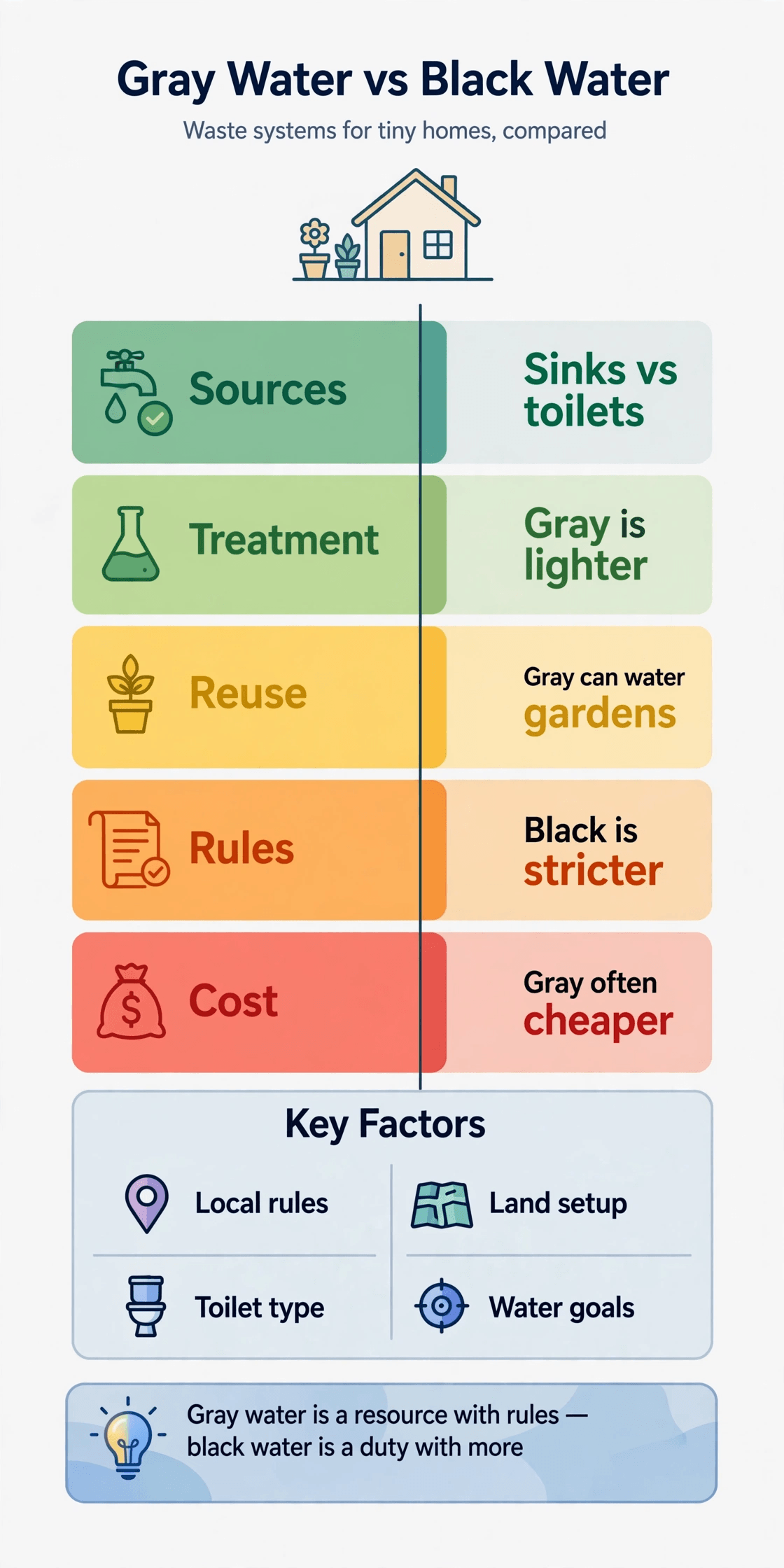
1. Sources: Which Fixtures Make Which Stream
Gray water is the used water from showers, bathtubs, bathroom hand basins and washing machines. It is called gray because it sits in the middle: no longer clean, but not contaminated with human waste. It carries soap, shampoo, skin cells, hair, laundry lint and the general evidence of daily washing. Kitchen sink and dishwasher water sits in a grey zone of its own in many rulebooks, because food grease and organic matter make it dirtier than shower water, and some jurisdictions count it with the toilet stream while others accept it as part of the washing stream with extra filtration.
Black water is toilet water, plain and simple, together with anything that has mixed with it. It carries human waste and the pathogens that come with it, which is why it gets its own name, its own pipes and its own rules in every plumbing code. The moment the two streams join in a shared pipe, the whole combined flow is treated as black, and the chance of easy reuse is gone. For a tour of how other tiny homes divide these streams in practice, our guide to simple greywater systems for your tiny home shows several real layouts at household scale.
2. Flow Paths: How Each Stream Leaves the Home
In a thoughtfully designed tiny home, the washing stream leaves through its own drain line, ideally with a diverter valve that lets you send it either to a holding tank and reuse point, or to the main drain when reuse is not suitable, for example after using strong cleaning chemicals. Because this water should never sit stored for long, the path is short and direct: fixture, filter, then out to a mulch basin, irrigation line or an approved drain. Gravity does most of the work in a small home, which keeps the system quiet, cheap and easy to understand.
The toilet stream follows a stricter path. A flush toilet drains through a larger soil pipe to a sewer connection, a septic system or a sealed holding tank that is emptied by a service or at a dump point. Homes that avoid this stream altogether use a composting or cassette toilet, which is a design decision with large consequences for plumbing, cost and permits. The supply side matters too, and our overview of how tiny houses get water pairs well with the drainage planning in our guide to tiny house plumbing layout and DWV design, because pipe falls, venting and access panels must be planned before walls close.
3. Treatment Needs: Light Filtration vs Full Sanitation
Gray water treatment at household scale is mostly about removing the physical load and using the water quickly. A lint and sediment filter catches hair and fibres, a small settling chamber lets grit drop out, and then the water goes to work in the soil, where a healthy mulch layer and soil biology finish the job that filters start. What it must never do is sit in an open tank for days, because stored washing water turns stale and bacterial fast. Simple, fresh and moving is the whole philosophy, and it is achievable with modest hardware.
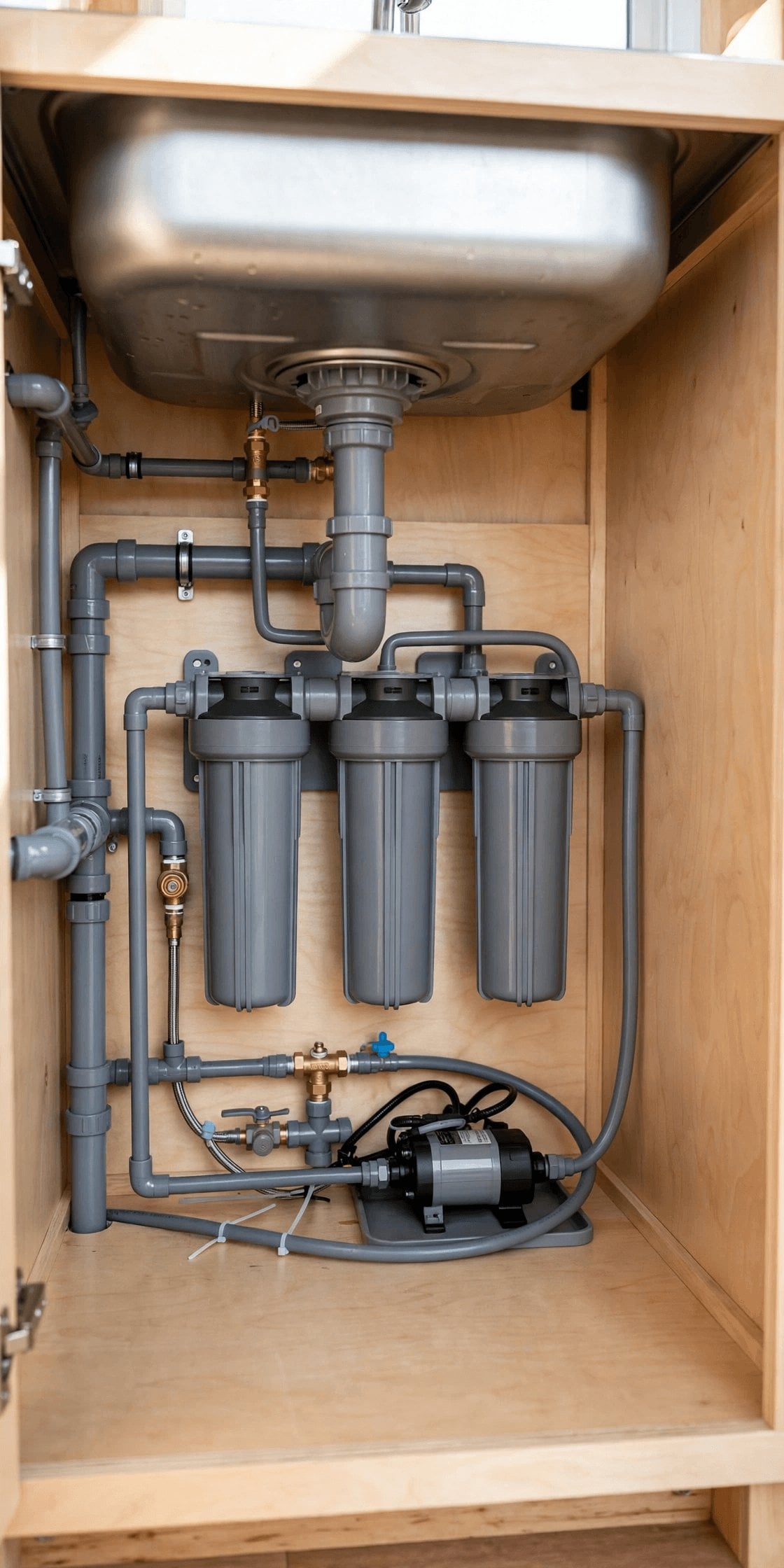
Black water treatment is sanitation, not filtration. Sewage needs either a municipal sewer, a properly designed septic system where soil and bacteria treat effluent over time, or an approved alternative system that is inspected and maintained as a sanitation device. This is not a place for improvisation: the entire point of the rules is to keep pathogens away from people, wells and waterways. A tiny home on a serviced lot connects and forgets; a tiny home off grid must choose between septic work, a holding tank routine, or eliminating the flush toilet from the design.
4. Reuse Potential: Garden Asset vs Leave It Alone
Reuse is where the washing stream earns its keep. Showering and laundry produce the largest share of a household’s wastewater, and sending that water to subsurface irrigation under mulch can keep trees, shrubs and ornamental planting green through dry months while cutting both your fresh water demand and the volume your main drain must handle. Sensible habits make it safer and more useful: biodegradable soaps, no pouring of harsh chemicals down reused drains, and irrigation below the surface rather than spraying, so people and pets never contact it. Edible gardens deserve extra caution, and many experienced households keep reused water to fruit trees and ornamentals.
Black water reuse at household scale is, for practical purposes, a closed door. Treating sewage to a standard safe for reuse is industrial work involving testing and certified systems, not a weekend plumbing project, and rules in most places reflect that. The realistic way to capture value from the toilet stream is indirect: a well-run composting toilet converts its contents, after proper maturing, into a safe soil-like material handled under local guidance. If water independence is your bigger goal, our roundup of off-grid tiny house water systems shows how reuse fits alongside tanks, pumps and filtration.
5. Rules and Strictness: Where Officials Draw the Line
Expect a clear pattern rather than identical rules: the toilet stream is regulated strictly almost everywhere, because the health risk is real, while the washing stream is regulated on a spectrum. Some places welcome simple, well-built household reuse systems, some require permits and specific designs, and some still treat all wastewater as sewage regardless of source. Kitchen water flips categories between jurisdictions often enough that you should always ask rather than assume. A friendly early conversation with your local health or building department is worth more than any forum thread.
The practical consequences of getting this wrong are asymmetric. An unapproved sewage arrangement can stop a placement, void insurance conversations and create genuine danger to a shallow well. An over-cautious design, by contrast, simply costs more and wastes reusable water. When you are planning the whole utility picture of a build, our guide to tiny house utilities for power, water and off-grid sewage helps you see where these decisions meet your power and water systems. Whatever your local answer, design so an inspector can see, reach and understand every part of both streams.
6. Health and Hygiene: Managing Real Risk in a Small Home
Small homes concentrate everything, including smells and moisture, so hygiene discipline matters more than in a big house with a distant utility room. For the washing stream the risks are manageable and mostly about freshness: use reused water promptly, keep filters clean so they do not become the problem, avoid storing water in open containers, and keep irrigation subsurface so children and animals are not playing in it. Choose washing products with reuse in mind and the stream stays a mild one that soil handles easily.
For the toilet stream the discipline is about containment: sound seals, correct venting so gases leave through the roof rather than the bathroom, and no cross-connections that could ever let waste water near fresh water lines. In a wet bath layout, where shower and toilet share one waterproofed room, good drainage falls and sealing keep the two streams conceptually separate even in a shared space, and our guide to how to waterproof a tiny house bathroom covers that detailing. None of this is exotic. It is ordinary good plumbing, applied carefully at small scale.
7. System Options: Tanks, Filters, Composting and Connections
The menu for the washing stream is refreshingly simple: a diverter valve, a filter unit sized for a small household, short pipe runs to a mulch basin or irrigation field, and the option of a small surge tank where the site needs one. Everything on that list is light, repairable with basic tools and cheap to replace piece by piece. The menu for the toilet stream is shorter and more serious: connect to a sewer or RV-style hookup, install or share a septic system, use a holding tank with scheduled emptying, or step off the flush path entirely with a composting or cassette toilet.
Pipework choices affect both streams more than most first-time builders expect: fall angles, clean-outs and flexible connections for a home that might move all belong in the first sketch, not the final fit-out. Our comparison of tiny house plumbing in PEX vs copper is worth reading before you freeze the layout, because repiping inside finished tiny walls is nobody’s idea of a good weekend. Whichever options you pick,photograph every run before the walls close; your future self, diagnosing a blockage in February, will thank you.
8. Space, Weight and Installation Footprint
Neither stream is bulky by big-house standards, but in a tiny home every litre of tank and every pipe chase competes with storage you actually want. A washing-stream system is mostly pipe and a filter the size of a bucket; its footprint is small enough to tuck under a sink or into a bench. Its water is also used fresh, so it needs almost no storage volume. That lightness is a real advantage in a house on wheels, where payload margins are precious and low, central weight placement matters for towing.
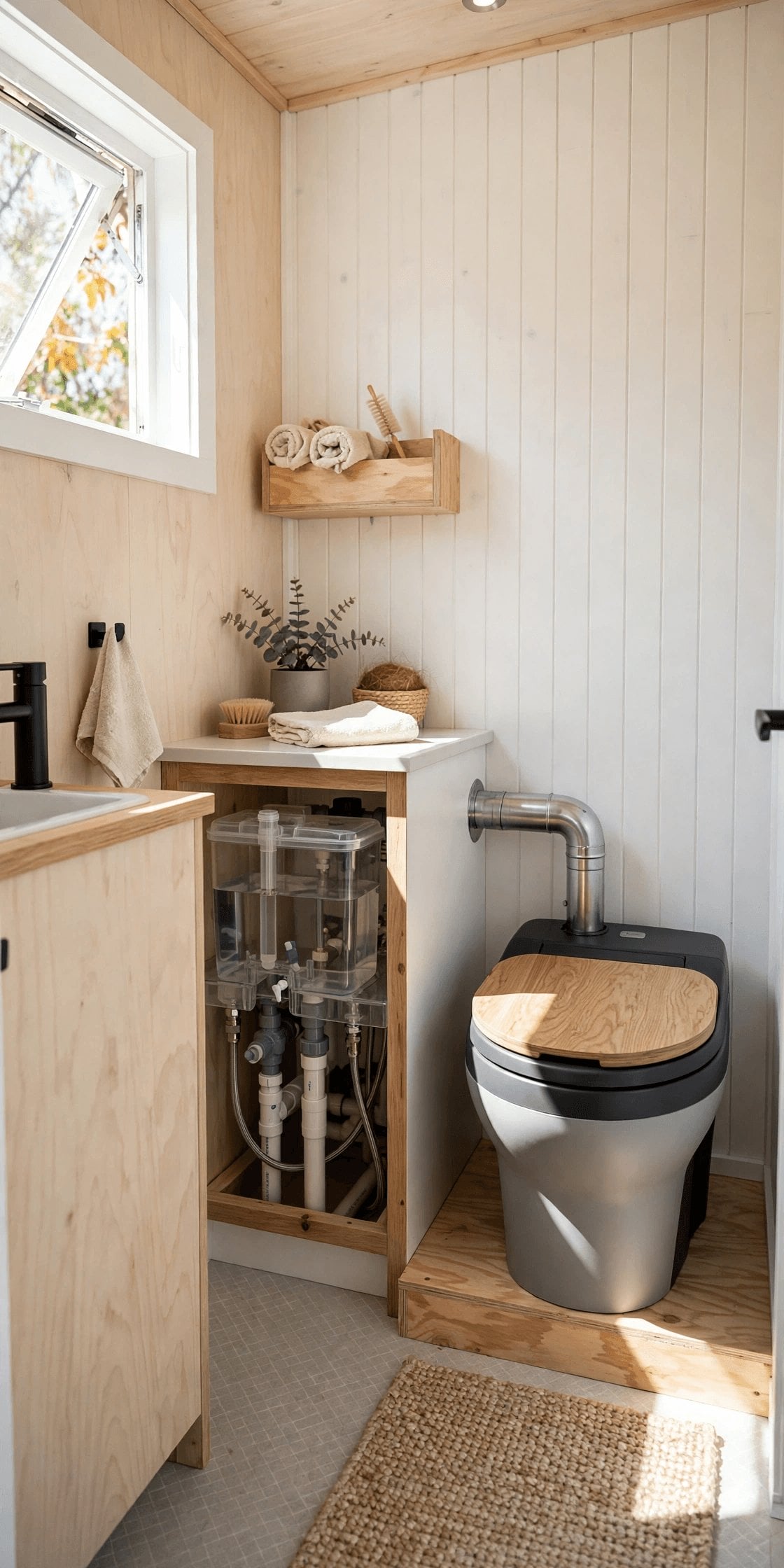
The toilet stream is the heavyweight, literally when tanks are full. A holding tank, a septic arrangement or even the venting and soil pipe for a flush toilet consumes underfloor or exterior space that must be designed in from the start, and a full tank adds serious travelling weight. Composting toilets trade that plumbing footprint for a modest in-bathroom footprint and a vent pipe, which is why so many small builds choose them. Decide this stream first when you draw the floor plan; the washing stream can adapt to almost any layout, but the toilet cannot.
9. Everyday Living: Smells, Upkeep and Cold Weather
Lived experience with the washing stream is mostly about rhythm. Filters want a quick clean on a regular cycle, reused water should move the same day it is produced, and the garden quietly tells you whether your soap choices are working. Get the rhythm right and the system disappears into the background of the week. Neglect the filter and it will remind you, usually by smell, that it exists. Winter asks one real question: irrigation lines and exterior filters need protection from freezing, and many households simply divert to the main drain through the coldest months.
The toilet stream’s everyday texture depends on your choice. A sewer or septic connection is nearly invisible in daily life. A holding tank adds a level gauge to watch and an emptying trip to schedule, which suits some travel patterns and irritates others. A composting toilet adds its own small rituals of turning, topping up medium and emptying on a longer cycle. None of these is the wrong life. The mistake is choosing one whose rhythm clashes with yours, so be honest about whether you are a set-and-forget household or a happy tinkerer before the plumbing is buried.
10. The Cost Picture: Setup, Running and Emptying
Costs here are best compared in shape rather than invented figures, because local labour, permit and servicing prices swing widely. The washing stream is the cheaper build by a wide margin: its parts are simple, installation is short, and its running costs are close to zero beyond filter media and your time. It also pays a quiet dividend by reducing the fresh water you haul or pump and the waste volume you pay to dispose of, which matters most on sites where water arrives by delivery or leaves by service visit.
The toilet stream is where money concentrates. Septic design and installation is a significant project on any lot, sewer connections carry their own fees and trenching, holding tanks convert a large upfront cost into a lifetime of smaller emptying costs, and composting toilets reverse the pattern again with a meaningful purchase price and very low running costs. Judge each option over the years you will actually live with it, include servicing and your own time honestly, and remember that the cheapest legal option is always the one that only has to be built once.
Final Considerations
Choose to separate the streams, and design the washing side for reuse, if your site has planting that can use the water, your local rules allow a sensible system, and you want to shrink both your water deliveries and your disposal burden. It suits settled and semi-settled tiny homes especially well, rewards small weekly habits, and turns a waste product into the garden’s quiet workhorse.
For the toilet stream, pick the most boring legal option your site offers: a proper connection where one exists, septic where the land suits it, a holding tank where your travel pattern makes emptying easy, or a composting toilet where you would rather delete the stream than manage it. Never let the two streams blur together by accident, and never let a clever shortcut talk you out of sanitation. Keep the gentle water working for you, keep the serious water properly contained, and a tiny home’s plumbing becomes one of its simplest pleasures instead of its recurring problem.


0 Comments