

Mississippi is where this series’ rulebook thins out — in the best and the riskiest ways at once. Outside its cities and suburbs, much of the state has no county zoning to argue with, building codes that counties may or may not have adopted, and land priced below what a suburban parking space costs elsewhere. For a tiny-house builder willing to self-manage, that lightness is opportunity. But Mississippi pairs it with the continent’s serious weather: Gulf hurricanes, river and flash flooding, and tornado seasons that audit every anchoring decision. Tiny House Laws in Mississippi are therefore less about permission than about physics and paperwork — septic approval from the health department, flood maps, wind design — in a state that will often let you build first and ask little, while nature asks everything.
This guide works through the full picture: wheels versus foundations, the patchwork of building codes, minimum sizes, county zoning and its absence, the informal state of ADUs, septic and water realities, flood and storm safety, permits, and where tiny living genuinely works — from the Gulf Coast to the Delta to the hills. The honest summary: Mississippi is the easiest state in this series to start a tiny house in, and one of the least forgiving in which to build one carelessly.
1. Tiny House Laws in Mississippi at a Glance
The table below answers the questions Mississippi readers ask first. Where an answer sounds unusually open, read the caution that travels with it — in Mississippi the binding constraints are usually environmental and financial rather than regulatory.
| Question | Mississippi in brief |
|---|---|
| Are tiny houses legal in Mississippi? | Generally yes. There is no state tiny-house law to comply with or hide from; legality turns on local zoning where it exists, septic approval, and flood rules. In unincorporated rural counties with no zoning, a small house on your own land is often simply a building project. |
| Is there a statewide residential building code? | Not one that is uniformly enforced on houses statewide. Mississippi leaves residential code adoption largely to local governments, so cities and some counties enforce a code while many rural counties have minimal or no permitting — confirm what your county and nearest city require. |
| Is a tiny house on wheels a house or an RV? | An RV or recreational vehicle in practice. Mississippi’s openness helps here — rural landowners host wheeled units with little interference — but cities and RV-specific rules still govern parks, and a wheeled unit is not a code house for financing or insurance purposes. |
| How small can a tiny house be? | Where no local code or zoning applies, there may be no official minimum at all. Where codes apply, standard habitability rules govern rooms and ceilings, and some city ordinances carry minimum dwelling sizes — the local text, when it exists, decides. |
| Where can I live in one full-time? | On your own rural land in most unincorporated areas, on a conforming lot in zoned communities, in manufactured-home parks with HUD-code units, and in RV parks or on hosted rural land for wheeled units — always subject to septic and flood reality. |
| What about septic and water? | The Mississippi State Department of Health oversees onsite wastewater: most rural homes need an approved septic or alternative system with a soil evaluation before installation. Wells are common and also evaluated locally. This approval is the one near-universal gate in rural Mississippi. |
| Do flood and storm rules change things? | Decisively. Floodplain management rules in participating communities require elevated construction in mapped flood zones, the Gulf Coast builds to high wind standards, and insurance pricing enforces what codes sometimes do not. Choose the lot with the flood map open. |
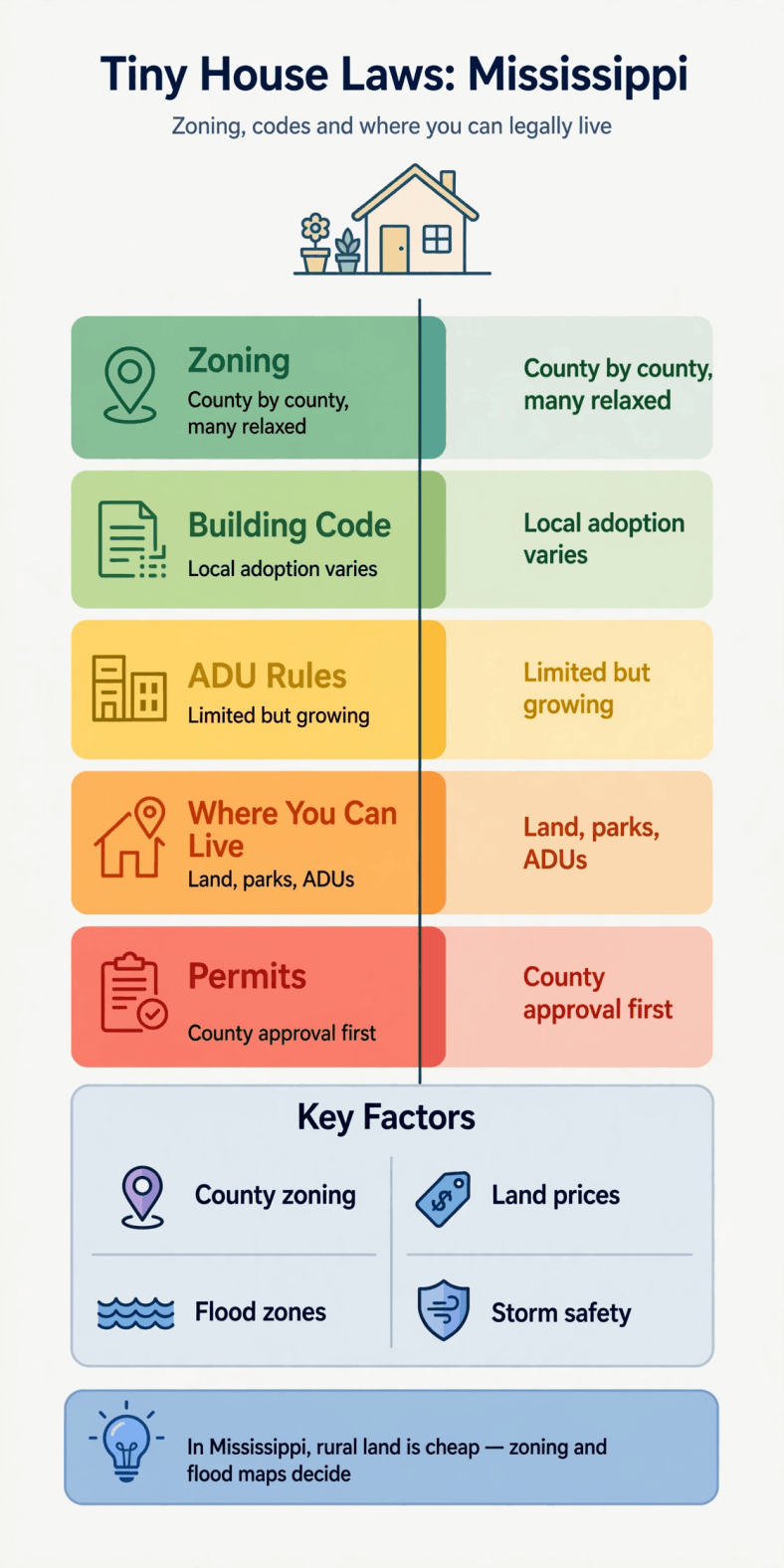
Tiny house laws in Mississippi — the whole picture on one chart: light-touch rural counties, health-department septic approval, and flood-and-storm design doing the real regulating.
Read the table as Mississippi itself works: permission is usually the easy part. The sections below therefore spend their weight where Mississippi projects actually succeed or fail — siting, septic, elevation, anchoring, and the documentation that keeps a lightly permitted house financeable and insurable.
2. Legal Status: Tiny Houses on Wheels vs on a Foundation in Mississippi
A foundation tiny house in Mississippi is, in most of the state, simply a small house. Where a city or county enforces a building code, it is permitted and inspected like any dwelling; where no local code program exists, construction proceeds with the health department’s septic approval as the main formal checkpoint. The freedom is genuine, and Section 3 explains why thoughtful builders voluntarily build to a recognised code anyway: the audience for that discipline is not an inspector who may never come, but the insurer, lender and future buyer who certainly will ask.
A tiny house on wheels sits in vehicle territory, as everywhere — but Mississippi’s rural culture changes its lived reality. Wheeled units on family land, farmsteads and hunting-camp country are common sights, utilities are often informally arranged, and in unzoned counties there may be no ordinance under which to object. Cities are different: municipal zoning commonly restricts RV living to parks and campgrounds, and suburban ordinances behave like suburban ordinances everywhere. The honest reading is that wheeled living in Mississippi is a rural privilege extended by geography, not a statewide right conferred by law.
Either way, the vehicle paperwork matters for wheels: follow how to register a tiny house as an RV for title and registration, and understand what RVIA certification means for a tiny house, because insurers in a hurricane state scrutinise wheeled dwellings hard, and a standards seal is often the difference between coverage and a declined application.
The Mississippi trade-off inverts the northern states in this series. There, foundations bought legality; here, legality is cheap in the countryside already, and what a foundation buys is storm performance — anchoring, elevation and continuity of structure when Gulf weather arrives. Price that honestly and the foundation usually wins on the coast, while wheels remain rational for the mobile, the seasonal and the far inland.
3. Building Codes for Tiny Houses in Mississippi
Mississippi’s code landscape is a patchwork by design. The state has statewide codes for some building types and strong model-code usage in its cities, but one- and two-family homes in unincorporated areas are, in many counties, built without a local code-enforcement program at all — a fact that surprises readers arriving from heavily coded states. Coastal communities are the systematic exception: after hard hurricane lessons, Gulf Coast jurisdictions enforce modern wind-resistant construction, elevation requirements and permitting with real rigour, and state-level coastal programs reinforce them.
For a tiny house on a foundation, the design consequences sort by geography. On the coast and in the southern counties, wind governs: continuous load paths, rated connectors, protected openings and roof systems chosen for uplift. Statewide, conventional IRC-based practice — the same model code family that Appendix Q amends for dwellings of 400 square feet or less — is the natural benchmark even where no official demands it; our explainer on IRC Appendix Q for tiny homes shows exactly what that benchmark asks of lofts, stairs and ceilings, and it doubles as a quality standard for self-managed rural builds.
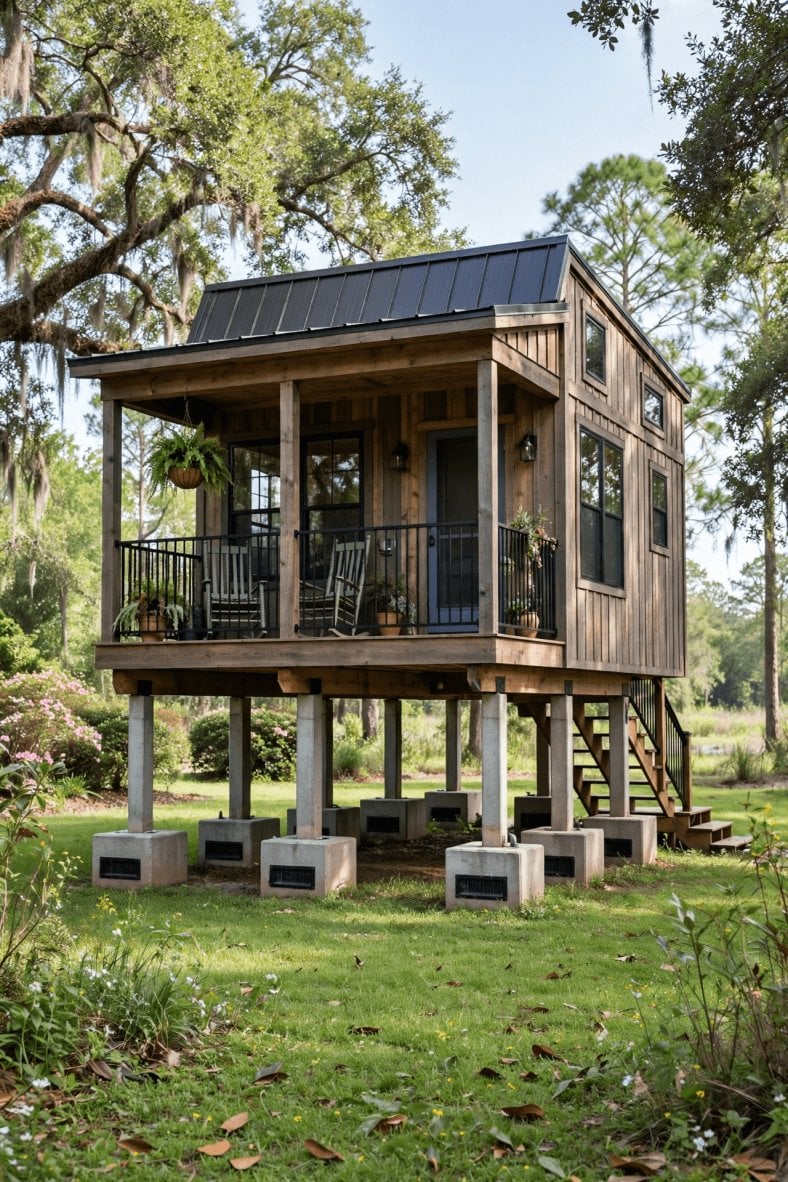
Tiny house laws in Mississippi — pin this overview for the build: county-by-county code adoption, elevated foundations in flood country, and wind-rated construction near the Gulf.
Two professional cautions belong here. First, electricity, gas and plumbing done without any inspection still must serve a household safely for decades — hiring licensed trades for those systems is the cheapest risk control in an uninspected build. Second, manufactured homes are regulated separately under the federal HUD code and state installation oversight, including tie-down requirements written for Mississippi wind; a manufactured unit is not a shortcut around siting, septic or flood rules, and a site-built tiny house should meet its anchoring standard as a floor, not an aspiration.
4. Minimum Size Requirements for Tiny Houses in Mississippi
Minimum size in Mississippi is a question with a location-dependent null answer. In unzoned rural counties without adopted residential codes, there may be no official minimum dwelling size at all — the floor is set by what the health department will serve with a septic system and by what the owner can finance and insure. Where a city or county has adopted codes and zoning, conventional habitability requirements apply to room sizes and ceiling heights, and some municipal ordinances do carry minimum floor areas for new homes. Subdivision covenants, where they exist, add a private layer that binds regardless of the county’s posture.
The practical sequence is therefore inverted from other states: first discover whether your parcel has any size rule at all — county office, city hall if near one, and the deed records — then design. Builders arriving from minimum-heavy states routinely over-build in Mississippi out of habit; builders arriving careless routinely under-document, and Section 8 explains why the paper matters even where no minimum does.
Septic sizing quietly disciplines size here as elsewhere: systems are designed around bedroom counts, and a two-bedroom design on paper should match the house as actually used. Align the plan, the permit and the household from the start.
5. Zoning and Placement Rules for Mississippi Tiny Houses
Zoning in Mississippi is a city-and-county option, exercised vigorously in the Jackson metro, the Gulf Coast cities, university towns and growing suburbs — and simply never adopted across much of the rural state. In zoned communities the familiar system applies: districts that separate residential, agricultural and commercial uses, dimensional rules for setbacks and lot coverage, and special scrutiny in historic districts such as those in Natchez, Vicksburg, Oxford and older Gulf towns. In unzoned counties, placement is governed by the practical law of the land — roads, easements, septic setbacks and flood maps — rather than a use table.
Floodplain placement is the state’s real zoning, whatever the county’s status. Communities participating in the National Flood Insurance Program enforce floodplain ordinances that require new homes in mapped special flood hazard areas to be elevated to or above base flood elevation, with flood-venting and anchoring duties attached; the Mississippi River, the Pearl, the Pascagoula and a hundred creeks and bayous draw those maps generously. A parcel outside today’s mapped zone can still take water in a Gulf storm or a stalled spring system, so siting judgment — high ground, drainage paths, distance from channels — is a design discipline, not paperwork.
Access and services complete the placement picture: driveway access onto county roads, 911 addressing through the county, and utility easements for power and water all arrive through county offices that are, in most of Mississippi, strikingly approachable. The style of conversation that works there is the one described in how to talk to zoning officials about tiny houses — parcel in hand, questions specific, answers written down.
6. ADU Rules: Backyard Tiny Houses in Mississippi
Mississippi has no statewide ADU framework and few formal ADU ordinances; what it has instead is a deep, older culture of the second dwelling — the in-law cottage, the garage apartment, the family-land house behind the main house — which much of the state has practised for generations without naming it. In unzoned counties, adding a small second home on family land is commonly a matter of septic capacity and family agreement rather than municipal permission. In zoned cities, the formal rules govern: some Mississippi cities allow accessory units within their residential districts or through their general dwelling provisions, while others restrict second units or handle them case by case — the city text is the only reliable guide.
The constraints that do apply are consistent: the second unit needs a legal wastewater answer — an MSDH-approved system sized for the added load or an approved connection — safe electrical service, and, in flood-mapped areas, the same elevation duties as any new home. Where a city requires the ADU to remain part of one parcel under one ownership, that condition follows the national pattern and should be assumed until the local text says otherwise.
Economically, Mississippi’s ADU story writes itself: land is already owned, rents in Jackson, the Coast and the university towns are real, and construction costs run below national norms. For multigenerational living — the use Mississippians have always made of second houses — no state in this series asks less or assumes more. Formalise what you build anyway; the next generation’s title search will thank you.
7. Where You Can Legally Live in a Tiny House in Mississippi
Mississippi’s tiny addresses, realistically: a foundation tiny house on your own land in an unzoned county — the state’s signature route, gated by septic approval and good siting. The same house on a conforming lot in a zoned city or county, permitted under local rules. A backyard or family-land second unit, formal or traditional, as Section 6 describes. A manufactured-home community, for HUD-code homes, of which Mississippi has many at genuinely low rents. And a wheeled unit on rural land, in an RV park, or in the state’s campground network — including near the Gulf and the reservoir lakes — where local rules and park terms allow.
Comparison-shop the hosted options carefully using tiny house communities versus RV parks, and apply Mississippi’s two filters to any answer: what does this site do in a flood, and what does this structure do in a storm? Land in Mississippi is cheap partly because water and weather are priced into it; the savings are real only if the house is elevated, anchored and insured to match its map. Owners who respect that arithmetic find Mississippi the most welcoming budget in this entire series; owners who ignore it meet the state’s other reputation.
8. Permits, Inspections and Documentation in Mississippi
The rural Mississippi sequence is short and health-led. The county health department — administering the state health department’s onsite wastewater program — evaluates the soil and site, approves a septic or alternative system design, and inspects the installation; wells are sited with required separations from that system. Counties add their own touches: floodplain development permits in mapped areas, driveway and addressing processes, and, in code-adopting counties and all cities, building permits with inspections. On the Gulf Coast, expect the full modern stack — elevation certificates, wind documentation and staged inspections — administered seriously.
Tiny house laws in Mississippi — the permit trail at a glance: health-department septic approval first, floodplain and local permits where they apply, documentation throughout.
Documentation is this state’s sleeper issue. Where no building department inspects, the owner should manufacture the record themselves: dated photographs of footings, anchoring and rough work before cover-up, receipts and specifications for structural connectors and roofing, the septic approval and as-built, the elevation certificate where one exists, and any permits obtained. That file is what converts a lightly regulated build into an insurable, financeable, sellable house — insurers writing Mississippi wind and flood business price evidence, not intentions.
Insurance itself deserves a line in the permit plan: wind coverage on the coast often runs through specialty or state-backed markets at prices that can exceed the mortgage logic of a cheap build, and flood insurance is its own policy with its own waiting periods. Quote both before closing on land, not after framing.
9. Notable City and County Examples in Mississippi
The Gulf Coast — Biloxi, Gulfport, Ocean Springs, Bay St. Louis and Pass Christian — is Mississippi’s engineered shore: modern codes, elevation discipline, fierce insurance arithmetic, and deep demand for small homes near the water from people who do the maths honestly. Inland, Hattiesburg pairs a university-and-medical economy with approachable land in surrounding counties. The Jackson metro splits the pattern: city and suburban zoning with full permitting inside, thinning quickly to county informality at its edges — and some of the state’s cheapest urban lots for those who work the city’s process properly.
Oxford and Starkville, the university towns, bring student-and-faculty housing pressure, formal zoning and real ADU-style demand wrapped in historic and neighbourhood sensitivities. Natchez and Vicksburg add river-bluff history and historic-district review atop flood consciousness. The Delta — Greenville, Clarksdale and their counties — offers the state’s lowest land prices and its most minimal rural regulation, with flood-plain respect as the governing skill. And the northeast hills around Tupelo and Corinth mix growing industry, county growth and attainable acreage. The through-line: Mississippi contains a workable version of tiny living in every region, and the local variable is never permission alone — it is water, wind and services, in that order.
10. How to Go Tiny Legally in Mississippi: Practical Steps
Step 1: Read the flood map before the listings. For any parcel, pull the flood mapping, ask locals where water has actually stood, and walk the land after rain if you can. In Mississippi this is not diligence theatre; it is the decision.
Step 2: Establish which governments govern. County zoning or none, city limits or not, code program or not, subdivision covenants or not — a half-day of office visits that defines the entire project. Write the answers down with names and dates.
Step 3: Open the septic file first. Soil and site evaluation through the health department sets the system’s type and price and confirms the lot can host a home at all. Everything else is decoration until this is known.
Step 4: Design for the state’s weather, wherever you build. Elevated where water suggests, anchored everywhere, roof and connectors rated for the wind zone you are actually in. Use the Appendix Q layout discipline for the interior and Gulf-grade thinking for the shell. Preparation of the homesite follows the grounded sequence in how to prepare land for a tiny house — access, clearing, drainage — with drainage promoted to first place in Mississippi.
Step 5: Price utilities and insurance together. Power runs to rural lots, well drilling, septic type and the wind/flood insurance quotes belong in one spreadsheet; tiny house utilities: power, water and sewage explained covers the service decisions. Mississippi’s cheap land can be ambushed by a long power run or a coastal premium — know before you close.
Step 6: Build the paper file as you build the house. Photograph every concealed stage, keep every approval and receipt, record the septic as-built and any elevation certificate. In a light-regulation state, the owner’s file is the inspection record.
Step 7: Finish the legalities. Final health-department sign-off on the system, 911 address confirmed, insurance bound with the documentation file attached, and any local permits closed out. Then the house is not just standing — it is established.
Final Considerations
Mississippi closes this run of state guides by inverting their shared lesson. Elsewhere, the work was persuading governments; here, the government mostly steps aside, and the work is persuading physics — siting above water, anchoring against wind, treating wastewater properly, and documenting a build that nobody may ever inspect. The state offers the cheapest legal entry to tiny living in this series and attaches the least supervision to it, which makes the owner’s own standards the entire ballgame.
Meet the state on those terms and Mississippi is a gift: land you can afford, counties that answer the phone, neighbours who have seen a small house before, and room — literal, financial, regulatory room — to build a modest permanent home. Bring the discipline the climate demands, and a Mississippi tiny house is not a loophole at all. It is simply how a lot of Mississippi has always lived, done properly.