

The classic bathroom is the room that never asks to be renovated. Freestanding tub, pedestal basin, marble and metro tile, taps like small architecture — its vocabulary was settled a century ago and has outlived every fashion that announced its death. It is not nostalgia. It is a design that finished evolving.
This page is the classic style lane of the bathroom’s wide family, whose whole survey — layouts, sizes, every style — lives on the bathroom ideas pillar. Here the subject is one tradition completely: its sanitaryware, its brassware, its tiles and stone, its vanities and light — and the discipline that keeps a classic bathroom classic rather than themed.
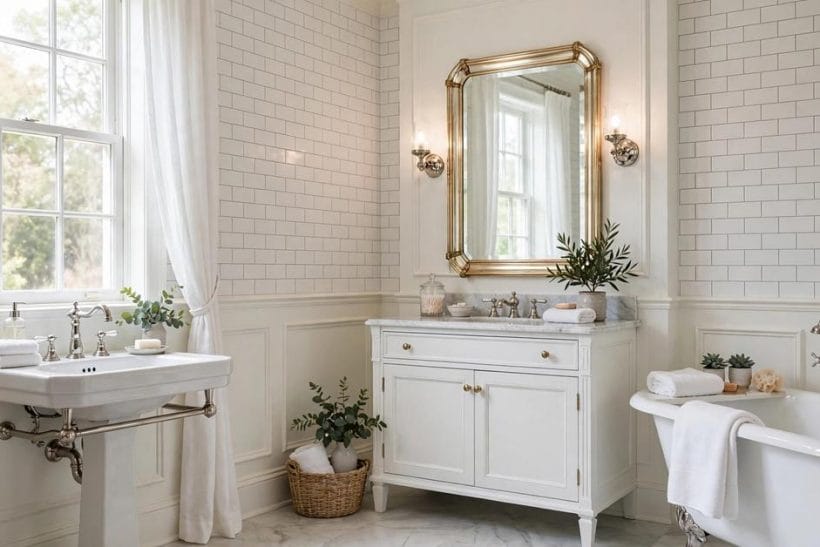
1. Traditional Bathroom Ideas at a Glance
A classic bathroom — the traditional bathroom in its other name — is a bathroom composed in the settled vocabulary of the early twentieth century’s best rooms: freestanding or panelled sanitaryware with visible craftsmanship, brassware in traditional silhouettes, marble and ceramic tile in enduring patterns, painted timber vanities and panelling, and symmetry used as the room’s organising courtesy. Its working parts are proportion, honest materials and details that were designed to be repaired rather than replaced. It is the formal elder of the bathroom family, the deliberate counterpoint to the modern bathroom, and the style against which the others’ newness is measured.
| Question | Short answer |
|---|---|
| What defines a classic bathroom? | Settled forms, honestly made: a freestanding or panelled bath, a pedestal or furniture-style basin, a high or boxed cistern tradition, taps with crossheads or levers in period silhouettes, marble or ceramic tile, painted woodwork, and a mirror where a picture would hang in any other room. Nothing in it is pretending to be new. |
| Does a classic bathroom suit a small room? | Especially. The classic vocabulary was perfected in the small bathrooms of period houses — a pedestal basin keeps the floor visible, a panelled bath front hides the plumbing tidily, and pale marble and metro tile make the most of modest light. Small classic bathrooms are among the most convincing rooms of any size. |
| Is the classic style expensive? | Its centre of gravity is the middle: ceramic tile, painted timber and quality chrome are not luxury goods. The spend concentrates in the bath, the brassware and any real marble — and the style’s longevity means the money is spent once, where fashionable rooms spend it repeatedly. |
| How do you stop classic tipping into theme? | By function. Every period detail in a true classic bathroom works: the towel rail heats, the bath is deep, the taps are the best available engineering in traditional dress. The moment an element is there only to look old — plastic mouldings, fake patina — the room becomes a film set. Buy the working article or leave it out. |
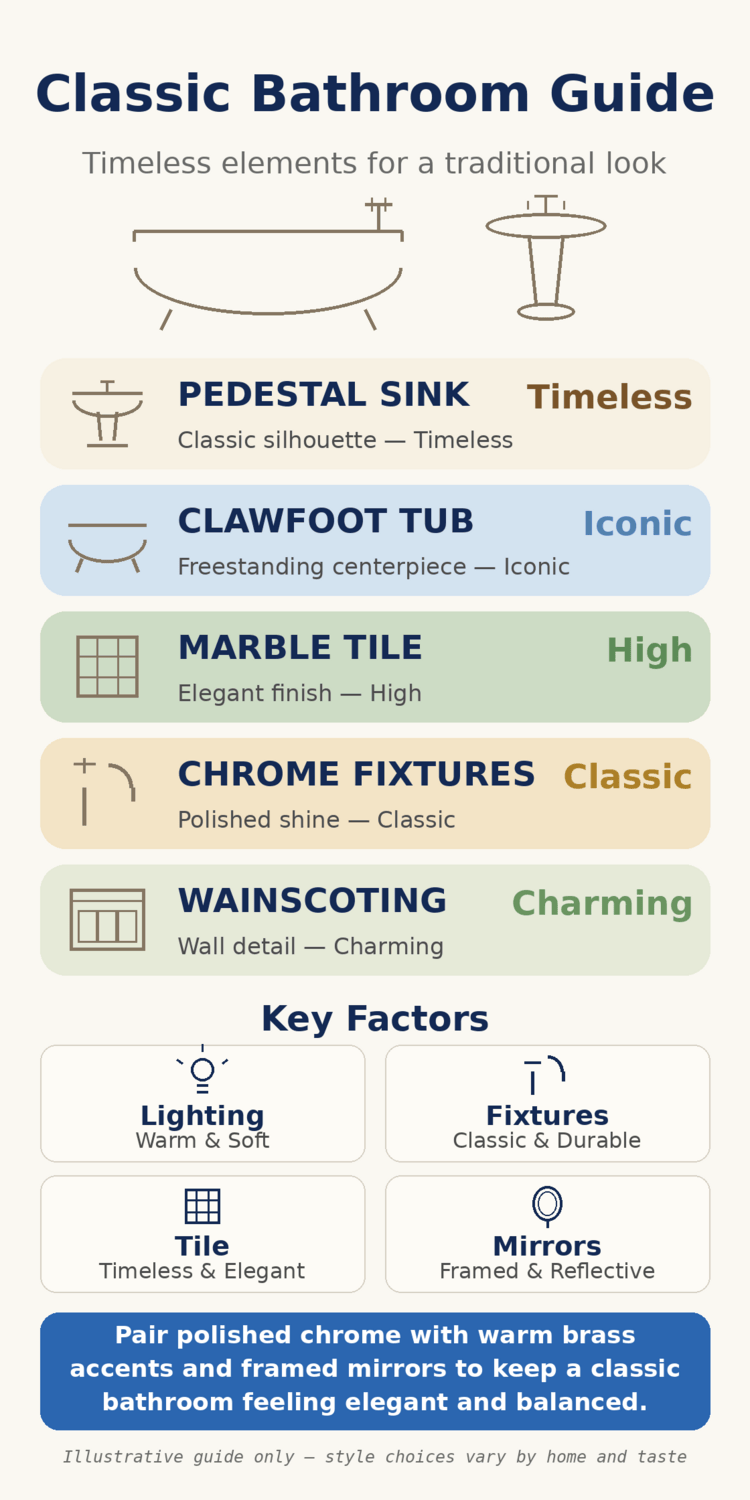
2. The Classic Vocabulary: Symmetry, Panels and Proportion
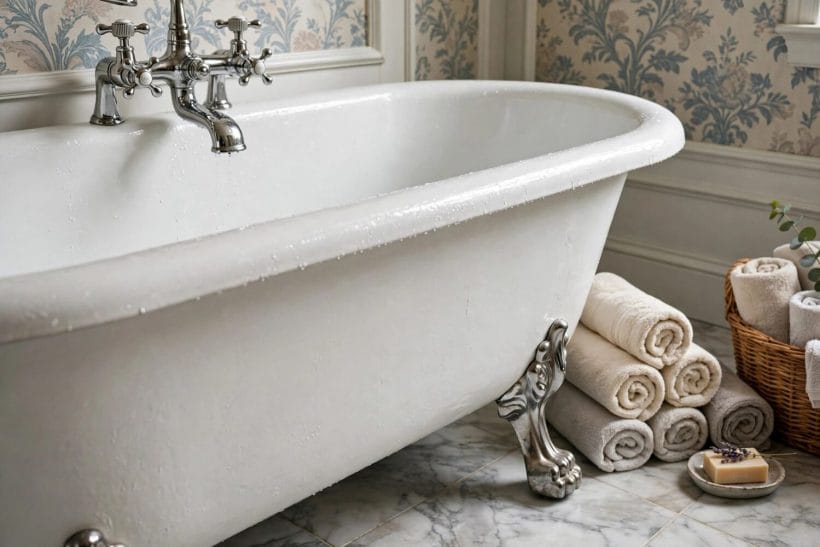
Before any fixture is chosen, the classic bathroom speaks its grammar: symmetry around a centre, panelling that gives walls their architecture, proportions borrowed from the house’s own period rooms. This section lays out the vocabulary — the rules of composition that make the difference between a bathroom assembled from period parts and a room that is genuinely classic.
1. Compose around a centre, as the room’s first courtesy
The classic room arranges itself around one axis — the bath under the window, the basin centred on its wall, the mirror above it like a portrait.
2. Let panelling give the walls their architecture
Tongue-and-groove, raised panels or simple board-and-batten to chair height, painted in the scheme’s colour: panelling is the classic bathroom’s wainscot tradition, protecting the splash zone and giving the eye the horizontal order the style runs on.
3. Borrow proportions from the house’s other rooms
The dado height echoes the hall’s, the cornice profile rhymes with the landing’s, the door furniture matches the bedrooms’.
4. Keep the palette in the settled register
Whites and their warm relations, marble greys, and one deep traditional colour — racing green, navy, oxblood, black — as the room’s gravitas.
5. Use the window as the room’s picture
A classic bathroom frames its window the way the house’s other rooms do — architrave, a sill for the bottle and the plant, privacy handled with a half-café curtain or bottom-up blind so the light survives.
6. Mind the ceiling and its rose
A simple cornice, a ceiling rose where the house’s age allows one, a pendant or a pair of wall lights rather than a grid of downlights: the ceiling keeps the room’s period manners.
7. Let the floor pattern set the room’s scale
The chequerboard, the basketweave, the octagon-and-dot: classic floor patterns are small in scale and exact in geometry, and they make small rooms feel jewelled rather than cramped.
8. Admit the house’s age honestly
A classic bathroom in a Victorian terrace speaks one dialect; in a 1930s semi, another; in a new build, the honest modern-traditional.
9. Keep ornament where the hand meets the room
Crosshead taps, ceramic lever handles, the chain pull, the towel rail’s finials: classic ornament lives at the touchpoints, small and functional. Walls and tiles stay plain; the jewellery is worn at the taps, where it is earned daily.
10. Draw the room before buying a single fitting
Elevations on paper — bath wall, basin wall, the door’s swing, the towel rail’s reach — settle the symmetry and expose the collisions while they are still free.
11. Leave one wall quiet
In the best classic bathrooms one stretch of wall does nothing but be painted, hung with the mirror or a single framed print.
3. Sanitaryware in the Traditional Register
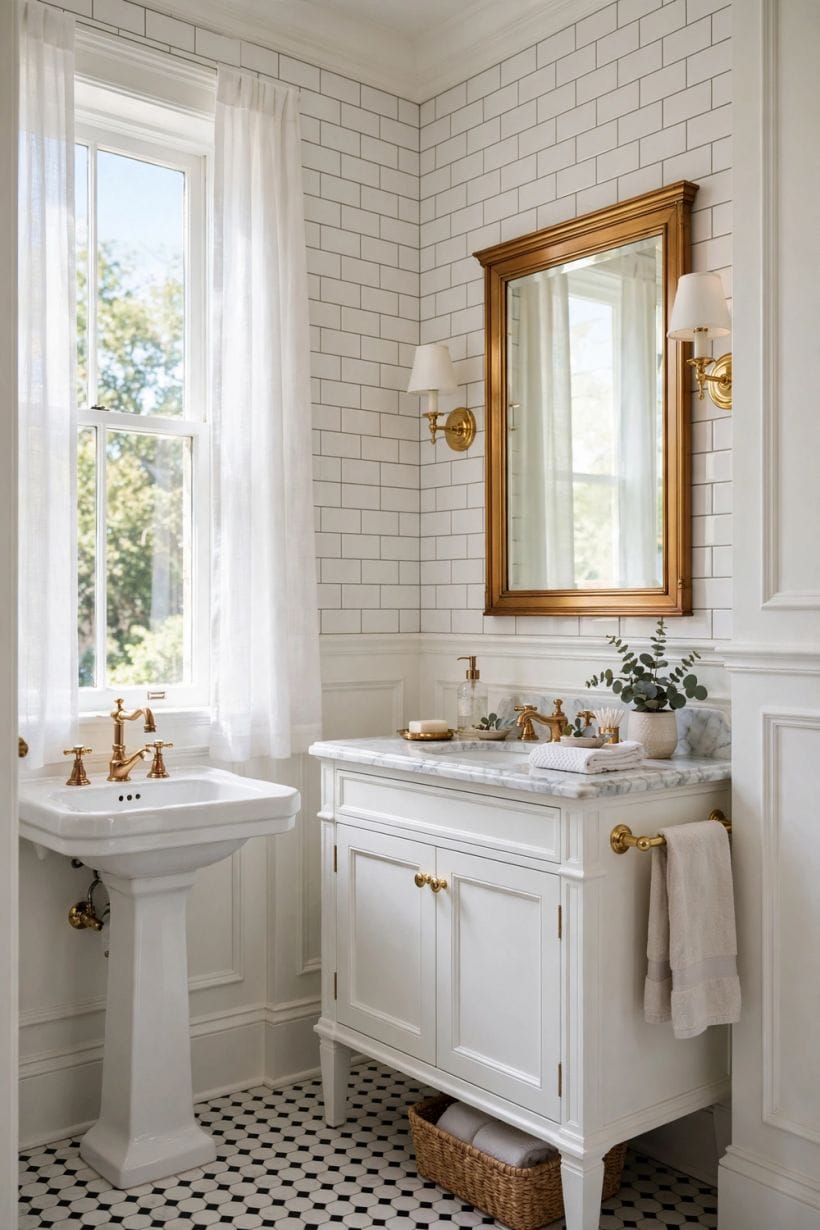
The fixtures are the classic bathroom’s furniture: chosen like furniture, expected to last like furniture. This section specifies the bath, basin and WC in their traditional forms — and the engineering inside them, which should be as modern as the century requires.
12. The freestanding bath as the room’s portrait
Roll-top, slipper or bateau — the freestanding bath is the classic room’s centrepiece and its photograph.
13. The panelled bath for the working classic room
Where space or budget argues, a straight bath in a painted panelled front is the tradition’s own answer — the panels echoing the walls’, the whole reading as joinery rather than appliance.
14. Pedestal basins: the floor stays visible
The pedestal’s virtue is negative space: the floor runs under it, the room breathes, the pipework is the pedestal itself. In the small bathroom this is a spatial gift; in large rooms a pair of pedestals under twin mirrors is the style’s most graceful composition.
15. Furniture basins where storage must be earned
A basin set into a painted timber vanity belongs to the tradition too — the washstand was furniture before it was plumbing.
16. The WC in traditional dress, with modern manners
High-level cisterns with their long pull are the photograph’s favourite and the small room’s burden; the boxed-in or close-coupled forms carry the same silhouettes with kinder proportions.
17. Bidets and extras: only where the life wants them
The classic room admits the period extras where the household genuinely uses them, and omits them without apology where it doesn’t.
18. Choose ceramic by its maker’s warranty and weight
Sanitaryware is bought for decades: vitreous china from makers who publish their standards, seats in timber or quality composite with soft-close manners, and every fixing specified in the room’s metal family.
19. Let the bath’s feet and the basin’s lines agree
Ball-and-claw with ball-and-claw, the plain plinth with the plain: the fittings’ small vocabularies should rhyme across the room. Classic composition is a hundred small agreements; the eye may not name them, but it totals them.
20. Site the towel rail where the bather actually lands
Tradition’s oversight is the beautiful rail across the room from the bath. Place warmth at the exit — beside the bath, near the shower — in the heated form the room’s system allows.
21. Plan the shower’s place in the tradition
Many classic bathrooms keep the shower over the bath with a glass screen in black or chrome framing — the modern necessity in period dress.
22. Respect the soil stack and the room’s given bones
The classic suite rearranges itself around the house’s drainage realities more gracefully than most — its freestanding pieces forgive odd corners. Design with the stack’s geography, not against it, and the room’s composition survives contact with the plumber.
4. Taps, Showers and Brassware: The Room’s Jewellery
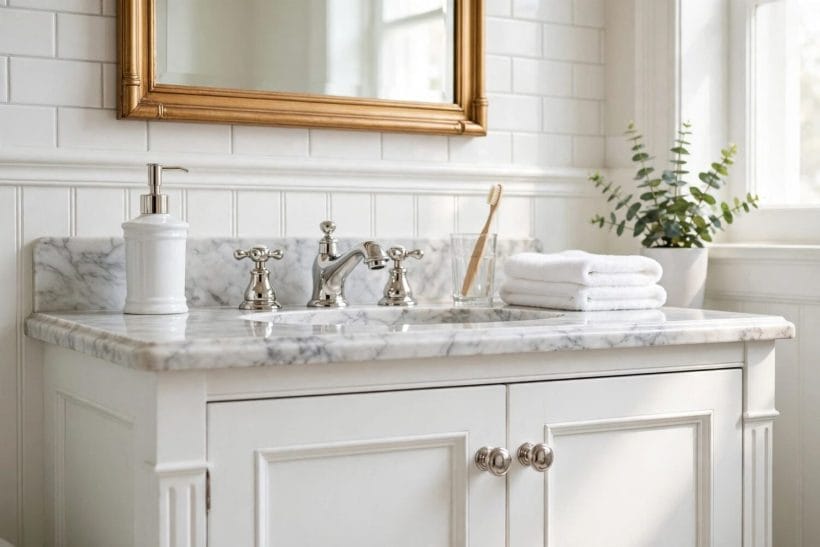
Brassware is where the classic bathroom keeps its wealth: small, heavy, handled a hundred times a day. This section chooses the taps, showers and fittings — their silhouettes, their finishes, and the engineering standard that makes the period dress honest.
23. Crossheads and levers: the handle is the handshake
The classic tap is worked by crosshead or ceramic lever — shapes the hand reads before the eye does, and that wet hands can govern.
24. Chrome: the tradition’s faithful metal
Polished chrome is the classic bathroom’s default for a century of reasons: it suits marble and white ceramic, it forgives water, it never fights the palette.
25. Nickel for the warmer, older light
Polished nickel glows warmer than chrome and suits the earlier, softer registers of the style — and it asks to be lived with, marking gently and polishing kindly.
26. Brass and bronze for the deep-coloured room
Where the walls run green, navy or black, unlacquered brass or aged bronze carries the room’s warmth at its touchpoints.
27. The exposed shower valve as wall sculpture
Traditional showering shows its engineering: the exposed thermostatic valve, the riser rail, the generous rose.
28. Rainfall roses and the hand shower’s courtesy
A fixed rose for the deluge and a hand shower on its rail for everything else — rinsing, hair, the bath’s cleaning.
29. Bath fillers: deck, wall or freestanding standpipes
The freestanding bath’s taps arrive by standpipe, wall spout or the bath’s own rim — each with its plumbing story to detail honestly.
30. Wastes, overflows and chains in the same metal
The plug on its chain, the click waste, the overflow’s face — the brassware family’s smallest members are specified in the room’s finish too.
31. Water pressure is the invisible specification
Period silhouettes assume nothing about the house’s water; the classic room’s shower is engineered — pump, cylinder or mains — to deliver what its rose promises.
32. One metal per room, repeated without exception
Taps, shower, towel rail, flush plate, cabinet knobs, the mirror’s frame: one finish, everywhere, the rule the whole style is built on.
33. Buy brassware from makers who sell spares
Cartridges, washers and ceramic discs will be wanted in year twelve; the classic room’s taps come from houses that publish exploded diagrams and keep parts.
5. Tiles and Stone: Marble, Metro and the Chequerboard
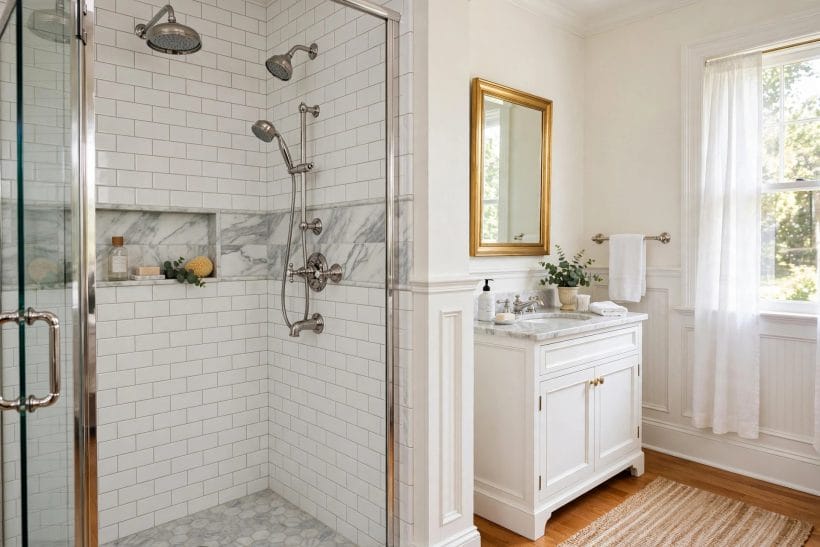
Surfaces carry the classic bathroom’s age and light: marble with its centuries, ceramic tile in the patterns that never left. This section specifies the walls’ and floors’ materials — real stone against its faithful imitators, the classic tile formats, and the grout that draws them.
34. Marble: the room’s birthright, used with judgement
Real marble on the classic bathroom’s floor or walls is not a luxury signal but the material the style grew up with — cool, veined, ageing on its own terms.
35. Porcelain marble-look where life argues otherwise
The faithful porcelain imitations have earned their place: family bathrooms, hard water and heavy use all argue for them, and the eye at grout-line distance cannot call the difference.
36. Metro tiles: the bevelled classic
The bevelled-edge metro in a brick bond is the style’s wall signature — cheap, bright, repairable tile by tile, and right in every decade.
37. Square tiles and the older geometries
Before the metro came the plain square, laid straight or diagonal, and the octagon-and-dot floor. These older formats carry the smaller, older house’s classic bathroom most convincingly — the pattern book is the house’s own building date.
38. The chequerboard floor, laid true
Black and white in marble or porcelain, squares sized to the room — small rooms take small chequers — and laid to a border that resolves at the door.
39. Basketweave and herringbone for the connoisseur
The woven marble mosaics and the tiled herringbone are the pattern family’s refined members, suited to floors and the bath’s splash wall.
40. Grout is the drawing ink: choose its tone deliberately
Pale grout dissolves the tile into a field; dark grout draws every unit and makes the pattern the subject. On classic floors a mid-grey is the working classic — it draws gently and forgives the years.
41. Tile to the heights the room’s tradition sets
Full-height in the shower’s country, half-height with panelling or plaster elsewhere, the dado line carried around unbroken: classic tiling respects the room’s horizontal order.
42. Stone thresholds and the marble shelf
The small stone courtesies — a marble threshold at the door, a shelf in the shower’s niche, the basin’s backsplash — carry the material into the hand’s reach.
43. Underfloor warmth beneath the classic floor
The tradition’s one invisible modernity is non-negotiable in cold climates: heat under the marble or tile makes the classic floor barefoot-kind at dawn.
44. Seal, ventilate and keep the room’s surfaces honest
Stone sealed on its calendar, grout kept sound, extraction quiet and sufficient: the classic surfaces are a kept system. The master bathroom survey makes the same maintenance argument at suite scale — the classic room simply has more decades riding on it.
6. Vanities, Cabinets and Mirrors: Furniture for the Washroom
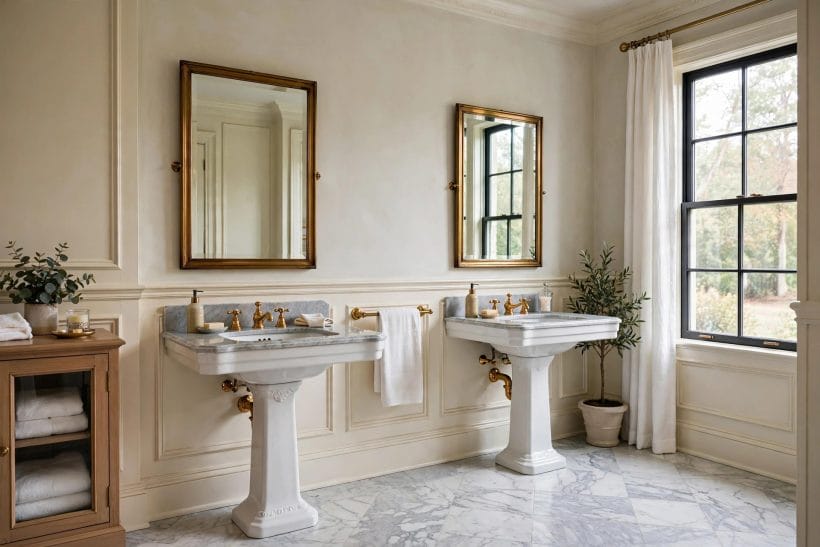
The classic bathroom stores like a dressing room: furniture-form cabinets, a mirror with a frame’s manners, shelves where a chemist’s bottles stand in order. This section furnishes the storage and the glass — the pieces that turn plumbing into a room.
45. The washstand vanity in painted timber
A freestanding or fitted vanity with framed doors, bun feet or a plinth, painted in the scheme’s deep colour or its white: the washstand is the basin’s furniture form, and its joinery lines set the room’s craft register more than any tile.
46. Marble or ceramic tops, detailed for water
The vanity’s top takes the room’s water discipline — stone with its sealing calendar, or the integrated ceramic top that shrugs and wipes.
47. Knobs and cup handles in the room’s metal
The vanity’s hardware joins the brassware family without exception — same finish, period silhouette, sized to the hand. It is a small line in the budget and a daily one in the room’s composition.
48. The mirror as the room’s portrait
Framed like a picture, sized to the basin’s generosity, hung at the household’s eye: the classic mirror is furniture, not a sheet of glass with ambitions.
49. Medicine storage behind or beside the mirror
The classic room hides its pharmacy in a proper cabinet — mirrored-fronted in the tradition, or in the vanity’s drawers.
50. A chair, a stool, a place for the clothes
The dressing-room courtesy: somewhere to sit, to lay the clothes, to keep the towels off the floor’s argument. In the coastal bathroom the same courtesy arrives as a bench; in the classic room it is a small upholstered or timber chair, and its presence civilises the whole routine.
51. Open shelving in the scullery manner
Where shelves are open, they are specified like a scullery’s: thick timber or painted boards, the white towels folded as the display, everything else behind doors. The classic room’s shelves are storage with posture, not a boutique.
52. The tall cupboard for the house’s linen
Where the room allows, a linen press in the vanity’s paint and hardware gives the bathroom its dressing-room depth — towels, the hot-water linen, the spare everything. It is the piece that makes guests call the room considered.
53. Glass-fronted cabinets for the beautiful necessities
A single glass-fronted cabinet — the chemist’s tradition — shows the brushes, jars and folded white order of the room. One is charm; a wall of them is a shop. The classic room doses its display like its colour.
54. Keep the bins, brushes and scales invisible
The working clutter’s housing is designed, not discovered: the bin within the vanity’s door, the brushes in their drawer, the scales that slide away. A classic bathroom photographed at any hour should show a room, not its administration.
55. Light the mirror from the sides, as dressing rooms do
Twin wall lights flanking the mirror, in the brassware’s finish with shades or opal glass, light faces the way the tradition always has — kindly and without shadow. The arrangement is specified with the mirror, not after it.
7. Walls, Floors, Heat and Light: The Room’s Comfort System
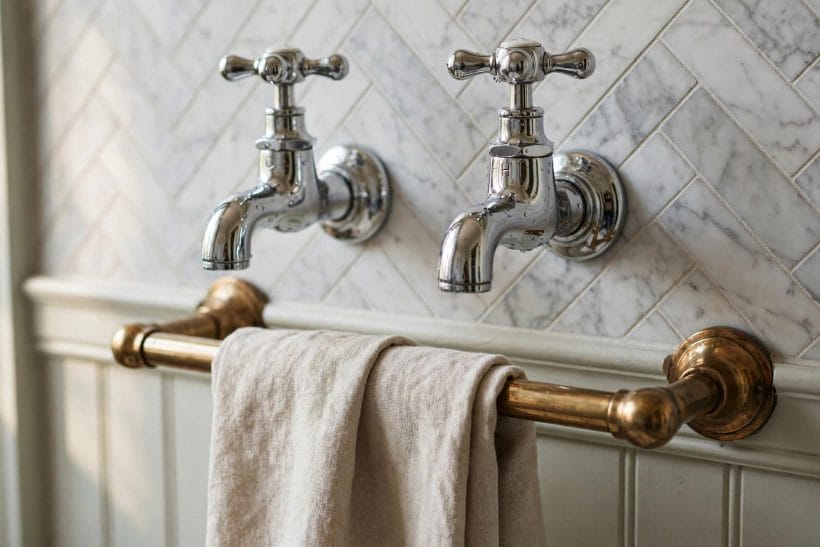
Under its period dress the classic bathroom runs a modern comfort system: warm floors, quiet extraction, layered light. This section specifies the room’s bones — wall finishes above the panelling, the heating that suits its forms, and light layered like the house’s formal rooms.
56. Paint above the panelling in the settled tones
The classic wall finish is paint — washable, renewable, in the palette’s soft whites and deep colours — with wallpaper admitted where the room’s dryness allows and the house’s period invites.
57. Heated towel rails as the room’s radiators
The ladder rail in the brassware’s finish is the classic bathroom’s heater and its towel butler in one.
58. Panelled bath fronts and boxing in the walls’ language
Every pipe run the room must hide is hidden in panelling that matches the walls’ — the bath’s front, the cistern’s boxing, the soil’s corner. Joinery camouflage is the classic system’s secret: the room shows furniture, never infrastructure.
59. Ventilation with period manners
Extraction quiet enough to forget, placed to serve the shower’s steam, its grille inoffensive in the ceiling’s order.
60. Wall lights and a pendant: the formal rooms’ lighting
The classic bathroom borrows the drawing room’s scheme — wall lights at the mirror, a central pendant where the ceiling’s rose allows, nothing recessed that the house’s age wouldn’t recognise.
61. Candles, plants and the room’s soft evidence
The finishing layer is life: a plant that likes the steam, the candle by the bath, the small framed print.
62. Blinds and café curtains in natural cloth
Window dressings in linen, cotton or woven timber, made to the window’s measure: privacy without exile of the daylight. The classic room’s windows are dressed like the house’s other windows, which is precisely the point.
63. The door’s furniture and the room’s threshold
A knob or lever in the house’s family, a lock with manners, hinges that match: the door is the room’s handshake and its hardware joins the composition. Even the bath mat is specified — woven, washable, in the palette.
64. Give the room its scent and sound manners
The classic room’s last comforts are invisible: ventilation that takes the steam without taking the conversation, a door that closes with a soft, weighted click, the faint order of soap and clean linen.
65. Let the room take a plant and a picture
A fern in the window’s light and one framed print on the quiet wall finish the room as a room.
8. The Classic Bathroom in Small Rooms and Family Life
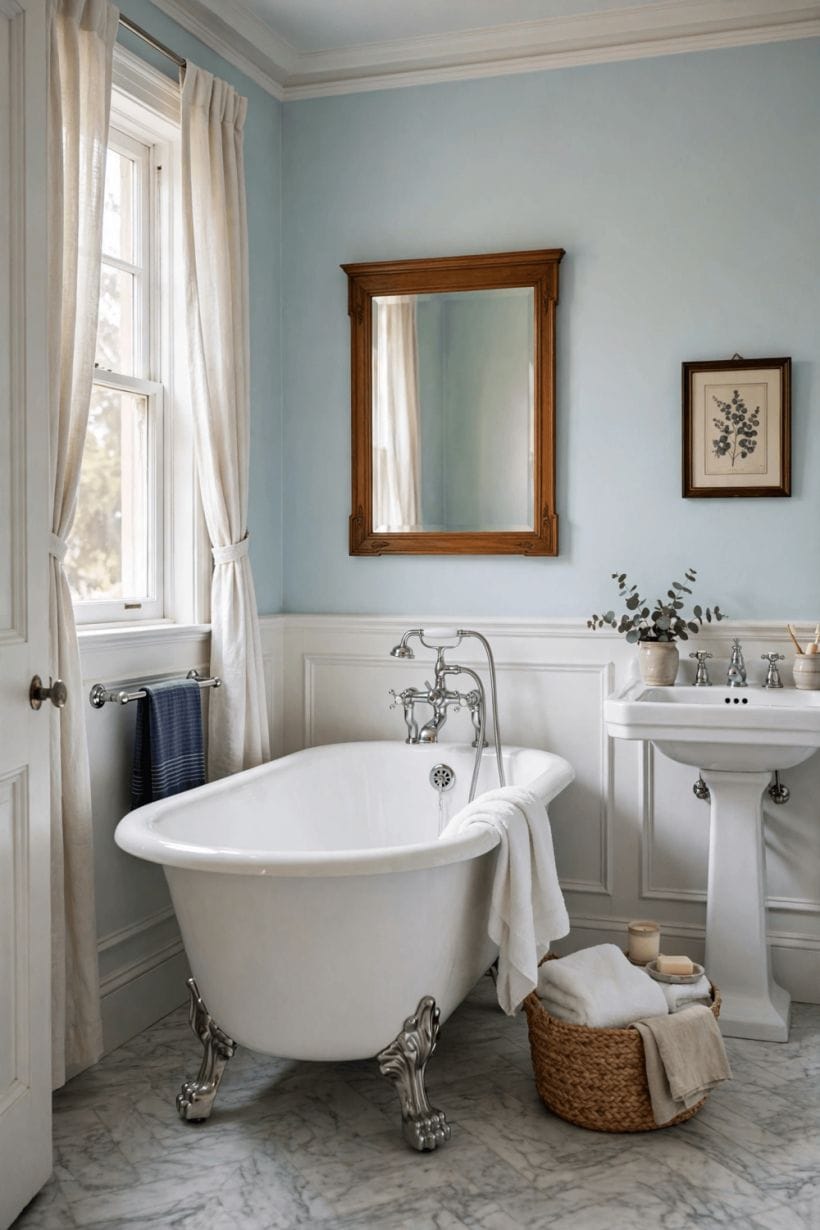
The tradition was perfected under real conditions: small rooms, large families, one bathroom per house. This final section applies the vocabulary at family scale — the shared morning, the children’s baths, the decades of daily use that are the classic room’s true examination.
66. Compose the small classic room around its one axis
In a small room the axis is everything: basin centred under the mirror, the bath along the long wall, the door’s swing plotted against knees.
67. Keep the floor visible and the walls pale
Pedestal over vanity where the room is tight, the patterned floor small in scale, the tiling to its traditional heights: the small classic room borrows air from its own discipline, and feels jewelled rather than compressed.
68. Specify for the morning’s traffic, not the photograph
Two people, one mirror, twenty minutes: the family’s classic bathroom is arranged for its rush — hooks for both towels, shelf room for both kits, a mirror wide enough for diplomacy. Choreography is a specification.
69. Let the bath be the children’s harbour
A deep, enamel-hearted bath with honest taps and a floor that forgives the flood: the classic bath was designed when bathing children was its primary industry.
70. Store the family’s fleet behind doors
Bath toys, spare bottles, the cleaning shelf: the classic room’s cabinets absorb the family’s administration so the composition survives the school week. One open shelf of white towels is display enough.
71. Choose finishes that forgive the household’s chemistry
Toothpaste, bath crayons, the occasional hair-dye expedition: chrome and porcelain forgive them all, and painted timber repaints in an afternoon. The family classic room is specified for evidence, not for innocence.
72. Keep a step, a stool and low hooks for small citizens
The tradition’s manners extend downward: a solid step at the basin, hooks at child height, the towel rail’s low bar. A classic bathroom that serves the whole family’s heights is simply the tradition completing its job description.
73. Plan the laundry’s place in the room’s order
A lidded basket in the room’s timber or weave, sized for the household’s real output, keeps the floor’s pattern visible. The classic room’s enemy was never dirt — it is drift, and the basket is the drift’s answer.
74. Let the room host the guest without a panic
The test of the family’s classic bathroom is the unexpected guest: surfaces clearable in two minutes, the good towels present, the room’s composition intact beneath its life. Rooms designed with storage pass the test unthinking.
75. Trust the room to outlast the family’s phases
Steps are outgrown, fleets of toys retire, the morning rush thins — and the classic room stands unchanged through every phase, asking only paint.
9. Checks and Mistakes: Before the First Purchase or the First Stone
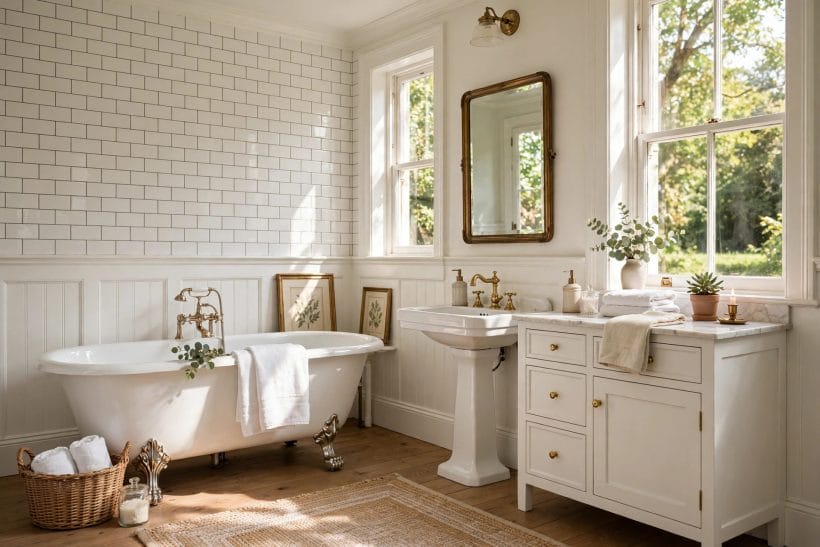
Before the first fitting is ordered, walk the checks in order: the composition drawn in elevations with its axis settled; one metal chosen for every tap, rail and knob in the room; the sanitaryware’s engineering specified modern while its dress stays traditional; the floor pattern sized to the room and its border resolved at the door; heating and extraction engineered invisibly; and every pipe the room must hide assigned its panelling before the plumber asks.
The faithful mistakes: five metals in one small room; period pieces that don’t work — the beautiful tap with the feeble cartridge, the deep bath nobody can leave gracefully; tiling every wall to the ceiling and flattening the architecture; fake patina and plastic moulding anywhere; and the shower — the room’s hardest-working citizen — squeezed into the corner the composition forgot. Every one is a discipline error, not a style error: the classic vocabulary was complete.
One check is about the house: the bathroom’s dado, cornice, door and palette should be able to shake hands with the landing outside. A classic bathroom that belongs to its house ages into the architecture; one imported entire from a catalogue remains a guest, however beautiful.
10. Costs and Pulling It Together
Costs follow the tradition’s mercy: its staple materials — ceramic tile, painted timber, chrome — are the market’s middle, and its longevity is the cheapest ownership in the bathroom world. The money concentrates where the hand and eye live longest: the bath, the brassware, the floor, and any true marble. Spend there, in makers who sell spares, and the room’s next renovation is a coat of paint in a decade.
Pulling it together: compose on an axis; panel the walls; set the settled sanitaryware; keep one metal throughout; lay the patterned floor and heat it; furnish the storage like a dressing room; and light it like a room, not a clinic. The bathroom then keeps company with the tiny house bathroom designs in the only way that matters across scales — every part working, every part meant.
Final Considerations
A classic bathroom is a household declining to renovate its taste every decade. Built in the settled vocabulary — symmetry, panelling, one metal, honest stone and tile — it becomes the room guests photograph and owners forget to think about, which is the highest compliment a working room can earn.
Begin with the elevations and the metal decision. Every choice after that — bath, tile, vanity, light — is made easily by a household that has settled the room’s grammar before shopping for its words.

0 Comments