
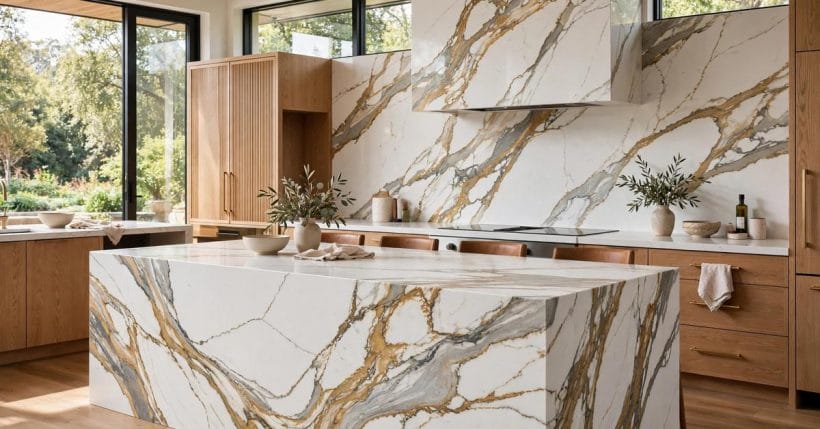
Ask a kitchen designer what has changed most in recent remodels and they rarely start with cabinets or appliances. They start with the surface you touch a hundred times a day — the countertop, grown bolder, warmer and more continuous until it has become the room’s main event.
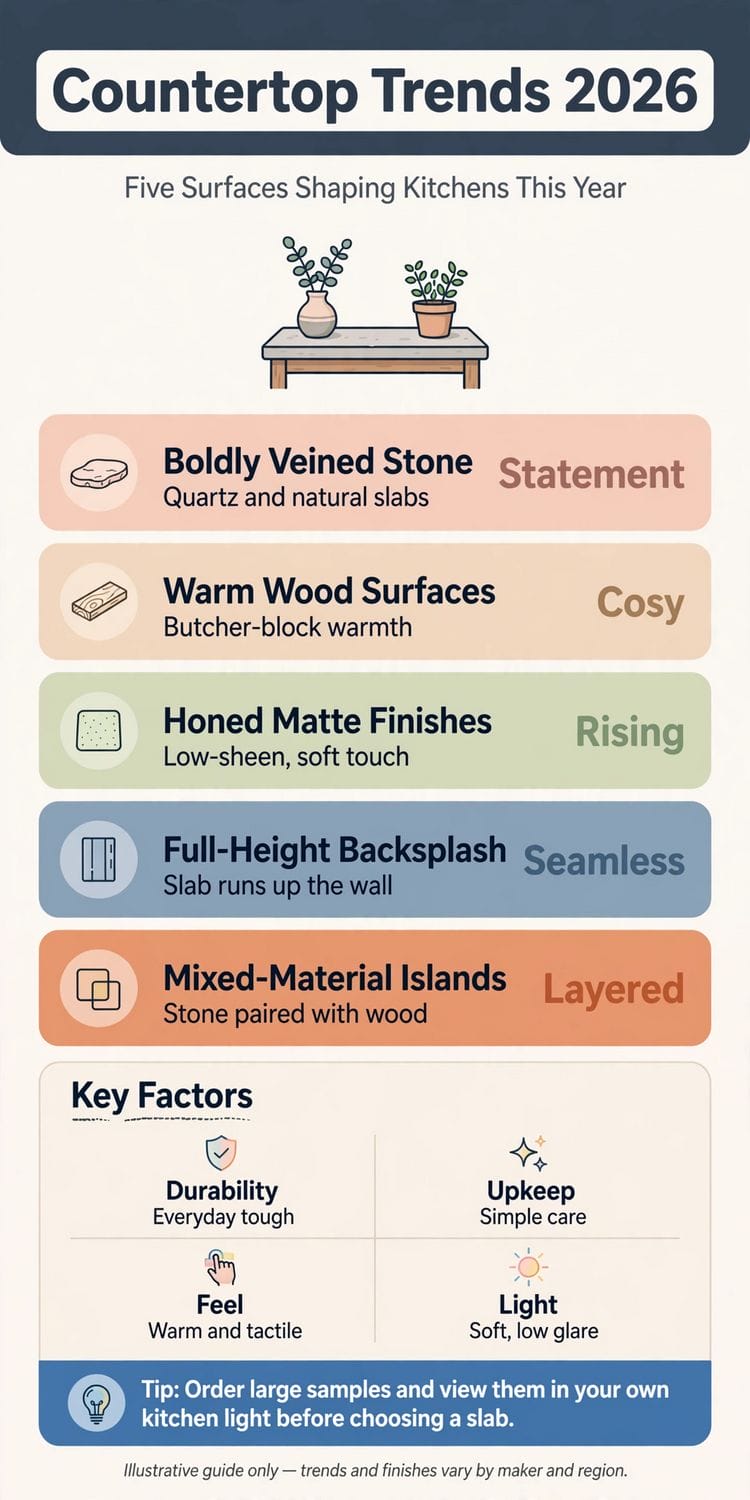
This article surveys trending kitchen countertops as five present-day surface directions — veined stone, warm wood, honed finishes, full-height slab backsplashes and mixed-material islands — and, for each, what to check before you choose: durability, upkeep, samples and fabrication, stated generally throughout.
1. Trending Kitchen Countertops at a Glance
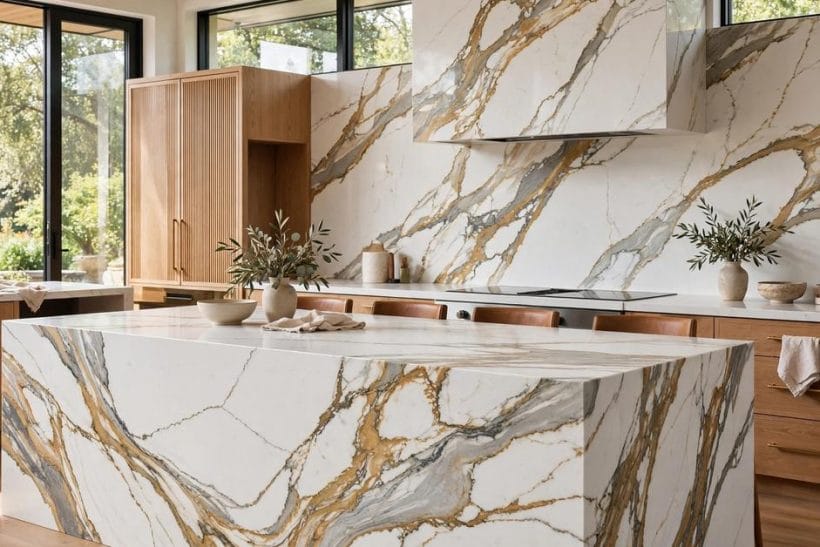
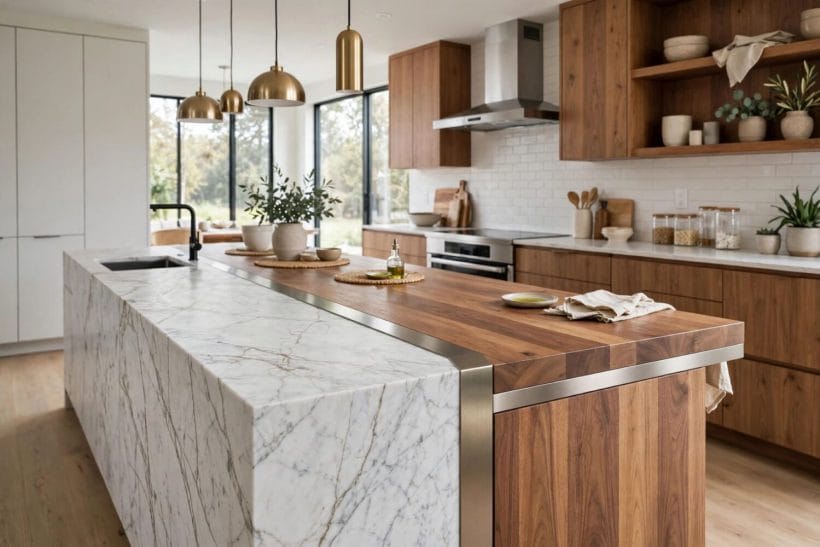
The central entity is the kitchen countertop as a designed surface, whose attributes are its material, pattern and veining, finish and sheen, how far it climbs the wall, and how it is edged, seamed and maintained. This post is the surfaces survey of the kitchen family: the room itself lives in the kitchen ideas pillar; the material duel is fought in butcher block vs quartz tiny kitchen; cabinet renewal belongs to replacing kitchen cabinet doors before and after; and the fine tiling detail that so often meets the counter’s back edge is handled in this batch’s companion corner guide — stated in prose here, as that post is new. One honesty note before the five directions: a trend survey describes what is being chosen now, in showrooms and finished kitchens; it is not a forecast, and no direction below is a promise about next year. The feature photograph shows direction one at full strength — veined stone wrapping an island, climbing the wall, and cladding the hood.
| Question | Short answer |
|---|---|
| What are the five directions? | Boldly veined stone, warm wood surfaces, honed matte finishes, the full-height slab backsplash, and islands that mix two materials instead of matching one |
| What should I check first? | How you actually cook: heat, knives, spills and cleaning habits decide which surface thrives; check upkeep and sealing duties against your real routine, not your ideal one |
| Natural stone or engineered? | Both are present in every direction below; natural slabs are unique and may need sealing, engineered surfaces are consistent and usually lower-upkeep — verify duties with the maker |
| How do I judge a pattern? | On the largest sample you can get, in your own kitchen’s light: small swatches hide veining scale, and showroom lighting flatters everything |
| What does it cost? | Drivers only: material, thickness and edge work, cutouts and seams, how far the slab climbs, templating and fitting — never a figure quoted from a photograph |
2. Direction One: Boldly Veined Stone
1. Boldly veined stone, in quartz and natural slabs
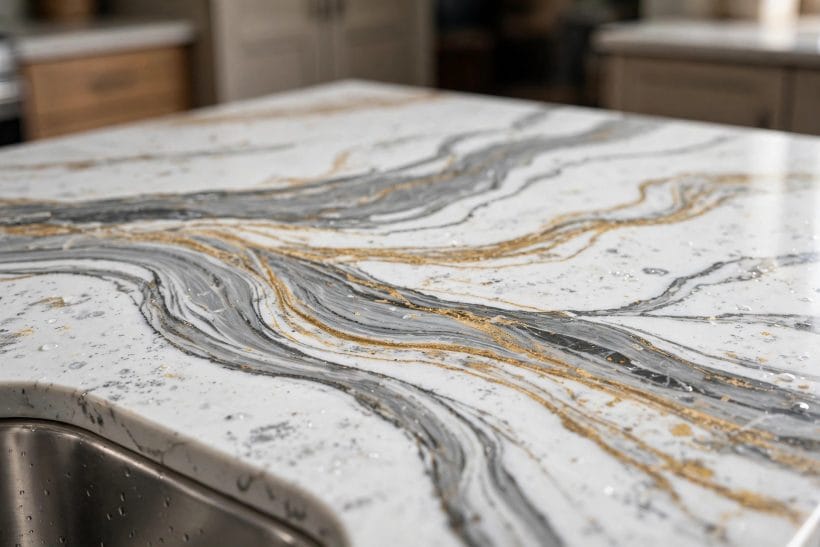
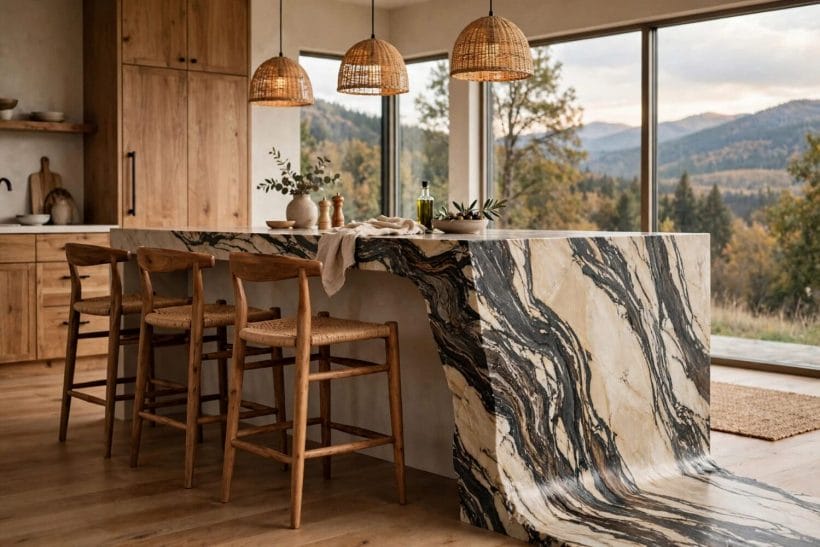
The quiet, speckled countertop has given ground to stone with something to say: broad veins of grey, gold and charcoal sweeping across a pale field, as the gallery close-up shows. In natural marble and quartzite the pattern is geology; in engineered quartz it is printed and cast with increasing confidence, which is why the direction spans price levels. What to check: veining is a whole-slab decision. A dramatic pattern that delights on an island can overwhelm a long run, seams interrupt veins rudely unless the fabricator book-matches or carefully places them, and the bolder the pattern the more its exact slab — not a sample of its cousin — deserves your inspection before templating.
The companion checks are practical ones. Ask how the slab behaves with heat, acids and oils, and what sealing it expects, following the maker’s own care guidance rather than folklore; confirm that offcuts and the sink run come from the same slab so the veining family matches; and stand in the room at the hour it gets its strongest light, because bold veins perform differently at noon and at dusk. Chosen with those checks made, a veined stone does the decorating for the whole kitchen, which is why the cabinets around it have gone so quiet.
3. Direction Two: Warm Wood Surfaces
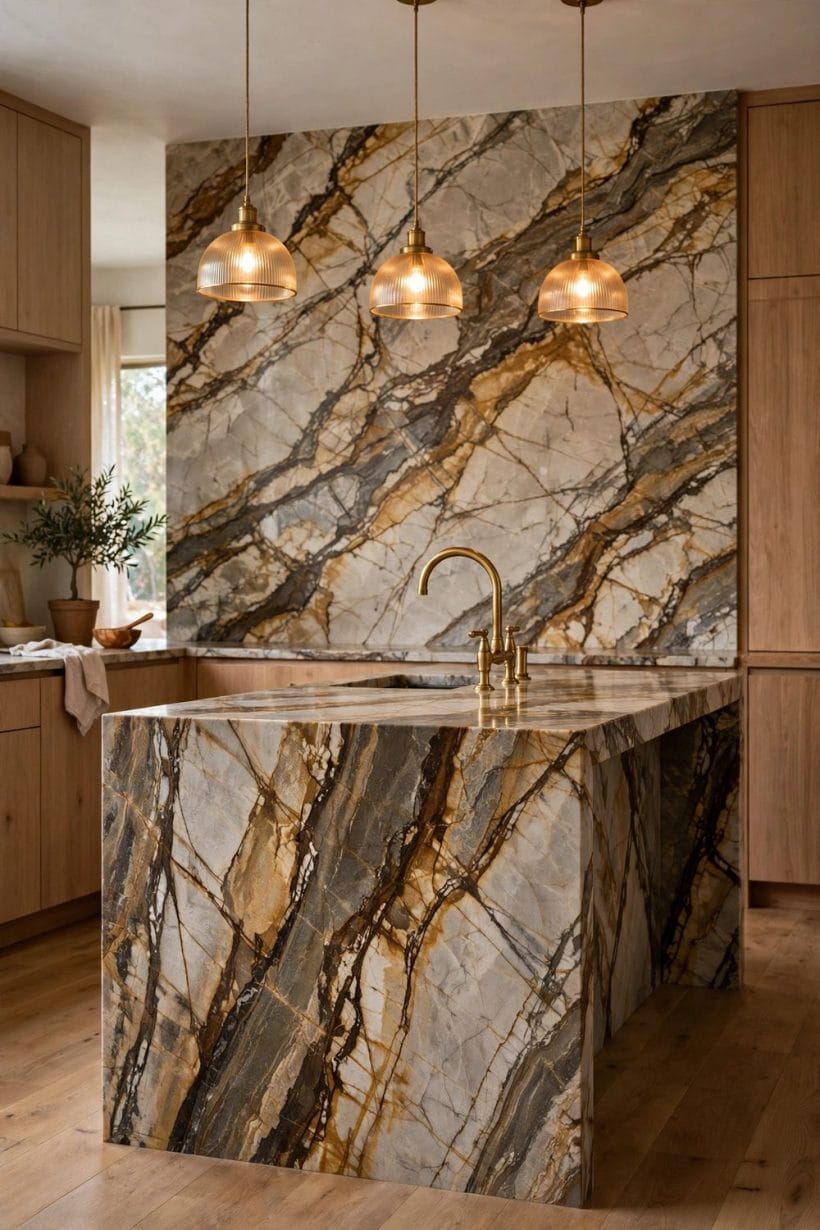
2. Warm wood surfaces and the butcher-block return
Against all that stone, wood keeps returning — as the full countertop in cottages and compact kitchens, and increasingly as the warm half of a mixed scheme. Butcher block and wide-plank surfaces bring a forgiving, repairable warmth that suits the small kitchens in tiny kitchen ideas, where one surface must be worktop, table and chopping block at once. What to check: wood and water are negotiating partners, not friends. Around sinks the finish and its renewal matter most; ask what the surface is sealed with, how often it wants attention, and whether you will honestly give it. Check end grain and joins near heat, expect the surface to record its life in marks, and decide in advance that you find that patina charming — because it is coming either way.
The compensations are genuine. Wood is quiet — plates and glasses land softly — kind to knife edges compared with stone, warm to the forearm on a winter morning, and the only common countertop material a home workshop can sand back to new. Its colours deepen rather than fade, and it pairs with painted cabinets and older houses in a way that high-pattern stone can bully. If the direction tempts you, the deciding question is not the species on the sample rack; it is whether your household will enjoy the small ritual of its care, because a wood surface that is loved looks better every year and one that is resented looks tired by the second.
4. Direction Three: Honed, Matte Finishes
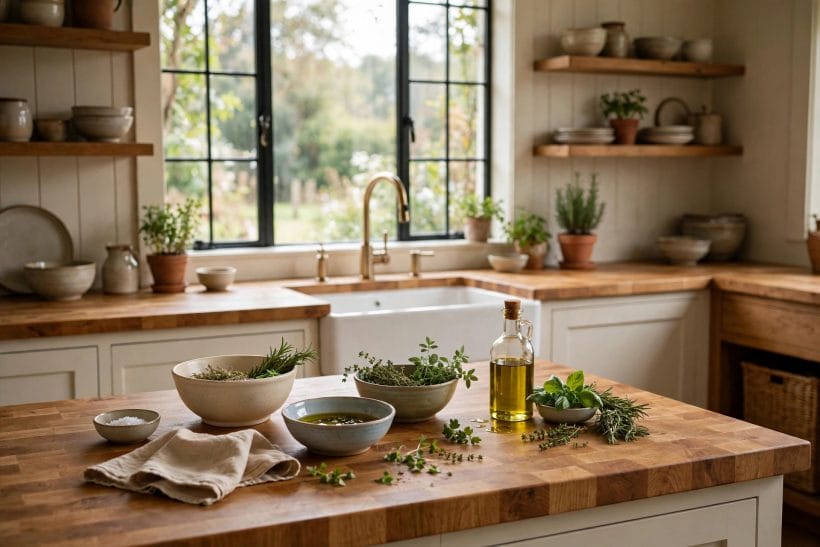
3. Honed and matte finishes over polished shine
The same stones, finished softer: honed marble and granite, matte engineered surfaces and low-sheen composites that drink light instead of throwing it back. The appeal in the kitchens gathered in tiny house kitchen design and far beyond is calm — no glare under downlights, no mirror showing every crumb’s shadow. What to check: matte finishes can show oils and fingerprints differently from polished ones, and some mark more readily while hiding scratches better; the trade is real in both directions. Handle a sample with cooking-oiled fingers before you commit, ask the maker how this exact finish is cleaned, and look at it under light raking across it, which is how your evening lighting will present it.
There is also a period argument for the matte direction: polished stone reads formal and metropolitan, while a honed surface sits comfortably in farmhouse, coastal and Scandinavian-leaning rooms, and alongside the warm wood of direction two. If the kitchen’s architecture is old or its cabinetry is painted and handmade in feel, a mirror-gloss counter can look like it arrived from a different building. The finish is therefore not a footnote to the material choice — for many kitchens it is the choice, with the material following behind it.
5. Direction Four: The Full-Height Slab Backsplash
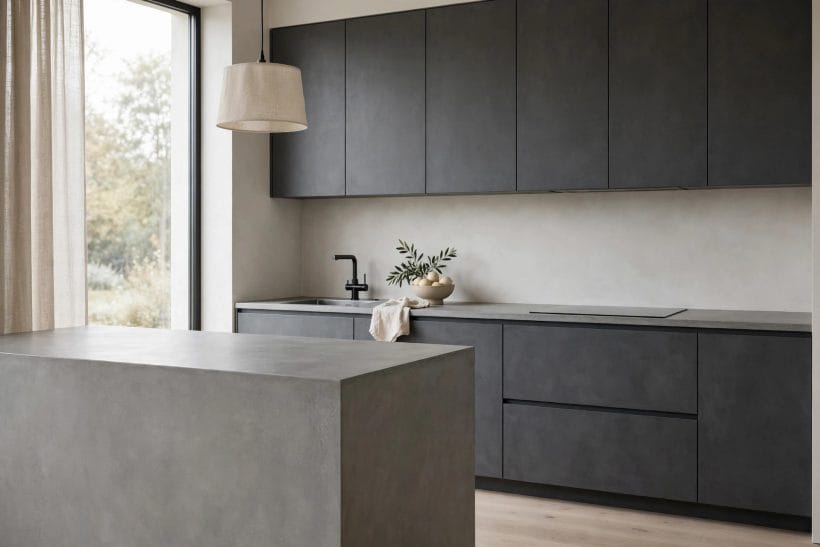
4. The countertop climbs the wall
In the feature photograph the surface never stops at the worktop line: it rises in one unbroken slab to the cabinets and beyond, replacing tile and grout with a single washable plane. As a direction it serves the veined stones especially, letting the pattern run like a landscape up the wall. What to check: the slab is heavy, the wall and cabinets must be ready for it, and sockets, rails and the hood all interrupt it with cutouts that must be templated exactly. There are no grout lines to scrub, but there is also no forgiving tile to swap if a corner is cut wrong — measuring is the whole craft here, and the fabricator’s templating visit deserves your full attention.
6. Direction Five: Mixed-Material Islands
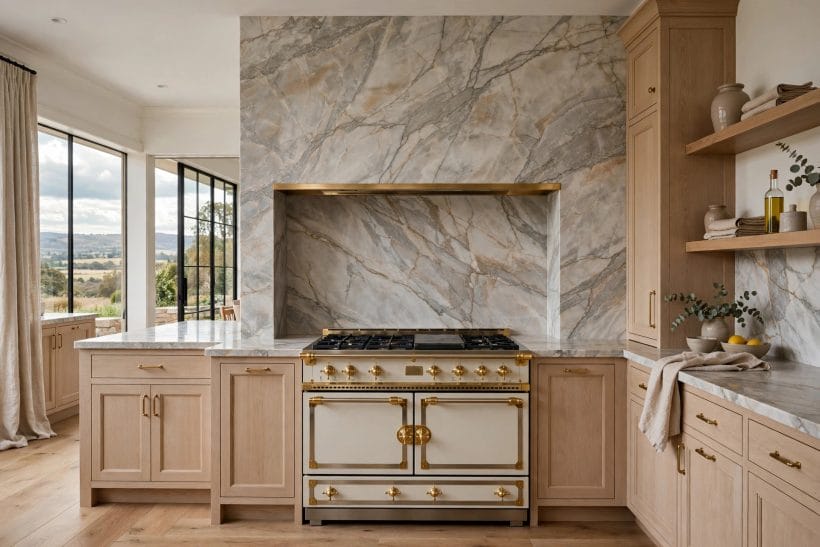
5. Two materials, each where it works best
The most practical direction of the five: the island stops matching the perimeter and starts specialising. Stone takes the wet, hot, knife-adjacent work around sink and hob; wood warms the overhang where people sit, lean and breakfast — the arrangement the compact schemes in kitchen tiny house small space design have used for years, now at full size. What to check: the junction is the design. Levels, thicknesses and edge profiles must be resolved so the two surfaces meet as a decision rather than a compromise; each material keeps its own care routine, so the household inherits two maintenance habits; and the contrast should be deliberate — a clear pairing, repeated nowhere else, reads as architecture, while three competing surfaces read as indecision.
7. What to Check: Durability, Sealing and Upkeep
Across all five directions, the honest questions are the same. What does heat do — can a pan land, or is the trivet a permanent resident? What do acids and pigments do — lemon, wine, turmeric, the daily evidence of cooking? Does the surface seal, how often, and with what? Can a chip or stain be repaired in place, or is damage forever? None of these has a universal answer; they are answered per material and per maker, which is why this survey keeps repeating its one instruction: verify with the maker of the exact surface you are buying, in writing where you can, and distrust any general claim — including a general claim in an article like this one — that promises a material never stains, never marks and never asks for care.
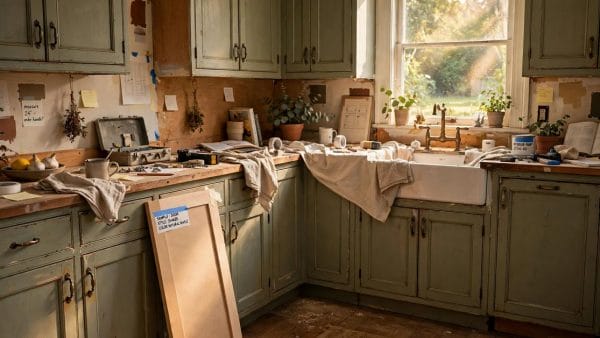
Repair deserves its own minute of the conversation. Some surfaces can be re-honed, re-oiled or locally patched until damage all but vanishes; others carry a mark for life, and a crack can mean a section replaced rather than mended. Ask what a repair visit involves before you need one, keep the offcuts from your own installation — a matching piece is the best colour reference and sometimes the repair material itself — and record the maker, the surface name and the finish in the house file. The households that stay calm about countertop accidents are the ones who asked these questions while everything was still hypothetical.
8. What to Check: Samples, Light and the Whole Slab
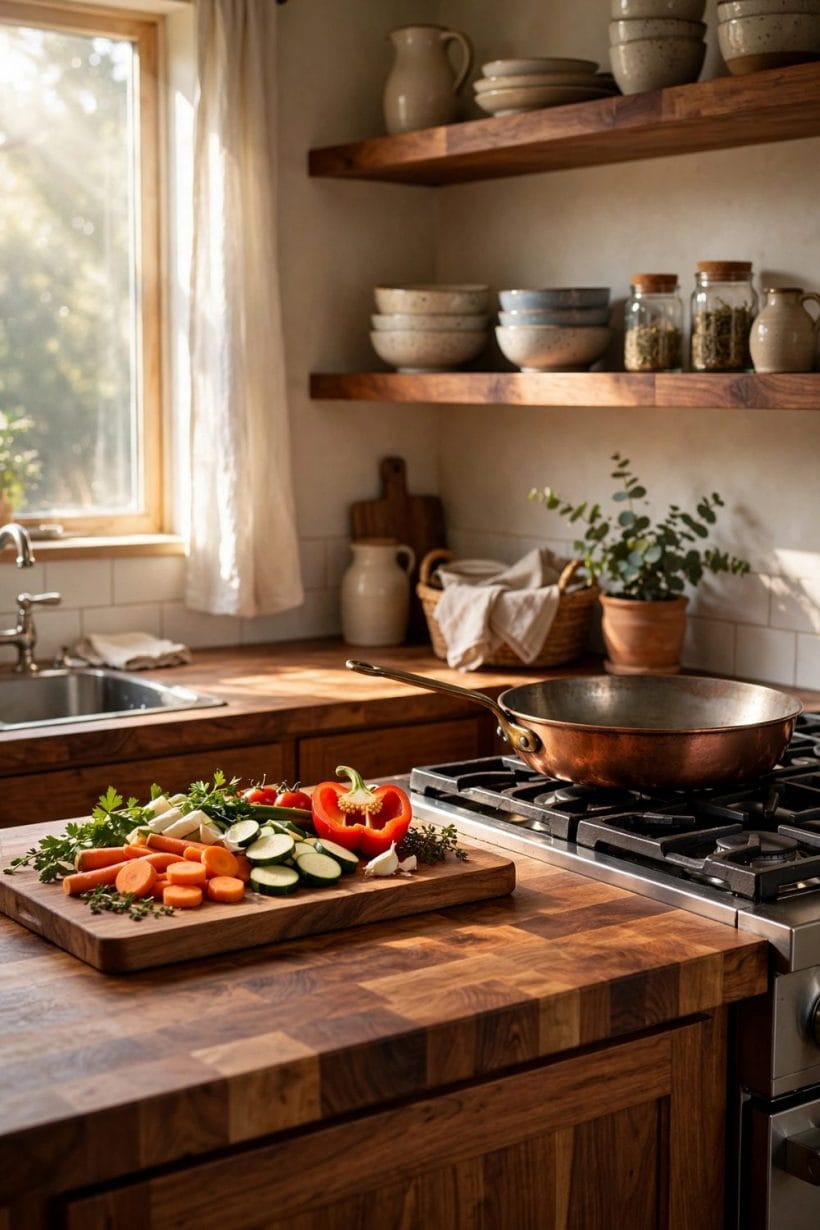
The infographic’s tip is the cheapest insurance in the whole project: order large samples and view them in your own kitchen light before choosing a slab. Countertop patterns are scale-dependent — a vein that is elegant across a full slab is chaos on a swatch and vice versa. Live with the samples on the existing counter for some days: beside the cabinet colour, under the evening lights, with a coffee ring test on the spare corner if the maker allows. For veined material, graduate from samples to the slab yard or the fabricator’s photographs of your actual slab, and agree where its best passages will fall — island first, usually, since that is where eyes rest.
Check the sample against everything it must live with, not just the cabinets: the floor’s tone, the wall colour, the metal of handles and taps, and the backsplash if the counter is not climbing the wall itself. Surfaces are rarely wrong alone; they are wrong in company. A stone that fights the floor will lose every day, in every light, and no amount of trend authority will rescue the pairing — which is why the whole company of samples should be judged together, on site, before a single slab is cut.
9. Edges, Seams and Fabrication Questions
Two kitchens can buy the same slab and receive different countertops, because fabrication is half the product. Ask about edge profiles and what each does to the material’s look and chip-resistance; where seams will fall and whether veining can be matched across them; how cutouts for sink and hob are reinforced and finished; and what thickness the price assumes, since built-up edges and full-thickness slabs are different objects wearing the same photograph. A good fabricator answers all of it plainly and shows you previous seams. The answers belong in the quote, because the quote is where drivers — material, templating, cutouts, seams, edging, the climb up the wall, fitting — become the honest total this survey refuses to guess at.
10. Choosing for the Kitchen You Actually Have
Trends are a menu, not an instruction. The veined island that sings in a large, light room can shout in a small one; the wood that forgives a farmhouse family’s life may weary a household that will never oil it; the full-height slab is serene exactly in proportion to the accuracy of its templating. Start from the cooking, the light, the upkeep you will honestly do, and the cabinets the surface must live with — then take from the five directions the one that serves those facts, and let the showrooms keep the rest. A countertop is the most-touched surface in the house; chosen for your hands rather than for a headline, it will still look right when the headlines have moved on.
One last check belongs to the household rather than the material: stand at the counter height you will actually have, with the people who will actually cook there, and mime the morning — kettle, board, pan, plates. Reach, space and the distance between sink and hob are felt in that rehearsal in a way no sample conveys. The right surface at the wrong layout still frustrates; the right layout makes even a modest surface feel generous. Choose the direction that survives both tests — the sample board and the rehearsal — and the trend will have done its real job, which is simply to show you what is possible.
Final Considerations
Bring the largest sample home, put it where the new surface will live, and cook a real meal around it — splash it, wipe it, lean on it, look at it at breakfast and at midnight. The surface that survives your actual kitchen with its dignity intact is your trend, whatever any survey says.
These five directions earn their place in current kitchens because each solves something real: veined stone gives a quiet room its drama, wood gives a hardworking room its warmth, honed finishes give bright rooms their calm, the full-height slab gives cooks a wall that wipes clean, and the mixed island gives every material the job it is best at. Keep the survey in present terms — check the maker, the sample, the seam and the upkeep — and the countertop you choose will be the one your kitchen was asking for.


0 Comments