
In a tiny kitchen, the countertop is not a detail — it is most of the room. It is your prep bench, your dining table, your desk, your landing strip for everything, and it sits in full view of the living space at all times. That is why the butcher block vs quartz tiny kitchen decision carries weight beyond its square footage. Butcher block — solid wood strips laminated into a thick, warm slab — is the light, repairable, hands-on option that asks for regular oiling and forgives nearly everything you do to it. Quartz — engineered stone, crushed quartz bound in resin and pressed into slabs — is the hard, heavy, set-and-forget option that shrugs off daily life and asks almost nothing back. Both make beautiful tiny kitchens. They make very different ownership experiences.
This comparison works through the two surfaces the way a tiny kitchen actually tests them: what each costs once fabrication is counted, how each survives knives, dropped pans, and ground-in daily wear, the maintenance rhythm each demands, how each handles hot pans and staining spills, what each does to your towing weight, and how each copes with the wettest square metre in the house — the zone around the sink. Kitchens in small homes also punch above their size in waste and water use, so our notes on zero-waste kitchens in tiny houses make a useful companion read. Then decide with the sections below, because in a kitchen this small, you will touch your countertop choice a hundred times a day.
At a Glance: Butcher Block vs Quartz Tiny Kitchen Head-to-Head
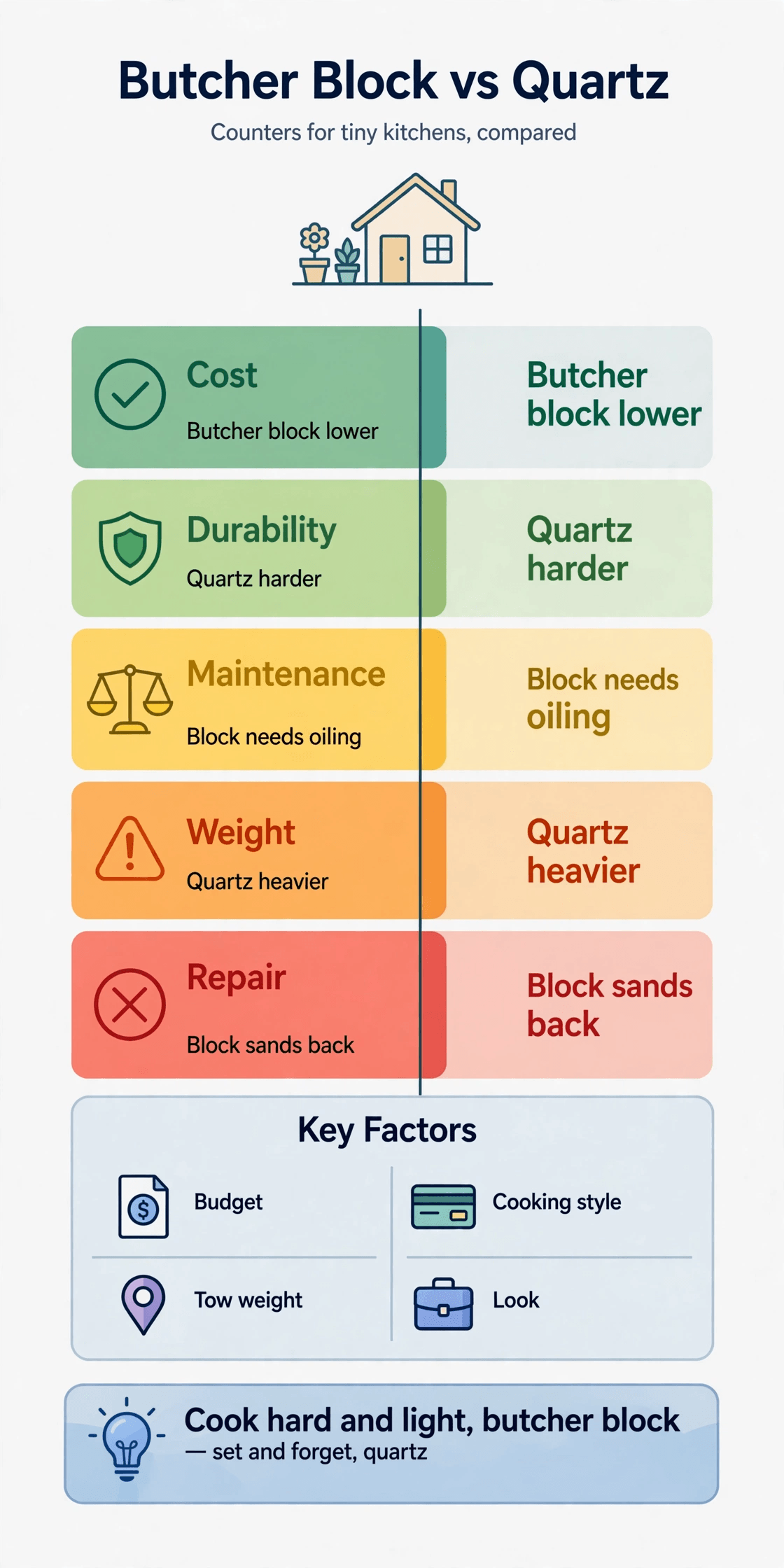
The short version: butcher block is the lighter, cheaper, DIY-friendly counter you maintain with oil and repair with sandpaper, while quartz is the heavier, pricier, professionally fitted counter you maintain with a cloth and repair — if it ever comes to that — with a phone call. The table sums up the comparison before the sections unpack each row.
| Criterion | Butcher Block | Quartz |
|---|---|---|
| Cost | Lower — slabs and pre-cut lengths are affordable, and DIY fitting keeps labour near zero | Higher — material costs more per area and professional templating and fitting are usually part of the price |
| Durability | Soft by design — it dents, scores, and records knife work, but damage is cosmetic and erasable | Very hard — resists scratches and dents in daily use; edges and corners can chip under sharp impacts |
| Maintenance | Regular — food-safe oil or finish refreshed on a cycle, more often near the sink | Minimal — no sealing or oiling; wipe-clean daily care |
| Weight for towing | Light — a fraction of the mass of a stone counter of the same size | Heavy — one of the heaviest finishes in the kitchen; counts seriously against a trailer budget |
| Repairability | Excellent — sand out stains and knife marks, re-oil, and the surface is new again | Poor for owners — chips and cracks are specialist repairs, and heat damage is permanent |
| Heat behaviour | Scorches and rings under hot pans; trivets are a way of life | Tolerates warmth but the resin can discolour or crack under thermal shock — trivets still advised |
| Stain behaviour | Stains if oil lapses, especially around water and pigments; most stains sand out | Highly stain-resistant in daily use; strong pigments left sitting can mark pale colours |
| Water tolerance | The weak point — standing water swells and blackens wood if the finish fails near the sink | Excellent — non-porous surface is indifferent to splashes and standing water |
| Looks and feel | Warm, natural, forgiving; gains character and patina with age | Crisp, cool, consistent; looks the same in year ten as in week one |
| Best suited to | DIY builds, towed houses, tight budgets, and cooks who like a working surface | Stationary houses, low-maintenance lives, and anyone who wants the kitchen finished permanently |
1. Two Countertop Materials: Joined Wood vs Engineered Stone
Butcher block is exactly what its name promises: strips of hardwood — maple, oak, walnut, birch, and acacia are the common offerings — glued edge to edge into a slab, typically with the grain running the length of the counter. It is a solid timber product, sold in standard lengths at building suppliers, cut with ordinary woodworking tools, and finished with food-safe oil, a hardening oil finish, or a film finish depending on how the owner wants it to behave. Because it is wood, it moves: it swells slightly with humidity and shrinks as the air dries, and a good installation leaves it room to do so without splitting or bowing.
Quartz countertop material is manufactured rather than grown. Crushed quartz — one of the hardest common minerals — is combined with resins and pigments and pressed under vacuum into dense slabs with a consistent pattern and colour. It is not natural stone in the way granite is, and it is not plastic in the way laminate is; it sits between the two, with a stone-like hardness and weight and a factory-controlled appearance. Slabs are cut, edged, and polished by fabricators using templates of your actual cabinets, then delivered and fitted, usually with seams joined and levelled on site.
The philosophical difference matters in a tiny kitchen. Butcher block is a material you receive and finish yourself, imperfect and adaptable. Quartz is a product you order and have installed, precise and final. One invites participation; the other promises completion. Neither attitude is wrong, and you will meet both again in every section of this comparison — in the costings, in the maintenance, and most of all in what happens the first time something goes wrong on the surface.
2. Cost: Countertop Slabs, Offcuts, and Fabrication in a Small Kitchen
Keep the standing honesty rule in view: prices move with region, species, brand, and fabricator availability, so treat every figure anyone quotes you — including in adverts — as a prompt to get your own quote. The shape of the two budgets, though, is consistent. Butcher block is the inexpensive route into a genuinely premium-feeling counter. Standard slabs are commodity items at home centres, a tiny kitchen’s counter run is short — often a single standard length covers it — and an owner with a saw and a sander pays no labour at all. Offcuts become chopping boards, shelves, and the bathroom vanity top, so even the waste line of the budget behaves itself.
Quartz prices start higher per unit area, and the material is only the first line. Templating, cutting, edge profiling, sink cut-outs, delivery, and fitting are skilled, equipment-heavy work, and fabricators price them accordingly, often with minimum charges that a very small kitchen still pays in full. That minimum-charge reality is the tiny kitchen’s specific quartz trap: your counter is a third the size of a suburban one, but the job’s fixed costs are not a third of the price. The honest counterweight is that a tiny quartz installation is still a modest project in absolute terms, and what it buys — a finished, sealed, permanent surface — arrives complete in a single day.
Run the numbers over ownership years before deciding. Butcher block’s low entry price is followed by small recurring costs: oil, the occasional sanding consumables, and your own time valued at whatever you value it. Quartz’s entry price is followed by almost nothing until an unlikely repair. For a kitchen you will own for two years, the arithmetic is not the same as for a twenty-year house, and both answers can be correct. What is never correct is comparing a raw slab price for one against an installed price for the other — insist on like-for-like totals, fitted and finished, before the comparison in this section means anything at all.
3. Daily Durability: Knife Marks, Dents, Chips, and Edges
Quartz wins the hardness contest on paper and mostly in life. Its surface resists the scratches of daily cooking — dragged pans, grit under a chopping board, keys and tools set down mid-project — with a composure butcher block never pretends to. In a tiny kitchen where the counter doubles as a workbench and a hallway surface, that hardness is not vanity; it is the difference between a surface that forgives your whole life and one that records it. The qualification is impact: quartz is hard but not elastic, and a heavy cast-iron pan meeting an edge or corner at the wrong angle can chip it, a wound that does not sand out.
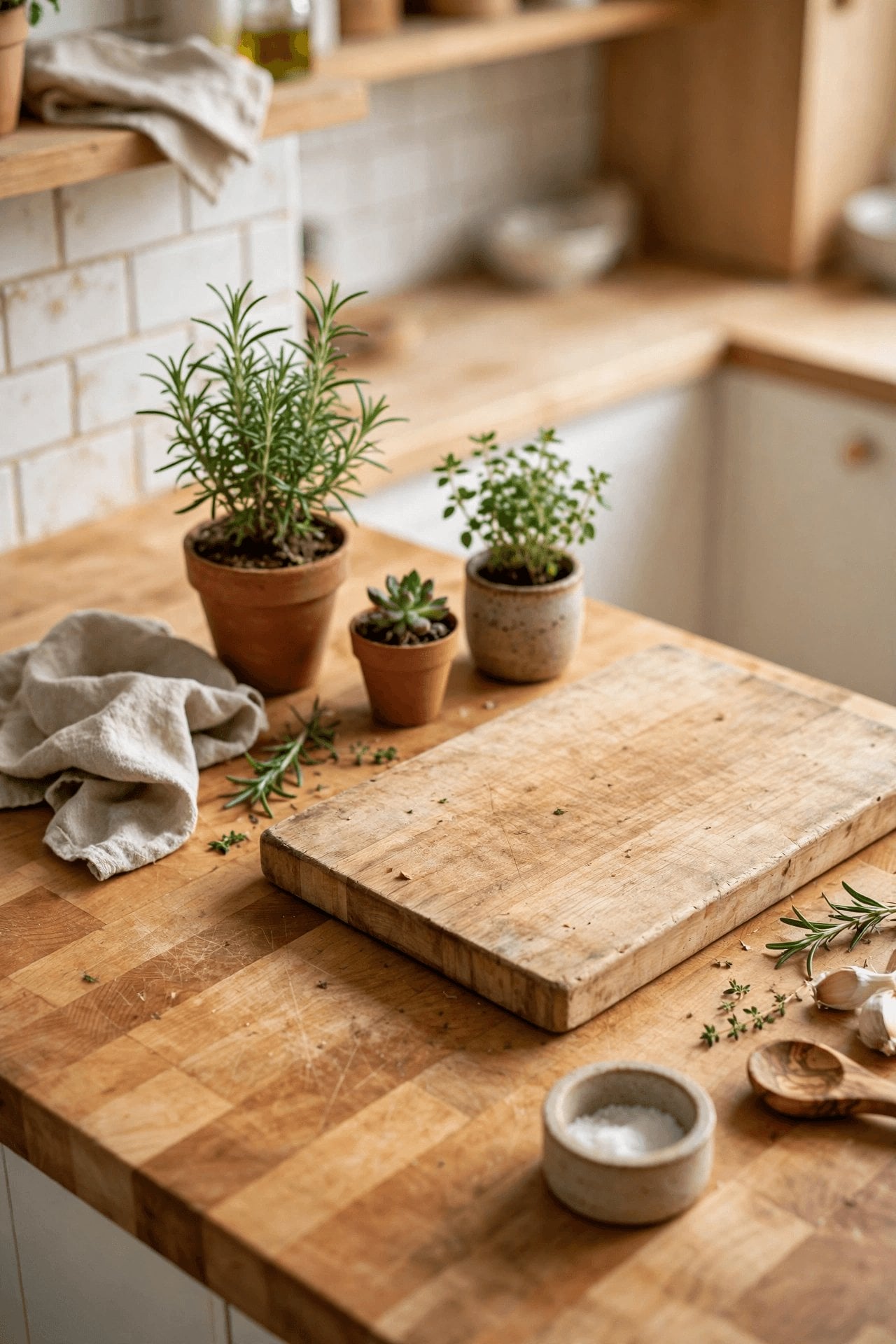
Butcher block dents and scores because it is wood, and the working cook’s surface will accumulate knife marks if you cut directly on it — most owners use boards for heavy work and accept light scoring as patina — plus the dents of dropped jars and the darkened ring where the kettle lives. Here is the honest reframe, though: everything in that list is shallow. The damage sits in the top fraction of a thick, solid slab, and the slab’s answer to damage is section 9 of this article. Wood’s durability strategy is not resistance; it is renewability, and judging it purely on hardness misses the design.
Edges deserve their own sentence in a small kitchen, because in a small kitchen you brush past the counter corners a hundred times a week carrying laundry, firewood, and shopping. Both materials should be ordered or finished with softened — eased or rounded — front edges: kind to hips, kinder to dropped-item impacts, and in quartz’s case the edge profile is part of the fabrication order, so decide it before the template, not after. Durability, in the end, is partly a property of the material and partly a property of the household: tidy, board-using cooks keep wood beautiful for decades; energetic, multi-use households will test quartz’s chip resistance in ways its brochure never pictured.
4. Maintenance: Oiling and Sealing vs Wipe-and-Forget
Butcher block has a rhythm, and you should choose it only if the rhythm sounds pleasant rather than burdensome. Finished with food-safe oil — the traditional choice for a working block — the surface wants re-oiling on a cycle that depends on use: frequently in the first weeks as the wood drinks, then settling into a routine of light refreshes, with the sink surround asking for the most attention. An oil finish keeps the wood’s matte, natural feel and lets spot repairs blend invisibly. Hardening-oil and film finishes stretch the interval considerably in exchange for a slightly less natural feel and more involved repairs. Either way, there is a calendar involved, and the calendar is yours to keep.
Quartz’s maintenance instructions can be written on the cloth you clean it with: wipe it down. No sealing schedule exists because the surface is non-porous by manufacture; no oil, no wax, no annual weekend. Daily care asks only for mild cleaners and a refusal to scour it with abrasive pads or attack it with harsh chemicals that can dull the resin. For owners whose tiny life is already full of maintenance rhythms — water filters, compost systems, wood stoves, batteries — a counter that requests nothing has a value beyond its price.
Do not skip the indoor-air angle in a kitchen this small: cooking moisture is the dominant load on a tiny house’s air, and while it matters far more to walls and windows than to counters, the ventilation habits in our guide to tiny house ventilation with HRV and ERV systems also protect a wood counter’s finish from the constant humidity cycling that ages it fastest. Maintenance verdict: if oiling a board sounds like a small, satisfying ritual, butcher block will feel cared-for rather than demanding. If it sounds like exactly the kind of chore you moved tiny to escape, believe yourself, and choose quartz.
5. Heat and Stains: Hot Pans, Red Wine, and Turmeric Reality
Neither of these surfaces is a trivet, and a tiny kitchen — where the pan comes off a two-burner hob and needs somewhere to go immediately — is exactly where that fact gets tested. Butcher block meets a hot pan with scorching: a darkened ring, or worse from a heavy pan straight off high heat, and repeated heat in one spot dries and can crack the wood. The damage is, characteristically, sandable — but the lifestyle adjustment is real. Trivets, pan stands, and one clear landing zone become part of how the kitchen runs.
Quartz handles everyday warmth calmly but carries a specific vulnerability its marketing understates: the resin that binds it can discolour under sustained heat and can crack under thermal shock — a screaming-hot pan on a cold slab is the classic scenario — and that damage is effectively permanent. So the quartz rule is identical to the wood rule in practice: trivets, always, and never let the slab’s stone-like confidence talk you out of them. Score this criterion as a draw at the level of behaviour, with different failure styles — wood forgives its failures in the sanding; quartz punishes rarer failures permanently.
Stains divide them more cleanly. Quartz’s non-porous face resists the tiny kitchen’s whole pigment arsenal — coffee, wine, beetroot, turmeric, tomato — in daily service, with only the caution that strong colours left to sit for many hours on pale slabs deserve a prompt wipe rather than overnight residence. Butcher block, if its oil is fresh, sheds most spills too, because the finish is doing the work; if the oil has lapsed, pigments and water walk straight into the grain and announce themselves. The consolation is structural: a stain in wood is a surface event on a thick slab, and section 9’s sanding routine retires most of them completely. Honest summary: quartz resists stains by nature, butcher block resists them by maintenance — which is this entire comparison in one sentence.
6. Weight for Towing: What a Stone Counter Adds to the Trailer
On a foundation, this section would not exist. On a trailer, it might decide the article. Engineered quartz is stone-weight material: a counter run of it is one of the heaviest single fit-out items in a tiny kitchen, and its kilograms sit exactly where a builder is already loading cabinetry, appliances, and stored water. Butcher block, at the same dimensions, is dramatically lighter — solid wood is simply a far less dense material than pressed stone — and in the arithmetic of a house being weighed against a trailer’s gross limit, that difference can equal a meaningful share of your remaining payload for everything else you own.
Weight in a kitchen has a second effect beyond the total: concentration. A stone counter’s mass rides on the cabinet boxes and the trailer frame in one zone of the house, and seasoned tiny builders think about distributing heavy fit-out items with the same care they give the walls and finishes — the philosophy behind our look at lightweight interior wall finishes for tiny houses applies with twice the force to counters. There is also a transport subtlety specific to quartz: a rigid, brittle slab dislikes flex, so the house’s towing life should be gentle, the counter well supported underneath, and the sink cut-out — the slab’s weakest geometry — given respect in how the cabinets beneath are built.
The counterweight argument, fairly stated: a tiny kitchen’s counter is small, so the absolute numbers are small too, and a build with comfortable weight margin will never feel the difference except on the day of installation. Stationary houses should score this section near zero. But the build hovering near its trailer limit — and there are many — should weigh both counters, literally or at least on the supplier’s stated weights, before falling in love with either. In weight-critical tiny houses, butcher block does not merely win this section; it can be the decision that lets the water tanks travel full.
7. Water, Sinks, and the Wettest Square Metre in the House
Every countertop material has a nemesis, and butcher block’s is standing water. Around a tiny kitchen sink — where splashes are frequent, space is too tight for drip trays, and a cloth lives permanently at the tap — an oil finish that lapses lets water into the end grain and joints, where it swells the wood and leaves the dark staining that owners dread. The defence is a system, not a hope: seal every face and edge of the slab including the sink cut-out, choose finishes honestly rated for wet zones, wipe water as a habit rather than a chore, and consider the undermount-versus-topmount decision carefully, because the rim where sink meets wood is where the battle is fought. Done properly, wood survives sink duty for years; done casually, it shows within a season.
Quartz is indifferent to the whole question. Its non-porous surface neither swells nor stains around the tap, the sink junction is a neat line of silicone rather than a maintenance frontier, and the day’s splashes are a wipe rather than a worry. In a wet-bath style tiny build where water discipline is already being designed carefully, that indifference is worth real money in peace of mind; the bathroom counterpart of this thinking appears in our guide to waterproofing a tiny house bathroom, and the same materials logic — non-porous where water lives — argues quartz’s case here.
Plumbing is the shared subplot. Whichever slab you choose, the sink position, tap holes, and any filter or instant-hot-water fittings are decided at counter stage and are expensive to change later — especially in quartz, where every hole is a fabrication decision. Plan the under-sink space with the same care as the surface above it; our breakdown of PEX versus copper plumbing for tiny houses will help you think about the pipework the counter will hide for a decade. Water verdict: quartz wins the wet zone by nature, butcher block survives it by discipline — and in a one-sink house, that zone is a large fraction of your entire counter.
8. Looks, Warmth, and How Each Surface Ages
Stand in a tiny kitchen and the counter is at eye level, hand level, and lamplight level simultaneously, so its visual temperature matters. Butcher block is warm in every sense: honey tones, visible grain, a surface that is matte and faintly soft to the touch, that takes the echo out of set-down mugs and makes a small room feel like a cabin galley in the best way. It also changes — deepening in colour, collecting a constellation of faint marks that owners read as the diary of meals cooked — and whether that ageing reads as charm or as wear is a genuine personality question, not a quality one.
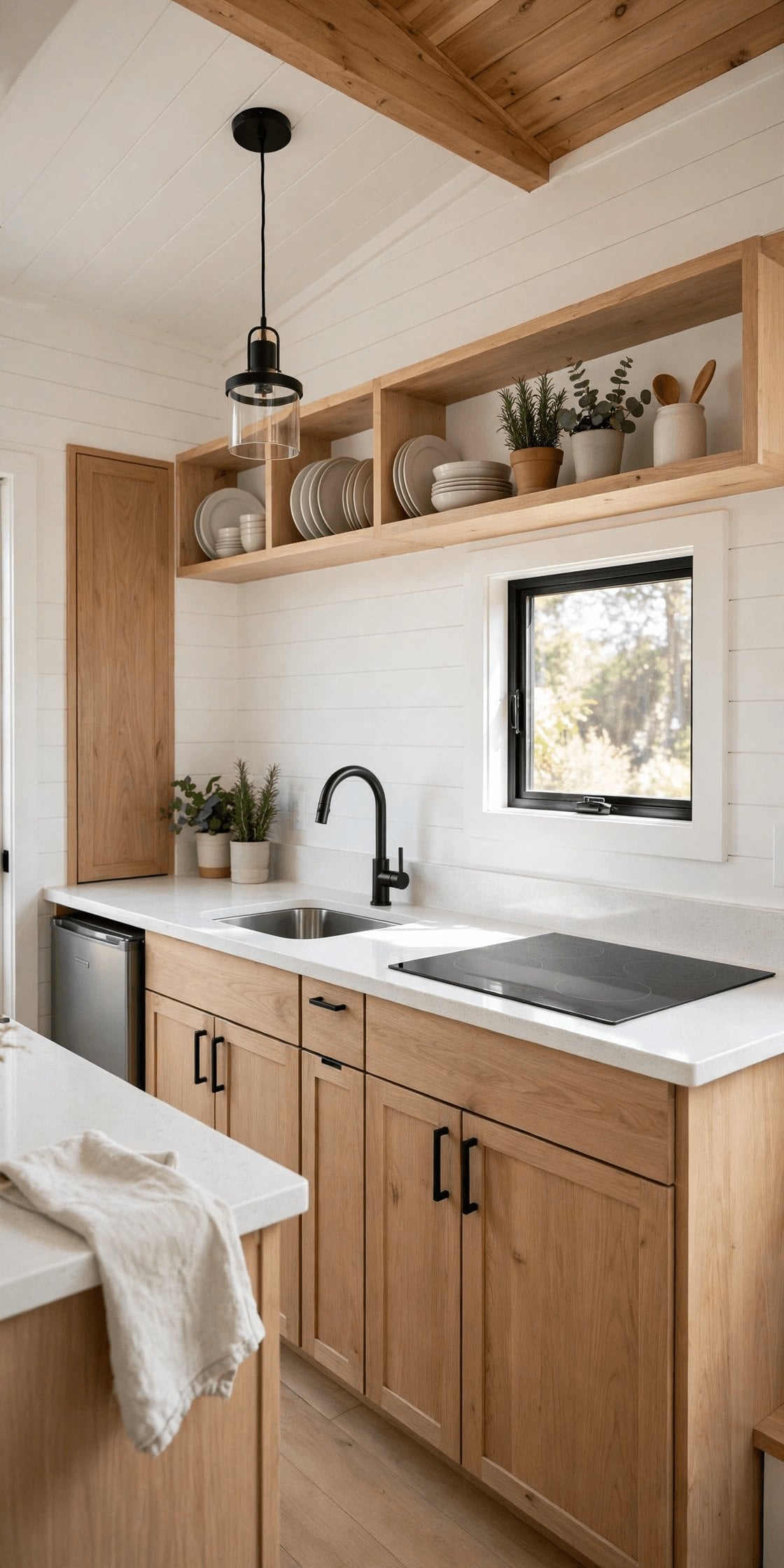
Quartz is cool, crisp, and consistent: flat planes of white, grey, black, or stone-patterned colour, with veining if you choose it, a polished or honed face that reflects light around a small room and makes the kitchen read as a designed object. It pairs with modern cabinetry and steel the way wood pairs with everything rustic, and its superpower is stasis: the counter in year ten is the counter from the photographs in week one, unmarked by the decade. For owners who rent their tiny house out, photograph it, or simply like a room that resets to new each morning, that stasis has real value.
Small-space design sense adds a practical note to the aesthetics: in the tiniest kitchens, the counter often continues visually into a dining ledge, a desk, or a fold-down table, and butcher block’s ability to be cut, extended, and matched by any competent woodworker later gives it a flexibility quartz’s fabricated pieces cannot follow. A quartz kitchen is finished when it is installed. A butcher block kitchen can keep evolving — an argument that belongs to looks as much as to installation, and one that suits the way tiny houses are actually lived in, changed, and improved over time.
9. Repairability: Sand It Out vs Call the Fabricator
This is butcher block’s home turf, so give it its full due. Knife scores, water rings, stains, scorch marks, the darkened patch by the sink: nearly the whole catalogue of countertop injuries is erased from a wood slab with sandpaper, working down through the grits, followed by fresh oil. A thorough refinish of an entire tiny counter is an afternoon’s pleasant work, costs almost nothing, needs no professional, and can be repeated many times across the slab’s life because the material is solid all the way through. The counter you install at year zero can be literally resurfaced at year ten. Few building materials anywhere offer that deal.
Quartz repairs sit at the opposite pole. A chip at an edge can be filled with colour-matched resin by a professional and made nearly invisible — at professional prices, with professional scheduling. A crack, a heat-damaged patch, or a failed seam is generally not repairable to original standard at all; the realistic options are living with it, disguising it, or replacing the piece. To be fair, quartz’s hardness means these events are rare — the repair question arises for a small minority of owners — but when it arises, the owner has almost no agency in it. You are a customer for a repair industry, not the repairer.
Let your household’s honesty arbitrate. Owners who are handy, who own a sander already, and who find the idea of refinishing their own counter satisfying should score this section heavily for wood. Owners who know — really know — that a damaged counter would sit unrepaired for a year while they meant to get around to it should note that quartz’s strategy is to make repair unnecessary in the most, which is a section aimed at them. Repairability only has value to people who repair.
10. Installation: Saw-and-Screw DIY vs Templates and Professionals
Butcher block is one of the most DIY-friendly installations in the entire tiny build. The slab is cut to length with a circular saw, the sink opening with a jigsaw, edges are eased with a router or sander, and the whole thing is fixed down with screws through the cabinet tops — with fixings that allow the wood its small seasonal movement. A careful beginner can template in cardboard, cut once, and have a fitted, oiled counter in a weekend, and the material’s low price forgives the learning curve: the offcut from a mistake is a shelf, not a write-off. It is also light enough for one person to handle, which in a solo tiny build is not a trivial virtue.
Quartz installation is a professional sequence: the fabricator visits with templates once cabinets are fixed and level, the slab is cut and polished in a workshop, delivered — carefully, because a long piece is heavy and its sink cut-out is fragile — and fitted, seamed, and levelled on site. The owner’s role is decisions, scheduling, and a clear room. Timelines stretch to the fabricator’s calendar, mid-build changes are expensive or impossible once cutting starts, and the cabinets below must be finished, true, and staying exactly where they are, because the stone will not be adjusted to meet them later.
One planning note binds the two routes: the sink and tap layout must be final before either installation begins, and in a tiny kitchen that layout is a plumbing layout too — the thinking in our guide to tiny house plumbing layout and DWV design belongs in the same afternoon as your counter measurements. Installation verdict: butcher block belongs to the self-builder as surely as quartz belongs to the owner who wants to sign one cheque and cook dinner the same evening the fitters leave.
Final Considerations
Reduced to one line, this comparison is between a surface you look after and a surface that looks after itself. Butcher block asks for oil, for trivets, for water wiped when it lands, and in exchange gives you warmth, lightness, a DIY installation, a forgiving answer to every accident, and a price that leaves budget for the rest of the kitchen. Quartz asks for money, for weight capacity, for decisions made permanently and early, and in exchange gives you a hard, cool, indifferent surface that will ask nothing of you for as long as you own the house. Neither request is unreasonable. Both become unreasonable only when they mismatch the owner.
So, who should pick which? Choose butcher block if you are building it yourself, if your house travels and its weight budget is spoken for, if your budget needs the counter line to be small, or if the idea of sanding a decade’s marks out of your own worktop sounds like an afternoon well spent. Choose quartz if the house is stationary, if maintenance-free is a genuine lifestyle requirement rather than a slogan, if your kitchen is small enough that the fabricator’s minimum charge still buys a whole permanent kitchen, and if you are confident the layout will never need to change. Wet-zone-heavy cooks who never remember to wipe a splash should weigh section 7 twice before wood; serial remodelers should weigh section 8 twice before stone.
Whichever surface you choose, its neighbours complete the kitchen: the sink, tapware, and water system beneath it deserve the same deliberate thinking, and owners designing off-grid should look at how the kitchen’s water is sourced and drained in our survey of off-grid tiny house water systems. A counter is touched more often than any other surface in a tiny home. Choose the one whose care routine — or glorious absence of one — matches the life you are actually going to live on it.


0 Comments