
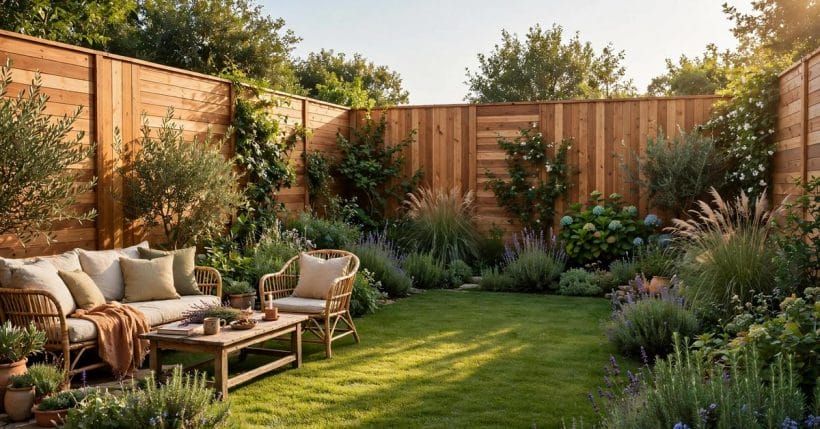
A fence can mark a boundary without giving you a private garden. The difference is sightline: the moment a solid, well-placed screen breaks the view from a neighbour’s window or the pavement, the garden becomes a room of your own.
These seventy-five ideas cover privacy fence ideas only: solid panels, slats, living screens, toppers and layered planting that block views kindly — heights and boundary rules referred to your local rules throughout, and costs kept to honest drivers.
1. Privacy Fence Ideas at a Glance
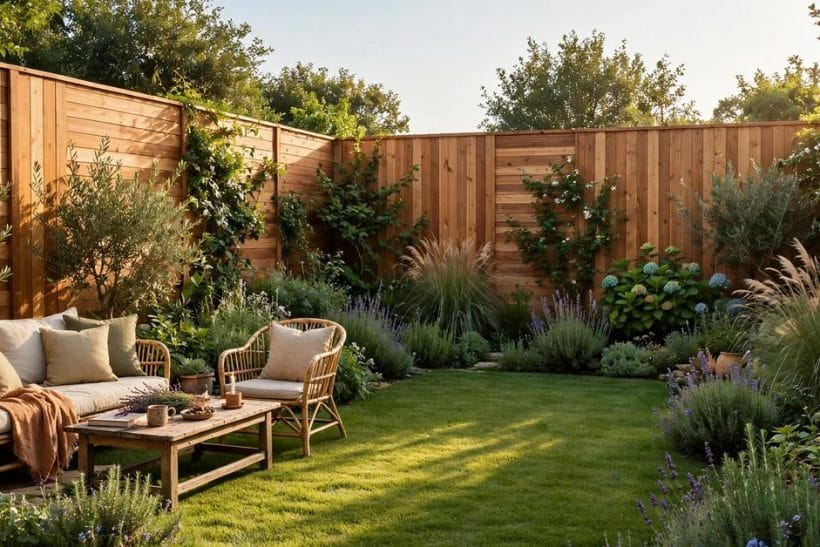
The central entity is the privacy fence: a boundary structure whose job is visual screening first and enclosure second, its attributes being height against sightlines, solidity of panel, material, corners and slopes, and the planting layered against it. This post keeps one slice of a wide fence family: the fence that opens and closes lives in the gate ideas pillar; modern boundary style is gathered in modern gate design; and the open mesh world of hog wire fence answers a different question — containing animals while keeping the view. Here the view is deliberately closed. The feature photograph shows the classic answer: warm horizontal boards, planted deeply on the garden side, turning an overlooked plot into a green room.
| Question | Short answer |
|---|---|
| What makes a fence private? | Solidity and sightline: no gaps at eye level, enough height to break the view from the angles that overlook you, and corners and gates screened as carefully as the straight runs |
| Which materials screen best? | Close-boarded timber, horizontal slats, composite boards and masonry all block views fully; hedges and layered planting screen softly and improve with age |
| How tall can it be? | Boundary heights are set by local rules and sometimes by agreement with neighbours; check your local position before building rather than copying a height from a photograph |
| What does it cost? | Drivers only: length and height of the run, material, post and footing work, gates, ground conditions, and whether old fencing must come out first |
| What about the neighbours? | A privacy fence has two faces; a finished face outward, honest conversation first, and planting on your side keep the boundary friendly as well as private |
2. Layouts and Sightlines: Blocking the View That Matters
Privacy is geometry before it is joinery. Stand where the overlooking eyes are — a landing window, a raised deck, the pavement — and note which seats and windows fall inside that cone of view. Most gardens need full screening in only a few places; these ideas place the solidity where the sightlines actually run.
1. A full-perimeter solid boundary
The complete answer: every side closed with the same solid treatment, no angle left open. It suits overlooked urban gardens best and asks the most of budget — which is why the sections that follow break it into softer pieces.
2. Screening only the overlooked side
Where one boundary does all the overlooking — a taller house behind, a footpath on one flank — spend the height and solidity there and let the other sides stay lower or greener. The garden feels larger when not every wall of it is tall.
3. An angled screen inside the boundary
A short run of solid fence set at an angle inside the garden, like a baffle, can guard a seating area without fencing the whole plot. Block the line, not the landscape.
4. A privacy screen for the terrace alone
The seats are what need hiding, not the lawn. A panel or two behind the terrace furniture, extended just past the sitting zone on each side, gives a private room outdoors while the rest of the boundary stays open and friendly.
5. Stepped heights along one run
Let the fence rise where the overlooking window is and step down where the view closes. It uses less material and keeps light falling into the garden’s quieter corners.
6. A double layer: fence plus inner screen
Where one solid line feels stark, set a second, lighter screen inside it — a slatted panel or trellis a short step into the garden. The eye stops at the nearer layer, the boundary disappears behind it, and climbers get somewhere to go.
7. Corner-first planning
Corners leak views: a diagonal sightline crosses two gardens at once. Wrap the solid treatment around corners generously before spending on the middle of runs, and plant the corner itself with something evergreen and dense.
8. Screening the view from above
Upstairs windows look down, and a vertical fence alone cannot answer them. A pergola beam, a sail, or a small tree canopy over the seating answers the downward view — privacy from above is a roof problem.
9. Gates that keep the secret
A solid run undone by an open gate is money wasted. Match the gate’s solidity to the fence, mind the gap beneath it, and set its swing so the garden is not displayed every time it opens.
3. Timber Panels: Board-on-Board and Close-Boarded Classics
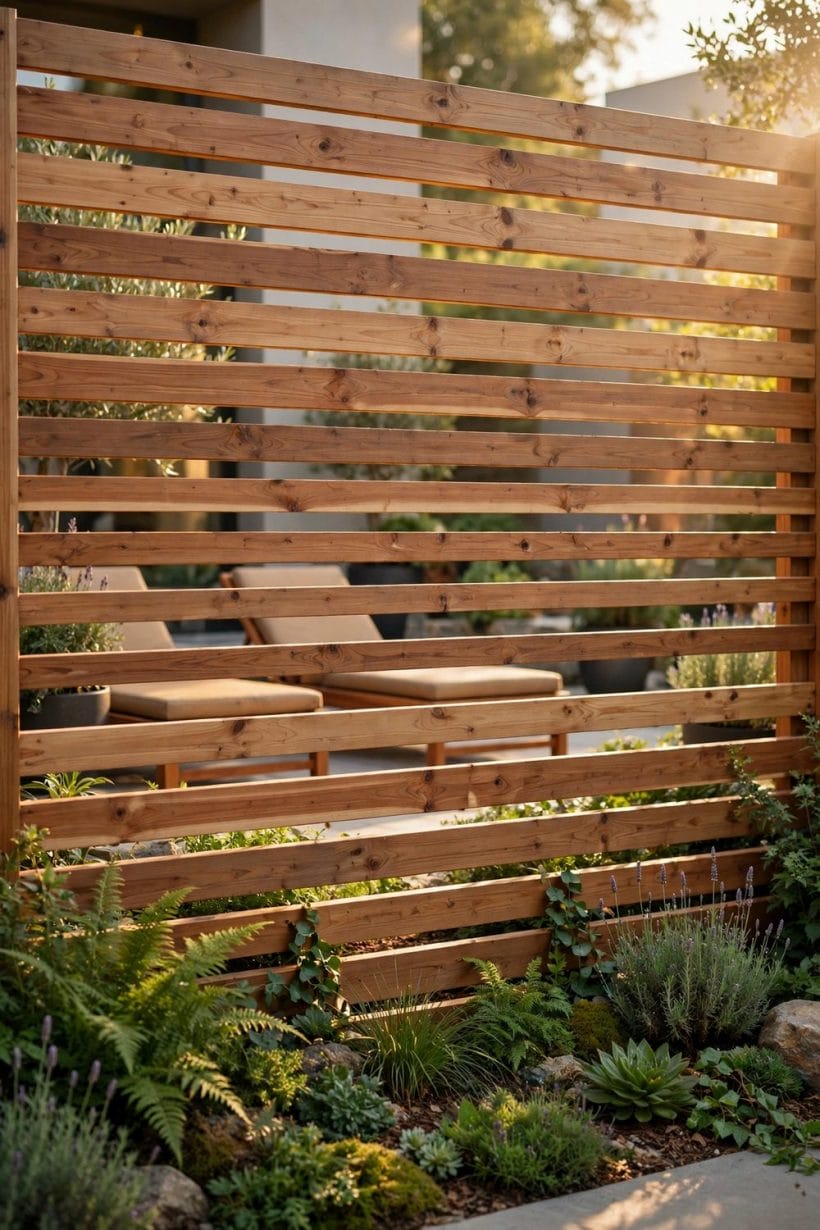
Timber is the default privacy material: repairable board by board, warm to live beside, honest about its upkeep. The patterns here differ in how they handle a wooden screen’s two enemies — gaps as boards shrink, and weather at the end grain.
10. Close-boarded vertical panels
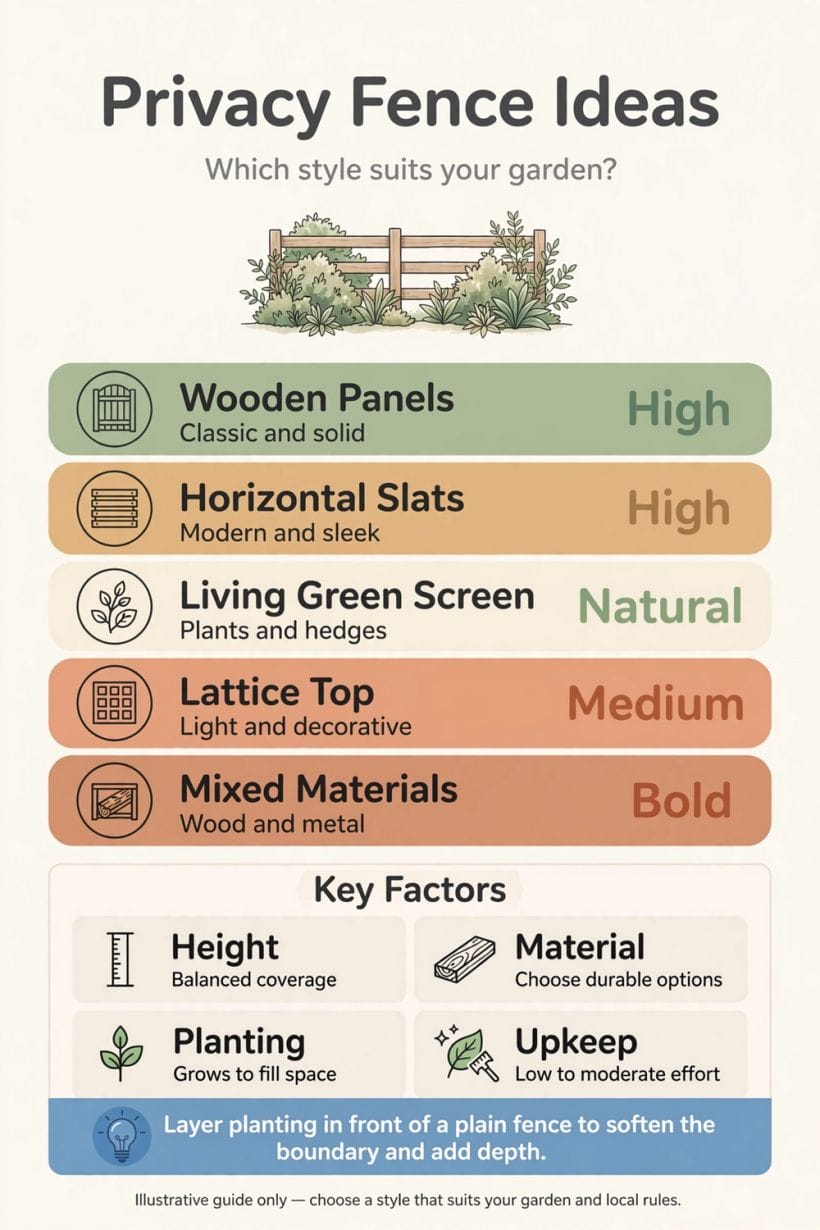
Vertical boards butted tight on horizontal rails: the workhorse of private boundaries, calm and regular from the garden side. Its privacy depends on boards staying tight, so sound fixings and a gravel board at the base matter more than ornament.
11. Board-on-board overlap
Two layers of vertical boards, the second covering the joints of the first. When timber seasons and shrinks, the overlap keeps the screen solid — the pattern for absolute visual closure.
12. Featheredge boards
Boards tapered like feathers, each overlapping the next, giving a ribbed face full of shadow lines. It is economical, forgiving of uneven ground when stepped, and reads cottage rather than contemporary — a good match for planted, informal gardens.
13. Hit-and-miss boarding
Boards alternated on either side of the rails, blocking the straight-on view while letting some air and light pass. From an angle it opens slightly, so place it where oblique sightlines are not the problem.
14. Tongue-and-groove panels
Interlocking boards give the flattest, most finished face of any timber pattern — the fence as wall, suiting painted schemes and formal gardens. Keep the bottom edge clear of soil so the interlock stays dry.
15. Shadowbox fencing
The neighbourly pattern: boards alternate sides so both gardens see a finished, textured face and neither gets the rails. Where the boundary is shared and relations matter as much as screening, the shadowbox earns its extra timber.
16. Painted timber in a deep colour
Dark stain or paint makes a fence recede: foliage reads brighter against it and the boundary line softens. Deep greens, charred browns and near-blacks all disappear behind planting in a way pale timber never quite manages.
17. Natural cedar left to silver
Some timbers are best left alone to weather grey, gaining a silvery calm that suits coastal and modern gardens. Choose this where maintenance access is awkward — a finish that expects nothing keeps its dignity.
18. A capped top rail
A broad cap along the top sheds water off the end grain and finishes the silhouette. Small detail, long consequence: most fence rot begins at an unprotected top edge.
4. Horizontal Slats and Modern Screening
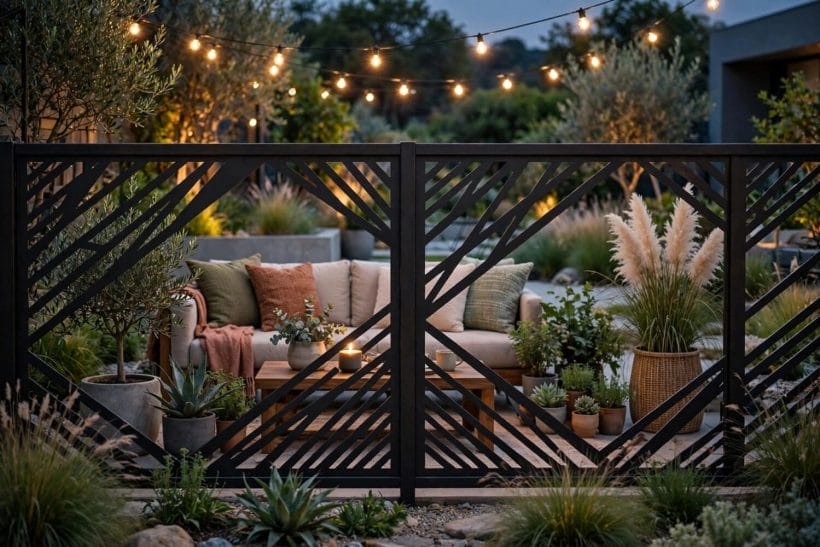
Turn the boards sideways and the fence changes character: long horizontal lines widen a small plot and suit contemporary houses. The privacy lives in the spacing — the closer the slats, the more complete the screen.
19. Tight horizontal slats
Slats fixed close, edge to edge in effect, give the modern garden a calm, architectural wall. The rhythm of shadow between boards does the decorating, so keep the timber species consistent and let the lines run unbroken around corners.
20. Slatted screens with hairline gaps
A whisper of space between slats throws striped light and still blocks the view at any normal distance. It is the pattern for gardens that need air movement — around pools and in hot, still courtyards where a solid wall would bake.
21. Wide-board horizontal runs
Fewer, broader boards read bolder and build faster, suiting large plots. The wider the board, the more it can cup or twist, so fixings and timber quality carry the design.
22. Slats on a dark frame
Warm timber slats held in a near-black metal or stained frame sharpen every line and hide the structure in shadow. The frame also stiffens long runs, letting thinner slats span further without sagging into waves.
23. A slatted screen wall inside the garden
Freestanding slatted panels, set off the boundary entirely, divide a garden into rooms and hide the bins or the heat pump. Being furniture as much as fencing, they can move when the garden changes its mind.
24. Horizontal slats above a solid base
A low solid wall or boarded base with slats above gives privacy at seated eye level and lightness above it. The combination suits front gardens, where a full-height solid wall can feel forbidding to the street.
25. Cedar and larch tones left natural
Warm-toned durable timbers carry the horizontal style best, their colour deepening through the first seasons. Set against gravel, stone and ornamental grasses, the fence becomes the garden’s warm backdrop rather than its edge.
26. A slatted corner return
Carrying slats around a corner without a post breaking the lines is the detail that separates a designed screen from a fence with ideas. Mitred or lapped returns keep the horizontal rhythm continuous — the eye reads one gesture, not two fences.
27. Slats with a planter base
A raised planter built along the foot of a slatted screen plants the boundary and the structure in one move. Herbs and grasses at the base soften the first hard line, and the planter’s depth stiffens the whole run against wind.
5. Living Screens: Hedges, Pleaching and Green Walls
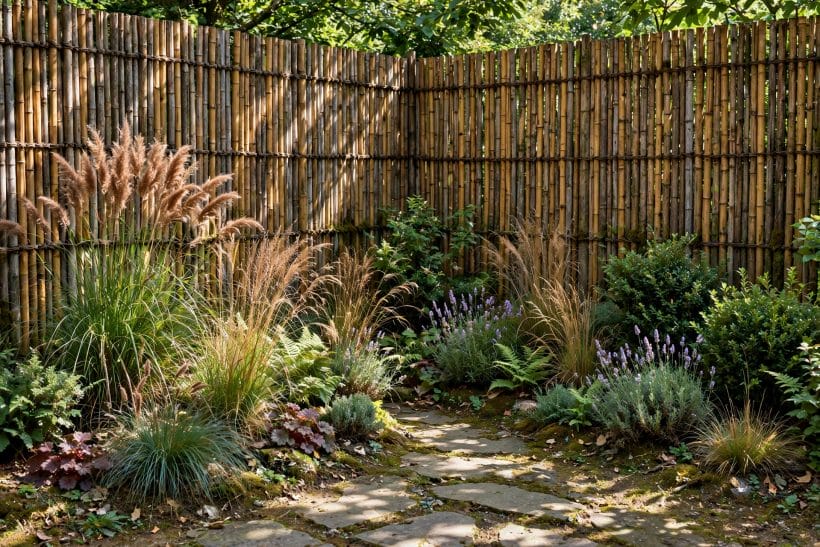
The oldest privacy fence is alive. Planting screens softly, improves yearly and never needs painting — its price is patience, water while it establishes, and width, since a hedge occupies more ground than any panel.
28. A clipped evergreen hedge
One species, planted in a line and clipped into a green wall: the most complete living screen there is. It asks for years to reach full height, then repays them with a boundary that muffles sound as well as sight.
29. Pleached trees on clear stems
Trained flat on frames above clear trunks, pleached trees screen upstairs views while the ground beneath stays open for planting and paths — the elegant answer to overlooking that starts at first-floor level.
30. A mixed native hedge
Several species woven together — blossom in spring, berries in autumn, thorns where security matters — screen as surely as a monoculture once knitted together, and feed the garden’s birds and insects while they do it.
31. Bamboo in a contained run
Clumping bamboo rises fast into a rustling green curtain, wonderful around terraces. Choose clumping rather than running types, or contain the roots properly: a screen that invades the neighbour’s garden makes the wrong kind of boundary statement.
32. Tall ornamental grasses
A drift of tall grasses gives a seasonal screen — full and whispering by midsummer, cut back in late winter. On its own it is a summer answer, so pair it with something evergreen where winter privacy matters.
33. Espalier against a wire framework
Fruit trees trained flat on wires occupy almost no width, screen a surprising amount once in leaf, and crop as a bonus — the privacy line becomes the garden’s most productive strip.
34. A hedge in front of a plain fence
The layered classic from the infographic: an ordinary fence does the legal and immediate work while a hedge grows against it, and within a few seasons the boards disappear entirely behind green. Two boundaries for the price of patience.
35. Evergreen shrubs as a loose screen
Unclipped large shrubs, planted in a staggered double row, screen without the formality of a hedge and flower as they grow. The informality suits cottage and woodland gardens where a straight green wall would feel imposed.
36. Green wall panels and planted screens
Modular planted panels — frames carrying pockets of ferns, grasses and trailers — screen a terrace where there is no soil at all. They need watering like any container planting, and repay it with a living picture.
6. Lattice, Trellis and Layered Toppers
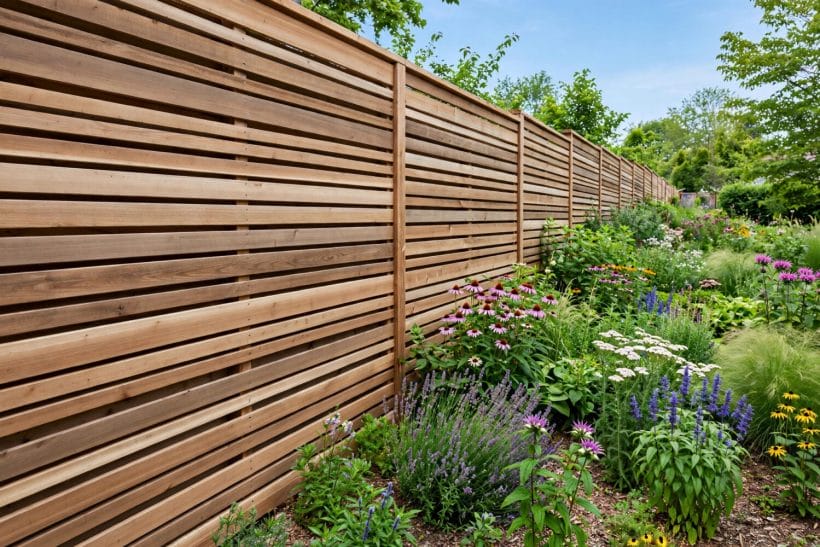
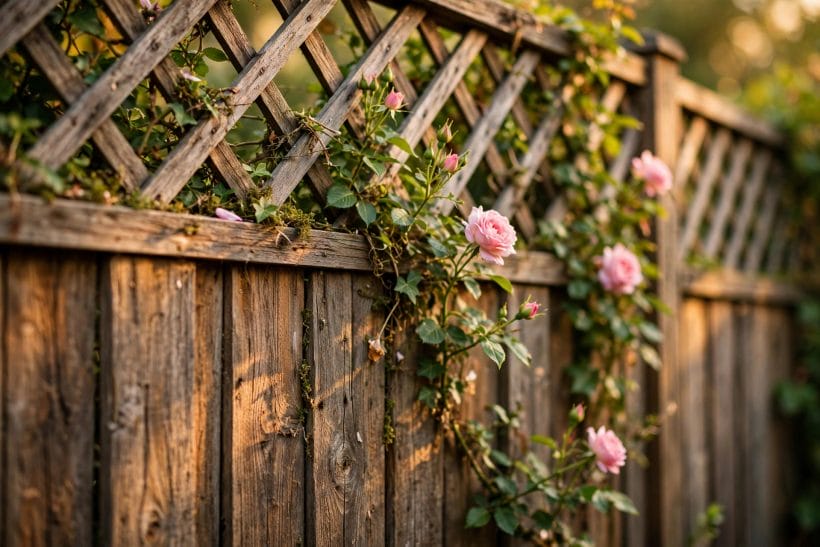
Height is the expensive part of privacy, and toppers buy it gracefully. A lattice or trellis section above a solid panel lifts the screen where eyes travel, keeps some light moving, and gives climbers their ladder — as the gallery photograph shows, roses through trellis soften the fence’s hardest-working part.
37. A lattice topper on solid panels
The established compromise: solid boards to seated eye level, open lattice above, screening standing views and high windows while the garden keeps its sky. Climbers close the lattice’s gaps within a season or two.
38. A trellis extension with climbers
Trellis fixed above the panel line, planted with jasmine, clematis or roses, screens with flower and scent. Choose climbers that keep some winter leaf where the overlooking is year-round.
39. A pergola beam along the boundary
Posts and a beam run inside the boundary, carrying vines above fence height, answer the downward view no fence top can reach — and double as the garden’s most pleasant structure to sit beneath.
40. Woven willow and hazel hurdles
Hand-woven hurdles bring a handmade texture no sawn board can imitate, screening rustically and repairing by the panel. Their life is shorter than sawn timber’s; treat them as the garden’s renewable clothing.
41. A diagonal lattice screen
Lattice turned forty-five degrees throws a diamond rhythm that reads more designed than the square grid, and its sightline behaviour is the same. It pairs well with both cottage planting and crisp modern borders.
42. Metal mesh with climbing plants
A plain welded mesh disappears entirely once planted — the screen becomes pure foliage on an almost invisible skeleton. It is the cheapest route to a tall green wall where a solid structure would need heavier posts.
43. A topper in a contrasting colour
Paint the trellis section differently from the panels — black above natural timber, cream above green — and the fence gains a deliberate two-storey architecture. The line where they meet becomes a design feature rather than an apology.
44. Screening plants in raised planters
Where digging is impossible — over services, on paving, against a wall — tall planters carry small trees and bamboos to screening height. Grouped, they form a movable green fence that can follow the sun or the gathering.
45. Layered heights: fence, topper, tree
The complete defence in depth: solid fence, planted topper, and one small tree behind the seating. Each layer catches the sightlines the others miss, and the garden gains real depth.
7. Metal, Composite and Mixed Materials
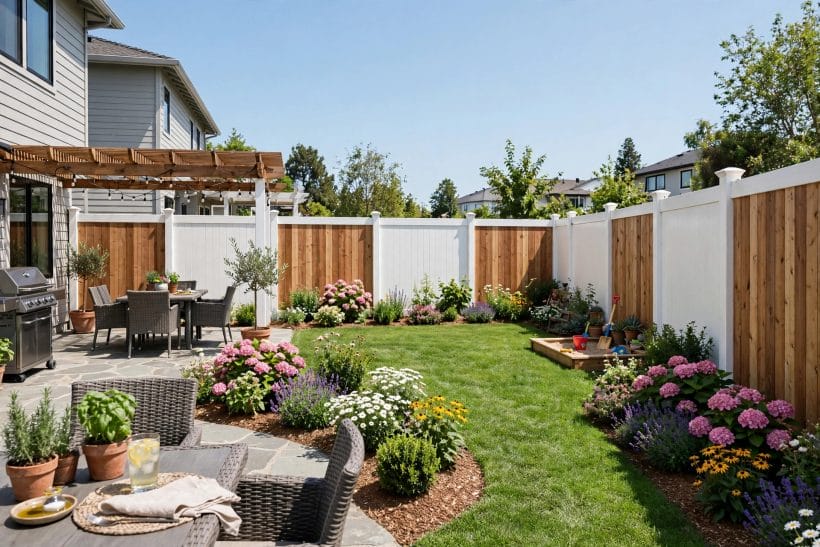
Not every private boundary wants timber’s upkeep. Metal and composite screens trade warmth for decades of indifference to weather, and mixed fences put the durable where weather bites and the beautiful where the eye rests. Decorative metalwork for its own sake belongs with the wrought iron gates family; here metal serves privacy.
46. Composite board fencing
Boards of wood fibre and recycled plastic, stacked in posts, give a solid screen that never needs painting and shrugs off ground moisture. The face is regular to a fault — plant against it early.
47. Corrugated and profiled metal
Profiled steel sheets make a thin, complete, long-lived screen with an industrial honesty. Painted deep green or black it disappears behind planting; left galvanised it suits yards and modern rural buildings.
48. Steel slat screens
Powder-coated aluminium or steel slats give the horizontal style without timber’s movement, in colours from charcoal to cream. They suit coastal gardens where salt air shortens a wooden fence’s patience.
49. Masonry and rendered walls
The permanent answer: block, brick or stone screens completely and forever, and carries gates and lights like architecture. It costs the most and changes the least — a decision the garden keeps.
50. Gabion baskets as a screen
Stone-filled cages stack into a textured, sound-swallowing screen that doubles as a retaining edge on slopes. Planted in its pockets and capped with a timber seat, it becomes the boundary you sit on.
51. Timber boards in metal posts
The mixed marriage that solves timber’s weak point: boards slotted into steel posts, so the structure outlasts several generations of boards. A tired board slides out; a new one slides in.
52. A brick pier and panel rhythm
Masonry piers at intervals, with timber or composite panels between, give a boundary the rhythm of a garden wall at a panel fence’s cost. The piers also carry the gate honestly — details the garden gates survey takes further.
53. Woven synthetic screening rolls
Flexible woven screens tied to an existing open fence upgrade it to privacy in an afternoon — the renter’s and the interim answer, transformative while the hedge grows behind them.
54. Frosted and slatted screens for small spaces
On balconies and roof terraces, frosted panels and fine slats screen at close quarters where weight and wind rule out solid boards. At that range the screen is also the view, so its finish matters most.
8. Corners, Slopes and Awkward Boundaries
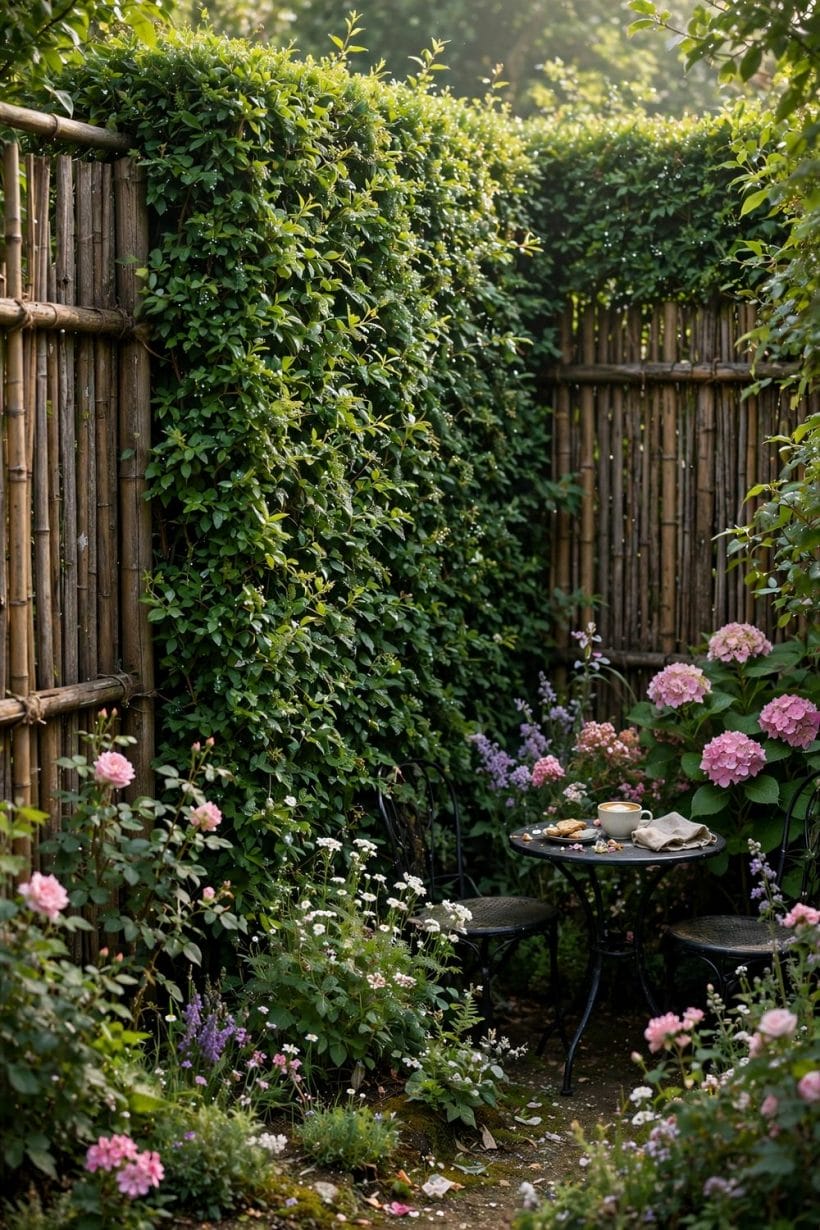
Straight, level boundaries are the easy minority. Real gardens slope, kink and meet at odd angles — and privacy fails at exactly those irregular places, where a gap opens at a corner or a stepped panel leaves a triangle of view.
55. Stepping panels down a slope
Level panels stepped like stairs keep each section’s top honest while the ground falls. The triangles beneath each step are the leak — gravel boards cut to the slope, or planting banked against the base, close them.
56. Racking panels that follow the ground
Some panel systems rack — the boards angle within the frame so the top follows the slope in one smooth line. It reads more finished than steps on gentle ground, and keeps the screen’s height constant where it matters.
57. A curved boundary run
Narrow boards or vertical slats can ease a fence around a gentle curve, turning a corner into a sweep. Plant the inside deeply and the boundary stops reading as a line at all.
58. Screening an overlooked corner plot
Corner plots are overlooked from two streets. Wrap the screening around the corner in one continuous gesture, keep the corner planted and tall, and resist the diagonal shortcut that surrenders half the garden.
59. Filling the gap beside the house
The narrow slot between house wall and boundary is where privacy quietly escapes. A solid gate or full-height panel across it is worth more than extra height anywhere else.
60. Fences against existing walls
Where a building or old wall already forms part of the boundary, screen only the gaps and match heights at the junctions — a planted climber at each seam forgives the differences.
61. Privacy around a raised deck
A raised deck lifts its users into everyone’s view. Screen the deck’s own edge at its level rather than raising the whole boundary — privacy placed at the people, not the perimeter.
62. Screening a hot tub or pool corner
The most private corner deserves the most complete screen: two sides solid, a topper or pergola above, planting outside the splash zone, and a gate that closes fully.
63. A front-garden screen that stays polite
Front boundaries meet the street and its rules, often with a lower height limit. A hedge, slatted screen or low wall with planting achieves front privacy without the fortress face.
9. Planting Against the Fence: Softening the Screen
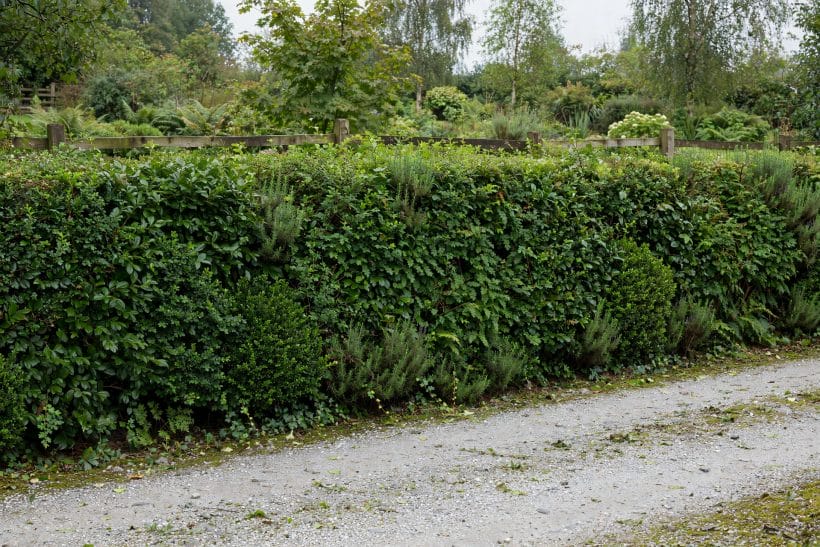
A bare fence is a wall; a planted fence is a garden. Planting against the screen turns privacy from an imposition into the best-looking thing in the plot — and adds a second, living layer of screening in front of the boards, exactly as the infographic’s tip advises.
64. A deep border along the fence line
The classic arrangement: shrubs against the boards, perennials in front, the fence as backdrop. Given depth, the border swallows the boundary and the garden’s edges become its richest planting.
65. Climbers on wires across the panels
Vines strung on wires a small distance off the boards green the fence without trapping damp against it. Evergreen climbers keep the screen in winter; flowering ones make the boundary a season.
66. Small trees inside the line
A few small, well-chosen trees just inside the fence lift the screening above its top and dapple the light below. Their canopies answer high windows as no fence extension politely could.
67. A grass and perennial screen at the base
Tall grasses and perennials along the foot blur the junction between fence and garden, moving in wind and catching low sun. It is the softest possible landing for a hard boundary line.
68. Evergreen structure shrubs
Rounded evergreen shrubs spaced along the run give the winter garden its architecture and keep the screen’s promise in the bare months, while seasonal planting comes and goes between them.
69. A shady-side planting scheme
The north face of a solid fence is a shaded, sheltered microclimate — ferns, hostas and woodland plants thrive in exactly the strip other schemes waste. Every boundary has this secret garden attached.
70. Pots and planters against the boards
Where soil is thin or paved, large pots against the fence carry the green layer. Grouped at varied heights they screen the fence’s base and move when the garden is rearranged — they belong beside the front porch railing ideas world of container gardening too.
10. Costs, Upkeep and Choosing Well
What a privacy fence costs is decided by its drivers, not by any number quotable honestly from a distance: the length and height of the run, the material and its grade, posts and footings, slope and stoniness, gates and hardware, removing an old boundary, and the finish. Labour follows the same logic — straight, level ground is kind; roots, rock and party lines are not. Upkeep divides the materials plainly: timber asks for periodic finish and board-by-board repair, composites and metal ask for washing, living screens ask for water, food and the clippers, and repay it by improving.
71. Choosing solidity before style
Decide first how completely each side must be closed, then dress that decision in a style. A beautiful fence with a gap at the overlooked corner is a failed fence in costume.
72. Spending height only where it hides something
Height is material, money and shadow. Raise the run where a sightline demands it, step it down where none does, and the same budget buys a better fence everywhere else.
73. Agreeing the boundary before building
Whose fence it is, where the line runs, and which face is finished are questions for conversation and, where needed, the deeds — not assumptions. A friendly agreement recorded early is the cheapest component in the project.
74. Building the good face outward
Where a fence has a finished side, custom gives it to the neighbour or the street. It costs nothing but forethought, and makes the street’s view of your boundary a credit rather than a complaint.
75. Planning the repair before the damage
Panels that lift out, boards that unscrew, matching stain kept in the shed: fences meet storms, balls and time. The fence mended in an hour is the one still screening in twenty years.
Final Considerations
Stand in the garden at the hour you use it most, and look at the boundary the way a visitor would: not as a line on a plan but as the room’s fourth wall. Where it leaks a view, close it; where it looms, plant it; where it merely marks, let it be light. Privacy done well is invisible as a problem — nobody in a well-screened garden thinks about fences at all.
A privacy fence earns its place by being chosen as a whole system: solidity matched to real sightlines, a material whose upkeep you honestly accept, corners and gates closed as carefully as the straight runs, and planting that turns the barrier into the garden’s green backdrop. Keep the family splits clean — gates with the gates, open mesh with the fences that keep views, modern boundary style with the modern designs — and let this one post be the closed, quiet, kindly screen. The garden behind it will feel like it was always yours alone.




0 Comments