
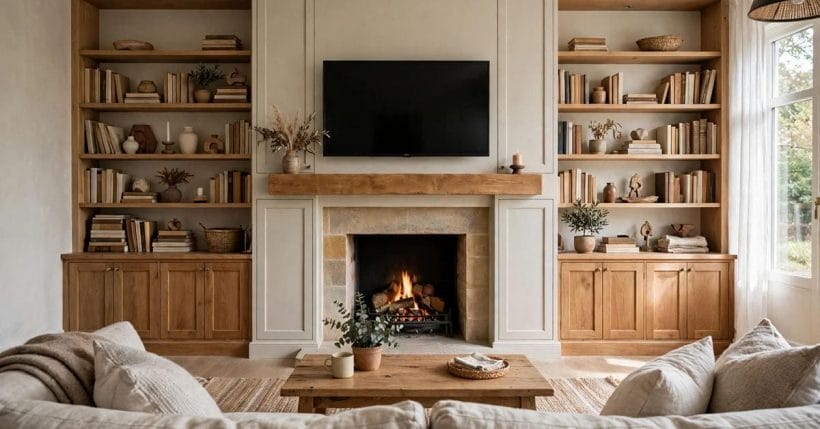
A wall that holds a fire, a screen and storage all at once can either feel calm or feel crowded, and the difference is rarely the size of the room. It is the way the built-in work around the fire is planned. A fireplace with tv above with built ins asks one wall to do several jobs: it must welcome the eye toward the flames, give the screen a settled home, and hold books, boxes and everyday things without letting any of them shout. When those jobs are shared out well, the wall reads as a single piece of furniture rather than a collection of competing parts.
This guide stays with that one form: the television above the fire, framed by built-in cabinets and shelving. It does not teach how to build or alter a firebox, a flue or a chimney, and it does not cover television wiring or heat-clearance decisions, which belong with qualified professionals who can judge the particular fire, the particular screen and the rules that apply to the home. What follows is about the shape of the wall, the balance of open and closed storage, and the styling that lets the fire stay at the heart of the room.
1. Let the Built-Ins Frame the Fire and the Screen
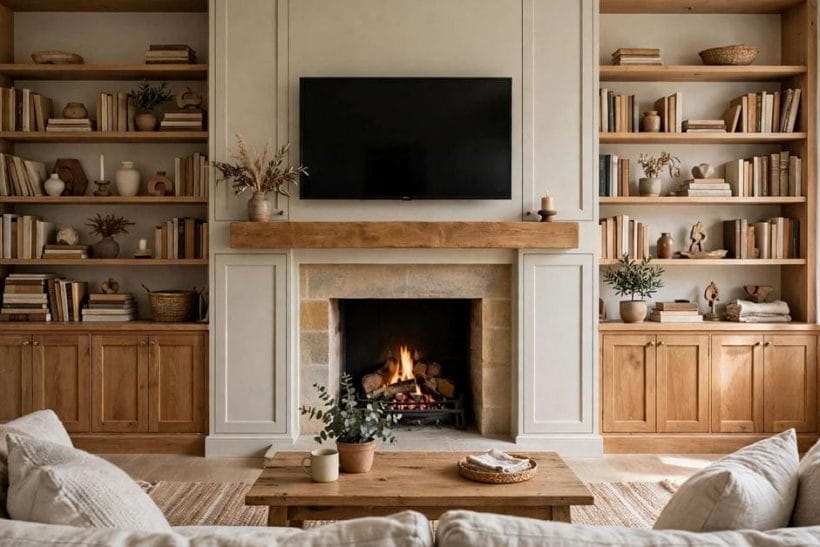
The most settled walls in this form share one habit: the built-ins are drawn as a frame, not added as an afterthought. The chimney breast holds the fire and the screen in the middle, and the cabinets and shelves on either side answer each other in height, depth and finish. That answering shape is what stops the screen from floating on a bare wall and stops the shelving from looking like a separate piece of furniture that happens to stand nearby. The eye travels from the fire upward to the screen, then outward to the shelves, and the whole wall feels considered.
Height matters more than ornament here. When the side units run to the same height as each other, the wall gains a steady horizon, and the mantel shelf can sit as a calm line across the middle. A tall unit on one side and a low unit on the other will pull the room off balance, even when both units are handsome on their own. Depth matters too: shelves that stand proud of the chimney breast will cast a shadow and crowd the fire, while shelves set back into the wall line will read as part of the architecture. The quietest walls keep the front faces close to one plane.
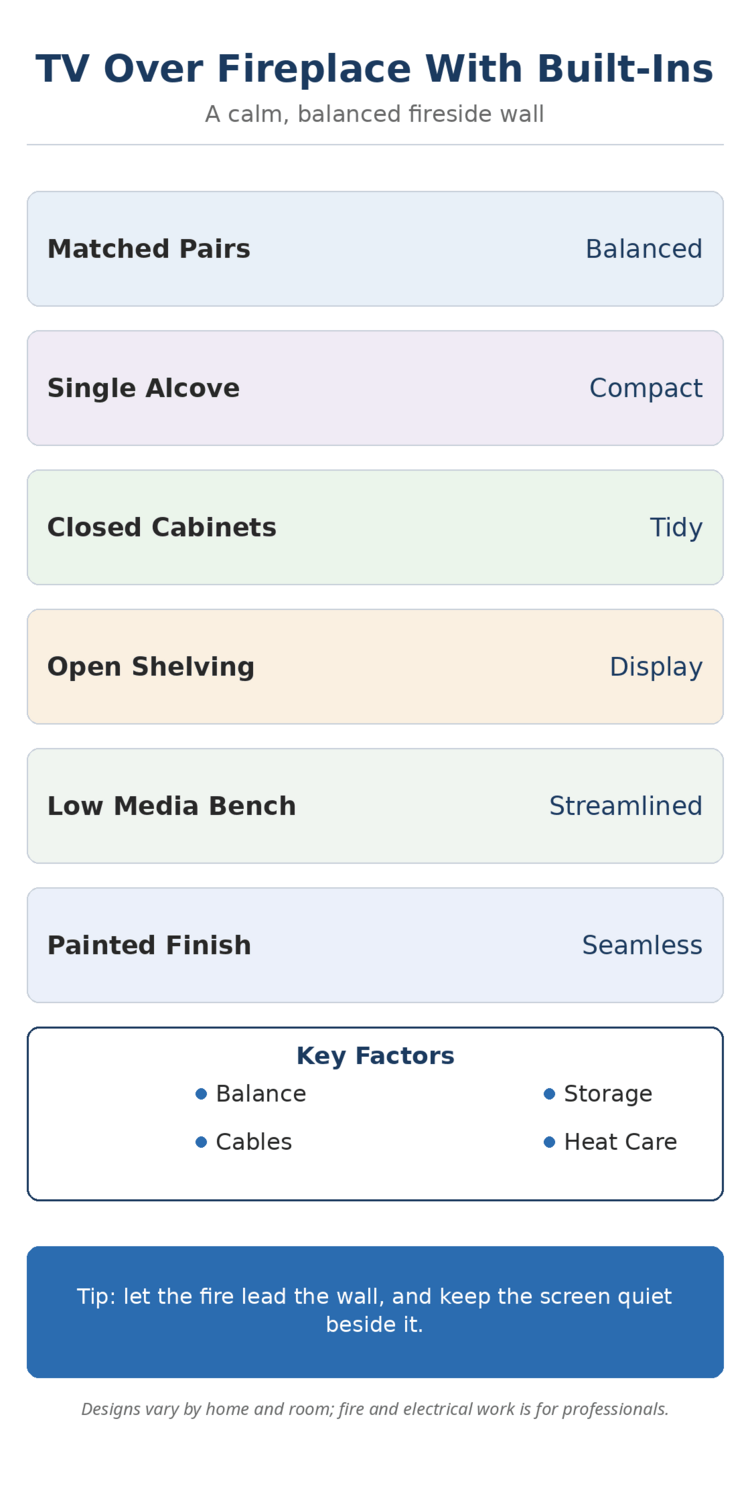
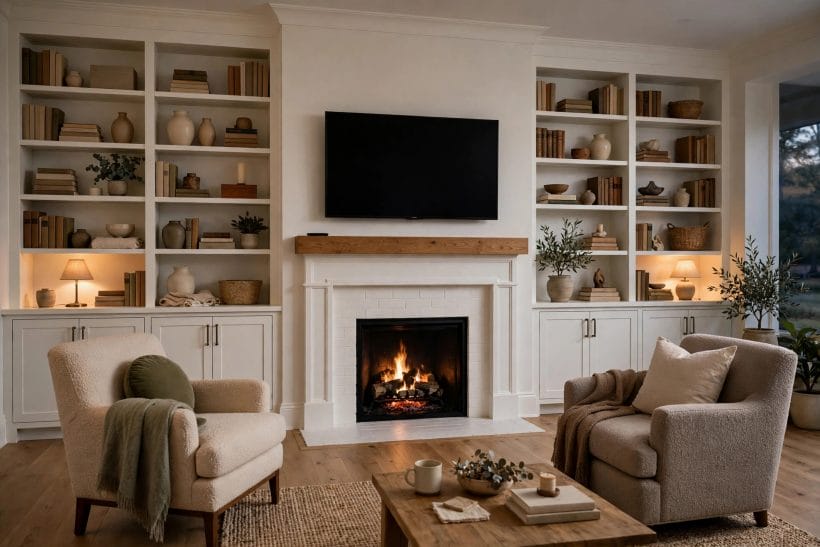
Finish is the third part of the frame. Painted units in the colour of the wall will melt into the room and let the fire and the screen carry the interest, while timber units will warm the wall and ask for a little more attention. Neither choice is better in itself; the better choice is the one that suits the room it stands in. A pale room with pale joinery will feel larger and calmer, while a room with timber floors and timber beams will feel more settled when the built-ins share that timber tone. The frame should serve the room, not compete with it.
2. Choose Matched Pairs or a Single Alcove
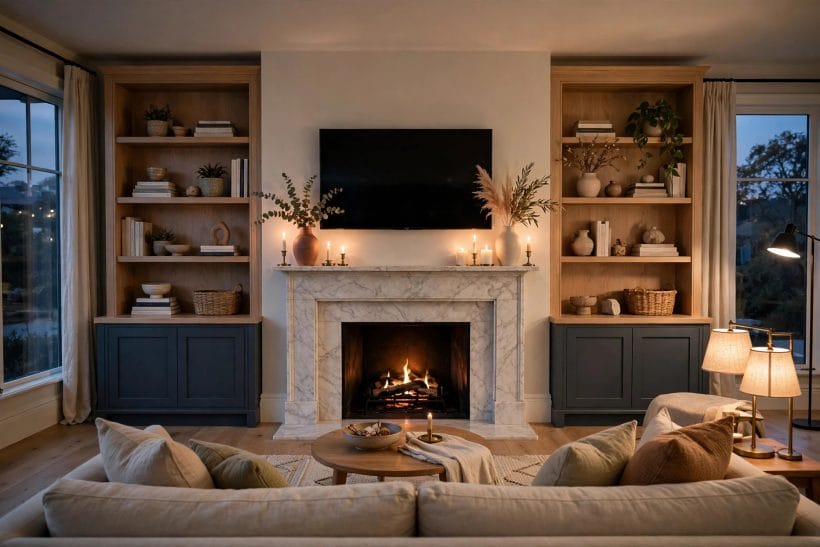
Where the wall allows, a matched pair of built-ins on either side of the fire gives the most balanced result. The symmetry suits the centred fire and the centred screen, and it gives the room a natural place for everything: books on one side can answer books on the other, and closed cupboards can hide the same kind of clutter on both sides. A matched pair also makes styling easier, because a vase or a stack of books placed on one side can be echoed, softly rather than exactly, on the other.
Not every wall can carry a pair, and a single alcove is an honest answer rather than a compromise. Many rooms have a window, a door or a radiator on one side of the fire, and forcing a pair into such a wall only creates a cramped unit that fights the room. A single tall unit on the open side, with the other side left as plain wall or a simple picture, can look deliberate and calm. The key is to let the single unit run to a generous height and to keep its finish in step with the mantel, so it reads as part of the wall rather than as a leftover.
General screen placement above a fire is a wider subject than this built-in form, and readers who want that wider picture can turn to TV above fireplace ideas, which covers placement in general terms. This guide stays with the built-in wall itself: the pair or the single alcove, the cabinets beneath, and the shelves above them. Keeping the two subjects apart is what keeps each wall honest, because a wall that tries to teach everything at once usually teaches nothing well.
3. Balance Open Shelving With Closed Cabinets
Open shelving shows everything, and closed cabinets hide everything, so a wall that uses only one of them will always feel either busy or blank. The settled walls mix the two: closed cupboards at the bottom for boxes, games, chargers and all the things that make a room untidy, and open shelves above for books and a few chosen objects. The closed base gives the wall weight and steadiness, while the open top gives it air and personality. The eye rests on the closed part and wanders pleasantly over the open part.
Proportion helps here. A base of cupboards that runs to about the height of a side table, with shelves rising above it, suits most rooms, because the closed part stays low and useful while the open part stays within easy reach for dusting and rearranging. Glass doors offer a middle way: they calm the look of open shelves by putting a quiet pane between the room and the objects, and they suit rooms where dust is a worry. Solid doors suit rooms where the storage is genuinely everyday and better kept out of sight.
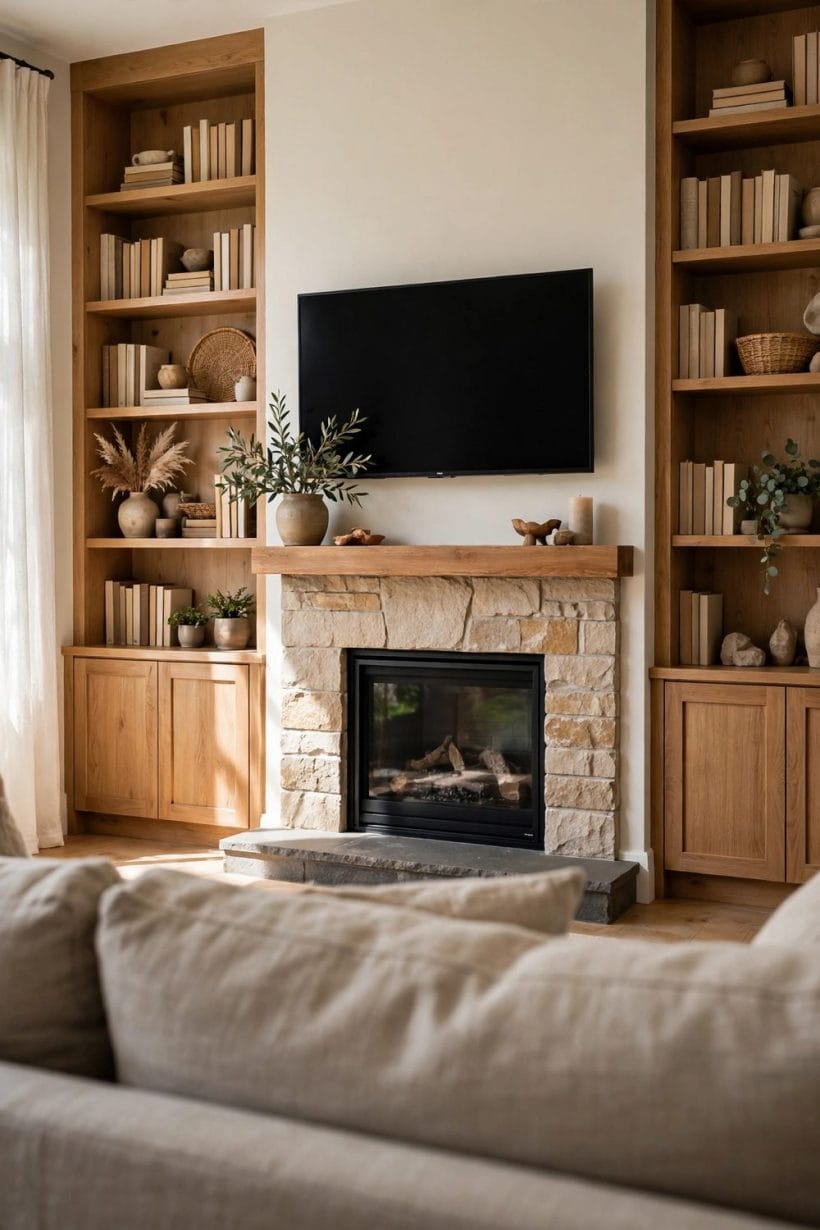
Bookcase built-ins beside a fire have their own character, and the mantel-and-bookcase form is covered on its own in fireplace mantel and bookcase built-ins, where books are the point of the wall rather than one part of a television wall. The distinction matters: on a television wall, books share the stage with the screen, so the shelves should stay calmer and less crowded than they would on a wall built for reading alone. Fewer books, with breathing room between groups, will serve the television wall better.
4. Give the Screen a Quiet Home Above the Mantel
The mantel shelf is the hinge of this wall. It separates the fire below from the screen above, and it gives the eye a resting place between flame and picture. A shelf with a little depth can hold a pair of candles or a low vase, and those small objects soften the hard edge of the screen. A shelf that is too thin will look lost beneath a large screen, while a shelf that juts far into the room will crowd the seating. The calmest mantels sit in proportion to the fire opening and to the width of the chimney breast.
Surround materials set the mood of the whole wall, and the wider survey of surround choices lives in fireplace surround designs, which looks at stone, brick, plaster and other finishes in their own right. On a built-in television wall, the surround should be chosen for quietness rather than drama, because the wall already carries a screen and shelves. A calm surround lets the built-ins and the fire share the attention, while a very bold surround will fight the screen for the eye and tire the room quickly.
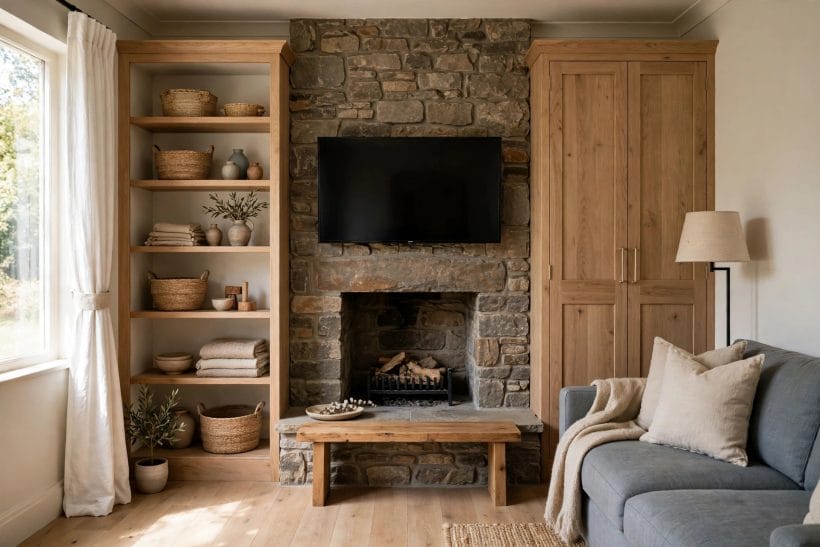
When the screen is dark, it becomes a large blank shape on the wall, and the built-ins are what keep that shape from dominating the room. Shelves with books and warm objects on either side break up the darkness, and a mantel dressed with something living, such as a small plant or a vase of stems, keeps the wall feeling like part of a home rather than part of an entertainment display. The goal is a wall that looks pleasant even when nothing is switched on, because for most of the day, nothing is.
5. Hide Cables and Boxes Inside the Joinery
Cables are the fastest way to spoil a built-in wall. A screen with a visible trail of leads, and boxes perched on open shelves with their lights blinking, will undo the calmest joinery. The answer belongs inside the cabinets: a cupboard near the screen can hold the boxes, and the leads can run behind the joinery where they are never seen. Planning that hiding place at the start, rather than after the wall is finished, is what separates a wall that looks built-in from a wall that only looks fitted around its wires.
Ventilation deserves the same early thought. Boxes that run warm need air, and a closed cupboard with no breathing room will shorten their life and warm the shelf above. A cupboard with a vented back, or a shelf left open behind a stack of books, gives the warmth somewhere to go without showing anything to the room. Doors that sit slightly ajar on purpose are not an answer; the answer is a cupboard designed, from the start, to breathe. This is also where professional advice earns its place, because television electrics and the warmth of a fire are not matters for guesswork.
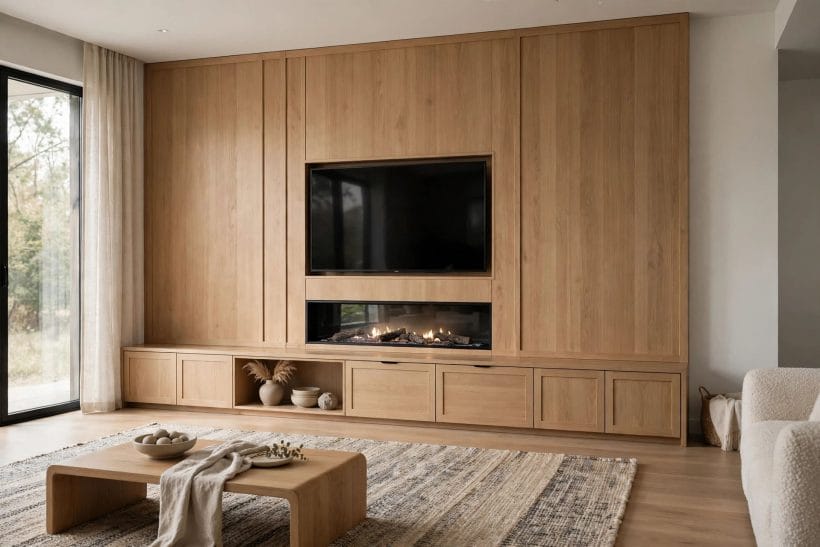
Remote controls, spare leads and small accessories all need a home too, and a shallow drawer in the base cupboard will serve better than a basket left on the hearth. The hearth should stay clear for the fire itself, with nothing stored against the fire opening. Keeping the small things inside the joinery is a modest habit, but it is the habit that keeps the wall looking finished on an ordinary Tuesday evening, when no guest is expected and the room is simply being lived in. Readers furnishing a compact room may also like small living room ideas, where the same hiding places are shown at a smaller scale.
6. Keep Heat and Electrics in Professional Hands
A fire gives off warmth that rises, and a screen above it sits directly in that rising warmth. Whether a particular fire and a particular screen can share a wall, and what clearance the screen needs from the heat, depends on the fire, the flue, the screen and the construction of the wall. Those are judgements for qualified professionals who can look at the actual installation, not for general guidance. No article can bless a particular combination, and this one does not try.
The same caution covers any work on the firebox, the chimney or the flue, and any alteration to the electrical supply for the screen. A wall that looks simple from the front may hide a flue, a lintel or a cable route that only a professional survey will reveal. The built-in work itself, the cabinets and the shelves, can be planned and discussed freely, but the moment the work touches fire or electrics, the right move is to step back and bring in someone qualified. A wall that is safe and slow to finish is worth far more than a wall finished quickly on a guess.
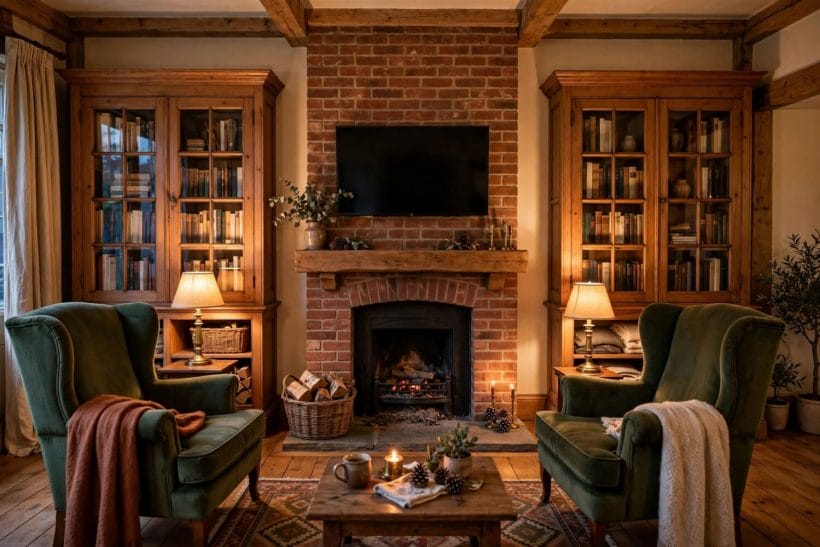
Signs that professional advice is needed are easy to recognise: a screen that feels warm to the touch after the fire has been lit, a mantel that discolours, or any smell of heat from the joinery. Those are not styling problems, and they are not solved by moving a vase or opening a cupboard door. They are reasons to stop using the combination and to ask a professional to look at it. The calmest walls are the ones whose owners never had to wonder, because the heat question was settled before the first shelf was fitted.
7. Style the Shelves So the Fire Still Leads
Styling is where a built-in television wall most often goes wrong, because shelves invite filling and a full shelf invites clutter. The better habit is restraint: groups of books standing upright, a stack lying flat, a single vase, and then empty space. Empty space on a shelf is not wasted space; it is what lets the eye rest and what lets the fire, when lit, become the brightest and liveliest thing on the wall. A shelf packed edge to edge will compete with the flames, and the flames will lose.
Colour helps the restraint. Books and objects in a loose palette drawn from the room, warm timber, soft linen, muted green, will sit quietly beside the fire, while a shelf of clashing bright objects will shout across the room. The palette need not be strict, and a home is not a showroom, but a shelf that borrows its colours from the rug, the cushions or the curtains will always feel more settled than a shelf assembled from whatever happened to be at hand. Small objects grouped in odd numbers, a pair of candlesticks with a vase between them, will look more natural than a row of equal things.
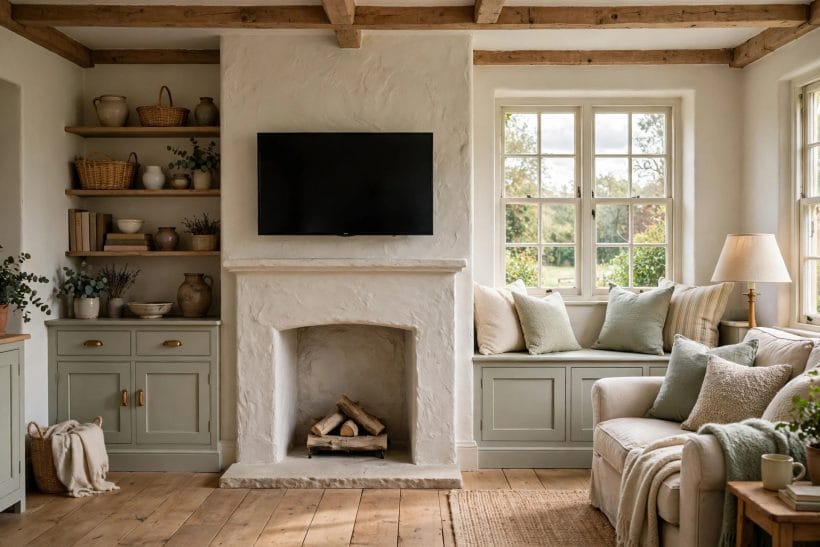
Seasonal change keeps the wall alive without a rebuild. A vase of stems in spring, a bowl of pine cones in winter, a stack of well-loved books turned to face the room, all give the shelves a reason to be looked at again. The fire itself changes with the seasons too, lit often in winter and quiet in summer, and the shelves can follow that rhythm: fuller and warmer when the fire is the centre of the evening, lighter and airier when the room is used mostly for reading and talk. The wall should feel like it belongs to the household, not to a photograph.
8. Shape Seating Around the Whole Wall
A built-in television wall is a wide wall, and seating should answer its width rather than crowding the fire alone. A sofa facing the fire will naturally face the screen as well, which suits evenings when both are in use, while a chair angled toward the fire suits reading when the screen is dark. The arrangement should let people choose: a seat that faces the fire squarely, and a seat that turns slightly away, so the room works for conversation as well as for viewing. A room with only one kind of seat will always feel as if it is waiting for a programme to start.
Distance matters as much as direction. Seats pulled close to the fire will feel the warmth and the screen together, which suits a cosy evening, while seats set further back will take in the whole wall, built-ins and all, which suits a gathering. The rug can mark the group: a rug that sits beneath the front legs of the seating will tie the group to the wall, while a rug that floats in the middle of the room will leave the group feeling adrift. Side tables beside the seats keep drinks and books within reach without cluttering the hearth.
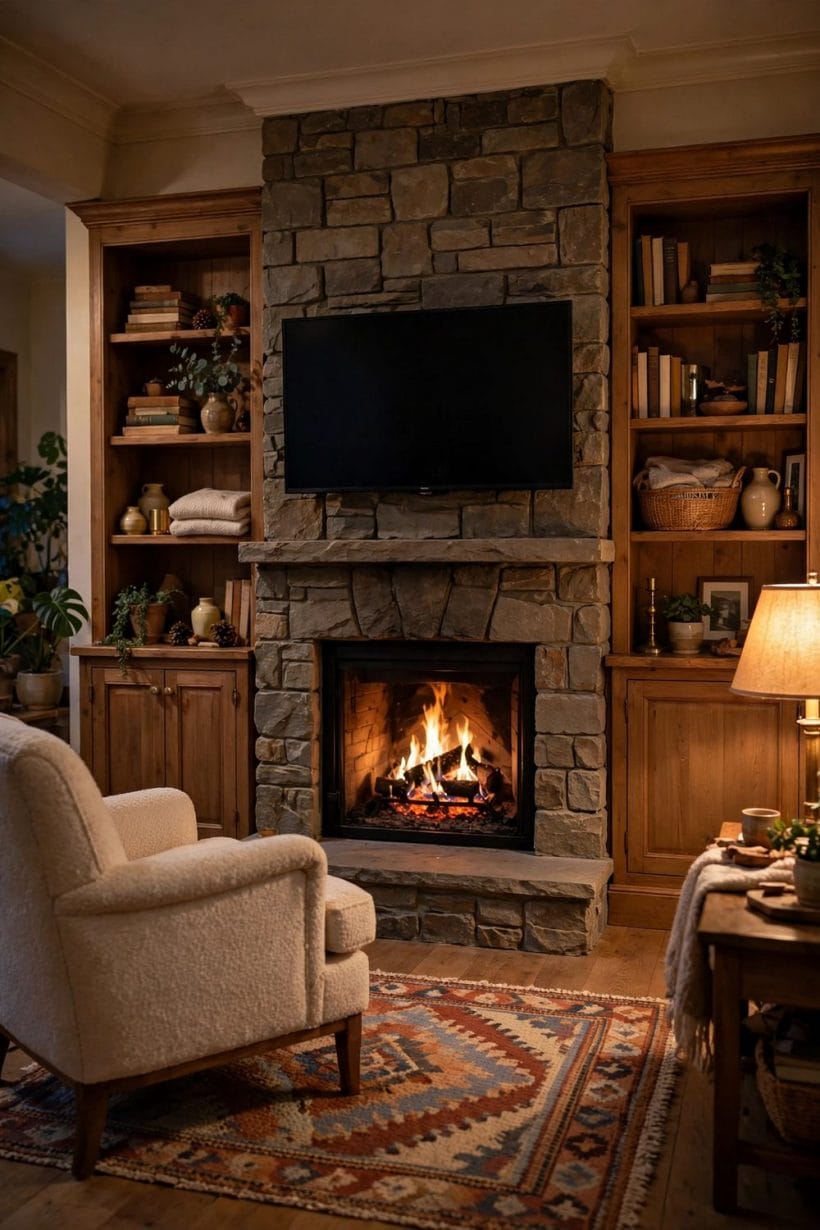
Furniture placement around a fire is a subject of its own, and furniture arrangement around a fireplace covers seating layouts in general terms, from facing sofas to reading corners. This guide borrows only the principle: the seating should serve the whole built-in wall, not just the screen. When the seating answers the full width of the wall, the built-ins feel like part of the sitting group rather than a backdrop, and the room feels gathered rather than arranged for viewing alone.
9. Carry the Same Wall Into a Small Room
Small rooms benefit most from this form, because a built-in wall replaces several separate pieces of furniture with a single fitted run. A freestanding bookcase, a media stand and a console table each take floor space and leave gaps behind them; a built-in run takes the wall and gives the floor back to the room. In a compact living room, that regained floor can be the difference between a room that feels cramped and a room that feels workable.
The small-room version should be simpler than the large-room version, not a squeezed copy of it. A single alcove unit, closed cupboards below and a few open shelves above, will serve a small room better than a matched pair forced into a narrow wall. Painted finishes in the wall colour will help the run disappear into the room, and shelves kept shallow will hold books without stealing floor space. A low media bench beneath the screen, rather than a tall run on both sides, can be the right answer where the wall is short.
Light matters more in a small room, because a dark wall of joinery can close the room in. Shelves lit softly from within, or a wall painted pale with the fire as the warm point, will keep the room feeling open. The screen, when dark, is the largest dark shape in a small room, so the shelves beside it should stay pale and calm rather than crowded with dark objects. Readers planning a compact home may find tiny house interiors useful, where fitted walls are shown working hard in very little space.
10. Keep the Wall Easy to Live With Over Time
A built-in wall is a long-term piece of the home, and it should be planned for dusting, for changing screens and for changing tastes. Shelves that can be moved up or down will outlast shelves fixed for one size of book, and a cupboard deep enough for a new box will outlast one sized for the box owned today. Screens change shape over the years, and a wall whose screen recess can accept a slightly different shape will age far better than a wall cut exactly around one model.
Finishes should be chosen for repair as much as for looks. Painted joinery can be touched up when scuffed, while a stained timber can be refreshed with oil or wax, and both will outlast a finish that cannot be mended without a rebuild. Handles and hinges, small as they seem, should be chosen for daily use, because a cupboard opened every evening will show a poor hinge quickly. The wall will be lived with far longer than it will be photographed, and its details should be judged on that longer timescale.
Finally, the wall should be allowed to change. Books come and go, objects are given and outgrown, and a shelf that is restyled once a year will feel more like home than a shelf dressed once and left untouched. The built-ins are the steady part of the wall; the styling is the changing part, and that division is what keeps the wall feeling both settled and alive. A wall planned this way will still suit the room when the household, the books and the screen have all moved on. Broader design continuity, from the fireside wall to the rest of the home, is explored in tiny house designs, where fitted walls sit within whole-home plans.
Final Considerations
A fireplace with tv above with built ins succeeds when the wall reads as one piece: the fire at its heart, the screen settled above the mantel, and the cabinets and shelves answering each other on either side. Matched pairs suit wide walls, single alcoves suit narrow ones, closed bases hide the everyday clutter, and open shelves above give the wall its character. Heat and electrical questions belong with professionals, cables belong inside the joinery, and the styling belongs to the household, changing gently with the seasons.
Before any work begins, it is worth standing in the room and looking at the wall as it is: where the light falls, where people naturally sit, and what the wall must hide as well as show. A wall planned from the room outward, rather than from a picture inward, will fit the home it stands in. The fire will lead, the screen will sit quietly above it, and the built-ins will hold the life of the room without ever stealing the scene.

0 Comments