

Two rectangles compete for the same wall, and both refuse to lose. The fireplace is the room’s ancient focal point; the television is its modern one. Mounting the screen above the fire settles the contest by stacking them — but the stack only works when heat, height and proportion have been thought through before the drill comes out.
This page is the placement angle of the fireplace cluster: the general survey lives in the fireplace living room pillar, the stone angle in its own lane, and here the subject is narrow and practical — how to put a television over a fireplace so the room stays comfortable, the screen stays safe and the wall still looks like a fireplace wall, not a sports bar.
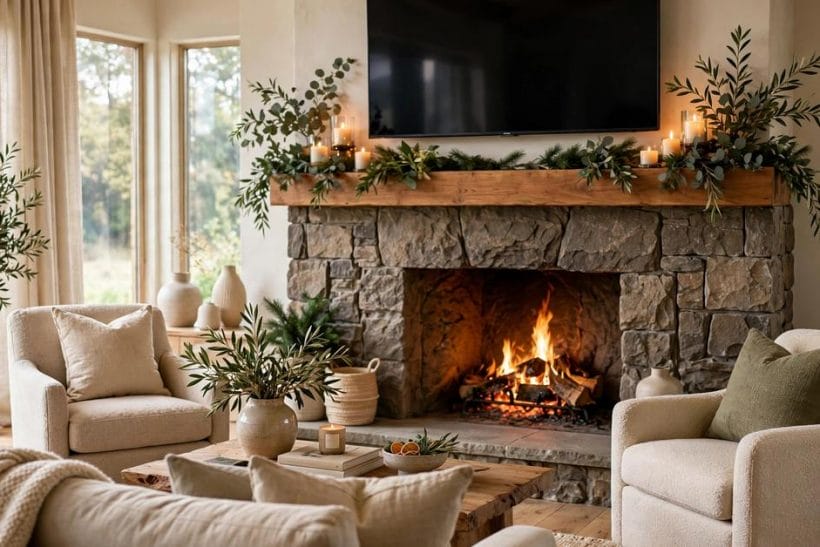
1. TV Above Fireplace Ideas at a Glance
A television mounted above a fireplace is a stacked focal point: the screen centred on the chimney breast, high enough to clear the fire’s heat and the mantel’s styling, low enough to watch without a cricked neck. Done well it depends on three disciplines — respecting the heat path with the clearances the fireplace and screen manufacturers state, mediating the gap with a mantel shelf or surround that gives both objects their own frame, and hiding every cable so the wall reads as architecture. It belongs to the fireplace family surveyed in the stone fireplace lane and its neighbours, and it succeeds or fails on measurements taken before anything is bought.
| Question | Short answer |
|---|---|
| Is it safe to mount a TV above a working fireplace? | It can be, with the heat respected. Rising heat is the screen’s enemy, so the arrangement depends on the clearances the fireplace maker and the television maker each state, on a mantel or deflector interrupting the heat path, and on honesty about how often and how hot the fire actually burns. A decorative fire lit on Sundays and a stove worked daily are different engineering problems wearing the same wall. |
| How high should the screen sit? | As low as the heat and the mantel allow. The comfortable screen is the one whose centre sits near seated eye level; above a fireplace that ideal usually has to compromise, so the craft is in minimising the lift — a shallow firebox surround, a low-profile mantel and the largest practical screen all pull the centre down. A slight downward tilt on the mount repays its small cost every evening. |
| Does the mantel matter to the television? | Twice over. Physically, the mantel shelf is a heat shield and a deflector standing between the firebox and the screen. Visually, it is the frame’s lower rail: the horizontal line that separates fire territory from screen territory and gives the stylist a shelf to work. A breast with no mantel asks the surround itself to do both jobs. |
| What is the biggest mistake with a TV over a fireplace? | Hanging the screen first and thinking second — cables dangling, the box collection perched on the mantel, the picture too high, the heat unconsidered. Every element of the good version is planned in the opposite order: heat, height, structure, cables, styling, and only then the screen. |
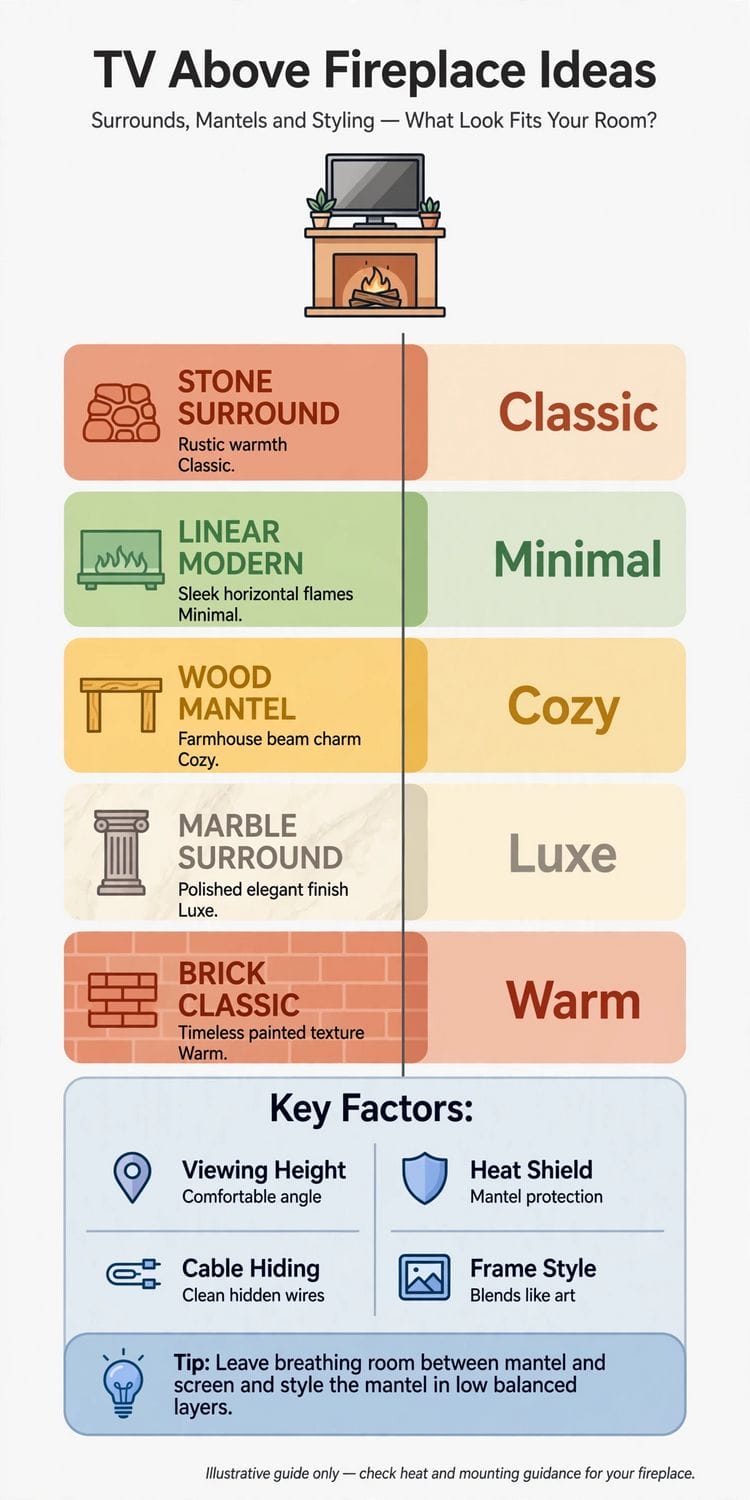
2. Reading the Wall: Heat, Height and the Honest Measurements
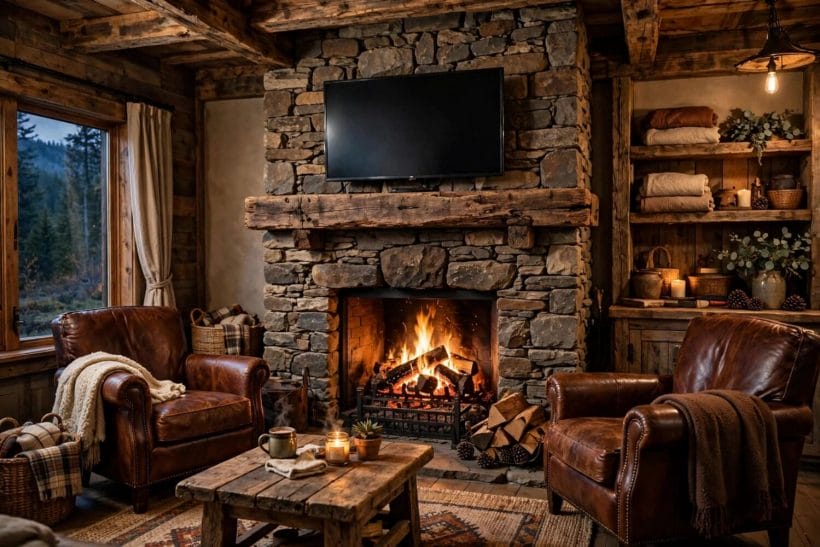
Before any styling, the wall gets audited like a building, because this arrangement fails physically before it fails aesthetically. Heat path, viewing geometry, structure and the fire’s real habits — this section takes the four measurements every later decision depends on.
1. Map the heat path before anything else
Light the fire as you actually use it — a full evening’s burn, not a demonstration flare — and feel the breast at screen height as the hours pass.
2. Respect the stated clearances, not the hopeful ones
Both manufacturers publish their requirements: the fireplace’s clearances around the opening and the screen’s tolerance for ambient heat.
3. Take the seated eye-line as the design’s datum
Sit on the actual sofa, at the actual distance, and mark where the eyes rest.
4. Let screen size work for the height problem
A larger screen lowers its own centre relative to the picture: the same mantel clearance that forces a small television uncomfortably high lets a bigger one’s image start lower and fill the view properly.
5. Check what the breast is made of before promising a mount
Brick, block, stone and studwork over a flue all hold fixings differently, and a chimney breast is not a free wall — the flue runs inside it.
6. Be honest about how the fire is really used
A gas flame effect lit for an hour at Christmas asks almost nothing of a screen above it; a wood stove worked from October to April asks everything.
7. Consider the pull-down and tilt mounts with clear eyes
Mounts that tilt the screen down, and mounts that pull it forward and down for viewing, genuinely solve the height compromise — at the price of moving parts in a warm environment and a screen that parks away from the wall.
8. Decide the sound before the screen goes up
A television’s own speakers fire at the wall’s terms: downward, backward, or thinly forward.
9. Photograph the empty wall and live with the tape outline
Mark the proposed screen’s outline on the breast in painter’s tape and leave it for two days of fires, films imagined and daylight.
10. Plan the power and signal as part of the structure
A socket behind the screen, the aerial or network point where the boxes will live, the route between them: these are building decisions wearing domestic clothes.
11. Keep the non-working fireplace option open in your thinking
Many of the happiest versions of this arrangement sit over fireplaces that burn rarely, burn gas gently, or no longer burn at all — the firebox dressed with candles or logs while the screen does the daily work.
3. Surrounds That Carry a Screen: Stone, Tile, Brick and Plaster
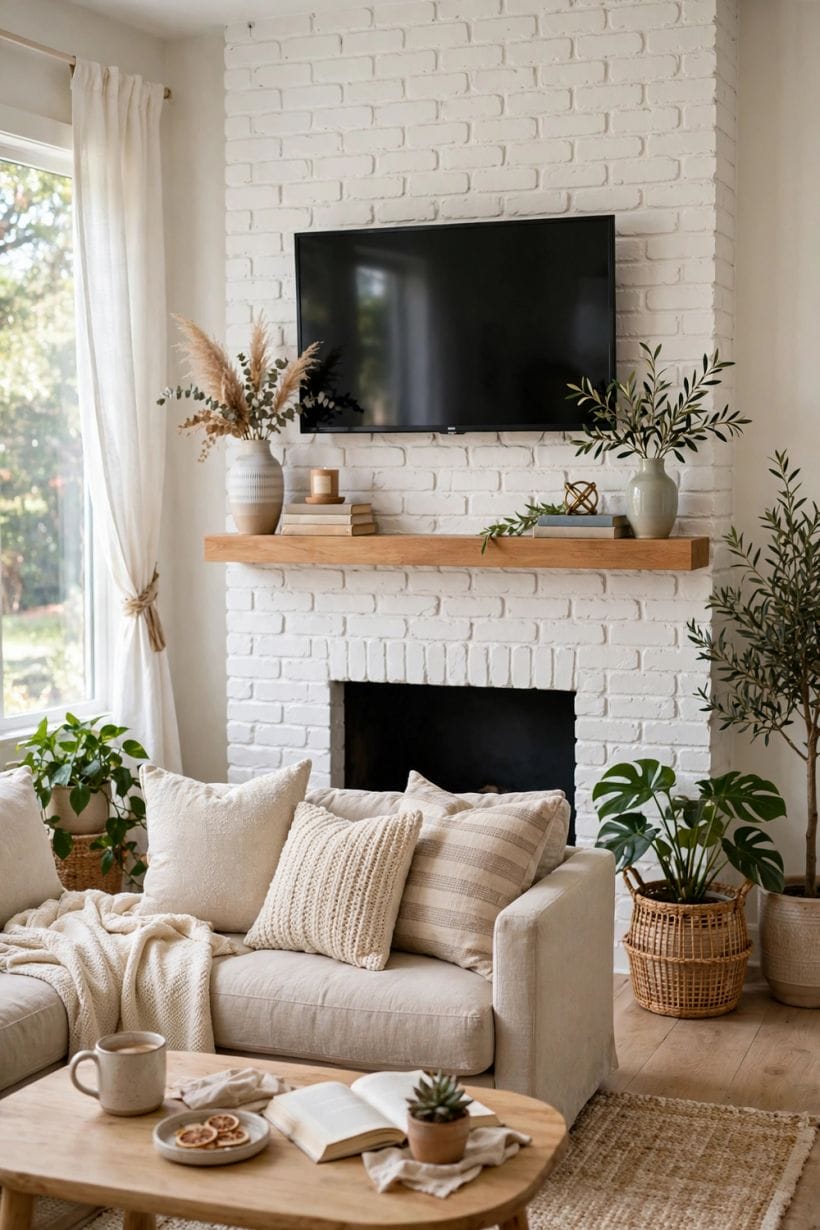
The surround’s job doubles when a screen joins the wall: it must frame the fire as it always did and give the television a composed field to sit in. This section works the materials — the same family the corner fireplace lane bends around a room’s angle — in their screen-carrying forms.
12. Extend the surround’s material up the breast
Running the surround’s stone, tile or brick up the full height of the chimney breast turns two objects into one architecture.
13. Build a shallow framed panel for the screen zone
Where a full-height treatment is too much, a shallow framed field — battens and board, limewash plaster, a rectangle of tile — gives the screen its own territory on the breast.
14. Use stone where the fire is serious
Stone carries heat’s neighbourhood with the least complaint and the most authority, and a stone breast makes the screen read as the modern layer on an old wall — a contrast the room can enjoy rather than apologise for.
15. Let tile give the wall a crafted scale
Small-format tile — metro, mosaic, handmade squares — gives a large breast a human grain that flatters both the firebox opening and the screen above it.
16. Brick suits the arrangement’s honesty
An exposed or painted brick breast absorbs the screen gracefully because brick is already a grid — the television becomes one more rectangle in a wall of rectangles.
17. Plaster and limewash for the quiet wall
The softest carrier is a plastered breast in limewash or a warm mineral paint, the screen floating on a surface with depth but no pattern.
18. Mind the breast’s width against the screen’s
A screen wider than the chimney breast breaks the arrangement’s first rule: the television must belong to the breast, not overflow it.
19. Carry the hearth’s material into the composition
The hearth stone or tile at the floor and the surround above it are the composition’s feet and frame.
20. Give the firebox opening its own finished dignity
A screen above draws eyes up the whole breast, which means the firebox — its lining, its grate, its interior brick — is more visible, not less.
21. Use a deep mantel shelf as the surround’s full stop
Where the surround stops at mantel height, the shelf itself becomes the punctuation — deep enough to deflect heat and carry styling, in a material that speaks to both zones. The fireplace mantel lane treats that shelf as a subject in itself; here it is the hinge the whole wall swings on.
22. Light the surround, and the screen benefits
A pair of picture lights, sconces flanking the breast or a wash of light down the stone gives the wall an evening life independent of the screen.
4. The Mantel as Mediator: The Shelf Between Fire and Screen
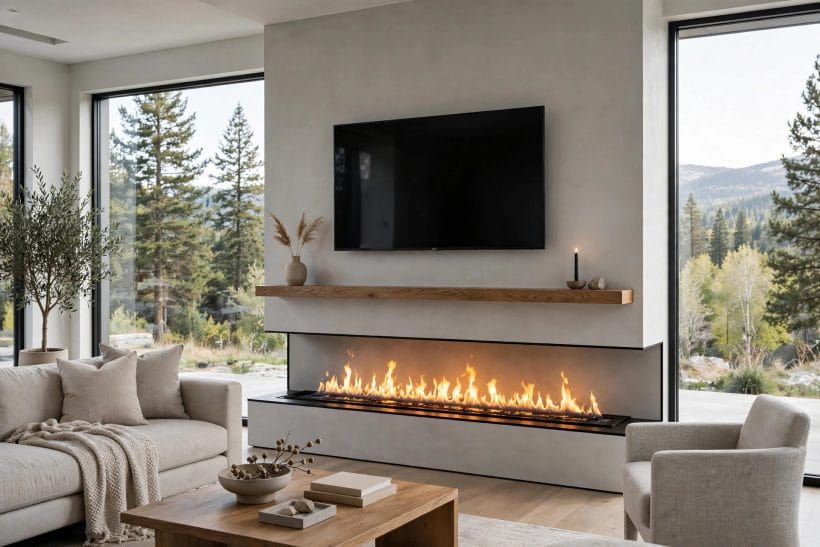
Between the flames and the electronics stands one horizontal line, and it does more work than any other element in the arrangement. This section treats the mantel as mediator — heat shield, styling stage and the border treaty between two eras of the hearth.
23. Depth is the mantel’s first virtue
A deep shelf interrupts rising hot air and pushes it out into the room before it reaches the screen — the physics that makes the whole arrangement kinder.
24. A floating beam for the modern register
A single oak or stained timber beam, floating on the breast, is the contemporary dialect of the mantel — and it mediates just as well, giving the screen a horizon line and the fire a lintel.
25. The traditional shelf with legs and frieze
A full mantelpiece — shelf, frieze and legs in timber, marble or cast stone — suits the screen better than purists expect: the strong horizontal and the formal opening give the black rectangle a frame of real authority to sit above. The traditional living room register absorbs the combination most naturally of all.
26. Stone and marble shelves for the serious fire
Where the fire works hard, a non-combustible shelf in stone or marble is the specification’s own answer, and its cool mass reads beautifully against a warm room.
27. Keep the shelf’s styling out of the screen’s sightlines
Tall objects on the mantel compete with the picture and can crowd the screen’s lower edge into visual noise.
28. Use the mantel ends as the styling stages
The composed version puts its objects at the shelf’s two ends — a stack of books and a vase, candlesticks and a small picture leaned against the breast — leaving the middle empty.
29. A garland or green line along the shelf’s front
Seasonally, a garland run along the mantel’s front edge softens the border between fire zone and screen zone, and the rest of the year a simple run of foliage in a low trough does the same work quietly.
30. The soundbar’s claim on the mantel
If the soundbar lives on the mantel, it should be chosen as part of the composition: centred, low, in a finish that disappears against the surround, its cable dropped invisibly behind.
31. No mantel at all: the deliberate modern absence
Some of the strongest versions delete the shelf entirely — a flush stone breast, the screen floating, the firebox a clean slot.
32. Let the mantel carry the room’s season
Because the shelf is the wall’s stage, it is where the year gets announced: spring branches, summer shells, autumn fruit, the Christmas garland.
33. Match the mantel’s material to one other thing in the room
A beam that echoes the floor’s oak, a marble shelf answering the hearth, a painted shelf in the bookcase’s colour: one rhyme is enough to seat the mantel in the room rather than on it.
5. Hiding the Hardware: Cables, Boxes and Sound
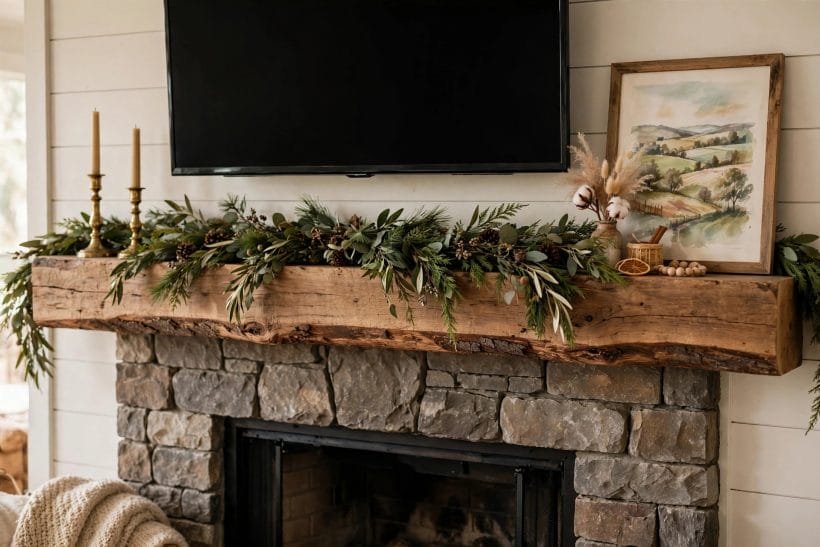
The arrangement’s elegance is decided in the wall, not on it. This section works the invisibility — power, signal, the box collection and the sound — because a television wall with visible wires is a sentence with the punctuation showing.
34. Chase the cables into the breast wherever the structure allows
The gold standard is a proper recessed route: power and signal run inside the wall or breast to a recessed box behind the screen, installed to the electrical code of the house by someone qualified.
35. Use a recessed media box behind the screen
A recessed box set into the breast gives plugs, a small power strip and excess cable a home that lets the screen sit nearly flush.
36. Give the boxes a home that is not the mantel
Streaming boxes, players and consoles belong in a cupboard, a basket-lined niche or the joinery beside the breast — ventilated, reachable by the remote’s signal or a repeater, and out of the photograph.
37. Run a conduit for the cables you have not met yet
Standards change faster than walls.
38. Surface trunking, painted in, as the honest retrofit
Where the wall cannot be opened — rented rooms, listed fabric, a stone breast — slim trunking run down the breast’s edge or behind the mantel line, painted to the wall’s exact colour, is the respectable second best.
39. Hide the soundbar’s wire with the same rigour
The soundbar sits in full view, so its cable must vanish at the back edge — down behind the mantel, through the breast or along the shelf’s underside into the wall.
40. Think about the remote’s line of sight early
Infrared remotes need to see their boxes; radio and app control do not.
41. Ventilate the hidden homes
Boxes in cupboards and niches make heat, and cooked electronics sulk and die young.
42. Put the router and network point on the plan
A streamed film is only as good as the connection behind the screen.
43. Label everything at installation, for the future stranger
The person who will thank you is yourself in four years, crouched behind the joinery.
44. Keep one access point reachable without moving the screen
Design the installation so a failed box, a tripped plug or a new device can be reached by opening a door or a panel, never by unhanging the television.
6. Styling Around the Screen: Symmetry, Art and the Black Rectangle
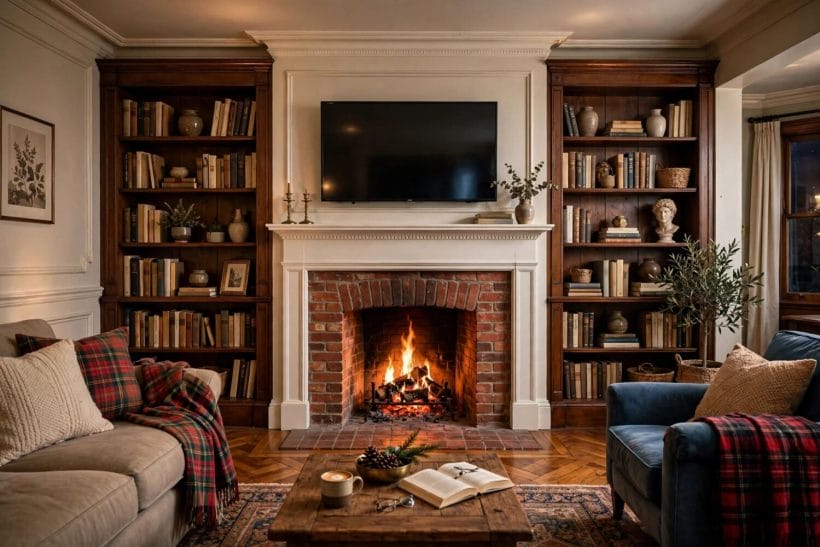
A switched-off television is a black rectangle with opinions. This section is about the wall’s other hours — the composition that makes the room a fireplace room with a screen in it, rather than a cinema that happens to have a hearth.
45. Accept the rectangle and compose with it
The screen will not disappear, so the design composes with it as it would with a dark painting: centred on the breast, given breathing room, balanced by the firebox below and the styling around.
46. Flank the breast to widen the composition
Bookcases, cabinets or a pair of tall plants on either side of the chimney breast stretch the wall’s composition sideways, so the screen becomes the centre of a wide arrangement rather than a black postage stamp on a narrow one.
47. Use a pair of objects or pictures at the mantel’s ends
Symmetry is the screen’s friend because the television itself is symmetrical and severe.
48. Screensavers and art modes, used tastefully
Many screens can hold a still image when idle.
49. Choose the screen’s finish and bezel as a design material
Matte screens drink light instead of throwing it back, and thin dark bezels read as a frame line rather than a rim.
50. Balance the black with the room’s other dark notes
The rectangle needs allies: a dark grate, blackened fire tools, an ink-dark cushion or two, frames in dark timber.
51. Keep the coffee table’s sightline in the styling
The composition is judged from the sofa, over the coffee table — so the view that matters includes the table’s own objects in the foreground.
52. Let the fire dress itself when the screen is on
During a film, the fire is the room’s second picture.
53. Pictures beside, never above
Art belongs at the breast’s sides or on the adjoining walls — the space above the screen is the ceiling’s, and anything hung there crowds the composition and guarantees a cricked judgment.
54. Solve glare with curtains, not with suffering
A window opposite the breast will write itself across every dark scene.
55. Photograph your own wall and judge it coldly
Rooms are forgiving in person and honest in photographs.
7. Small Rooms and Low Ceilings: The Arrangement at Modest Scale
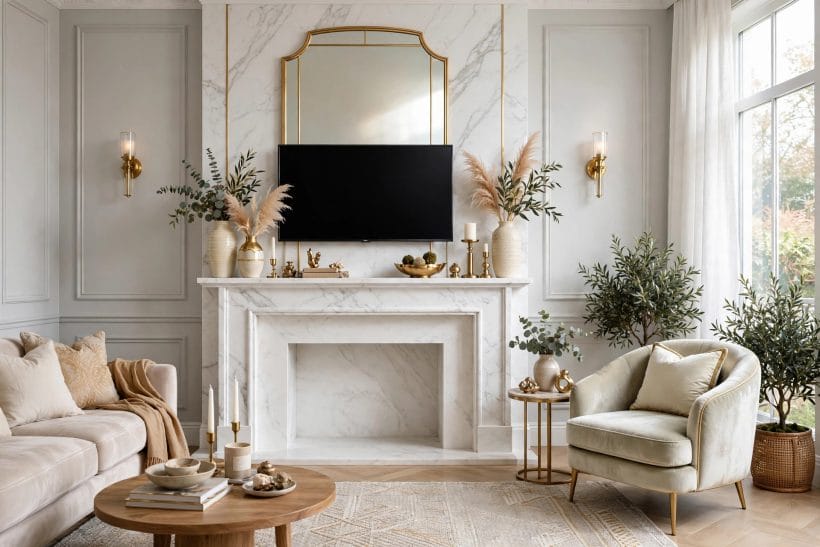
The stacked focal point earns its keep most honestly where space is scarce — one wall doing two jobs is a small room’s best bargain. This section works the modest version: low fires, compact screens and the joinery that makes a small room feel planned rather than squeezed.
56. The small room is where the arrangement proves itself
In a compact sitting room, separate walls for fire and television split the seating into two audiences.
57. Choose the screen by the breast, then by the distance
In a small room the viewing distance is short, which flatters a moderate screen — and the breast is narrow, which demands one.
58. Low fires and low surrounds keep the stack low
A low, wide firebox opening — the modern landscape format — drops the whole composition: mantel lower, screen lower, eyes happier.
59. A corner or flanking arrangement for the awkward room
Not every small room’s breast deserves the screen: where the chimney breast is very narrow or the seating sits oddly, the fireplace remodel thinking applies — sometimes the remodel moves the focus, building a media wall on the adjacent flat wall and letting the fire keep its own. The cluster’s rule is a composed room, not a stack at any price.
60. Built-in joinery either side swallows the small room’s clutter
Shallow cupboards and shelves flanking the breast give a small room its storage without eating floor: boxes, games, the folded throw, the children’s tide.
61. Keep the mantel styling to a whisper
At modest scale, the shelf carries one or two objects, low and calm — the small room’s eye is close to everything, and mantel clutter at close range is noise.
62. Pale surrounds enlarge; dark screens anchor
The small room’s breast in a pale limewash or soft plaster keeps the wall light, while the screen’s dark rectangle gives the composition its one deep note.
63. Mind the heat twice in a small volume
A small room concentrates everything, warmth included.
64. Use the hearth’s level as extra seating and surface
A raised hearth in a small room is a bench, a side table and a child’s kingdom in one — and it gives the composition a generous base that makes the stack above feel grounded.
65. Let one good chair turn to both fires
The small room’s seating plan: the sofa faces the stacked wall, and a single comfortable chair sits angled in the corner, able to join the film or turn toward the fire and a book.
8. Styles to Steer By: The Stack in Different Registers
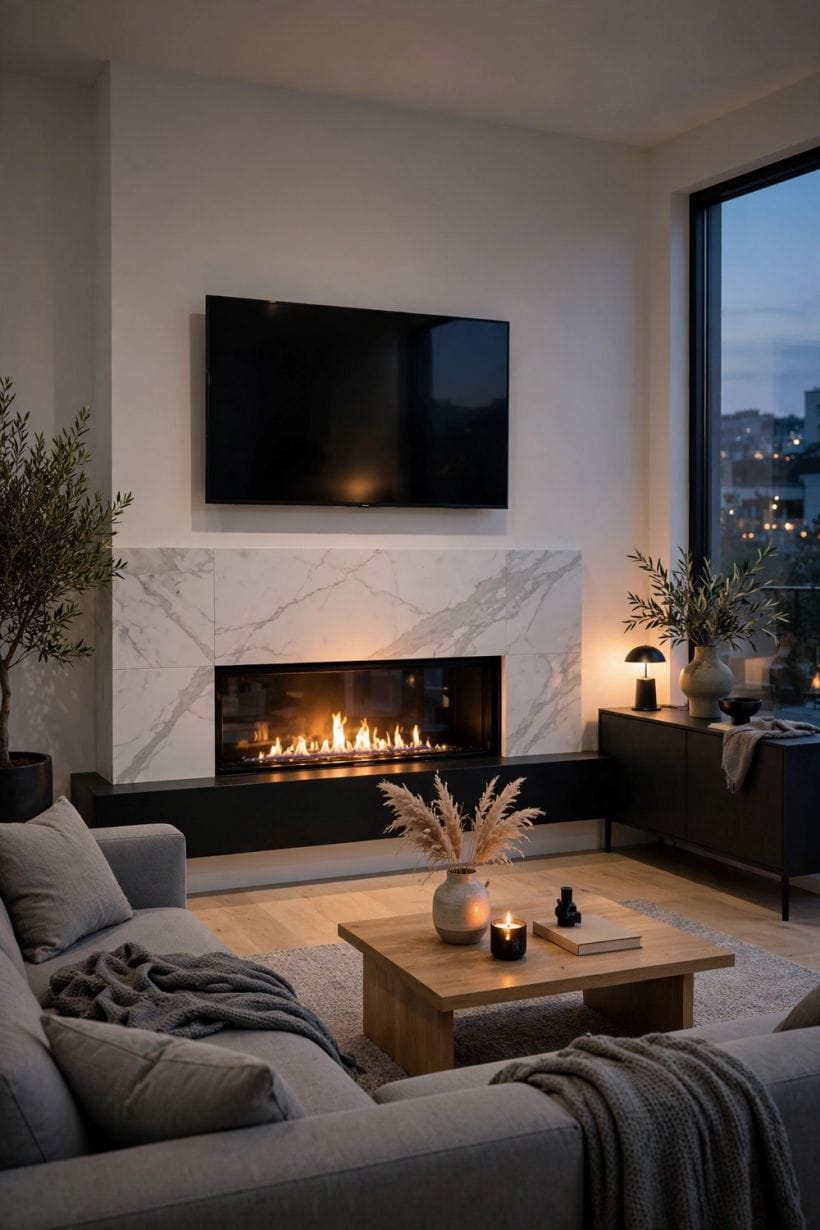
The same arrangement speaks several dialects. This closing section runs the registers — cottage, traditional, modern, industrial, Scandinavian, eclectic — because the screen-over-fire that suits one room’s language will jar in another’s, and the translation is mostly in the surround and the shelf.
66. Cottage: painted brick, a timber beam and a modest screen
The cottage version wears the arrangement most forgivingly: a painted brick or plaster breast, a chunky beam for a shelf, the screen sized with restraint and the styling in jugs, books and green things.
67. Traditional: the full mantelpiece carries the screen with authority
Marble or timber mantelpiece, a framed panel above, sconces at the sides — the traditional room absorbs the screen into a classical composition so completely that guests register the fireplace first.
68. Modern: flush stone, no mantel, the screen as a plane
The contemporary version makes the television one plane among planes: a full-height stone or microcement breast, a slot fire, no shelf, the screen floating flush.
69. Industrial: bare brick, steel and the honest bracket
In the loft register the arrangement shows its working: exposed brick, a steel shelf or a reclaimed beam, even a visible articulated arm reads as machinery honestly worn.
70. Scandinavian: pale plaster, light timber, the calm stack
The northern version keeps everything quiet: white or pale grey breast, a light oak shelf, the screen’s black softened by pale walls and daylight, styling in ceramics and linen tones.
71. Farmhouse: shiplap or board, a working mantel, family scale
Board-clad breasts and generous timber shelves suit the screen’s family duties — big enough for everyone, styled with the household’s real objects.
72. Eclectic: let the surround be the artwork
The collected room can make the breast itself the picture — patterned tile, a bold colour, a mural register in the plaster — with the screen as a calm dark window inside it.
73. Rental and reversible: the stack without the surgery
Where walls cannot be chased or drilled at will, the arrangement goes reversible: a floor-standing easel or a console in front of the breast, the fire dressed rather than burned, trunking painted and removable.
74. The media-wall migration: when the fireplace keeps its own wall
Some houses resolve the contest by divorce, handsomely: the fireplace keeps the breast for art and mirrors, and a purpose-built media wall takes the screen, the sound and the boxes. The fireplace living room survey treats both settlements as successes — the failure is only ever the unconsidered stack.
75. Whichever register, the order of decisions does not change
Heat, height, structure, cables, sound, styling, screen.
9. Checks and Mistakes: Before the First Purchase or the First Stone
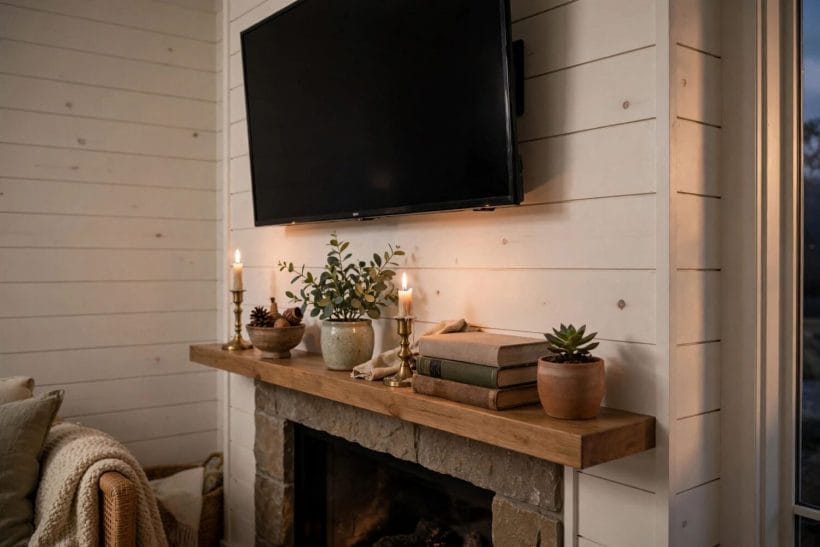
The checks begin with the fire lit properly and an evening spent in the room before anything is fixed permanently: the heat at screen height felt by hand, the tape outline judged from the sofa, the glare found and assigned its curtain. Then the structural check — fixings in sound material, clear of the flue, made by someone who understands what a chimney breast is — and the electrical check, which belongs to a qualified electrician wherever the installation goes beyond a plug in an existing socket.
One check is about mercy: the household’s least technical member should be able to turn the whole arrangement on, find a film, and turn it off, with one remote and no incantations. The concealed installation that needs its designer present to operate is a puzzle box, not a living room. Test the mercy before the plaster dries.
The mistakes repeat faithfully: the screen too high because the mantel was too grand; the cables visible because they were an afterthought; the boxes on the mantel because the cupboard was forgotten; the heat discovered in January because the audit was done in July. Every one of them is a decision made out of order — which is why this page put the measurements first and the shopping last.
10. Costs and Pulling It Together
Costs in this arrangement concentrate in the invisible: the electrician’s hour, the recessed box, the conduit, a mount that moves properly, the joinery that swallows the boxes. The screen itself is the priced item everyone shops for; the wall’s transformation is bought in the unglamorous lines around it, and skimping there is how an expensive television ends up looking cheap. The surround’s material is the second concentration — stone and full-height treatments carry real money, paint and limewash carry almost none — and the honest budget decides which register the room can afford to finish properly.
Pulling it together: audit the heat and the eye-line; choose the surround to carry the composition; let the mantel mediate; bury the hardware; style the wall for its off-hours; and hang the screen last, in the centre of a wall that was designed for it. The two rectangles then stop competing — the fire keeps the room’s heart, the screen takes its turn above it, and the wall becomes what the house always wanted: one focal point with two weathers.
Final Considerations
A television above a fireplace is a negotiation between the oldest technology in the house and the newest, and like all good negotiations it ends with both parties keeping their dignity. The fire is not demoted by the screen above it, nor the screen apologised for by the fire below — each frames the other, candlelight and lamplight’s descendant, stacked on the same breast.
Begin with the tape outline and the lit fire. Every good version of this wall started as an evening’s honest looking before it became a morning’s drilling.


0 Comments