
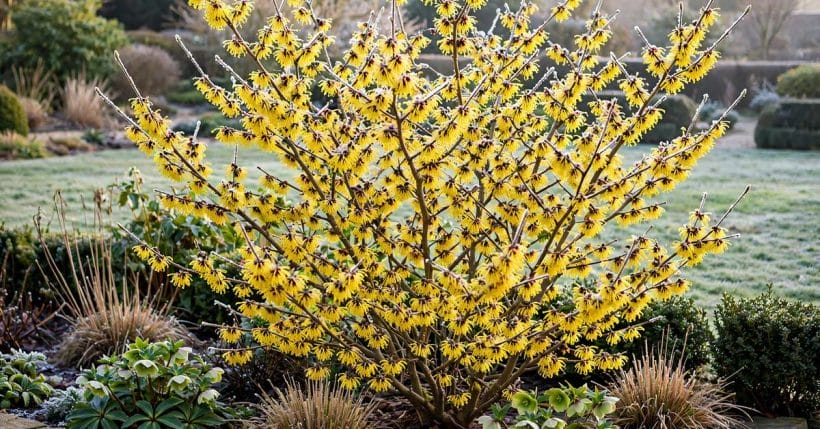
Mid-winter, when almost nothing else in the garden dares, a bare shrub covers itself in ribbons of yellow — witch hazel flowers on the coldest branches of the year, and gardeners who grow one tend to talk about it the way people talk about a reliable friend.
This guide answers the grower’s question properly: what witch hazel is, how to choose a plant, where it thrives, how to plant, water, mulch and prune it, and what to honestly expect from a slow, long-lived shrub — horticulture only, in our own words.
1. Witch Hazel at a Glance
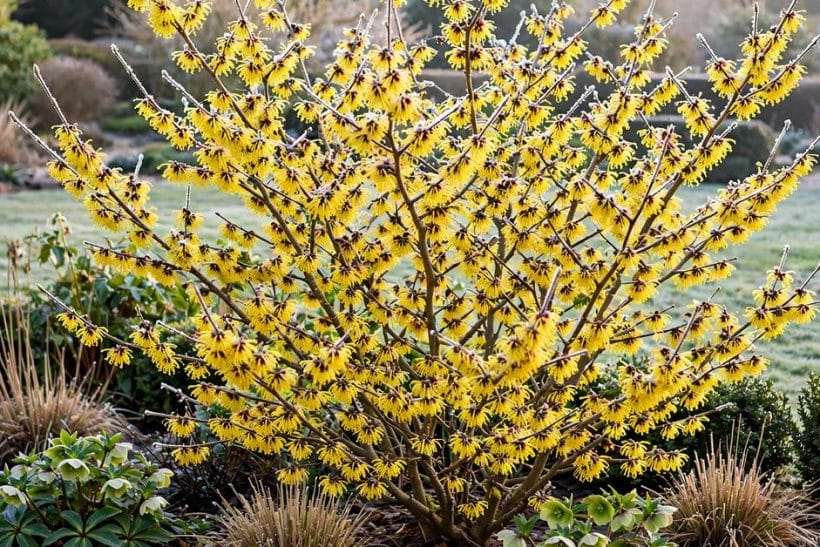
Witch hazel, Hamamelis, is a small family of hardy deciduous shrubs — and occasionally small trees — grown for one remarkable habit: flowering in late autumn or the depths of winter, when their spidery, ribbon-petalled blooms open on bare wood and shrug off frost that would ruin lesser blossom. The leaves follow in spring, broad and hazel-like, and in autumn they often colour warmly before falling to reveal the flower buds waiting their turn. This post is a growing guide and nothing else: site, soil, planting and care. Its garden neighbours have their own honest treatments — the rose survey in rose growing basics covers that shrub family end to end, and tiny house garden ideas handles small-plot planting generally — so everything here can stay with the one shrub that blooms in the snow.
| Question | Short answer |
|---|---|
| What is witch hazel? | A hardy deciduous shrub, Hamamelis, flowering on bare branches in late autumn or winter |
| When does it flower? | Depending on the kind — the autumn species as leaves fall, the better-known kinds in the depth of winter into early spring |
| What site suits it? | Sun or light shade, sheltered from harsh wind, in ground that stays evenly moist but drains freely |
| What soil suits it? | Rich, leafy, moisture-holding soil; most kinds prefer it on the acid side and dislike shallow chalk and waterlogging |
| How much pruning? | Very little — shape lightly after flowering, removing dead, crossing or wayward wood only |
| Is it fast? | No — it is famously slow and steady, which is exactly why a well-placed plant is a decades-long pleasure |
2. What Witch Hazel Is: A Shrub That Flowers in Winter
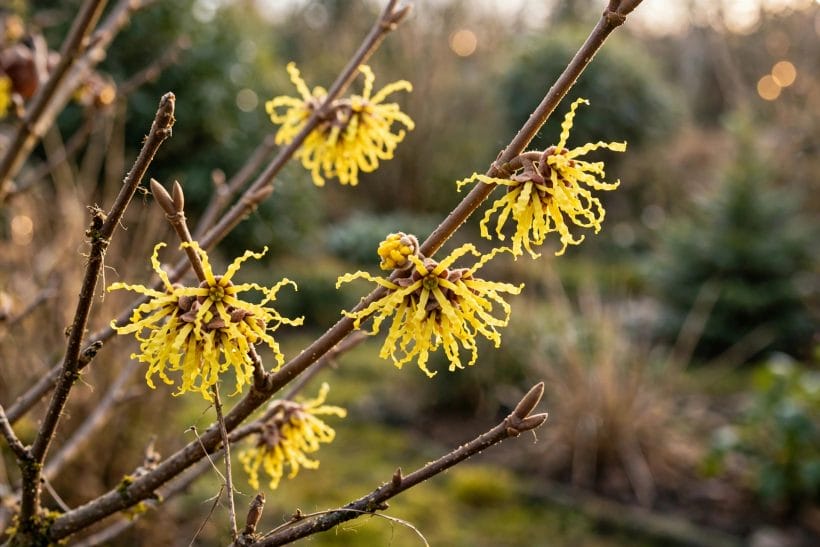
Understanding the shrub’s rhythm makes every later decision easy. Witch hazel spends spring and summer as a quiet, leafy, vase-shaped bush — pleasant, unremarkable — and saves its entire performance for the season when the garden is emptiest.
Flowers built for frost
Each flower is a small cluster of narrow, crinkled ribbon petals that unfurl on mild winter days and curl protectively when hard frost returns, then unfurl again. This curling trick lets a single flowering last for weeks through weather that changes daily, which is why the shrub earns its keep out of all proportion to its size.
Scent on cold air
Many kinds are sweetly fragrant, and cold, still air carries the scent surprisingly far. Planting near a path, gate or door — somewhere winter feet actually pass — turns a passing shrub into a daily pleasure precisely when the garden offers least else.
Leaves and autumn colour
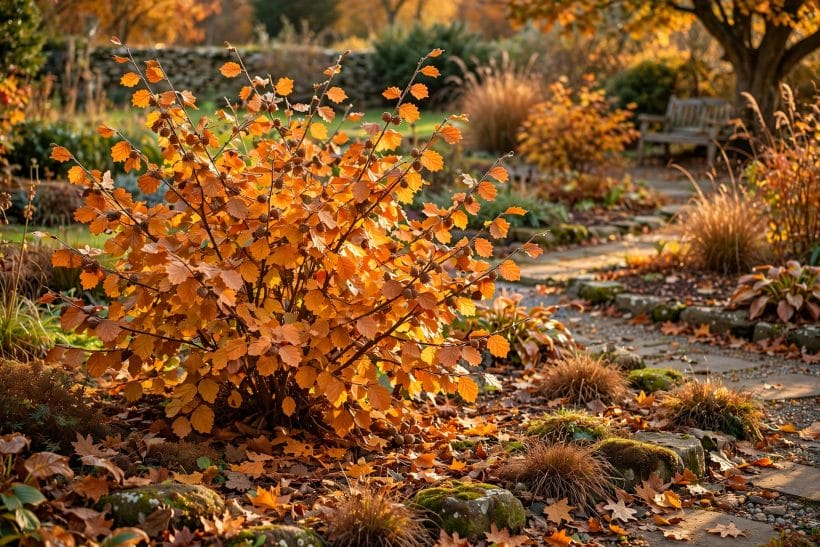
The broad, wavy-edged leaves resemble the hazel leaf that gives the shrub the second half of its name. In autumn many plants colour in yellows, oranges and warm reds before the leaves drop — a second, quieter season of interest that bridges the garden into the flowering months.
A vase shape that wants room
Left alone, witch hazel builds an open, spreading, vase-shaped framework of branches. It is not a shrub to wedge into a narrow gap or clip into a ball; its whole elegance is that spreading architecture, silhouetted — and in season, flowered — against a winter sky.
3. Choosing a Plant: Kinds and Flower Colours
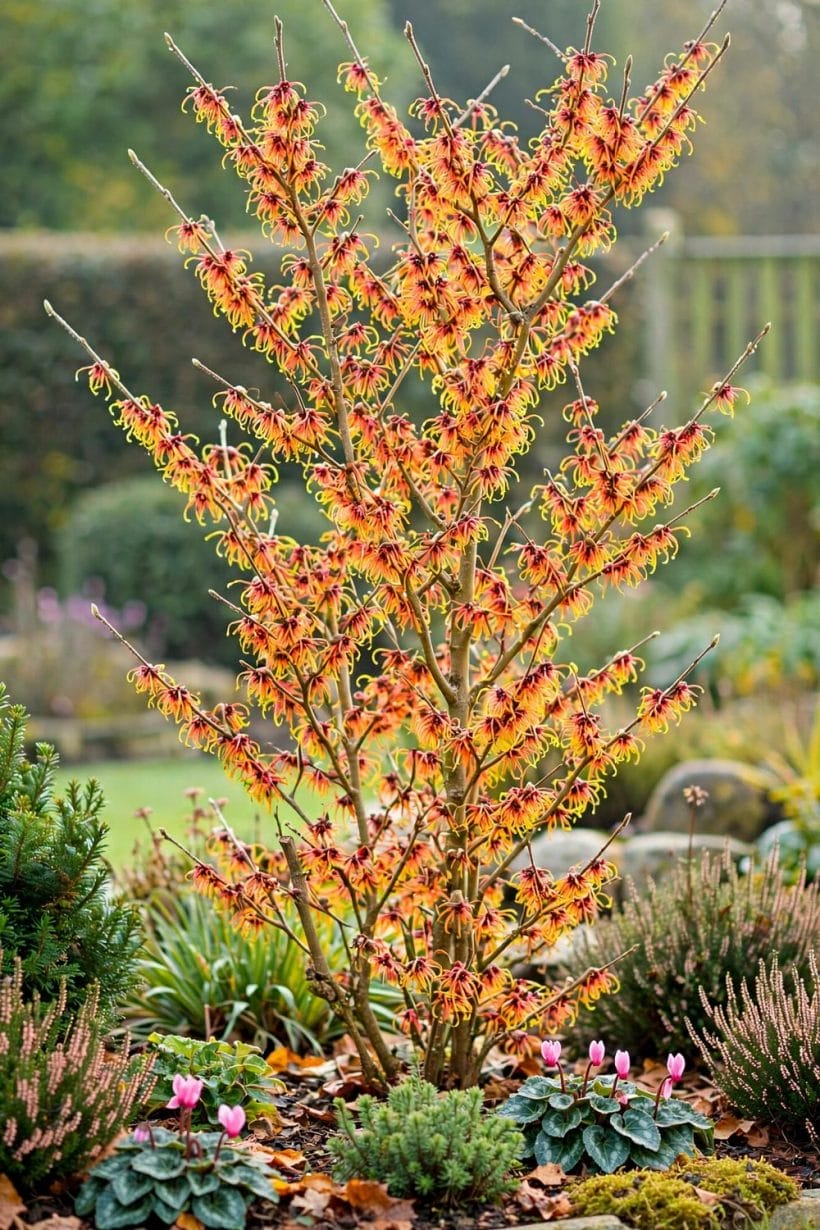
The witch hazels in gardens are mostly the Asian kinds and their hybrids, with the American kinds grown for their autumn flowering. Choosing well means matching flowering season, ultimate spread and flower colour to your garden — in general terms, on the nursery’s label advice.
The winter hybrid kinds
The hybrid witch hazels are the ones most gardeners grow: large, spidery flowers in the depths of winter, in shades running from clear yellow through coppery orange to deep red, often with real fragrance. Buy in flower if you can — winter is the one season when you can judge colour and scent with your own eyes and nose before paying.
The Asian species
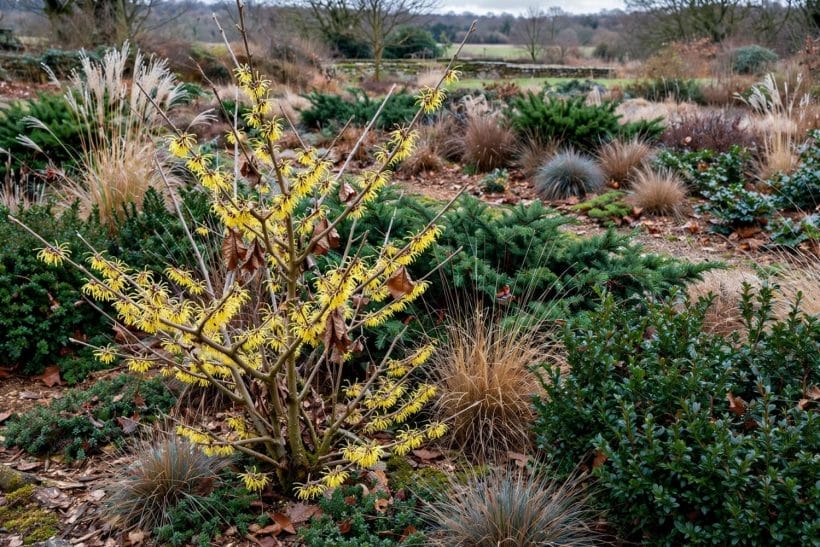
The Chinese and Japanese species behind the hybrids flower a little earlier and carry the same ribbon flowers in yellows. They are elegant, slightly smaller shrubs, and a good choice where a hybrid’s eventual spread would crowd its neighbours.
The autumn-flowering American kinds
The American witch hazels flower in autumn, as or after their leaves colour and fall — smaller, subtler yellow flowers, but a plant of real character and the kind most at home in a naturalistic or woodland-edge planting.
Yellow, orange or red?
Yellow flowers read brightest against dark evergreen backing and carry furthest in flat winter light. Oranges and reds are richer, moodier, and show best where pale winter sun reaches them or a light wall stands behind. There is no wrong answer — only the right backdrop.
Buy the biggest healthy plant you can
A slow shrub rewards buying size rather than saving money: a well-grown, bushy plant from a reputable nursery establishes its framework years sooner. In a small plot the same slow habit can work in a large pot for its first years, in the spirit of the flexible planting in container garden ideas — though the ground is its honest long-term home.
4. Site and Light: Where Witch Hazel Thrives
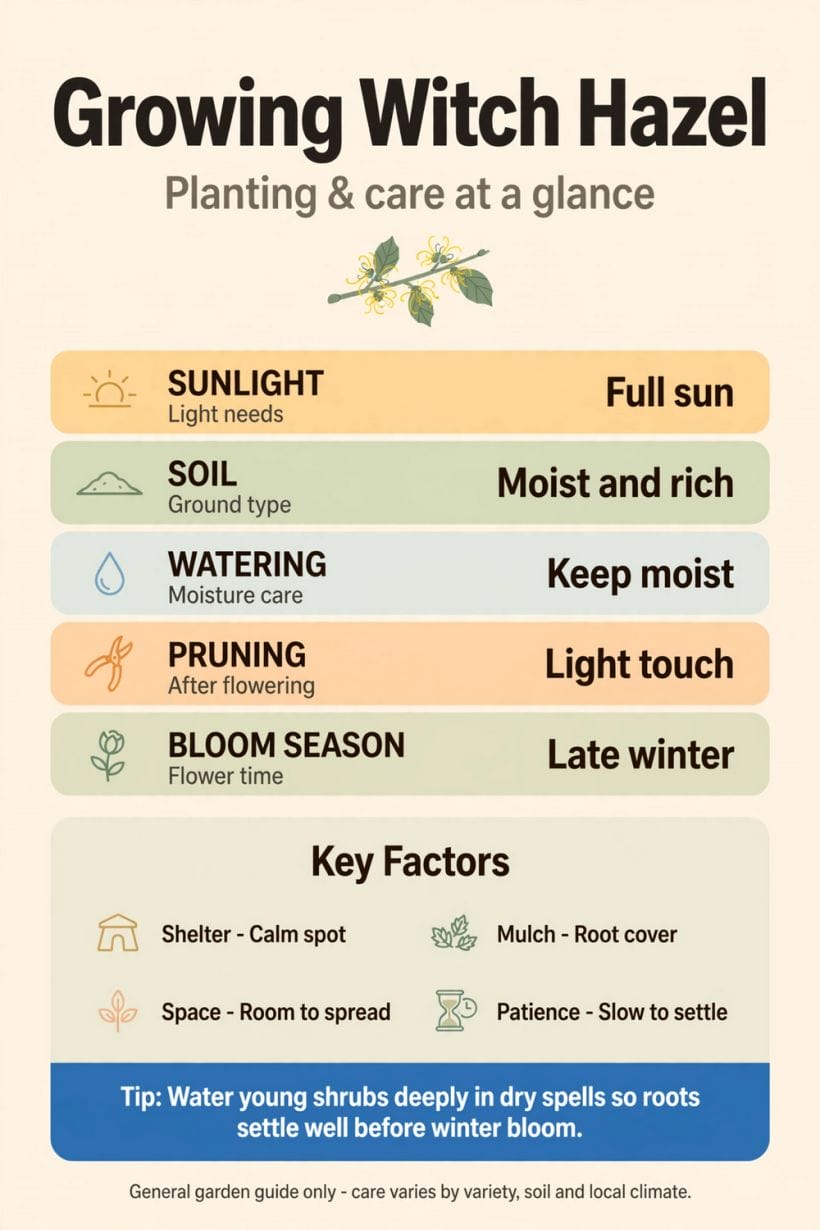
The infographic’s first row asks for full sun, and the fuller truth is a generous one: witch hazel flowers best with plenty of light, yet tolerates the light, dappled shade of a woodland edge happily. What it will not forgive is a site that bakes dry in summer or drowns in winter.
Sun for flowers, with one kindness
Give the plant sun for most of the day where your climate allows, and it will set flower buds freely along its branches. In hotter gardens a little afternoon shade is a kindness rather than a compromise, keeping the roots’ moisture — the thing the shrub values most — from vanishing in high summer.
Shelter from the worst wind
A calm spot, one of the infographic’s key factors, protects the winter display: harsh, drying wind desiccates flower buds and young growth and makes the open blossoms’ short season shorter. A fence, hedge or building at the wind’s back is all the shelter it asks.
Room to spread, planned from day one
Space is the other key factor, and it is decided at planting, not later. Set the shrub where its mature vase can spread without swamping paths or neighbours — witch hazel resents being hacked back to fit a space it has honestly outgrown.
A backdrop that shows the flowers
Winter flowers on bare wood need contrast to be seen. Dark evergreens, a yew or holly hedge, or a plain wall behind the plant turn a pretty shrub into a glowing winter picture; against a tangle of other bare shrubs, the same flowers nearly vanish.
5. Soil and Drainage: Moist, Rich and Never Soggy
The infographic’s soil row is the whole recipe: moist and rich. Witch hazel wants ground that holds moisture like a woodland floor — leafy, humus-rich, always slightly damp — yet lets spare water drain away, because roots sitting in stagnant winter water sulk and fail.
The woodland-floor standard
Think of where the wild kinds grow: at the edges of woods, where leaf litter has enriched the ground for centuries. Working generous compost or leaf mould into the planting area before the shrub goes in is the single most valuable hour you can spend on its whole future.
Acid leanings, honestly stated
Most witch hazels prefer soil on the acid to neutral side and can look pale and unhappy on shallow, chalky ground. If your soil is strongly alkaline, grow the shrub in a very large pot of suitable compost instead, or choose a different shrub — no feeding regime honestly repeals soil chemistry.
Drainage without drought
On heavy clay, plant on a gentle mound or in a raised, compost-enriched bed so the crown sits above winter wet. On light, sandy ground, the battle reverses: bulk up the organic matter and mulch deeply, or summer drought will check a young plant again and again.
Mulch as a standing habit
Mulch — the infographic’s root-cover key factor — is not a planting-day event but a yearly one. A deep layer of leaf mould, bark or compost each spring keeps moisture in, weeds down and the soil’s quiet biology fed, exactly as a woodland floor renews itself.
6. Planting: Getting a Young Shrub Settled

Planting itself is ordinary good practice done carefully — the shrub is slow, so the start you give it echoes for years. Autumn and early spring are the kind seasons, while the ground is workable and moisture is reliable. Young plants raised under cover, as in the sheltered starts described in greenhouse ideas, still harden off fastest when they meet real garden weather in those mild windows.
Dig wide, not deep
Prepare a planting hole several times the width of the rootball but no deeper, so the shrub sits at exactly the depth it grew in its pot. Roots spread sideways into loosened, enriched soil far more willingly than they dive into a deep, narrow pit.
Tease, settle, firm
Loosen circling roots gently, set the plant, backfill in stages with the enriched soil, firming lightly as you go to leave no air pockets, and keep the stem’s original soil mark level with the surface. A plant set too deep is a plant quietly struggling for years.
Water in, deeply and immediately
The infographic’s tip is the planting rule in one line: water young shrubs deeply. A thorough soaking straight after planting settles soil around the roots and starts the partnership properly — a sprinkle on the surface does neither.
Stake only if the site demands it
A sheltered shrub usually needs no stake. On an exposed site, one low, flexible tie for the first season steadies the rootball while new roots anchor — then remove it, because a framework that never sways never learns to stand.
7. Watering, Feeding and Mulching Through the Year
After planting, care is a short, calm routine: keep moisture even while the plant is young, mulch every year, feed lightly if at all, and otherwise leave this self-sufficient shrub alone. The few tools the routine needs live happily in any of the organised stores in garden shed ideas — a can, a fork, a pair of secateurs and patience cover the whole job.
Watering: deep, occasional, at the roots
The infographic’s watering row says keep moist, and the method matters: a deep drink at the base in dry spells, then a pause, teaches roots to run downward. Established shrubs in decent soil need help only in real drought; young ones, for their first summers, need watching whenever rain stays away.
Feeding: a light hand
Witch hazel is not a hungry shrub. An annual spring mulch of compost feeds it gently and sufficiently in most gardens; forcing soft growth with rich feeding buys leaves at the expense of the flower buds the plant exists to make.
The yearly rhythm
Spring: mulch and a check for winter damage. Summer: water in drought, enjoy the quiet green. Autumn: leaf colour, and on the American kinds, flowers. Winter: the main event — and the moment to stand, look, and decide on the lightest of pruning once the blossom fades.
8. Pruning: The Light Touch

The infographic’s pruning row — light touch, after flowering — deserves its own section because misunderstanding it is the one common way gardeners spoil this shrub. Witch hazel builds its character slowly; pruning should edit, never redesign.
When to prune
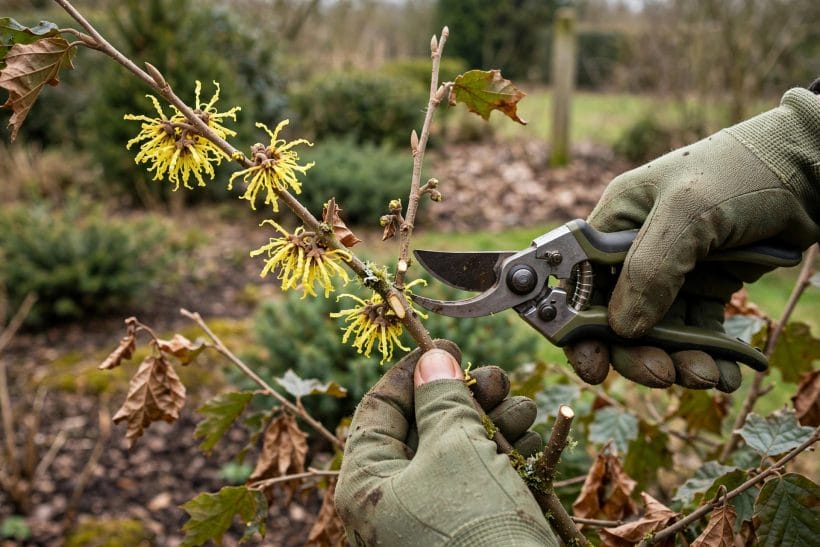
Prune straight after flowering finishes, which for the winter kinds means early spring as the blossom fades. The plant then has the whole growing season to make the wood that carries next winter’s buds — prune in autumn and you are cutting the display away before it happens.
What to take out
Dead wood, crossing branches that rub, weak twiggy growth in the centre, and any suckers rising from below the graft point on grafted plants. Work branch by branch, stepping back often, following each stem to its origin rather than clipping the shrub’s outline from outside.
What never to do
Never shear it, never head back the whole framework to a smaller size, and never prune hard to correct a planting made in too small a space. A witch hazel cut like a hedge answers with a thicket of graceless shoots and years without flowers.
Rejuvenating an old shrub
An old, congested plant is renewed gradually: one or two of the oldest stems removed at the base each year over several years, letting young framework replace old without ever stripping the shrub bare in a single season.
9. Witch Hazel Through the Seasons — and in Small Gardens
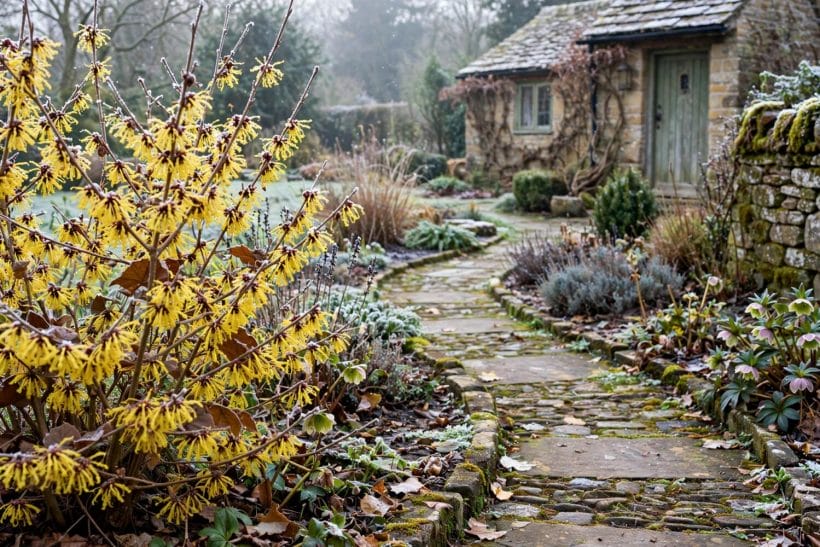
A shrub that performs in winter must still earn its ground in the other three seasons. Witch hazel’s case is quieter than a rose’s but real: fresh spring leaf, a calm summer presence, autumn colour — and winter flowers that can feed the garden’s earliest stirring life, in the spirit of the planting in wildlife friendly garden ideas.
Partners that set it off
Underplant with winter’s other honest workers — snowdrops, hellebores, winter aconites and early bulbs gather at its feet exactly when it flowers, while dark evergreen shrubs behind it carry the backdrop duty described earlier. In summer its leafy vase shades those same spring bulbs harmlessly.
In a pot, for a while
A young plant grows happily for some years in a large pot of rich, moisture-holding compost on a sheltered patio — the way to enjoy the winter flowers at nose height beside a door. Watering becomes your job entirely, and in time the ground, or a still larger pot, will honestly be asked for.
Against a wall
Given the spread it wants, a witch hazel trained loosely against a sheltered wall or fence makes a superb winter picture, flowers held forward where they catch what light there is. Train it as an open fan from youth; do not attempt to flatten a mature vase.
One shrub, chosen well
In a small garden this can be the single specimen shrub — the winter garden’s whole argument in one plant. That argues for buying the best plant, in flower, from a good nursery, and giving it the garden’s calmest, richest corner rather than a leftover gap.
10. Problems, Patience and Honest Expectations
Witch hazel is among the untroubled shrubs — few pests, few diseases, no routine spraying — and its difficulties are almost all difficulties of placement: wrong soil, drought when young, a space it outgrows. The last section is the honest ledger.
Slow is normal
Patience is the infographic’s final key factor, and it is literal: a young witch hazel may grow modestly for its first years while it builds roots, and flowering can be light until the framework settles. This is the plant’s nature, not a failure of your care — judge it over years, not seasons.
Pale leaves and poor growth
Yellowing leaves on an otherwise willing plant usually point back to soil — too alkaline, too dry, or too waterlogged — rather than to any disease. Answer the cause named in the soil section instead of reaching for a bottle: move it, pot it, or improve the ground, in that order of honesty.
Frost and the flowers
Hard frost curls the open flowers tight; it rarely harms them, and they unfurl again as the day softens — the shrub evolved this trick long before gardens borrowed it. Buds are hardy; it is wind and winter drought at the roots, not cold air, that a grower should watch.
Deer, rabbits and young plants
Young shrubs in country gardens can be browsed or frayed like any other planting. A simple guard for the first seasons, removed once the framework is woody and up out of reach, is the whole answer — no product promises more than that honestly.
Final Considerations
Does anyone grow witch hazel? Gardeners with patience do — and winter gardens are built on them. Choose a plant in flower, give it sun, shelter and moist rich ground with room to spread, water it deeply while it is young, mulch it every spring, prune it barely and only after flowering, and it will repay you in the darkest weeks of every year for decades. That is the whole of the craft: the right shrub, honestly placed, then left largely alone to do the thing only it does.




0 Comments