

Every off-grid electrical system makes one foundational decision, usually before the first wall is framed: at what voltage will the home actually live? Batteries store direct current, solar panels produce direct current, and the appliances in an ordinary house expect alternating current at household voltage. The 12v vs 120v off grid tiny house question is about where, and how often, your system converts between the two, because that choice shapes which appliances you can buy, how thick your cables need to be, how much energy is lost as heat along the way, and how the whole installation behaves on a grey week in winter.
Neither answer is a fad. Twelve-volt DC is the native language of vehicles, boats and battery banks, efficient for small continuous loads and unforgiving of long cable runs. One-twenty-volt AC is the native language of houses, compatible with almost every appliance ever sold and dependent on an inverter that must be awake, sized and fed. Most well-designed small systems end up using both, deliberately, and this comparison explains the attributes of each so you can decide where the boundary belongs in your own home rather than copying someone else’s diagram.
12V vs 120V Off-Grid Tiny House at a Glance
A note on wording before the table: the main keyword for this comparison names the choice as it is usually searched, while the table below compares the two voltages attribute by attribute. In North American homes the household standard is 120V; in many other regions it is a higher mains voltage, and the same logic applies with your local standard in place of 120V.
| Criterion | 12V DC System | 120V AC System |
|---|---|---|
| Appliance choice | Vehicle, marine and camping appliances: lights, fans, fridges, pumps and USB charging made for DC | Ordinary household appliances from any store, including larger kitchen and laundry equipment |
| Efficiency | No conversion needed for native loads, so battery energy goes straight to the device | An inverter converts DC to AC and loses some energy as heat, plus its own standby draw while switched on |
| Wiring cost | Higher currents need thicker, costlier copper cable, especially over longer runs | Lower currents at higher voltage travel on thinner, cheaper cable for the same power |
| Safety profile | Low shock risk, but high currents can overheat poor connections and undersized cable quickly | Household shock and arc risks, demanding proper breakers, grounding and code-conscious work |
| Best suited loads | Lighting, ventilation, water pumps, electronics charging and efficient DC refrigeration | Cooking appliances, power tools, washing machines, air conditioning and other large or motor loads |
| System complexity | Simple at small scale, strained as loads grow and cable runs multiply | Needs an inverter and AC distribution, but scales and expands like ordinary house wiring |

1. The Two Voltages Explained: Native DC and Household AC
Direct current flows one way, out of your battery bank, through the load and back. A 12V system keeps that power at battery voltage from storage to device, which is why the wiring centres on a DC fuse panel much like a vehicle or boat. Lights, fans, pumps and electronics designed for this world sip power steadily and tolerate the voltage wandering a little as the battery charges and discharges through the day. It is a simple, robust architecture, and at small scale it is hard to beat for elegance.
Alternating current reverses direction many times per second and is what grid homes, and therefore almost all domestic appliances, are built around. An off-grid home creates it with an inverter, which takes battery DC and synthesises household AC. That single box is what lets a tiny house run an ordinary kettle, a washing machine or a power tool, and it is also a single point of cost, heat and potential failure. Understanding that the inverter is not an accessory but the heart of the AC side is the first step to designing either system honestly.
2. How an Off-Grid System Is Put Together: Panels, Batteries, and Inverter
Both architectures share the same front end. Solar panels feed a charge controller, the controller manages the battery bank, and the bank is the reservoir every load draws from. The method in our guide to solar panel kits for tiny homes and sizing an off-grid battery bank covers that shared half of the system. Where the designs diverge is downstream of the batteries: the DC design runs a fused distribution panel at battery voltage, while the AC design runs an inverter first and a small breaker panel second.
Portable power stations compress this whole chain into one box, which is why our comparison of off-grid power stations from Jackery, Bluetti and EcoFlow is worth reading even if you plan a component system: they show, in miniature, the standard pattern of DC outputs for small loads beside AC outlets for household ones. That pattern is not marketing. It reflects the physics this article is about, and purpose-built systems copy it for the same reasons.
3. Appliance Choice: What Runs Natively on 12V and What Wants Household Power
The DC appliance catalogue comes from the road and the water. Expect LED lighting, ventilation and extractor fans, water pumps, efficient compressor fridges designed for vehicles and boats, diesel heater controls, phone and laptop charging, and small televisions. Quality in this catalogue is real but specialised: you shop from RV, marine and expedition suppliers, pay more per appliance than the household equivalent in many cases, and accept a smaller range of sizes and styles. For the continuous background loads of a small home, though, these devices are typically frugal and well proven.
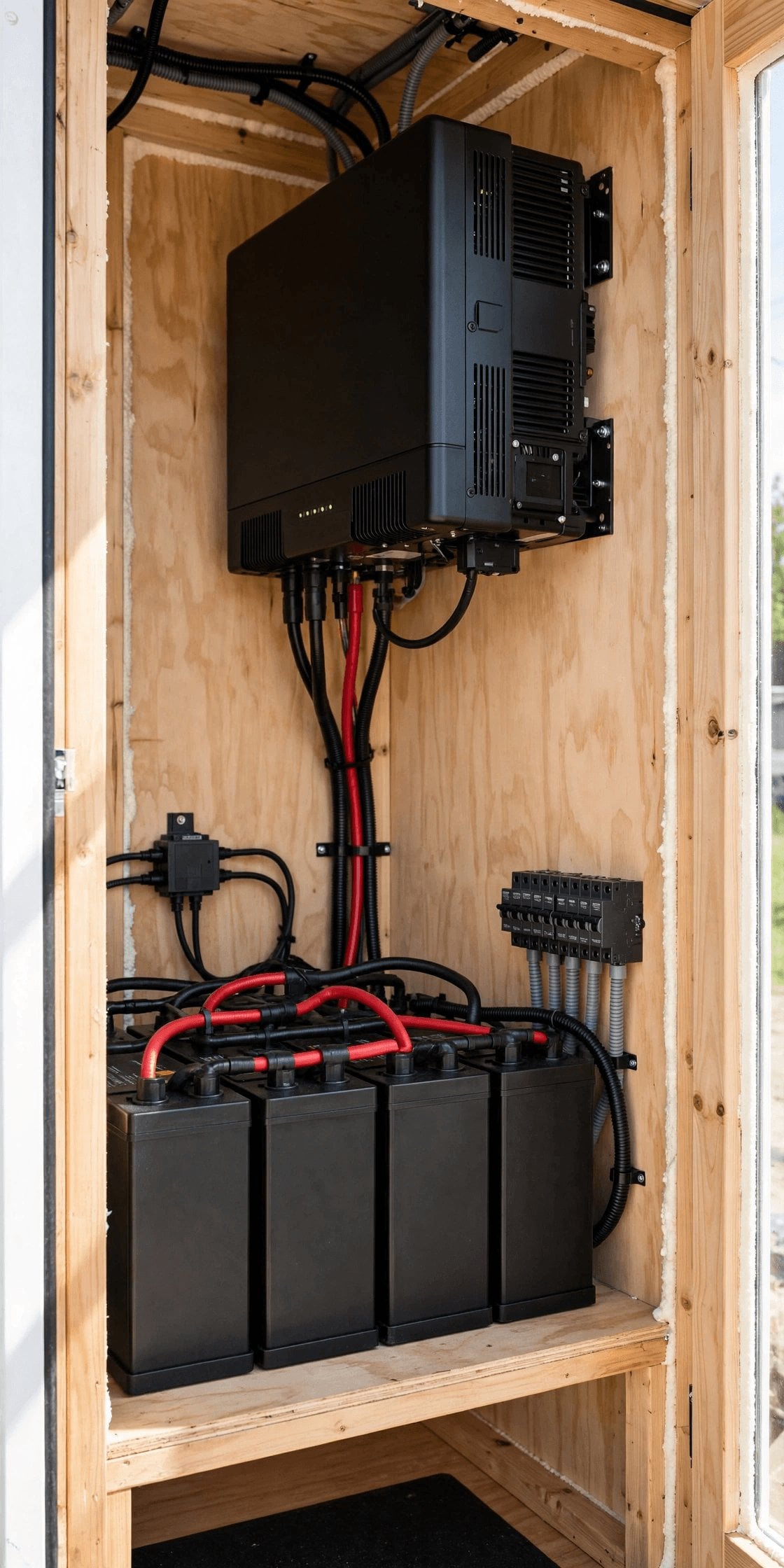
Household voltage unlocks the ordinary world: induction hobs, kettles, toasters, washing machines, standard fridges, power tools and air conditioners, all replaceable from any appliance store. Our roundup of the best compact kitchen appliances for tiny houses is largely a catalogue of AC devices for exactly this reason. The catch is appetite. Many household appliances draw heavy power for short bursts or, like anything with a heating element, heavy power for as long as they run. On a battery system, appliance choice is energy policy: every AC device you adopt is a commitment the battery bank and inverter must honour daily.
4. Efficiency and Inverter Losses: The Cost of Converting Power
Conversion is never free. An inverter turning battery DC into household AC loses a portion of the energy as heat, and the loss is proportionally worst at small loads, when the inverter’s own electronics consume a noticeable share of what passes through. It also draws power simply by being switched on and waiting, which is why leaving a large inverter idling overnight to run one tiny load is the classic off-grid own goal. None of this requires invented figures to understand: energy converted is energy taxed, and the tax runs twenty-four hours a day if the inverter does.
Native DC loads skip the tax entirely. A light or fridge fed straight from the battery uses only the energy the device itself consumes, which is why the always-on background of a home, lighting, ventilation, pumps, refrigeration and device charging, is where DC efficiency quietly wins every single day. The honest framing is not that one system is efficient and the other wasteful; it is that AC conversion charges a toll on every unit of energy that crosses it, so thoughtful systems route the frequent, small, continuous loads around the toll booth and reserve the inverter for loads that genuinely need it.
5. Wiring Cost and Cable Size: Copper, Distance, and Voltage Drop
Here the physics reverses. For the same power, a lower voltage means a higher current, and higher currents need thicker cable to travel without losing energy as heat along the way. In a 12V system, a modest appliance at the far end of the home can demand surprisingly heavy copper, and skimping shows up as voltage drop: lights dimming, pumps labouring and fridges struggling to start, because the device at the end of a thin cable is no longer really receiving twelve volts. Cable, lugs, fuses and switches rated for chunky DC currents are a real and often underestimated budget line.
At household voltage, the same power moves at a fraction of the current, so cable is thinner, cheaper per metre and more forgiving of distance, one reason houses are wired the way they are. The trade is that AC wiring carries household risks and belongs in proper conduit, boxes and breakers, designed and ideally installed or inspected by someone qualified. In a tiny house the runs are short, which softens the DC penalty, and good layouts exploit that by placing the battery bank centrally so no 12V run is longer than it must be. Measure your longest run before you fall in love with either architecture, because distance is the variable that prices the copper.
6. Safety: Why Low Voltage Is Not the Same as No Risk
Twelve volts will not give you a dangerous shock in normal circumstances, and that fact breeds a carelessness the voltage does not deserve. A battery bank can deliver very large currents into a fault, and at DC currents an undersized cable, a loose lug or a missing fuse becomes a heating element inside a wall. The discipline of the DC world is therefore fusing close to the battery, sizing every cable for its load and length, crimping and protecting connections properly, and treating ventilation and battery storage with respect. Done well, a 12V system is gentle and safe; done casually, it is a slow fire risk.
Household AC demands the opposite instinct: the current is lower but the voltage can shock, arc and kill, so the protections are formal ones, breakers, grounding, residual-current protection where applicable, enclosed junctions and respect for your local electrical code. In many places, fixed AC wiring must be installed or certified by a licensed electrician, and an off-grid inverter system is not an exemption. The practical conclusion is that neither side is the safe option by default. Each is safe when its own rules are followed, and the rules are simply different, which is why mixed systems need both disciplines in the same small wall.
7. Charging, Shore Power, and Generators: Talking to the Outside World
Few off-grid homes are off-grid every day. Shore power at a marina, a friend’s barn or a powered pitch, and a generator during a dark, still week, are the two visitors your system must receive gracefully. For an AC-centred system this is natural territory: an inverter-charger or a separate battery charger takes incoming household power, charges the bank and often passes power straight through to the home’s outlets. The generator conversation, sizing, noise and fuel, then becomes a simple extension of the same AC thinking.
A DC-centred system receives visitors through a charger sized for the bank, which is straightforward but must be planned rather than improvised with whatever automotive charger is in the shed. Vehicle charging belongs in this conversation too: homes that move can harvest the alternator through a DC-to-DC charger while driving, a trick native to the 12V world and genuinely valuable. Whichever architecture you choose, write down the winter plan, the cloudy-week plan, before installation. The energy decisions in our propane vs electric in tiny houses comparison interact with this plan as well, because every load you move to propane is a load the electrical system no longer has to survive January with.
8. The Hybrid Answer: Running Both Systems Where Each Belongs
For most full-time tiny homes, the mature answer is a hybrid: a 12V backbone carrying the continuous loads, lighting, fans, pump, fridge and charging, and an inverter, switched on when needed, carrying the household loads, kitchen appliances, tools and laundry. The battery bank is shared, the solar charging is shared, and each load simply plugs into the voltage it was born for. This is the architecture inside most quality RVs, expedition vehicles and, increasingly, thoughtfully built off-grid homes, because it spends conversion losses only where conversion buys something.
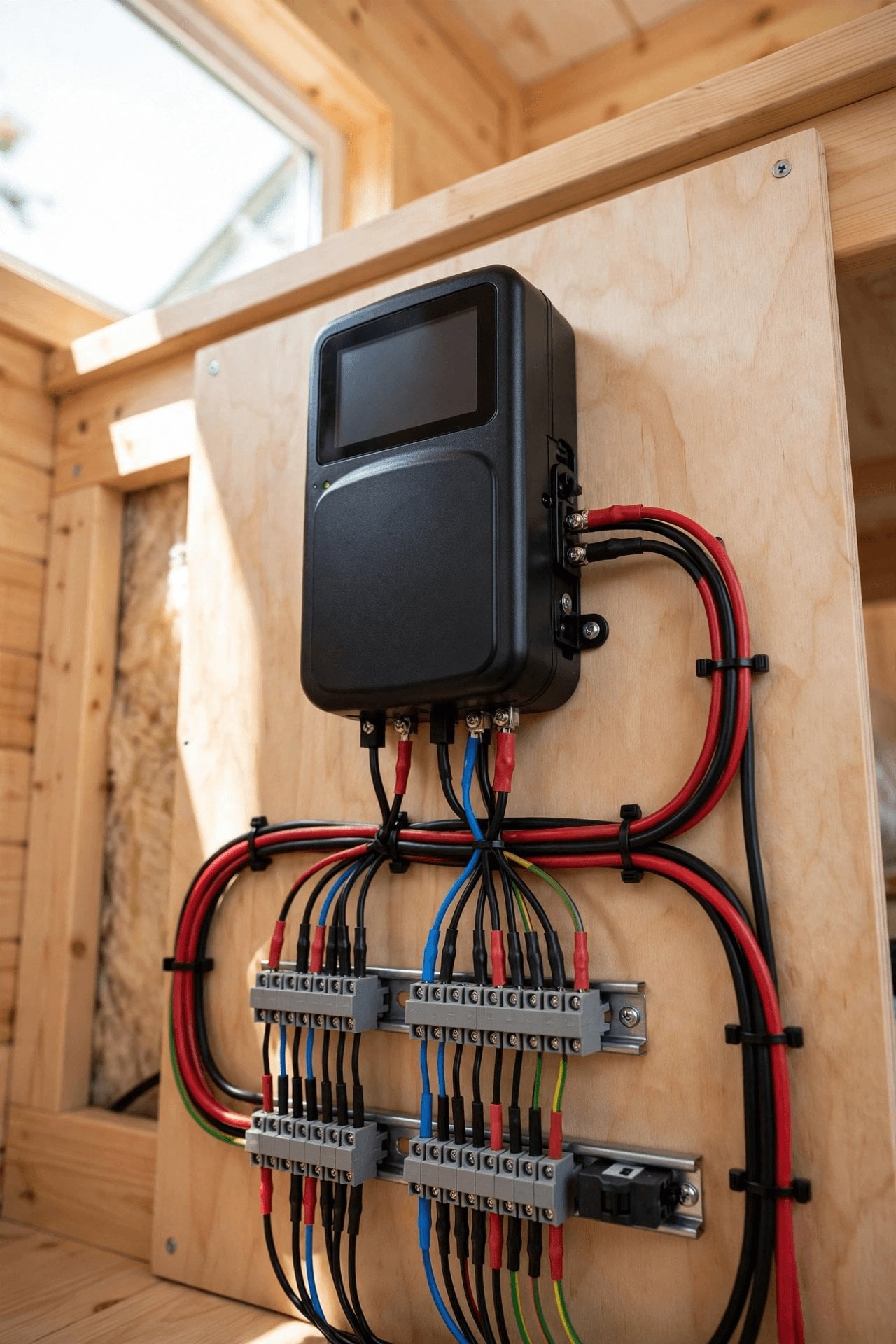
Designing the hybrid well is about habits as much as hardware. Size the inverter for your largest legitimate simultaneous load rather than a fantasy, keep it off or in its low-draw search mode when no AC is needed, and put the always-on loads on DC without exception. Big comfort loads deserve individual scrutiny: our guide to how to install a mini-split in a tiny house shows why air conditioning is an AC commitment that reshapes the whole energy budget, and the same scrutiny applies to electric water heating and tumble drying. Hybrid done casually, inverter on all day for no reason, quietly performs worse than either pure system.
9. The Loads Audit: Designing Around Your Actual Appliances
Every successful system in either voltage starts as a list, not a purchase. Write down each appliance you genuinely intend to use, its power draw from its label or manual, and honest hours per day, then separate the list into native DC candidates and AC-only devices. The totals tell you the battery bank size, the inverter size if any, and the solar array that must refill it all in your worst month, not your best. Guesswork at this stage becomes either an overspent system or a home that goes dark at inconvenient moments.
The audit also exposes lifestyle decisions disguised as electrical ones. Electric heating in any form dominates a winter budget, which is why many off-grid homes pair modest electrical systems with combustion heat and treat electricity as too valuable to burn for warmth, while background ventilation, covered in our guide to tiny house ventilation with HRV and ERV systems, is a small continuous load that belongs on the efficient DC side. Rank your loads by how much you would miss them during a week of bad weather. That ranking, not a catalogue, is your system design.
10. Retrofitting and Expanding a System You Already Own
Systems evolve, and the two architectures expand differently. A DC system grows by adding battery capacity, panel capacity and individual circuits, all modular and forgiving, until the day a large AC appliance arrives and an inverter joins the design, which is a well-trodden upgrade path rather than a rebuild. Keep the DC panel, bus bars and battery layout tidy from the start and that day is an afternoon of work instead of an excavation.
An AC-centred system expands around its inverter: a larger inverter, more outlets and eventually a bigger bank behind it, with the wiring standard already in place. Either way, leave physical room around the electrical cupboard, label every circuit, and keep a diagram of what you installed and why. Cold weather is the other expansion to plan for, since battery behaviour and heating loads shift together, and the preparation habits in our notes on tiny house living in cold climates belong in the electrical plan as much as in the plumbing one. Future you, fault-finding at midnight, is the audience for every label you write today.
Final Considerations
Think of the choice as assigning each load to its native voltage rather than crowning a winner. Twelve-volt DC is efficient, simple and safe-handling for the small continuous services of a home, and punishes distance, heavy loads and sloppy connections. Household AC is universal, expandable and appliance-friendly, and charges a conversion toll, in losses and standby draw, on everything it touches. Cost follows the same split: DC spends its money on copper and specialised appliances, AC spends its money on the inverter and ordinary appliances, and both spend it on the batteries either way.
Who should pick which? Choose a mainly 12V system if your life fits the vehicle and marine catalogue, your loads are modest, your cable runs are short and you value simplicity over appliance freedom. Choose a mainly 120V system if you expect ordinary household appliances, larger loads and easy expansion, and you accept the inverter as a permanent, properly installed part of the home. For most people building a full-time off-grid tiny house, pick the hybrid on purpose: DC for the background, AC for the bursts, an inverter you switch with intention, and a loads audit pinned inside the electrical cupboard door. Then have the design checked by a qualified electrician familiar with off-grid work before the walls close, because that review is the cheapest component in the entire system.


0 Comments