

The battery bank is the most expensive consumable in an off-grid tiny house, and it is the component most likely to be replaced during the home’s life, which makes the chemistry you choose a financial decision as much as a technical one. The lithium vs lead acid tiny house solar debate is usually argued on sticker price, and that is the least useful way to argue it: one chemistry charges more upfront and gives more of itself away every day for longer, while the other charges less, asks for gentler treatment and regular attention, and wears out sooner under the same work.
Terminology first, because it decides what you are actually buying. In this comparison, lithium means lithium iron phosphate, the lithium chemistry sold for homes, boats and RVs, not the cells in a phone. Lead-acid covers the deep-cycle family: flooded batteries you can top up, and sealed AGM and gel types you cannot. Both store the same solar harvest and run the same lights, and both will disappoint an owner who sizes, charges or stores them against their nature. What follows compares the attributes that decide real ownership: usable capacity, lifespan, weight, true cost per cycle and behaviour in the cold.
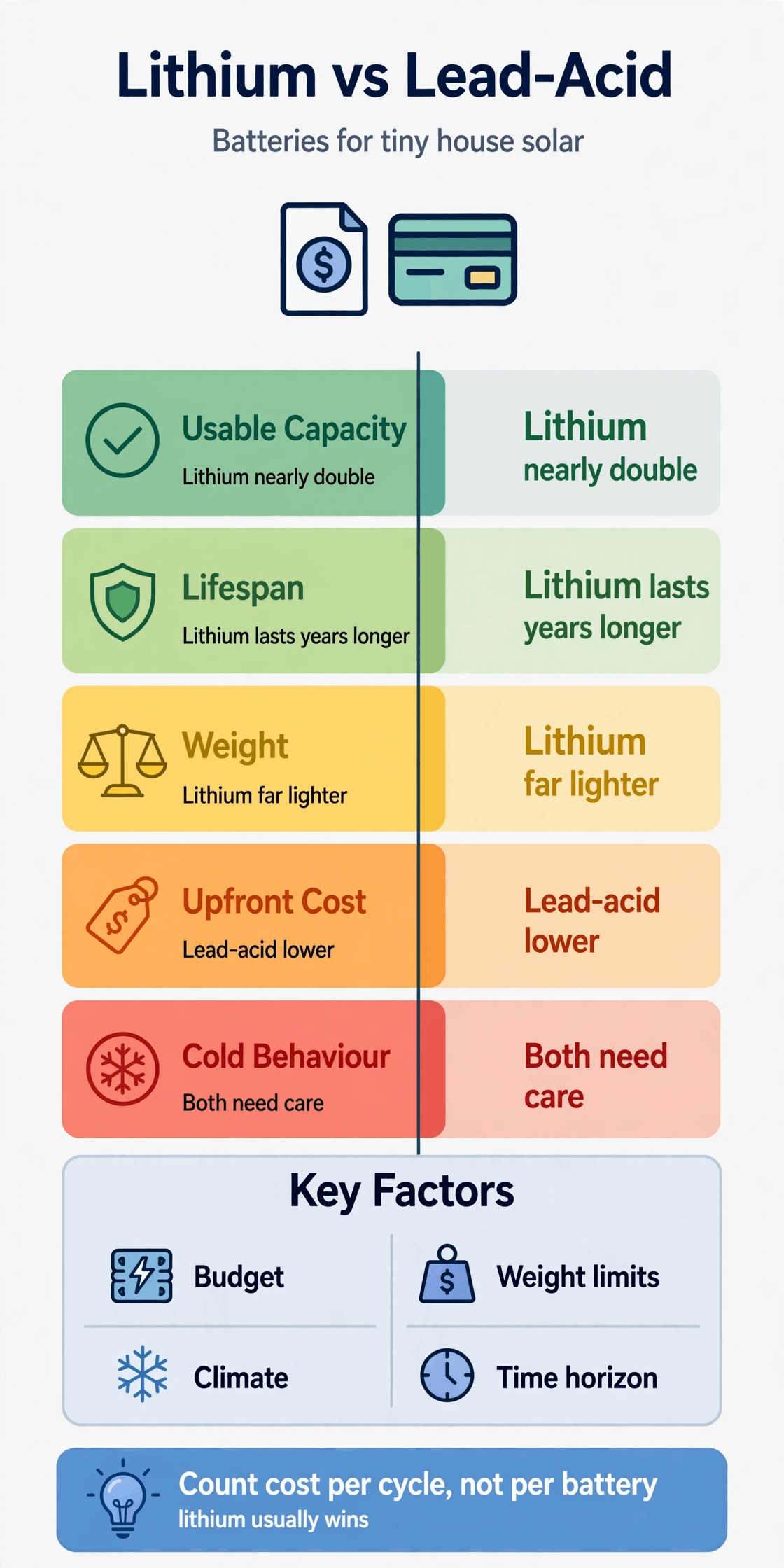
Lithium vs Lead-Acid Tiny House Solar at a Glance
The table below summarises the head-to-head differences. Treat the figures as patterns rather than promises: every manufacturer rates its own batteries, and the datasheet for the exact model you are buying always outranks a general comparison, including this one.
| Criterion | Lithium Iron Phosphate | Lead-Acid (Deep-Cycle) |
|---|---|---|
| Usable capacity | Most of the rated capacity can be used regularly, as guided by the built-in battery management system | A common rule of thumb limits regular use to a portion of rated capacity to protect lifespan |
| Lifespan pattern | Typically rated for many more charge cycles and a longer service life under comparable use | Fewer cycles, with life shortened sharply by deep or careless discharge |
| Upfront cost | Higher purchase price per battery | Lower purchase price per battery, the traditional budget entry point |
| Cost per cycle | Often competitive or lower once usable capacity and cycle life are counted | Can rise quickly if the bank is replaced several times across the same years |
| Weight and size | Noticeably lighter and more compact for the same usable energy | Heavy and bulky for the same usable energy, a real factor in a home on wheels |
| Cold behaviour | Discharges in the cold with reduced capacity, but charging below freezing can damage cells unless the battery protects or warms itself | Loses capacity in the cold and a discharged battery can freeze, yet accepts a winter charge without the same restriction |
| Maintenance | Essentially none beyond monitoring; management electronics are built in | Flooded types need water checks and cleaning; all types reward regular full charging |
1. The Two Chemistries Explained: What Is Inside Each Battery
A lead-acid battery stores energy in lead plates and an acid electrolyte, a design refined over more than a century of starting engines and buffering power. Deep-cycle versions use thicker plates built for repeated discharge and recharge rather than one violent burst, and they come flooded, with caps for topping up water, or sealed as AGM and gel. The chemistry is forgiving of rough charging, tolerant of simple equipment and heavy in every sense: the energy arrives in a package a person struggles to carry, because much of the weight is lead doing slow, dependable work.
A lithium iron phosphate battery stores energy by moving lithium ions through cells that are supervised, cell by cell, by a battery management system. That electronic guardian is not optional decoration: it watches voltage and temperature, balances the cells and disconnects the battery before abuse becomes damage. It is why a lithium battery behaves more like an appliance than a raw chemical store, why it can be mounted in living space without venting in normal use, and why its manual, charging voltages and temperature limits deserve reading rather than assuming. Check the exact model’s datasheet before purchase, because capacities, charge settings and protections are model-specific, not chemistry-wide promises.
2. Usable Capacity: Why the Nameplate Rating Is Only Half the Story
Batteries are sold by rated capacity, but homes run on usable capacity, and the gap between the two numbers is where this comparison is really decided. Lead-acid lifespan falls steeply the deeper it is discharged, so experienced owners plan to use only a portion of the rating on a regular basis and size the bank bigger than the maths first suggests. A bank that looks generous on its label can therefore feel modest in February, and chronic deeper discharge is the most common way these batteries are killed young by people who believed the nameplate.
Lithium iron phosphate tolerates deep discharge far better, and its management system enforces the limits the chemistry needs, so a much larger share of the rated capacity is available for daily use without the same lifespan penalty. The practical consequence for a tiny house is sizing honesty: compare banks by usable energy, not rated energy, or you will conclude the lead-acid bank is cheaper for the same storage when it is actually storing less you may touch. The sizing method in our guide to solar panel kits for tiny homes and sizing an off-grid battery bank starts from daily consumption, and this usable-capacity adjustment belongs at the centre of that calculation.
3. Lifespan and Cycle Life: Counting Years, Not Just Winters
A cycle is one discharge and recharge, and cycle life is the count a battery survives before its capacity fades below usefulness. Manufacturers publish cycle ratings against a stated depth of discharge, and the honest way to read those tables is comparatively: lithium iron phosphate is consistently rated for substantially more cycles than lead-acid at comparable or deeper use, which is why it is expected to remain in service through years in which a lead-acid bank may need replacing, sometimes more than once under hard daily cycling. Exact numbers belong to the datasheet of the model in your hand, because ratings vary by brand and by how the test was run.

Calendar life runs beside cycle life. A lightly used system in a weekend cabin may age its batteries by time more than by cycling, which softens lithium’s cycle advantage and strengthens the case for the cheaper bank. A full-time home cycling daily does the opposite. Sulfation, the slow crystallisation that afflicts lead-acid left sitting partly charged, is the other lifespan thief, and it punishes exactly the under-charged, cloudy-week pattern off-grid life produces. Lithium does not sulfate, though it prefers not to be stored brim-full and baking hot. Match the chemistry to your usage rhythm, not to a stranger’s.
4. Cost per Cycle: The Honest Way to Compare Upfront Price
Cost per cycle is the comparison this purchase deserves. Take the price of the bank, divide it by the energy it can realistically deliver across its life, meaning usable capacity multiplied by realistic cycles, and the two chemistries change places in many households’ maths. Lead-acid wins the invoice on day one and can lose the decade, because replacements, plural, belong in its total. Lithium’s higher invoice buys more usable energy per box and more cycles over which to spread the price. Neither direction is automatic: a lightly used system may never cycle a lead-acid bank to death, and in that home the expensive chemistry’s advantages sit unused.
Worked honestly, the calculation needs your own numbers: quotes for the exact models you are considering, your measured daily consumption, and the manufacturers’ cycle tables for those models. Beware two traps. The first is comparing a quality lithium battery against the cheapest lead-acid on the shelf, or the reverse; compare like quality with like. The second is ignoring the supporting cast, because lithium may need compatible charger settings, and lead-acid may need more solar to replace its lower charging efficiency and to guarantee the regular full charges it craves. Whole-system cost, over the years you expect to live in the home, is the only figure that should make this decision.
5. Weight and Space: Batteries in a Home That Counts Every Kilogram
In a house on wheels, mass is a budget with a legal ceiling. For the same usable energy, a lithium bank is dramatically easier to carry: lighter per unit of storage and smaller in volume, so it can live in a bench base, a tongue box rated for it, or a cupboard that would never accept the lead-acid equivalent. That freedom is not cosmetic. Battery placement decides weight distribution over the axles, and a heavy bank in the wrong place follows you to every weighbridge and every tow.
Before choosing on weight, do the honest arithmetic for your own build with how to calculate the weight of a tiny house and the limits in tiny house weight limits, GVWR and axle ratings. A stationary tiny home on a foundation cares far less, though floor loading and the simple logistics of installing, and one day removing, a very heavy bank still count. Remember that lead-acid’s weight also buys a kind of rugged simplicity some stationary owners value: no electronics to fail, and a chemistry any rural supplier understands. Weight is lithium’s clearest win, but it is worth the most to homes that move.
6. Cold Behaviour: Charging and Capacity When Temperatures Drop
Cold is where the two chemistries trade their sharpest warnings. Lithium iron phosphate will discharge in freezing weather with the expected reduction in available capacity, but charging it below freezing can cause permanent internal damage, which is why its management system should refuse a sub-zero charge, and why better batteries for cold climates add internal heating that warms the cells from the incoming charge before accepting it. If your home winters where nights freeze, treat low-temperature charge protection as a required feature on the datasheet, not an upgrade, and plan battery placement inside the insulated envelope wherever possible.
Lead-acid has the mirror-image temperament. It accepts charging in the cold, though capacity falls and a fully charged battery resists freezing far better than a discharged one, which can freeze and be destroyed in a hard snap. The winter discipline is therefore state of charge: keep the bank charged, because a flat lead-acid battery in January is a battery at risk from both sulfation and ice. The preparation habits in our guide to tiny house living in cold climates, and insulating the battery’s home much as you would protect pipes with the approaches in our tiny house skirting options guide, apply to whichever chemistry you choose.
7. Charging Speed, Solar Matching, and Charge Controllers
The two chemistries drink sunlight differently. Lithium accepts charge quickly and efficiently through most of its range, soaking up a short winter midday burst or a generator run with little waste, and it is content to sit partly charged between sunny days. Lead-acid charges in stages, with a long, slow finishing phase that cannot be hurried, and it genuinely needs to reach a full charge regularly to stay healthy, which means your solar array must be sized not merely for daily energy but for the hours of good sun a full finishing charge requires.
Controller settings are where the chemistries meet your hardware. Modern charge controllers and inverter-chargers carry profiles for both, but the profile must match the bank actually connected, and mixing habits carried over from one chemistry to the other is a quiet source of damage. All-in-one units have collapsed much of this distinction for small systems, as our comparison of off-grid power stations from Jackery, Bluetti and EcoFlow shows, with lithium now the default inside portable power. Whichever bank you buy, confirm in writing that your controller, charger and any battery monitor support its exact requirements before the first connection.
8. Maintenance, Monitoring, and Daily Habits
Ownership feels different day to day. A flooded lead-acid bank asks for a small ritual: check electrolyte levels, top up with distilled water as the manual directs, keep terminals clean and tight, and glance at a hydrometer or monitor. Sealed lead-acid drops the watering and keeps the discipline of regular full charges and voltage awareness. Lithium removes the ritual almost entirely: no watering, no equalising, no acid, with the management system standing guard. What remains is monitoring, because a battery you cannot see is a battery you will be surprised by.

Monitoring deserves emphasis because voltage alone misleads on both chemistries, in opposite ways. Lead-acid voltage sags under load and recovers at rest, while lithium holds a famously flat voltage until it is nearly empty, so a simple voltmeter makes one look tired and the other look immortal. A proper shunt-based battery monitor, counting energy in and out, is the instrument that makes either bank legible. The habits in our propane vs electric in tiny houses comparison belong here too: every load you shift off electricity extends the life of whichever bank you bought, because cycles not spent are cycles saved.
9. Safety, Venting, and Where Each Battery May Live
Flooded lead-acid produces hydrogen gas while charging, so it belongs in a vented compartment, away from sparks and living space, with acid respected during handling and watering. Sealed types vent far less in normal use but are still usually installed with ventilation and restraint in mind. Lithium iron phosphate is the stable lithium chemistry and does not vent in normal operation, which is why it may live inside the insulated cabin, but it is not exempt from rules: it needs physical protection, correct fusing close to the terminals, secure mounting against road vibration and a management system that has not been bypassed or defeated.
Both chemistries store enough energy to start a fire through a short circuit, so the universal rules apply: fuses sized for the cable, cables sized for the current, connections torqued and covered, and the bank secured so it cannot move in transit. Keep the installation inspectable and the documentation with the home, following the spirit of our guide to how to keep your tiny house safe. If you are not confident designing the protection side, have a marine or off-grid electrician review the plan; battery banks reward professional eyes more than almost any other part of a small system.
10. Disposal, Recycling, and the End of the Bank’s Story
Every bank is eventually replaced, and the chemistries leave differently. Lead-acid has one of the most established recycling loops of any product: the lead and plastic are valuable to recyclers, trade-in and core-charge systems are routine, and disposal is a solved logistics problem in most regions, provided the battery goes to a proper collection point rather than a shed corner. Its environmental debit was taken during manufacture and use; its exit, at least, is well organised.
Lithium recycling is younger and more variable by region, with iron phosphate cells containing less of the high-value material that drives collection economics, so check your local hazardous-waste and battery recycling routes before the bank dies rather than after. A quality lithium bank offsets some of this with sheer longevity, one battery doing the years of several, but the responsible plan is the same: buy from a maker who publishes end-of-life guidance, keep the paperwork, and never let a swollen, damaged or waterlogged battery of either chemistry ride to the tip in the back of a car. Ask the seller about take-back at the moment of purchase; their answer is part of what you are buying.
Final Considerations
Compared on the attributes that decide ownership, the pattern is consistent. Lithium iron phosphate offers more usable capacity from a smaller, lighter box, many more cycles over a longer life, fast and forgiving charging and almost no maintenance, at a higher purchase price and with one winter rule, never charge it frozen, that must be engineered around. Lead-acid offers the lowest entry price, simple and well-understood behaviour, cold-charge tolerance and excellent recycling, at the cost of weight, bulk, gentler discharge limits, regular attention and replacement on a shorter rhythm. Cost per cycle, calculated with your own consumption and the real datasheets, is the tiebreaker that turns this from an argument into an answer.
Who should pick which? Choose lithium if your home cycles daily, moves on wheels, winters off-grid or simply needs the most usable energy in the least space, and your budget can absorb the upfront step for the cheaper decade. Choose lead-acid if the system is small, stationary, lightly cycled, closely attended and honestly budgeted, especially where a limited purchase budget today beats a lower lifetime cost tomorrow. Whichever chemistry you choose, size it from usable capacity, protect it properly, monitor it with a real shunt-based meter and read its manual the way you would read a contract, because in energy terms, that is exactly what it is.


0 Comments