

The number one regret in tiny kitchens is not the small fridge. It is the toy sink you cannot fit a sheet pan into. A tiny kitchen can absolutely cook a real dinner — even Thanksgiving — but only if every appliance is a compact version of real equipment rather than a shrunken novelty. This guide sizes the sink, the cooking setup, the fridge and the power behind them.
1. Compact Kitchen Appliances for Tiny Houses at a Glance
A tiny house kitchen can cook like a big one, and the trick is not miniaturizing everything — tiny appliances frustrate. The trick is choosing compact versions of real equipment: a sink deep enough to hide the dishes, an oven that holds a roasting pan, a fridge that holds a week of food, and circuits planned for the load they will actually carry. The system has seven parts — sink, cooking, cold storage, dishwashing, ventilation, power and weight — and each part is sized by the same test: would this still work on the four-hundredth dinner, not just the first? The table gathers the whole system in one place; the sections after it take each part apart, dimension by dimension.
| Attribute | Detail |
|---|---|
| The Rule | Compact versions of real equipment — never shrunken novelties that frustrate daily |
| The Sink | Single bowl, 24–30″ wide and 8–10″ deep — the hardest-working square foot in the kitchen |
| Cooking | A 24″ apartment range, or a 2-burner cooktop plus a countertop convection oven |
| The Fridge | 10 cu ft apartment fridge, 24″ wide — a week’s groceries for two |
| The Dishwasher | Countertop 18″ unit at $250–400, or a single drawer at $800–1,200 |
| Ventilation | A real range hood vented outside — 200+ CFM, never recirculating |
| Layout | Galley with 8–10 linear feet of counter; work triangle 12–20 feet total |
| Power | 20A GFCI kitchen circuits; the simultaneous load peaks at 2,800W |
| Fridge Draw | 2–2.5 kWh/day — the #2 electrical load after heating and cooling |
| Weight | Fridge 150–250 lbs, range 150–200 lbs — cluster the heavy appliances over the axles |
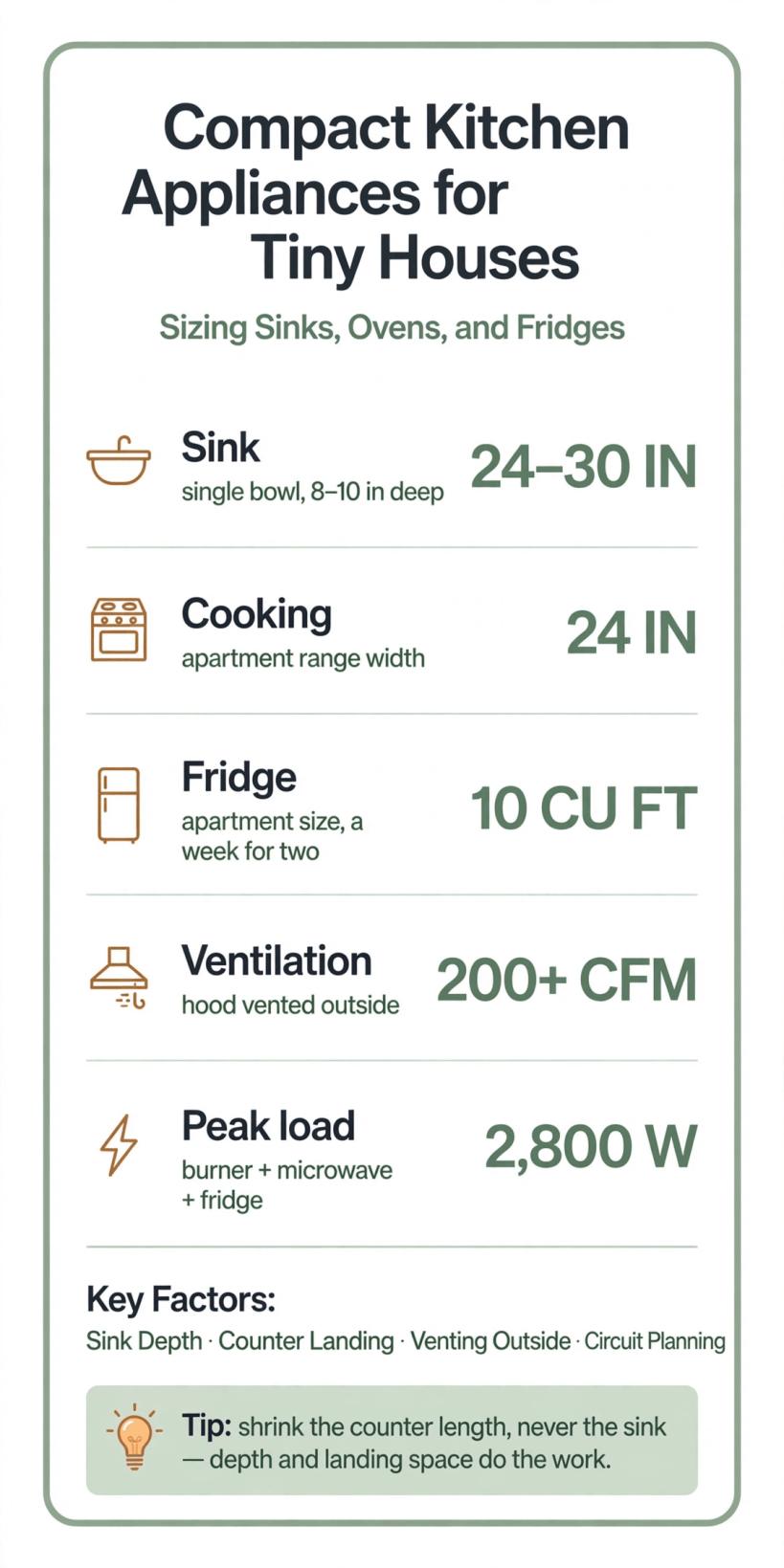
A 24–30-inch sink, a 24-inch range, 10 cubic feet of fridge and a 2,800-watt peak load — the compact kitchen on one card.
Sizing starts from the cooking, not the catalogue. The appliances are chosen after the layout is fixed, because the galley geometry decides how much counter exists to land on and the floor plan decides where the heavy boxes can sit. That layout-first order is the same one the tiny house kitchen floor plans guide applies to the room itself; this guide picks up where it leaves off and sizes everything that plugs, burns or fills with water inside it.
2. Layout First: The Galley, the Triangle and the Landing Zone
The layout that makes compact appliances work is the galley: 8–10 linear feet of counter on one or two walls, the efficient standard in which everything sits within a pivot. Inside a galley the work triangle — sink, stove, fridge — totals 12–20 feet, compact by nature in a tiny house, and that compactness is the advantage of small: no step in the cooking sequence is ever far from the last one. The triangle is why a tiny kitchen can out-cook a sprawling one; the distances that make big kitchens tiring simply do not exist.
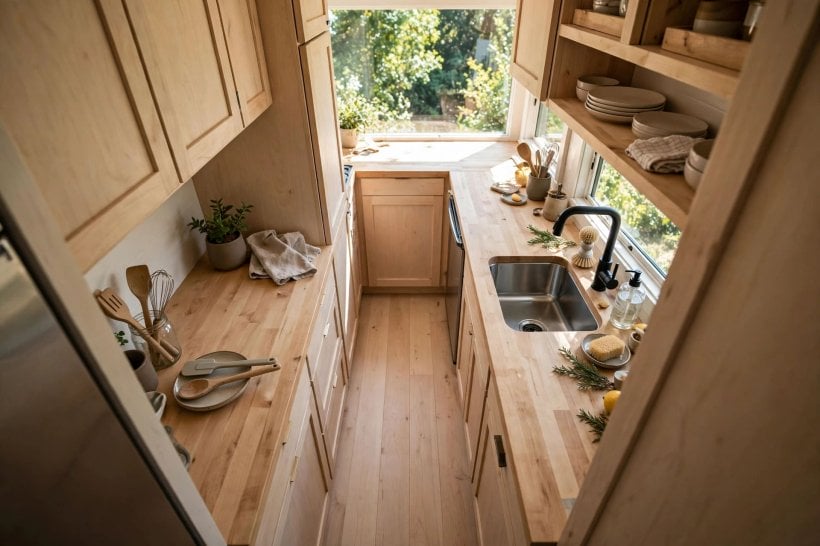
Two dimensions protect the layout. Counter depth stays at the standard 25″ — do not shrink depth, because shallow counters frustrate; shrink length instead. And landing zones are non-negotiable: 12″ or more of clear counter beside the stove and beside the sink, because a hot pan or a dripping colander needs somewhere to go the moment it leaves your hands. No landing zone, no functional kitchen. What the counters cannot hold goes vertical: shelves and rails up the wall, pots on rails, spices on magnetic strips — the walls are the pantry. Only once that geometry is fixed does appliance sizing begin, which is why the household-to-layout matching in the tiny house floor plans calculator comes before a single appliance is bought.
3. The Sink: Bigger Than You Think
Size the sink generously: a single-bowl 24–30″ sink, not the 15″ bar sink — you cannot wash a sheet pan in a bar sink, and the too-small sink is the #1 tiny kitchen regret. The single bowl is the point. One wide, uninterrupted basin swallows the roasting pan, the stockpot and the cutting board in a way two small bowls never can, and in a kitchen where the sink is also the prep rinse, the wash-up and the landing zone for everything wet, its capacity is the kitchen’s capacity.
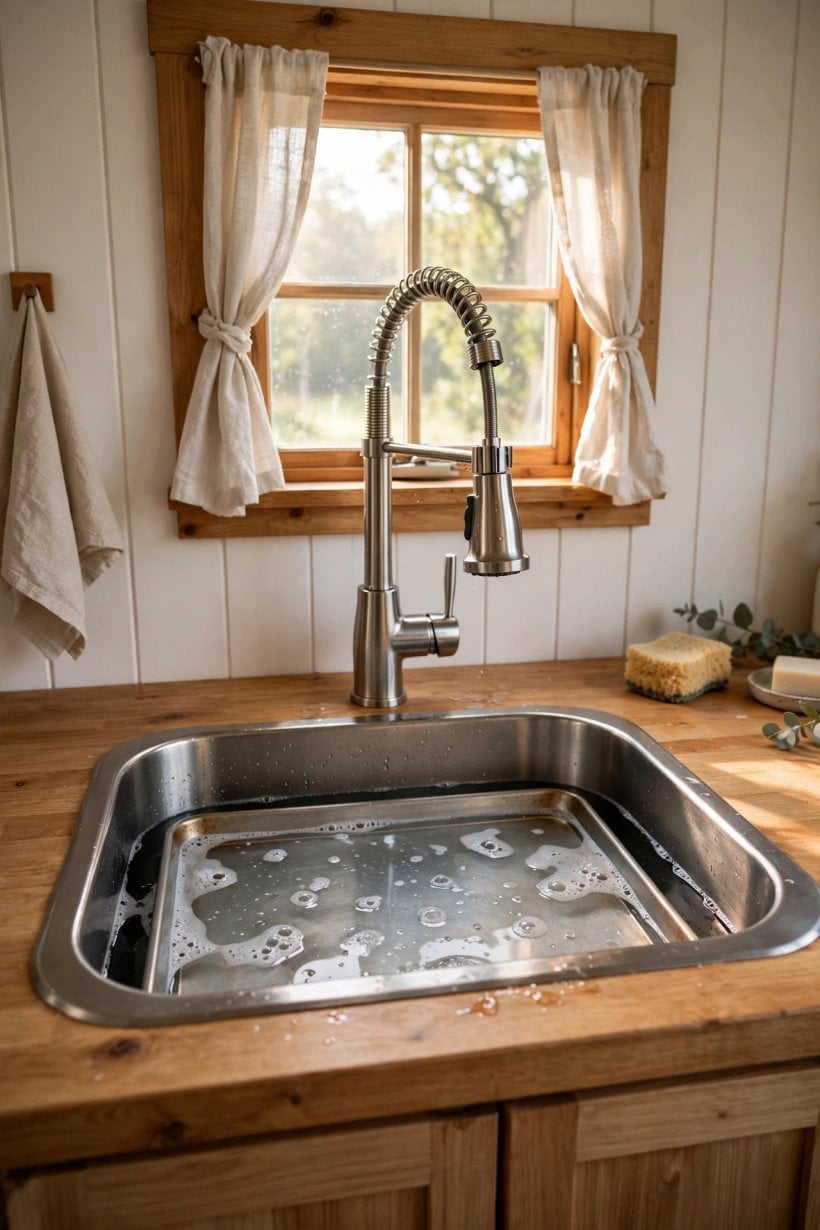
Depth does the second job: 8–10″ deep hides dirty dishes below the sightline — the visual trick that keeps small kitchens calm, because a shallow sink displays its mess at counter height while a deep one keeps it out of view until washing time. Material is a weight-and-budget choice: stainless steel is light, tough and cheap at $100–250; composite granite is quieter and prettier but heavier at $200–400. The faucet completes the station: a high-arc pull-down, $80–200 — the arc clears tall pots, and the pull-down rinses the whole basin. The rule underneath all of it: the sink is the hardest-working square foot in the kitchen. Do not shrink it to save counter; shrink something else.
4. The Oven and Cooktop: Real Cooking, Compact Footprint
Three honest routes lead to real cooking. Option A is the apartment range: a real oven plus four burners in 24″ wide — Avanti and Summit are the named examples — at $500–900. It is the closest thing to a full kitchen, and it asks for 24″ of counter run and proper ventilation. Option B splits the job: a 2-burner propane or induction cooktop at $100–400 plus a countertop convection oven or toaster oven at $100–300 — flexible, compact, and great for most cooking. Option C is the minimalist’s portable induction: single or double burners at $60–150 and no built-in oven at all, for cooks who rarely bake.
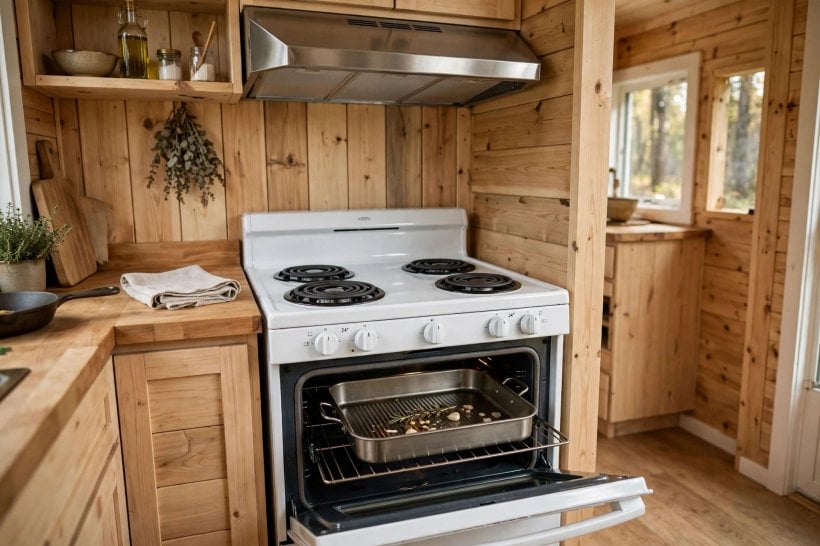
The fuel choice runs underneath the format choice. Propane is off-grid friendly and powerful; induction is precise and adds no combustion moisture to a small, tightly sealed house — but each induction burner draws 1,800W, and that electrical load matters, as §9 totals up. Whichever route you take, price it as part of the whole build rather than as a bargain hunt: the appliance lines sit inside the same all-in discipline the true cost of tiny houses breakdown applies to the house itself, where the honest number is always the finished number. What none of the three options permits is the novelty oven — the undersized box that fits neither the roasting pan nor the sheet pan is the cooking equivalent of the bar sink.
5. The Fridge: The Space Hog
The fridge is sized by shopping rhythm. A 10 cu ft apartment fridge, 24″ wide — the tiny house standard — holds a week’s groceries for two. Go smaller only if you genuinely shop every 2–3 days; a fridge undersized for your rhythm does not save space, it spends your time. The three types divide by power source and price: the apartment fridge at $400–700 is cheap and reliable with a 100W average draw; the 12V compressor fridge or cooler at $500–1,200 — Dometic and ARB style — is ultra-efficient on solar but small and pricey per cubic foot; the propane fridge uses no electricity at all, but it is expensive, runs less cold, and is a fading technology.
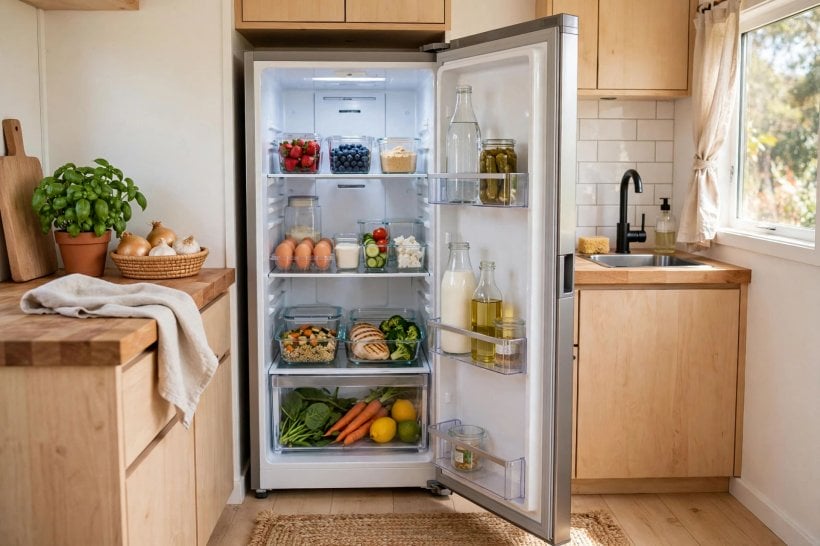
Placement decides whether the fridge lives long. Ventilate the coils with 2″ of clearance — fridges sealed into tight cabinets overheat and die young. Keep it out of direct sun, and never put the fridge next to the oven: they fight each other, the oven’s heat forcing the fridge’s compressor to work against it, so separate them in the layout. And budget its appetite honestly: the fridge is the #2 electrical load in the house after heating and cooling, so size the solar and battery for its 2–2.5 kWh/day as a real, daily, non-negotiable draw.
The type choice is really a power-source choice wearing a price tag. The apartment fridge wins on simplicity and upfront cost wherever shore power or a generously sized system makes its 100W average draw a non-issue. The 12V compressor unit earns its premium only where every watt-hour is harvested — on solar, its efficiency stretches the battery bank, but you pay for that efficiency per cubic foot and give up capacity to get it. The propane fridge removes the electrical question entirely and replaces it with a colder-performance compromise and a technology the market is walking away from. Match the fridge to the house’s power reality first; the shopping rhythm of the 10 cu ft standard does the rest.
6. The Dishwasher: The Luxury Question
The dishwasher is the one appliance the tiny kitchen debates, and two formats survive the debate. The countertop dishwasher — 18″ wide, $250–400, no plumbing hookup needed: you fill it manually and it drains to the sink — is the tiny house dishwasher that actually fits, and it washes a day’s dishes for two. The drawer dishwasher — the Fisher & Paykel single drawer, $800–1,200 — is the built-in luxury, and it needs real plumbing. Between them sits the whole question: is this a luxury, or is it infrastructure?
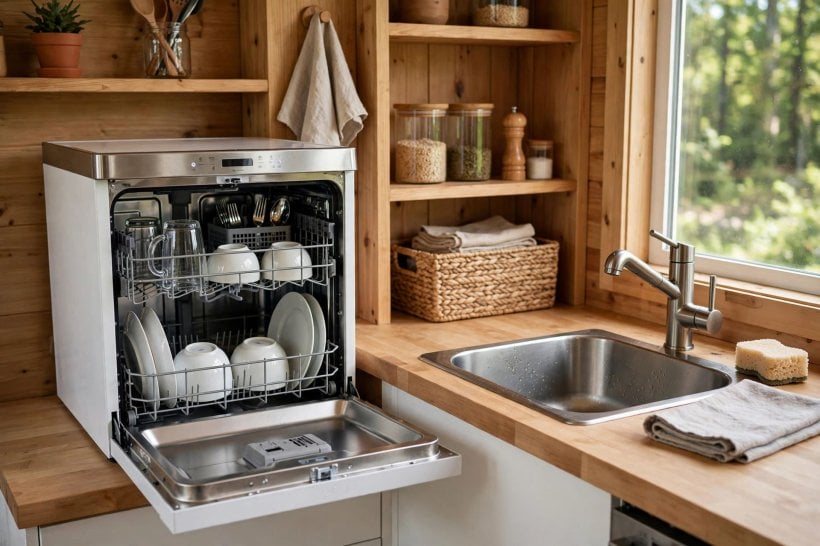
The case for is water and morale: a dishwasher uses less water than hand-washing, which matters off-grid, and it ends dish dread — the daily low-grade chore that a deep sink merely hides. The case against is counter space: counter is the scarcest surface in the house, and a dish tub and drying rack cost $20. The verdict follows the cooking: the countertop unit earns its keep for couples who cook daily, generating a full day of dishes every day; skip it if you are a minimalist hand-washer whose dish load never justifies the footprint.
7. Small Appliances: The Supporting Cast
Small appliances are audited one by one, and the survivors share a trait: each replaces several tools or asks for nothing. Coffee is pour-over or a French press — no counter footprint, no power; the tiny house answer, while the espresso machine stays in the big house. The microwave is a compact 0.7 cu ft unit at $80–120, drawing 700–900W: the reheating workhorse, mounted to free the counter. The toaster oven or air fryer doubles as the second oven — the Ninja Foodi-style multi-cooker at $150–250 replaces four appliances and is the tiny kitchen’s MVP. The blender is an immersion blender at $30–60, drawer-stored, doing 90% of blender jobs.
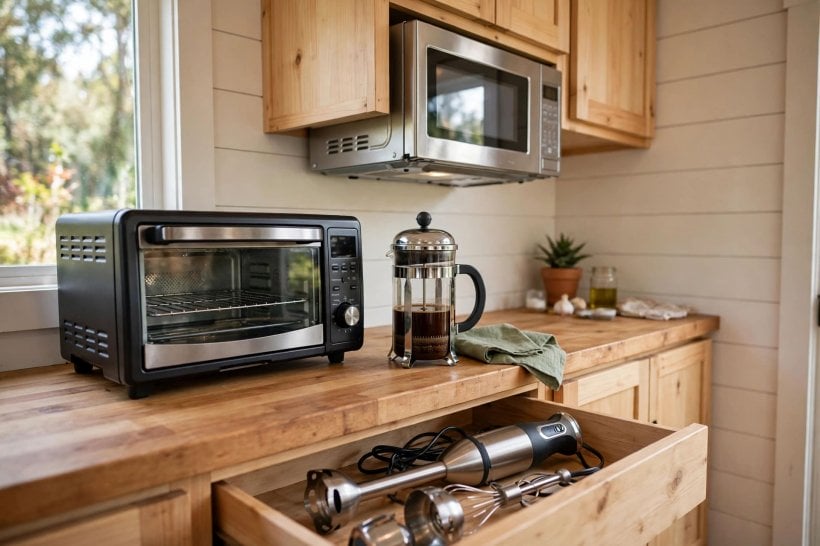
The rule is absolute: every appliance must earn its storage. One-trick gadgets — bread makers, juicers — do not survive the tiny kitchen audit, because in a small kitchen every stored object is stored instead of something else. The wider storage-first thinking behind the audit is the same instinct collected in the tiny house kitchen ideas guide, where the kitchens that work are the ones where nothing is kept on reputation. An appliance that earns its place twice over — cooking two ways, storing in a drawer, drawing no power at all — is the supporting cast at its best.
8. Ventilation: The Moisture Has to Leave
Ventilation is an appliance decision too, and it is not optional. Fit a real range hood vented outside — not recirculating — at 200+ CFM and $150–400. The tiny house needs the moisture and grease OUT: cooking releases both into a very small volume of air, and a recirculating hood merely filters and returns them, which in a full-size house is a compromise and in a tiny house is a slow damp problem with a grease film on every surface.
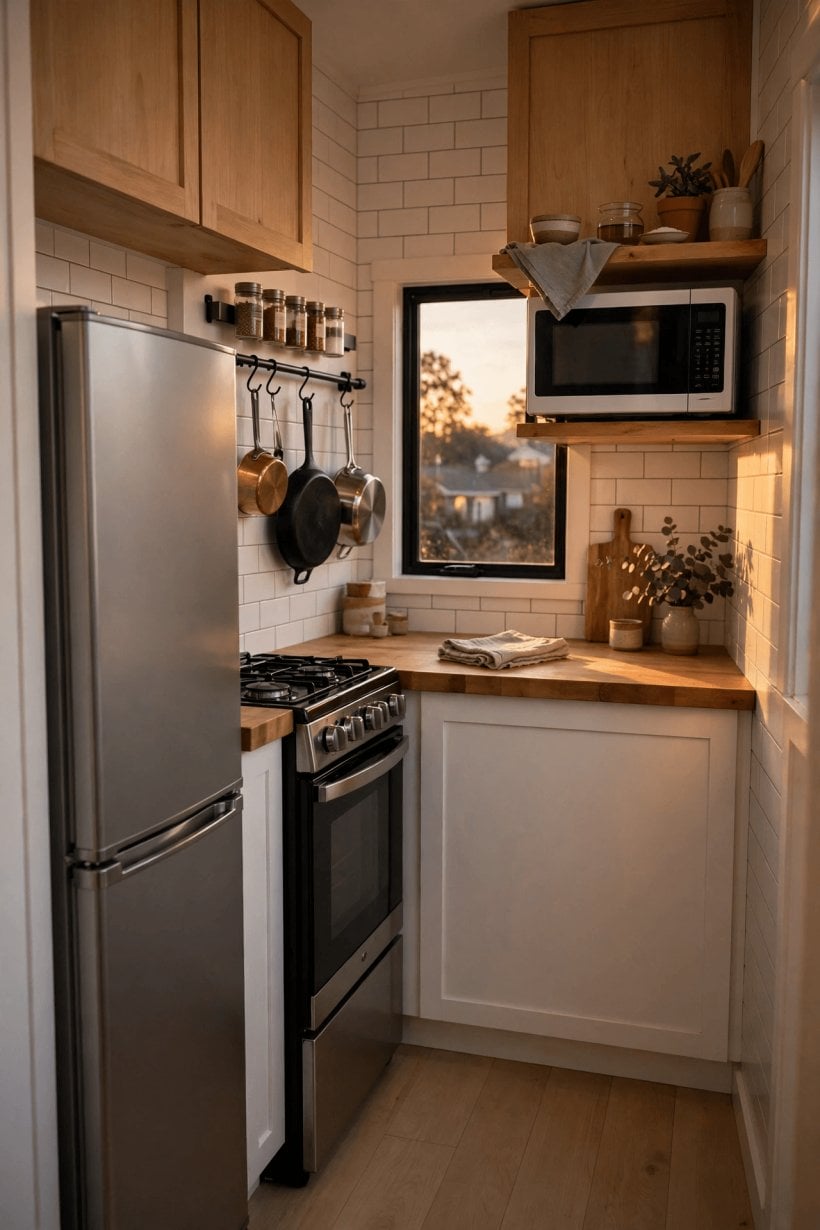
The hood interacts with the fuel choice of §4. Induction adds no combustion moisture of its own, which is one of its quiet advantages in a tight house; propane cooking adds its combustion byproducts to the cooking moisture, which makes the vented hood even less negotiable. The hood is therefore sized and bought with the range, not after it — 200+ CFM, ducted through the wall or roof to the outside air, treated as part of the cooking appliance itself rather than an accessory to be added when the budget recovers.
9. Power: Plan the Circuits, Not Just the Outlets
The kitchen’s electrical reality is addition. Kitchen circuits need 20A GFCI protection, and the small appliances add up: an induction burner at 1,800W, plus a microwave at 900W, plus the fridge at 100W, totals 2,800W of simultaneous load — plan the circuits, not just the outlets. A layout that puts the burner and the microwave on one circuit has not saved anything; it has scheduled a tripped breaker for the middle of dinner, every time both run together.
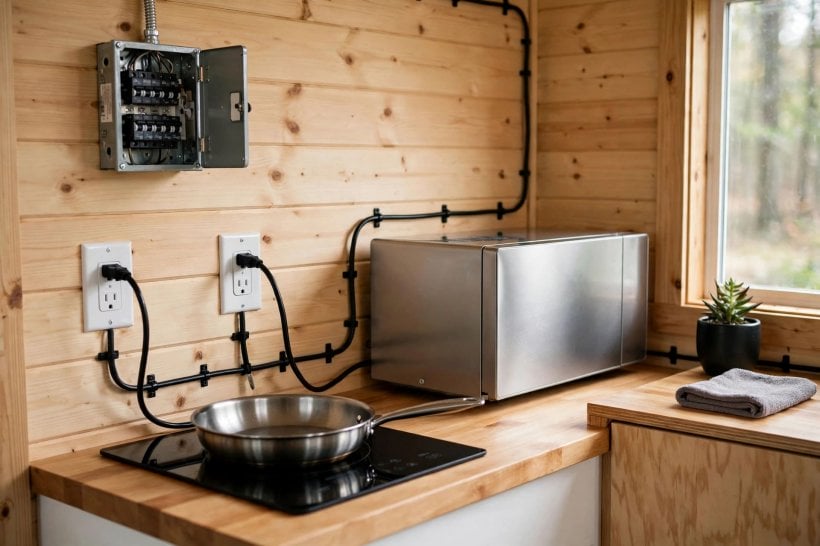
Off-grid, the arithmetic widens from peaks to days. The fridge’s 2–2.5 kWh/day from §5 is the standing load the solar array and battery bank must cover before a single burner is lit, and it runs through the night and the cloudy week alike. That is why the power budget is drawn alongside the appliance list rather than after it — the systems view in the tiny house utilities guide, covering power, water and sewage as one design problem, is the right frame: an appliance you cannot power is not an appliance, it is furniture.
10. Weight and Placement: The Hidden Constraints
Appliances are dense, and on wheels density is destiny. The fridge weighs 150–250 lbs and the range 150–200 lbs, and both belong in the weight ledger from the first sketch, not discovered at the weighbridge. The placement rule follows: cluster the heavy appliances over the axles, where the trailer is built to carry concentrated load, rather than scattering hundreds of pounds toward the ends of the house. The ledger discipline is the same one the tiny house trailer-specific floor plans apply to the whole weight map — heavy rooms and heavy boxes sit where the steel wants them.
Propane closes the constraint list. If you are cooking with propane, the line needs proper sizing and a shutoff, and the house needs a propane detector — $30 — mounted low, because propane sinks: a detector at ceiling height is guarding the wrong air. None of these constraints appears on an appliance listing, and all of them decide whether the appliance can actually live in the house. The compact kitchen succeeds on the constraints nobody photographs: circuits, kilograms and clearances, planned before the boxes arrive.
Appliances are only one half of the room — for the wider picture, layouts, storage and design ideas across tiny kitchens, see the kitchen ideas guide.
Final Considerations
Size the sink generously, choose a real cooking setup — a 24″ range or a cooktop plus a convection oven — give the fridge its 10 cubic feet and its 2″ of breathing room, ventilate the cooking moisture outside, and make every small appliance earn its place. Chosen that way, the compact kitchen appliances for tiny houses stop being a compromise list and become an edit: a tiny kitchen is not a compromised kitchen, it is an edited one. Edit well, and it cooks like a kitchen twice its size.


0 Comments