

Twenty acres is a small farm wearing a homestead’s heart — fields, herds and a real wood, all run from one small yard.
This plan keeps that yard deliberately tiny, splits the ground 35/35/30 between fields, woodland and grazing, and treats leased fields and managed woodland as tools, not afterthoughts.
1. The 35/30/35 Split: A Small Farm in Three Parts
A workable 20 acre homestead layout divides the land into three honest parts. About thirty-five percent is fields and growing ground: hay and arable fields, the market garden, household beds and the orchard. About thirty percent is pasture and livestock ground: rotational paddocks, the barn and yards, handling facilities and winter sacrifice ground. The remaining thirty-five percent is woodland, water and the homestead itself — managed woods and coppice, the pond and its margins, hedges and shelter, plus the house, yard, lanes and work areas that stay, by design, the smallest thing on the farm.
Walk the twenty in every weather you can before a line is drawn. Fields claim the flat, deep ground machinery can work in long straight passes; pasture claims the grazing slopes and the fields that plough badly; woodland claims the wet, steep and boundary ground and turns it into shelter, fuel and quiet. The scales below this one are planned in the 10 acre homestead layout with fields, pasture and woodland in balance, the 5 acre homestead layout with rotational grazing paddocks and a market garden and the 3 acre homestead layout with pasture, a hay corner and a pond option, and the small house at the core of all of them starts in the tiny house floor plans collection.
| Zone | Share | What it contains | Water | First job |
|---|---|---|---|---|
| Fields and growing ground | About 35% | Hay and arable fields, market garden, household beds, orchard, compost area | Pond and tank irrigation, garden header supply | Field pattern, gates and main lane before first cultivation |
| Pasture and livestock ground | About 30% | Rotational paddocks, barn and yards, handling pen, sacrifice ground | Troughs in every paddock from the main spine | Boundary fencing, paddock divisions, fenced stock lane |
| Woodland, house and services | About 35% | Managed woodland and coppice, pond, hedges, house and yard, lanes, work yard | House supply, pond as the system reserve | Lanes and water spine, woodland plan from the first winter |

At a glance: the 35/30/35 split compared — fields and woodland the senior partners, pasture between them, and the homestead core kept small.
2. The Homestead Core Stays Small
The central discipline of this plan is refusal: at twenty acres, the core does not grow. House, yard, kitchen garden, fuel store, workshop and everyday parking occupy the same compact footprint they held on five acres, beside the entrance, with the barn and machinery yard one step beyond. The family lives and works on foot inside that core; the farm’s wheels take over only at its edge. Every yard added to driveways, lawns and turning circles near the house is an acre quietly subtracted from fields and woods that pay.
Services are sized for the farm but rooted in the core: the well and main tanks where the yard can reach them, the workshop big enough to repair machinery under cover, fuel and chemical stores placed for safe delivery, and drainage that sends yard water to the pond rather than the foundations. Simple, mapped and repairable beats clever at this scale too, following the same thinking as the guide to tiny house utilities for power, water and off-grid sewage — systems the household understands completely, because on a small farm the household is also the maintenance department.
3. The Layout Diagram: Distance Is the Design
The diagram below is organised by distance. The core sits at the entrance corner; the main lane runs from it past the barn to the furthest fields, with the paddock block on one side — divided along a fenced stock lane — and the field block on the other, in large straight-worked rectangles. The woodland wraps the far and weather boundaries, the pond lies low where fields and woods drain toward each other, and the market garden holds the best soil inside the daily loop, an island of intensive ground in an extensive farm.
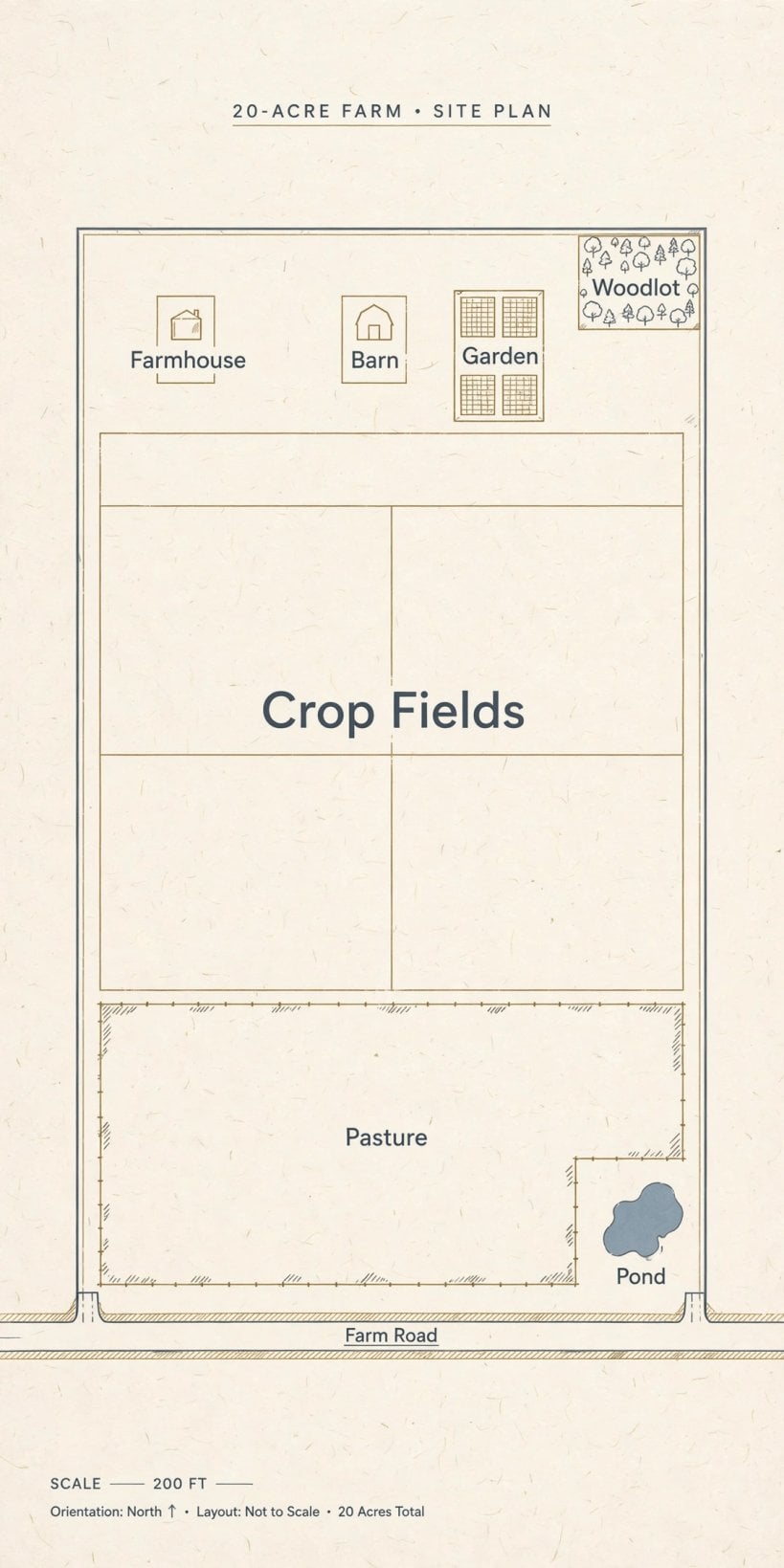
Check the drawing against the year’s traffic. Hay travels field to barn in a straight run; livestock walk fenced lanes end to end without meeting a vehicle; timber comes downhill from the rides to the stacking yard; a contractor’s machine, a feed delivery or a vet can reach the barn and turn, in the rain, without entering a field. Where a journey needs the gate left open, the field crossed or the garden threaded, the lane is wrong — and a lane is far cheaper to move on paper than after its first winter of stone and drainage.
4. Fields: Hay, Arable and the Leased Option
The owned fields carry the rotation the farm depends on: hay leys that rest and feed the soil, arable breaks of roots, grains or green manures, and the fertility-building years that let a field change jobs without changing fences. Fields are shaped for machinery from the start — long, rectangular, gated at corners, headlands honest — because on twenty acres every awkward field edge is a cost repeated at every pass of every season, and the savings from straight work compound as reliably as the costs do.
Beyond the boundary, leased fields are the plan’s flexible margin. A neighbour’s field taken on a simple seasonal agreement can carry a hay crop, a grazing mob or an arable break in a year when the home ground needs rest, extra feed or a different rotation — flexibility bought without buying land, fencing or a bigger mortgage. Lease only what the labour can actually work, agree gates, water and responsibilities in writing, and treat leased ground kindly: its fertility is borrowed, and the relationship that renews the lease is worth more than one season’s extraction.
5. Pasture and Livestock at Small-Farm Scale
Pasture is run as a rotation of paddocks sized for a real herd or flock: graze in sequence, rest until full recovery, move down the fenced lane as a matter of routine rather than roundup. Water stands in every paddock, shade is designed where the plan wants animals to rest and dung, and the handling yard by the barn — pens, a race, a loading point — lets a small team work stock calmly and safely. Enterprises are chosen for the grass that grows and the outlets that exist, and added one at a time.
Stocking follows the fields, not the ambition. The hay harvest and the grazing season together set the numbers, the sacrifice ground protects wet paddocks in winter, and the leased-field option gives the rotation somewhere to breathe in a drought or a flood year. Keep the margin sacred: a small farm that can destock early, feed from its own hay and rest a third of its grass in a hard year will still be farming, profitably and calmly, when a fully stocked neighbour is buying feed at the season’s worst prices.
6. Lanes, Gates and the Machinery Circuit
At twenty acres the lane network is the farm’s circulatory system, and it is built before the enterprises that will use it. The main lane is drained, cambered and surfaced for the wettest month, wide enough for the largest machine the farm or its contractors will ever bring, with spurs to the barn yard, the woodlot stacking area, the pond access and the far field gates. Turning circles at the barn and at the lane’s end mean no load is ever reversed blind across a yard in the dark.
Gates are placed and sized as machinery decisions, not fencing afterthoughts: full-width on every machinery route, hung to swing clear and stay hung, with gateways kept out of the wet corners where wheels and hooves do their worst damage. Verges are mown before they seed into the drainage, soft spots are stoned in autumn rather than cursed in February, and nothing is stored, parked or planted where it narrows a turning circle. Distance is the standing cost of a twenty-acre holding; the lanes are how it is paid once, in stone.
7. Water: Pond, Well and a Spine That Reaches
Water is planned as levels of security. The pond, sitting low between fields and woodland and sealed by its own subsoil, is the reserve — irrigation backup, fire water, stock emergency supply and the habitat heart of the farm — fenced from hooves and drawn from by pump or trough, never by direct access that churns its banks. The well or borehole by the core is the daily source, feeding a buried spine that runs with the main lane: house, barn, garden header tank, then trough lines down the paddock block and standpipes at the field gates.
Storage and gravity do the quiet work between those levels: roof catchment for the gardens, tanks that can feed the barn when a pump stops, bowsers that can reach any trough when a line is down for repair. The design load is the thirstiest week of the year, every enterprise drawing at once, and the test is failure, not flow — what still drinks when the power is out in August. The choices behind wells, rain, storage and surface water are compared in the guide to off-grid tiny house water systems for wells, rain and storage, and at this scale the answer is a hierarchy of sources, arranged so the farm degrades gracefully instead of all at once.
8. Woodland Management: A Wood That Works for a Living
Seven acres, give or take, of woodland make forestry a department of this farm rather than a view from it. The woods are divided into working parts: coppice coupes cut in steady rotation for firewood, poles and stakes; standards grown on for timber; shelterbelts on the weather boundaries that take wind off fields and pasture; and the wet wood around the pond left largely wild, as the farm’s reservoir of birds, insects and patience. Rides reach every coupe, extraction runs downhill to the stacking yard, and every cut area is protected and replanted or regrown from the day it opens.
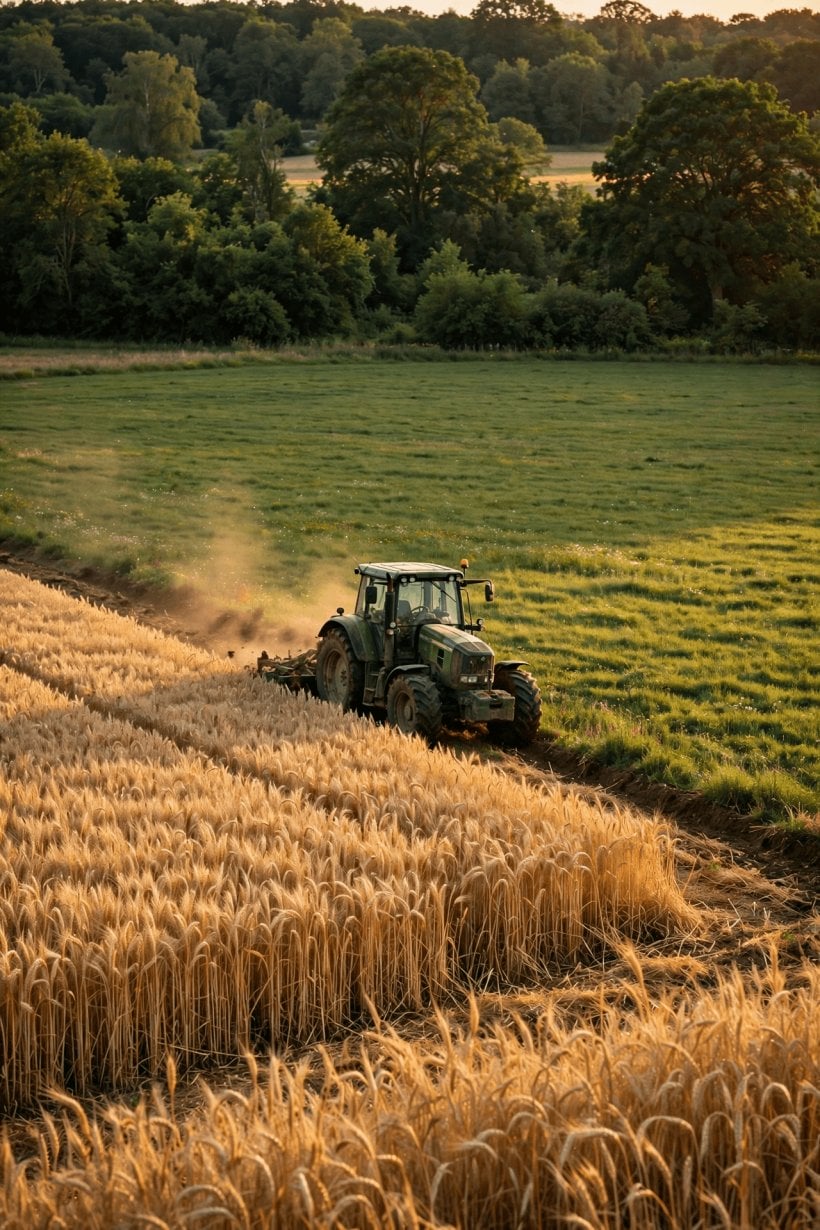
Management is a written cycle, simple enough to fit on one page and firm enough to survive a busy year: which coupe, which winter, what comes out, what goes back in. Worked that way, the wood pays in fuel that displaces bought energy, fencing material the farm consumes endlessly, shelter that raises the value of every field behind it and a timber reserve that appreciates while machinery depreciates. The failure mode to fear is the heroic one — clearing years of growth in a single enthusiastic winter and spending the shelter, the cycle and the bank in one bonfire of good intentions.
9. Fencing a Small Farm: Boundary, Divisions, Corridors
Fencing twenty acres is a programme of years, sequenced so the money works hardest first: the boundary built once, to the standard of the strongest stock in the worst weather; then the stock lane as a fenced corridor in its own right; then paddock divisions following the rotation; then field gates and the garden’s defences against the farm’s own animals. Every internal line is placed so a paddock can be split again in a growth flush or opened up in a drought without rebuilding the system around it.
Choose materials for the repair one person can do alone, in winter, with what is in the barn store: strainers that re-tension, wire that re-ties, gates that re-hang without a second pair of hands. Walk the boundary on a rota with tools in hand, keep spare posts and a spare gate in stock, and record every repair on the same page as the grazing records. A small farm’s fences are never finished; they are either being kept at standard or quietly leaving it, and the plan assumes keeping.
10. Sequence, Labour and the Economics of Enough
Build in the order that lets each stage pay for the next: lanes and the water spine first, boundary fencing with them, barn and yards next, fields and paddocks fitted as their seasons come, the woodland under management from the first winter, and livestock numbers grown only as hay, handling facilities and rested grass prove themselves. Leased fields come last in the sequence and first in flexibility — they are how the farm breathes in a hard year without selling stock it wants or buying land it does not.
Labour and money are audited together, every winter, field by field and enterprise by enterprise: what earned, what merely occupied, what ate the others’ hours. Twenty acres can absorb a family’s entire working life and still ask for more, so the plan decides in advance where enough lies — in herd size, in enterprises, in the acres actually worked rather than merely owned. The money discipline behind that decision is set out in homesteading economics and the road to financial independence off grid, and on a small farm it matters as much as any fence.
Final Considerations
Twenty acres succeed when the core stays small enough to run on foot, the fields rotate and rest, the woods are worked on a cycle, and leased ground is used as a margin rather than a crutch. The same thinking scales all the way down — to the 10 acre homestead layout with fields, pasture and woodland in balance and the 1 acre homestead layout with a market garden, orchard and paddock — because it was never really about acreage. It is about proportions kept honest, water and lanes before livestock, and a household that decides what its land is for. Decide that, and twenty acres will carry a family, a herd, a wood and a business, generously, for a generation.


0 Comments