

Forty acres can swallow a budget, a season and a good intention — or it can run like a small farm with room to spare. The difference is not horsepower, fencing wire or effort. It is the order in which zones, water and access are decided, long before anything is built.
This plan keeps the working core compact, gives fields and grazing the broad middle ground, and lets woodland and water hold the far side. Build it in phases, and let each finished phase start paying for the next one.
1. The Split at Forty Acres: A Compact Core, a Working Middle and a Wild Far Side
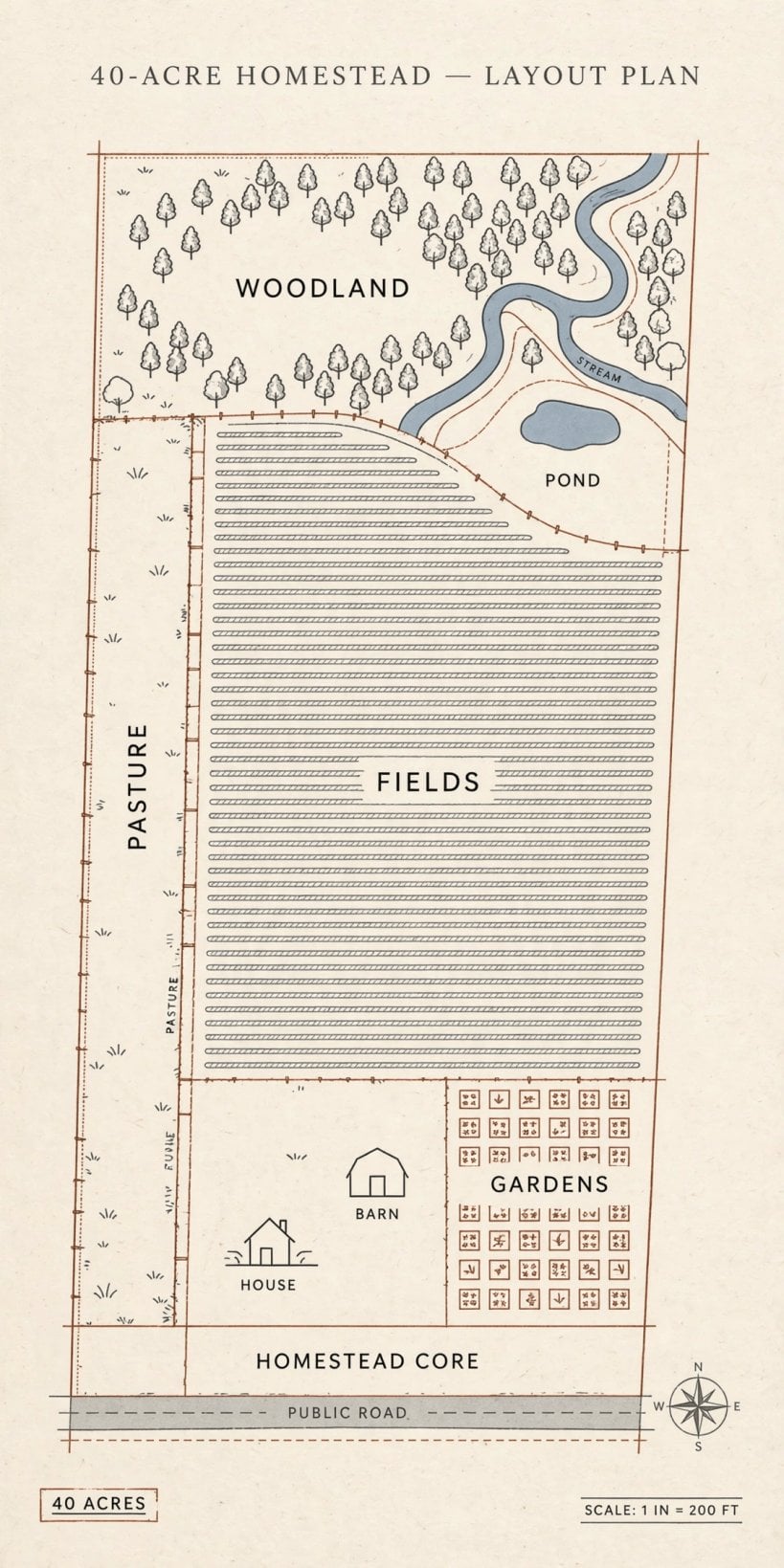
A workable 40 acre homestead layout divides the holding into three unequal partners. The homestead core — house, barns, gardens and yards — takes just three to five acres, because everything in it is touched daily and should stay within a short walk. Fields and grazing take fifteen to twenty acres, the productive middle where crops, hay and pasture rotate across the seasons. Woodland and water take the remaining fifteen to twenty acres, producing timber, shelter and a reliable reserve rather than a weekly harvest. The proportions matter more than the exact lines on the map.
Read the ground before you assign it. Fields want the flatter, deeper, better-drained soil that machinery and repeated cultivation reward. Grazing wants the slopes, thin corners and awkward shapes that plough badly but grow grass honestly. Woodland wants the wet, steep and boundary ground, and repays it with fuel, fencing material and wind protection for everything inside it. The smaller plans in this series argue the same discipline at tighter scales: the 25 acre homestead layout with a compact core and rotated fields, the 20 acre homestead layout that treats fields, pasture and woodland as partners and the 10 acre homestead layout with fields, pasture and woodland in balance. At forty acres the principle does not change — only the distances, and the cost of getting them wrong, grow.
| Zone | Acres | What it contains | Water | First job |
|---|---|---|---|---|
| Homestead core | 3–5 acres | House, barns, gardens, workshop, yards and parking | Well or main supply, house and garden water | Access, drainage and services before buildings spread |
| Fields and grazing | 15–20 acres | Crops, hay fields, pasture paddocks, orchard and market garden ground | Troughs on a piped loop, irrigation from pond and tanks | Field pattern, gates and the fenced stock lane |
| Woodland and water | 15–20 acres | Managed timber and coppice, stream and pond margins, shelter and habitat | Stream and pond as the system reserve, protected banks | A written woodland rotation from the first winter |
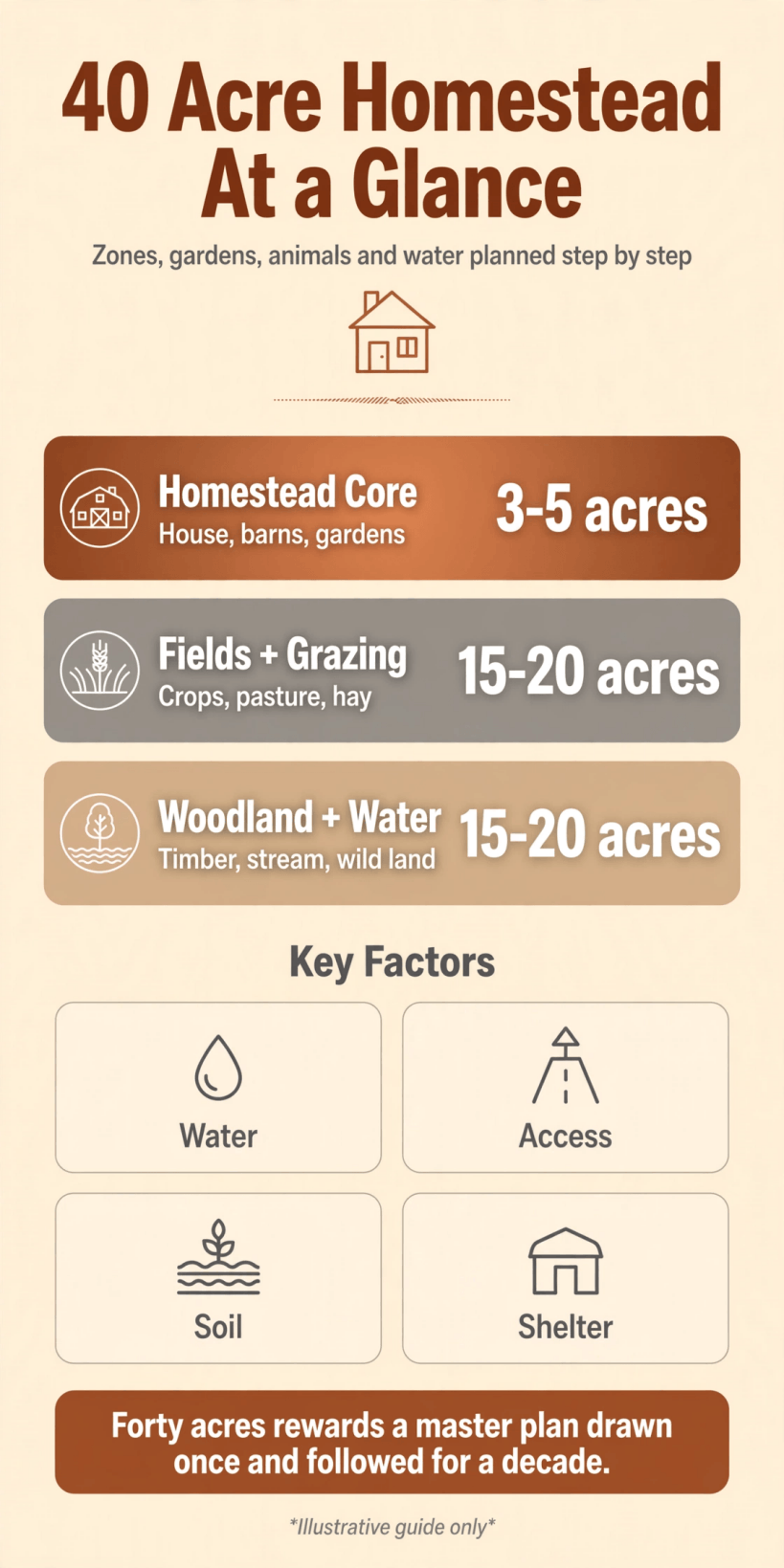
At a glance: a three-to-five-acre core, fifteen to twenty acres of fields and grazing, and fifteen to twenty acres of woodland and water.
2. The Homestead Core: House, Barns and Yards on Three to Five Acres
Place the house where the land is already kind: close enough to the entrance for deliveries, on ground that drains away from the foundations, and turned toward the light and away from the worst weather. Around it keep only what daily life touches — kitchen garden, fuel store, workshop, machinery parking and the yards where animals are handled. Everything else belongs further out, because every building placed in the core is a building heated, roofed, insured and walked past a thousand times a year.
Keep the dwelling itself modest even when the land is not. A compact house on a large holding is cheaper to run and easier to extend honestly than a sprawling one, which is why the tiny house floor plans collection rewards a look before any footprint is fixed. Cluster the barns and sheds along one service yard with hard standing, so feed, bedding and machinery move in straight lines, and leave a clear firebreak and turning circle that a delivery truck — or a fire crew — can use in the dark and the wet.
3. Gardens and the Orchard: Feeding the House from the Core Outward
The kitchen garden belongs beside the house, where it is seen, watered and harvested daily; a garden placed at a distance becomes a weekly intention and then a weed bed. Beyond it, the market garden and soft fruit take the best sheltered ground in the inner fields, close to water and to the lane, so crates move to the gate without crossing the whole holding. Beds, compost and the cold frames form one working cluster, fed by manure from the yards and returning produce to the house by the shortest path.
Plant the orchard on a gentle slope where cold air drains away and blossom escapes the worst frosts, and fence it as seriously as any pasture — deer and stock undo years of pruning in a single night. The 5 acre homestead layout with rotational grazing paddocks and a market garden shows the same garden logic compressed; at forty acres the difference is scale, not kind: more beds in longer rows, a real packing corner, and space for a small orchard to become a genuine enterprise rather than a hobby row.
4. Fields: Crops and Hay on the Best Fifteen Acres
Give the plough the best of the middle ground. Fields want depth of soil, gentle slopes and drainage that machinery can work a day after rain, and they want to be shaped as a few large, squarish blocks rather than many small, pretty ones — every corner is turning time, fuel and compaction. Rotate what each field carries: a fertility-building ley, a hungry crop, a cleaning crop, then rest. Written down as a simple cycle, the rotation protects the soil from the slow theft of growing the same thing in the same place.
Hay deserves its own respect in the pattern, because winter feed bought in is winter profit sent away. Cut from the fields that dry fastest and store under cover near the yards, so bales travel once, downhill, in good weather. Leave the field margins wide and unsprayed where they meet hedges and water; the strips cost little yield, hold the beneficial insects that pollinate and protect the crops, and give the whole middle ground a resilience that a tighter, greedier layout quietly loses.
5. Grazing: Paddocks, Rotation and the Stock Lane
Divide the grazing into paddocks that can be rested, not just occupied. Grass grows in the rest period, not the grazing one, so a rotation that moves animals before they bite the regrowth keeps both pasture and stock healthier across a long season. Size the paddocks to the herd and the week, not to the shape of the map, and run a fenced stock lane down the middle of the grazing ground so animals move from any paddock to the handling yards without crossing a field, a garden or the public road.
Water decides where grazing really works. A piped loop with a trough in every paddock is cheaper, over a decade, than the daily labour of hauling water and the poached gateways of a single shared trough. Shade matters as much: a belt of trees on the paddock edge, or access to the woodland fringe in high summer, keeps animals grazing through the heat instead of crowding a corner. Fence for the smallest, most determined animal you keep, and the rest of the fencing decisions become simple.
6. Animals: Housing, Handling and Honest Numbers
House animals where feeding, bedding and mucking out are shortest — at the edge of the core, downwind of the house and uphill of any watercourse. The handling yard is the heart of the system: a race, a crush or pen, and gates that let one person move stock safely. Design it before the herd grows, because retrofitting handling around established animals is miserable work. Poultry, by contrast, belong mobile: arks and tractors moved across rested pasture spread their fertility where it is needed and break parasite cycles by leaving them behind.
Stock the land to its grass, not to your ambitions. The smaller plans make the point sharply — the 3 acre homestead layout with zones, gardens, animals and water in balance only works because its animal numbers stay honest. At forty acres the same honesty, scaled, means carrying what the fields and hay harvest can winter without panic buying. Keep breeding, finishing and young stock in separate groups with separate grazing where possible; disease, bullying and feed bills all fall when animals are not one undifferentiated crowd.
7. Water: Well, Stream, Pond and the Piped Loop
Walk the water before anything else, in the driest month you can. The well or mains supply serves the house and core; the stream and pond serve the land; tanks and a piped loop connect them into one system with a reserve. A pond placed low in the middle ground can gravity-feed troughs and irrigation, store storm water that would otherwise carve the lanes, and stand as the holding’s insurance through a dry summer. Fence its margins, plant them, and let the water stay clean by keeping hooves and manure at a managed distance.
Roof water is a harvest, not a nuisance: every barn roof sheds enough in a wet month to matter in a dry one, so gutter into tanks at the buildings and pipe outward. Protect every source as if the whole plan depended on it, because it does. Crossings where lanes meet the stream get hard bottoms or bridges, drains are kept out of the water and into settlement areas, and the map of pipes, taps and stopcocks is drawn once and kept — the person who needs it most, in the dark, in a flood, will be grateful it exists.
8. Woodland and Wild Ground: Timber, Shelter and the Long Rotation
The fifteen to twenty acres of woodland and water are not the land left over; they are the holding’s slow bank account. Managed on a written rotation — a coupe cut, thinned or coppiced each year in turn — woodland yields firewood, fencing stakes, building timber and shelter in a steady stream rather than a single clear-felled windfall. Rides and edges, kept open, become the most wildlife-rich ground on the farm and the driest walking in winter. Plant new corners and shelterbelts early, because a belt planted in year one is protecting stock in year ten, and a belt promised for later rarely happens.
Shelter is the woodland’s quiet dividend across the whole forty acres. Stock graze longer, crops suffer less wind rock, and the core itself sits calmer behind well-placed trees. Keep the wild margins connected — hedge to wood, wood to stream, stream to pond — so wildlife moves through the holding rather than around it, and the predators and pollinators that work for you can reach the fields where they earn their keep. Wild ground, properly valued, is productive ground on a longer clock.
9. Access, Fences and the Working Lanes
One good entrance, honestly built, beats three poor ones. The main lane should reach the core on a line that drains, carries a loaded trailer in February and does not cross the best field or the stream at its softest point. From the core, farm lanes follow the zone boundaries — core to fields, fields to grazing, grazing to woodland — so movement never has to cut through a working area to reach another. Gates go where lanes meet, wide enough for machinery, hung to swing the way stock naturally flow.
Fence the perimeter first and properly; it is the boundary of every legal and neighbourly question you will ever have. Internal fences can then be lighter, more electric and more movable, changing as the rotation learns. Keep a simple map of fences, gates, pipes and wires, updated when anything changes. On forty acres, memory is not a management system: the second person to run the holding, or the same person ten years older, needs the plan on paper, not in folklore.
10. Phasing the Build: A Decade Plan in Honest Order
Build in the order the land demands, not the order the catalogue suggests. Year one is access, water, perimeter fencing and the core’s drainage — unglamorous work that every later project stands on. The house and one good barn follow; then the garden, orchard and first paddocks; then the field pattern, pond and piped loop; and through every year, a piece of woodland planted or brought into rotation. Each phase should leave the holding more workable than it found it, and none should depend on a later phase to function.
Keep the surplus honest while the plan matures. Ground not yet in the rotation can be hayed, leased to a neighbour or sown to a simple fertility ley — anything except left to scrub and bills. Review the whole plan each winter against what the seasons actually taught, in the spirit of the tighter plans in this series, such as the 2 acre homestead layout planned step by step: zones first, wishes second. A forty-acre holding rewards patience more than speed; the plan drawn once, and followed, compounds like interest.
Final Considerations
Forty acres rewards a master plan drawn once and followed for a decade. Keep the core small enough to run on foot, the fields and grazing large enough to rest in rotation, and the woodland and water protected enough to keep paying their slow dividends. Walk the ground in every season before you fix a line, write the rotations down, and let each phase pay for the next. Do that, and the holding stops being forty separate acres of work and becomes one system that works together.


0 Comments