

Three acres is where pasture stops being a paddock with ambitions and starts feeding animals in earnest.
This plan gives the grass its share first, then fits a serious garden, a bigger barn and a hay corner around it — with a pond held as an option, not a promise, and water planned before fencing.
1. The 40/35/25 Split: Grass Earns Its Share
A workable 3 acre homestead layout begins by admitting what the extra acre is really for: grass. About forty percent grows food directly — the vegetable garden, orchard, soft fruit and a hay corner that is cut, not grazed. About thirty-five percent is pasture and animal ground: rotational grazing, the barn yard, poultry runs and sacrifice ground for wet weather. The remaining twenty-five percent carries the house and yard, tracks and parking, tanks and lines, the work yard and a woodlot corner, plus the pond site if the ground and the water table agree to it.
Survey before you split. The pasture wants the free-draining slopes, the hay corner wants the flattest, driest field you can cut and turn, the garden wants the deepest soil in full light, and any pond belongs only where water already gathers and the subsoil will hold it — a pond dug in hopeful ground is an expensive hole. The step down in scale is shown in the 2 acre homestead layout with a full garden, orchard and a small woodlot and the 1 acre homestead layout with a market garden, orchard and paddock, the step down further in the half acre homestead layout with zones for gardens, animals and water, and the house itself begins in the tiny house floor plans collection.
| Zone | Share | What it contains | Water | First job |
|---|---|---|---|---|
| Growing ground | About 40% | Vegetable garden, orchard, soft fruit, hay corner, compost bays | Well and rain lines, drip irrigation | Soil, beds, and the hay ground fenced out of grazing |
| Pasture and livestock ground | About 35% | Rotational pasture, bigger barn and yard, poultry runs, sacrifice area | Troughs on fence lines, pond as backup if built | Boundary fencing, then internal divisions and lanes |
| House, services and woodlot | About 25% | House and yard, tracks, tanks, work yard, woodlot, pond site held in reserve | House supply, roof catchment | Access, water spine, trees planted in the first winter |
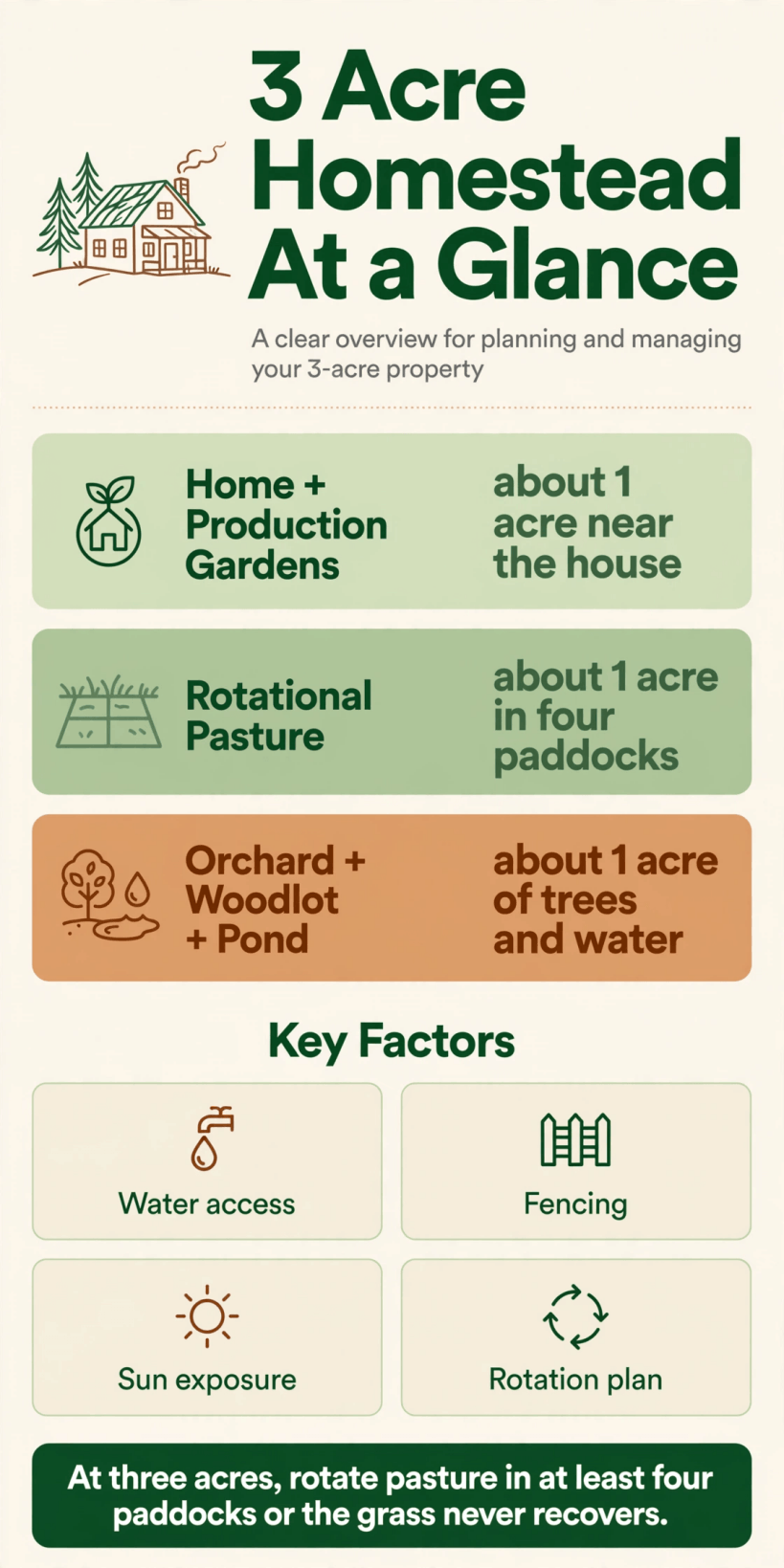
At a glance: the 40/35/25 split compared — growing first, pasture a close second, and the house, services and trees sharing the rest.
2. The House End, Kept Deliberately Small
On three acres the temptation is to let the house ground sprawl, and the plan resists it. The cottage, its yard, the kitchen garden and the everyday stores stay in a tight knot by the entrance, because every square yard given to lawn here is taken from hay or grazing that pays its way. From the door, the sightlines run to the barn yard and the first pasture gate, and the daily path — house, poultry, barn, garden — stays short enough to walk before breakfast without thinking about it.
Keep the services beside the house equally compact and legible: tanks where the roof can fill them, a wood store on the dry side, cold frames and a nursery bench within hose reach, and a work yard where trailers turn without chewing the garden edge. A small house with plain, well-planned services outperforms a large one with improvised systems every winter, as the guide to tiny house utilities for power, water and off-grid sewage sets out — and on this holding, the money saved on floor area is spent where it earns: fencing, water and the barn.
3. The Layout Diagram: Pasture at the Centre of the Drawing
The diagram below shows the change of emphasis that three acres bring. The pasture is no longer fitted around the garden; the garden, orchard and hay corner are fitted around a grazing block that is shaped for rotation — roughly rectangular, divisible into equal strips, with a lane running back to the barn. The house holds the entrance corner, the barn stands between house and pasture where feed, stock and people all pass, and the woodlot and pond site close the far boundary, sheltering the grass from the prevailing wind.
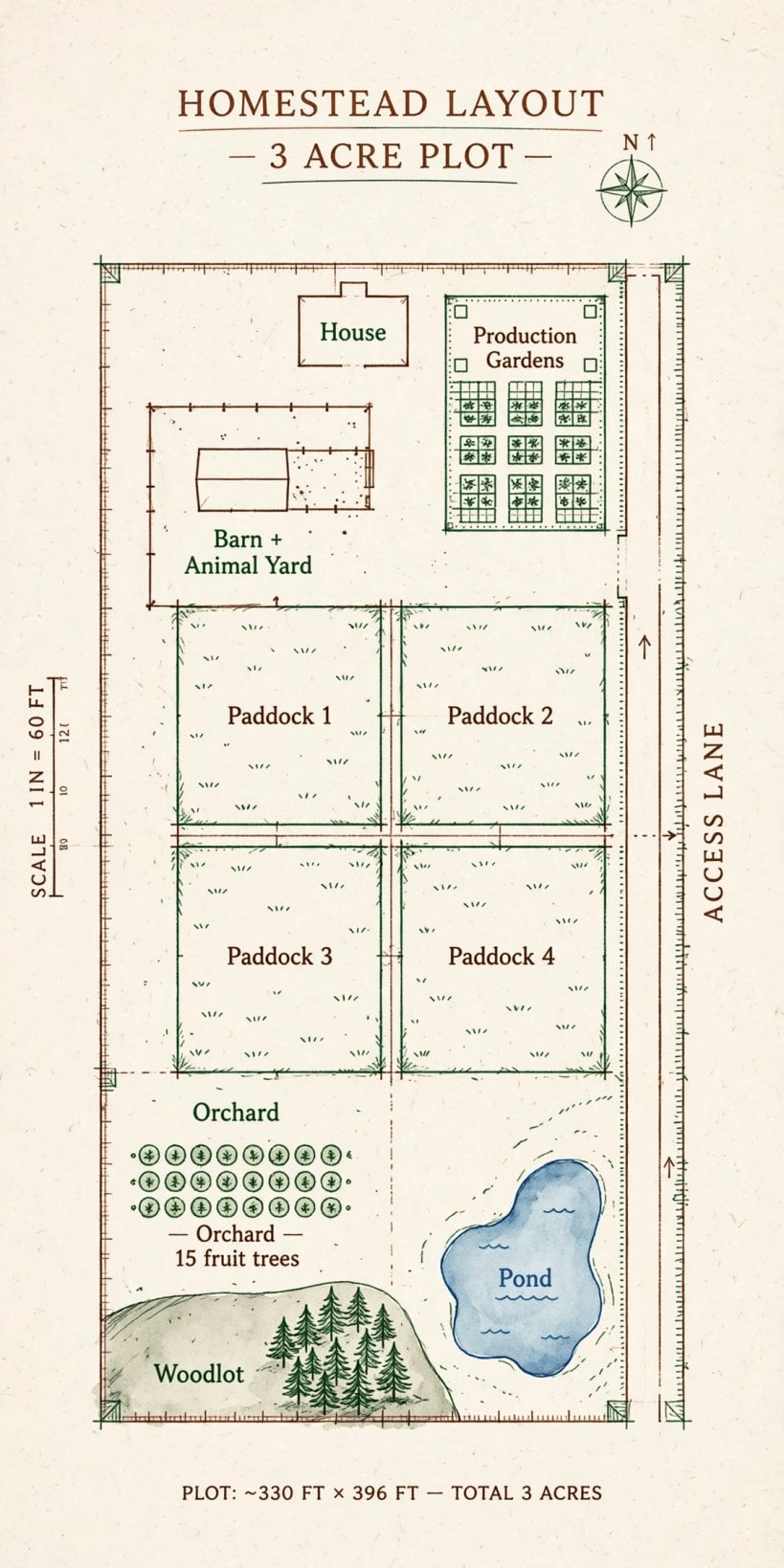
Trace the journeys on the diagram before you trust it. Hay moves from the hay corner to the barn by the shortest dry route, never across the vegetable ground. Animals move from barn to any pasture strip down the lane without crossing the garden or the yard. The mower, the trailer and a delivery of fencing posts can all reach the barn and turn. If any of those journeys crosses another enterprise’s ground, redraw the line now: on paper, a fence costs an eraser; in the field, it costs a weekend and a strained back.
4. The Garden and Orchard: Feeding People First
The garden keeps the scale it had on two acres — permanent beds in rotation blocks, compost at its heart, paths that never move — because the household’s appetite has not grown with the land. What changes is what surrounds it: the orchard expands along the pasture fence where its shade falls on grass, not beds, and soft fruit lines the garden’s own boundary, picked on the daily round. Surplus capacity goes to storage crops, seed saving and a small surplus for barter, not to ever more beds demanding ever more weeding.
Perennials do more of the work each year on this scale. Asparagus, rhubarb, herbs and fruit ask for spring attention and then largely manage themselves, while annual beds carry the succession sowings that fill the table weekly. Keep the compost system where barn, garden and poultry meet, so every barrow journey carries something useful in at least one direction, and keep the records honest: on three acres it is easy to grow a great deal of food and still not know which beds earned their space, unless last season’s yields were written down.
5. Pasture That Feeds: Rotation on a Bigger Stage
Pasture enters seriously here, and serious pasture is a system, not a field. Divide the grazing block into strips with internal fencing, move the animals often enough that they graze evenly and trample little, and rest each strip until the sward has fully recovered — leaf, root and soil together. Water travels with the system on the fence lines, so no strip depends on animals walking back to the barn, wearing a track and grazing their favourites twice while the far corner goes rank and unpalatable.
Stocking is set by the worst month, not the best. The grass that grows in a kind May must carry animals through a wet November and a dry August, with the hay corner as the bridge between seasons. Keep a sacrifice area of hard ground by the barn for the weeks when hooves would tear wet pasture apart, and accept its mud as the price of grass that survives. A pasture managed this way improves yearly — deeper roots, more clover, fewer weeds — while a set-stocked field declines at exactly the same speed in the opposite direction.
6. The Bigger Barn and the Hay Corner
The barn grows up on three acres: more stalls, a real hay store under cover, a handling area where animals can be penned, checked and loaded without drama, and lean-to space for the mower and trailer that pasture work demands. Site it on drained ground at the head of the lane, with a hard yard that stays usable in February, gutters that throw roof water away from the bedding, and feed storage that vermin and damp cannot reach. A barn is judged in its worst week, not on the day it is finished.
The hay corner is the barn’s partner. A flat, fertile corner of the growing ground is fenced out of grazing, cut once or twice a year, and turned and dried with the weather watched like a forecast matters — because it does. Its yield is the holding’s insurance: winter feed grown at home, at a typical cost in time and fuel rather than in bought bales whose price moves with everyone else’s drought. Rotate the corner with fertility-building leys and garden ground over the years, and never graze it in a hungry spring: hay eaten standing is the most expensive feed on the farm.
7. Water, and the Pond Held as an Option
The water spine follows the same order as on smaller holdings — well or borehole by the house, a piped line to garden standpipes, then troughs along the pasture fence lines — but on three acres it reaches further and must be planned for pressure, frost and distance from the start. Roof catchment fills tanks for the garden, and every trough stands on drainage that carries overflow away from gates. Animals drink a surprising amount in hot weather, and the system is sized for the herd on its thirstiest day, not its average one.
The pond is treated as an option with conditions, not a decoration dug on impulse. It earns its place only where the ground already holds water seasonally, the subsoil is tight enough to seal, and it can serve as backup stock water, irrigation reserve, fire reserve and wildlife habitat without stealing the best grazing. Fence it, plant its margins, and keep stock drinking from a trough fed by it rather than from its soft edges. The choices behind wells, rain, storage and surface water are compared in the guide to off-grid tiny house water systems for wells, rain and storage.
8. Woodlot, Shelter and the Edges That Work
The woodlot corner and the shelterbelts earn more on three acres than on any smaller plot, because pasture is exposed ground and wind is a tax on grass, animals and buildings alike. A belt of trees on the weather boundary slows the wind that chills stock and strips moisture from pasture, while the coppice corner banks firewood, poles and fencing stakes on rotation. Plant both in the first winter, guard them from the stock they will one day shelter, and let hedges thicken along the internal fences instead of strimming them into sticks.
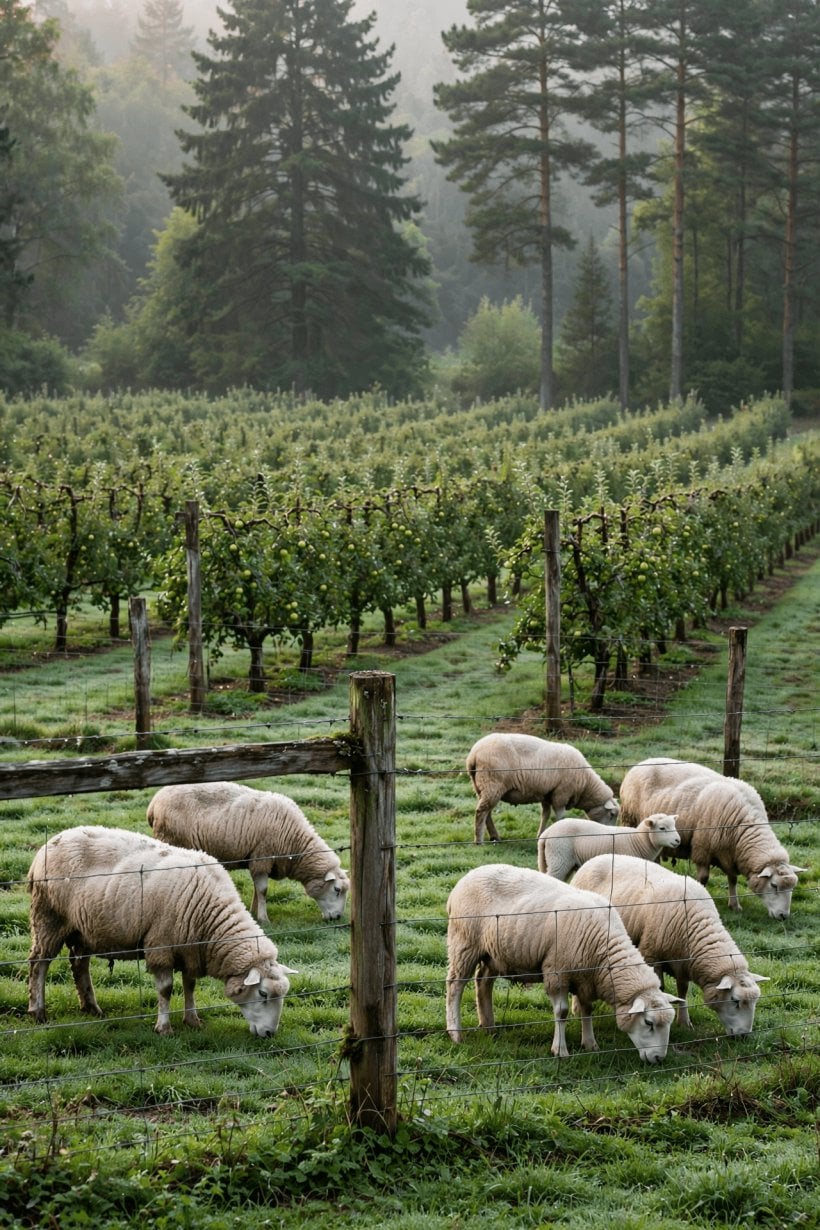
Edges are production that does not appear in the accounts. A hedge gives berries, blossom for pollinators, perches for the birds that eat insects, and a corridor that wildlife uses instead of crossing the garden. The woodlot gives shade the pasture rests under in a heatwave and a windbreak the barn yard thanks every storm. Manage them with a light, regular hand — lay a length of hedge, coppice a coupe, thin a few standards each winter — and the holding’s boundaries become an asset that appreciates, rather than a fence line forever demanding repair.
9. Fencing, Lanes and Moving Animals Without Drama
Fencing money is spent in order: boundary first, to a stockproof standard that can be trusted in the dark; then the pasture divisions and the lane; then the garden fence that keeps rabbits and poultry on their own sides of the arrangement. Gates hang where the lane meets each strip, wide enough for machinery, swinging clear of troughs, and every internal line is placed so a strip can be split again in a growth flush without rebuilding the system. Temporary electric divisions inside permanent strips give the rotation its fine adjustment.
The test of the whole network is a November afternoon: rain, failing light, animals to move and feed to carry. If that job is calm — gates opening the right way, the lane firm, the barn lit and dry at the end of it — the fencing plan is right. If it involves chasing, lifting or wading, the plan is wrong in a specific place, and the honest response is to fix that place in spring rather than curse it for a decade. Good fencing is not an expense on this holding; it is the labour force that never asks for a day off.
10. Sequence and Scale: What to Build, in What Order
The building order protects the budget: water spine and boundary fencing first, the lane and barn next, pasture divisions as the grass is ready, and animals only when feed, fencing and shelter are all standing. The hay corner is fenced out and cut in the first season, even before stock arrives, because its yield tells you the truth about how many animals this land can carry — a truth worth learning from a hay crop rather than from hungry beasts in February. Trees and hedges go in the first winter, when they are cheap, small and patient.
Resist expanding every enterprise at once. Three acres can quietly become a full-time job wearing a hobby’s clothes, and the plan’s proportions are the guard against it: if pasture work swallows the garden, or the garden swallows the weekends, the split — not the household — is adjusted. The financial side of that balance, what the holding should earn, save and refuse to spend, is worked through in homesteading economics and the road to financial independence off grid, and it deserves reading before the second animal enterprise is added, not after.
Final Considerations
Three acres succeed when grass is treated as a crop, hay as insurance and the barn as a workplace — and when the pond, if it comes, is dug where water already wants to be. Scale the same logic upward and the 5 acre homestead layout with rotational grazing paddocks and a market garden turns pasture and growing toward a small farm, while the 10 acre homestead layout with fields, pasture and woodland in balance adds field scale and equipment lanes. Keep this holding’s proportions honest, its water ahead of its buildings and its fences ahead of its animals, and three acres will feed more — food, fodder and confidence — than plots twice its size managed on impulse.


0 Comments