

Twenty-five acres is enough land to lose money on quietly — and enough to feed a family, run livestock and grow timber well. The difference is not effort. It is placement, decided before the first fence post goes in.
This plan keeps the lived-in core to two or three acres, gives fields and grazing the middle ground, and protects a large wooded, watered margin. Lease or hay what you cannot work. Idle acres still cost taxes.
1. The Split at Twenty-Five Acres: A Compact Core, Working Fields and Wild Ground
A workable 25 acre homestead layout divides the holding into three unequal partners. The homestead core — house, barn, gardens and yards — takes just two to three acres. Fields and grazing rotation take twelve to fourteen acres, the productive middle where crops, hay and pasture follow one another across the seasons. Woodlot, water and wild land take the remaining eight to ten acres, producing timber, shelter and habitat rather than a weekly harvest. The proportions matter more than the exact lines: the core stays small enough to run on foot, the working ground stays large enough to rest in rotation, and the wild margin stays intact enough to shelter everything inside it.
Read the ground before you assign it. Fields want the flatter, deeper, better-drained soil that machinery and repeated cultivation reward. Grazing wants the slopes and the awkward corners that plough badly but grow grass honestly. Woodland wants the wet, steep and boundary ground — and repays it with fuel, fencing material and wind protection. The plans below this scale make the same argument at smaller sizes: the 20 acre homestead layout that treats fields, pasture and woodland as partners, the 10 acre homestead layout with fields, pasture and woodland in balance and the 5 acre homestead layout with rotational grazing paddocks and a market garden. Each one keeps the same discipline — a small core, rotated working ground and a protected margin — and lets the acreage, not the principle, change.
| Zone | Acres | What it contains | Water | First job |
|---|---|---|---|---|
| Homestead core | 2–3 acres | House, barn, gardens, workshop, yards and parking | Well or main supply, house and garden water | Access, drainage and services before buildings grow |
| Fields and grazing rotation | 12–14 acres | Hay and arable fields, pasture paddocks, market garden ground, orchard edge | Troughs in the paddocks, irrigation from pond and tanks | Field pattern, gates and the fenced stock lane |
| Woodlot, water and wild land | 8–10 acres | Managed woodland and coppice, pond, hedges, shelter and habitat | Pond as the system reserve, protected margins | A written woodland rotation from the first winter |
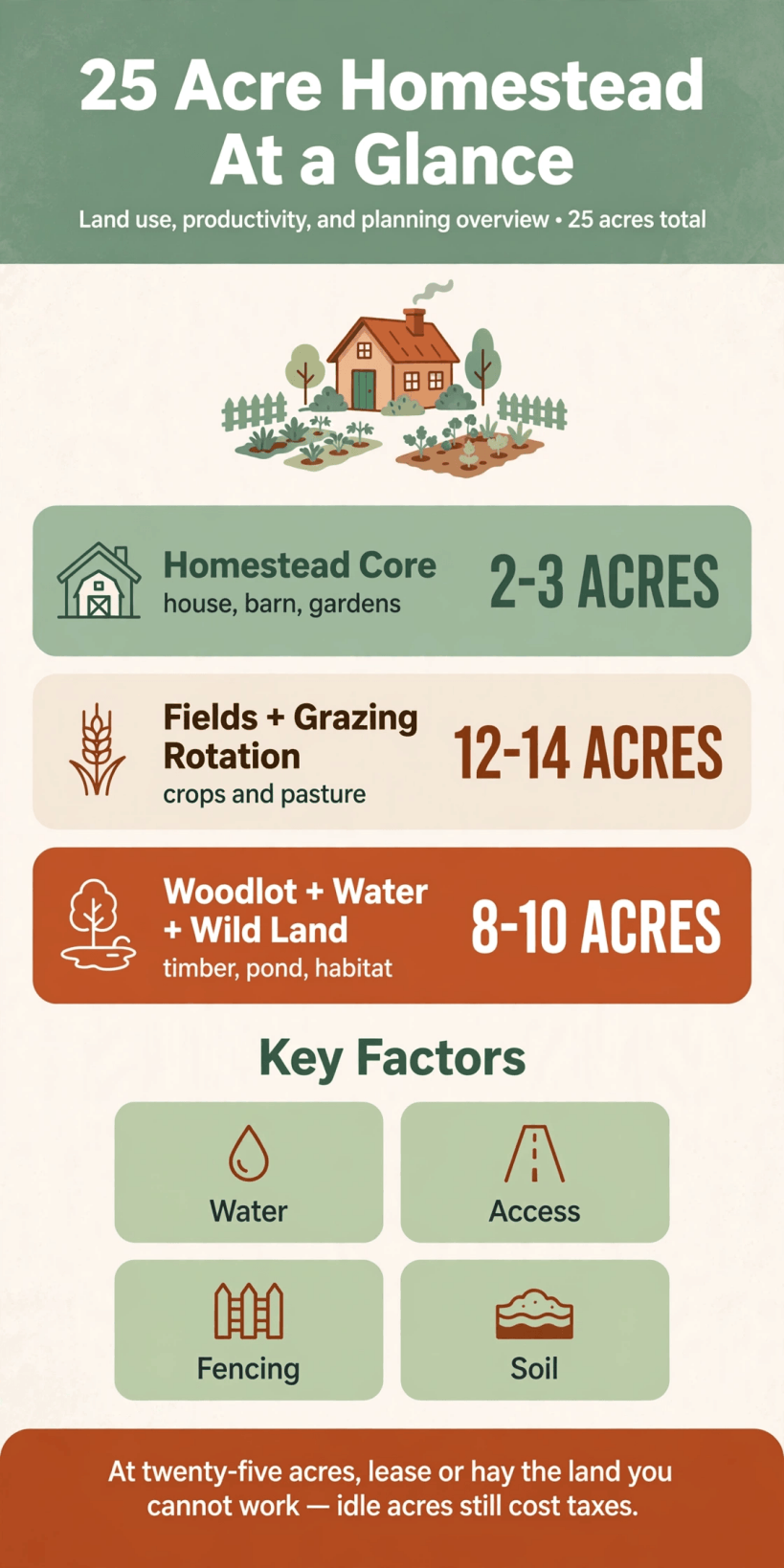
At a glance: a small two-to-three-acre core, twelve to fourteen acres in fields and grazing rotation, and eight to ten acres of woodlot, water and wild land.
2. The Homestead Core: House, Barn and Gardens on Two to Three Acres
Place the house where the land is already kind: near the entrance for deliveries and visitors, on ground that drains away from the foundations, and facing the weather you most need to escape or invite. Around it, keep only what daily life touches — kitchen garden, fuel store, workshop, parking for the vehicles in constant use, and paths that stay passable in the wettest month. A house that begins compact stays affordable to heat, roof and repair, which is why the tiny house floor plans collection rewards a look even when the house you build is not, strictly, tiny.
Put the barn one step beyond the yard, close enough for winter chores in bad light, far enough that flies, smells and machinery have their own territory. Between house and barn, plan the working yard once and properly: hard standing, a turning circle a trailer can use without drama, and drainage that carries yard water to a settlement corner or the pond margin, never toward the well. Water, power and waste services all root here and run outward in mapped, repairable lines, so a fault in any season is a short dig, not an excavation of the whole holding.
3. Gardens That Feed the House First
Feed the house before you feed a market. The household garden belongs inside the core, steps from the kitchen door, on the best small patch of soil you own, fenced well enough that deer and hens are a story rather than a harvest method. Grow intensively here — salads, herbs, soft fruit and the vegetables eaten daily — because ground this close gets daily attention, and daily attention is the most reliable fertiliser, pest control and irrigation system ever invented. Beds you pass four times a day simply do not stay weedy, thirsty or unharvested for long.
The market or field garden, if you run one, belongs at the edge of the fields instead, where compost, manure and machinery arrive without crossing the yard, and where a failed crop is an agronomic lesson rather than a view from the kitchen window. Compost sits between the two gardens and the barn, receiving from all three. Shelter matters at this scale: a hedge or fence on the weather side buys the garden weeks at both ends of the season, and a dedicated water point — not a hose dragged from the house — turns watering from an expedition into a routine.
4. Fields and the Grazing Rotation: Twelve to Fourteen Working Acres
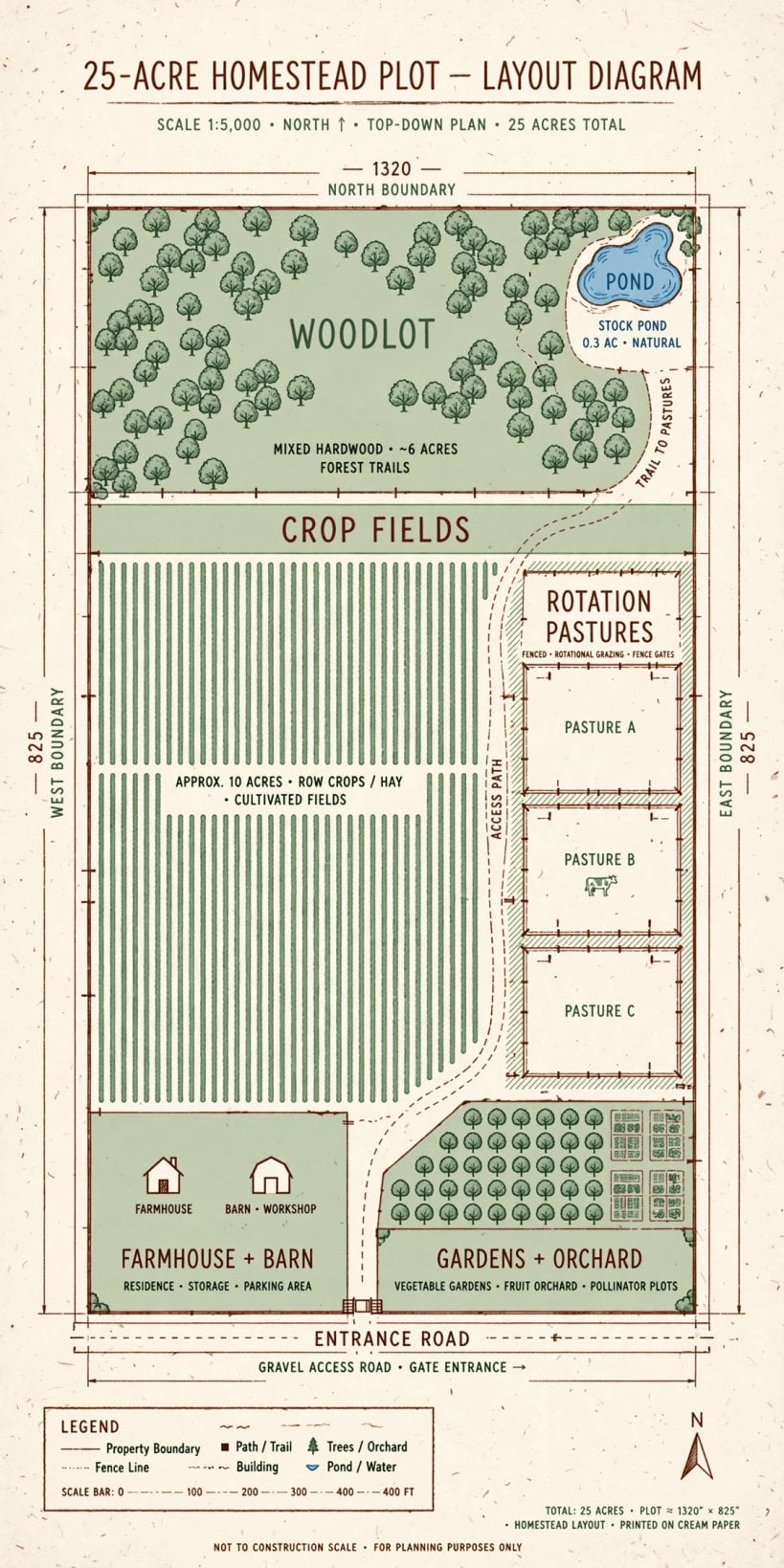
Twelve to fourteen acres is enough to rotate honestly and too much to garden intensively, so treat this middle ground as a rotation, not a set of permanent assignments. Hay fields rest the soil and feed the winter; arable breaks grow fertility as clover and roots; pasture follows cropping while the herd cleans, manures and treads the ground back toward grass. Move the roles every few seasons and the land improves under each of them. Keep field shapes simple — long, near-rectangular runs that machinery can work without endless turning, with gates wide enough for the largest vehicle you will ever hire.
Decide the surplus question in advance. Ground you cannot work in a given year should be leased to a neighbour, cut for hay, or sown to a cheap fertility-building cover — never simply left, because idle ground still draws taxes, grows a weed seed bank, and quietly trains you to ignore a fifth of your holding. A modest rent or a hay share keeps the field in the rotation and keeps a neighbour invested in your boundaries. The same surplus question grows sharper at the next scale up, as the 40 acre homestead layout with separate field, pasture and woodland blocks shows in its own split.
5. Animals Placed by Work, Not by Habit
Place animals by the work they create, not by where a picturesque barn would look best in a photograph. The barn is the hub: handling pen, loading point, feed store and winter shelter in one fenced complex at the meeting point of the paddock system, reached by the stock lane and never through the garden, the yard or the orchard. From that hub, paddocks radiate or run in a chain so a move is a gate opened at the right moment, not a rodeo across open ground with buckets, dogs and rising voices. The principle is visible at small scale in the 3 acre homestead layout with pasture, a hay corner and a pond option.
Graze species in sequence where you can. Larger stock take the first bite and break the sward; smaller stock and poultry follow, tidying what was left, spreading manure differently and interrupting parasite cycles that a single species, permanently resident, would build against itself. Rest is the other half of grazing: a paddock eaten and then rested grows roots and resilience, while a paddock grazed continuously grows bare patches and weeds. Winter needs its own honest provision — a sacrifice area on hard, drained ground near the barn, accepted as mud, so the resting fields are not poached into next spring’s problem.
6. Woodlot, Wild Land and the Eight to Ten Acres That Protect Everything Else
Eight to ten acres of woodland, water margins and rough ground is not the land left over. It is the holding’s insurance policy. Managed lightly — coppice on rotation for fuel and poles, standards left to grow toward timber, deadwood left standing where it is safe — a wood produces something every year while asking for a few weeks of winter work in return. Ride and path edges become habitat; unmown corners hold the insects, birds and predators that do unpaid pest control across the gardens and fields all summer long.
Resist the two temptations this margin invites. The first is tidiness: clearing, draining and improving until the wild ground becomes poor pasture that needs constant subsidy to stay mediocre. The second is neglect dressed as reverence: never cutting, never planting, and watching a single ageing generation of trees decline together. Instead, work a simple written rotation, plant the gaps with the species the ground itself suggests, and let shelter do its quiet arithmetic — stock, crops and people all spend less energy on land that is not being scoured by wind in every month of the year.
7. Water: Well, Pond and a Spine That Reaches Every Zone
Water decides more of this plan than any fence line. The well or main supply roots at the core, protected, accessible and tested, with storage sized so a pump failure is an inconvenience measured in days rather than an emergency measured in hours. From that root, one buried spine runs outward — to the barn, the gardens and troughs in the paddock system — with stop valves and a drawn map, so any section can be isolated, drained before hard frost, or repaired without cutting supply to everything else on the holding.
The pond is the system’s reserve and its second heart. Place it where the land already gathers water, fence stock out of its margins, and let it serve irrigation in a dry summer, wildlife in every season, and peace of mind in a drought year. Roof water is a third source worth harvesting into tanks at the barn and house before it is allowed to become runoff. Plan all three sources together — well, pond and roof — and dry weather becomes a management problem with levers to pull, rather than a verdict delivered from the sky.
8. Access, Lanes and Fencing: The Quiet Infrastructure
One good lane beats five improvised tracks. Run the main access from the entrance to the core and on to the barn and field gates, surfaced where wheels turn and loaded vehicles pause, and wide enough that two vehicles — or a vehicle and a herd — can pass without either climbing a bank. A separate stock lane, fenced on both sides, keeps animal moves off that surface and out of the garden. Everywhere else, resist permanent tracks: rotated ground recovers from hooves and wheels, but a compacted informal road across a field outlives the reason it was first driven.
Fence in the order the land will be used: boundary first, because everything inside a sound boundary is yours to plan; then the stock lane and paddock divisions; then the garden and orchard protection; and only then the internal niceties. Gates belong where lanes meet fields, hung to swing with the slope and wide enough for machinery. On twenty-five acres the fencing bill is large enough to deserve phasing across seasons — permanent, well-strained work on the boundaries and lanes, simpler movable divisions inside the rotation, upgraded as each block settles into its long-term role.
9. The Order of Work: Years One to Three
Year one is infrastructure and observation. Secure the boundary, prove the water, surface the lane to the core, and put the house, barn shell and garden fencing in place. Grow the first household garden, keep stock numbers deliberately low, and watch a full year of weather move across the ground — where frost sits, where water stands, which corner dries first — because that knowledge, bought cheaply in year one, is expensive to buy later by moving things. Lease or hay the fields you are not yet ready to work, and let the income offset the fencing bill.
Years two and three add enterprises to a skeleton that already works: the full paddock rotation as the herd grows, the field garden or first arable breaks, the coppice rotation begun in the wood, and the pond if the land and budget allow it to be dug properly rather than scraped hopefully. Each addition should attach to services that already exist. The sequence matters more than the speed, and it is the same sequence the smaller plans in this series follow — compare the 2 acre homestead layout with zones for a house, garden and small livestock and the 1 acre homestead layout planned zone by zone — ground first, water second, buildings third, numbers last.
10. Mistakes That Shrink Twenty-Five Acres
The commonest mistake at this scale is core creep: a bigger lawn, a second yard, a turning area that becomes storage, a storage area that becomes a graveyard for machinery — each small, reasonable and together subtracting working acres while adding mowing, gravel and maintenance. The second is buying animals at the scale the land could eventually carry, in the first spring, before fences, water and winter housing exist. The third is clearing the woodlot for a few extra grazing acres, trading decades of shelter, fuel and habitat for pasture that the herd did not actually need.
The quieter mistakes do as much damage over a decade. Skipping the water spine and relying on hoses and carried buckets burns hours every week forever. Leaving the surplus field question undecided lets weeds set seed and taxes arrive for ground producing nothing. Drawing the whole plan in the first month, in ink, guarantees the plan will fight the land instead of learning from it. Hold the principles firmly — small core, rotated middle, protected margin — and let the details stay in pencil until the ground itself has had a full year to comment.
Final Considerations
Twenty-five acres rewards the homesteader who thinks like a steward of three small farms at once: a compact, comfortable core; a working middle that rotates crops, hay and grazing without exhausting itself; and a wild third that shelters, waters and quietly supplies the other two. None of the three needs to be perfect. Each needs to be deliberately placed, properly served with water and access, and reviewed honestly as seasons pass and enterprises change.
Start with the boundary, the water and the lane. Keep the core small enough to love maintaining. Work the middle ground in rotation, lease what you cannot yet work, and let the woodlot stand as the holding’s savings account — growing in the background, sheltering the foreground, and waiting patiently for the years when you need it most. Planned that way, twenty-five acres is not a burden to keep up. It is a system that keeps you.


0 Comments