

Thirty inches is one of those measurements that turns up everywhere, from curtain drops to counter heights, yet many product listings state it only in centimetres. Converting 30″ to cm takes one multiplication, and the answer is exact: 76.2 centimetres. This guide shows the working, a table for nearby values, and the measuring habits that keep converted numbers trustworthy.
1. At a Glance: The Conversion in One Table
Here is everything essential before the detail. Unlike many home measurements, this conversion is exact arithmetic rather than a rule of thumb, because the inch is defined as exactly 2.54 centimetres. That definition means the answers below are precise, not approximate, and they never change with context, temperature, or the brand of tape you happen to own.
| Question | Answer |
|---|---|
| How many centimetres is 30 inches? | Exactly 76.2 cm. |
| What is the conversion factor? | 1 inch = 2.54 cm exactly. |
| What is the formula? | Multiply the inches by 2.54 to get centimetres. |
| How do you convert back? | Divide the centimetres by 2.54 to get inches. |
| Is rounding ever needed? | Only for convenience. 76.2 cm is already exact at one decimal place. |
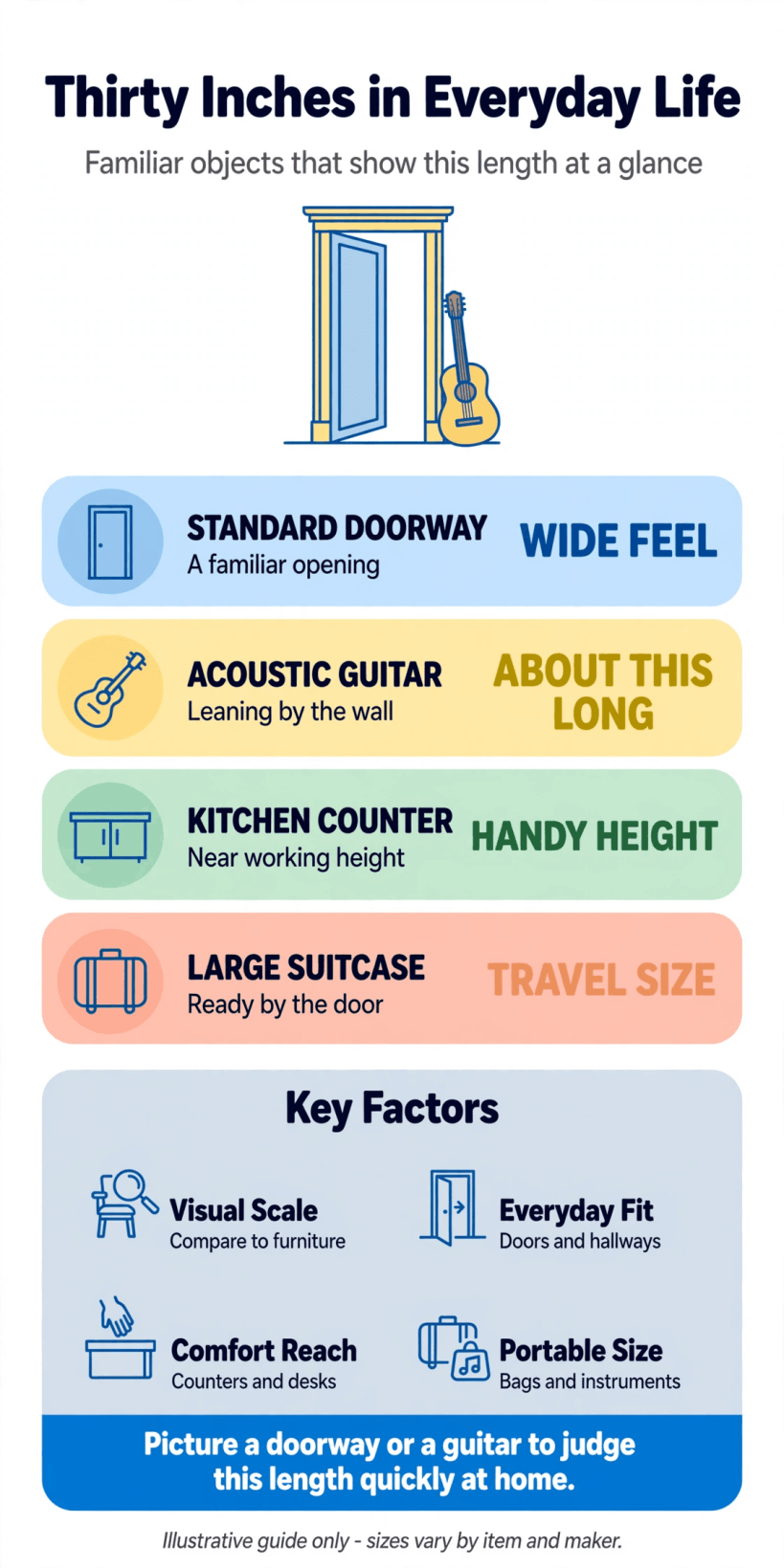
The conversion at a glance: one exact factor turns any inch measurement into centimetres.
The rest of this guide slows the process down on purpose. A single multiplication is easy to mistype, easy to misremember, and very easy to apply to a measurement that was taken carelessly in the first place. Understanding where the factor comes from, how to handle fractions and decimals, and how to measure the original inches properly will make every conversion you do afterwards faster and more reliable. By the end, the goal is not just one answer but a small, dependable routine you can apply to any inch value a plan, pattern or product listing throws at you.
2. The Answer and the Formula

The working is short enough to memorise. Take the inches, multiply by 2.54, and the result is centimetres. For this guide’s central value: 30 multiplied by 2.54 equals 76.2, so 30 inches equals 76.2 centimetres exactly. The multiplication splits neatly if you prefer mental arithmetic: 30 times 2 is 60, and 30 times 0.54 is 16.2, and 60 plus 16.2 is 76.2. That split method works for any whole number of inches and is a handy check on calculator results when your hands are covered in sawdust or flour.
The factor itself is not a measurement someone took once; it is a definition agreed internationally, which is why it carries no uncertainty. Every inch everywhere is the same 2.54 centimetres, in a tape measure bought in Texas or a ruler printed in Tokyo. This is also why converting is safer than estimating with body measures or shoe lengths, tricks that drift from person to person and project to project. When a listing, plan or pattern depends on the number, do the multiplication properly; it takes seconds, it is exact, and it removes doubt completely.
3. Why Two Systems Still Exist

Inches survive mainly in the United States and in particular trades elsewhere, while centimetres serve most of the world and nearly all science. Building materials, screen sizes, clothing and older furniture plans often speak inches; modern manufacturing, medicine and most international retail speak metric. Living between the two systems is now normal, which is why conversions like this one get searched for so often. Neither system is better in the abstract; they are simply different rulers laid over the same world, each with generations of tools and habits behind it.
Trouble starts when the two mix silently. A plan dimensioned in inches built with a metric-only tape, or a product photographed beside a hand for scale, invites small errors that compound across a project. The defence is boring and effective: write the unit beside every number, every time, and convert at the moment you record the measurement rather than later from memory. Households deep in renovation research, perhaps comparing tiny houses for sale in Charlotte, NC, meet this constantly, because tiny homes squeeze tolerances until a centimetre of confusion genuinely matters.
There is a social side to the two systems as well. Family patterns, inherited workshop notes and second-hand furniture all arrive speaking whichever system their maker used, sometimes both on the same page. Rather than re-drawing everything, most households simply become bilingual in measurements over time, keeping one tape with both scales and a conversion habit for everything else. Children absorb whichever system school teaches and then cheerfully confuse the household’s older notes, which is one more reason to label every figure plainly. Fluency, not loyalty to one ruler, is the practical goal.
4. A Worked Example, Step by Step
Worked examples fix a method in memory better than formulas alone, so here is the full routine applied to a shelf board measured at 30 inches. Step one: confirm the measurement and its unit, 30 inches, read from the tape at eye level. Step two: write the formula with the numbers in place, 30 × 2.54. Step three: calculate, giving 76.2. Step four: attach the new unit, 76.2 cm, and say it back in the sentence you actually need: the shelf is 76.2 centimetres long.
Step five is the one people skip: sanity-check the result. Centimetre numbers should always be larger than the inch numbers they came from, roughly two and a half times larger. If your answer came out smaller, you divided instead of multiplying. If it came out ten times too big, a decimal point slipped. This five-second check catches nearly every conversion error ever made at a kitchen table. The same routine serves garden projects and room layouts alike, the kind of planning that fills notebooks for readers browsing small home interior design ideas.
5. A Worked Table for Nearby Values

Real projects rarely stop at one number, so here is the same multiplication worked for the values either side of thirty. Each row uses the identical method, inches multiplied by 2.54, so you can trust the pattern and extend it yourself: 33 inches would be 83.82 cm, and 34 inches would be 86.36 cm, following exactly the same steps shown in section four.
| Inches | Working | Centimetres |
|---|---|---|
| 28 | 28 × 2.54 | 71.12 cm |
| 29 | 29 × 2.54 | 73.66 cm |
| 30 | 30 × 2.54 | 76.2 cm |
| 31 | 31 × 2.54 | 78.74 cm |
| 32 | 32 × 2.54 | 81.28 cm |
Notice the rhythm in the results: each extra inch adds exactly 2.54 cm, so the centimetre column climbs in even steps. That pattern is your built-in error detector. If a table, app or listing ever shows uneven jumps between consecutive inches, something has been mistyped or rounded badly. People use these nearby values constantly when comparing product sizes, checking whether a 32-inch item fits a space measured in centimetres, for instance, a comparison that comes up often in the compact layouts discussed among tiny houses for sale in Nashville, TN.
6. Converting the Other Way: Centimetres to Inches

Reverse conversions use the same factor in the opposite direction: divide centimetres by 2.54 to get inches. Checking this guide’s headline value backwards, 76.2 divided by 2.54 equals 30, which returns the original measurement exactly. That round trip is worth performing whenever a converted number will be cut, drilled or ordered against, because it confirms no digits wandered during the first calculation. Calculators make the check painless; the habit is what matters, especially when several measurements travel together through a plan.
Reverse answers often land on awkward decimals, and that is normal. A metric product listed at 80 cm, for example, divides to about 31.5 inches, which a tape measure reads as 31 and a half inches. Round to the nearest fraction your tape can actually show, and note the rounding in your records so nobody mistakes the rounded figure for an exact one later. This two-way fluency is the real skill behind every 30″ to cm lookup: not memorising one answer, but being able to move between the systems in whichever direction the next product listing, pattern or plan demands.
7. Fractions, Decimals and Half Inches

Tape measures speak in fractions while calculators speak in decimals, so conversions often start with a translation. A half inch is 0.5 in decimal, a quarter is 0.25, an eighth is 0.125, and three quarters is 0.75. Apply the factor after translating: 30.5 inches, for instance, multiplied by 2.54 gives 77.47 cm exactly. Writing the decimal version beside the fraction on your notebook page prevents the classic error of multiplying the fraction’s bottom number by mistake, an error that has quietly ruined more than one carefully measured board.
Decimal places deserve the same calm treatment in the answer. The exact product of a whole number of inches and 2.54 never needs more than two decimal places, and for most home purposes one decimal place, as in 76.2 cm, is more precision than the original tape reading honestly contains. Resist copying eight calculator digits into a cutting list; they imply an accuracy your measuring never had. Woodworkers and sewists comparing notes in gift shop interior design ideas threads make the same point about materials: match the precision of the number to the precision of the tool, and the work goes smoothly.
8. Where 30 Inches Shows Up at Home

Thirty inches is a quietly common dimension around the house. It appears in furniture widths, appliance footprints, curtain drops, doorway clearances, and the sizing of all manner of storage, which is why its metric twin, 76.2 cm, is worth recognising on sight. When a flat-pack listing gives only centimetres, picturing 76.2 cm as your known 30-inch reference, roughly the width of a generous chair or a small desk, helps you judge fit before ordering and saves the particular misery of a delivery that almost fits through the door.
Screens add a caution: television and monitor sizes quoted in inches describe the diagonal, not the width, so converting the diagonal tells you nothing directly about whether the set fits a shelf. Measure the actual width and height in whichever system your tape uses, then convert those. The principle generalises across the home: convert measurements of real edges, not marketing numbers. Space planners working through home interior design ideas for small spaces lean on this habit hard, because in a compact room a converted diagonal mistaken for a width is the difference between furniture that fits and furniture that blocks a doorway.
Kitchens and workspaces reward the same care. Worktop runs, hob clearances and shelf spacing are frequently planned in one system and supplied in the other, and a 30-inch gap that becomes 76.2 cm on paper still has to accept appliances whose metric sizes were rounded by their makers. Dry-fit where you can, keep packaging until the fit is proven, and remember that skirting boards, plugs and pipe runs all eat into the honest measurement. None of this changes the arithmetic; it simply decides whether the exact answer gets the chance to be useful in the real, slightly irregular room.
9. Measuring Tips for Accurate Results

A perfect conversion of a sloppy measurement is still sloppy, so measure with the same care you calculate with. Hook or butt the tape’s end correctly for inside and outside measurements, keep the tape straight and flat rather than sagging or twisted, and read the scale at eye level to avoid parallax errors. Measure twice, ideally from opposite ends, and be suspicious when the two readings disagree; the truth is usually the one taken with the tape properly seated and the case snug against the edge.
Record the result immediately, with its unit, and photograph the tape in place for anything expensive or irreversible. For long spans, a helper holding the far end beats any solo stretching technique, and for room dimensions, measuring at the height the furniture will actually occupy catches walls that lean or bow. These habits are unglamorous and decisive. Readers planning whole layouts, including those exploring where to rent a tiny house before committing to compact living, find that careful raw numbers make every later decision, conversion included, almost effortless.
10. Common Mistakes and How to Avoid Them
Most conversion errors fall into a short list. Multiplying when you should divide, or the reverse, is the champion; the size check from section four, centimetres larger than inches, catches it instantly. Using 2.5 as the factor for speed is acceptable for a rough estimate but not for cutting or ordering, because across 30 inches it quietly loses more than a centimetre, enough to matter in a fitted project. Mixing units mid-project, measuring some pieces in inches and others in centimetres and adding them together, causes the worst workshop arguments and is prevented by converting everything to one system at the notebook stage, before a single cut is made.
Rounding too early is the quieter villain. If you round each measurement before adding or comparing, the small losses stack into a visible gap at the far end of the run. Keep full precision through the arithmetic and round once, at the end, to a figure your tools can express. Finally, beware silent unit switches in apps and spreadsheets, which may display a converted value beside the original with no label. Label everything yourself, in ink, and your future self will never have to guess whether 76.2 was the inches, the centimetres, or the answer to something else entirely on a long-forgotten page.
Final Considerations
The conversion itself could not be simpler or more certain: one inch is exactly 2.54 centimetres, so 30 inches is exactly 76.2 centimetres, and every nearby value follows by the same multiplication. The worked table, the reverse check and the fraction translations in this guide exist to make that one fact usable under real conditions, with real tapes, real listings and real deadlines, in kitchens, workshops and small homes alike.
Build the small habits around the arithmetic: write units beside numbers, sanity-check the size of every answer, round once at the end, and measure carefully before you convert at all. Do those things and inches and centimetres stop being rival systems and become what they should be, two interchangeable languages for describing the same well-measured home, each ready whenever the next project speaks it.




0 Comments