
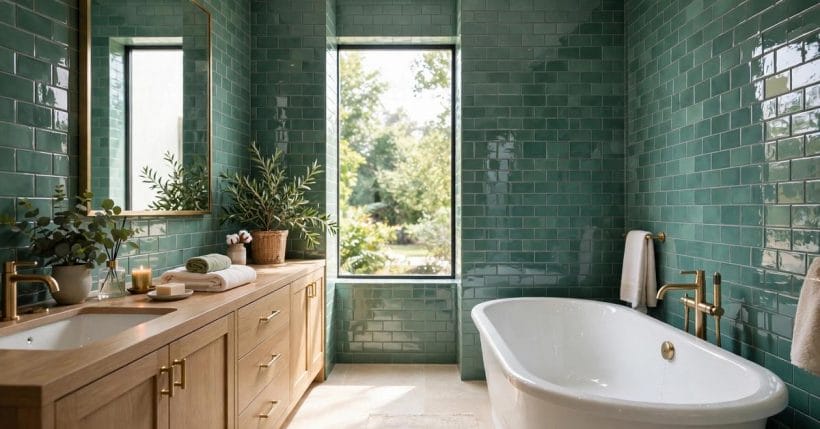
Every wall, floor to ceiling, in one glossy green skin of tile — the room stops being painted plaster with fittings on it and becomes a single, washable, light-catching surface.
These seventy-five all wall tile bathroom ideas cover how much wall to tile, the formats and patterns that suit walls, colour and grout, vanities and space-saving fixtures against tile, light and mirrors, small-room versions, and the care and cost drivers behind a fully tiled room.
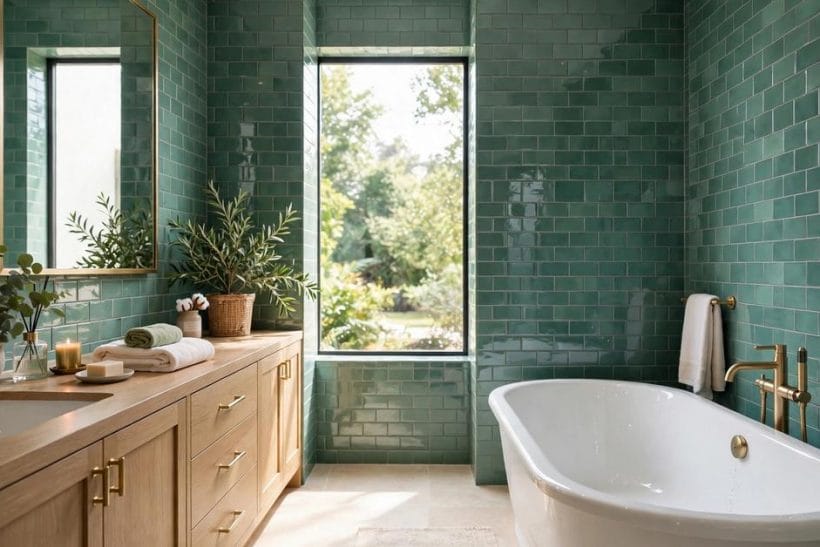
1. All Wall Tile Bathroom Ideas at a Glance
An all-wall-tile bathroom tiles its walls as the primary surface — full height, part height carried high, or every wall in the wet zone and beyond — rather than confining tile to a splashback and a shower. This post is the wall treatment only: the tile, its pattern, its grout and the walls it covers. Bathroom styles have their own posts — the transitional bathroom ideas in the sister post treat one style end to end — and the whole bathroom family gathers in the bathroom ideas pillar. Here, the walls themselves are the subject, and everything else is judged by how it sits against them.
| Question | Short answer |
|---|---|
| What counts as all wall tile? | Walls tiled as the main surface — full height on all walls, or high and continuous through the wet zones |
| Why tile every wall? | One washable, water-tolerant surface; a unified room; pattern and colour carried at architectural scale |
| Which tiles suit walls? | Almost any tile — walls carry no foot traffic, so lighter, glossier and more delicate finishes are allowed |
| What decides the look most? | Tile size, laying pattern and grout colour, in that order — before the tile’s own colour |
| Is it cold or echoing? | It can feel both; rugs, towels, timber and a blind soften sound and touch without touching the walls |
| What does it cost? | Drivers only: wall area, tile price, pattern complexity and the preparation of the walls beneath |
2. Layouts: How Much Wall to Tile
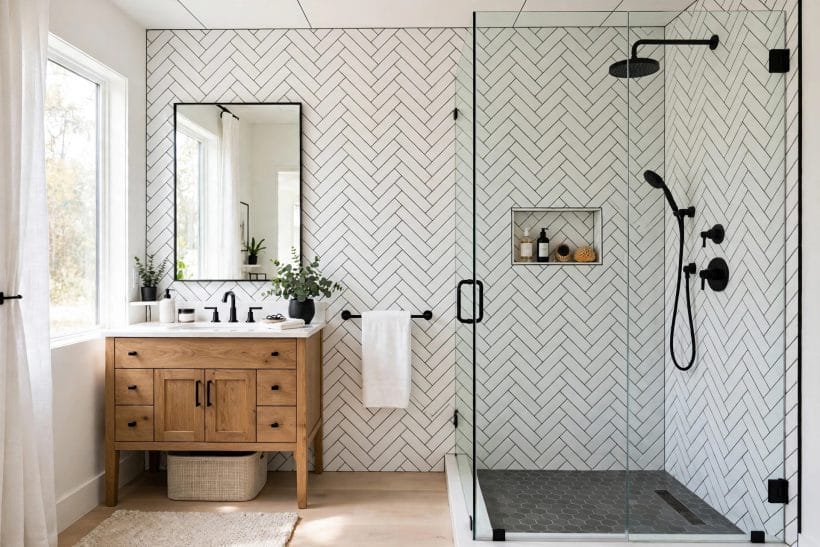
The first decision is coverage, and it is a layout decision before it is a shopping one: which walls, to what height, and where the tile stops. The nine schemes below run from the full wrap of the feature photograph to the single tiled wall — each changes how the room is cleaned, lit and perceived, and each suits a different budget of tile and nerve.
1. Full height, every wall
The complete treatment: tile from floor to ceiling on all four walls, the room sealed in one material. It is the easiest bathroom in the world to wash down, the boldest to look at, and the scheme the rest of this post keeps returning to as the reference.
2. Full height in the wet zone, high elsewhere
Tile to the ceiling around bath and shower, and to a high dado line on the remaining walls, with paint above. The wettest areas get the full armour while the room keeps a softer, cheaper upper register — the pragmatic classic.
3. The wainscot-height wrap
Tile carried around every wall to shoulder or basin height, finished with a border or trim, paint above. It protects exactly the splash band, costs a fraction of full height, and gives small bathrooms a tailored, panelled feeling.
4. One full feature wall
A single wall — behind the vanity or the bath — tiled floor to ceiling in the room’s boldest tile, the rest painted plainly. The concentration makes one wall carry the whole design, and repainting the others can refresh the room for years.
5. The shower taken out of its box
Instead of a tiled cubicle, tile the whole end wall and returns of the room and let the shower live openly against them. The bathroom reads larger, the tiling reads architectural, and there is no enclosure frame interrupting the surface.
6. Tile wrapped into the window reveal
Carrying wall tile into and around the window opening protects the bathroom’s most condensation-prone corner and looks deliberately crafted. The reveal is where amateur tiling shows; a good tiler’s mitres here are worth every penny of their day rate.
7. A tiled bath panel and apron wall
Tile the wall behind the bath and continue the same tile down the bath’s own panel, so tub and wall read as one built object. It grounds a freestanding-look scheme at fitted-bath prices and hides the panel’s plainness entirely.
8. Ceiling-line tile with a picture rail of paint
In tall rooms, stop the tile a hand’s breadth below the ceiling and paint the remaining band and ceiling together. The gap softens the full wrap’s intensity, saves a row of cuts, and gives the room a cornice line it never had.
9. Different heights, deliberately stepped
Full height at the shower, dado at the basin wall, splashback only behind the bath: stepped coverage follows the water honestly around the room. Keep one tile and one grout throughout, or the steps read as indecision instead of design.
3. Tile Formats for Walls
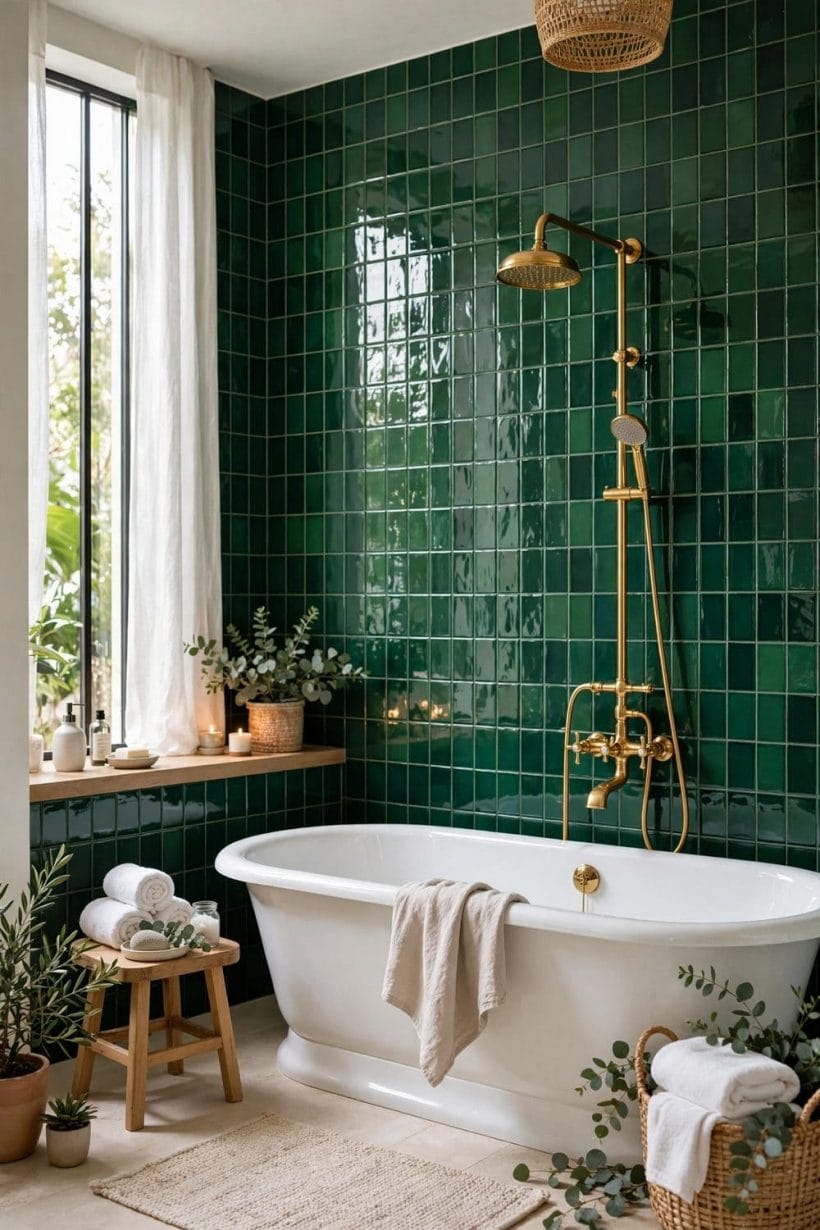
Walls are tile’s easiest assignment — no weight of footsteps, no dropped cast iron — so formats forbidden on floors flourish here: gloss, relief, delicacy, scale. The ceramic family that most of these belong to is covered in depth in ceramic tile bathroom; the nine formats below are the wall worker’s shortlist, from the metro brick to the great slab.
10. The metro or subway brick
The elongated brick that tiled the underground stations of two centuries is still the wall tile to beat: cheap, forgiving, endlessly patterned, and at home in every style from period to industrial. In gloss green, as in the feature room, it becomes something richer than its price.
11. Square tiles, honestly gridded
The plain square, stacked in a true grid, is modernism’s bathroom wall: calm, graphic, and entirely dependent on grout colour for its mood. It suits small tiles in small rooms and larger squares where the grid can breathe.
12. Large-format wall tiles
Big rectangles or squares cover a wall in few pieces and fewer grout lines, reading as stone panelling rather than tiling. They demand flat walls — every undulation telegraphs through a large tile’s reflection — so preparation is the real cost here.
13. Kit-kat and finger mosaics
Slim vertical fingers, sold on mesh sheets, give walls a ribbed, textile softness that drinks light beautifully. They curve gently around slight irregularities, forgive small walls their crookedness, and turn a plain basin wall into the room’s texture.
14. Hexagon and penny mosaics on walls
Small geometric mosaics climb walls as happily as floors, wrapping niches and curves that defeat larger formats. On a whole wall they read as woven pattern; their many grout lines want a grout chosen as carefully as the tile.
15. Zellige and handmade-look tiles
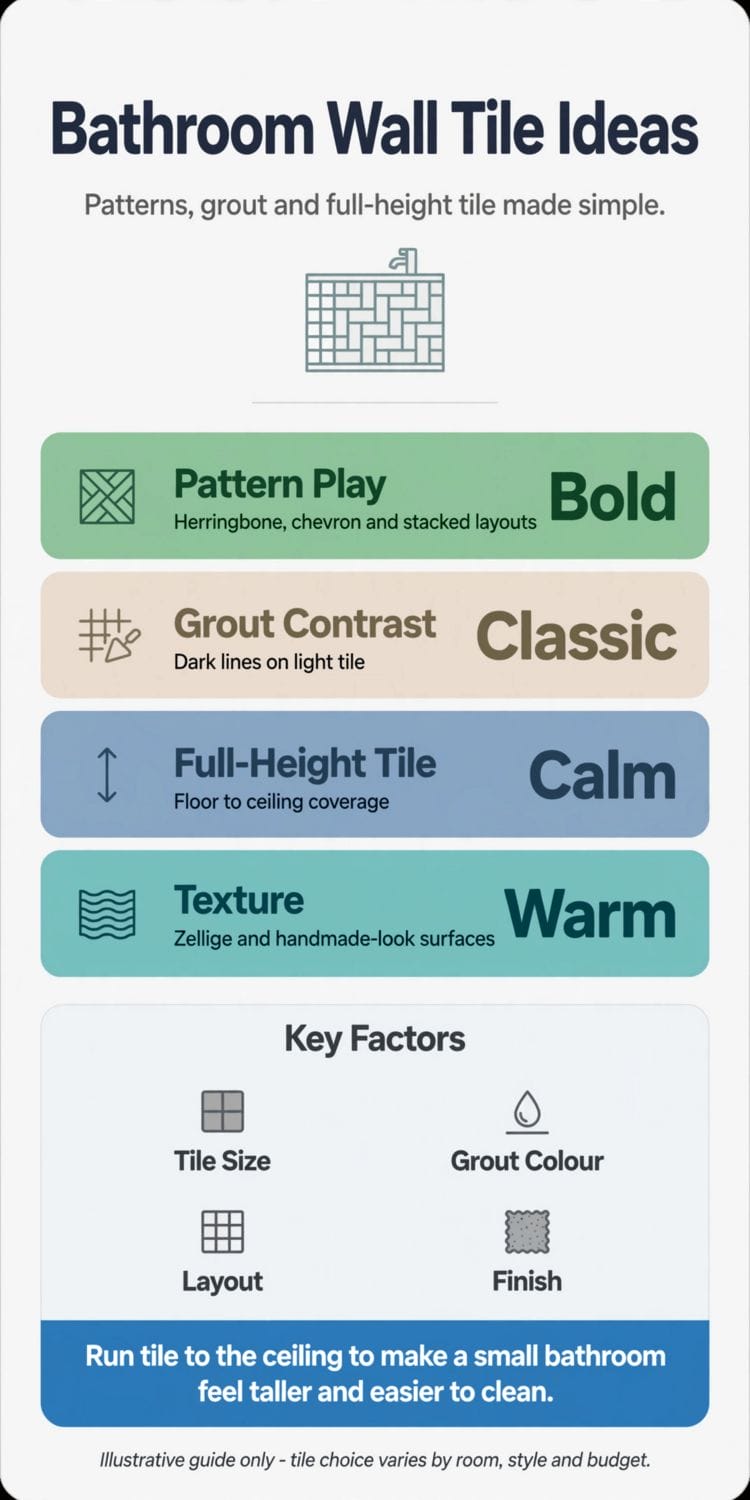
Uneven edges, pooled glaze, no two pieces alike: the handmade look turns a flat wall into water in sunlight. It is the texture row of the infographic made real, and it forgives — celebrates — the slight irregularities other tiles expose.
16. Relief and three-dimensional tiles
Fluted, ridged and sculpted tiles make walls that shadow-play all day as light moves. Keep them out of the shower’s scrub zone if their relief traps soap, and let them star on the dry walls where hands and light can enjoy them.
17. Marble and stone-look wall tiles
Veined porcelain gives the full-height marble bathroom without marble’s sealing, weight or price, and modern printing carries the vein across pieces convincingly. In gloss it is grand; in matt it is spa — the same tile, two different rooms.
18. Terrazzo-look large tiles
Stone chips suspended in a calm ground give walls a speckled, forgiving surface that hides water marks and suits mid-century and modern rooms alike. The pattern’s busyness calms when the format is large and the grout is matched close.
4. Patterns and Laying Directions
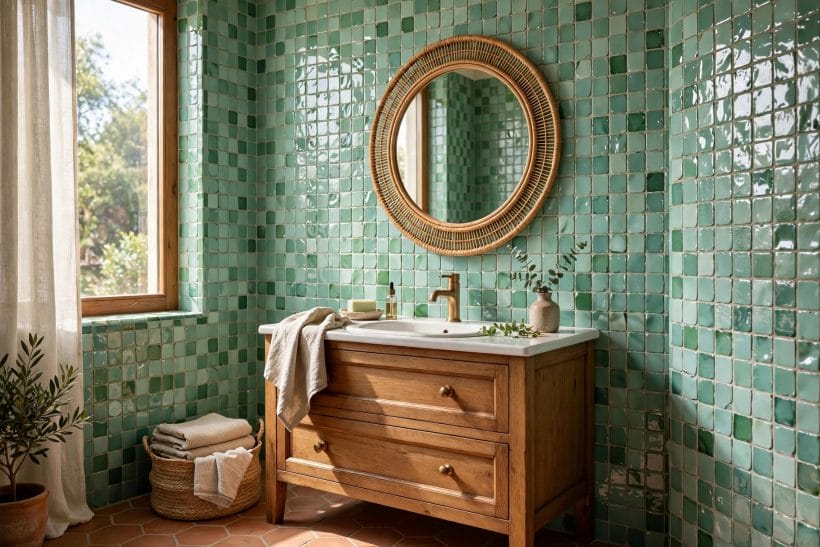
The same tile in four patterns makes four bathrooms. Laying direction is the cheapest design decision in the whole post — it costs nothing but the tiler’s setting-out time — and it is the one most often wasted by defaulting to whatever the last bathroom did.
19. Running bond, the brick pattern
Rows offset by half a tile: the metro brick’s native pattern, horizontal, calm and lengthening. It widens narrow rooms visually and forgives slight size variation in handmade tiles better than any aligned grid can.
20. Stacked, in a true grid
Tiles aligned both ways for a graph-paper wall: modern, strict, and unforgiving of crooked rooms — the setting out must be perfect because the eye checks it against every door frame and ceiling line in sight.
21. Vertical stacking to lift the ceiling
Turning the stack upright draws the eye up and makes low bathrooms feel taller — the infographic’s tip in pattern form. Vertical metro bricks are the current favourite for exactly this theft of height.
22. Herringbone for movement
Zigzag herringbone animates a whole wall with nothing but direction, turning plain tiles into pattern. It earns its extra cutting on one feature wall most of all; on every wall it can busy a small room, so judge it in a drawn elevation first.
23. Chevron, the sharper zigzag
Chevron’s mitred points make a cleaner, more tailored zigzag than herringbone’s overlaps. It reads dressier and more deliberate — the difference between a scarf and a tie — and suits the vanity wall’s formality.
24. Basketweave and woven patterns
Pairs of rectangles alternating direction weave a wall like cloth, a pattern with Arts-and-Crafts warmth that flatters period houses. It asks for two tile sizes or one tile used both ways, planned on paper before the first row.
25. A pattern change at the dado line
Run one pattern below and another above — brick below, stack above — divided by a trim row. The change gives full-height tiling a horizon, breaks its monotony, and lets a costly pattern live only where it is seen most.
26. Border rows and pencil trims
A slim contrasting row at the top of a dado, or framing a mirror zone, is jewellery for tiled walls. Traditional pencil and rope trims finish raw tile edges beautifully where the tiling stops mid-wall.
27. Setting out from the centre line
Whatever the pattern, the tiler sets out from the wall’s centre or its most-seen corner, so cuts land balanced at both ends. Ask to see the setting-out plan — uneven edge cuts are the amateur signature no grout can hide.
5. Colour on the Walls
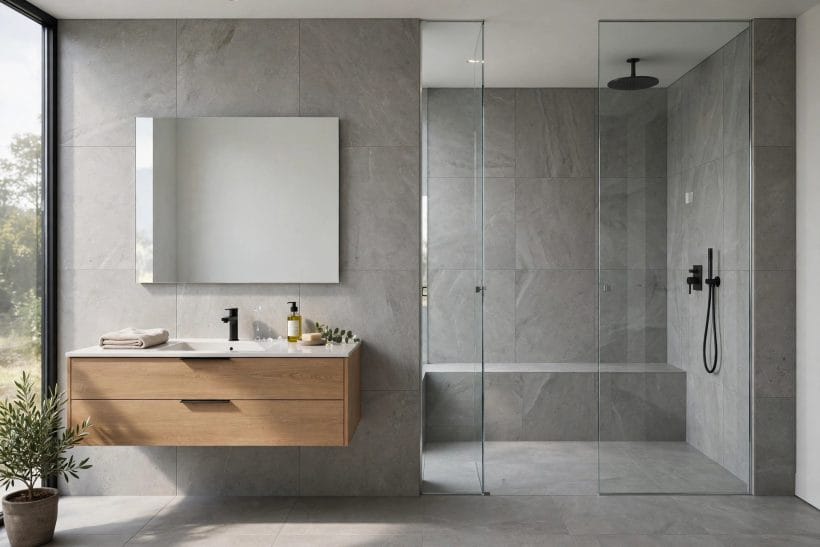
Colour at wall scale behaves differently from colour on a sample card: a full room of it surrounds the bather, reflects onto skin, and doubles itself in the mirror. The palettes below run from the feature room’s green confidence to the pale schemes that borrow their colour from towels instead — several sit comfortably beside the palettes in modern bathroom ideas.
28. Deep green, the current classic
Bottle and emerald greens in gloss tile make a bathroom feel like a conservatory at bath time — verdant, calm and flattering. Green is the colour plants, brass and white enamel all agree with, which is why the feature room wears it so easily.
29. All white, texture doing the work
White tile on every wall is not a surrender when the tile has relief, variation or a handmade edge: the room becomes a study in shadow and shine. It is also the scheme that tolerates any future colour of towel, blind or bath mat.
30. Soft blue and sea-glass tones
Pale blues and aqua glass tiles carry the water reference lightly and cool a sun-baked bathroom pleasantly. Glass tiles glow when light passes their edges — a vanity wall of them behind a mirror doubles the effect.
31. Warm neutrals: bone, putty, stone
The spa palette: warm off-whites and stone tones in matt or satin, grout matched close, timber and linen finishing the thought. These rooms photograph gently and live even more gently, hiding water spots with aristocratic ease.
32. Black walls, dramatic and deliberate
Full-height black tile is a nightclub of a bathroom — glamorous, enclosing, unforgettable — and it shows every dried droplet as a pale star. Choose it with a soft water supply or a strong cleaning will, and light it like a stage.
33. Terracotta and clay warmth
Earthy reds and clay tones in handmade-look tile make northern bathrooms feel sun-warmed at any hour. They pair naturally with aged brass, dark timber and cream, and they are kinder to skin tones than any cool colour.
34. Two colours, split by height
Deep tile below the dado, pale above it — or the reverse for the brave — gives full tiling a tailored two-piece suit. The split line should run level and meet the basin and bath heights gracefully, which is a setting-out conversation, not an accident.
35. Colour matched in the mirror’s view
Choose the wall colour by what it does reflected: the wall behind the bather is the one seen in the mirror, tinting every morning’s face. Test the tile there first — a colour that flatters in the mirror earns its place on every wall.
6. Grout: The Quiet Design Decision
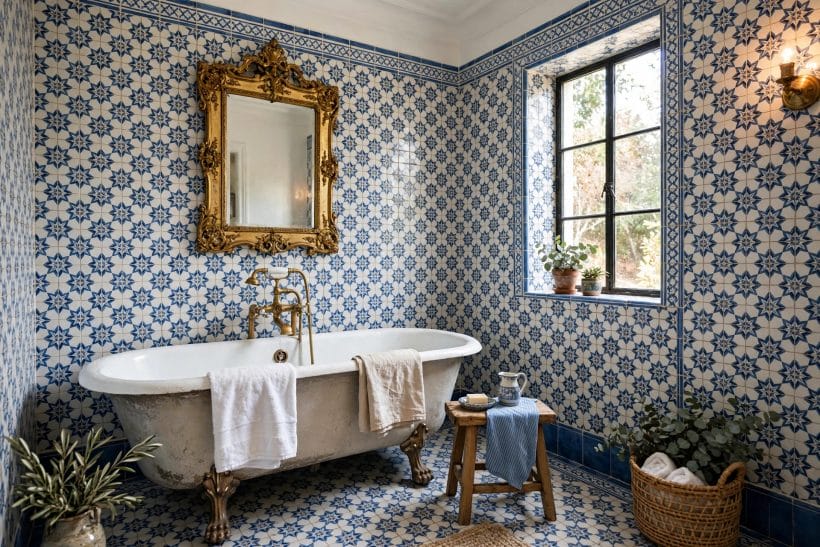
Grout is half the visible surface of a small-tile wall, and it decides whether the tiling reads as pattern or as plaster. The eight choices here — contrast, tone, width, material and upkeep — are made once and lived with for decades, which makes them the highest-leverage decisions in the whole bathroom.
36. Contrasting grout for the drawn grid
Dark grout on light tile inks in every line, turning plain metro bricks into graphics — the infographic’s Classic row. It hides its own ageing gracefully and forgives slight tile variation by making a feature of the grid itself.
37. Matched grout for the seamless wall
Grout coloured to the tile melts the joints away and lets large or veined tiles read as continuous stone. It is the calmer, more expensive-looking choice, and it shows a crooked row mercilessly — pick it with a good tiler.
38. Mid-tone grout, the forgiving middle
Soft grey or greige grout neither shouts nor vanishes: it tones with most tiles, hides everyday marks better than white, and survives colour fashions on both sides of it. More real bathrooms choose this than admit it.
39. Joint width as a style lever
Slim joints read modern and precise; wider joints read rustic and handmade. The tile’s edge decides what is possible — rectified edges take hairline joints, handmade edges need room to wander — so the width is chosen with the tile, never after.
40. Epoxy grout in the wettest zones
Where walls take daily water — inside showers, around baths — epoxy grouts resist staining and moisture far beyond cement-based ones, at a higher price and a fussier installation. Many rooms use it only in the wet zone and standard grout elsewhere.
41. Sealing and the honest upkeep
Cement grout in wet areas benefits from sealing and from ventilation that dries the room after bathing; mould feeds on damp grout, not on tile. A bathroom fan that actually runs is a grout product as much as the sealer is.
42. Grout colour changes as renewal
Years on, re-colouring sound grout with a purpose-made coating can refresh a whole tiled room in a weekend without touching a tile. It is the cheapest transformation in this entire post, and the reason to keep grout sound rather than perfect.
43. Metal and trim edges where tile ends
Where tiling stops — at a dado, a corner, the ceiling gap — a metal strip, a bullnose tile or a pencil trim finishes the edge professionally.
7. Vanities, Fixtures and Space-Saving Fittings Against Tile
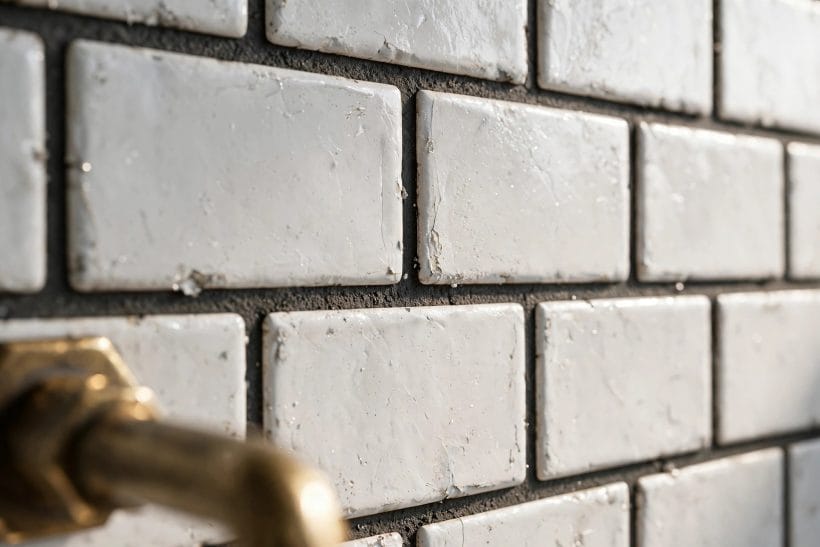
A fully tiled wall changes how everything mounted on it behaves: fixings drill into tile, mirrors hang on tile, and the tile itself becomes the backdrop that either flatters or fights the furniture. The warm timber vanity of the feature room — kin to the furniture in craftsman bathroom ideas — shows the friendliest possible relationship between wood and tile.
44. Timber vanities against cool tile
Wood is tile’s oldest companion: warm against cool, matte against gloss, alive against mineral. A drawer vanity in oak or walnut in front of full-height tile gives a bathroom its furniture note and its storage in the same object.
45. Wall-hung vanities that show the tiling
Floating the vanity keeps the wall tile running uninterrupted behind and below it, doubling the tiled effect and freeing the floor.
46. A basin set into the tile field
Vessel and semi-recessed basins sit forward of the wall, letting the tile run behind them as a full splashback with no cut edges at basin height.
47. Mirrors hung on tile
Drilling tile for mirror fixings wants the right bit, a steady hand and fixings rated for the mirror’s weight — or adhesive systems made for the purpose.
48. Space-saving fixtures for the fully tiled small room
Wall-hung loos, short-projection basins and corner fittings keep a small tiled bathroom’s floor clear and its walls continuous. Every fitting that floats lets the tiling — the room’s whole investment — remain the visible surface it was bought to be.
49. Niches tiled into the wall
A recessed shelf in the shower or beside the bath, tiled in the wall’s own tile or a deliberate contrast, stores bottles without a single plastic caddy.
50. Heated towel rails on tile
A rail fixed through tile into solid fixing points warms towels and takes the chill off a fully tiled room’s air.
51. Matching metals across the tile
Taps, rails, trims and mirror frames in one metal finish read as a single decision against the tile; mixed metals can work when they are clearly deliberate in twos and threes.
8. Light, Mirrors and Reflections on Tile
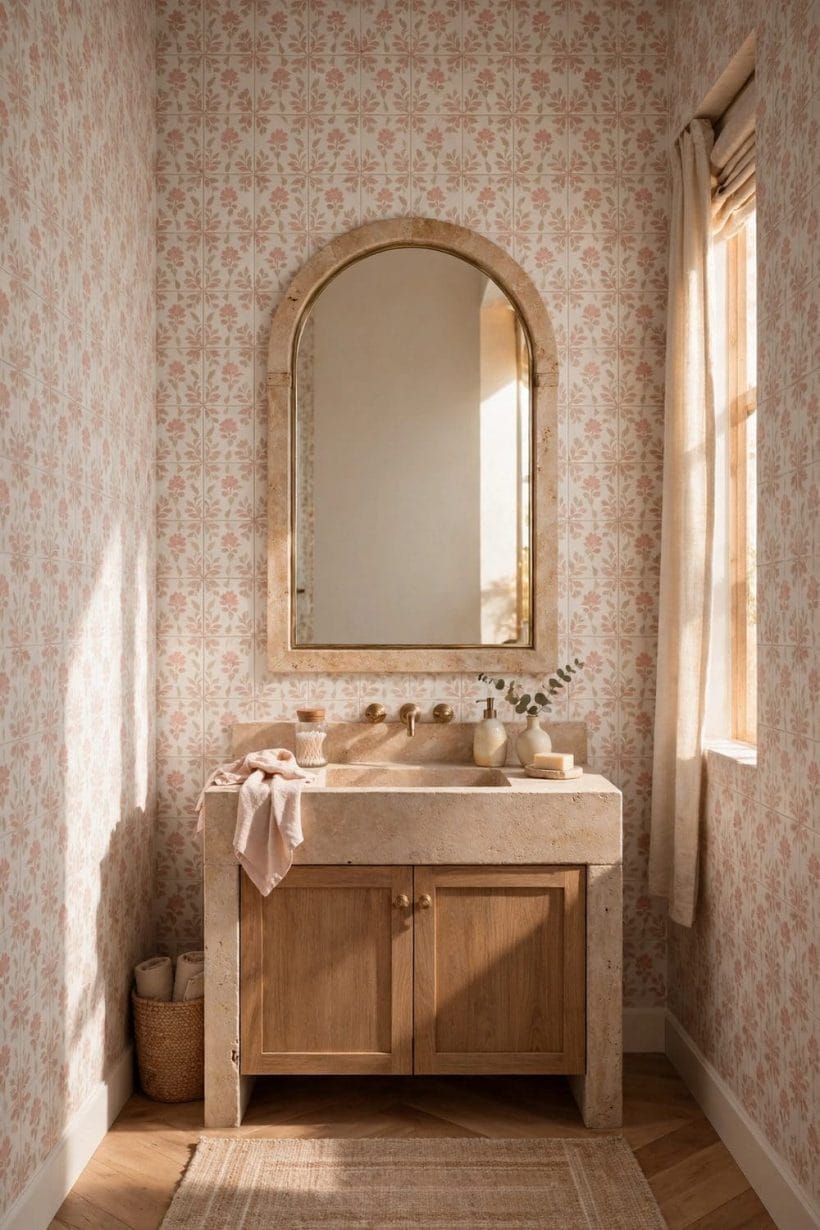
Gloss tile is a light instrument: it reflects windows, doubles lamps and throws watery highlights around a room — or glares, dazzles and shows every flaw, depending on how the lighting is planned against it. The eight ideas here treat light as a material of the tiled room, equal in importance to the tile itself.
52. Daylight first: gloss loves a window
A glossy tiled wall beside a window comes alive all day, its surface moving like water as the light changes.
53. Sconces either side of the mirror
Face-level light flatters the bather and rakes gently across tiled texture, showing relief tiles at their best. Against gloss tile, frosted or shaded fittings prevent the doubled glare that bare bulbs bounce around a small tiled room.
54. Matt tile for the calm, lamplit room
Where evenings are the bathroom’s main hour, matt and satin tiles absorb light into a soft, spa-like gloom that gloss cannot imitate.
55. A lit niche or shelf line
A small, warm light source inside a tiled niche turns shampoo storage into a glowing alcove and gives night-time visits a gentle guide light.
56. Mirrors that multiply the pattern
A wide mirror over a tiled vanity wall reflects the opposite tiling, doubling the room’s investment and its light in one sheet of glass.
57. Avoiding the downlight grid glare
Rows of ceiling downlights reflect in gloss wall tile as rows of doubled dots, a disco nobody ordered. Fewer, better-placed fittings, or wall-washing light aimed along the tile rather than at it, keeps the sparkle and loses the glare.
58. Candlelight and the evening test
Fully tiled rooms are bath rooms, and baths are taken by low light: test the chosen tile under a lamp’s warm glow before ordering the room’s worth.
59. Black fittings as punctuation in the light
Matte black taps and rails against glossy coloured tile give the eye rests and the room its graphic punctuation. They also show limescale honestly — the eternal bargain of black fittings, accepted gladly by their many devotees.
9. Small Bathrooms in Full Tile
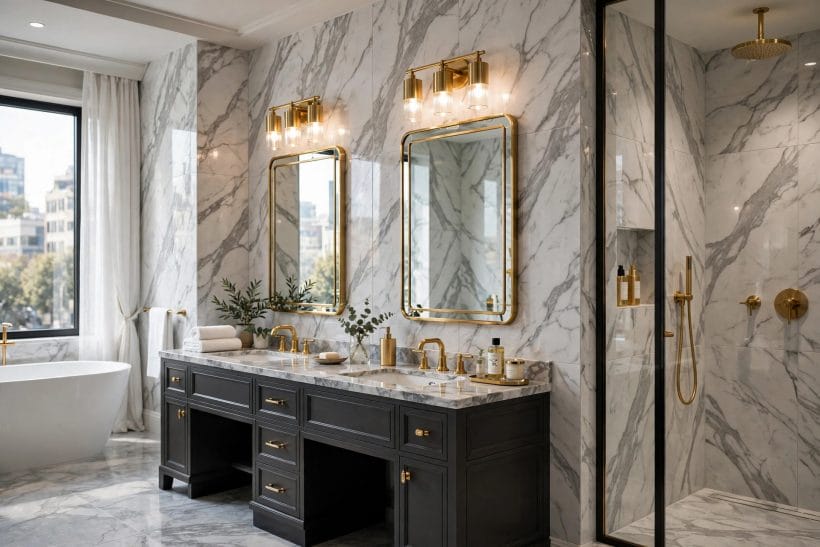
Small bathrooms gain the most from all-wall tile and risk the most from it: one continuous surface unifies a cramped room beautifully, while the wrong scale of tile can shrink it to a tiled box. The infographic’s own tip — run tile to the ceiling to make a small bathroom feel taller — heads a list that the small-room craft in tiny bathroom ideas complements from the layout side.
60. Full height to steal vertical inches
Tiling to the ceiling removes the horizontal paint line that caps a small room’s height, and the eye travels up uninterrupted.
61. One tile, everywhere, no exceptions
In a small room, a single tile on all walls — ideally continued tones on the floor — erases the visual joins that chop the space into pieces.
62. Large tiles for fewer lines
Fewer grout lines mean a calmer, larger-reading wall, provided the walls are flat enough to carry the format honestly. In old, wavy-walled small rooms, a handmade-look smaller tile may paradoxically look calmer, by hiding the waves in variation.
63. Pale gloss for borrowed light
A windowless small bathroom lives on reflected light, and pale gloss tile is its best mirror short of glass itself.
64. A single bold wall, three quiet ones
Where full commitment frightens, one deep or patterned wall with three pale tiled companions gives a small room its drama and its calm in fixed proportions.
65. Continuity through the shower
Carrying the same tile through an open shower zone, with the glass screen frameless or absent, removes the last visual barrier in the room.
66. Storage carved into the tiling
Niches, a tiled ledge along the bath wall, and a mirrored cabinet recessed into the tile depth keep bottles off every surface.
67. Softening layers that never touch the walls
A timber stool, a woven basket, a linen blind, towels in a warm colour: the tiled small room softens through its objects, all changeable in an afternoon.
10. Care, Costs and Choosing
The last eight ideas are the ledger. All-wall tile is a decades-long commitment of surface, so the choosing questions are about preparation, the tiler’s craft, and the care the room will actually receive — with costs stated as the drivers they are, since tile prices and day rates vary too widely by place for any figure here to be honest.
68. Preparation: the wall beneath decides
Tile is only as flat, dry and sound as what it covers: sound plaster or proper tile backer boards, waterproofing in wet zones, and no tiling over flaking paint or damp.
69. Waterproofing the wet zones properly
Behind the tile of showers and bath surrounds, a tanking system keeps water in the room’s plumbing rather than in its walls.
70. Cleaning: the tiled room’s great ease
Routine care is a wipe with mild cleaner and a squeegee’s discipline in the shower; tile asks less weekly care than any painted wall in a steamy room.
71. Cost driver: tile price times wall area
Full walls multiply whatever tile is chosen, so the per-box price matters more here than in any splashback scheme — and the savings from a humbler tile, spent instead on the tiler, usually show more.
72. Cost driver: pattern and format complexity
Herringbone, mosaics and small formats consume tiler-time; large simple grids consume wall preparation. Either way the labour follows the complexity, which is why a drawn pattern and a flat wall are the two honest economies available.
73. Choosing the tiler by their setting out
Ask candidates how they would set out the hardest wall and finish the edges, and prefer the answer with drawings in it.
74. The sample board, lived with
Fix a few chosen tiles and a stripe of the intended grout to a board, and stand it in the bathroom through a full day’s light changes.
75. The decade test for walls
Finally: this surface will outlast the towels, the taps’ fashion and possibly the bath — will the colour and pattern still please in ten years of mornings?
Final Considerations
An all-wall-tile bathroom is a room finished in one honest material: washable, luminous, and unified in a way paint never quite achieves. Decide the coverage first, the format and pattern second, the grout as seriously as the tile, and the preparation more seriously than either — then let vanities, mirrors and towels live their changeable lives against a surface that will not need re-deciding for decades. The tiler’s setting-out plan and a sample board in the room’s own light are the whole secret; everything else is enjoyment.

0 Comments