

Every garden has one spot where the smoke goes, the sun lands at six, and everyone ends up standing. That spot is either a barbecue area or an accident waiting for chairs.
Seventy-five outdoor BBQ areas follow: the station, its zones, surfaces and shade, the dining beside it, fire stated seriously, and the small-yard versions — the standalone cooking-area lane, kept distinct from grills built into patios and from built-in island kitchens.
1. BBQ Area Ideas at a Glance
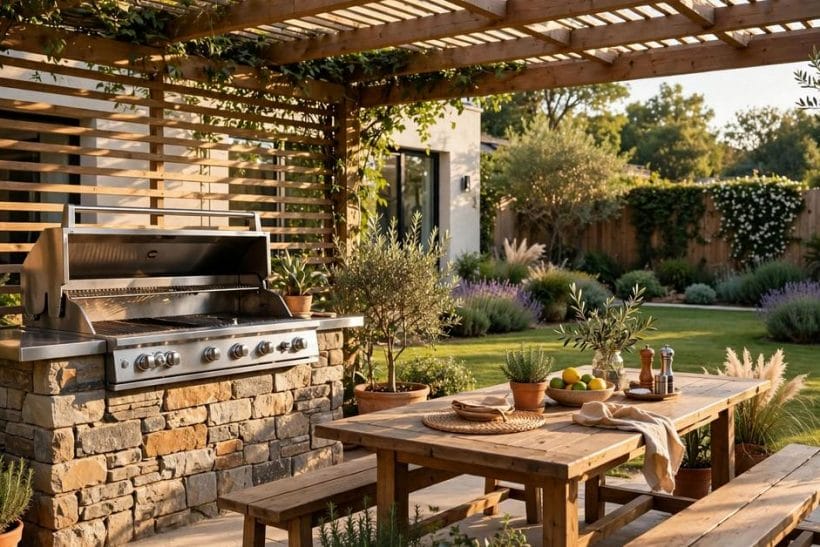
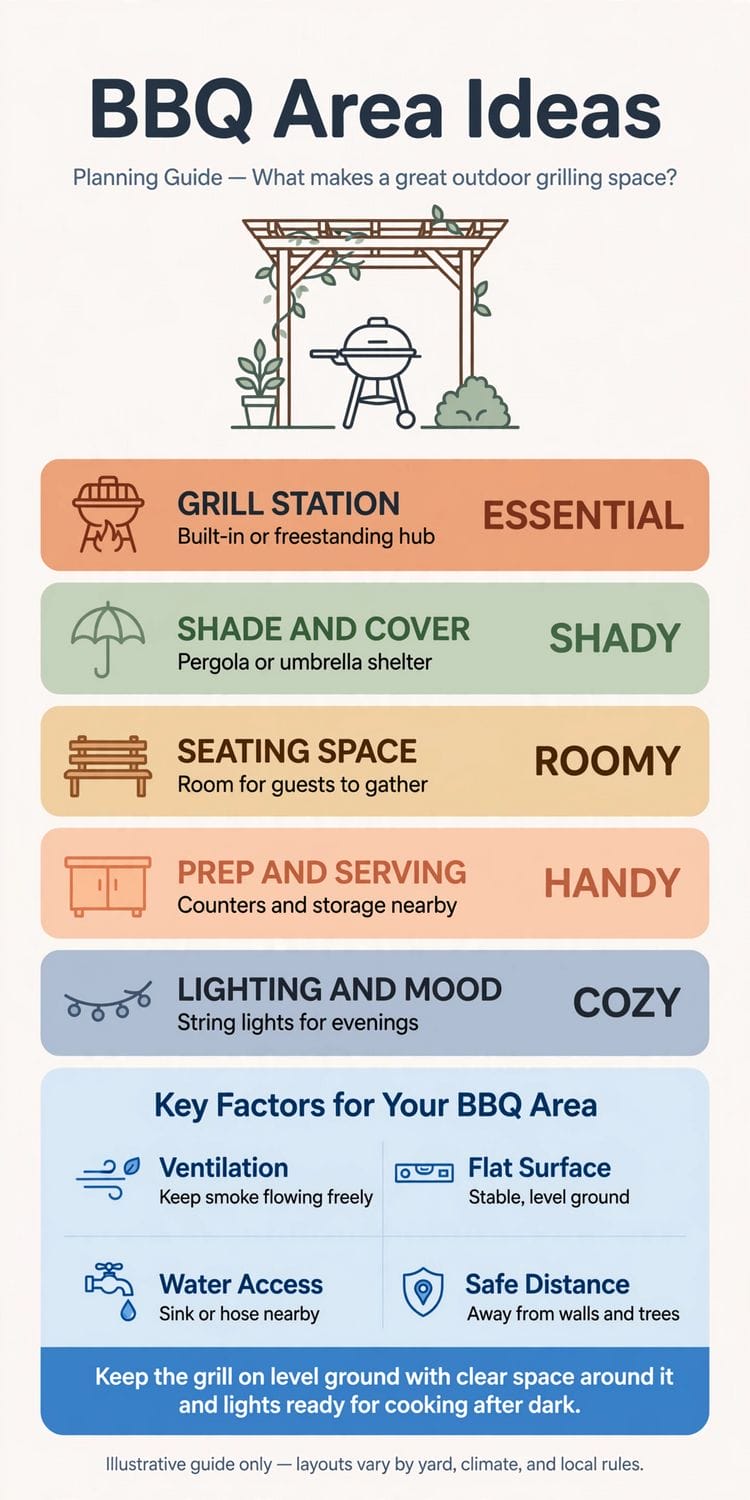
The central entity is the outdoor BBQ area: a defined cooking ground in a garden, terrace or courtyard, built around a grill — freestanding, built-in or portable — with landing counters, a dining place within talking distance, and fire, fuel and ventilation handled as the serious attributes they are. Its attributes are the station’s form, the three zones of cooking, dining and lounging, surfaces that forgive grease and heat, shade placed over people rather than fire, and keeping habits that survive the off-season. This post owns the standalone BBQ area: the general patio field is the patio ideas pillar’s, and grills integrated into general patio schemes, and built-in island kitchens as their own subject, are other posts’ territory, linked where they belong rather than absorbed. All fire, fuel, gas, electrical and structural points are stated generally, deferring to makers’ instructions and local rules throughout.
| Question | Short answer |
|---|---|
| What makes a grill spot an area? | Zones: a cooking station with landing space, dining within talking distance, and lounging beyond the smoke — arranged, not accumulated. |
| Where does the grill go? | Where its maker’s clearances, open air and the garden’s usual breeze agree — safety documents choose the spot; styling follows. |
| What goes overhead? | Shade over the diners; open sky over the fire, so smoke and heat always have somewhere to go. |
| What keeps it alive for years? | Keeping: covers on clean appliances, little-and-often cleaning, dry storage, and a proper winter shutdown. |
2. The Cooking Station Itself: Grills, Counters and Built Form
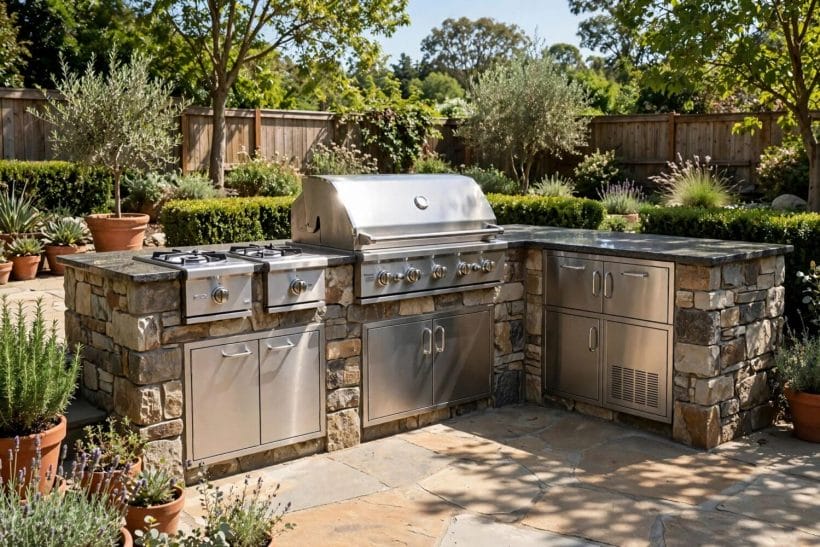
Everything in this survey hangs on the cooking station: the grill, the counter beside it, and the ground it stands on. The wider outdoor field belongs to the patio ideas pillar; this section stays on the station itself — its forms, from a kettle on a terrace to a built counter run.
1. The freestanding grill on its own paved pad
The simplest station: a freestanding grill given a proper paved pad, a clear working side and a heat-safe backdrop.
2. The built-in grill in a masonry counter
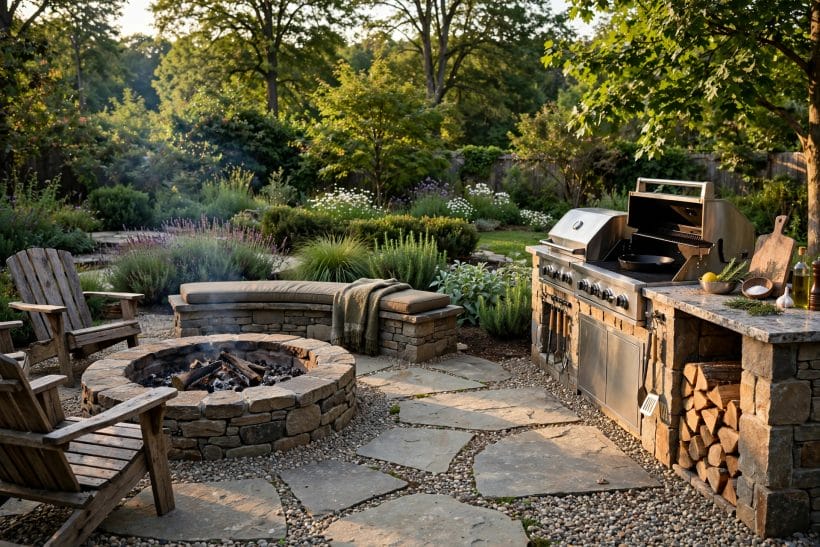
A grill set into a built counter of brick, stone or rendered block is the area’s permanent register: worktop at both elbows, storage below, and a station that reads as architecture.
3. The counter run: landing space on both sides
Whatever the grill, the cook needs landing space on both sides — raw food arriving, cooked food leaving, never sharing a surface.
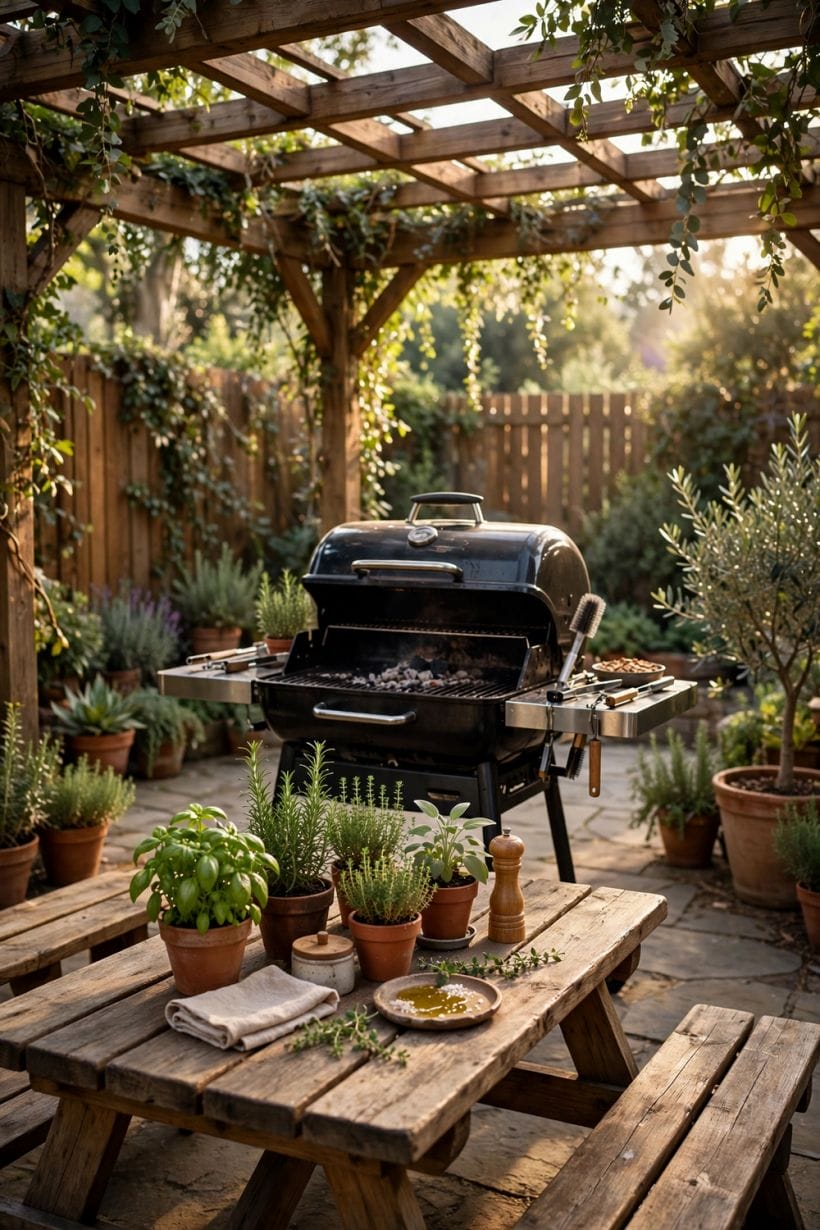
4. The kettle grill corner
A kettle grill in a composed corner — a screen behind, a small counter or trolley beside, hooks for tools — gives charcoal cooking a station of its own.
5. The gas grill with its connections done properly
A gas grill’s convenience depends on its connections being sound: cylinders stored and handled as their makers and local rules direct, hoses and seals checked, and any fixed supply line installed by a qualified professional.
6. The kamado and ceramic cooker as a sculptural station
A ceramic kamado cooker brings a sculptural, egg-shaped presence and a devoted following for slow cooking.
7. The flat-top griddle station
A flat-top griddle station suits breakfasts, smash burgers, vegetables and the teppanyaki mood — cooking as performance at the centre of the gathering.
8. The smoker given its own downwind place
A smoker works for hours and perfumes all of them, so it earns its own place in the area — downwind of the seating in the garden’s usual breeze, on its own pad, where its long, low fire can be tended without crossing the party.
9. The wood-fired oven as the area’s hearth
A wood-fired oven makes the barbecue area a hearth room outdoors: pizza nights, bread, the long theatre of fire.
10. The trolley and prep cart for flexible stations
A sturdy trolley gives a freestanding grill its missing counter: ingredients out, cooked food back, tools hung at its side.
11. Tool storage at the station, not in the kitchen
Tongs, brushes, thermometers and gloves belong at the station in a lidded box, a cabinet bay or a hook rail under cover — not trailing through the house on the cook’s memory.
3. Layouts: Zones, Distances and the Shape of the Area
A barbecue area is three zones in conversation — cooking, dining and lounging — arranged so heat, smoke and traffic never argue. This section stays on their placing: the distances that keep cooks working, guests comfortable and children out of the hot corner without being banished from the party.
12. The three-zone layout: cook, dine, lounge
The classic arrangement separates the hot zone from the eating zone by a serving step, and the lounging zone sits beyond, where smoke and splatter never reach.
13. The galley run along the house wall
A station run along the house wall — grill, counters, storage in a line — keeps services short, the wall as heat backdrop, and the garden open beyond.
14. The island station in the garden’s middle
An island station in the garden’s centre makes cooking the gathering’s hearth: the cook faces the guests, counters serve both sides, and the party arranges itself around the work.
15. The L-shaped corner station
An L of counters in a garden corner gives the cook two working arms — grill on one, prep and serving on the other — and leaves the corner’s angle for storage.
16. The station at the patio’s edge, facing in
Placing the grill at the patio’s far edge, with the cook facing back toward the house and guests, keeps smoke drifting away from the seating behind the cook’s back.
17. Keeping the cook’s lane clear of through-traffic
Paths to doors, sheds and gates must not cross the cook’s working side: hot pans and opening lids need a lane no child or guest crosses absent-mindedly.
18. Seating placed for the usual breeze
Every garden has a usual breeze; learn it before siting anything. Seating belongs upwind of the grill in that breeze, so smoke crosses the cook’s station and leaves, rather than settling over the table for the whole evening.
19. The serving counter as the zones’ border
A counter or table between grill and dining makes the border physical: cooked food is set down, guests serve themselves, and nobody reaches across the cook’s workspace.
20. Distances from fences, hedges and structures
Heat and structures keep a respectful distance, always: the grill maker’s stated clearances and local rules govern, and this survey states the principle generally — never place a hot appliance against fences, hedges, sheds or overhanging planting, and never under a roof or branch its maker forbids.
21. Levelling the cooking ground first
A grill on sloping or soft ground is a station already failing: lids swing, fat runs wrong, wheels wander.
22. The area that grows by stages
Not every area is built at once: pad and grill this season, counter next, shelter after.
4. Surfaces, Shade and Shelter
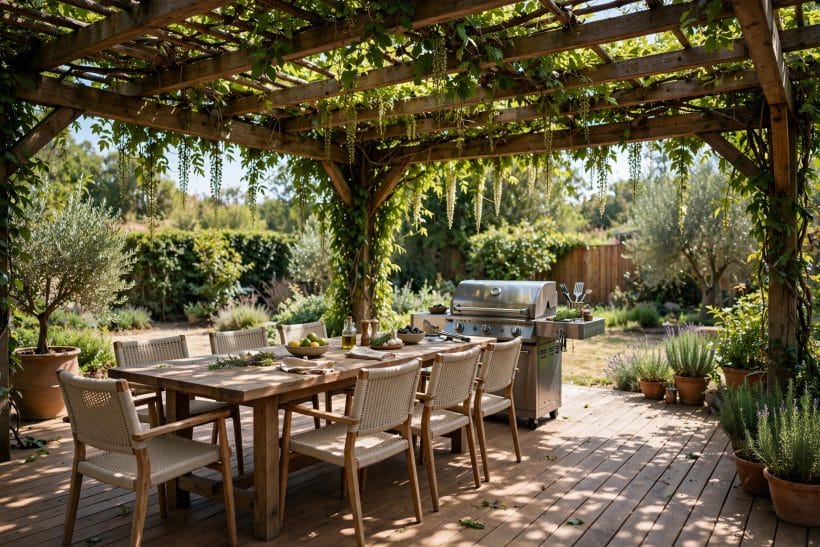
The area’s floor, shade and shelter decide how many weeks of the year it is used. Floors here connect to the concrete patio ideas survey’s material field; this section stays on what a cooking area specifically needs overhead and underfoot — grease, heat, rain and evening light included.
23. Paved floors that forgive grease and heat
The cooking zone’s floor wants to be paved, non-slip and forgiving: grease spots and ember marks are its biography.
24. The pergola over dining, not over the grill
A pergola‘s shade belongs over the table, where people sit for hours — the grill itself needs open sky for its smoke and heat to leave, unless a purpose-made, professionally installed extraction arrangement exists.
25. The sail shade angled for the evening sun
A shade sail over seating, angled against the low evening sun when barbecues happen, cools the gathering without enclosing it. Sails and their fixings take wind loads seriously — anchoring is structural work, done properly or professionally, never improvised into fence posts.
26. The umbrella as the flexible shade
A large garden umbrella shades a table, tilts with the sun and folds away for winter — the renter’s and the small garden’s shelter.
27. The covered veranda station, ventilated by design
Some houses offer a veranda, and a grill beneath cover is tempting; it is also where ventilation stops being a preference and becomes the whole question.
28. Screens against the prevailing wind
A screen of slats, planting or trellis on the windward side shelters flames from gusts and guests from chill, making marginal evenings usable.
29. Evening light at the grill: seeing the food
The cook needs light on the food, not just atmosphere around it: a task light at the station — fitted properly, outdoor-rated, and installed by a qualified electrician where wiring is involved — plus the garden’s softer light beyond.
30. String lights over the dining zone
Festoon and string lights over the table give the evening its ceiling of warm points, hung clear of the cooking zone’s heat and smoke path. Outdoor-rated fittings only, fixed securely, and kept as the dining zone’s jewellery rather than the grill’s decoration.
31. The outdoor rug under the table only
An outdoor rug under dining furniture softens the zone and defines it — and stays there. Rugs never belong under or before a grill, where fat, embers and heat make them a liability; the cooking zone’s floor stays bare, paved and sweepable.
32. Drainage: the puddle that must not form
A barbecue area that holds a puddle after rain loses days of use and grows slippery where the cook stands.
33. The fire feature beyond the cooking zone
A fire pit or chiminea beyond the seating gives the evening a second hearth after the cooking fire dies — the fire field in full is linked in this survey’s fire section.
5. Dining, Seating and Serving Beside the Grill
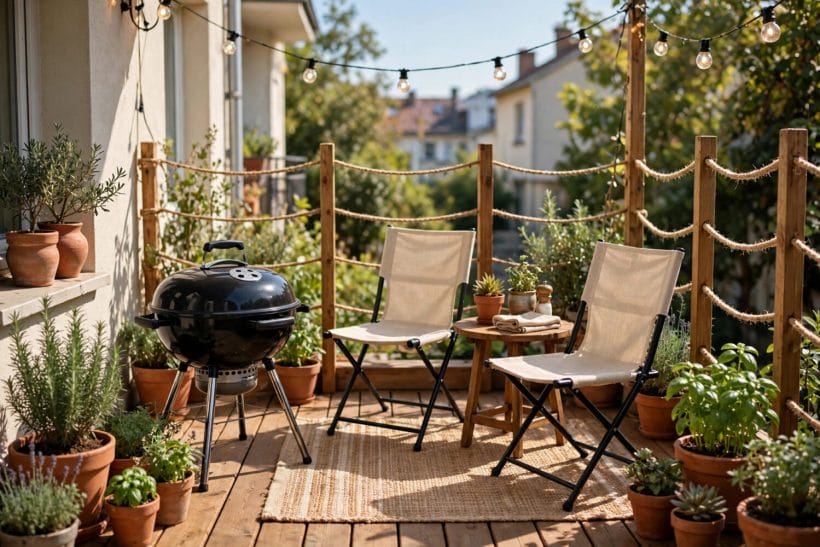
A barbecue is a meal eaten within sight of its making, and the dining arrangement is half the area’s design. The backyard patio ideas survey owns the wider patio field; this section stays on the table, seats and serving furniture that belong to a cooking area specifically.
34. The table within talking distance of the cook
Place the table close enough for conversation with the cook and far enough for smoke and splatter to miss it — the social distance of the barbecue area.
35. Benches for the squeeze-in feast
Benches along a table’s sides seat the variable crowd a barbecue always gathers — two more guests simply shuffle along.
36. The serving table that is not the dining table
A separate serving surface — a sideboard, a console, the counter’s end — holds salads, breads and sauces so the dining table holds people, plates and elbows. Serving furniture is the barbecue area’s unsung piece; without it, every dish migrates onto laps.
37. Drinks kept out of the cooking lane
A drinks station — a cooler chest, a trolley, a small table at the area’s edge — keeps thirsty guests out of the cook’s lane entirely. It is a small safety decision disguised as hospitality: the hot zone’s traffic drops to the cook alone.
38. Bar stools at the counter’s guest side
Where a built counter exists, stools on its guest side give the cook an audience at the perfect distance — close, seated, and behind a border of stone or timber.
39. Shade and seating for the cook
The cook deserves a seat and a patch of shade within the station: a stool at the counter’s end, the pergola’s edge reaching the serving side.
40. Children’s seating inside the sightlines
Children eat best — and are supervised easiest — at a small table or the main table’s end inside the adults’ sightlines, well away from the cooking zone’s edge.
41. The buffet line along a wall or hedge
For larger gatherings, a buffet run along a wall or hedge — serving dishes in cooking order, plates at one end, cutlery at the other — moves a crowd past the food without besieging the grill.
42. Furniture light enough to chase the shade
Chairs and small tables that one person can move let the area follow the day: shade at noon, sun at six, the fire’s circle at nine. Heavy dining sets fix a barbecue area into one arrangement; light pieces give it the season’s full range.
43. Cushions and textiles in outdoor fabrics
Cushions in proper outdoor fabrics — quick-drying, fade-tolerant, stored dry between uses — make hard garden furniture an evening’s seat. Keep them out of the cooking zone’s splatter range, and store them at the station in the lidded box this survey keeps recommending.
44. The after-dark arrangement: seats around warmth
When the meal ends, the area’s second act is seats drawn toward warmth — the fire feature, the grill’s last embers watched from a distance, blankets from the storage box.
6. Fire, Fuel and Ventilation: The Serious Section, Stated Generally

Every pleasure in this survey is fire, managed — so this section states the fire discipline plainly and generally, the way the fire pit ideas survey states its own. Nothing here replaces a grill maker’s instructions or local rules; everything here defers to them.
45. Reading the maker’s clearances before choosing the spot
Every grill arrives with its maker’s clearances — distances from walls, fences, overhead branches and roofs. Those figures, and local rules where they apply, choose the grill’s position; the layout decorates around them.
46. Ventilation: smoke must always have somewhere to go
Smoke and combustion gases rise and must leave: the grill belongs in open air, never in a garage, tent, enclosed porch or any space where fumes gather.
47. Gas safety in general terms
Gas arrangements are kept sound in general terms: cylinders upright, stored and handled as directed, connections checked as the maker instructs, any smell of gas treated as a stop-everything event, and fixed pipework left to qualified professionals under local rules.
48. Charcoal discipline: lighting, tending and ash
Charcoal is lit as its maker directs, never with petrol or spirits not made for the purpose, tended while it burns, and never left until it is out.
49. Fat, flare-ups and the calm response
Fat fires flare; the calm responses are the lid, the distance and the patience to let a flare die on closed heat.
50. Children, pets and the hot zone’s border
The hot zone has a border and the household keeps it: children and pets are supervised in the garden while anything burns, and the area’s layout — counters, serving borders, drinks placed away — does most of the guarding.
51. Wind judgement: the evening that says no
Strong wind defeats umbrellas, sails, screens and fire control alike; the experienced cook reads it early and moves the party’s cooking indoors without apology.
52. Electrical points and outdoor fittings
Power at the station — for lights, a rotisserie motor, a speaker — belongs to outdoor-rated fittings installed by a qualified electrician under local rules, with cables routed where feet and mowers never meet them.
53. Wood storage dry, separate and sensible
Wood and charcoal are stored dry, off the ground, and at a sensible remove from the fire they will feed — a log store at the area’s edge, not a pile against the grill.
54. The chiminea and fire bowl as managed fires
Chimineas and fire bowls follow the same discipline as the grill: sited on non-combustible ground, clear of structures and planting as their makers direct, tended while lit, and cold before they are left.
55. When something is wrong: stop, cool, get it checked
A grill that burns unevenly, a valve that sticks, a hose that perishes, a counter that cracks near heat — each is a stop-and-check, with the appliance out of service until the maker, a manual or a qualified professional has answered.
7. Small Yards, Terraces and Compact BBQ Corners
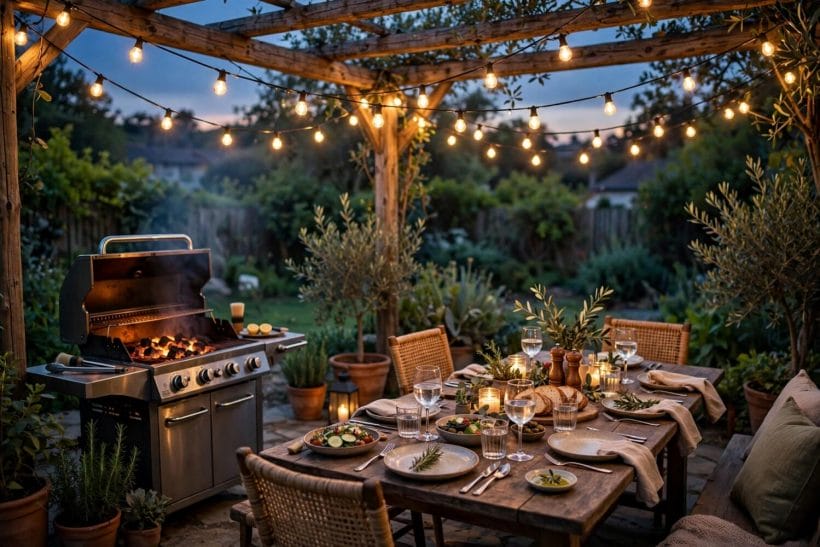
A barbecue area does not need a big garden; it needs a grill, a surface, two seats and the discipline of its larger relations. This section stays on the compact versions — corners, terraces, balconies where rules allow, and the portable stations of small households.
56. The corner station in a small yard
A small yard’s corner takes a compact grill, a fold-down counter on the fence side — respecting heat clearances — and two chairs that tuck away.
57. The terrace trolley station
On a terrace, a grill-and-trolley pairing wheels out for the evening and wheels back against the wall after: the area exists when it is used.
58. Balconies: rules first, grill second
Balcony cooking is governed before it is styled: building rules, tenancy terms and local fire rules decide whether any grill — and which kind — belongs there at all, and many balconies rightly refuse open flame entirely.
59. The portable grill at the park and beyond
A portable grill takes the barbecue area travelling — park, beach, campsite — under each place’s own rules about fires, which are checked before the charcoal is bought.
60. Fold-down and flip-up counters
A counter that folds down from a wall or fence doubles a small station’s workspace for the cooking hour and returns the garden its space after.
61. Two chairs and a side table: the complete small area
The minimum viable barbecue area is honest: a grill, a surface, two comfortable chairs and a side table between them.
62. Vertical storage on the small area’s wall
Hooks, a rail and a lidded box on the wall beside a compact station hold the whole kit vertically — tools, gloves, brush, cover — returning the floor to feet.
63. Screening the neighbours, keeping the peace
Small yards cook close to their neighbours: a screen of trellis and planting on the shared boundary, the grill sited for the breeze’s usual direction, and cooking hours kept neighbourly do more for the small area’s future than any appliance.
64. The shared courtyard station
In shared courtyards and communal gardens, a barbecue area is a negotiated amenity: booking habits, cleaning rituals and storage agreed among households. The station itself stays simple and robust, and the agreement — not the grill — is the real installation.
65. Compact covers: the small area’s winter face
Small areas show their covers all winter, so covers are part of the design: fitted, sound, in a colour the garden tolerates, over a station cleaned before it sleeps.
8. Keeping, Covers and the Off-Season
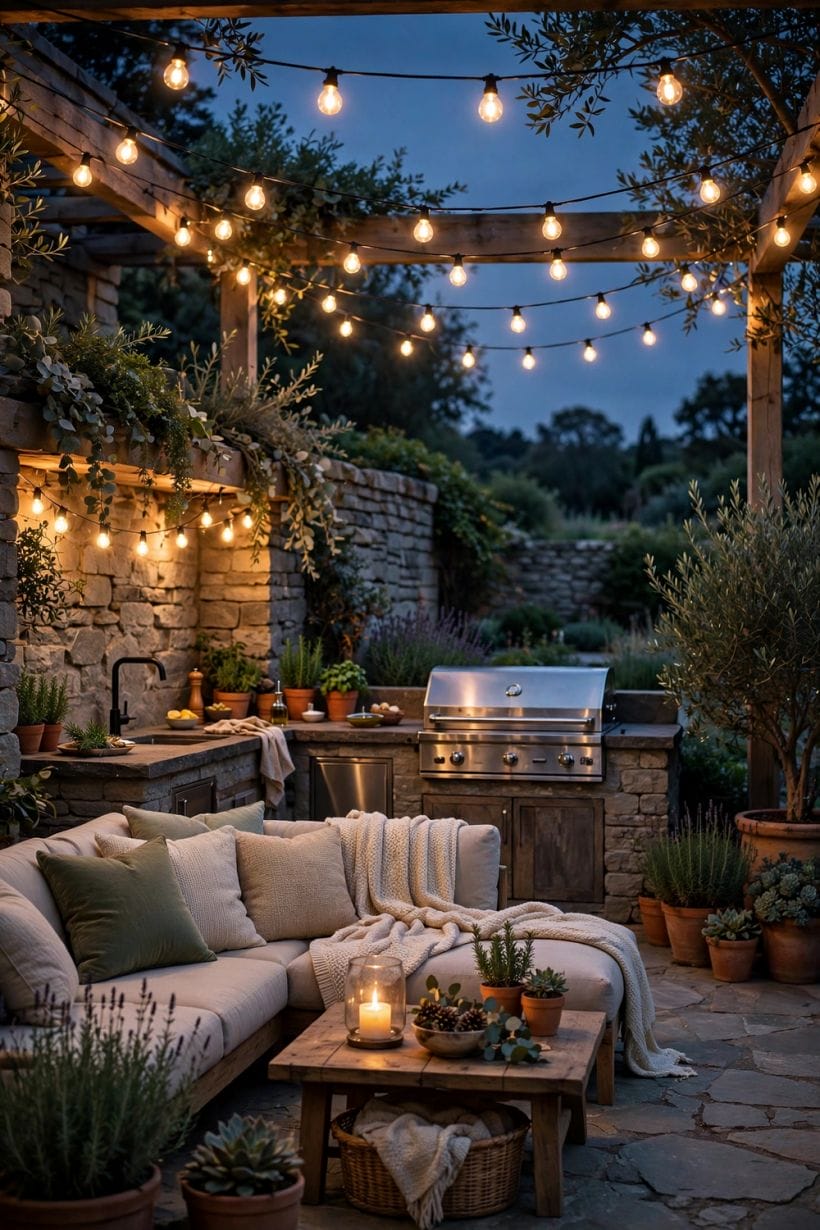
A barbecue area is kept outdoors through everything the year sends, so its keeping is designed, not improvised. This closing survey section stays on covers, cleaning, storage and the winter months — the habits that decide whether the area greets spring as a station or a project.
66. The fitted cover as the station’s coat
A sound, fitted cover over the grill — and over built counters where their makers allow — is the single keeping habit that most extends an area’s life.
67. Cleaning rhythms: little and often
Grates brushed while warm, drip trays emptied, surfaces wiped after use: the small rituals after every cook prevent the deep-clean ordeals that put households off their own areas.
68. Grease management as ground care
Fat and grease are managed, not shed: trays and liners used as directed, spills on paving treated promptly, and wash-water kept out of soil and drains as local guidance directs.
69. Cushions, textiles and their dry store
Outdoor cushions live between uses in a dry, ventilated store — the deck box at the area’s edge, aired on fine days. Textiles stored damp return as mildew; textiles stored dry return as furniture.
70. Timber elements: oiling and shelter
Timber counters, screens and furniture in the area grey and dry under weather; their makers’ oils and finishes, renewed as directed, keep them sound and handsome.
71. Metal, rust and the coastal garden
Metal frames, hinges and grill bodies near the sea air ask for rinsing, drying and prompt attention to chips, because salt accelerates every corrosion.
72. The winter shutdown, done properly
At the season’s end the area is shut down like a boat: everything cleaned, fuel stored dry and safe, gas arrangements closed down exactly as their makers direct — with any disconnection beyond the manual left to qualified professionals — covers fitted, and loose pieces stored.
73. Pests, leaves and the covered station
A covered, quiet station attracts the garden’s tenants — insects in the vents, leaves in every corner, occasionally worse.
74. Refreshing the area each spring
Spring’s refresh is mostly editing: the perished replaced, the sound cleaned, the layout walked once with the year’s gatherings in mind.
75. The area that earns its ground
A kept barbecue area earns its ground in the garden’s hardest currency: evenings actually spent outside.
9. Checks and Mistakes: Before the First Purchase or the First Fitting
Before the first purchase, check the site against the serious documents: the grill maker’s clearances, the property’s own rules — tenancy, building and local fire rules among them — and the garden’s usual breeze, observed on real evenings rather than assumed. Those three checks choose the station’s position; everything decorative in this survey decorates around them.
Check the ground next: level, firm, paved under the cooking zone, with rain falling away from the house and grease planned for rather than shed. Then check the zones — the cook’s lane clear of through-traffic, the drinks outside it, the children inside the sightlines — by walking the layout at the scale of an actual busy evening.
Check services with professionals: any fixed gas work, electrical points and built structural work belong to qualified trades under local rules, arranged before the masonry rises, not improvised after. And check the household’s keeping honesty — covers, cleaning rhythms, dry storage — because an area whose keeping is resented will not be kept, and an unkept area quietly stops being used.
The mistakes repeat across barbecue areas: the grill placed for the photograph against a fence, under a branch, on the lawn; shade built over the fire instead of the diners; the table in the smoke’s usual path; no landing surface, so raw and cooked food share a plate’s journey; and fuel arrangements improvised by confidence rather than installed by qualification. Each is avoidable before the first fire, and expensive or dangerous after it.
10. Costs and Pulling It Together
Costs in a barbecue area, stated generally and without invented figures, arrange themselves by permanence: portable and freestanding stations cost least and move house with their owners; built counters, paved grounds and shelters cost most and stay with the garden. Between them sit the area’s true value pieces — landing counters, good seating, sound lighting installed properly — which decide how the cooking feels at every price point. Fuel, covers and keeping are the running costs, modest and continuous, and the household that budgets for them keeps an area; the one that does not keeps a ruin with a grill in it.
Pull the whole area together as one room outdoors: a station with landing space, zones that keep heat, smoke and traffic in their places, shade over the diners and open sky over the fire, and keeping habits that return it ready each spring. The wider outdoor field around it — patios, planting and the rest of the garden’s rooms — lives in this site’s home design ideas collection; this post’s territory is the cooking ground, and it is complete.
Final Considerations
A good barbecue area is not really about the grill. It is about a garden that gains a kitchen, a hearth and a dining room in a few square metres — fire managed with respect, guests seated out of the smoke, a cook who is part of the party. Site it by the serious rules, furnish it for the evenings it will actually host, keep it like the kitchen it is, and the area will pay its ground rent in gatherings for years.



0 Comments