

Fresh concrete is a blank page that hardens by Friday. What gets written on it in those few working hours — the finish, the colour, the joints — is what the garden will read for decades.
These 75 ideas stay on the concrete itself: its faces, shapes, colours and zones, with the planting and the wider garden left to the posts this one links to, each in its own place below.
1. Concrete Patio Ideas at a Glance
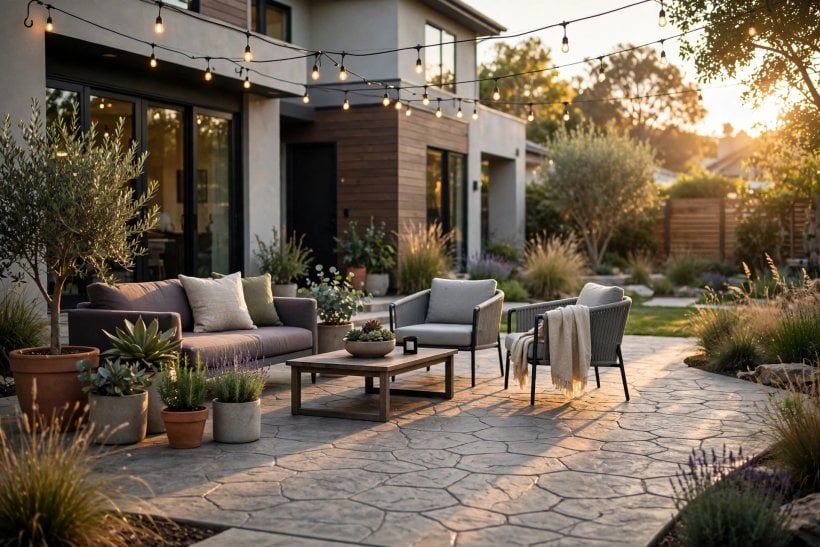
The central entity is the poured concrete patio: a single-material outdoor floor whose attributes are its finish, its shape and joint pattern, its colour, its zoning for dining, lounging and fire, and the base and drainage beneath it that decide how gracefully it ages.
| Question | Short answer |
|---|---|
| What is the most forgiving finish? | A plain broom or lightly exposed aggregate finish: grippy, calm and easy to live with. |
| What decides the cost most? | Size, ground preparation and finish complexity, in that order; pattern and colour sit on top of those. |
| How is cracking handled? | With planned control joints placed as part of the design, so movement follows tidy lines. |
| Where does a concrete patio work best? | On level or gently terraced ground where one pour can serve as floor, path and threshold together. |
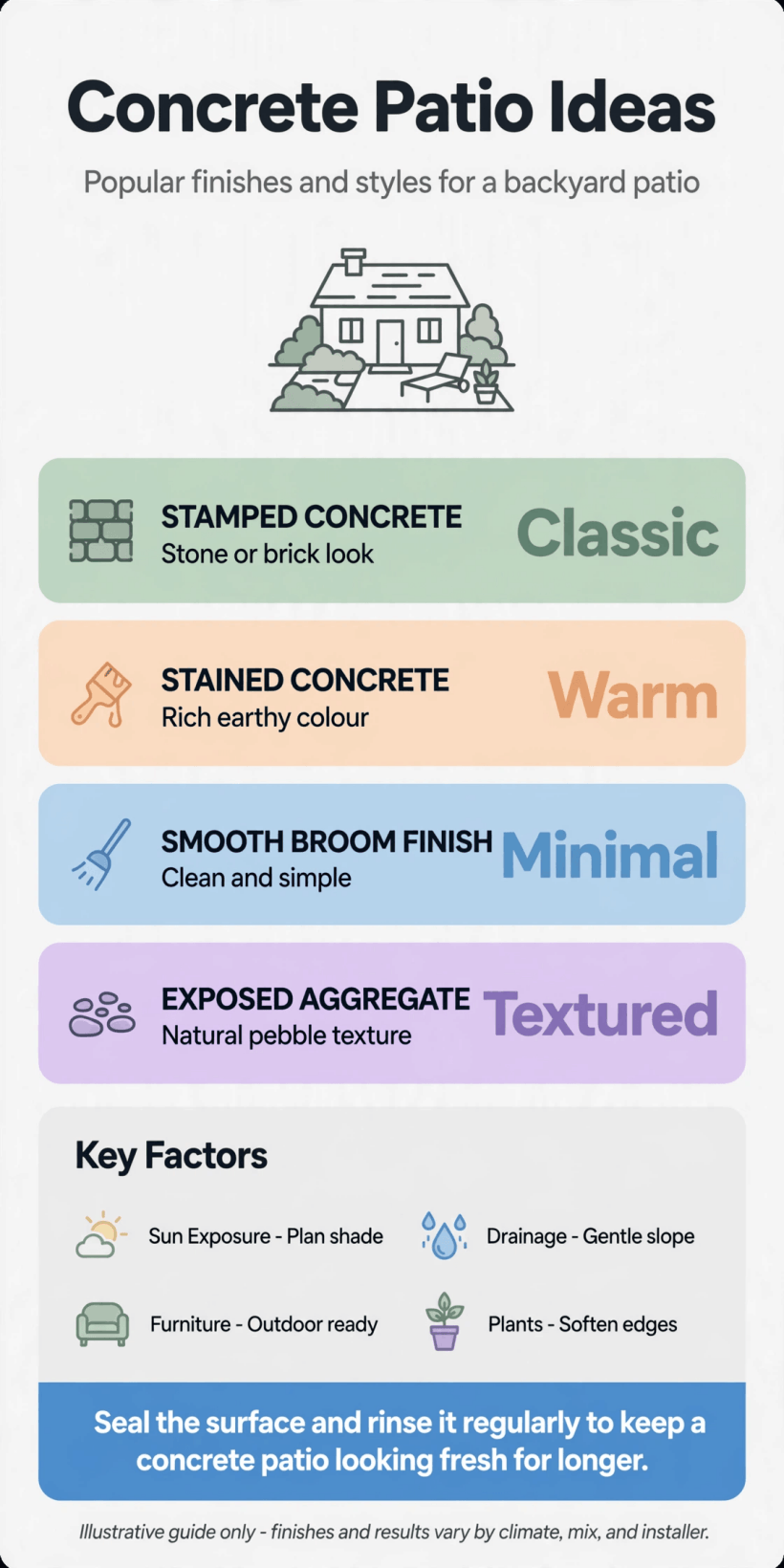
2. Surface Finishes: The Face of Poured Concrete
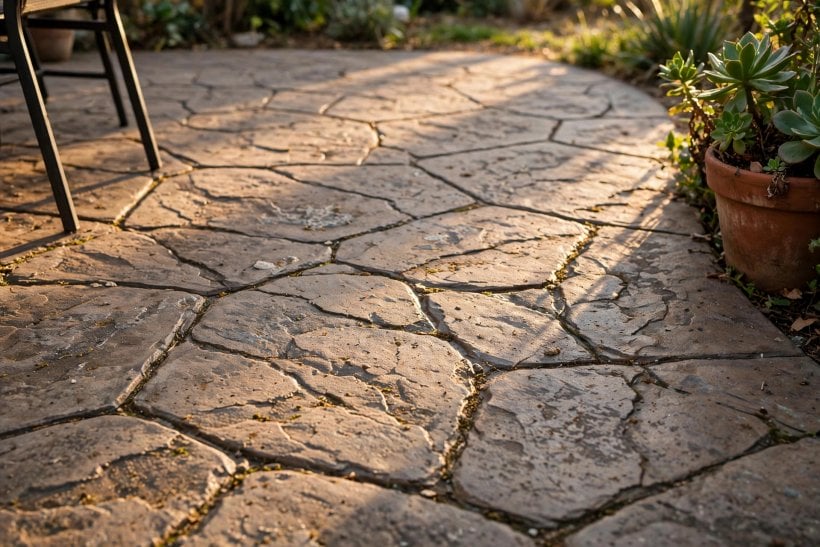
A concrete patio is one material wearing many faces. The finish is chosen before the pour, not after it, because most of these surfaces are worked into the slab while it cures. Start with the face, and let the wider patio ideas pillar handle the rest of the garden.
1. Choose a Plain Broom Finish for Honest, Grippy Simplicity
A broom finish is dragged lightly across the fresh surface to leave fine lines that grip underfoot when wet.
2. Let Exposed Aggregate Show the Stone Inside the Slab
Exposed aggregate washes the surface cement away so the small stones within the mix show as a speckled, natural texture.
3. Stamp a Stone Pattern Where Real Stone Is Out of Reach
Stamping presses a pattern into fresh concrete so one pour reads as laid stone. The pattern must suit the house: big, regular shapes for modern homes, looser coursing for cottages.
4. Use a Slate-Effect Stamp for a Cooler, Flatter Look
Slate-effect stamps give broad, smooth faces with fine joints, reading calmer than rugged stone patterns.
5. Try a Wood-Plank Stamp Where Decking Would Rot
Plank stamps borrow the rhythm of boards without the maintenance of timber at ground level. The grain is shallow, so the surface still drains and sweeps clean, while the eye reads warmth.
6. Polish a Covered Patio for a Smooth, Interior Feel
Polished concrete belongs under cover, where rain will not make its smoothness treacherous.
7. Pick a Salt Finish for Soft Texture Around Water
A salt finish presses rock salt into the surface and washes it out, leaving small pitted texture that grips gently.
8. Add Integral Colour So the Tone Runs Through the Slab
Integral colour is mixed through the concrete itself, so chips and wear never reveal a different shade beneath. Earthy, muted tones age best outdoors; strong colours fade unevenly in sun.
9. Stain an Existing Slab Instead of Replacing It
Stains soak into cured concrete and give translucent, varied colour that no paint can copy. They rescue sound but tired slabs, deepening plain grey into warm brown, slate or terracotta moods.
10. Band the Surface With Brushed Strips for Quiet Pattern
Alternating smooth and brushed bands across one pour creates pattern without stamps or colour. The change is subtle, felt underfoot and seen in raking light, and it helps large slabs feel designed rather than merely big.
11. Keep One Finish Across the Whole Patio for Calm
Mixing finishes is tempting and usually a mistake. One well-chosen surface, carried across dining, lounging and paths, makes even a modest patio feel generous and deliberate.
3. Shape, Edges and the Joint Pattern
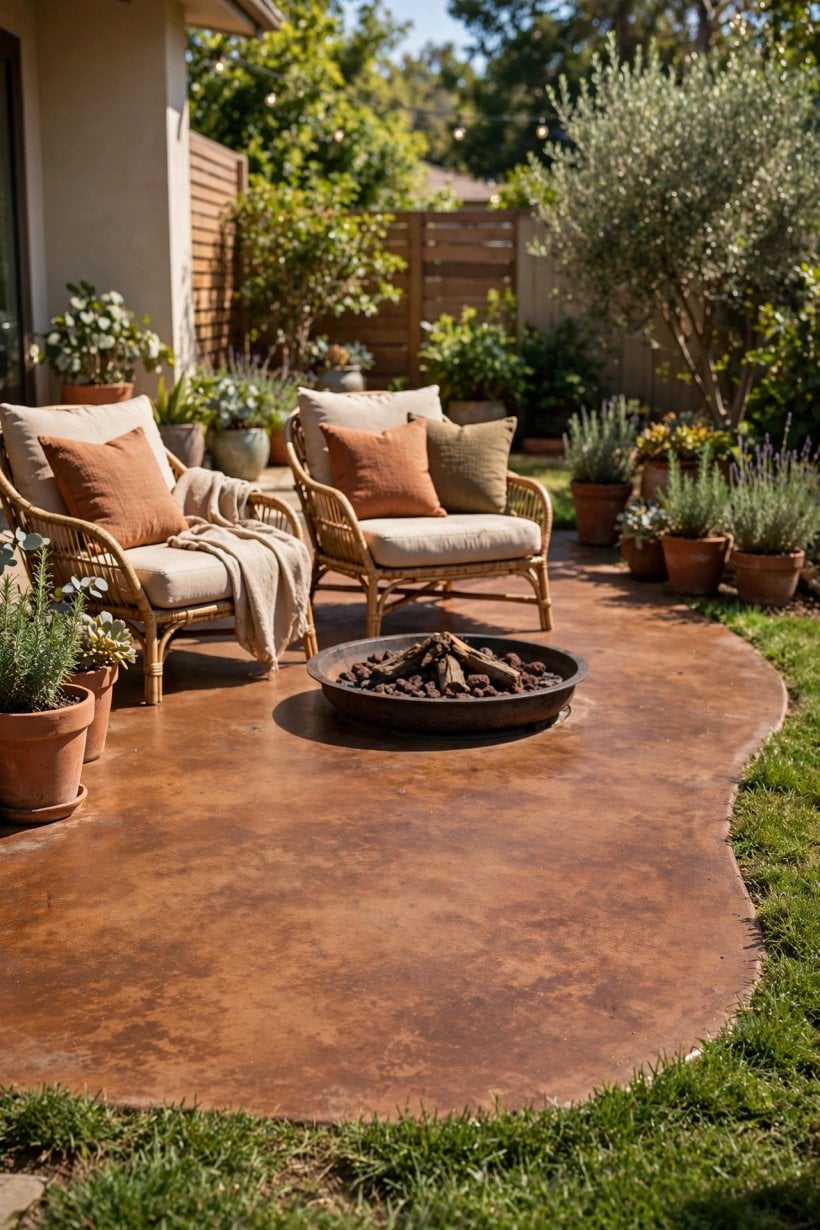
Before colour, before furniture, the outline decides everything. Concrete rewards a clear shape and honest joints, because the control joints that keep it from cracking randomly can be placed as part of the design rather than hidden from it.
12. Draw a Generous Rectangle and Let Planting Soften It
The simplest patio is a rectangle sized by the furniture it must hold, with planting beds breaking its edges. Straight lines form easily, pour cleanly and suit most houses.
13. Curve the Edge Where the Garden Is Informal
A curved edge suits winding gardens and older houses, and formed concrete follows a curve gracefully. Curves cost more in formwork and care, so earn them: one sweeping edge against lawn is enough theatre for a whole patio to trade on.
14. Lay Large Slabs With Open Joints as a Modern Grid
Separate square slabs with gravel or planted joints read as a calm modern grid and move the eye slowly.
15. Use Stepping Pads to Cross Lawn Without a Full Slab
Spaced at a comfortable stride and set flush, they feel architectural; set into gravel, they suit the looser routes described in backyard landscaping ideas.
16. Carry One Slab From Patio to Path for a Joined-Up Garden
Pouring the patio and its connecting path in the same concrete, same finish, same day, ties the garden together in one gesture.
17. Step the Patio Down in Levels on a Sloping Plot
Slopes are handled honestly with level terraces and proper steps, not with a slab that tilts. Two modest levels create natural zones, dining above and lounging below, and the step itself becomes seating.
18. Sink a Conversation Area a Step Below the Main Slab
One step down changes the psychology of a space: the lowered area feels sheltered, gathered and fire-ready. The surrounding step edge doubles as extra seating for a crowd.
19. Frame the Slab With a Darker Border Pour
A border band in a darker mix or contrasting finish frames the main field like a mat inside a picture frame.
20. Align Control Joints With the Design, Not Against It
Concrete moves, and control joints tell it where to crack neatly. Placed on a regular grid that matches borders, furniture zones and door lines, the joints become part of the pattern.
21. Score Saw-Cut Lines Into a Subtle Diamond or Grid
Shallow saw cuts add a fine graphic pattern to a plain slab after curing, cheaply and precisely. Diamonds suit traditional houses, grids suit modern ones. The lines also break up large pale surfaces that would otherwise glare in strong sun.
22. Edge the Patio With a Concrete Kerb for a Clean Stop
A raised kerb edge gives the slab a deliberate end, keeps mulch and gravel off the surface, and protects the vulnerable edge from mower strikes.
4. Colour and Pattern: Dressing a Grey Material
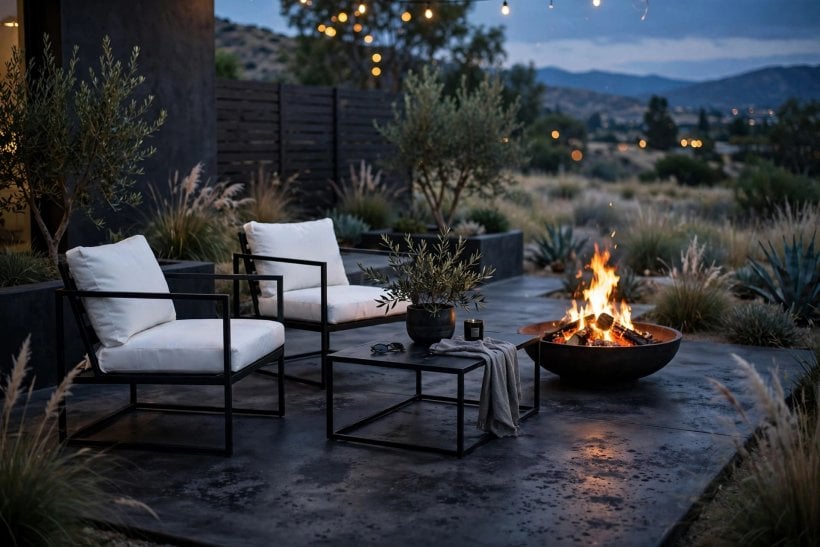
Grey is concrete’s starting point, not its limit. Colour works best outdoors when it is muted, varied and chosen against the house walls, the roof and the garden’s own greens, then tested in the unforgiving light of the actual site.
23. Start With Warm Grey, the Most Forgiving Outdoor Tone
Warm grey sits comfortably against brick, timber and stone, hides dust better than pale shades and glare better than dark ones.
24. Go Charcoal for Contrast Against a Pale House
A dark charcoal slab grounds a white or cream house and makes green planting look richer by contrast. Charcoal shows pale dust and pollen more readily, so it suits swept, tidy households and covered or partly shaded patios best of all.
25. Tint Toward Terracotta in Sunny, Planted Gardens
A gentle terracotta or clay tint warms concrete toward the Mediterranean without pretending to be tile. It flatters terracotta pots, olive greens and warm timber furniture, and it forgives the reddish dust that rural and garden soils bring onto any surface.
26. Use Two Tones: Field and Border, Nothing More
Two-tone work succeeds when it is disciplined: one field colour, one border colour, repeated nowhere else. A third tone turns design into indecision. The border carries the darker shade, where wear and dirt concentrate, and the field stays light and calm.
27. Stain a Checkerboard Only Where the Mood Is Playful
A stained checkerboard is charming on a small courtyard patio and exhausting on a large one. Scale decides. Where it works, keep the contrast soft, more chessboard-in-faded-ink than games hall, and let plain furniture calm the pattern down again.
28. Stencil a Border Motif Onto a Plain Cured Slab
Stencilling adds pattern to existing concrete with stain or a suitable surface treatment, along edges and thresholds rather than across the whole field. A simple repeated motif near the door personalises a rental-grade slab without the cost of replacement.
29. Blend Aggregates for a Terrazzo-Like Speckle
Choosing the stone inside the mix, pale river pebble, dark basalt fleck, warm gravel, gives exposed finishes their character. The blend is the colour scheme.
30. Let Saw-Cut Pattern Carry a Colourless Design
Pattern does not need pigment. A plain grey slab, thoughtfully scored and bordered, has a graphic confidence that coloured imitations often lack. This is the disciplined end of concrete patio ideas, and frequently the one that ages with the most dignity.
31. Choose Colours That Fade Gracefully, Not Brightly
Sun rewrites outdoor colour over the years. Muted, mineral tones fade into themselves, looking weathered rather than ruined, while bright synthetic shades patch and streak.
32. Match the Slab to the House Before the Furniture
Furniture changes; the slab and the house stay. Take colour cues from brickwork, render, roof and window frames first, in that order, and let cushions and pots supply any brighter accents.
33. Test Colour on a Sample Pour, in Place, Wet and Dry
Concrete darkens when wet and lightens as it cures, sometimes dramatically. A small sample slab, poured with the real mix and watched through rain and sun for a week, prevents the most expensive disappointment in the whole project.
5. Outdoor Rooms: Zones Laid Over One Slab
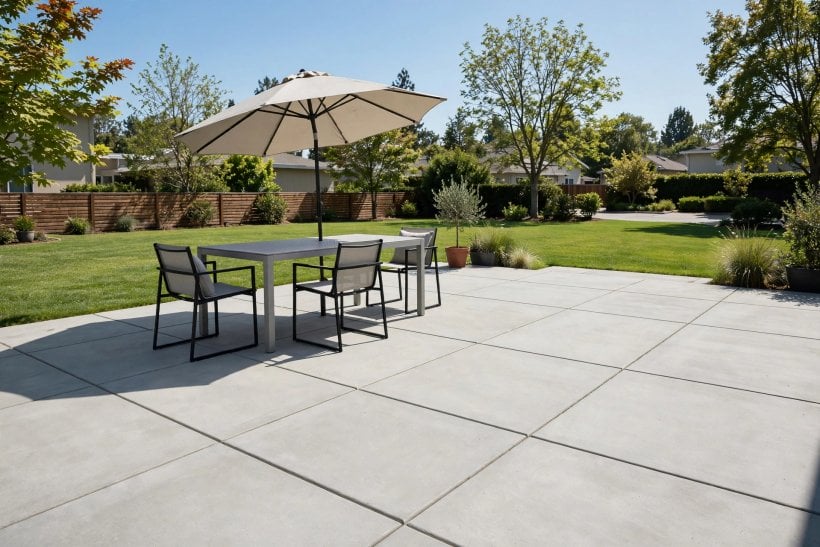
A patio earns its size when it works as rooms without walls: somewhere to eat, somewhere to sink, somewhere around fire. The slab is the floor plan, and the zones are marked by rugs, furniture weight and light rather than by partitions.
34. Give Dining the Flat, Close-to-Kitchen Zone
Dining belongs on the most level part of the slab, nearest the kitchen door, where trays travel shortest.
35. Set Lounging on the Sunniest or Shadiest Corner, by Climate
Mark the zone with an outdoor rug over the concrete to soften sound and signal rest, a trick the wider deck ideas collection uses on timber too.
36. Build a Fire Zone on Its Own Concrete Pad
Keep the fire zone at the slab’s edge, away from doors and overhangs, and let the design-led fire pit ideas post handle the shapes and seating circles.
37. Add a Built-In Concrete Bench Along One Edge
A bench cast or built along the patio’s edge is seating that never needs storing, cushions aside. It defines the boundary, seats the overflow at parties and gives children a stage.
38. Use Low Concrete Walls as Seat, Shelf and Border
A low wall at sitting height does triple duty: extra seats, a shelf for drinks and pots, and a clear edge between patio and planting.
39. Pour Footings for a Pergola Into the Slab Itself
Retrofitted posts bolted through a thin slab invite cracks. The shade structures in pergola ideas sit happiest on ground that was designed to receive them.
40. Plan a Cooking Corner With Heat and Worktop in Mind
An outdoor cooking spot needs a level, fire-safe surface and room to work, both of which concrete gives plainly. Keep it downwind of seating where you can, near the door for supplies, and leave clear floor for the cook’s turning circle.
41. Integrate Planters Into the Slab’s Edges
Cast or built planters at the patio’s corners soften concrete’s hardness exactly where the eye lands. Herbs near the cooking corner, something scented near the loungers, and one architectural plant per planter is a reliable recipe that never looks fussy.
42. Reserve a Plain Pad for the Hot Tub or Plunge Pool
Planning the pad with the patio keeps the wet zone tidy; the backyard pool ideas post covers the water itself.
43. Leave a Flexible Empty Bay for Games and Gathering
Not every square metre needs a purpose in advance.
44. Anchor the Zones With One Rug and Repeat Its Colours
A single outdoor rug under the main seating, with its colours repeated in cushions and pots across the other zones, stitches separate areas into one room. The concrete stays neutral underneath, which is precisely why the stitching works.
6. Small Patios, Courtyards and Side Yards
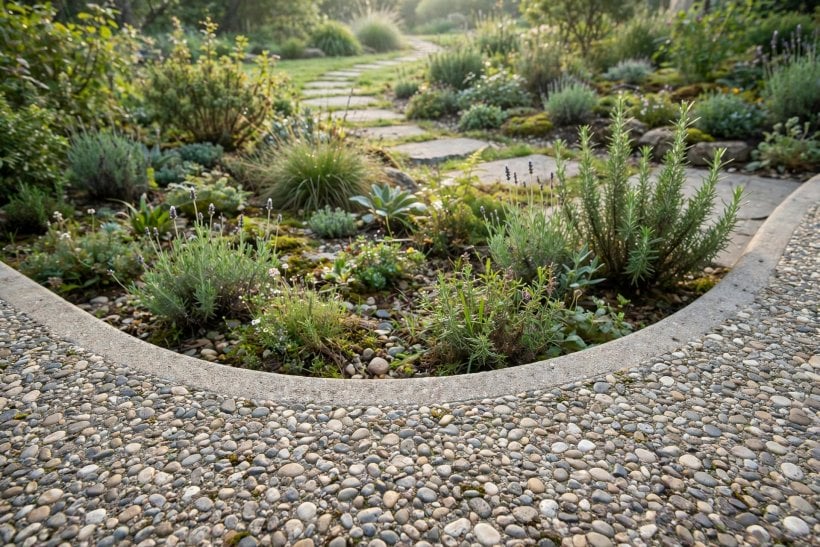
Concrete suits small spaces particularly well because one pour can be floor, path and threshold at once, with no grout lines to chop the space into confetti. The discipline is lightness: pale tones, few joints and furniture that folds.
45. Pour One Pale Slab to Make a Small Yard Feel Larger
A single pale surface, unbroken by borders, reflects light into tight courtyards and makes walls feel further apart. Dark or busy patterns shrink small spaces.
46. Alternate Pads and Gravel Where Budget or Roots Demand
Where a full slab is unaffordable or tree roots forbid it, generous concrete pads in a gravel field give dry footing with a designed rhythm.
47. Run a Concrete Ribbon Down a Narrow Side Yard
Side yards become useful when a firm, level ribbon of concrete turns them into a route for bins, bikes and barrows.
48. Make a Courtyard Patio the House’s Outdoor Hall
In a courtyard plan the concrete floor is the hall every room opens onto.
49. Plant the Joints With Low Creepers for a Softened Grid
Open joints planted with tough, low creeping plants soften a slab grid into a living chequerboard. The plants belong in the joints, never across the walking field, and they need a patient first season.
50. Choose Folding Furniture So the Slab Can Breathe
On a small patio, furniture that folds flat against a wall returns the whole floor for other uses: exercise, play, a ladder for pruning. Concrete’s flatness makes the folding possible; lumpy surfaces defeat even the best folding chair’s small feet.
51. Brighten a Shaded Patio With the Palest Sound Mix
North-facing and overshadowed patios need the lightest practical surface to borrow what light there is. Pale concrete with a fine texture reflects without glaring and shows green shade as a mood rather than a gloom. Avoid dark stains here entirely.
52. Use a Single Step as Threshold, Seat and Stage
One broad step between house and patio does the work of three features in a small garden. It is the threshold, the extra seat at gatherings and the stage for pots that change with the seasons.
53. Keep Patterns Large in Small Spaces
Small patios need large, simple patterns: one border, a wide grid, nothing fiddly. Tiny motifs at small scale create visual noise the space cannot absorb. When in doubt, enlarge the pattern and reduce the colours until the patio exhales.
54. Borrow the View Beyond the Slab’s Edge
A small concrete patio feels bigger when its edge is a low kerb or open lawn rather than a fence of furniture.
55. Store Cushions in a Bench That Sits on the Slab
Outdoor storage benches keep cushions dry and the patio clear, and a level slab is what makes a storage bench sit true and open smoothly.
7. Ground, Drainage and a Slab That Ages Well

The beautiful part of a concrete patio is the top few millimetres; the successful part is everything underneath. Base, fall and drainage are unglamorous attributes that decide whether the surface is still handsome in a decade.
56. Give the Slab a Gentle Fall Away From the House
Every patio must shed water, and the fall should carry it away from walls and doors toward drainage or planting. The slope is slight enough to keep chairs level and honest enough that puddles never linger against the house after rain.
57. Let a Channel Drain Become a Design Line
A discreet channel drain across the slab’s lower edge collects runoff cleanly, and its straight line can align with the joint pattern so necessity reads as design. Hidden drainage failures are expensive; a visible, maintainable channel is the grown-up solution.
58. Prepare the Base Like It Matters, Because It Does
A compacted, level base of suitable hardcore is what keeps a slab from settling, rocking at the edges and cracking across its face. Skimping underground to spend on surface pattern is the classic false economy of patio building, repeated every summer.
59. Respect Control Joints as Crack Insurance
Control joints do not prevent concrete’s natural movement; they direct it into straight, tidy lines. A patio whose joints were planned with its pattern, as described above, ages into its lines instead of fighting them.
60. Seal the Surface on a Sensible Schedule
A suitable sealer protects coloured and stamped work from stains and weather and deepens its tone.
61. Keep Mats and Planters From Staining the Story
Lift and move them occasionally, stand pots on small feet, and the surface stays even. These small habits preserve the permeable, natural finishes discussed in permeable rock pavers for eco driveways and patios as much as any slab.
62. Plan Around Tree Roots Before They Plan Around You
Roots lift slabs slowly and certainly. Near established trees, choose pads-and-gravel construction, bridge the root zone, or move the patio. A design that respects the tree keeps both; a slab poured in defiance will be re-poured at the tree’s convenience.
63. Treat Winter Kindly in Cold Climates
In freezing climates, keep standing water off the slab, clear leaves before they stain, and use only de-icing products the concrete’s maker allows. Freeze and thaw punish trapped moisture, so autumn drainage checks are the cheapest winter protection available.
64. Blend Repairs by Working Whole Panels at a Time
Patch repairs on concrete almost always show. When a panel between joints is damaged, replacing or resurfacing that whole panel keeps the repair inside the design’s own lines, where a colour difference reads as pattern rather than accident.
65. Wash Gently and Often Instead of Blasting Rarely
Regular sweeping and a gentle wash keep concrete cleaner than occasional aggressive jet-washing, which can etch finishes and open the surface to faster soiling. Treat the patio like a floor, little and often, and it will behave like one for years.
8. Evening Light and the Finishing Touches
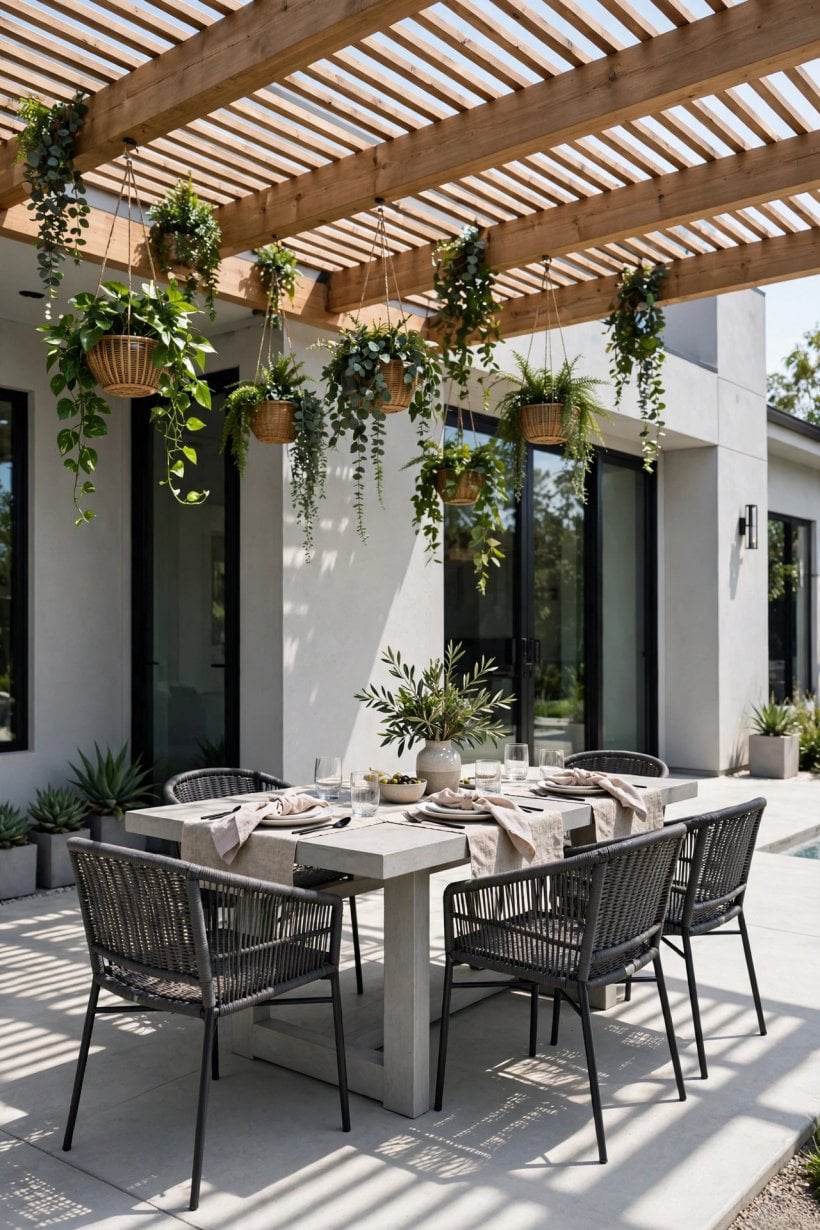
Concrete comes into its own at dusk, when its pale surface holds the last light and lamps pool warmly on it. The final ideas are about the hours when patios are loved most, and the small things that complete them.
66. Set Low Lights at the Slab’s Edge, Not Across It
Lighting belongs at edges, steps and thresholds, where feet need guidance, not dotted across the sitting field.
67. Use the Pale Slab as a Reflector for Lanterns
Candles and lanterns placed on pale concrete borrow its surface as a reflector, doubling their glow without extra fittings. Group lanterns at corners and beside seats rather than scattering them, and the whole patio reads as lit, not dotted.
68. Lay an Outdoor Rug to Warm the Hardest-Working Zone
A rug over concrete changes the acoustics and the temperature of a seating zone at once, and lets colour enter without staining the slab.
69. Repeat One Metal Finish Across Furniture and Fittings
Black, bronze or brushed steel, chosen once and repeated in furniture frames, lanterns and door furniture, gives a plain concrete patio a designed coherence. Mixed metals make even expensive furniture look gathered by chance rather than chosen on purpose.
70. Bring Scent to the Seating Edge in Pots
Concrete gives no scent of its own, so pots must. Something fragrant beside the loungers and near the dining chairs, lavender, herbs, jasmine where climate allows, completes the sensory picture that the hard, handsome surface deliberately leaves open.
71. Hang a Simple Curtain or Screen at the Windward Side
A curtain panel or slatted screen at the patio’s exposed side breaks wind, adds privacy and softens the architecture’s hard lines against the concrete.
72. Keep a Fire Bowl Mobile on Its Own Pad
A movable fire bowl, used on a clear concrete pad and stored under cover, gives small patios firelight without a permanent structure.
73. Style the Threshold With the Best Pot You Own
The step from house to patio is crossed a hundred times a week; it deserves the household’s best pot and healthiest plant.
74. Let One Sculptural Piece Carry the Whole Design
A single bench, boulder, water bowl or urn, well chosen and well placed, can carry a plain concrete patio’s entire design. Concrete’s neutrality is the perfect gallery floor for one confident object; clutter is what neutrality cannot survive.
75. Finish With a Sweeping, Seating and Staying Test
Before calling the patio finished, sweep it, sit in every seat at the hour you will use it, and stay for a whole evening.
9. Checks and Mistakes: Before the First Pour or Purchase
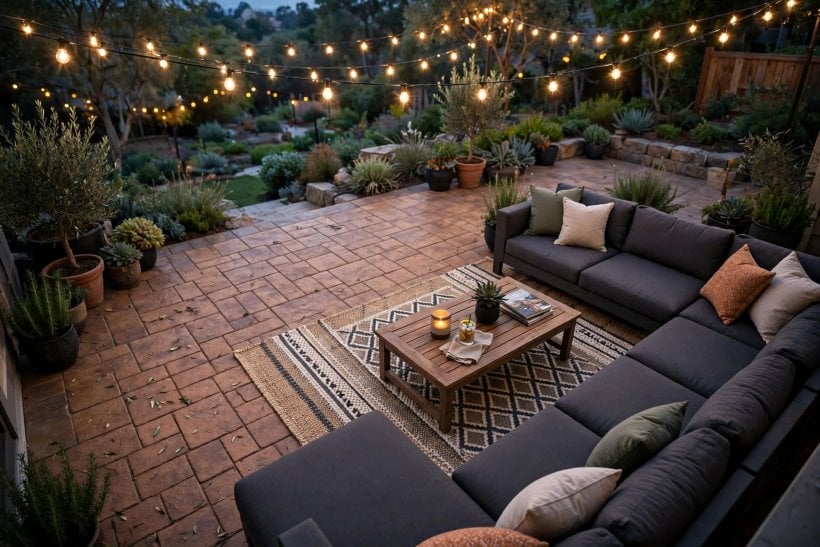
Walk the site after rain before designing anything: where water stands now is where it will stand on the finished slab, only more embarrassingly. Note the sun’s path across the day, the view from the kitchen door and the route trays will take, because a patio is a floor plan before it is a surface.
Check the levels against the house honestly. The finished slab must sit sensibly below the damp-proof course and fall away from the walls, and steps between house and patio should be even and generous. These are questions for the builder and, where rules apply, the local authority; no patio pattern is worth a damp wall.
The common mistakes are all versions of haste: choosing colour from a photograph, mixing finishes, aligning joints with nothing, and spending the budget on stamping while starving the base. Each is avoided by the same discipline, sample in place, plan the joints, fund the ground first.
Measure the furniture before the slab, not after it. A table and its chairs, pulled out with people seated, take more honest room than catalogues suggest, and a lounger needs its length plus the walkway behind it. Chalk the true footprints on the ground, live with the chalk plan for a weekend, and only then fix the patio’s outline in the design.
Finally, agree the finish in writing with whoever pours it, broom, exposed, stamped, sealed, in plain words with a sample. Verbal enthusiasm cures faster than concrete and lasts about as long.
10. Costs and Pulling It Together
Costs stay qualitative here on purpose: a plain broom-finished slab on easy ground is the economical end of concrete patios, while stamping, integral colour, multiple levels and built-in benches each move a project toward the expensive end, and difficult access or poor ground can outweigh every decorative choice combined.
Pull the design together by deciding in the right order: shape and joints first, finish second, colour third, zones and furniture last. That sequence is the whole secret. A patio designed in that order can be as plain as broom-finished grey and still be the best room the house owns.
Final Considerations
A concrete patio is not the cheap option pretending to be a design; chosen well, it is the design, one honest material given a face, a shape and a job. Pour it once, pour it thoughtfully, and let the years of evenings do the rest. The gardens that get used daily are rarely the most decorated ones; they are the ones whose floor is level, dry, calm and exactly where the house needed it, and a well-poured slab delivers all four without asking for attention in return.


0 Comments