

In practice, the best mattress tiny house loft sleeping allows is rarely the thickest, softest, or most heavily advertised option in a showroom. It is the one that leaves you enough headroom to sit up without ducking, weighs little enough to get up a ladder or steep stair, and lets the warm air that collects under the roof escape instead of trapping it around your body all night. A loft is not a normal bedroom with lower ceilings. It is a platform with a slope on one side, a guardrail on the other, a hatch or ladder opening at one end, and very little spare space around the bed for turning, lifting, or wrestling a bulky purchase into place.
That is why this guide does not rank products by brand. Instead, the twelve picks promised in the title are covered here as twelve mattress types and selection entries, from thin foam slabs and folding pads to low-profile hybrids and custom-cut pieces, each judged by the same criteria: profile and headroom, weight on the access route, ventilation, firmness by sleep style, and how honestly it copes with daily loft life. Read the measuring section first, compare the types in the table, then work through the criteria in order. A mattress that fails your measurements is not a bargain at any price, however comfortable it felt for three minutes in a store.
| Option type | What it suits | What to verify |
|---|---|---|
| Thin all-foam slab | Very low lofts and light sleepers who need every centimetre of headroom | Density and support, so it does not bottom out on the platform |
| Layered foam, low profile | Everyday sleepers who want a softer top without a tall build | Total thickness including the pillow, and heat retention |
| Thin latex layer build | Hot sleepers who want bounce and quicker moisture release | Weight, because latex types are often heavier than they look |
| Low-profile spring or hybrid type | Sleepers who dislike the sinking feel of foam | Whether it can bend or fold enough to pass the hatch or stair turn |
| Tri-fold or folding pad | Guest lofts, part-time homes, and platforms that double as storage or play space | Seams under hips and shoulders, and folded storage size |
| Futon-style loft pad | Minimalist sleepers who prefer a firm, simple surface | Regular rolling or turning needs, and firmness over time |
| Custom-cut foam piece | Sloped, tapered, or odd-corner platforms no standard size fits | Your template accuracy, and return terms for cut-to-order pieces |
| Inflatable or air-pad type | Occasional guests only, where the bed must disappear afterwards | Noise, puncture repair, and pump access in a cramped loft |
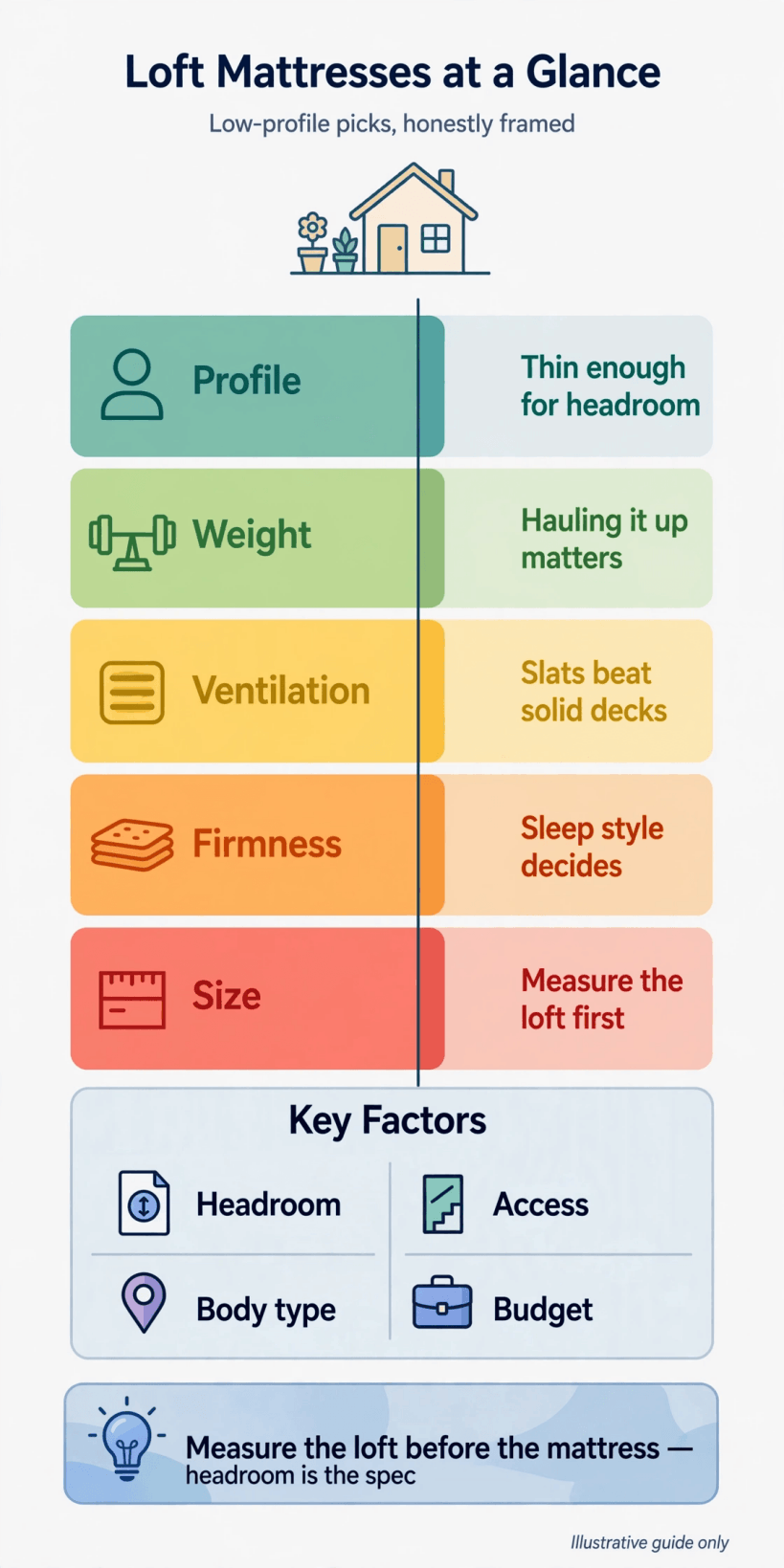
1. Measure the Loft Before You Shop for Any Mattress
Start with a tape measure, not a shopping list. Record the platform length and width at floor level, then measure again at the height your mattress will reach, because sloped ceilings and knee walls steal space as the bed gets thicker. Note the narrowest point, which is often beside the guardrail or where the roof slope meets the platform edge. Write down the hatch or stair opening too. A mattress that fits the platform perfectly but cannot pass the opening is a return waiting to happen, and returns from a loft are far harder than deliveries to one.
Next, measure the structure itself. Check the platform build, the spacing of any slats or boards, and whether the surface is solid, slatted, or partly open. Our guide to tiny house loft framing, joist span and load capacity explains why the platform and its supports decide how much combined weight of sleepers, mattress, and bedding the loft should carry. Photograph every corner with the tape in frame. Those photos settle arguments later about whether a corner is square, rounded, or cut away for the ladder, and they make custom-cut quotes far more accurate.
2. Protect Headroom: Profile Height and Sitting-Up Space
Headroom is the criterion most buyers underestimate. Sit on your current sleeping surface, or on a stack of cushions the same height as the mattress you are considering, and measure from the surface to the lowest point of the ceiling above your head. You need room to sit up, turn over, read, and climb in half asleep without meeting the roof. Then add your pillow honestly. A thick pillow on a medium mattress can equal a thin pillow on a tall one, and it is the combined height that your head actually experiences every night.
Profile choice is a trade-off, not a contest. Thinner builds preserve headroom and are easier to move, but they offer less material between you and the platform, so support and pressure relief depend heavily on density and layer quality. Taller builds can feel plusher, yet they raise you toward the warmest air and the slope. If your measurements show that no reasonable mattress leaves you sitting space, treat that as design information, not a shopping failure. Comparing your layout with single-story tiny house plans with ground-level bedrooms shows how some households solve the problem by moving sleep downstairs entirely.
3. Judge Weight by the Ladder, the Stairs, and Your Arms
Weight matters three times in a loft: when the mattress arrives, every time you lift a corner to change bedding or check for moisture, and on the day it eventually leaves. Ask how the piece is delivered. Does it arrive rolled, folded, vacuum packed, or flat? A rolled or folding type can be carried up by one person in stages. A large flat piece may need two people, a clear stair turn, and a plan for the moment it blocks the only way down. Be honest about who will actually do this lifting in your household.
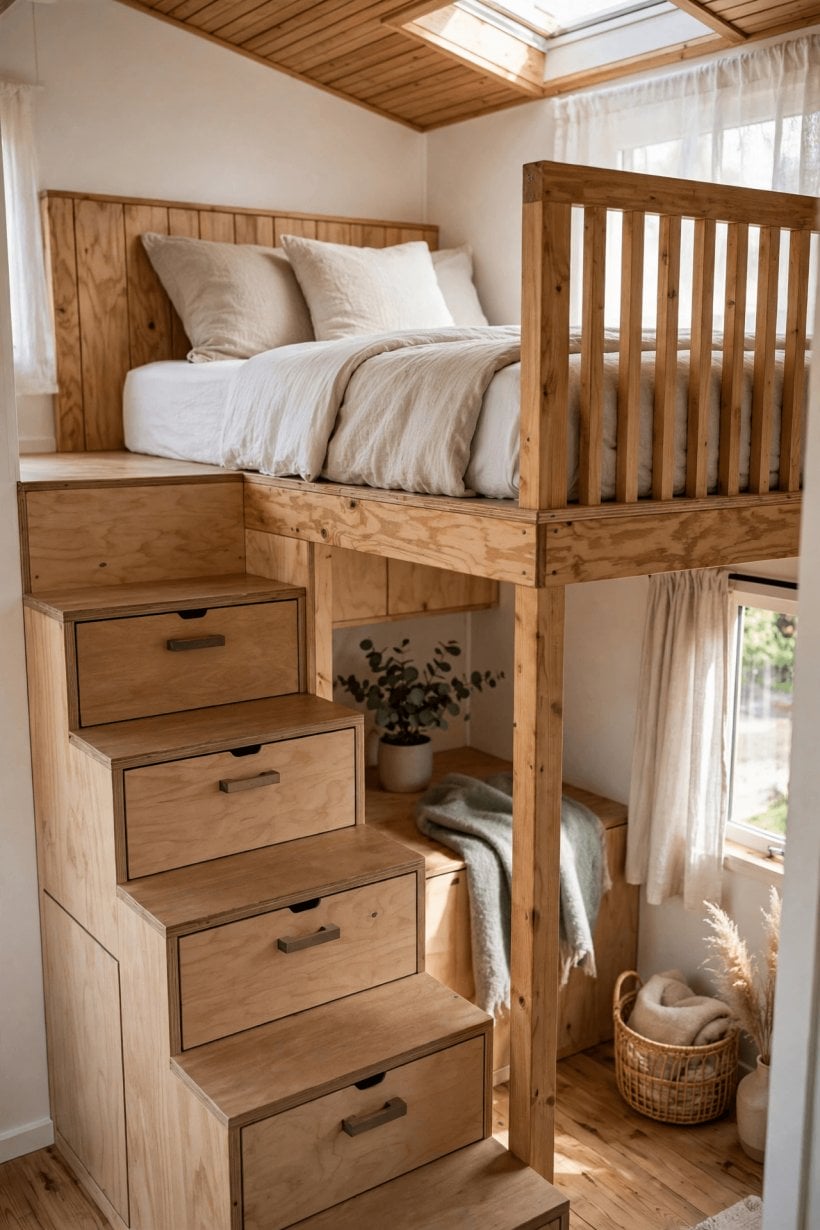
Weight also interacts with layout. In a double-loft home, two sleeping platforms may share access, storage, and guardrails, so a heavy choice in one loft complicates the other. The layouts in 300 sq ft tiny house plans with double lofts show how tight those shared routes can be. Practically, favour the lightest construction that still supports you properly, choose handles or a fold if they are offered, and never assume a stated weight includes packaging, protectors, and bedding. If a seller cannot state the weight clearly, treat that as a reason to pause, not a detail to discover on delivery day.
4. Match Firmness to Sleep Position and Body Weight
Firmness labels are not standardised, so use them as rough sorting, not truth. Side sleepers usually need enough surface give for shoulders and hips to sink slightly without the spine bending. Back sleepers generally need steady support that keeps hips from dropping into a hammock curve. Front sleepers often do worst on soft, thick builds because the hips sink and the lower back arches. In a thin loft mattress there is less material to absorb mistakes, so a firmness error you might tolerate in a deep conventional bed becomes obvious within a week.
Body weight changes the calculation as much as position. A lighter sleeper may find a firm thin slab supportive and stable, while a heavier sleeper compresses the same slab straight through to the platform and feels every board. Couples sharing a loft platform should test the compromise honestly: the surface must support the heavier partner without turning into a slope toward the middle. If you are between options, a medium build with a changeable top layer is often the safer loft choice, because you can adjust the feel without replacing the whole mattress and repeating the ladder carry.
5. Control Heat and Moisture in a Warm, Enclosed Loft
Warm air rises, and in a tiny house it rises straight into the loft. The sleeping platform is usually the warmest place in the home in summer and the place where cooking steam and shower moisture end up in winter. Dense foam types tend to hold heat around the body more than open, springy, or fibrous builds, and a solid platform traps moisture underneath the mattress where you cannot see it. Choose breathable covers, avoid sealing the underside in plastic, and lift or inspect beneath the mattress regularly, especially in the first season when you learn how your home behaves.
Ventilation is a whole-house system, not a mattress feature, so connect the two. Our overview of tiny house ventilation, HRV and ERV choices and mould prevention covers the fresh-air side of the same problem. The underside deserves equal attention: a cold platform over an unheated space can become a condensation surface, which is why the principles in how to insulate a tiny house against cold and moisture matter under the bed as well as in the walls. A slatted or airflow layer under a loft mattress is a modest addition that prevents an expensive, musty lesson.
6. Choose a Construction Type That Tolerates a Platform
Each construction family behaves differently on a loft platform. All-foam types are quiet, light in thin builds, and easy to trim or order in odd sizes, but quality varies enormously with density, and soft foam compresses permanently if it is underspecified. Latex-style builds feel springier and often sleep cooler, yet they can be surprisingly heavy and awkward to grip. Thin spring or hybrid types give a familiar, responsive feel and better airflow, but they resist bending, which can make the hatch or stair turn the deciding factor rather than comfort.
Folding, futon-style, and custom-cut types solve geometry problems rather than luxury ones. A tri-fold gives up some seam-free smoothness in exchange for access and storage. A futon-style pad gives a firm, simple surface that suits minimalists but disappoints anyone expecting plushness. Custom-cut foam fits the platform you actually have, including tapered corners, but it transfers the risk to your template and usually limits returns. None of these is the correct answer in general. The correct answer is the family whose weaknesses your loft, your access route, and your sleep style can absorb without daily irritation.
7. Plan Access: Folding, Rolling, and Getting It Up There
Walk the delivery route before you order. Measure the exterior door, the interior pinch points, the stair width or ladder angle, and the turn at the top where the mattress must change direction in a space barely wider than itself. Note light fittings, rails, and the kitchen units everyone forgets until a corner meets them. If the route includes a near-vertical ladder, a flat, rigid piece is effectively excluded unless it can be hoisted another way, and hoisting through a window is a plan to make with help and daylight, not an improvisation.
Flexible formats earned their place in tiny homes for exactly this reason. The same thinking behind tiny house plans with convertible, multi-use furniture applies to the bed: pieces that fold, roll, or separate into sections earn their keep every time the space changes job. Ask how long a vacuum-packed mattress needs to expand, and where it will expand, because a loft platform may be the only flat space large enough, which means you sleep elsewhere that first night. Plan the packaging disposal too. A loft full of plastic film and cardboard, with one ladder down, is a small but real problem.
8. Check Edges, Corners, and Odd-Shaped Loft Platforms
Few loft platforms are perfect rectangles. Corners are rounded for safety, cut for ladders, or angled where the roof slope arrives. A standard mattress pushed into a shaped platform either overhangs, which stresses its edge every time you sit to dress, or leaves gaps that swallow pillows, phones, and socks. Measure corner shapes with cardboard templates before ordering, and check edge support specifically: in a loft you sit on the edge constantly, because there is nowhere else to sit while you pull on shoes or climb down.
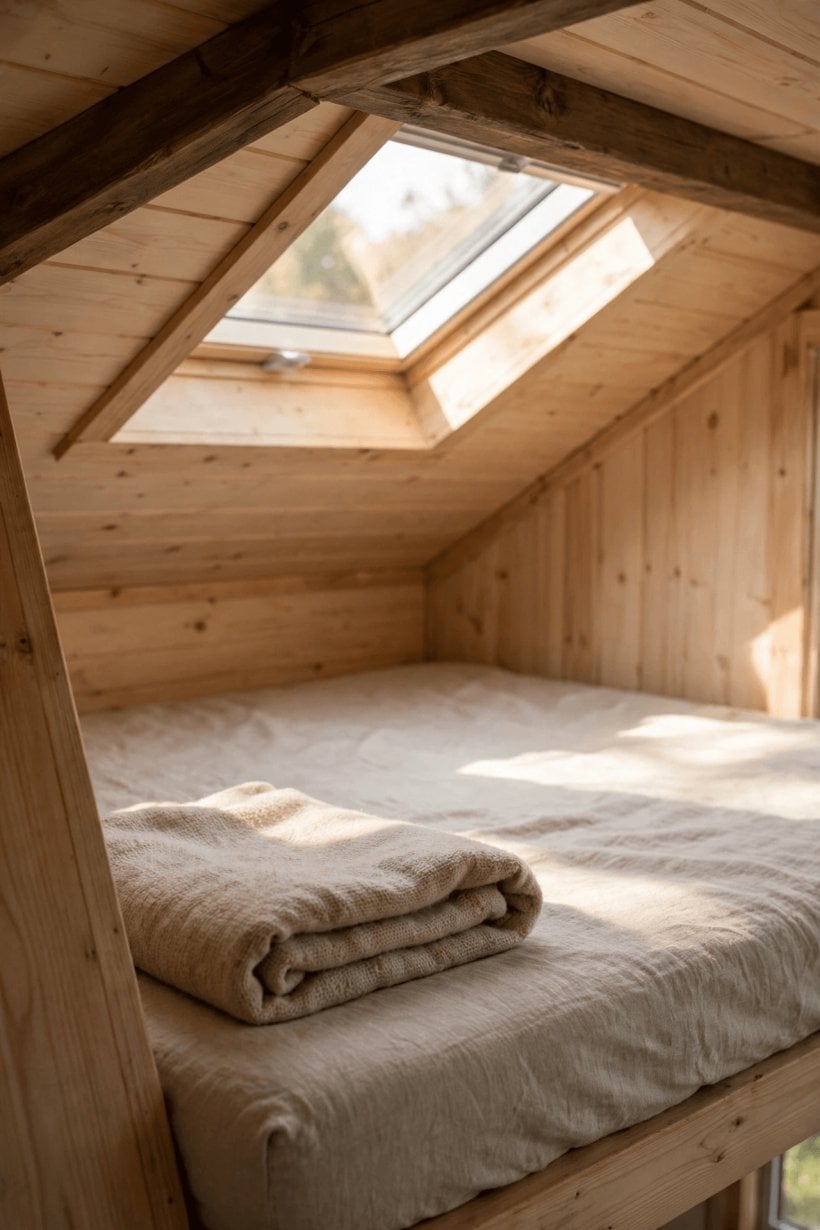
Sliding is the other quiet problem. Smooth platform surfaces, light mattresses, and a slight slope add up to a bed that migrates toward the guardrail or the wall through the week. A non-slip layer, a lip on the platform edge, or straps where the design allows them will save daily shoving. Check also that the guardrail still does its job with your chosen thickness in place. Rails are positioned relative to the sleeping surface, not the platform, so a taller mattress quietly reduces the effective rail height above the bed. That single check connects comfort shopping back to basic loft safety, where it belongs.
9. Think About Cleaning, Covers, and Everyday Upkeep
Loft beds collect dust from below and roof dust from above, and they are harder to strip than a ground-floor bed because every sheet travels up and down a ladder. Choose a removable, washable cover if the type offers one, and a protector you can actually launder in your setup, whether that is a small home machine or a laundrette run. Think about how you will rotate or turn the mattress if the maker recommends it. Some types are one-sided and simply need spinning head to foot, which still requires clear space at the platform end that your loft may not have.
Build a small routine instead of relying on enthusiasm. Air the mattress when you change bedding, vacuum the platform corners where dust gathers against the knee wall, and check the underside for damp at the same time, so one job covers three. Households in cold regions should read our notes on tiny house living in cold climates for the winter version of this routine, when windows stay shut and condensation risk peaks. Upkeep sounds unglamorous beside showroom comfort, but in a loft the mattress you can clean is the mattress that stays pleasant in year three.
10. Balance Budget, Trial Logic, and How Long It Must Last
Judge price as cost per year of acceptable sleep, not as a sticker. A very cheap thin pad that compresses into a hard layer within a season is expensive twice: once to buy, and again to replace, with two ladder carries included. A mid-priced, well-specified piece that lasts for years of nightly use usually wins the honest comparison, especially once delivery, a protector, an airflow layer, and possible return costs are counted. Our breakdown of the true cost of tiny houses, prefab versus DIY, makes the same point at house scale: the purchase price is only the first line of the real total.
Trials and warranties need loft-specific reading. A home trial is only useful if a failed mattress can realistically leave your loft and your home, so check collection terms before the trial starts, not after. Warranty conditions often assume ventilation, a suitable base, and no moisture damage, all of which are your responsibility on a platform bed. Keep the receipt, the stated weight and dimensions, and your platform measurements together. If a claim ever happens, that small folder is the difference between a straightforward conversation and an argument about a mattress nobody can measure any more.
Final Considerations
Bring the decision back to the order of this guide. Measure the platform, the ceiling, and the access route first, and let those numbers eliminate most of the market without regret. Shortlist by profile and weight, then choose firmness by sleep position and body weight, then check heat, moisture, and upkeep against how your household really lives. Treat the twelve types in the table as starting points for questions, not as a podium, and be suspicious of any recommendation that ignores your headroom measurement.
Finally, sleep on the decision for a night before ordering, ideally after re-checking the tape measurements once more in the morning. Loft mattresses are unusually hard to return, unusually personal to judge, and used every single night, which makes them one of the worst purchases in a tiny house to rush. A careful, criteria-led choice made this week will still feel careful three winters from now, and that, more than any label or discount, is what makes a loft bed a good one.


0 Comments