

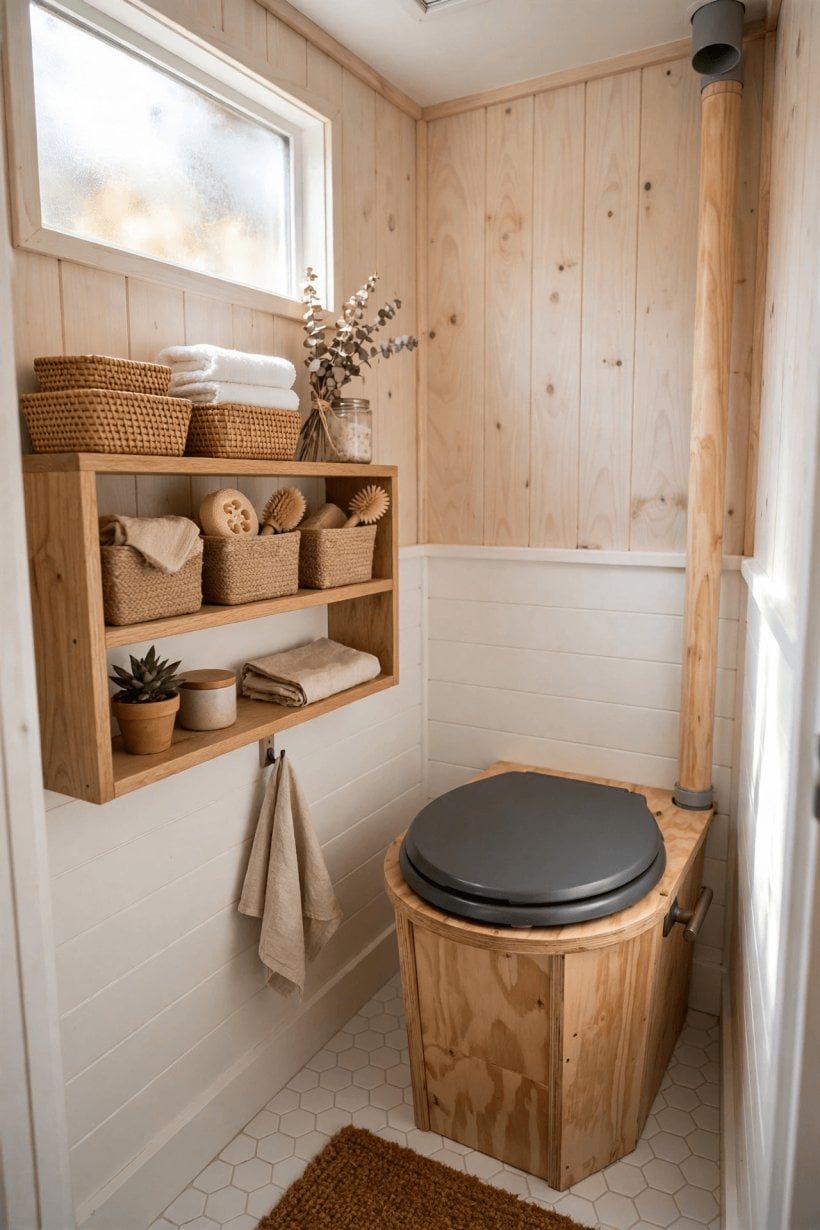
A composting toilet is the appliance a tiny house lives or dies by, because it is the one system you interact with every single day, in the smallest room in the house, with no plumber to call and no second bathroom to retreat to. This guide compares the best composting toilet tiny house owners can realistically choose between — not by inventing brand names, model numbers, prices or laboratory test results, but by comparing the toilet TYPES on the market against the ten criteria that decide daily life with one: odour, emptying, power, cold behaviour, installation, upkeep and honest fit for your household.
The word tested in the title is used carefully here. No brand was bought, bench-tested or scored for this article, and any review that claims otherwise about unnamed products should be read with suspicion. Instead, each type — urine-diverting separators, self-contained composting units, central systems with a remote chamber, and the simple bucket-and-separator build — is put through the same ten tests on paper, using how the technology physically works. Physics does not have a marketing department, and a type that fails a test on paper will fail it in your bathroom too, just more expensively.
| Toilet type | What they suit | What to verify |
|---|---|---|
| Urine-diverting (separating) toilet | Most tiny houses: small footprint, low power, simple parts, forgiving upkeep | Vent fan and hose route, liquids bottle size, seat ergonomics for everyone |
| Self-contained composting toilet | Owners who want active composting in one unit and can give it power and warmth | Continuous power draw, heater and fan needs, chamber capacity for your household |
| Central (remote-chamber) system | Foundation tiny homes with space below the floor and higher daily use | Floor penetration and chute route, chamber access, local rules for the set-up |
| Bucket-and-separator build (DIY) | Minimal budgets, part-time cabins and anyone testing the lifestyle honestly | Your own discipline: cover material supply, emptying plan, venting you add yourself |

1. The Toilet Types Compared: Separating, Self-Contained, Central and Simple
Every waterless toilet is one of four machines wearing different clothes. A urine-diverting toilet separates liquids from solids at the seat, sending urine to a bottle or drain while solids fall into a chamber with cover material; because the two never mix, most of the smell chemistry of a toilet never gets started. A self-contained composting unit keeps everything in one body and actively composts it with a bulking medium, a mixing mechanism, warmth and a fan. A central system puts the seat in the bathroom and the composting chamber below the floor or outside, connected by a chute. And the bucket build is the separator principle at its simplest: a seat, a diverter, a bucket, and your own routine.
The honest trade-offs begin immediately. Separators are simple, cheap to run and hard to break, but ask you to manage a liquids bottle. Self-contained units automate more and demand power, warmth and money in return. Central systems offer the most capacity and the least bathroom bulk, at the highest install cost. Our earlier comparison of tiny house composting toilets: commercial vs DIY walks the same families in more depth. Everything after this section is one of these four types being measured against the tests that matter.
2. Odour Control: Separation, Venting and the Honest Truth
Odour is the test every buyer cares about and the one most surrounded by brave claims, so here is the honest mechanism. Toilet smell comes mainly from urine and solids mixing, from anaerobic conditions, and from warm moist air escaping into the room instead of leaving through a vent. Separating types attack the first cause at the source, which is why a well-run separator smells of almost nothing — the solids dry, covered, in a ventilated chamber, and drying material does not reek. Self-contained composters attack the second and third causes with a fan that keeps the unit under slight negative pressure, pulling air in through the seat and out of the house. Stop the fan, and the same unit announces itself within hours.
Venting is therefore not an accessory; it is the odour system. Whatever type you choose, budget for a properly routed vent — ideally straight up, with minimal bends, a fan that runs continuously and an outlet placed so wind does not push air back down it. The principles mirror whole-house thinking in our guide to tiny house ventilation, HRV, ERV and mould. When owners report a smelly composting toilet, the investigation almost always ends at a kinked hose, a dead fan or a urine bottle left a day too long — which is to say, odour is a maintenance report, not a type verdict.
3. Emptying Rhythms: What Each Type Asks of You, and How Often
Emptying is where paper specifications meet your actual tolerance, so think in rhythms, not capacities. On a separating toilet, the liquids bottle is the metronome: for one or two people it typically needs emptying every few days, and the honest measure is not the bottle’s size but whether the job — carry, rinse, a drop of vinegar, done — fits your routine without resentment. The solids chamber works on a slower rhythm of weeks, and its contents, dried and covered, are emptied into a bag or a composting spot with far less drama than first-timers fear. Miss either rhythm and the toilet tells you, first with weight, then with smell, then with fruit flies auditioning for a part.
Self-contained units stretch the solids rhythm with active composting and a finishing drawer, but add their own tasks: turning the mixing mechanism, managing moisture with bulking medium, and eventually emptying a larger, heavier chamber. Central systems stretch the rhythm furthest — a big remote chamber can go many months — paid for at installation instead of weekly. The right question is not which type empties least often, but which emptying job you would rather actually do: small and frequent, or rare and substantial. Answer honestly; the wrong answer is the one you gave to impress the salesperson, who does not live at your address.

4. Power Draw: Fans, Heaters and the Off-Grid Budget
Power is the test that separates the types most cleanly. A separating toilet needs, at most, a small vent fan — a draw so modest it disappears into a daily energy budget as a rounding error, and many owners run it from the smallest solar set-ups without noticing. A self-contained composting unit is a different animal: the fan runs continuously and many designs add a heating element to keep the compost active and evaporate liquids, which turns a plumbing decision into an energy-system decision. On grid power that is a modest running cost; off grid, in winter, it can be the largest single load in the house.
Do the arithmetic before the purchase, not after the first flat battery. Add the toilet’s continuous draw to your daily watt-hour budget and check it against your array and storage using the method in our guide to solar panel kits for tiny homes and battery bank sizing. Central systems sit between the two: a fan, sometimes more, but no heated chamber inside the living space. The pattern is consistent — the more a toilet does for you, the more of your power system it quietly owns, forever, including every cloudy week.
5. Cold-Weather Behaviour: When Composting Sleeps
Composting is biology, and biology slows down in the cold. Below roughly the mid-teens Celsius, the microbial activity that turns waste into compost effectively pauses; the material does not vanish, it waits. Self-contained units fight this with heaters — spending the power discussed in section four — and can still struggle in an unheated bathroom. Separating toilets are largely indifferent: drying and storage do not need warmth, which is why separators dominate cold-climate and part-time cabins. Their cold weakness is elsewhere: a liquids bottle or drain line in a freezing space can crack or block, and a vent fan pushing warm moist air into a cold hose can condense and, in hard frosts, narrow the vent with ice.
Plan the toilet’s winter the way you would plan the house’s. Keep the unit inside the heated envelope if you can, route vents to shed condensate, insulate or heat-trace any liquid line that leaves the warm space, and never let a central chamber’s access become a snowdrift excavation project. The wider cold-living picture is covered in our guide to tiny house living in cold climates. A toilet chosen for a July brochure and installed in a January climate is the classic tiny house regret; the types that shrug at cold are known, and they are the simple ones.
6. Install Effort: Floors, Vents, Chutes and Space Claims
Installation difficulty rises steeply across the types. A separator typically asks for a level spot, four screws, a vent hose through a wall or floor, and a decision about the liquids bottle or a small drain — an afternoon’s work for a competent DIYer, reversible if you change your mind. A self-contained unit adds a dedicated power supply and a more serious vent, and its larger body must fit the bathroom’s tightest dimension, including the swing of knees and door. Measure the room, then measure the unit, then measure the route it travels to reach the room; more than one tiny house bathroom has been designed around a toilet that could not physically enter it.
Central systems are construction projects: a chute through the floor, a chamber positioned below with weather protection and emptying access, and venting sized for the volume. In a foundation build that is planned work; in a tiny house on wheels it is usually a non-starter, which is a legitimate verdict, not a failure. Whatever the type, respect clearances around the seat and the servicing access behind your choice — and if your bathroom is a wet room, read our guide to how to waterproof a tiny house bathroom before drilling anything. Install effort is paid once; servicing effort is paid forever, so judge both.
7. Liquids, Bulking Agents and the Consumables Nobody Mentions
Every waterless toilet runs on supplies, and the honest cost of ownership is written in them. Separators and bucket builds consume cover material — coconut coir, peat-free alternatives or fine wood shavings — added after each solids use; the supply must be stored dry, somewhere, in a house where somewhere is a genuine design problem. The liquids side has its own small economy: the bottle wants a rinse and a splash of vinegar, a drain line wants an occasional flush of enzyme cleaner, and any trap or diverter wants a scrub on a schedule measured in weeks, because urine scale is patient and entirely unimpressed by neglect.
Self-contained units trade some of that for proprietary-feeling consumables: bulking medium in greater volumes, filters where fitted, and parts — seals, fans, mixing hardware — that eventually wear. None of this is expensive per month, but all of it must be obtainable where you live and storable in the space you actually have. Before choosing a type, price a year of its consumables and pace out where they will live. Tiny house ownership punishes systems whose running needs were discovered after the cupboards were built, and rewards the boring virtue of a toilet whose supplies fit in one labelled box.
8. Upkeep Honesty: The Weekly, Monthly and Seasonal Reality
Here is the section brochures skip. Weekly, a separator asks for the bottle emptied and rinsed, the seat and diverter wiped, and cover material topped up — five unglamorous minutes. Monthly, it wants the vent checked, the fan filter or intake cleared, and the solids chamber assessed with clear eyes. Seasonally, it wants seals inspected, hoses checked for scale and sag, and the whole unit deep-cleaned while you remind yourself that this is still easier than a black tank. Self-contained units shift the balance: less bottle work, more compost management — moisture judged by eye, medium added, the mechanism turned, the chamber’s progress honestly assessed rather than assumed.
The honest headline is that no composting toilet is maintenance-free, and the type that suits you is the one whose maintenance you will actually perform. Fruit flies, the universal symptom, almost always trace back to a missed rhythm, excess moisture or an unguarded vent — all fixable, none mysterious. Choose the upkeep you find least annoying, because annoyance compounds daily and a resented toilet gets neglected, and a neglected toilet of any type becomes the story guests remember about your house. Five willing minutes a week beats an hour of quarterly penance, in sanitation as in most of domestic life.
9. Rules, Neighbours and Disposal Etiquette
A composting toilet removes the sewer, not the responsibility. What leaves the unit still has to go somewhere lawful and neighbourly: liquids to a drain, a soakaway where permitted, or diluted onto land you control and away from watercourses; finished solids to continued composting, burial where rules allow, or the general waste stream double-bagged where that is the local expectation. Rules vary by state, county and park, and the time to learn yours is before installation, not during an inspection. Owners who ask officials early — and keep the paperwork — report a far easier life than owners who treat discretion as a strategy.
The wider system thinking is set out in our guide to tiny house utilities: power, water and off-grid sewage. Etiquette matters as much as law. Vent outlets placed away from a neighbour’s deck, emptying done discreetly and hygienically, and no liquids near anyone’s well or vegetable bed are the customs that keep composting toilets welcome in communities and parks. The technology’s reputation is collective: every careless owner makes the next owner’s permit conversation harder, and every tidy, odour-free installation quietly argues that waterless living is a reasonable way to run a home.
10. Choosing by Household: Solo Dwellers, Couples, Families and Guests
Capacity claims are where type choice meets household reality. A solo dweller stretches every rhythm in this article to its most forgiving: bottles last, chambers fill slowly, and even the simplest bucket build can be a rational, dignified choice. A couple roughly doubles the liquid rhythm and halves the patience available for a system that needs fiddling; separators and self-contained units both serve couples well, and the deciding factors move to power, space and temperament. Add children and the calculus changes again — aim, enthusiasm and visiting friends all test a diverter’s design, seats must suit smaller users, and the emptying rhythm belongs to whoever drew the household short straw, which is to say the owner.
Guests deserve a thought of their own. A composting toilet that needs a briefing longer than a sentence will eventually receive a contribution it was not designed for, so favour types that forgive innocent misuse, and keep instructions gracious and brief. Layout helps too: the arrangements in our guide to tiny house bathroom layouts show how seat position and elbow room change daily satisfaction more than any specification sheet. Choose for the household you actually are on an ordinary Tuesday — its size, its patience, its power budget, its winters — and the toilet will repay the honesty by disappearing into the background of your life, which is the highest praise any toilet can earn.
Final Considerations
There is no best type in the abstract — there is a best match between a toilet’s demands and a household’s realities. Choose a separator for simplicity, cold tolerance and a near-zero power bill, and accept the bottle rhythm. Choose self-contained composting for automation and a finished output, and accept the power draw, the warmth it needs and the price of both. Choose a central system when the house is permanent, the use is heavy and the build can absorb a real installation. Choose the bucket build when budget rules and your discipline is genuine. Score all ten tests honestly, stock the consumables before you need them, and keep the vent clear. Do that, and the smallest room in the house becomes what it should be: unremarkable, odour-free and entirely forgotten between uses.


0 Comments