

The best sofa bed tiny house living can honestly support has to pass two completely different tests. By day it must be a real sofa: compact enough for the only living space in the home, firm enough to sit on for hours, and light enough in appearance that the room does not feel like a furniture warehouse. By night it must become a real bed: flat, supported, long enough for an adult, and quick enough to open when everyone is tired. Most designs pass one test and quietly fail the other, which is why so many small homes end up with a sofa nobody enjoys sitting on and a bed nobody enjoys sleeping on.
This guide avoids brand rankings entirely. The fifteen picks in the title are covered here as fifteen type and layout entries across four families, pull-out beds, futons and click-back designs, daybeds with trundles, and sectional sleepers, in single, double, and corner variants. Each family is judged by the same practical criteria: the closed footprint, the much larger open footprint, mechanism durability, mattress quality, and whether the design suits nightly sleeping or only occasional guests. Measure both footprints before anything else, compare the families in the table, then use the sections that follow to eliminate designs your room, your doorway, and your routine cannot support.
| Option type | What it suits | What to verify |
|---|---|---|
| Pull-out bed, double | Couples and guest pairs who need a familiar bed shape | Open length into the room, and folded mattress thickness |
| Pull-out bed, single or chair size | Solo guests and children’s sleepovers in very small lounges | Actual sleeping width, not the chair width in the brochure |
| Futon with a folding frame | Daily simplicity, firm sleep surfaces, and easy mattress airing | Frame slat spacing and how the fold feels under hips |
| Click-back or flat-fold sofa | Studios where the back folds flat to form the bed | The seam or ridge where the back meets the seat |
| Daybed, with or without trundle | Rooms that need a deep seat by day and spare beds below | Trundle clearance and whether bedding fits when it slides away |
| Sectional or corner sleeper | Larger tiny homes that host groups by day and sleep several by night | Which side the bed pulls from, and total open footprint |
| Storage ottoman or bench bed | Occasional guests where every piece must also store bedding | Internal storage volume versus sleeping length when unfolded |
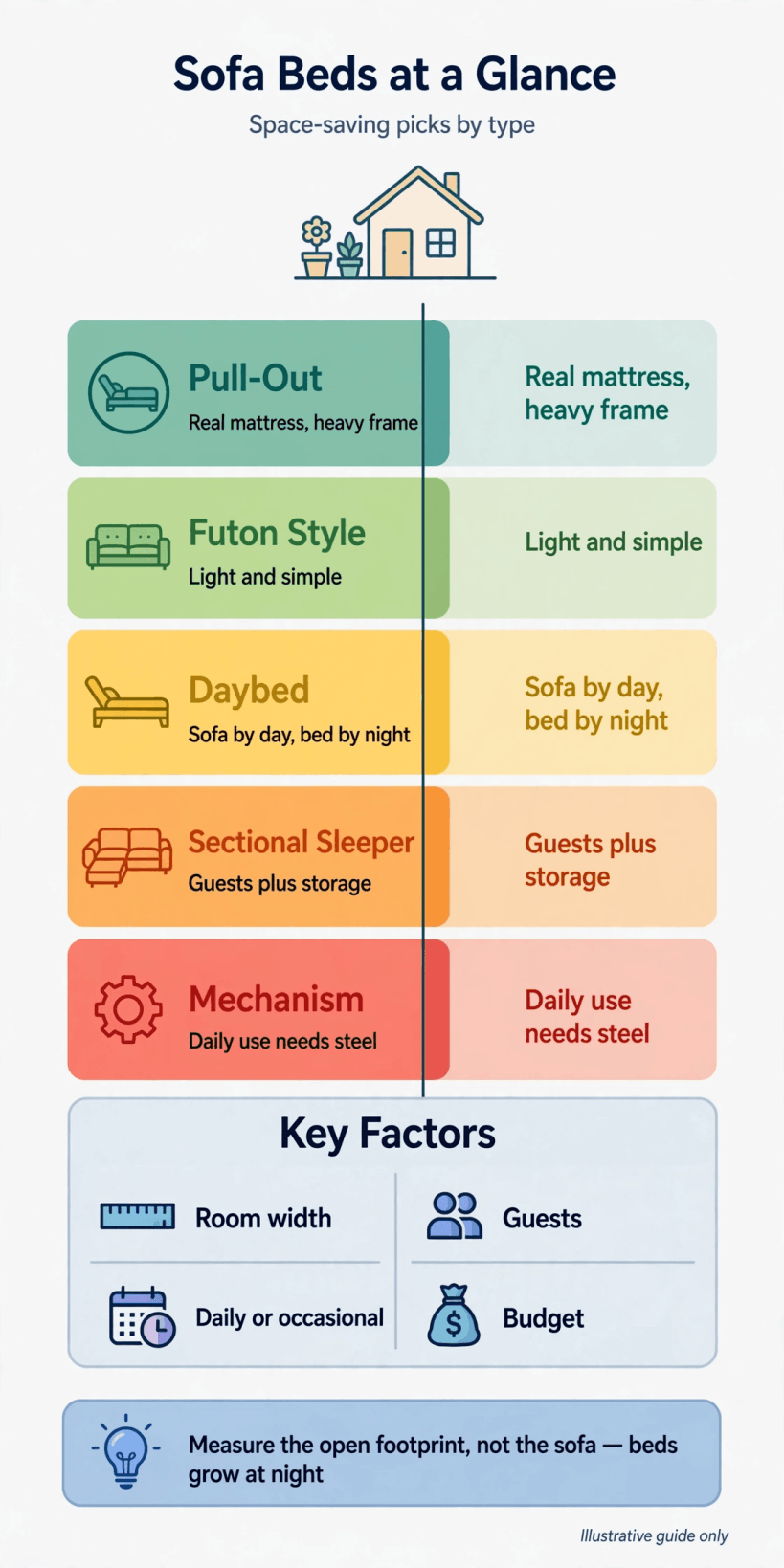
1. Measure Closed and Open: The Two Footprints That Decide Everything
Every sofa bed has two sizes, and sellers naturally quote the smaller one. Measure the closed footprint first: width, depth from wall to front edge, and the space its arms and cushions need so drawers, doors, and walkways still work beside it. Then measure the open footprint with the bed fully extended, including the pillow end and the space a sleeper needs to climb out sideways in the dark. In many tiny homes the open bed reaches the kitchen units, blocks the bathroom door, or seals the front door, and discovering that at midnight with a guest standing in their socks is too late.
Tape both outlines on the floor and live with them for a day. Cook, dress, and cross the room with the open outline in place, and be honest about what it blocks. This is the same discipline behind tiny house plans with convertible, multi-use furniture: a transforming piece only saves space if both of its forms fit the room. Note ceiling height too if the design lifts or folds upward, and check light switches, sockets, and heaters that the open bed may cover. A footprint that works on paper but covers the only heater or socket is not a working footprint.
2. Choose by How Often It Sleeps Someone: Daily Use Versus Guest Use
The single most useful question in this whole comparison is how many nights a year someone will sleep on it. A guest bed used twelve nights a year can trade some comfort for compactness, storage, and price. A bed slept on nightly, by the homeowner or a long-term occupant, must be judged almost as strictly as a main bed: surface support, ventilation, mechanism wear, and the effort of the daily fold all compound. Be honest about your real pattern. Many tiny homes are sold a guest fantasy and then live a daily reality, and the furniture suffers for the mismatch.
Daily use also changes what good looks like in the sitting position, because the same cushions are worked twice as hard. If the sofa bed is actually your main bed, compare the whole arrangement with the alternative of a fixed bed and a smaller sofa, or with the ground-level sleeping layouts in single-story tiny house plans with ground-level bedrooms. Sometimes the brave, space-honest answer is a proper bed and two chairs. If folding nightly is genuinely right for your household, prioritise a mechanism you can operate in under two minutes, bedding that can stay partly in place or store within arm’s reach, and a mattress you would accept for a month, not a weekend.
3. Pull-Out Types: A Familiar Bed That Folds Into the Sofa Base
The classic pull-out hides a folding frame and a thin mattress inside the sofa base. Its great strength is familiarity: guests sleep on a flat, rectangular surface at a normal-ish height, with room for normal bedding. Its weaknesses are equally familiar. The mattress must fold, so it is usually thinner than a fixed-bed mattress, and the folding frame beneath it can be felt through worn or underspecified padding. The mechanism adds weight, which matters when the sofa must be moved for cleaning or delivered through a narrow tiny-house door in the first place.
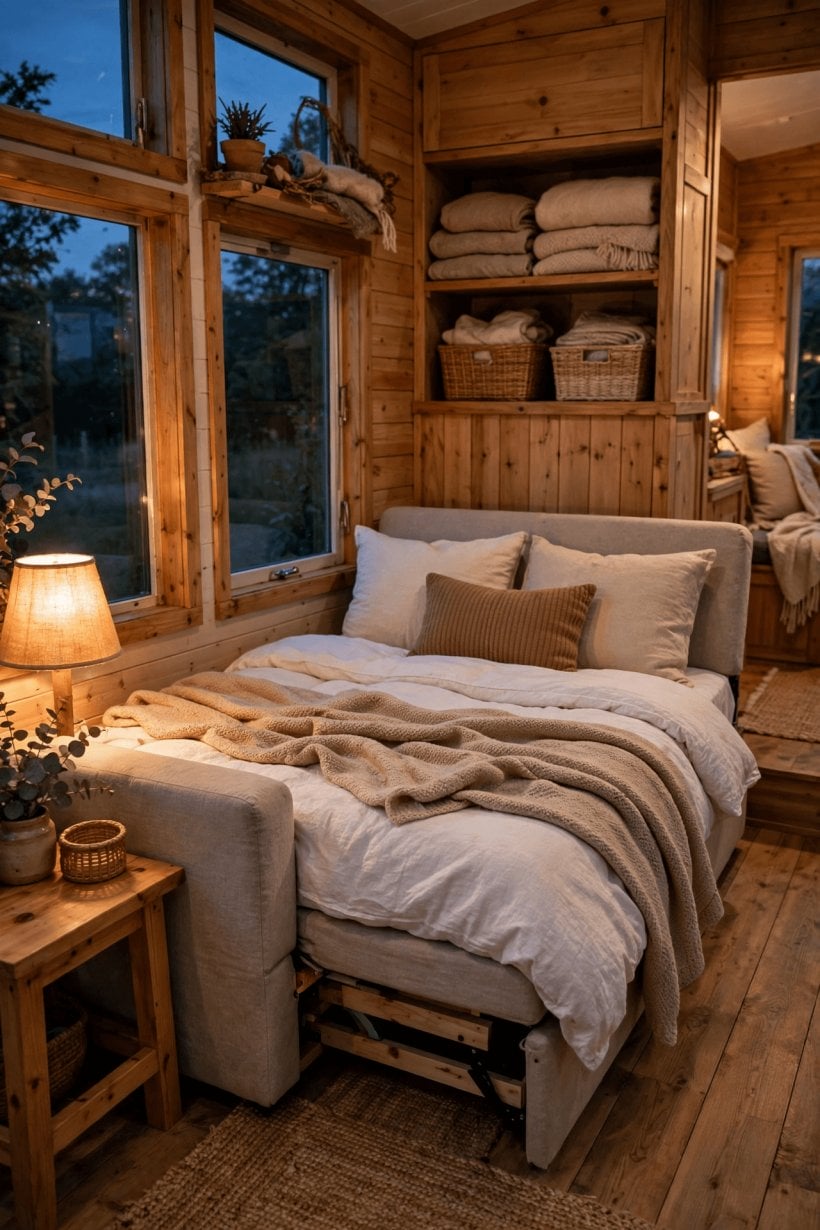
When you assess a pull-out, open and close it yourself several times in the shop or on delivery day. The action should be smooth, balanced, and possible without dragging the whole sofa across the floor. Lie on it in your normal sleep position, not just on your back in the middle, and press your hips where the folds fall. Check how the sofa sits as a sofa too, because pull-out bases can produce a firm, shallow seat that guests forgive but owners feel every evening. A pull-out earns its space when the bed is used often by adults who value a conventional sleeping surface and the room can absorb its open length.
4. Futon and Click-Back Types: Simple Mechanisms, Firm Honest Comfort
Futon-style designs fold a single padded mattress over a slatted or solid frame, while click-back designs fold the sofa back flat until seat and back form one sleeping plane. Both families avoid the hidden folding frame, and that simplicity is their durability argument: fewer hinges engineered to carry a whole bed, and a mattress you can lift off, air, turn, and eventually replace without replacing the sofa. The trade-off is firmness. These surfaces usually sleep firmer and simpler than a sprung bed, which some backs love and others reject within a night, so personal testing matters more here than any description.
Pay attention to the middle. On click-back types, the join between seat and back can form a ridge, a dip, or a change in firmness exactly where hips land. On futon types, check slat spacing and whether the pad bridges the gaps or sinks between them, and ask how the pad should be rolled or turned to keep its fill even. These are also the easiest types to move between homes and rooms, which suits renters and park-model households whose furniture must leave through the same small door it entered. Simple, light, and honest is a perfectly respectable brief for a tiny home, provided the sleeper genuinely likes a firm bed.
5. Daybeds and Trundles: A Deep Seat by Day, Spare Beds Below
A daybed is a single bed that behaves like a deep sofa, dressed with cushions against the wall. It makes no mechanical promises, which is precisely its strength for daily sleeping: the mattress can be a proper single mattress, chosen and replaced like any other. The compromises are sitting depth, which some people find too deep for upright sitting without extra cushions, and width, because a daybed is a single bed however it is dressed. Add a trundle beneath and the same footprint sleeps a second guest on a lower pull-out bed, provided the floor is level and the trundle can roll fully clear.
Daybeds suit rooms with one long wall free and households whose guests are usually single, children, or a couple happy to sleep in adjacent singles pushed together with a shared topper. They appear often in the layouts collected in 300 sq ft tiny house plans with double lofts and other compact plans because they serve a lounge, a guest room, and a reading corner without transformation. Before choosing one, sit on it as a sofa for ten honest minutes, check the trundle height against skirting and rugs, and confirm whether bedding can stay on the trundle when it slides away, because remaking a hidden bed nightly quickly stops feeling clever.
6. Sectional Sleepers: Generous Seating That Sleeps a Household
Sectional and corner sleepers are the largest family here, and they belong in the largest tiny homes: park models, wide cabins, and small houses where the living space is a genuine room rather than a corridor with cushions. By day they seat a family and guests properly, anchor the room, and often include storage inside a chaise section. By night the bed usually pulls or folds from one section, so the sleeping size and the seating size are not the same thing, and the chaise that looked like bonus bed space may be only bonus lounging space.
Measure a sectional sleeper in three states: as delivered, as a sofa, and as a bed. Delivery is the hidden hurdle, because corner units may arrive in sections that fit the door, or as one beautiful object that does not. Confirm which side the bed mechanism occupies, whether the corner can be reversed if you move home, and whether the open bed plus the remaining chaise still leaves a route to the bathroom. In the right home this family is the most sociable choice in the guide. In a home ten centimetres too small, it becomes the room, and every other activity negotiates with it.
7. Judge Mechanism Durability: Frames, Folds, and Moving Parts
Whatever family you choose, the mechanism is the part that ages fastest. Hinges, folding legs, sliding rails, click joints, and trundle wheels all work under load, often with grit from tiny-house floors in their joints. Look for smooth, positive actions that lock clearly in both positions, with no side-to-side wobble when the bed is open and loaded. Operate everything with one hand where possible, because the other hand will usually be holding bedding, a cushion, or a sleepy child’s toy. Ask what can be tightened, lubricated, or replaced, and treat sealed, non-serviceable mechanisms as consumables with a lifespan, not as furniture for life.
Frame material and floor protection belong in the same check. A heavy sleeper sofa dragged nightly will mark floors and loosen its own joints, so glides, castors where appropriate, and a rug strategy are part of the purchase. Spread the load honestly: two adults plus the mechanism’s own weight concentrate force on small legs and wheels. If a design creaks, flexes, or twists when new, it will not improve with a thousand folds. Durability in this category is not about impressive-sounding materials. It is about simple load paths, replaceable wearing parts, and an action so easy that nobody in the household starts avoiding opening the bed properly.
8. Mattress Quality on a Folding Base: Thin Does Not Have to Mean Bad
Folding mattresses are thin for geometric reasons, so judge them by density, support, and how they handle their folds, not by thickness envy. A thin, well-specified foam or futon pad that supports evenly is a better bed than a thicker, soft build that bottoms out on the frame. Test with your hip and shoulder at the fold lines, because that is where padding is interrupted and where a sleeper actually lies. If the design allows a separate topper, measure the storage for it with the same honesty as the bed itself. A topper that must live in the shower is not a system, it is a compromise with good marketing.
Moisture matters more in folding beds than in fixed ones, because a mattress folded away damp, inside a closed base, has nowhere to dry. Air the bed before folding after use, especially after guests, and read our guidance on tiny house ventilation, HRV and ERV choices and mould prevention with folding furniture in mind. Washable covers, protectors that fit the folded size, and a base you can vacuum inside all extend the pleasant life of the bed. Comfort gets the attention in the shop, but in year two it is usually hygiene and air that decide whether a sofa bed still feels like a good idea.
9. Clearance, Bedding Storage, and the Night-Time Routine
A sofa bed succeeds or fails at 10 p.m., in the routine. Time the full conversion: cushions off, bed open, bedding on, and note where every removed item goes. Seat cushions that fit nowhere except the kitchen floor, and bedding stored in another room or a high loft, turn a two-minute job into a household expedition. The strongest tiny-home setups store bedding inside the sofa, in an ottoman that doubles as a table, or in a single cupboard within two steps of the bed. Walk the route in the dark, too, because guests will, and check that the open bed does not block heat sources, which our guide to how to heat a tiny house with propane, wood and electric options treats as a clearance question as much as a heating one.
Room flow by day deserves the same rehearsal. The open and closed outlines decide whether the sofa crowds the cooking zone, so compare them with the working clearances discussed in compact kitchen appliances and layouts for tiny houses if your lounge and kitchen share one space, as most do. Leave a walking lane you can use with a laundry basket, not just sideways in socks. If the only workable arrangement blocks a door when the bed is open, write that into your household rules for guests and fire safety, rather than discovering it during a 3 a.m. alarm of any kind.
10. Balance Budget, Delivery, and Long-Term Value
Price this furniture as two products in one, because it is. A cheap sofa bed that sits badly and sleeps worse is not half the value of a separate sofa and bed, it is close to none of it, and replacement in a tiny home means another delivery, another door problem, and another disposal. Mid-range money spent on a sound mechanism, a replaceable mattress or pad, and upholstery you can clean usually outperforms both the cheapest convertible and the luxurious one whose size dominates the home. Count the full system cost: delivery, protectors, a topper if planned, bedding in the right size, and storage furniture if the design needs it.
That whole-system habit is the same one we recommend for the house itself in the true cost of tiny houses, prefab versus DIY. Before ordering, confirm the delivery path in writing: door widths, stair turns, packaging size, and who takes the packaging away. Confirm return terms for a piece that must be assembled or unfolded to be tested, and photograph the mechanism on arrival so any transit damage is documented before the first guest sleeps on it. Value, in a small home, is a piece that still works smoothly, smells clean, and fits its room after years of twice-daily duty, not a saving made once at the till.
Final Considerations
Decide in this order: how often it sleeps someone, which family fits both footprints, whether the mechanism and mattress pass hands-on testing, and only then upholstery, colour, and price. Let the fifteen entries in the table narrow the field, not crown a winner, because the right answer for a nightly bed in a park model is the wrong answer for a guest corner in a shepherd’s hut. Be suspicious of any design you are not allowed to open, close, and lie on before committing.
Finally, rehearse the routine once more in your head, cushions, bedding, bathroom route, and morning fold included. A sofa bed in a tiny house is not occasional furniture; it is a daily machine for living, judged twice a day by the people who use it. Choose the design whose compromises you understand, can maintain, and still like at midnight and at breakfast, and it will earn its considerable footprint honestly.


0 Comments