

A city earns the label tiny-friendly on paper, not in brochures. The welcome that matters is written into zoning codes, accessory dwelling rules, permit checklists, and utility standards, because those documents decide whether a tiny house on wheels can legally sit, connect, and stay, or whether it is tolerated only until the first complaint. When people search for tiny house friendly cities, they are really searching for places where the paperwork and the pavement agree, where a THOW is a recognised way to live rather than a loophole waiting to close.
This guide therefore does something more useful than naming names it cannot verify: it shows you the five paper signs of a genuinely welcoming place, organises the search into twenty-five place types you can look for anywhere, and gives you a verification method that works on any city you are considering. Cities change their rules, and a list frozen in print would mislead you within a year or two. The signs and the method below will still be true a decade from now, and they will let you test any specific claim, including ours, before you tow a house across the country on the strength of it.
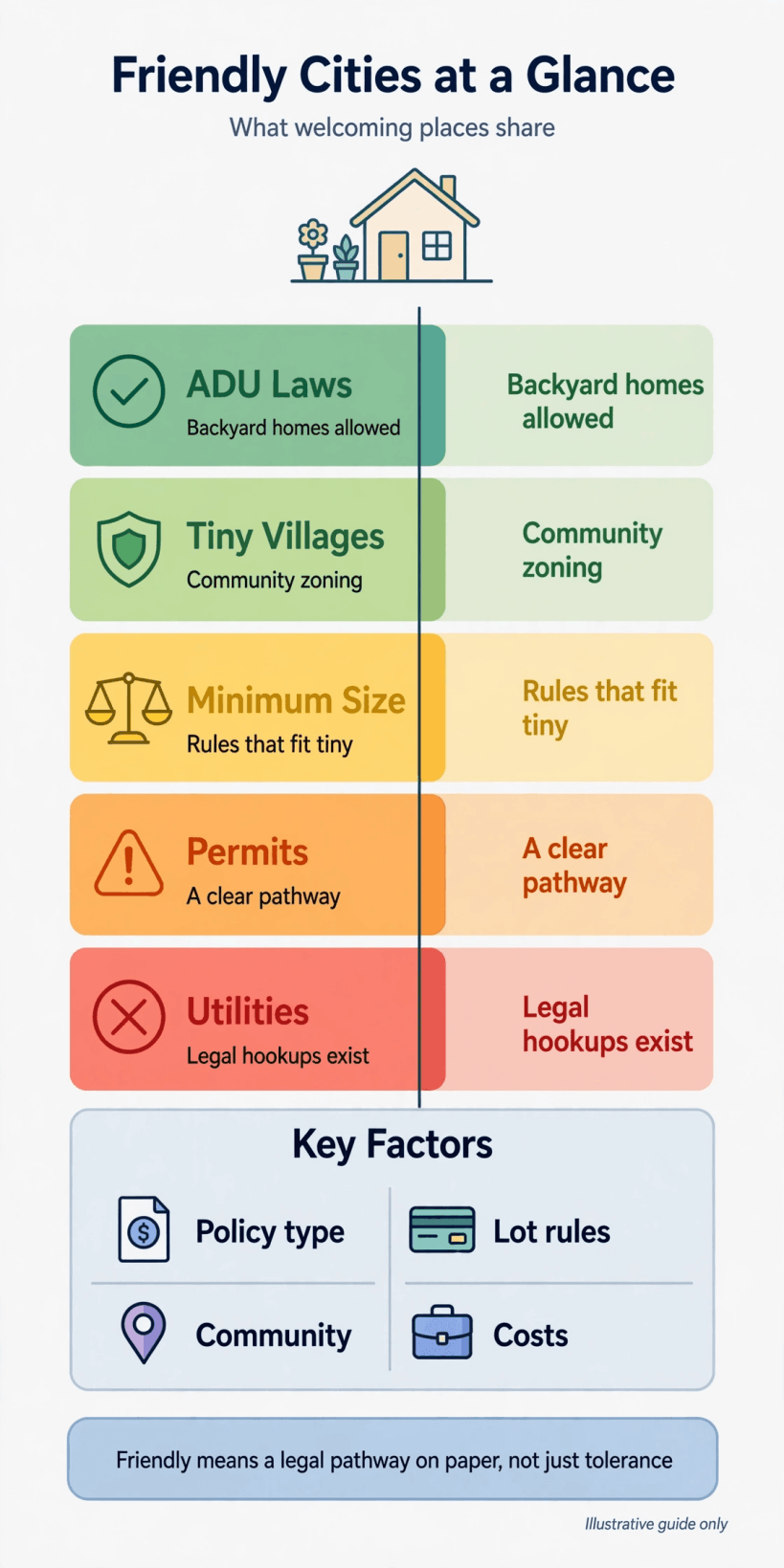
At a Glance: Five Signs of Welcome, Twenty-Five Place Types
| Sign of welcome | What it looks like on paper | Place types it creates |
|---|---|---|
| ADU pathways | Accessory dwelling rules that accept small units on existing lots | Backyard cottages, garage conversions, lot-share homes, garden suites, carriage houses |
| Community zoning | Districts or permits where tiny villages and clusters are allowed | Tiny villages, co-living clusters, cottage courts, eco-villages, senior tiny communities |
| Fitted minimum sizes | Dwelling size rules a genuine tiny house can actually meet | Foundation tiny homes, small-lot cottages, micro homes, cabin districts, compact infill |
| Clear permits | Published checklists, named forms, predictable inspections | Permitted THOW lots, legal host driveways, sanctioned long-stay parks, approved farm stays, licensed backyard placements |
| Legal hookups | Standards for connecting water, power, and waste lawfully | Full-hookup communities, utility-ready rural lots, serviced urban lots, marina-style long-stay sites, park-model neighbourhoods |
1. What Welcoming Means in Writing: The Five Paper Signs
A welcoming city can be recognised before you ever visit, because welcome leaves a paper trail. The zoning code names small dwellings somewhere instead of ignoring them. The accessory dwelling rules describe a process instead of a prohibition. The permit office publishes a checklist a normal person can follow. The utility department has a standard for connecting a small home rather than improvising one. And somewhere in the system, an official can answer the question “where may this house legally sit?” with an address category instead of a shrug.
None of this requires a city to love tiny houses. It requires only that the rules be knowable in advance, which is the entire difference between a legal home and a tolerated encampment. When you evaluate any place, score it against the five signs in the table above, and treat a missing sign as a cost or a risk to be priced, not as a detail to be discovered after the house is already parked.
2. ADU Pathways: The Backyard Route Into Town
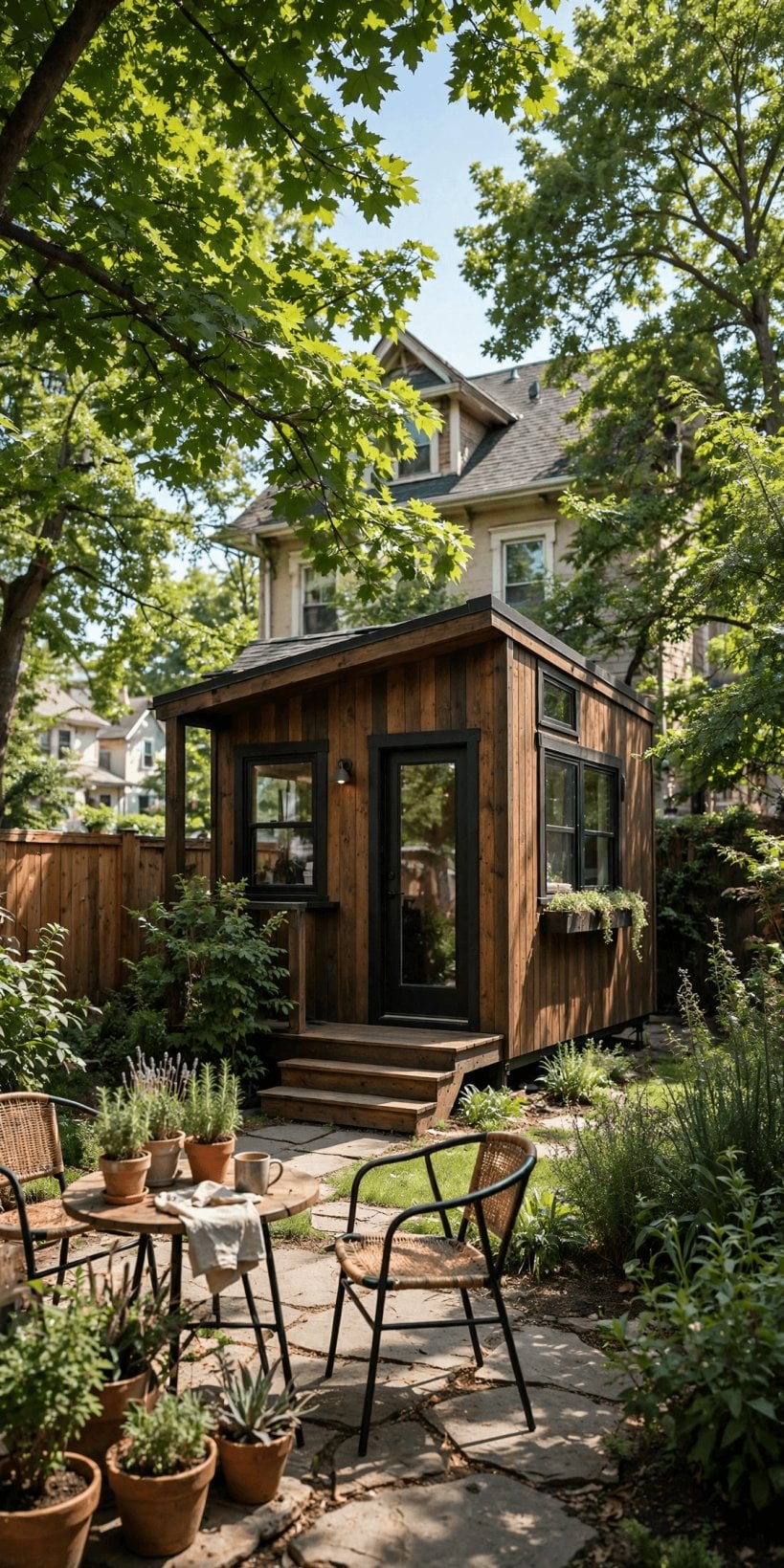
The accessory dwelling unit is the most powerful tiny-house pathway in modern zoning, because it lets a small home join an existing residential lot: a backyard cottage, a converted garage, or a compact unit above or beside the main house. Where ADU rules are permissive, a tiny house builder or buyer gains something rare, a legal route into established neighbourhoods with streets, services, and neighbours already in place, instead of exile to wherever enforcement is sleepiest.
The details decide whether the pathway is real: whether the unit may be on wheels or must be on a foundation, whether the lot owner must live on site, how parking and hookups are handled, and whether the unit may be rented. Read the actual ADU page of any city you favour, and prepare the ground properly if you take this route, because our guide on how to prepare land for a tiny house covers the excavation, access, and utility work that an ADU placement still requires, wheels or not.
3. Tiny Villages and Communities Inside the Rules
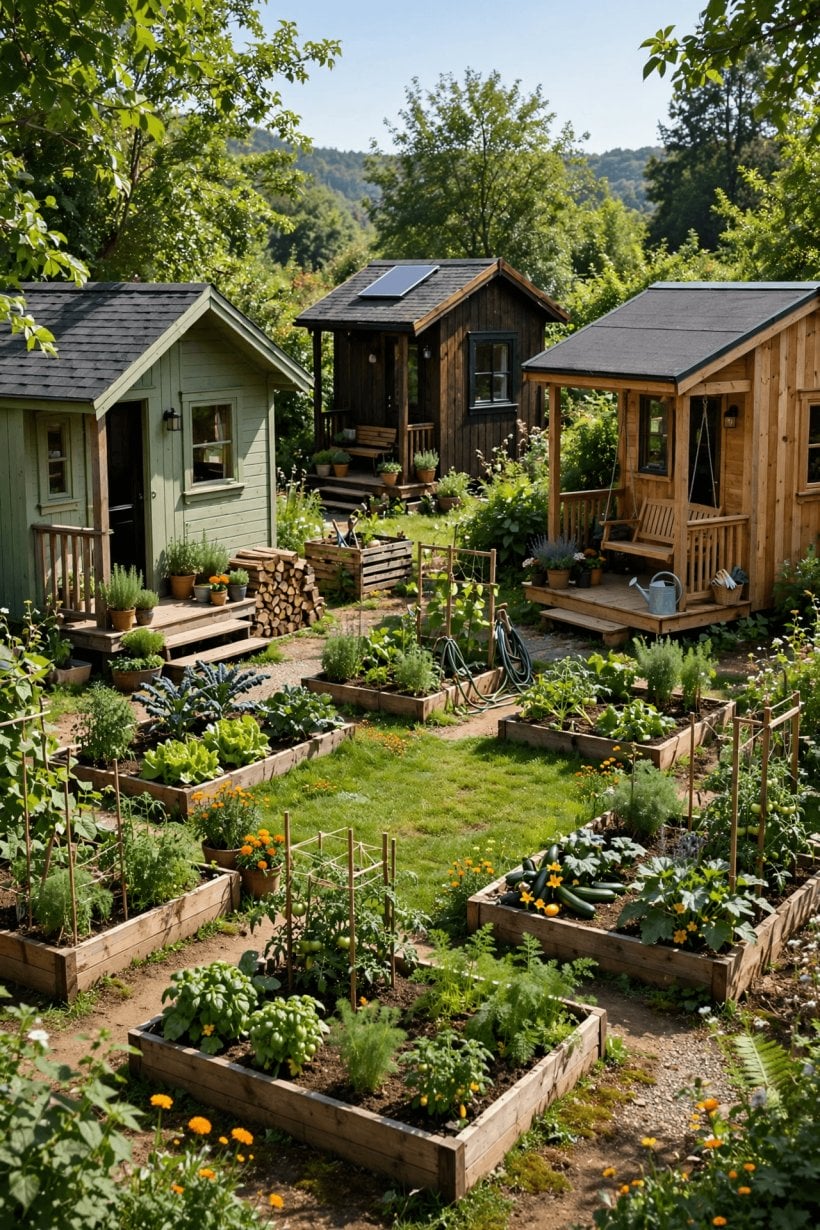
The second sign is a place designed for many small homes at once: a tiny house village, a cottage court, or a community with shared facilities and individual lots. These exist where a city or county has found a zoning answer for clustered small dwellings, whether through a specific district, a planned-development approval, or a park framework adapted to permanent small homes. For a THOW owner, a community converts a legal puzzle into a lease: the community solved the zoning, and you rent the benefit of that solution.
Communities come in many flavours, from market-rate villages to mission-driven projects, and our tour of tiny house communities for seniors shows one well-developed model in detail. If you are an organiser rather than a resident, our guide on how to start your own tiny house community lays out the zoning and business steps involved, while our overview of off-grid alternative communities, cohousing, and ecovillages places tiny villages in their wider family of shared-living experiments.
4. Minimum-Size Rules That Fit a Tiny House
Minimum dwelling size is the quiet gatekeeper of tiny living. Where the code demands a large minimum floor area, a tiny house is excluded before any other question is asked; where the minimum is low, absent, or written around recognised small-dwelling standards, the gate stands open. A welcoming city is therefore partly a numbers question, except the honest numbers are the ones in the local code, which you must read for the specific district you want, because they differ street by street and change over time.
Foundation tiny homes benefit most from fitted size rules, since a small house on a permanent foundation can be treated as an ordinary, if compact, dwelling. Houses on wheels depend on how the code classifies them, which is why size and classification must always be checked together. A district whose minimum a foundation tiny home can meet, near services you need, is one of the most stable forms of welcome there is, because it does not depend on a special programme surviving its next budget round.
5. Permit Pathways You Can Actually Follow
Welcome sign number four is administrative: a permit pathway with a beginning, a middle, and an end. You can find the form. The form names the documents it wants. The inspection steps are listed. The fees are published or quotable in advance. This sounds dull, and it is the most valuable thing on this page, because predictability is what lets ordinary people comply instead of guessing, and compliance is what makes a tiny home a home rather than a secret.
Test the pathway with a phone call before you commit to a place. Describe your house plainly: its size, its wheels or foundation, its certification if any, and where you hope to put it. A welcoming system answers with steps; an unwelcoming one answers with warnings or transfers you in a circle. Keep notes of names, dates, and answers, because in borderline cases the difference between a legal placement and an enforcement letter is often the paper trail showing you asked first and followed what you were told.
6. Legal Hookups: Water, Power, and Sewage Without Guesswork
A house you may park but may not connect is only half legal, so the fifth sign is a lawful way to handle water, power, and waste. Welcoming places specify how a tiny house connects: a standard electrical pedestal or service, a water connection with backflow protection, and an approved route for greywater and sewage, whether that is a sewer connection, a septic approval, or a sanctioned dump and haul arrangement for a genuinely mobile setup.
Hookups are also where hidden costs live, in trenching, panels, permits, and inspections, so price them while you evaluate a city, not after you arrive. Our tiny house utilities guide explains the power, water, and off-grid sewage options in practical detail and will help you read a community’s or a city’s hookup rules with informed eyes, including spotting when “full hookups” in an advertisement means less than the phrase suggests.
7. The Twenty-Five Place Types: A Field Guide to the Archetypes
Here is the honest way to hold a list of twenty-five: as archetypes to search for, not as pins on a map someone else verified for you. Five arise from ADU rules: backyard cottages, garage conversions, lot-share homes behind a main house, garden suites, and carriage-style units. Five arise from community zoning: tiny villages, co-living clusters, cottage courts, eco-villages, and senior tiny communities. Five arise from fitted size rules: foundation tiny homes, small-lot cottages, micro homes, cabin districts, and compact infill houses.
Five more arise from clear permit pathways: permitted THOW lots, legal host driveways, sanctioned long-stay parks, approved farm and rural stays, and licensed backyard placements. And five arise from legal hookups: full-hookup communities, utility-ready rural lots, serviced urban lots, long-stay serviced sites, and park-model neighbourhoods. Any real place you find will be one of these twenty-five wearing a local name. Search by the type plus your region, then verify the specific place with the method in the next section, and the list becomes a tool instead of a promise.
8. How to Verify a City’s Real Position
Verification is a four-step habit. First, read the zoning code for the district you want, searching it for the terms that decide your case: accessory dwelling, minimum dwelling size, recreational vehicle occupancy, and any small-dwelling or cottage provisions. Second, read the building code adoption, because model provisions for tiny homes only help where they have actually been adopted, a distinction our explainer on the IRC Appendix Q rules for tiny homes makes clear. Third, call the planning office with your specific house and placement and take notes. Fourth, ask for the answer in writing, or confirm it by email, before money moves.
Cross-check the official picture against lived reality: are there existing tiny homes, communities, or ADU permits visible in the area, and what do local builders say about working there? Cities with genuinely workable systems tend to develop an ecosystem around them, much as our survey of US cities with strong urban agriculture and sustainable living codes found for a neighbouring topic: where codes welcome a practice, practitioners gather, and their presence is itself evidence you can check.
9. Questions to Ask the Planning Office
Arrive with questions that force specifics. May a tiny house on wheels be lived in within city limits, and under what classification? Is there an ADU pathway, and does it accept a unit on wheels or require a foundation? What minimum dwelling size applies in the district I am considering? What permits, inspections, and hookup standards apply to a placement like mine? Are there time limits on occupancy, and what renews them? Each answer either opens a door or saves you from walking through the wrong one.
Ask the same questions of the county if your target sits outside city limits, because the boundary between the two jurisdictions is where many tiny plans quietly fail. And ask about the neighbours’ world too: setbacks, screening, and parking rules are the small print that decides whether a technically legal placement stays peaceful. A welcoming city answers these questions as routine administration. That ordinariness, more than any festival or news story, is the truest sign that tiny houses belong there.
10. Red Flags: When Friendly Marketing Meets Hostile Rules
Finally, learn the warning signs. A place marketed as tiny-friendly where nobody can name the legal pathway. Rules that exist only as verbal assurances. A community operating in a district whose code plainly excludes it. Enforcement that runs on complaints, which means your legality lasts exactly as long as your least happy neighbour’s patience. And advertisements that blur the line between a park that accepts tiny houses for holidays and one that permits them as homes, a distinction our comparison of tiny house communities vs RV parks explores in depth.
Red flags do not always mean walk away; sometimes they mean negotiate, price the risk, or keep the house mobile enough to leave. What they never mean is ignore. The whole craft of finding a welcoming city is refusing to confuse being unbothered with being legal, because the first can end with a single letter and the second is what lets you plant a garden, register to vote, and plan a life around an address that is truly yours.
Final Considerations
Welcoming is written, not wished. Look for the five paper signs, ADU pathways, community zoning, fitted size rules, clear permits, and legal hookups, search by the twenty-five place types, and verify every specific city with the code, the call, and the written answer before you move. Do that, and any list of friendly places, including the ones you build from this guide, becomes reliable in the only way that matters: you checked it yourself, for your house, in the place you actually intend to live.


0 Comments