

Buying furniture used to mean sitting on it. Online, the showroom is a screen, the sofa is a photograph, and the first time you touch your new chair is the day it arrives on a pallet — which is exactly why the checking has to happen before the buying.
This guide is the what-to-check list for furniture bought at a distance: measuring the room and the route in, reading a listing the way an inspector would, understanding what photographs cannot tell you, and knowing the delivery and returns terms before they matter. It names no shops and quotes no prices — the checks are the same everywhere, and they are the difference between a bargain and a warehouse problem in your hallway.

1. Buying Furniture Online at a Glance
Furniture is the hardest thing to buy unseen: it is bulky, heavy, personal to sit in, and expensive to send back. The whole craft of buying it online is front-loading the judgement — tape measure first, listing second, payment last. The wider craft of choosing pieces themselves is covered by the furniture buying guide; this post is about the distance part — everything that changes when the shop is a screen.
| Question | Short answer |
|---|---|
| What goes wrong most often? | Scale — the piece is bigger, smaller, deeper or lower than the photograph suggested, because photographs carry no size |
| What is the single best habit? | Measure the room, the piece’s footprint and the whole delivery route — doorways, turns, stairs — before ordering anything |
| Can comfort be judged online? | Partly — seat height, depth, cushion fill and frame construction are all stated or askable; what cannot be judged must be covered by the returns terms |
| What should be read before paying? | The delivery terms and the returns policy, in full — who carries it in, what a return costs in effort, and what condition the piece must be in |
| What is the classic failure? | Falling for the styled photograph, skipping the dimensions line, and meeting the truth on the doorstep with the driver waiting |
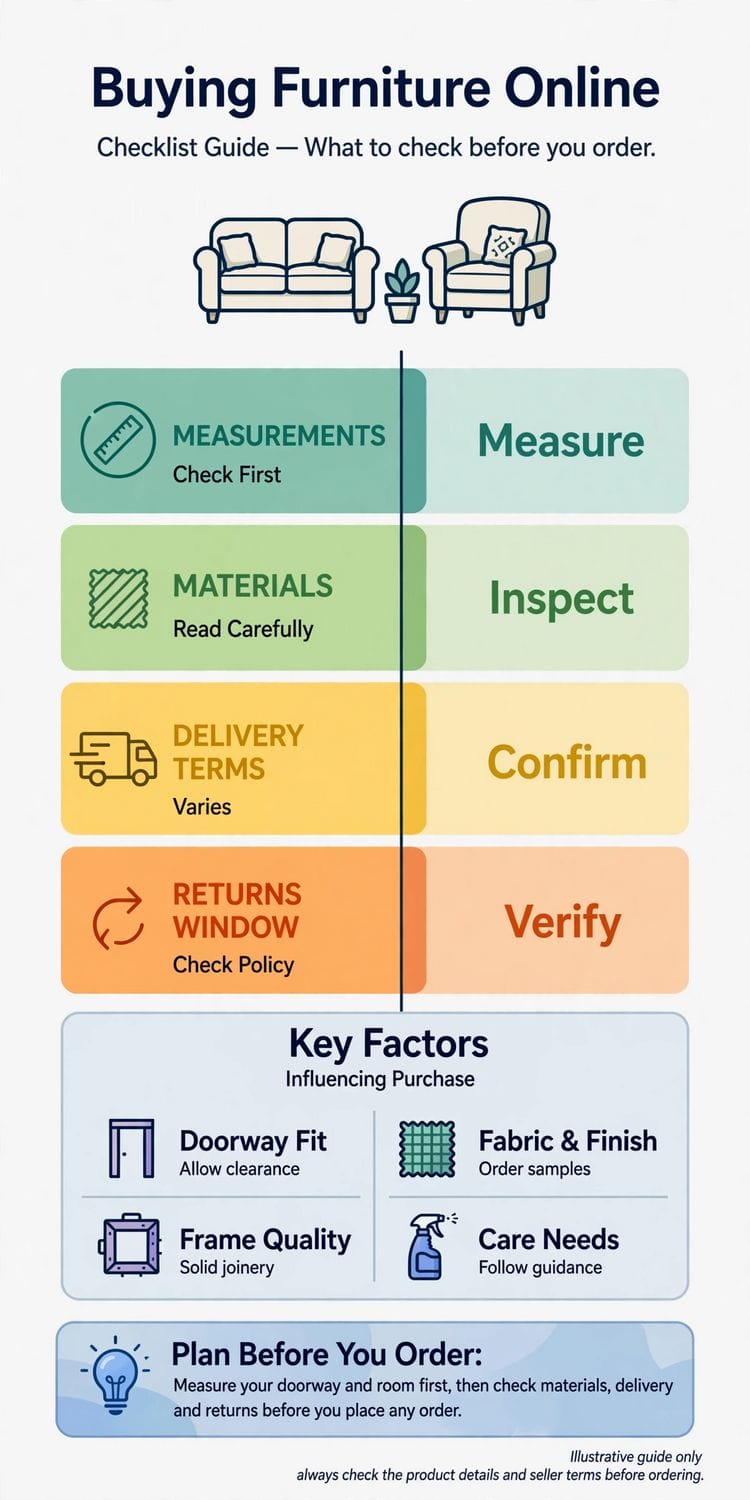
2. Measure First: The Room, the Piece and the Route In
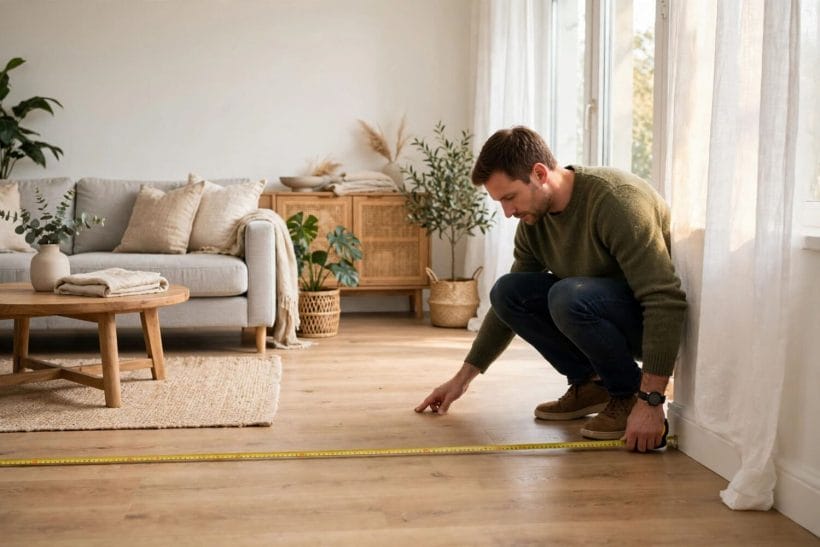
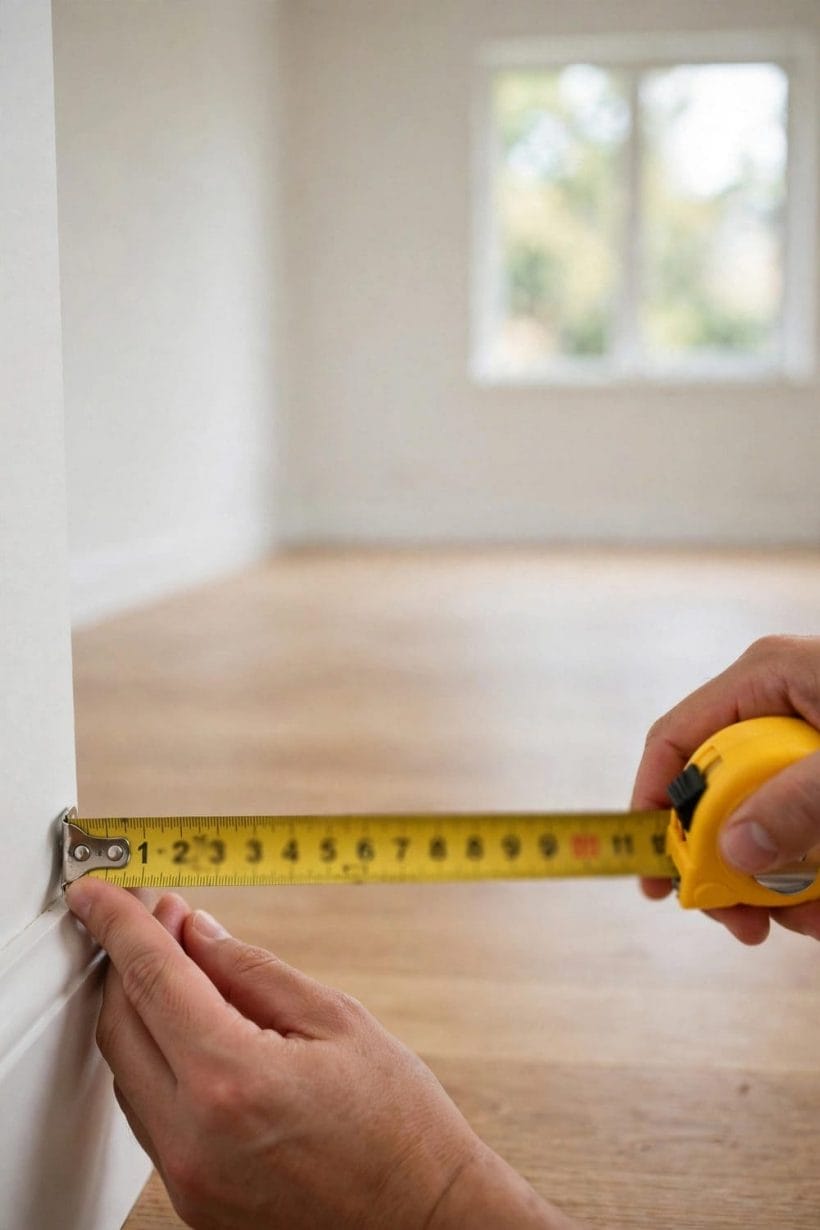
Every online furniture disappointment begins as a measurement that was never taken. Start with the destination: measure the wall the piece will stand against, the floor it will occupy, and the space it must leave — walkways, door swings, radiator clearance, the rug it should sit on or inside. Then mark the footprint on the floor with painter’s tape and live with the tape for a day; the outline is unignorable in a way a number never is, and it exposes the coffee table that is wider than the sofa’s approach or the bookcase that eats the light switch.
Then measure the piece from its listing — width, depth and height, and for seating the seat height and seat depth, which decide comfort more than the overall size does. Finally, measure the route: the front door’s clear opening, the hallway’s narrowest turn, the staircase’s ceiling height where a tall piece must pivot, any lift’s depth. The route is the measurement everyone forgets and the one that cannot be improvised on the day. A house whose openings are already understood — the thinking in the hallway width guide applies to furniture as much as to people — receives deliveries calmly; everyone else meets their new wardrobe at an angle, in a doorway, in the rain.
3. Reading a Listing Like an Inspector

A listing is a sales document, and the inspector’s skill is knowing which lines are facts and which are weather. Dimensions, materials and construction details are facts — hold the seller to them. Adjectives are weather. The materials lines deserve slow reading: solid timber, veneer over board, and printed foil over board are three different objects wearing one description’s clothes, and the honest listings say which is which in the specification, not the headline. For upholstered pieces, look for the frame’s material, the suspension type, and what the cushions are filled with; each is stated in a serious listing and conspicuously absent in a careless one.
Photographs need the same scepticism. A piece shot alone in a white void gives no scale; a piece shot in a styled room gives the stylist’s scale, where every object has been chosen to flatter. Prefer listings that show the piece from behind and beneath, in joinery close-up, and in a room with a door in frame — a standard door is the furniture world’s metre stick. Where a detail matters and is not shown — the back of the bookcase, the underside of the table, the drawer runners — ask for it. A seller who answers with photographs is telling you something good about the whole transaction.
4. What Photographs Cannot Tell You: Comfort, Finish and Scale

Three things never survive the journey through a camera. The first is comfort: whether a seat’s angle, depth and give suit your body is written in specifications — seat height against your leg, seat depth against your thigh, cushion fill against your weight — and in nothing else. Translate the listing’s numbers into your own body by measuring the chair you already sit in happily, and buy the piece whose numbers rhyme with it. The second is finish: screens warm some colours and cool others, timber photographs richer than it lives, and fabric in a thumbnail is a rumour. Where the finish must match existing pieces, order the swatch or sample first if one is offered; where none is offered, that absence is itself information.
The third is presence. Furniture has a visual weight no photograph carries — a bookcase that looked airy online can dominate a small room like a wardrobe in a tent. The tape footprint from the measuring section helps, but add height to it: stack boxes to the piece’s full height in its taped outline for an hour, and the room will tell you the truth the photograph was paid to hide.
5. Delivery: Thresholds, Rooms and Stairs
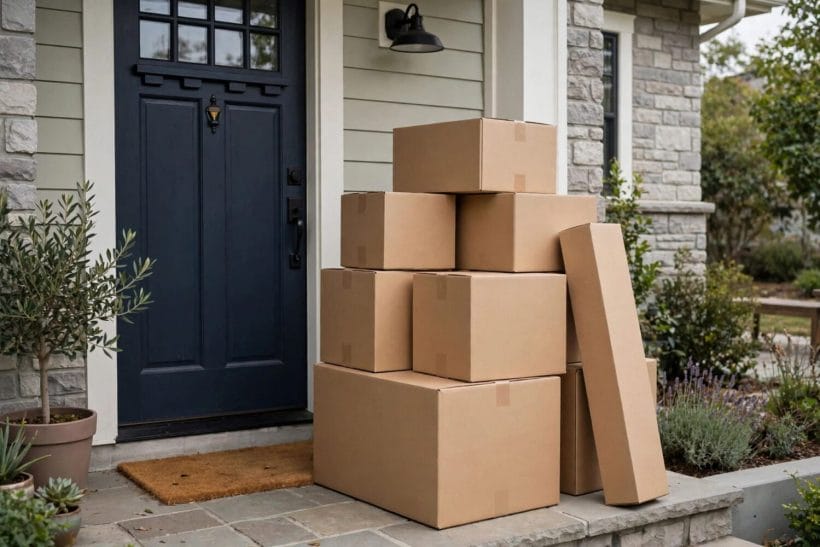
Delivery terms are where online furniture purchases are quietly won and lost, and they must be read before the order, not during the knock at the door. Establish what the standard delivery actually includes: to the kerb, to the door, into the room, or into the room with packaging removed are four different services wearing one word. Establish who decides if the piece cannot be got in, and what happens then. If the route measured in section two includes a tight turn or a flight of stairs, say so when ordering, not when apologising to a delivery crew — many services will plan for it if told, and most are entitled to refuse if ambushed by it.
On the day: clear the route, protect the floors and corners, and inspect the piece before signing anything — in daylight, with the packaging opened, looking for transit damage at corners and edges where it always happens. Note any damage on the delivery record itself, photograph it, and keep every piece of packaging until the piece has lived in its place for a few days. The household that treats delivery as a stage of the purchase, rather than an interruption of it, is the household that rarely has a furniture dispute.
6. Returns and Damage: Reading the Policy Before You Buy
The returns policy is the part of the contract written for the day things go wrong, and it deserves the same attention as the piece itself. Read for four things. What can be returned and in what condition — assembled or not, used or merely unwrapped — because furniture is often excluded from the easy returns that small goods enjoy. Who arranges and who pays for the collection of a large item, since returning a sofa is a logistics exercise, not a parcel. How long the decision window runs, counted from delivery rather than order. And what happens with damage or faults, which is a different and stronger set of rights than changing your mind, in most places — know which situation you are in before you make contact.
None of this is pessimism; it is what allows optimism safely. A generous, clearly written policy is a seller’s confidence made visible, and a vague one is information of the opposite kind. The pre-owned route makes the same point from the other side — the world of vintage online furniture runs on exactly these checks, with condition reports standing in for returns policies.
7. Reviews and Ratings: Signal from Noise
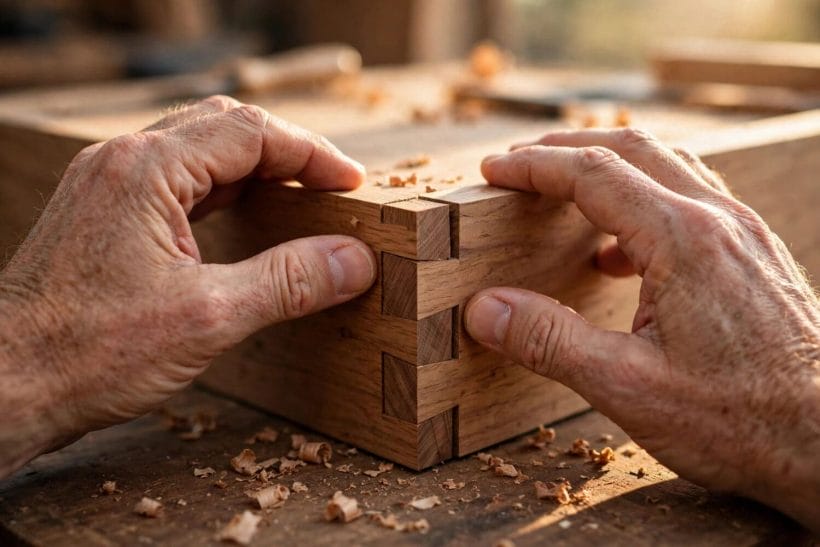
Ratings are a crowd’s shorthand, and crowds are better at some judgements than others. Read reviews for the things a crowd can actually know: whether the piece arrived as described, whether the colour matched its photographs, whether assembly was honest work or a feud, whether delivery behaved as promised, and whether the piece still pleases after months rather than minutes. Weight the detailed, specific, slightly annoyed reviews heavily — they are written by people who lived with the thing. Discount the extremes in both directions, and be wary of a wall of short, similar praise posted in a cluster.
For comfort and longevity, a crowd’s verdict is weaker: comfort is personal, and longevity has not happened yet to any reviewer. Let reviews veto — a pattern of wobbling legs and splitting seams is a fact, not a taste — but never let them choose. Choosing remains the work of sections two, three and four: measurements, materials and the honesty of your own tape outline on the floor. Independent sources beyond the seller’s own site are worth the detour for exactly this reason, in the same way a local search like furniture stores near me can turn up the showroom where the same piece, or its near relation, can be sat on in person.
8. Timing, Stock and Made-to-Order Honesty
Furniture bought online runs on longer clocks than almost anything else in the basket, and peace comes from believing the clock you are given. Stock pieces may arrive in days; made-to-order and upholstered pieces are commonly built after the order, on timescales the listing should state plainly. Read the stated window, add your own margin for the room’s readiness, and do not book the decorator, the carpet or the housewarming against the optimistic end of anyone’s estimate. Where a date truly matters — a move, a birth, a guest — say so before ordering and get the answer in writing; a seller’s cheerful assurance in a chat window is not a schedule.
Stock signals deserve the same plain reading. “Low stock” and countdown language are sales furniture, arranged to hurry you; the honest information is whether the piece can be ordered, when it is expected, and what happens if it slips. Sales and promotions follow their own seasons in the furniture trade, stated generally — a household that has done its measuring can afford to wait for them, and a household that has not will waste the saving on the wrong piece bought at the right price.
9. Common Mistakes: The Doorstep Syllabus
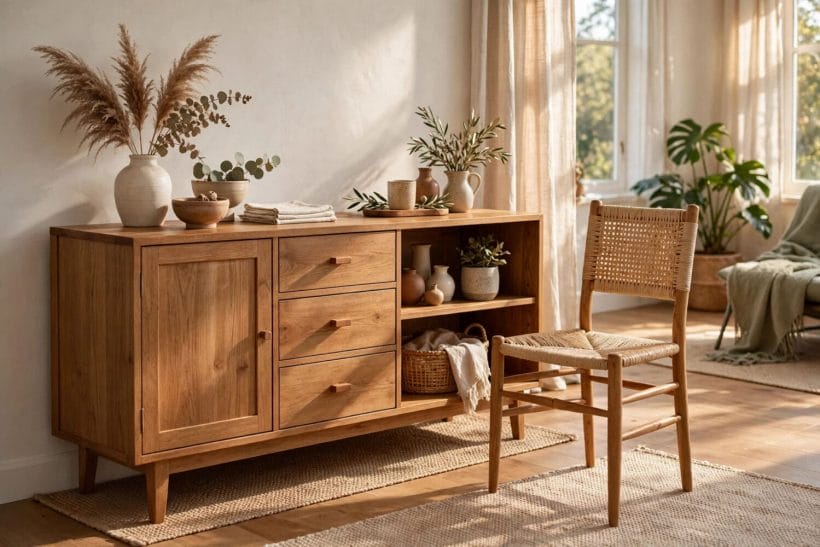
The mistakes repeat because they are tempting. Ordering to the photograph — falling for the styled room and never finding the dimensions line. Measuring the room but not the route, so the right piece cannot reach its room. Trusting a colour through two screens. Skipping the construction lines and discovering, a season later, that the “oak” was a photograph of oak. Signing for the delivery without opening the packaging. Treating the returns policy as fine print instead of as the insurance it is. And the subtlest of all: buying the whole room at once from one screen, so that every mistake arrives on the same lorry and nothing in the room has earned its place against anything else. The corrective habits are all in this guide — tape, specifications, swatches, policy, patience — and they share one trait: they happen before the card does.
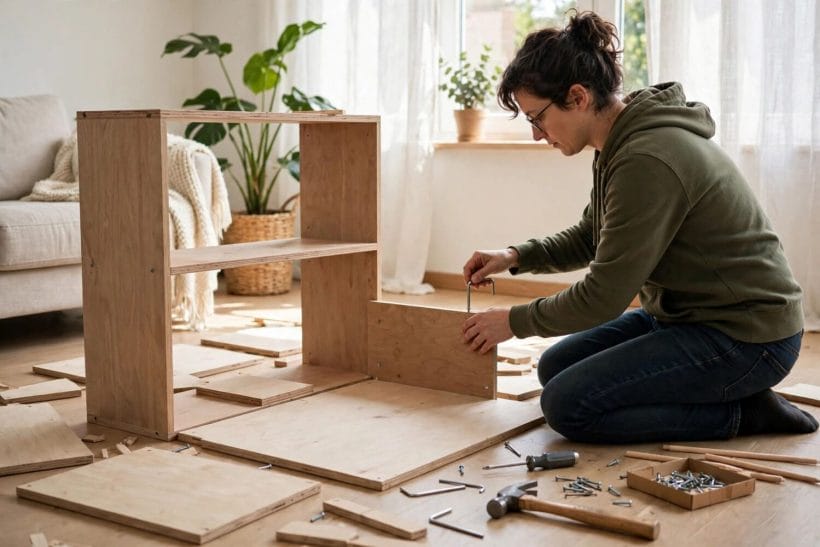
Assembly deserves its own honest paragraph, because a great deal of furniture bought online arrives as a kit of parts, and the listing’s cheerful phrase “some assembly required” covers everything from screwing on four legs to a weekend with an instruction booklet and a strong opinion about cam locks. Before ordering, find out which end of that range the piece lives at: how many parts, what tools, whether the instructions exist anywhere to preview, and whether the finished weight can be moved by the people who will be home to build it. Storage furniture makes the point kindly — the pieces in any honest set of tiny house storage ideas earn their keep only when they stand square and true — and a wobble built in on day one never improves. Allow the build its real time, check every panel for transit damage before the first screw turns (a damaged part discovered mid-build is a far longer story), and keep the fittings and the instructions together in a labelled bag when the piece is done. Future moves, repairs and re-sales all begin with that bag.
10. Pulling It Together: The Pre-Buy Checklist
Run the list in order and an online furniture purchase becomes a calm, almost boring transaction — which is the highest praise a large purchase can earn. One: the room is measured and the footprint has survived a day in tape. Two: the route in is measured, tight spots noted, delivery told about them. Three: the listing has been read like an inspector — dimensions, materials, construction — and the photographs have been forgiven their flattery. Four: comfort has been translated into numbers from a chair you trust, and a swatch has been ordered where finish matters. Five: delivery terms are known, and the returns policy has been read in full and found acceptable. Six: reviews have been allowed their veto and denied their vote. Seven: the timescale is believed, with margin.
Seven checks, none of them shopping, all of them the purchase. Do them and the screen becomes what it should be — not a gamble with a checkout button, but the largest furniture showroom in the world, visited from a chair whose measurements you know by heart. Households furnishing whole rooms this way often pair the method with flexible pieces — the thinking behind convertible furniture in tiny house plans is the same discipline at smaller scale: know the space, know the piece, and let no photograph do a tape measure’s job.
Final Considerations
Distance buying rewards the methodical and taxes the impulsive, and furniture — big, heavy, lived on — magnifies both. None of the checks in this guide require expertise; they require only that they be done before paying rather than after delivery.
Measure the room, measure the route, read the listing like it owes you money — because it is about to — and the piece that arrives will be the piece you thought you bought. That is the whole secret of buying furniture online: there is no secret, only a checklist, honestly run, in the right order, before the money moves.




0 Comments