
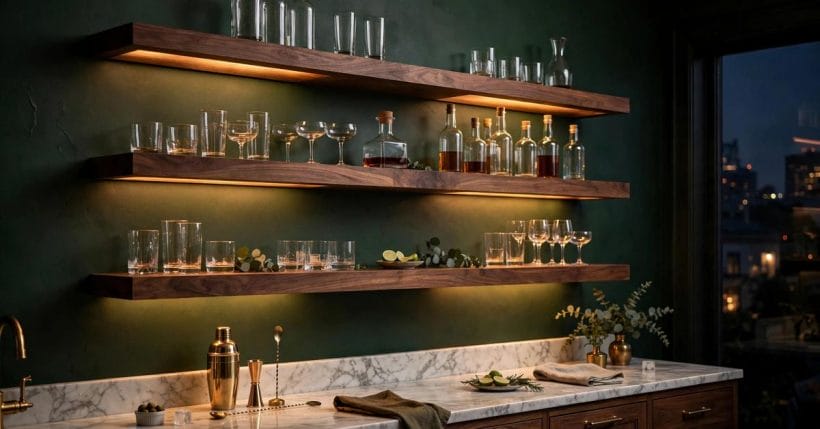
A home bar is mostly a display problem. The bottles, the glasses, the tools of the ritual — they want to be seen, reached and admired, and the floating shelf is the piece of furniture that does all three without touching the floor.
These seventy-five ideas are about that shelf: its material, its light, its load and its styling. Among all the bar shelf arrangements a home can hold, the floating run — clean-lined, wall-borne, glowing slightly — is the one that makes even a modest collection look like a destination.
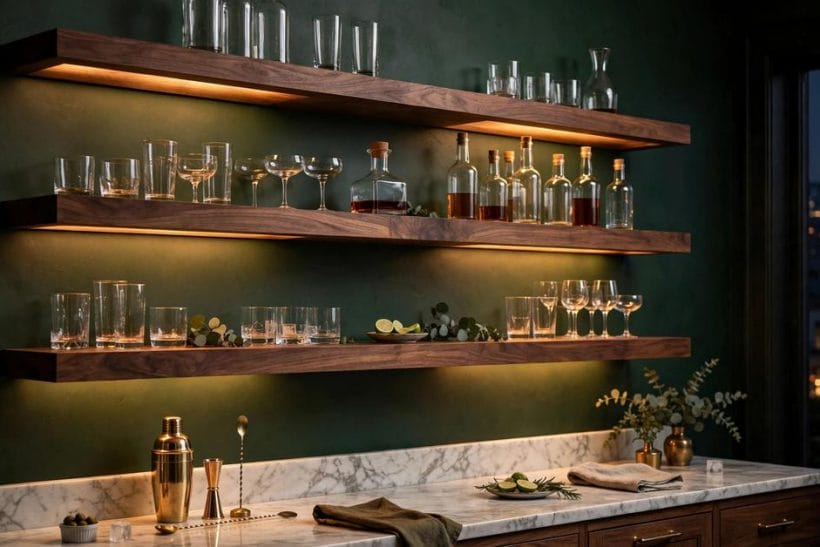
1. Home Bar with Floating Shelves Ideas at a Glance
A floating shelf is a shelf whose fixings hide inside it, so the board appears to hover. Over a bar counter or along a bar wall it carries bottles and glassware in the open, bar-style, while the floor below stays free for stools, a counter or a cabinet. This post is the shelving slice of the bar family whose pillar is the home bar itself; the no-plumbing counter is the dry bar’s ground, the basement build is its own post, and here the subject is only the shelf and everything that makes it work.
| Question | Short answer |
|---|---|
| Why floating shelves for a bar? | They display like a real bar’s back shelves, keep the floor clear, and can run any length the wall allows |
| How many shelves does a bar need? | Two runs suit most home bars — glasses at hand height, bottles above — with a third for the tall and the treasured |
| What do they honestly hold? | Plenty, when the brackets are rated for the load and fixed into studs or sound masonry — the fixing, not the shelf, is the limit |
| What is the classic failure? | Shelves fixed into plasterboard alone, sagging under a row of full bottles — the load is real and grows one bottle at a time |
| Where do floating shelves not belong? | Over the mixing station at head height, or anywhere a tall bottle must be lifted down over glassware below |
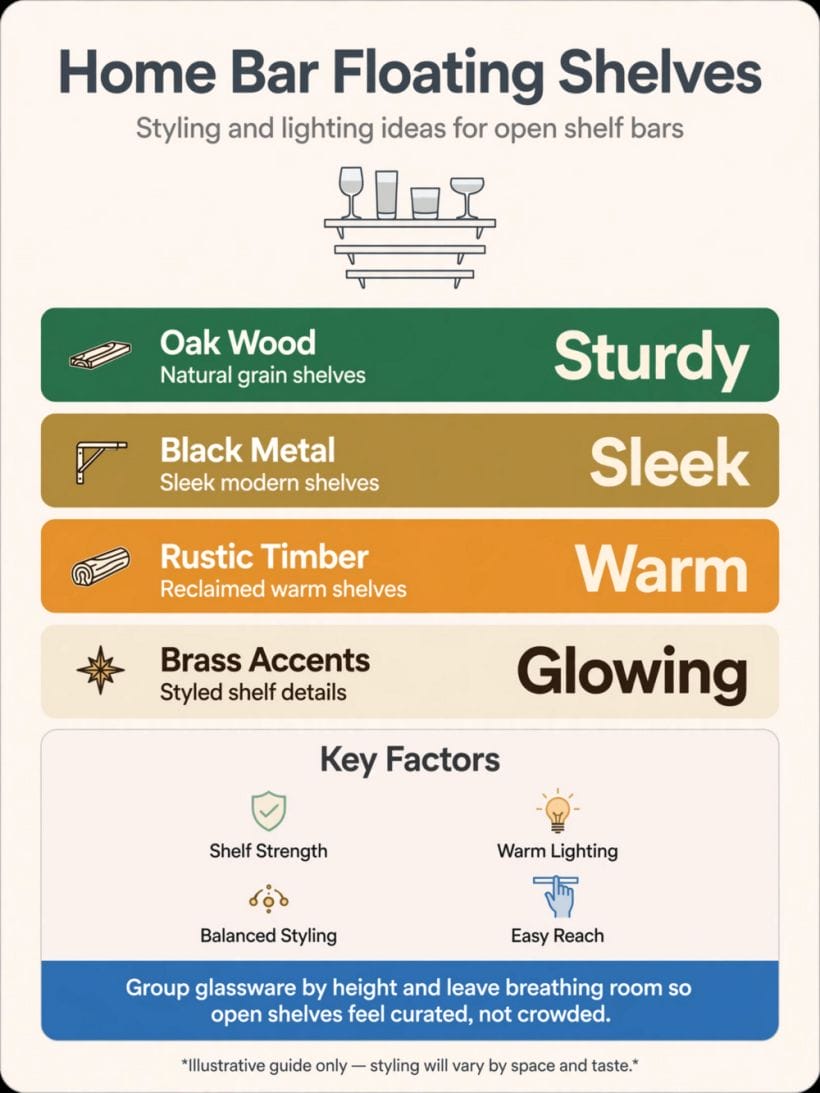
2. The Classic Run: Shelves Over a Counter
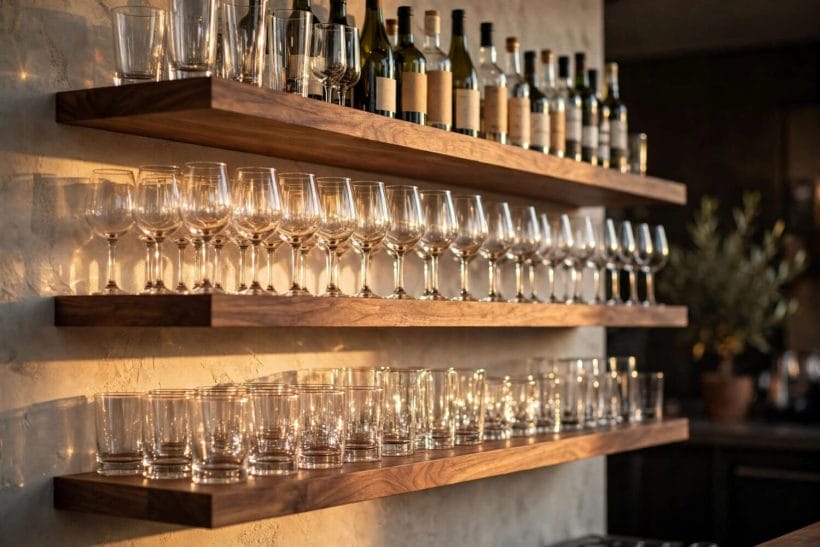
The arrangement every real bar teaches: a work counter below, shelves above, everything visible and reachable. Get this run right and the rest of the bar is decoration.
1. Run two shelves over a straight counter
The canonical layout — glasses and everyday bottles on the lower shelf, the tall and the special above. Two runs give the bar its rhythm without crowding the wall.
2. Keep the lower shelf at pouring reach
The working shelf should meet the hand, not the stretch. Bottles in daily use live where they can be lifted down in one motion, without reaching over the glassware.
3. Centre the shelves on the counter, not the wall
Composition follows the furniture, not the architecture. A run centred on the counter looks deliberate even on a wall that runs on emptily to one side.
4. Leave a tall gap for the tallest bottle
Measure the collection’s giants before fixing anything — the shelf spacing is set by the tallest bottle you own plus the hand that lifts it. Future bottles will thank present honesty.
5. Extend the run the full width of the bar
End-to-end shelving reads as architecture; a short run reads as an afterthought. If the bar is long, let the shelves commit to its length.
6. Step the shelves around a corner
An L-shaped run follows the bar into its corner, doubling display without doubling wall. Mitred or butted, the corner shelf is where the best bottle earns its spotlight.
7. Add a third, higher shelf for display only
Decanters, the antique shaker, the bottle too beautiful to open — the top shelf is the bar’s gallery, styled rather than used, and lit accordingly.
8. Break the run with a mirror or art panel
A gap in the shelving, backed by mirror or a framed print, rests the eye and reflects the glow. Continuous bottles wall-to-wall can read as stockroom; a pause makes it a bar.
9. Under-run a rail for hanging glasses
Stemware racks beneath the lowest shelf keep glasses dust-light, visible and in the pouring path. The rack and the shelf together are the home bar’s handshake.
10. Keep the counter below the shelves clear
The counter is the stage the shelves perform over: board, shaker, ice, one bowl of citrus. If the worktop crowds, the shelves above look like storage instead of display.
11. Match the counter’s edge to the shelf material
Same timber, same stain family, or a deliberate metal echo — the eye ties counter and shelves into one piece of furniture when their materials rhyme.
3. Shelf Materials: Oak, Walnut, Metal, Glass and Stone
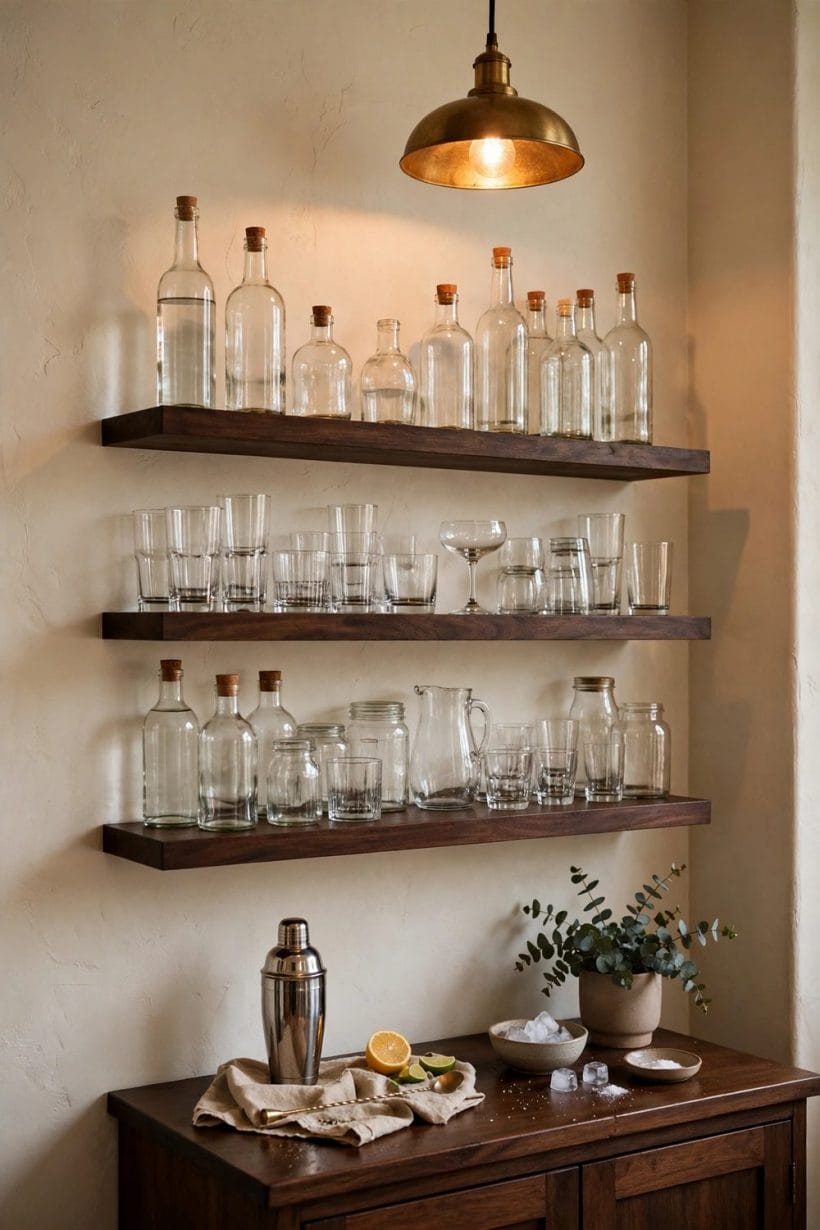
Material decides the shelf’s character and its honesty about load. Thick timber is the classic; glass is the modern lightener; metal is the industrial note. All of them must be fixed like they mean it — the fixings section below is not optional reading.
12. Choose thick oak for the traditional run
A deep, chunky oak shelf carries the eye and the bottles with the same confidence. Its grain warms every spirit colour behind glass, and it ages like the bar itself should.
13. Go dark with walnut for a cocktail mood
Walnut’s depth turns a shelf run into evening. Against a pale wall it is smart; against a dark wall it is a speakeasy. Either way, brass and amber glow against it.
14. Use reclaimed timber for a story per shelf
Old joists and scaffold boards bring dents, stamps and saw marks no new board can fake. Seal them well — bar shelves meet splashes — and let the history show.
15. Pick live-edge boards for a rustic bar
The waney edge turns each shelf into a landscape. Live-edge runs suit cabin, lodge and country bars, and they forgive slight irregularities in the wall behind.
16. Float glass shelves for a light, modern bar
Toughened glass vanishes under the bottles, letting light and colour do the display work. It suits small bars and bright rooms, and it wipes clean in a second.
17. Run blackened steel for the industrial note
Slim steel shelves with a matte finish carry a workshop crispness that suits brick, concrete and the industrial home. Their thinness is a lie only the brackets know about.
18. Try a stone or composite shelf for luxury
A marble or stone-look shelf over a serious counter is the hotel bar translated home. Heavy, cool and permanent — a decision to make once the layout has proved itself.
19. Mix materials by height
Timber low, glass high; or steel for the working shelf, wood for the gallery. Mixed runs feel collected rather than catalogued, provided one material clearly leads.
20. Paint the shelves into the wall
Shelves in the wall’s own colour recede, and the bottles become the entire exhibit. It is the quietest treatment in this list and one of the most elegant.
21. Deepen the shelf where bottles stand two rows
A display shelf and a storage shelf are different depths. Size each to its job — shallow for single-file display, deeper where the reserves queue behind.
22. Edge the shelf with a brass or timber lip
A slim upstand or a brass rail along the front edge is insurance against the sliding bottle and a visual finish in one. On glass shelves, a polished edge does the same work.
4. Lighting the Shelves: Strips, Spots and Glow
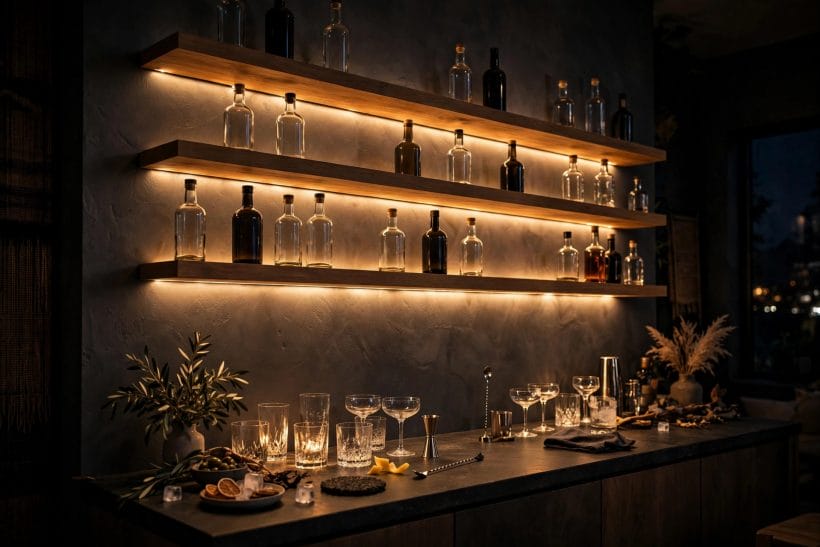
Bars are evening rooms, and shelf lighting is what turns storage into theatre. The rule is simple: light the bottles, hide the source, and keep the colour warm.
23. Run a warm strip under each shelf
The under-shelf strip is the bar-lighting classic — it grazes the bottles below, pools light on the counter and asks for nothing but a channel to hide in.
24. Back-light through a frosted panel
A glowing panel behind glass shelves turns every bottle into a lantern. It is the back-bar trick of grand hotels, scaled down to a single wall.
25. Spot the gallery shelf from above
One or two small ceiling spots aimed at the top shelf make the treasured bottles perform. Keep the beams tight; a flooded wall flatters nothing.
26. Put the shelf lights on a dimmer
Full light for mixing, low light for drinking. The dimmer is the cheapest atmosphere upgrade a bar can buy, and shelves are where it shows most.
27. Light the glassware, not just the bottles
Glasses sparkle from light above or behind; a strip set forward of the glass run makes the everyday shelf look like a jeweller’s window.
28. Use picture lights over a short run
For a two-shelf bar, a pair of picture lights treats the whole arrangement as art — a good answer where channels and strips cannot be hidden.
29. Keep light colour consistent with the room
Warm shelves in a cool-lit room look like a shop window pasted on. Match the tone of the home’s evening lighting and the bar belongs to the house.
30. Hide the cables like you mean it
Routed channels, trunking painted in, drivers tucked into the cabinet below. Visible cables are the one detail that demotes a floating shelf from architecture to DIY.
31. Add a lit niche for the mixing station
A small illuminated recess where drinks are actually made keeps the work zone bright while the display runs stay moody — theatre and workshop at once.
32. Let candles and lamps finish the job
Shelf light is the base layer, not the whole evening. A lamp at the bar’s end and flame somewhere low give the glow its depth.
33. Test the lighting before the final fixing
Strips tacked up temporarily for one evening will tell you more than any plan — where the glare hits, which bottles go dark, and whether the gallery shelf earns its spot.
5. Styling the Shelves: Bottles, Glassware and Order
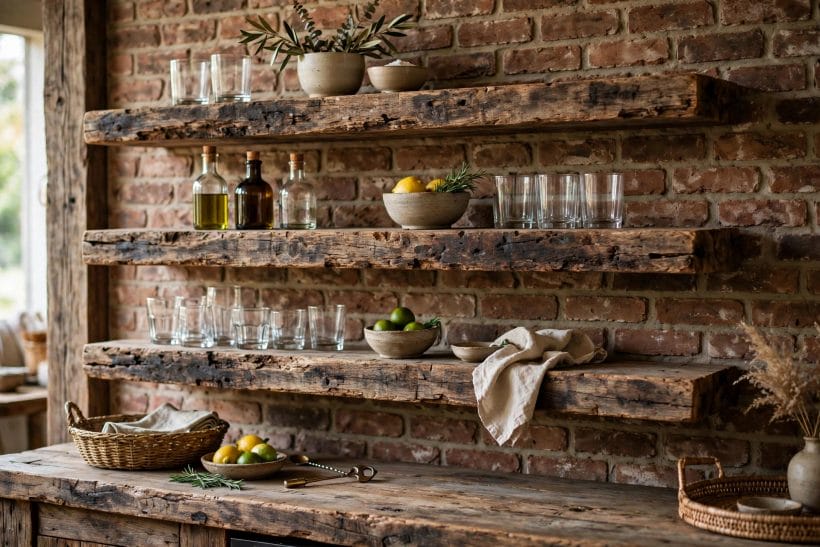
A bar shelf is edited like a shop window by someone who drinks. Grouping, breathing room and one or two beautiful objects separate the collection from the cupboard — and the compact end of this thinking is the small home bar, where every shelf must argue for its contents.
34. Group bottles by family, not alphabet
Whiskies together, gins together, the clear and the amber in their regiments. The eye reads families as order even when the count is generous.
35. Give the best bottle the eye-level centre
Every collection has a flagship. Placing it at the composition’s centre, with air around it, makes the whole run look considered.
36. Work in odd numbers and varied heights
Threes and fives, tall beside short, a decanter breaking the bottle line — the arranger’s oldest rules are oldest because they always work.
37. Decant the everyday into beautiful glass
A decanter or two lifts the shelf’s register and hides the supermarket label among the distinguished. What is poured nightly deserves the promotion.
38. Row the glasses like they are on parade
Glassware in files, rims even, types together. Nothing else on a shelf signals a serious bar as quickly as disciplined glass.
39. Leave breathing room on purpose
An empty hand’s width here and there is styling, not shortage. Shelves crammed to the last centimetre read as storage in every material and at every budget.
40. Add one non-drink object per shelf
A small plant, a framed menu, a brass jigger stand, a stack of cocktail books lying flat — the single foreign object is what makes the shelf a composition instead of an inventory.
41. Put the tools on show
Shaker, strainer, bar spoon and measure in a crock or on a tray at the counter’s end, under the shelves’ light. Working tools displayed are the bar’s credentials.
42. Keep labels facing, mostly
A shelf of turned labels looks fussy; a shelf of bottles at natural angles looks lived in. Straighten for photographs, relax for life.
43. Rotate the display with the season
Dark spirits forward in winter, the bright and botanical in summer. A shelf edited twice a year never needs redecorating — it is the decoration, refreshed.
44. Cap the collection at the shelves’ honest capacity
When a new bottle arrives and nothing can leave, the bar has outgrown its shelves. The floating run is a frame; the picture stays good only while the frame fits.
6. Small Bars, Corner Bars and Borrowed Walls
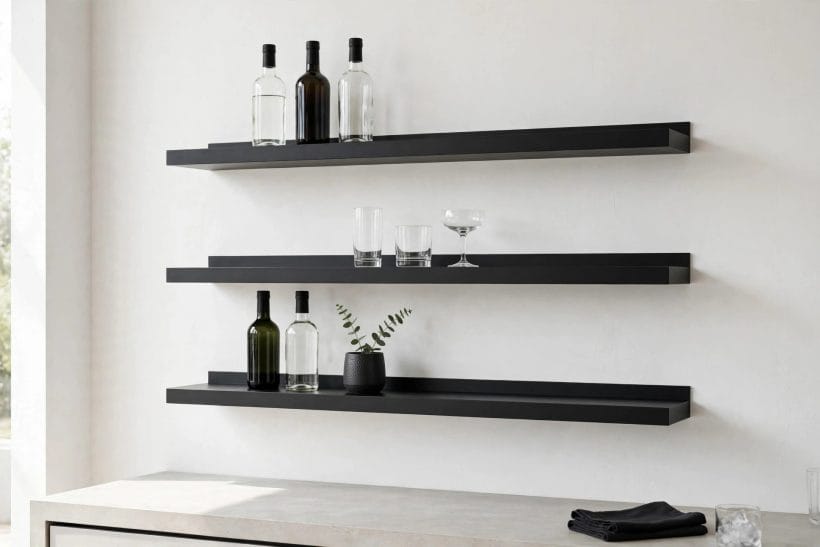
Floating shelves are the small bar’s best friend: no footprint, full display, and a bar that folds into a wall when the party ends. The no-sink counter version of the idea is the dry bar; here the shelves do the same space-saving work vertically.
45. Make a bar of one short wall
Two shelves, a narrow counter or a cabinet below, stools that tuck under. A wall the width of a door becomes the house’s favourite destination.
46. Float the shelves over a sideboard
The classic small-bar formula: a closed cabinet for the stock, open shelves for the show. Closed below, open above is how small bars stay tidy.
47. Take the corner nobody uses
A stepped corner run gives a forgotten angle a purpose. Corner bars serve the room from its edge and leave every wall’s centre free.
48. Build a bar into a wide hallway niche
Hallways near dining rooms hold depth nobody misses. Shelves, a slim counter and a pendant turn a passage into the house’s smallest room.
49. Use one long shelf as a micro bar
A single generous shelf — bottles, glasses, tools in a row — over a tray table or a trolley. The smallest honest bar in this list, and often the most used.
50. Shelf over a radiator-free stretch of kitchen wall
Bars near kitchens borrow ice, water and glass-washing without plumbing of their own. The breakfast room’s end wall is the usual, willing site.
51. Let shelves define the bar in an open-plan room
Where no wall divides, a shelved section of the long wall announces the bar zone. Add a rug and a pendant and the room gains a room.
52. Stack shelves up a stair wall
The rising wall over a staircase flight is display space going begging in many houses; a stepped run of short shelves climbs it beautifully — for looking at, with the working bottles kept at the bar itself.
53. Float shelves over a bar cart’s parking spot
The cart rolls out for parties; the shelves hold the permanent display above its home base. Together they are a bar that expands on demand.
54. Keep small-bar shelves shallow
In tight quarters depth reads as bulk. A single-file shelf keeps the display, loses the intrusion and makes every bottle reachable.
55. Give the guest-room corner a shelf of welcome
Water, glasses, a bottle and two tumblers on a single shelf turn a spare room hospitable — the hotel gesture, at home scale.
7. Heights, Depths and Safe Fixings
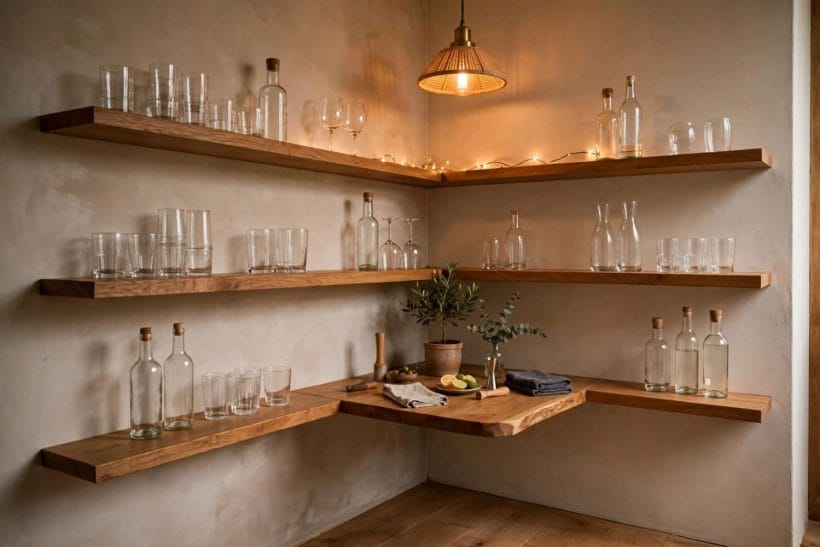
This is the section the whole post depends on. Bottles are heavy, glass is unforgiving, and a floating shelf is only ever as good as what it is screwed into — the discipline the full basement build in the basement bar applies to its joinery applies here to a single board.
It is worth pausing on why floating shelves, of all bar furniture, demand this respect. A cabinet carries its load down through its own body to the floor; a floating shelf hangs its entire burden on a hidden frame and a handful of fixings, in tension, forever. The engineering is well understood and the hardware is excellent — rod brackets and internal frames are made for loads far beyond a row of bottles — but the chain is only as strong as its last link, and the last link is the wall itself and the care of whoever drilled it. None of this should frighten anyone off; it should simply reorder the project. In every other section of this post the order of decisions runs from looks to logistics. Here it runs the other way: find the structure, choose the bracket, prove the load, and only then cut the beautiful board to length.
56. Fix into studs or sound masonry, always
Timber studs, brick or block will hold a bar’s worth of bottles; plasterboard alone will not, and no anchor marketing changes that for a loaded shelf. Find the structure first, then design the run around it.
57. Choose brackets rated well past the load
Hidden rod brackets and internal frames carry floating shelves. Pick a system whose stated rating clears your fullest shelf with room to spare — a row of full bottles is heavier than it looks.
58. Count the load before you style it
Weigh the shelf’s intended contents honestly — bottles, glasses, the shelf itself — and let the number choose the brackets. Guessing is how shelves learn to sag.
59. Set the working shelf between waist and shoulder
Bottles should be lifted down, never reached for on tiptoe over glassware. The display shelf can go higher; the working shelf stays in the body’s comfortable zone.
60. Leave head clearance over standing drinkers
Shelves over a counter where people stand need height that clears heads and raised glasses alike. Sit the seating, stand the standing, and measure both against the lowest shelf.
61. Space shelves by bottle families
One run tall enough for the tallest spirits, one closer run for glasses and short bottles. Uniform spacing wastes the wall; family spacing uses every centimetre honestly.
62. Keep depths honest to the contents
A shelf deeper than its bottles invites double-parking and dust; a shelf shallower than a bottle’s base is a hazard. Measure the collection, then cut the board.
63. Level twice, drill once
A floating shelf one degree out advertises itself in every photograph and every poured drink’s meniscus. Long levels, marked studs, and patience are the whole technique.
64. Add a retaining rail where life is lively
Homes with football in the garden and dancing in the kitchen should give low display shelves a slim front rail or lip. It costs nothing visually and saves the irreplaceable bottle.
65. Recheck fixings as the collection grows
Shelves loaded gradually creep gradually. A yearly hand on each shelf — a press, a look at the wall line — catches the millimetre that precedes the disaster.
8. Backs, Mirrors and Backing Panels
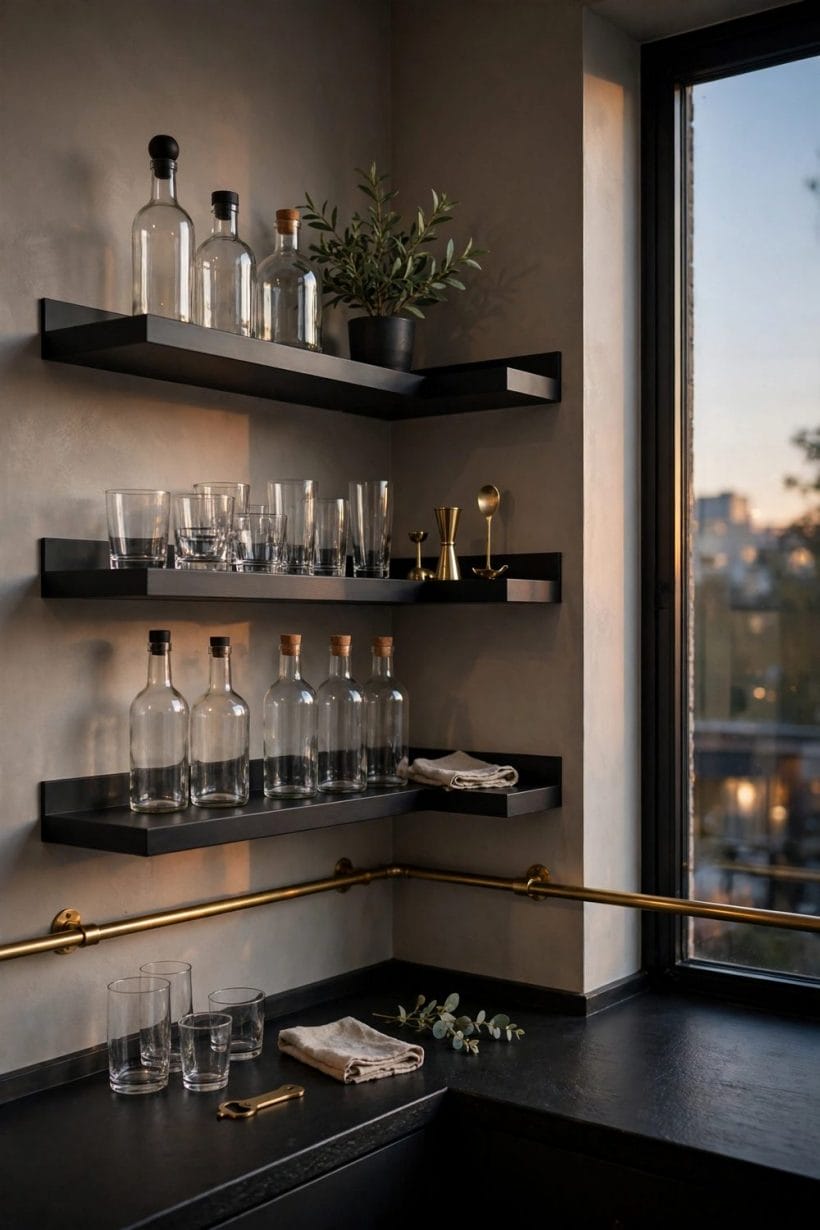
The wall behind the shelves is half the display. Mirror doubles the collection, dark paint deepens it, and timber warms it — the backing is where a good run becomes a great one.
66. Mirror the wall behind the shelves
The oldest back-bar trick there is: every bottle twice, every light doubled. Antique or smoked mirror softens the multiplication into a glow.
67. Paint the backing deep and matte
Ink, forest or oxblood behind pale shelves makes bottles silhouette like stock in a painting. It is also the cheapest transformation in this entire post.
68. Panel the backing in timber
Boards or slats behind the run give the bar a cabin or a clubhouse warmth, and they hide a multitude of wall sins between the shelves.
69. Tile the splash zone only
Behind the counter, below the first shelf, a tiled or stone splashback takes the splashes while the upper wall stays painted — practical exactly where it needs to be.
70. Hang art between the shelves
A framed print in a deliberate gap ties the bar to the room’s other walls and gives the eye a rest between bottles — the pause that makes the display read as taste.
71. Wallpaper the backing for pattern at no depth
A bold paper behind glass or timber shelves gives the bar a designed backdrop flat against the wall — particularly good in rented homes where the shelves themselves are the only fixings.
72. Leave one section of backing bare
An unbacked stretch of plain wall among mirrored or panelled sections keeps the composition breathing. Bars, like shelves, need their rests.
73. Run the backing into a full bar wall
When the shelves, backing and counter are composed as one elevation, the bar stops being furniture against a wall and becomes the room’s architecture — the endgame of everything in this post.
74. Backlight a frosted panel as the only backdrop
For the minimal modern bar: glass shelves, a glowing panel, nothing else. The bottles become silhouettes and the whole wall becomes the lamp.
75. Let the backing carry the colour story
If the room is pale, let the bar’s backdrop be its one deep note — the shelves and bottles will hold the colour the way a frame holds a picture.
9. Checks and Mistakes: What Brings Shelves Down
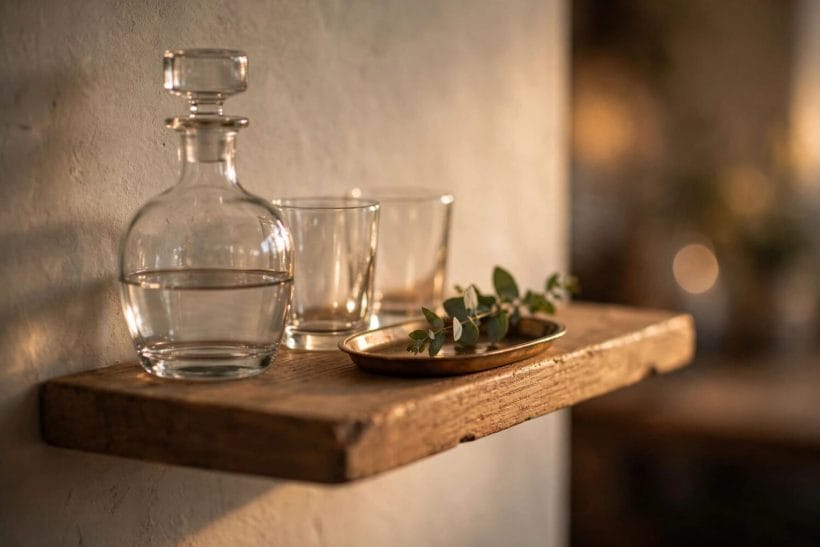
The failures are famous because they are repeated. Fixings into plasterboard alone are the first and worst: a shelf of full bottles is a serious load, and it grows bottle by bottle until the day the wall lets go — structure first, always, with brackets rated beyond the fullest shelf you can imagine. The second failure is spacing by eye: shelves fixed before the collection is measured, leaving the tall bottles homeless and the glasses rattling in a too-tall gap. Third is light without thought — strips visible from the sofa, glare in the drinker’s eyes, cables trailing like an afterthought. Fourth is styling without editing, the stockroom shelf, where a good collection disappears into its own crowding. And the last is forgetting the room around the bar: a floating-shelf bar is a feature in the man cave tradition as much as in a dining room, but wherever it lives, the seats, the light and the route to the kitchen decide whether it is used weekly or admired monthly. The fix for all of it is the same: measure the bottles, find the studs, light a test evening, and edit until the shelf looks inevitable. A novelty corner like the home coffee bar makes the same point at breakfast scale — shelves work where they are honestly fixed and honestly filled.
10. Costs and Pulling It Together
The money ladder is honest here. The modest end is a painted timber shelf on sound brackets over an existing cabinet — mostly timber, fixings and a weekend. The middle is solid hardwood runs with hidden lighting, where the boards, the electrical tidiness and the backing finish share the bill. The top is stone, glass and backlit panels with a composed bar wall, where materials and skilled fitting dominate and the design should be settled before anything is drilled. Across every rung, the wrong economy is the bracket: it is the cheapest component in the whole arrangement and the only one whose failure is total. Spend there first, light second, and let the timber be as humble as the budget requires — a well-fixed plain shelf outlasts a sagging beautiful one.
Pull the design together by choosing the run’s length from the wall, its spacing from the bottles, its material from the room, and its light from the evening you want to drink in. The shelf is simple; the thinking is the craft.
Final Considerations
A floating shelf is a small piece of trust between a wall and a collection. Fixed honestly and styled with restraint, it turns the bottles a household already owns into the room’s best decoration.
Measure twice, fix into structure, light it warm — and raise the first glass to the bracket nobody can see.

0 Comments