
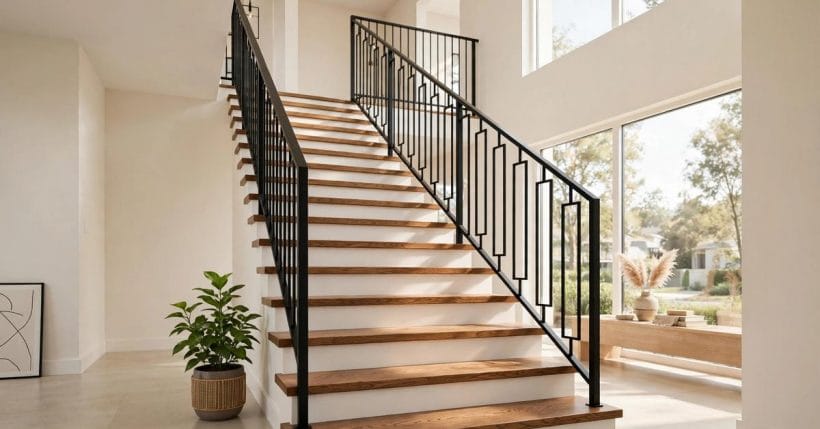
The carpeted staircase is the default nobody chose: it came with the house, it matches nothing, its tread noses are going bald, and it holds the dust of a decade in the one place a vacuum cannot properly reach. Lifting it feels drastic only until the alternatives are laid out — there are twelve good ones.
This article carries all twelve: bare and painted finishes that show the stair itself, runners and partial coverings that keep carpet’s grip and quiet in a smarter dose, and new surfaces — cork, rubber, tread caps, tiled risers — that give the flight a fresh working skin.
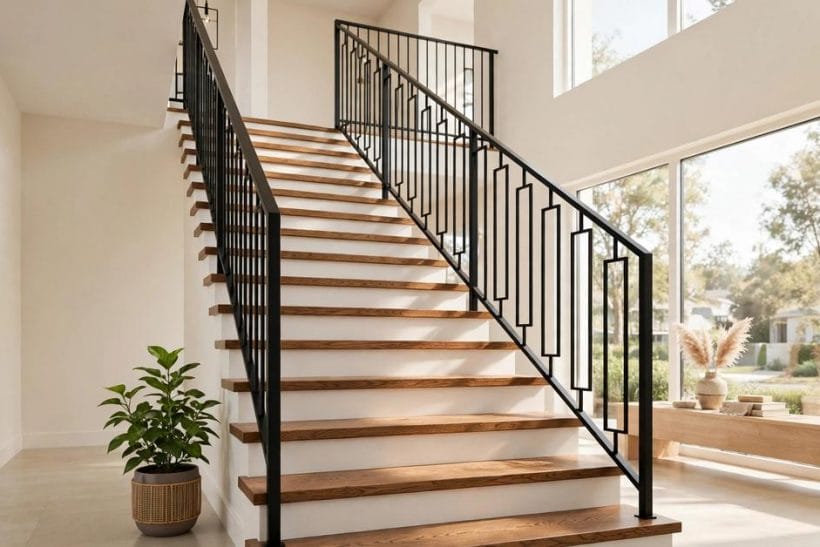
1. Carpeted Staircase Alternatives at a Glance
A carpeted staircase can be replaced by anything that covers three jobs the carpet was doing: grip for the feet, quiet for the house, and warmth underfoot — plus the fourth job nobody lists, which is hiding the treads. The alternatives divide by how much of the stair they show and how much of the carpet’s softness they keep, and the right choice is the one whose ledger of grip, noise, upkeep and reversibility fits the household climbing it daily.
| Question | Short answer |
|---|---|
| What is the best all-round alternative to stair carpet? | A fitted central runner over painted or bare treads: carpet’s grip and quiet where feet land, the stair’s architecture visible at the edges, and a covering that can be lifted, cleaned and replaced on its own. |
| Can you just paint a staircase instead? | Yes — one colour over treads, risers and string is the classic cover for wood that is sound but ugly. Use a paint made for floors, and expect to recoat the tread centres as they wear. |
| What is the quietest hard alternative? | Cork: warm, springy, naturally grippy and nearly as silencing as carpet, with a surface that sweeps and washes clean. |
| What suits a house with dogs and muddy boots? | Rubber or linoleum treads, or natural-fibre covering — washable or brushable, hard-wearing, and honest about the traffic they serve. |
| Which alternatives can a renter use? | The reversible ones: individual tread pads, a runner with rods, and cork or fibre coverings that lift away — all removable in an hour without touching the stair beneath. |
2. First, What the Carpet Is Doing
Stair carpet is never only decoration. It warms cold treads, quietens a staircase that would otherwise drum through the house, gives feet — especially small, elderly and four-legged feet — their grip, and, in a great many houses, it hides treads that were never meant to be seen. Any honest alternative has to replace those jobs, not just the look.
People lift stair carpet for understandable reasons: it wears bald on the tread noses first, it holds dust and allergens in the one place they cannot be vacuumed well, its pattern dates a hall faster than any other surface, and underneath it there is sometimes a staircase worth showing. The wider staircase field — layouts, rails and forms — is surveyed in staircase ideas; this article stays on the treads themselves.
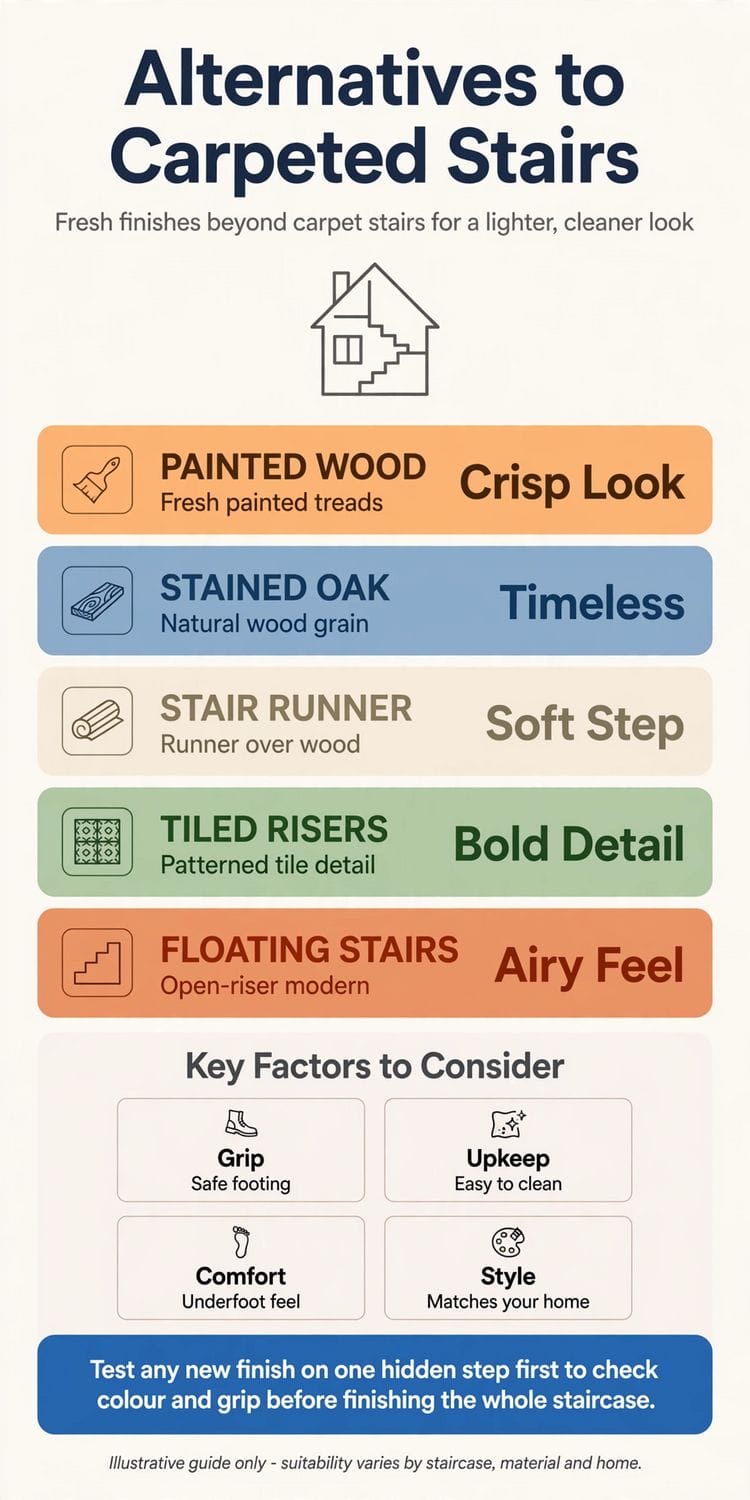
The twelve alternatives that follow divide into three families: bare and painted finishes, which keep the stair itself visible; runners and partial coverings, which keep some of carpet’s softness; and new surfaces and tread treatments, which give the stair a fresh working skin. Every one is a real, buildable answer — none requires a new staircase.
One more truth before the twelve: carpet forgives a staircase its sins in a way none of these will. A flight that creaks, flexes or carries a damaged tread will announce all three the day the carpet lifts. The alternatives reward a sound stair and expose a tired one, so the honest first step is the assessment this article returns to later — an hour with a lifted corner and a torch, before any money follows the idea.
3. Bare and Painted Finishes: The First Four Alternatives
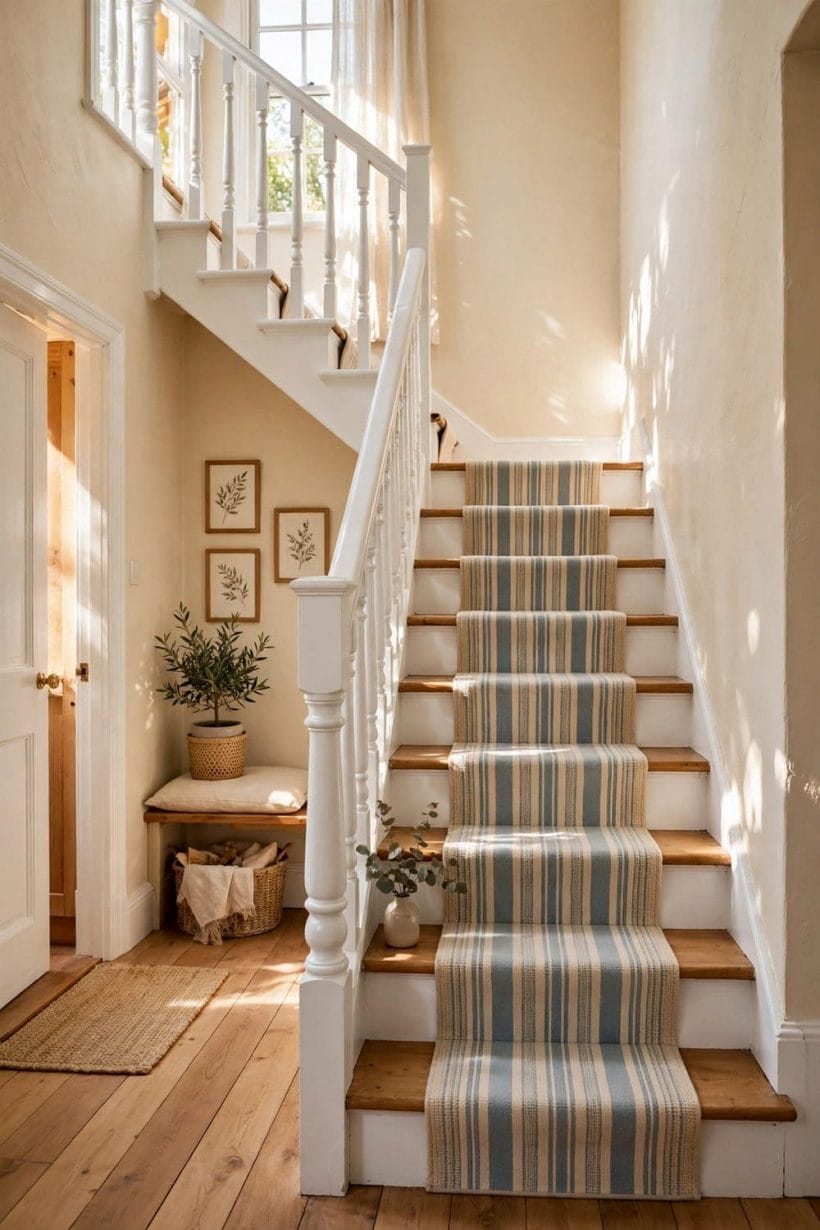
The first family assumes the staircase underneath deserves daylight — or can be made to. The treads’ own material is the theme of wooden staircase design; here the wood is simply the one already in the house, uncovered and judged.
1. Strip back to bare wood and oil it
The original uncovering: lift the carpet, remove the gripper rods and staples, fill, sand and oil or wax the treads. Pine that was laid as a paint-grade stair often has grain worth showing, and a hard-wearing oil keeps it warm-toned and repairable. It is the cheapest alternative and the most revealing — every flaw the carpet hid becomes the finish’s character.
2. Paint the whole staircase in one colour
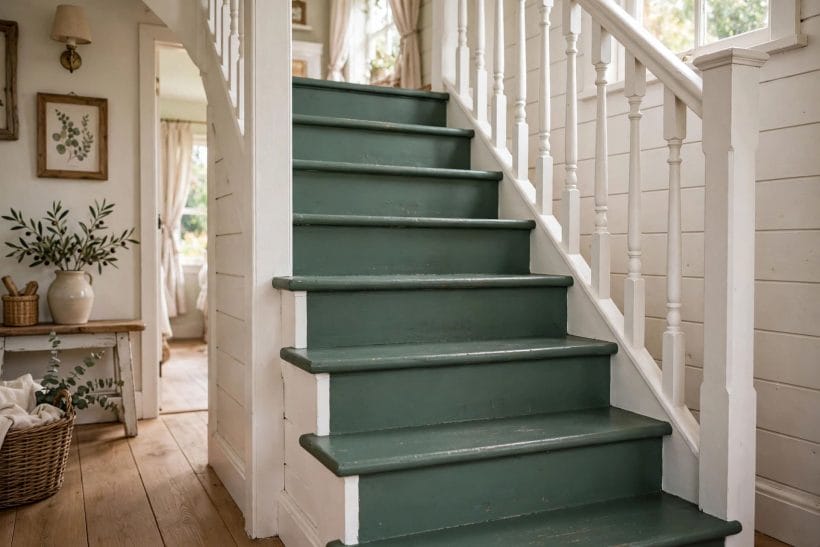
Where the wood is patched, stained or plain ugly, paint is the honest cover: treads, risers and string in a single hard-wearing floor paint. One colour turns a shabby stair into a deliberate object, and dark tones hide the scuffs of the house’s busiest route. Expect to recoat the tread centres as they wear — the price of the look, budgeted in.
3. Paint the risers, keep the treads wood
The two-tone classic: risers painted — white for light, or a deep colour for drama — with the treads left oiled or varnished wood. The eye reads the warm tread it steps on and the crisp riser it faces, and wear lands on the surface best able to take it. It suits period houses especially, where the stair’s bones are good and its faces are plain.
4. Whitewash or limewash the treads for a pale, soft finish
A wash thins the paint to a veil: the grain shows through, the tone turns pale and coastal, and the stair brightens a dark hall without the starkness of full white paint. It is the gentlest of the bare finishes and the easiest to renew — another coat restores it in an afternoon.
4. Runners and Partial Coverings: The Middle Four Alternatives
The second family keeps the carpet’s virtues — grip, quiet, warmth — in a narrower, smarter dose. A runner is also the strongest design statement a staircase can make, drawing the eye up the flight like a red carpet in a house that has earned one.
5. Fit a central runner and show the treads at both sides
The halfway answer that is usually the best answer: a woven runner down the flight’s centre, with painted or bare treads visible at each edge. The feet get carpet’s grip and quiet exactly where they land; the house gets the stair’s architecture back; and the runner, being a separate piece, can be lifted, cleaned and one day replaced without touching the stair.
6. Dress the runner with stair rods as a deliberate feature
Rods at the base of each riser began as fixings and became jewellery. In a dark or brushed metal they turn a plain runner into a tailored installation, and they suit the runner over painted treads especially — the combination is the classic hall’s signature. Choose rods as a finish you will see daily, because you will.
7. Cover each tread with individual pads or carpet tiles
Tread-by-tread covering — a shaped pad or tile on each step, risers left bare — gives most of the grip and much of the quiet with the least upheaval. Individual pads can be lifted for washing and replaced singly when one wears, which on a staircase is always the third tread from the bottom. Best where the household wants softness but not a fitted carpet’s commitment.
8. Run natural fibre — sisal, jute or coir — as the covering
Plant-fibre coverings bring a dry, textured, unmistakably natural note that wool carpet cannot imitate, and they wear like rope. Fitted as a runner or tread pads, they suit halls with garden doors and houses that prefer texture to pattern. They are firmer underfoot than pile — a virtue for grip, a matter of taste for bare feet at midnight.
5. New Surfaces and Tread Treatments: The Final Four Alternatives
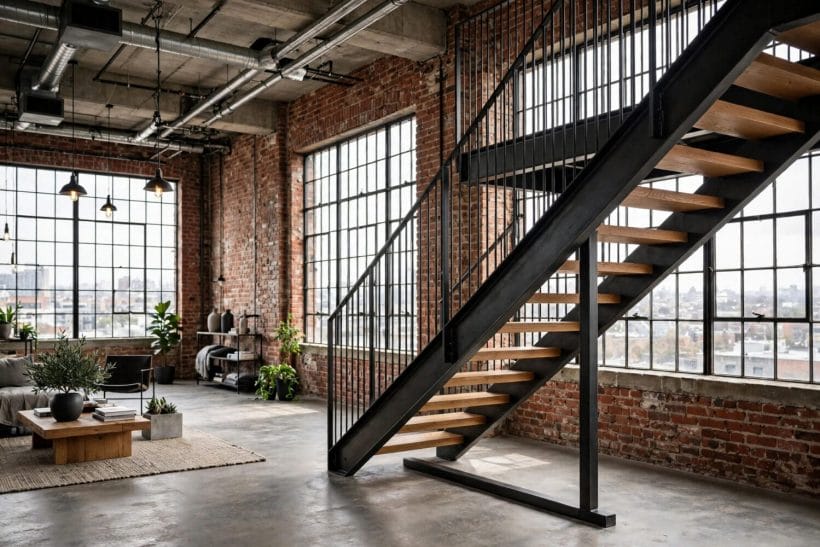
The third family gives the stair a new skin altogether — materials that arrive flat, hard-wearing and washable, several of them borrowed from the contract world. The contemporary end of this thinking meets modern staircase ideas, where the covered stair is a designed surface rather than a found one.
9. Cap the treads with laminate or engineered-wood overlays
Tread caps — shaped covers in laminate or engineered timber that fit over the existing steps — give a worn stair a brand-new wooden face without rebuilding it. The noses arrive finished, the colour choice is wide, and a competent fitter can transform a flight in a day. It is the alternative for stairs whose shape is good and whose surface is beyond paint’s help.
10. Lay cork on the treads for warmth and quiet
Cork is the stair covering nobody expects and everybody’s feet approve: warm, springy, naturally grippy and astonishingly quiet — it silences a staircase the way carpet does, with a surface that sweeps clean. Sealed for duty, it suits households choosing between carpet’s comfort and wood’s hygiene and wanting both.
11. Fit rubber or linoleum treads for a washable, hard-wearing skin
Rubber and linoleum — the classic coverings of schools, studios and ship decks — bring colour, grip and near-indestructible wear to a domestic stair. In sheet, tile or tread form they read modern and deliberate, shrug off muddy boots, and wash back to new. For a stair that serves a workshop, a garden door or a pack of dogs, they are the professional answer.
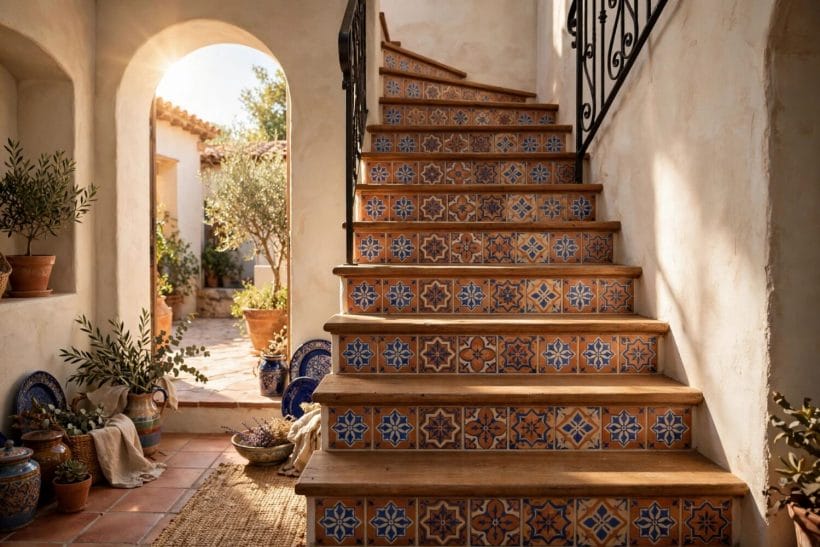
12. Tile the risers and keep wooden treads
The decorative inversion: treads in honest wood, risers faced in patterned or plain tile, so the staircase becomes a gallery of small pictures climbed daily. It suits Mediterranean and eclectic halls, adds a wipeable face where heels strike, and lets a household commit pattern to the surface that never wears underfoot. The treads carry the traffic; the risers carry the art.
6. Safety, Noise and Grip: The Honest Ledger
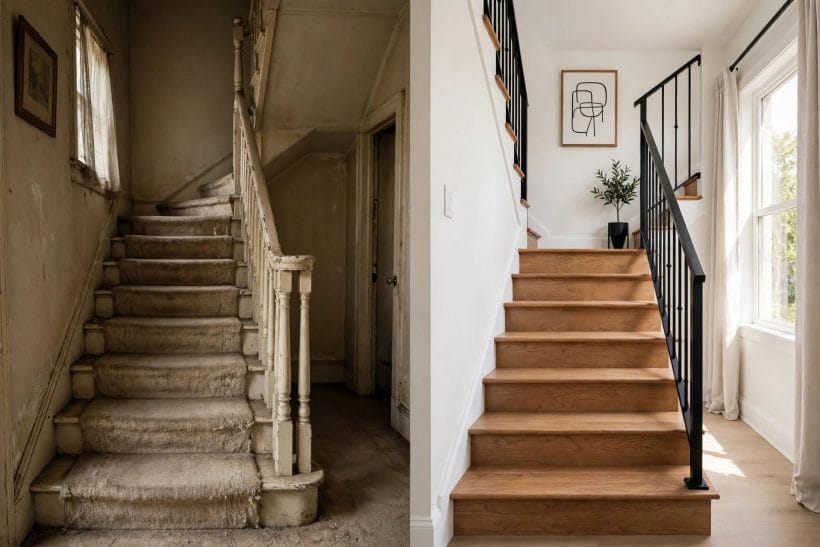
Every alternative changes the stair’s safety arithmetic, and the ledger should be read before the carpet is lifted, not after. Carpet’s grip is real: bare wood, paint and tile are all smoother, and a staircase is the one surface in the house where a slip has a staircase’s consequences.
The mitigations are equally real. Runners and pads restore grip exactly where feet land. Matte and textured finishes grip better than gloss. A sound handrail — its design world is stair railing ideas — matters more than any surface, and lighting that shows each tread’s edge matters nearly as much. Households with toddlers, elders or big dogs should weight the ledger honestly toward the grippy end of the twelve.
Noise runs the other way: hard stairs drum. Cork, rubber, linoleum, runners and pads all quieten a flight; bare painted wood in a tall hall can turn footsteps into announcements. If the staircase rises through the house’s middle, the quiet alternatives earn a premium. Local building rules govern stair dimensions, rails and guards — nothing in this article replaces checking what applies to your home before altering structure or balustrades.
One small detail repays attention in every family: the tread’s front edge. A defined nosing — picked out by a runner’s border, a metal strip on a painted stair, a contrasting tile on the riser below — shows the foot where the step ends. On a staircase used at night and by guests, that legibility is a safety fitting disguised as a design detail.
7. What Lies Underneath: Assessing the Stair You Have
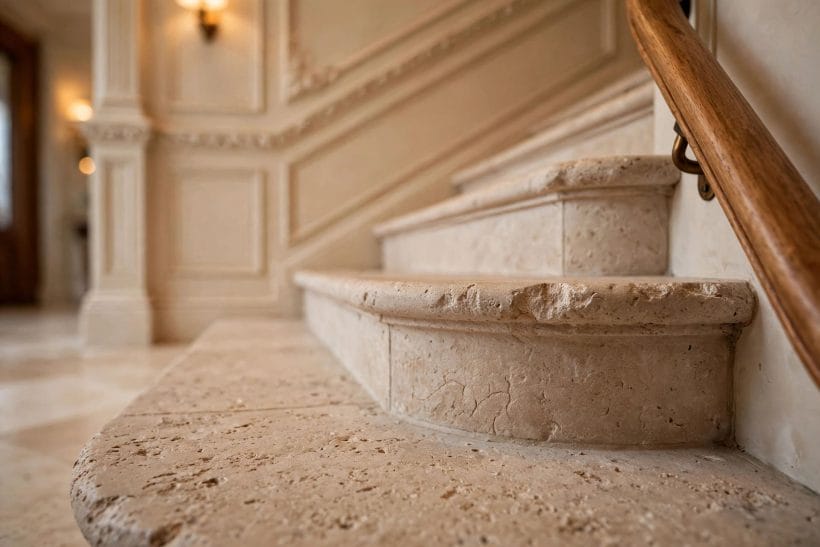
The alternatives divide by a question only the lifted carpet can answer: what is the staircase actually made of, and in what state? Lift a corner first — in a cupboard-under-stairs corner if one exists — before committing to any finish that displays the wood.
Sound, full-width timber treads can take any of the twelve. Treads that are patched, split, or built of paint-grade board point to paint, caps or coverings. A stair with a fine closed string and turned newels may deserve the bare treatment for its architecture alone; a plain boxed flight often looks best painted in one confident colour. The assessment costs nothing but an hour and decides the budget — do it before the carpet is skipped and the point of no return passed.
Look also at the details the carpet has been hiding: the nosing profile, the fit of tread to riser, the state of the skirting where it meets the string. Crisp joinery argues for showing the stair; gaps and filler argue for covering it kindly. And count the staples and gripper rods with respect — their removal, a thousand small extractions, is the true labour price of every bare alternative, and the hour it takes is never the hour estimated.
8. Cleaning and Upkeep, Compared Honestly
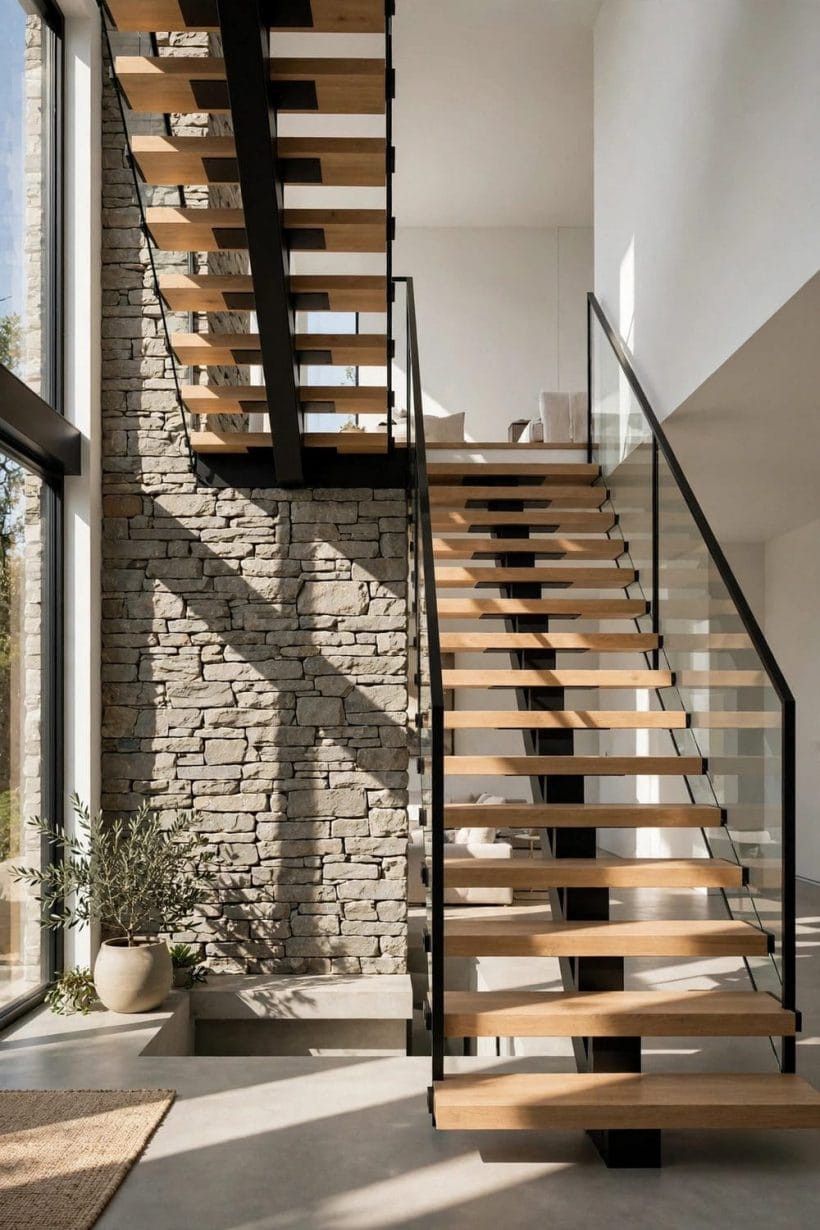
Carpet’s upkeep is familiar: vacuum what can be reached, shampoo what cannot, accept the tread-nose wear. The alternatives mostly trade that for simpler, more frequent care — hard surfaces sweep and wash in minutes, and dirt is seen rather than harboured.
Painted stairs ask for the touch-up pot kept in the hall cupboard and a recoat of the tread centres when they dull. Runners lift for a real clean and can be replaced alone when they tire — the only stair covering with a planned second act. Cork, rubber and linoleum simply wash. Bare wood wants re-oiling on the traffic line as it dries. None of the twelve is maintenance-free; all of them are maintenance you can see, which is precisely why their owners prefer them.
There is also the matter of what the house smells and breathes like. A stair carpet in the middle of the house is a dust reservoir on the landing’s air path; hard and washable alternatives measurably change the hall’s air for households that notice such things. Allergy households, in particular, rarely go back — the staircase is the one carpet whose removal is felt in the breathing within a week.
9. Reversibility, Renting and Resale
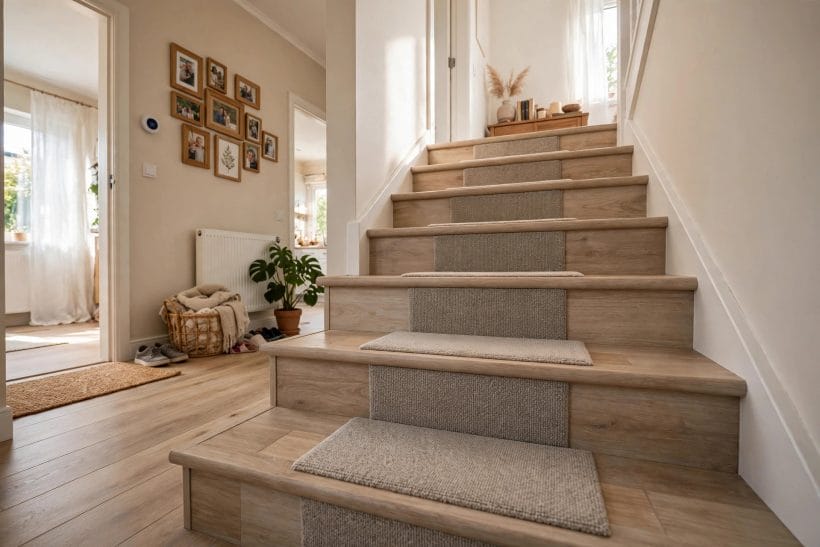
Some of the twelve are weekends; others are commitments. Pads, runners and rods reverse in an hour and suit renters and the undecided. Paint reverses with effort. Caps, tile and fitted surfaces are decisions — handsome ones, but decisions.
For resale, the safest ground is the middle of this article: a well-kept runner over painted treads reads as care to every buyer, while a boldly tiled or rubber-clad stair is a taste a buyer must share. The alternatives that spiral upward in architectural ambition have their own showcase in spiral staircase ideas; for the ordinary straight flight, choose the finish the household will enjoy daily and keep it immaculately — condition persuades more than novelty, on stairs as everywhere else in the home design ideas field.
10. Costs and Pulling It Together
Costs divide the twelve cleanly: paint, washes and your own labour sit at the low end; runners, rods and quality pads in the middle; tread caps, tile work and fitted hard surfaces at the top, where a fitter’s day is part of the price. Against all of them, price the carpet’s own replacement cycle honestly — the alternatives are mostly bought once.
Pull it together by choosing the family first — bare, runner or new skin — and letting every other decision follow: the rail’s finish, the hall’s light, the colour of the risers. A staircase finished in one idea reads as architecture; a staircase finished in three reads as indecision.
Final Considerations
The carpeted staircase persists because it is the path of least resistance, not because it wins any comparison that matters. Grip, quiet and warmth all have better-looking suppliers among these twelve — and several of them are cheaper over a decade than the carpet they replace.
Lift one corner, judge the stair underneath honestly, and choose the alternative whose ledger fits the feet that climb it every day.


0 Comments