

A spiral staircase is the most economical piece of theatre a house can own. It climbs a whole storey inside the footprint of an armchair, it turns every journey between floors into a small ceremony, and it asks only one thing in return: that it be chosen honestly, for the traffic it will really carry.
This page is the spiral’s own survey, inside the wider family gathered on the staircase ideas pillar. The general staircase questions — straight flights, winders, storage beneath — live there; this page keeps to the coil itself: its shapes and materials, its treads and rails, its light and colour, and the daily life it suits and the daily life it does not.
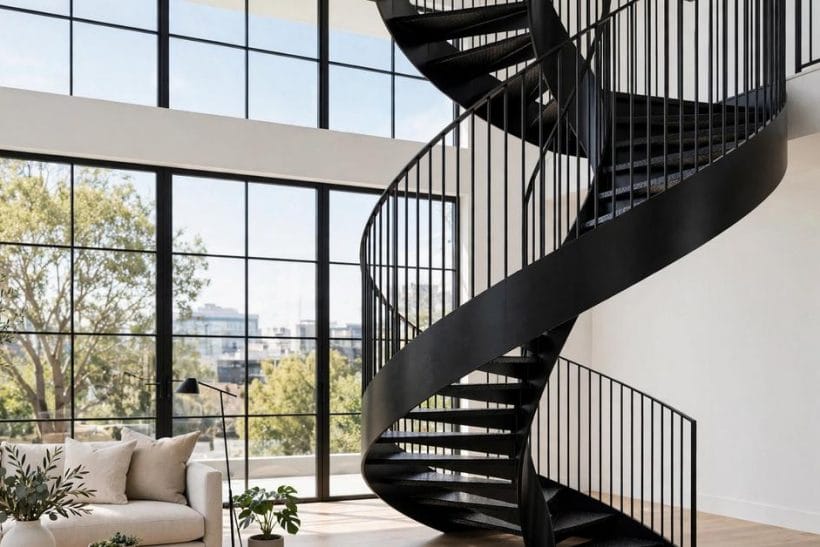
1. Spiral Staircase Ideas at a Glance
A spiral staircase is a stair that winds around a central pole or an open well, its treads radiating like the blades of a fan. Its working parts are the centre — pole or open core — the treads hung or stacked upon it, the balustrade that guards the open side, and the handrail that the climbing hand never leaves. It is the compact member of the stair family, cousin to the modern staircase in its sculptural manners and to every space-saving stair in the small-house tradition.
| Question | Short answer |
|---|---|
| Why choose a spiral over a straight stair? | Room, mostly, and character. A spiral climbs within a circle where a straight flight demands a long rectangle, and it arrives in the room above as a piece of furniture rather than a hole in the floor. What it gives back in space it takes in convenience for carrying large things. |
| Is a spiral staircase comfortable to use daily? | A well-proportioned one is — generous in diameter, even in its rise, with a handrail the whole way. Comfort lives in the walking line, the part of each tread where feet actually fall, and a good spiral keeps that line honest. Headroom and tread comfort are governed by local rules; a reputable maker works to them as a matter of course. |
| Can a spiral be a house’s only stair? | In many homes it serves as the main stair happily, especially where the household is small and the furniture went up another way. Where it is the sole route to bedrooms, think hard about the nightly traffic, the laundry basket and the sleeping child before committing. |
| What does a spiral cost compared with a straight stair? | Kit spirals in steel are among the most affordable stairs a house can buy; bespoke timber or stone-clad coils are furniture-grade commissions. The honest comparison includes the balustrade, the well opening and the finishing, not the kit price alone. |
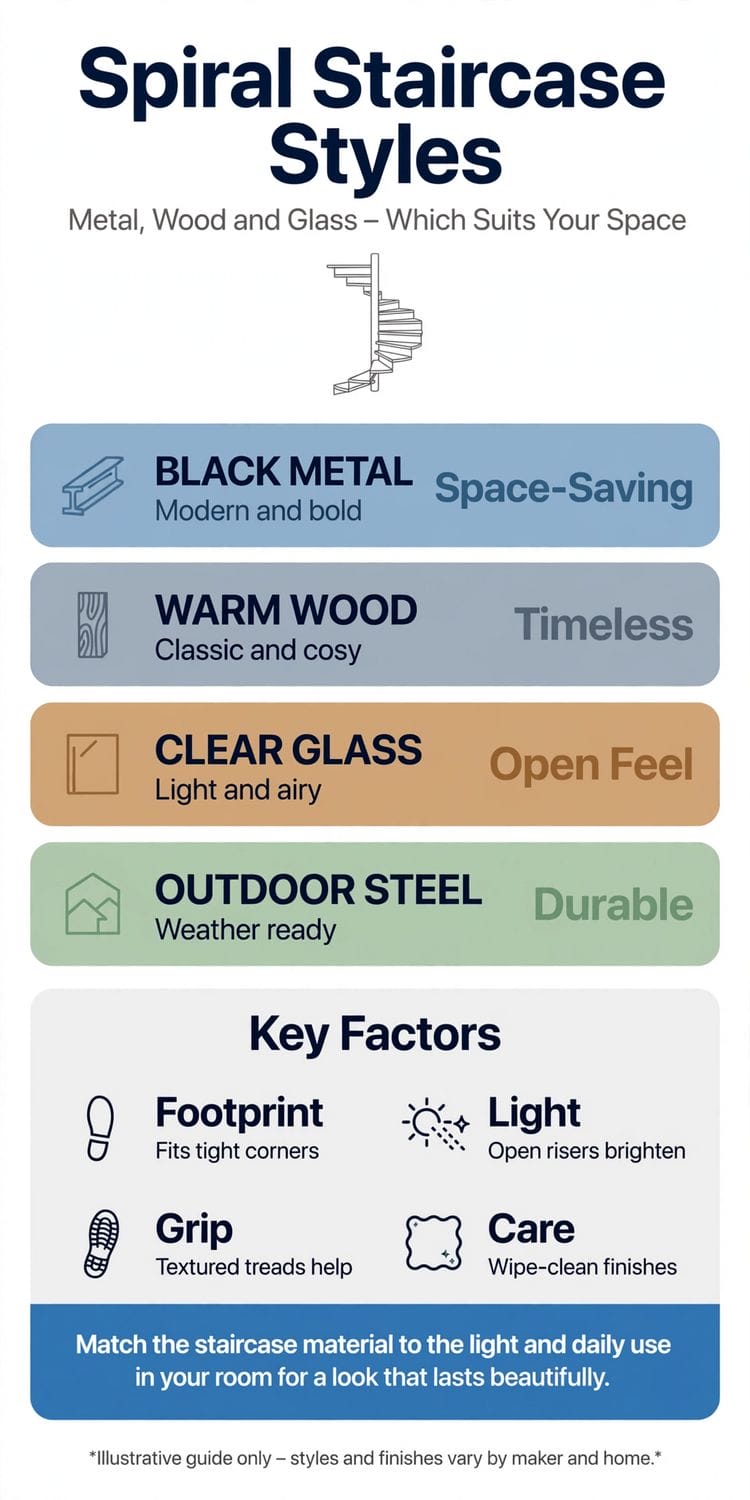
2. Choosing the Spiral: Shape, Direction and Where It Belongs
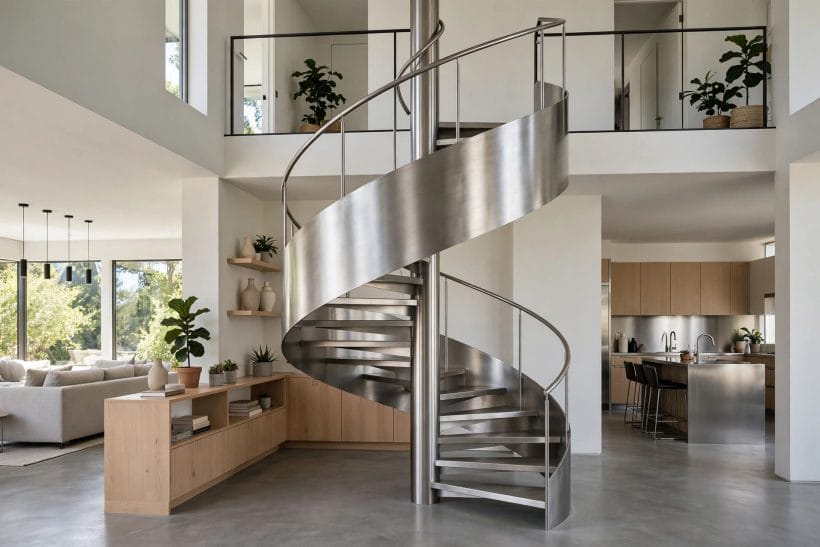
Every spiral begins as a decision about the room it will serve. The coil’s diameter, its direction of turn, and the floors it joins set everything else — material, rail and finish are servants of those first choices. This section settles the geometry before a single tread is ordered.
1. Let the diameter be generous before anything else is beautiful
The single decision that decides a spiral’s whole life is its width. A generous coil walks like a stair; a mean one walks like a ship’s ladder with ambitions.
2. Choose the direction of turn by the rooms, not by habit
A spiral can climb clockwise or anti-clockwise, and the right answer is written by the doors it serves: the turn should deliver the climber facing the room they are entering, not its wall.
3. Set the entry and exit treads where the traffic actually flows
The first tread belongs where the hall’s walking line arrives, and the last where the upper room wants its guests.
4. Give the spiral a well it can be admired from
A spiral is a sculpture the house uses, and it earns a setting: entered from a hall with a sightline to the coil, or rising through a double-height corner where the whole turn can be read.
5. Decide whether it is the main stair or the second stair
The second stair — to a loft, a library gallery, a cellar den — is the spiral’s happiest employment, where its compactness is pure gain.
6. Match the coil’s tightness to the household’s legs
Children, grandparents, the dog and the laundry basket all have votes. A wide, gentle coil serves them all; a tight, steep one serves the young and the unburdened.
7. Plan the well opening before the stair is chosen
The hole in the upper floor is the spiral’s true footprint — round, square or trimmed to the joists — and it is carpentry before it is shopping.
8. Let a spiral rescue a room a straight stair cannot reach
The attic bedroom, the mezzanine study, the garden room below the terrace: rooms written off for want of a stair’s long run are the spiral’s natural conquests.
9. Keep the spiral off the house’s carrying route for big furniture
Sofas, wardrobes and the Christmas tree do not climb spirals gracefully.
10. Give the landing at the top a proper arrival
The last tread should open onto a landing with room to turn, a rail that continues until the feet are level, and light to arrive by.
11. Draw the coil at full size before ordering anything
Chalk the circle on both floors, mark the entry and exit, and walk the ghost of the stair with a basket in your arms.
3. Materials and the Centre: Steel, Timber and the Honest Pole
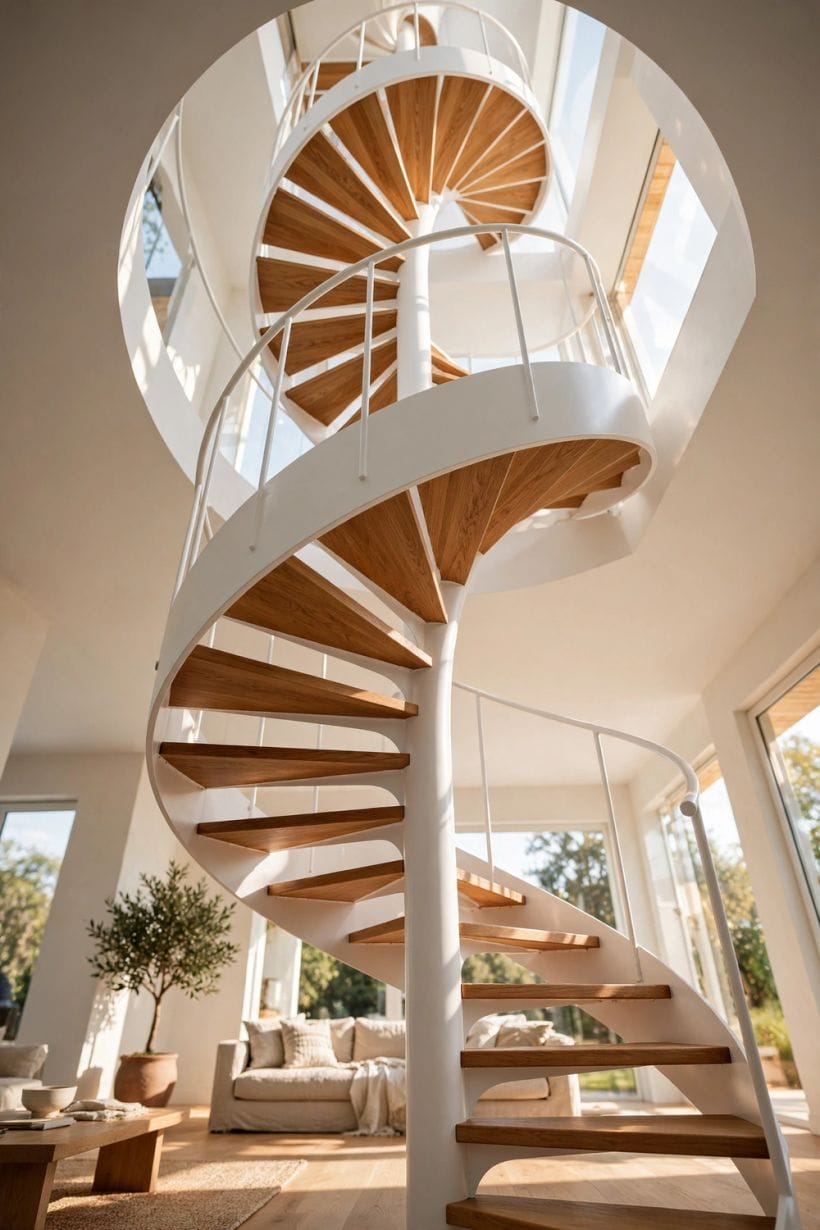
A spiral is built around its middle. The central pole or open core carries the treads, sets the stair’s character, and announces its material to the whole house — blackened steel for the workshop temper, turned timber for the cottage, a smooth plastered core for the modern room. The treads then dress the structure in the house’s own accent.
12. Choose a steel pole for the crisp, modern coil
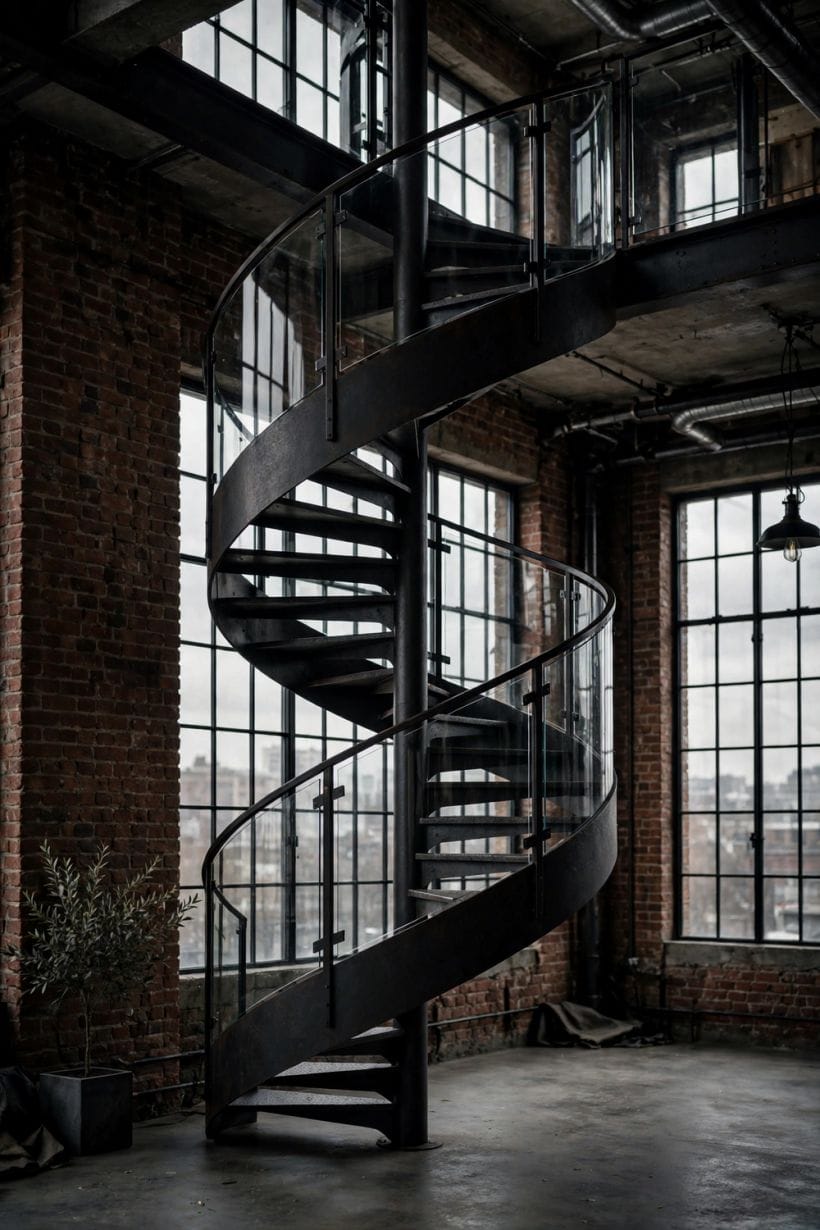
Steel carries a spiral with the least bulk and the sharpest lines: thin treads, an honest pole, a silhouette like a drawn spring.
13. Choose timber for the spiral that must feel like furniture
A timber centre and treads warm the coil into the joinery family, at home beside beams, banisters and old floors.
14. Consider the open-core spiral where light must pass
Some spirals wind around a void rather than a pole, their treads cantilevered from a curved stringer.
15. Kit or bespoke: decide by the well, not the wish
Kit spirals arrive as engineered parts in set diameters and serve standard wells admirably for a fraction of a commission’s cost. Bespoke is for the awkward well, the cherished material, the stair that must land precisely here.
16. Let treads be the house’s accent material
The treads are the spiral’s largest visible surface and the hand’s and foot’s whole experience. Timber treads on a steel spine soften an industrial stair; steel treads on a timber pole sharpen a cottage one.
17. Treat the centre pole’s base like a piece of joinery
Where the pole meets the floor is the spiral’s handshake with the room: a plinth, a collar, a clean rosette in the boards.
18. Mind the sound the material makes underfoot
Steel treads ring, timber treads thud kindly, and carpeted treads hush. In a house where the stair is climbed at midnight by the whole family, that acoustic signature is a nightly fact.
19. Match fixings and finials to the house’s other metal
The coil’s bolts, rail brackets and finial speak the same language as the door handles and hinges ideally — not matched like a uniform, but family.
20. Use contrast where the stair must be read in dim light
A pale tread on a dark spine, or a dark handrail over pale balusters, is not merely style: it is the eye’s map of the stair at dusk.
21. Let an outdoor spiral be galvanised and unashamed
The garden spiral to a roof terrace or a treehouse office wants weatherproof honesty: galvanised steel, open treads that shed rain, a rail that can be gripped with wet hands.
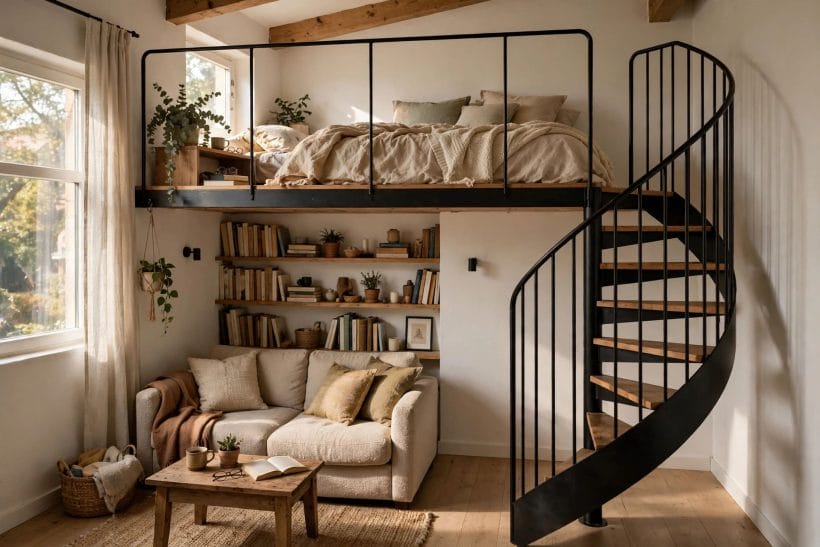
22. Ask the maker for the stair’s whole weight and its fixings
A spiral concentrates its load at the pole’s foot and the well’s edge; the floor must be ready for both.
4. Treads, Risers and the Walking Line
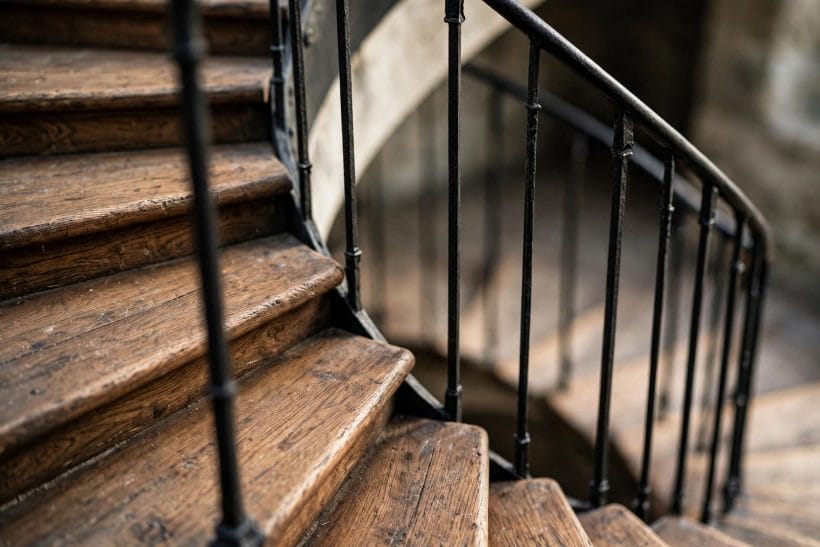
Nobody experiences a staircase as a drawing; they experience it one tread at a time, at the walking line — the arc, roughly a hand’s breadth from the rail, where feet actually fall. A spiral lives or dies by the evenness of that line: every tread the same rise, every foothold honest, the hand and the feet agreeing about the rhythm of the climb.
23. Keep every rise identical, without one exception
The leg learns a stair in three steps and then trusts it blindly; a single tread that breaks the rhythm is a trip rehearsed daily.
24. Judge the tread at the walking line, not the pole
Beside the pole, every spiral tread is a narrow wedge — that is geometry, not a fault. What matters is the depth where the foot lands, out along the walking line, and a generous diameter is what buys depth there.
25. Let the nosing be rounded, grippy and visible
The tread’s front edge meets the toe a thousand times a year.
26. Close the risers where children and pets climb
Open risers give the spiral its light, floating look, but small feet and paws read them as puzzles.
27. Give the treads a surface the sock respects
Polished timber in socks is the spiral’s classic mishap. A matte finish, a woven runner on the walking line, or treads in a naturally grippy grain all civilise the descent; the finish is chosen for the 7 a.m.
28. Set the handrail’s height to meet the hand, not the eye
On a spiral the rail is not decoration — it is the third point of contact on every step.
29. Light the treads from the side they are climbed
A spiral climbed against the light is a silhouette puzzle.
30. Let the first and last treads announce themselves
The eye should never have to guess where the stair begins or ends.
31. Test the stair with a tray, a basket and a toddler’s hand
Before signing off any spiral, climb it carrying the household’s real cargo: a laundry basket, a tea tray, a small hand in yours.
32. Keep the walking line clear of the balustrade’s tricks
Decorative balusters that bulge, scroll or lean into the climbing arc steal inches the feet were promised.
33. Plan for the tread finish to be renewed, not mourned
Treads wear at the walking line first and honestly.
5. Balustrades, Handrails and the Open Side
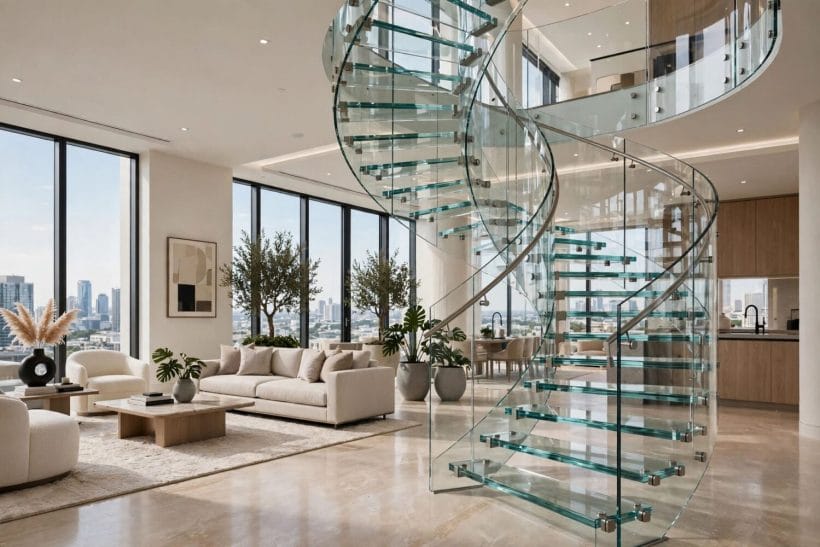
The spiral’s guard is its most visible craft: a ribbon of rail following the coil, carried on balusters that must turn with the stair and never leave a gap a child could argue with. The stair railing ideas page treats rails across every stair type; here the subject is the rail that bends — the one that makes a spiral feel safe at its outer edge, where the drop is.
34. Continue the handrail from before the first tread to past the last
The hand should find the rail while both feet are still on the floor, and keep it until both feet are level again at the top.
35. Choose vertical balusters for the calm, classic guard
Upright balusters following the coil give a spiral its traditional harp-like rhythm and the fewest arguments with small climbers, for whom horizontal rails are a ladder in waiting. Turned, square or plain rod — the family’s temper chooses the profile.
36. Choose a curved stringer and panels for the sculptural guard
Sheet panels — steel, glass or perforated metal — swept along the turn make the modern spiral a single gesture.
37. Mind every gap as if a small head will test it
Because one will. The guard’s openings — between balusters, under the rail, at the landing’s edge — are sized by the household’s smallest explorer and by the local rules the maker works to.
38. Give the rail a profile the whole hand can close on
A rail is gripped, not admired, at the moment it matters. Round or softly oval sections of a graspable size, warm in timber or honestly cool in steel, beat the flat designer plank that the fingers slide off.
39. Carry the guard around the well’s open edge upstairs
The stair is only half the fall: the well opening upstairs needs its own balustrade, continuous with the spiral’s, until the floor is safely fenced.
40. Let the newel and finial finish the sentence
Where the rail begins, a newel or a returned end-cap finishes the stair’s first impression.
41. Use the rail to carry the house’s colour story
The long ribbon of a spiral rail is the largest single gesture of colour a hall may own: black against pale walls, brass warming timber treads, or the house’s accent colour climbing in a helix.
42. Keep the guard’s fixings invisible or beautiful
Brackets, shoes and bolts along the turn are seen at hand’s height for years.
43. Light the rail’s line for the night climb
A handrail that can be found by the eye at 3 a.m. — caught by a low hall light, or gently underlit — is the night-climber’s guide rope.
44. Have the guard’s sturdiness tested by a lean, not a look
At installation, lean on the rail with an adult’s full sideways weight at the turn’s midpoint.
6. Light, Colour and Finishes Around the Coil
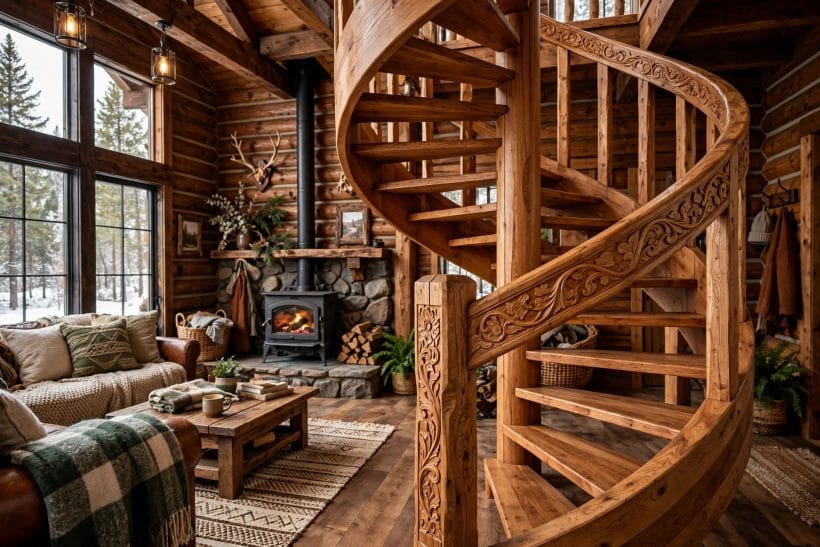
A spiral occupies its room twice: once as a stair, and once as a tall piece of sculpture in the room’s light. Colour and finish decide whether the coil reads as dark machinery, pale ghost or warm furniture — and the well above it is a light shaft the wise house exploits rather than wastes.
45. Paint a steel spiral the room’s deepest tone for the classic silhouette
Black or near-black on a steel coil is the traditional stage dress: it draws the stair as one confident line against pale walls and forgives the scuffs of a thousand climbs.
46. Take a pale spiral where the hall is small and borrowed light is precious
White or stone-pale coils recede, letting a small hall keep its air.
47. Let a timber spiral be oiled, not varnished into plastic
Oil and wax keep timber’s grain open to the hand and the eye, and they can be fed and repaired tread by tread forever.
48. Give the well a ceiling moment: pendant, skylight or lantern
The space above a spiral is a natural lantern.
49. Use the wall behind the coil as the stair’s backdrop
The wall the spiral turns against is its scenery: a deep colour, limewash, panelling or a run of bookshelves in the well’s curve.
50. Finish treads a tone apart from the floor they leave
Where the hall floor and the treads match exactly, the first step hides.
51. Let brass or copper warm a dark coil’s details
Handrail caps, finials, tread nosings and the pole’s collar in a warm metal lift a black spiral from industrial to jewelled.
52. Carpet the walking line where the house is quiet and carpeted elsewhere
A bound runner following the treads’ walking line softens sound, warms the foot and protects the timber — the country-house answer.
53. Keep the palette honest in a period house
Old houses forgive spirals readily when the coil respects their palette: cream and black iron for the Georgian temper, warm timber for the cottage, no chrome where chrome was never born.
54. Play with the shadow the coil throws
A spiral in a sunlit hall draws a moving helix of shadow on the wall all day — the house’s slowest clock.
55. Renew the finish on a rhythm, not a crisis
Painted coils want a touch-up season; oiled timber wants its yearly feed. A spiral kept on a small rhythm of care never needs the scaffold-and-strip rescue that neglected stairs eventually demand — maintenance as housekeeping, not as surgery.
7. Where Spirals Serve: Lofts, Libraries, Cellars and Terraces
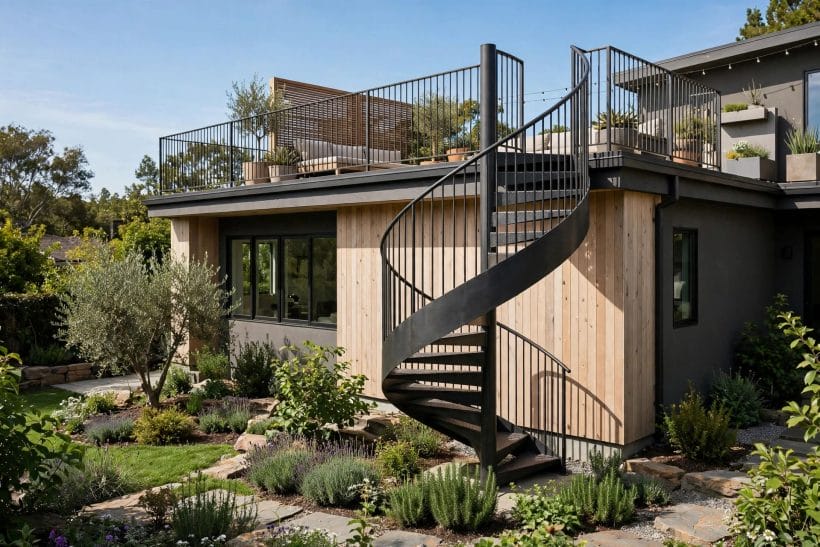
The spiral’s employments are a tour of the house’s awkward addresses — the rooms a straight stair cannot reach and the corners a corridor cannot serve. In the tiny house staircase tradition the coil is a founding tool; in the big house it is the secret second stair that turns dead floors into loved rooms.
56. Give a loft bedroom its own coil and it becomes a suite
The attic over the garage, the eaves bedroom, the studio in the roof: each waits for a stair that fits in a corner.
57. Serve a library gallery with the scholar’s spiral
A gallery of bookshelves around a room’s upper walls, reached by a slim coil in the corner, is the spiral’s most storied employment — half stair, half ceremony.
58. Drop a spiral to the cellar den and reclaim a floor
Cellars become dens, cinemas and workshops the day they gain a stair that does not eat the room above.
59. Climb to a roof terrace on an outdoor coil
The flat roof over the extension, the sun deck over the garage: an exterior spiral in galvanised steel reaches them without touching the house’s interior plan at all.
60. Let a mezzanine study ride above the living room
In a double-height room, a mezzanine for desk and books, served by a corner spiral, adds a whole workplace without a single new wall. The coil below and the rail above become the room’s architecture — borrowing the bedroom-quiet, working-height world view from a few feet up.
61. Split a tall entrance hall with a sculptural arrival
Grand halls sometimes own a spiral not from need but from composition: the coil gives the tall room its centrepiece and the upper gallery its access.
62. Serve a children’s den with a castle stair
The play loft, the den over the garage, the reading turret: children file the spiral under castle equipment, and they are not wrong.
63. Connect a garden room to the terrace above it
The potting room under the deck, the studio under the terrace: garden levels stack as readily as floors do, and an outdoor coil between them turns two half-used spaces into one address. Weatherproofing and grip are the whole specification, honestly kept.
64. Give a split-level house the short link it lacks
Houses built in half-storeys often strand rooms a few feet apart with a long walk between. A compact coil or part-coil bridging the levels where they nearly meet can retire a corridor’s worth of steps from every single day.
65. Keep a spiral as the house’s second, secret stair
The back-stairs tradition is not dead; it has become the spiral.
8. Living With the Spiral: Family Life, Furniture and Finishing Touches
The last questions are the domestic ones: how the coil behaves at breakfast time and in the moving van’s shadow, what lives beneath it, and which small finishes turn an efficient stair into the house’s favourite object. A spiral chosen with its daily life in view stays loved; chosen from a photograph, it is negotiated with forever.
66. Store beneath the coil without apology
The cylinder of space under a spiral’s low side is small but true: a cellar door’s worth of storage, a dog’s bed, the vacuum’s home, or a low bookcase curved in spirit if not in fact.
67. Hang the hall’s coats clear of the climbing arc
Hooks and hats belong on the wall the spiral does not turn against. Coats brushing the climber’s shoulder narrow the walking line and sour the climb; the hall’s furniture plan is drawn around the coil’s swept circle, coats included.
68. Choose the dog’s verdict before the order
Many dogs climb open spirals happily; many flatly refuse, and a refused stair in a one-stair house is a daily carrying sentence.
69. Plan the Christmas tree’s route once, in writing
Trees, mattresses, the heirloom wardrobe: every house owns three objects that cannot climb a coil.
70. Let children grow up the stair in stages
Gate the coil while climbers are small, close the risers while feet are, and let the guard’s height be re-judged as the family grows.
71. Put a mirror or art where the climber’s eye rests
Halfway up every spiral is a pause-point where the eye lands on the same patch of wall a thousand times. Give that patch the house’s kindness: the mirror that borrows the garden’s light, the print that rewards the daily glance.
72. Keep a small light burning on the stair’s route at night
The household’s night traffic — water, children, the cat’s affairs — uses the stair half asleep.
73. Let the pole’s crown carry one ornament only
A finial, a small lantern, a turned wooden apple: the crown of the pole is the spiral’s signature spot. One ornament, chosen once and loved, finishes the composition; a collection up there turns the stair into a hat stand.
74. Photograph the stair in its seasons
The coil dressed for winter with a garland on the rail, the spring light falling through the well, the summer door open below: a spiral is the house’s most photogenic servant.
75. Decide the stair’s name and be done with it
Houses with spirals name them — the corkscrew, the tower stair, grandmother’s folly.
9. Checks and Mistakes: Before the First Purchase or the First Stone
Before ordering, walk the checks in order: the diameter measured against the household’s real legs and luggage; the direction of turn walked on both floors with the doors’ swings in mind; the well opening drawn against the joists; headroom and tread comfort confirmed with the maker against the local rules that govern stairs, stated generally here because they vary by place and must be settled by the professional on the job; and the big furniture’s alternative route agreed in writing.
The faithful mistakes: the coil bought a size too small to save a rug’s worth of floor; the rail that starts a tread too late; open risers ordered for a house of toddlers and paws; a mirror-polished tread finish chosen in a shod showroom; and the spiral made the only stair by a household whose sofa, tree and grandmother all travel another way. Every one of these is a planning error, not a product error — the stair was fine, the brief was not.
One check is about honesty: sit the household down and ask who climbs, carrying what, at what hours, for the next twenty years. A spiral specified from that conversation — generous where it must be, pretty where it may be — is the one that is still being praised when the catalogue it came from is long recycled.
10. Costs and Pulling It Together
Costs follow the old stair rule: the kit in steel is the affordable end, the bespoke timber or open-core commission is furniture money, and in both cases the true bill includes the well opening, the landing guard, the finish and the making good — never the stair alone. Spend first on diameter and the rail; economise, if economise you must, on ornament, which can always join the stair later.
Pulling it together: give the spiral room to be a stair and not a ladder; turn it by the rooms it serves; build its centre and treads in materials the hand approves; keep every rise identical and the rail unbroken; light the walking line; and set it to work on the floors a straight stair cannot reach. It then earns the place it holds in the wider family of home design ideas — the smallest stair in the house, and the one nobody forgets.
Final Considerations
A spiral staircase is a promise a house makes to its own awkward corners: that no floor need be wasted for want of a few square feet of stair. Kept generously and guarded honestly, the coil repays its small footprint with decades of small ceremonies — the climb to the loft, the descent to the garden, the pause halfway where the light falls.
Begin with the diameter and the rail. Every other decision on this page hangs from those two, and a spiral that is wide enough and held all the way up has already forgiven itself most of its future.


0 Comments