

Stand at your curb and give your house the thirty-second stranger test. For a tiny home, the house itself is too small to carry the first impression, so the front yard does the talking — and bare dirt mumbles. Stone speaks clearly: structured, clean and finished. This makeover guide audits the yard zone by zone, then rebuilds it around the entry path, the foundation beds and the one focal point that stops the eye.
1. Front Yard Rock Landscaping at a Glance
Front yard rock landscaping is the highest-leverage exterior upgrade a tiny home can get, because the front yard is the handshake: where the house itself is small, the landscape carries the curb appeal. Stone delivers maximum impact per square foot — structured, clean and water-wise — and it does it from the mailbox to the front door. The makeover has four working zones: the entry path a visitor walks, the foundation bed that frames the house, the parkway strip between sidewalk and street, and the lawn replacement that ends the watering and mowing. Work them in that priority order and even a one-weekend budget lands where the eye lands first. The table gathers the whole makeover in one place; the sections after it take the audit, each zone, the details and the budget tiers apart.
| Attribute | Detail |
|---|---|
| The Test | The 30-second stranger test from the curb — judge the yard as a visitor sees it, then photograph it |
| The Zones | Entry path, foundation bed, parkway/hellstrip, and lawn replacement |
| The Priority Order | Entry path first (highest impact per dollar), then foundation beds, then the lawn |
| The Entry Path | 4 ft minimum wide — flagstone with gravel joints at $8–15/sq ft, or compacted DG with stone edging at $3–5/sq ft |
| The Landing | A generous stone pad at the door, 4×4 ft minimum |
| Foundation Beds | 3–4 ft deep along the front foundation, gravel mulch, 2–3 feature boulders per bed |
| The Parkway | Gravel or river rock groundcover with sedums, creeping thyme, blue fescue and lavender |
| Lawn Replacement | A 500 sq ft lawn drinks 10,000+ gallons a year; the rock replacement uses zero water and zero mowing |
| Lighting | Solar LED path lights every 6–8 ft at $15–25 each — the #1 curb appeal multiplier after dark |
| Budget Tiers | $500 refresh, $2,000 DIY makeover, $5,000+ professional build |
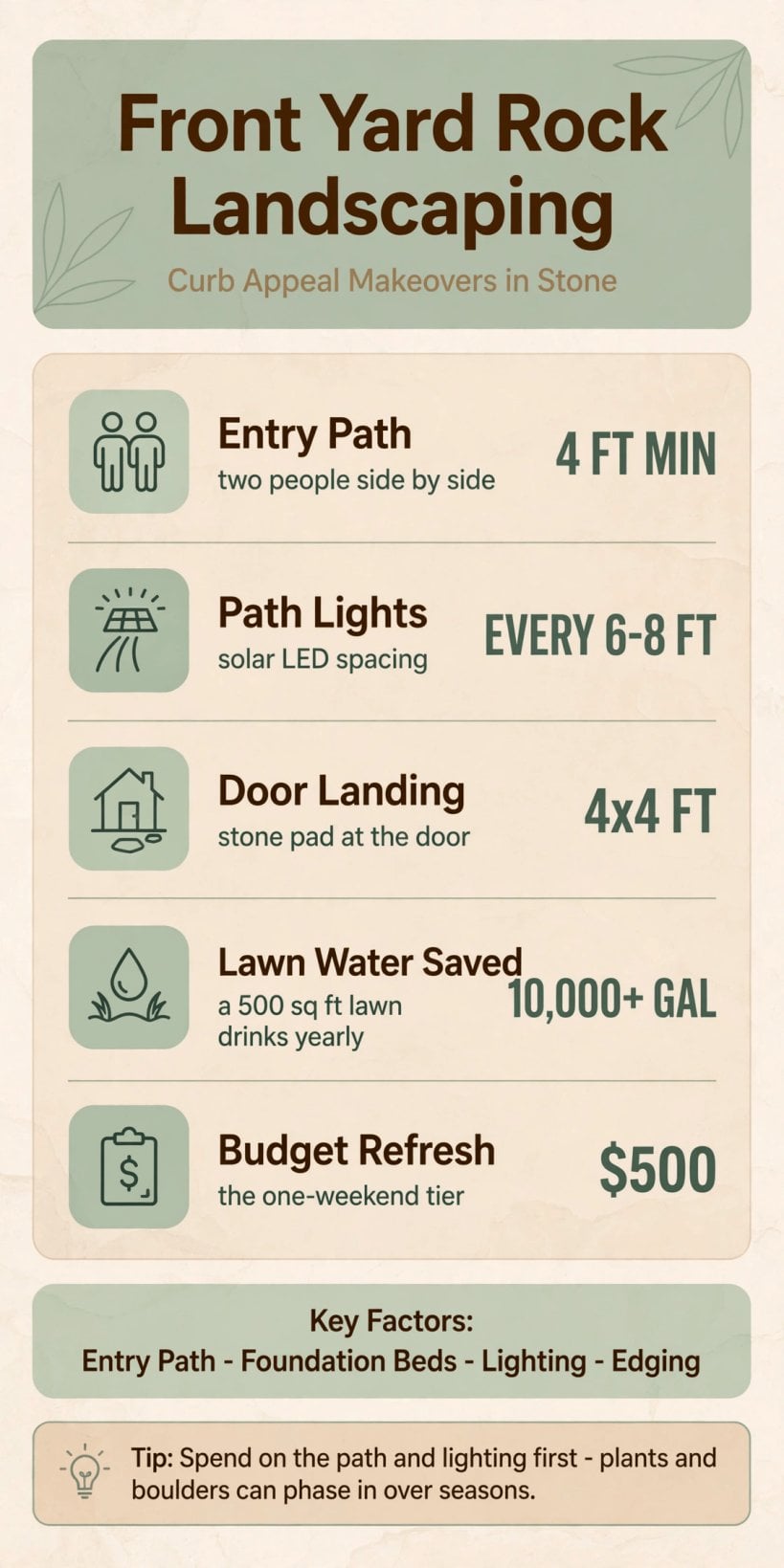
Four feet of path, lights every six to eight feet and a lawn’s 10,000 gallons saved — the makeover on one card.
Read the table as a sequence rather than a shopping list: the audit decides where the money goes, the path and landing follow because every visitor experiences them, and the budget tiers simply scale the same plan up or down. Nothing here is decorative filler — each element guides the eye, frames the house, survives the street or removes a chore.
2. The Curb Appeal Audit: The 30-Second Stranger Test
Every makeover starts at the curb, not at the garden centre. Stand where a visitor stands and run the 30-second test: what does a stranger actually see? On most tiny home frontages the honest answer is some combination of patchy lawn, bare dirt and overgrown shrubs — a yard that reads as leftover space rather than as part of the home. Then photograph it. The camera reveals what the eye forgives: clutter, dead spots and dated edging show up in a photo with a bluntness your daily familiarity edits out.
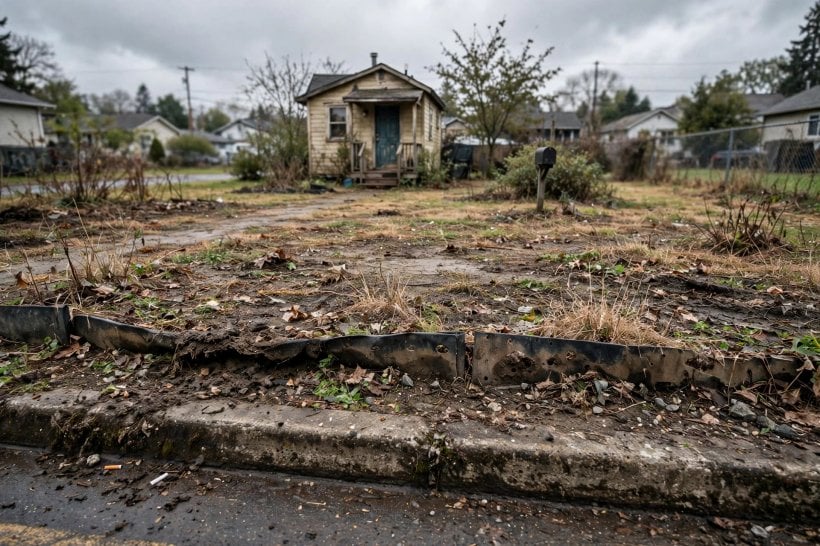
The audit’s real output is a zone map. Identify the four zones and judge each on its own terms: the entry path, the approach to the front door; the foundation bed running along the house; the parkway or hellstrip between sidewalk and street, the toughest zone of all; and the lawn, usually the big water-waster of the yard. Then prioritize without sentiment: entry path first, because it carries the highest impact per dollar, then the foundation beds that frame the house, then the lawn. The audit discipline is the same one behind the wider tiny house landscaping ideas for the whole plot — read the ground honestly before spending anything on it.
One advantage works in the tiny home’s favour from the start: small frontage means small budget. The area to be reworked is a fraction of a suburban front yard, so a tiny home’s makeover costs a fraction of a suburban one — the same stones, the same plants, far fewer of them. The audit converts that advantage into a plan by ranking the zones, so the limited budget is spent in the order a visitor’s eye travels, not in the order a catalogue happens to list products.
3. The Entry Path: Width, Stone and the Door Landing
The entry path is the red carpet of the makeover, and its first specification is generosity. Build it 4 ft wide at minimum, enough for two people to walk side by side; a 3-ft path feels mean, and the entry deserves better than mean. The path is the one part of the yard every single visitor uses, which is why the audit ranks it first and why its materials set the tone for everything behind it.
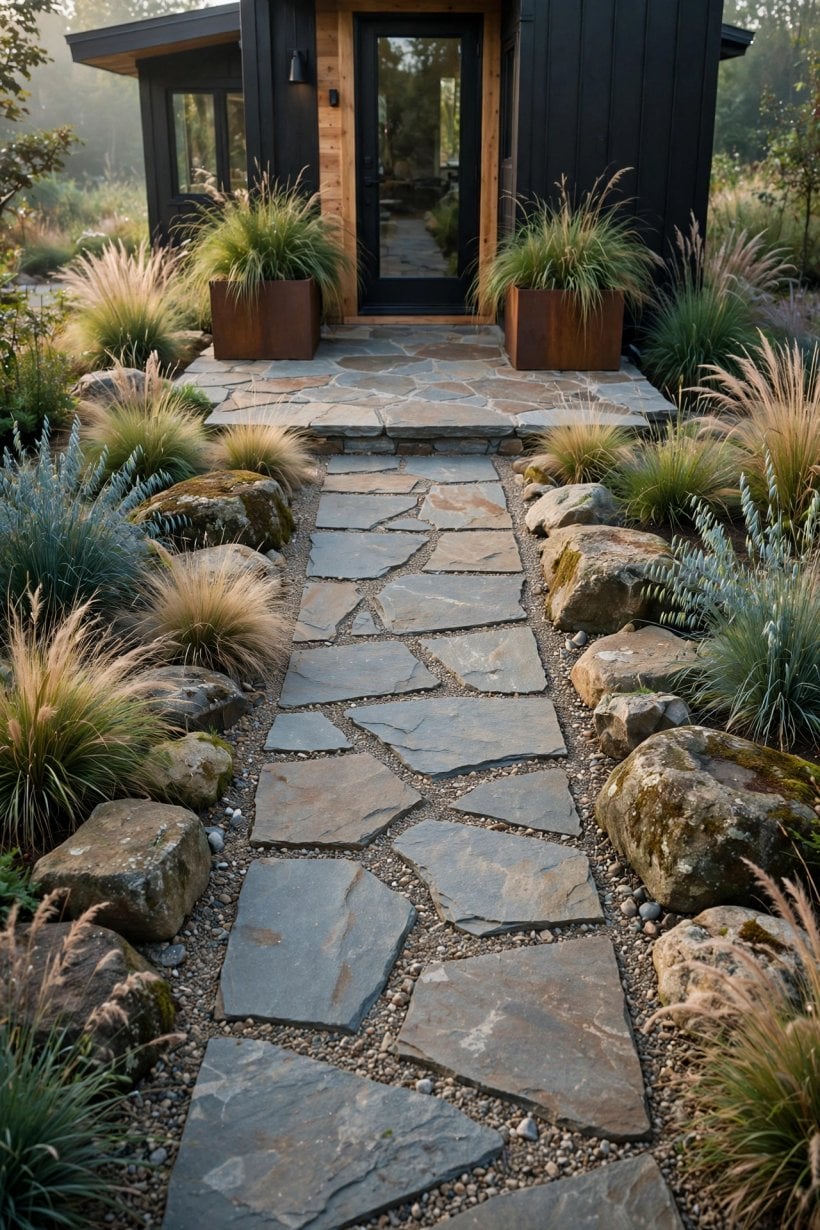
Two material routes cover the budgets. The premium look is flagstone or large pavers with gravel joints, at $8–15 per square foot — big stone, tight craft, the finish that reads as architecture. The budget-modern route is compacted decomposed granite with stone edging, at $3–5 per square foot — a firm, clean surface whose edge does the visual work. Either way, the path should be flanked rather than bare: boulders and ornamental grasses along its length turn a walkway into a procession, so the approach feels like an arrival, not a sidewalk. How those flanking stones are composed at small scale is the whole craft of the rockscapes for small yards, where boulders, river rock and gravel are layered into yards no bigger than this one.
The path ends at the door landing, and the landing is sized like the path — generously. Give it a stone pad of 4×4 ft at minimum: room for two people, a stack of packages, and a welcome mat that actually fits. A cramped landing undoes a wide path at the last step; a generous one completes the arrival the flanking boulders began.
4. Foundation Beds: Boulders, Gravel Mulch and Height Gradation
The foundation bed is what makes the house sit IN the landscape instead of on bare dirt. Run it 3–4 ft deep along the front foundation and build it in three layers: gravel mulch as the ground plane, boulders as the anchors, and structural planting as the frame. The bed is the visual plinth of the house — the band a visitor’s eye reads as the building’s base — so its finish quality matters as much as the path’s.
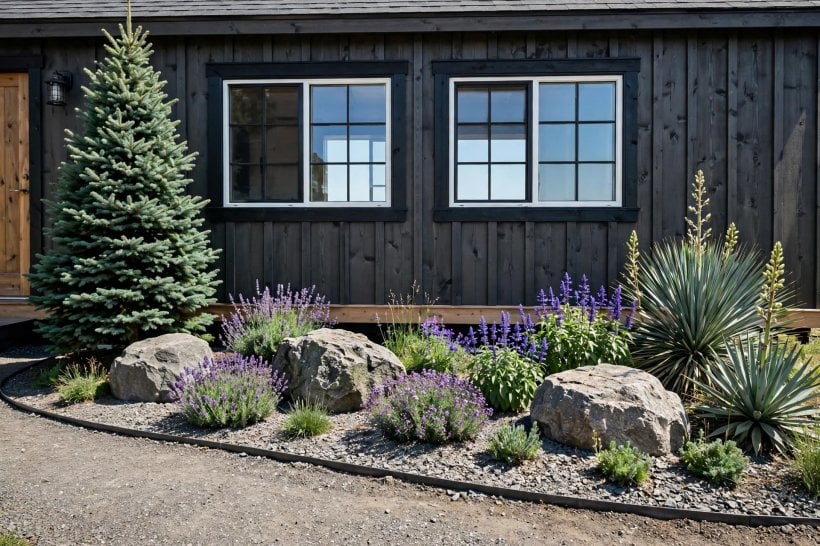
Stone comes first in the build order: set 2–3 feature boulders per bed as the anchors, then finish the surface with river rock or gravel mulch for the tidy, swept look. Planting follows a structure-then-colour logic. Evergreen structure — dwarf conifers, yucca, agave — gives year-round presence, so the bed never collapses into a winter gap. Seasonal colour comes from perennials planted in drifts — penstemon, salvia, lavender — rather than in dotted singles. The planting palette overlaps heavily with the drought-tolerant native plants for rock gardens, species chosen to thrive in the reflected heat and lean soil a stone bed creates.
Height gradation is the rule that keeps the planting honest. Go tall at the corners, where height anchors the house’s edges and ties the building into the ground. Stay low in the middle, in front of the windows — hiding the windows behind shrubs is the classic foundation-planting mistake, and it makes a small house look smaller and darker at once. The same bed logic, pushed further into pure stone planting, becomes the alpine rock garden, where the plants live among the rocks rather than in front of them. Finish the bed with edging — steel or stone — because the crisp line between bed and lawn or gravel is the detail that reads as “designed” from the street.
5. The Parkway: Gravel Groundcover and Hellstrip-Tough Plants
The parkway — the hellstrip between sidewalk and street — is the toughest zone in the yard, and it earns the name. The ground is narrow and compacted, dosed with road salt, walked on by strangers and dug up whenever a utility needs access. Nothing delicate survives there, so the design starts by accepting the abuse and armouring for it.
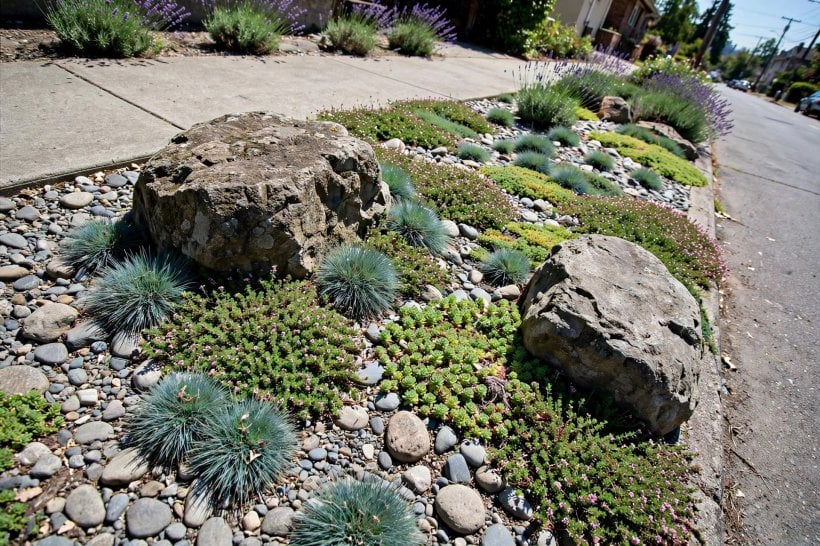
The rock solution is a gravel or river rock groundcover — no irrigation needed, and indifferent to the abuse — with a few tough boulders as the armour. Planting is chosen from the short list of the genuinely hellstrip-tough: sedums, creeping thyme, blue fescue and lavender, all drought-proof, salt-tolerant and trample-resistant. Keep the design simple and bold, because the parkway is seen at speed, from moving cars: big gestures register, fussy detail vanishes. The zone is the front yard’s version of the conditions handled by landscaping with rocks in high-desert climates — heat, reflected glare and almost no water — and the same gravel-and-boulder vocabulary answers both.
One check precedes the work: local rules. Many cities regulate parkway planting with height limits and approved species lists, and a ticket ruins a makeover. Confirm what your city allows on the strip before the first load of gravel arrives — the hellstrip is the one part of the yard you landscape on land the city still governs.
6. Lawn Replacement: Killing the Grass
The lawn is the audit’s big water-waster, and the math against it is blunt. A 500 sq ft front lawn drinks 10,000+ gallons a year and demands weekly mowing; its rock replacement uses zero water and zero mowing. For a water-wise frontage, the lawn is not a feature to be maintained but a cost to be retired — and on a tiny home’s small frontage, retiring it is a weekend-scale project rather than a season’s campaign.
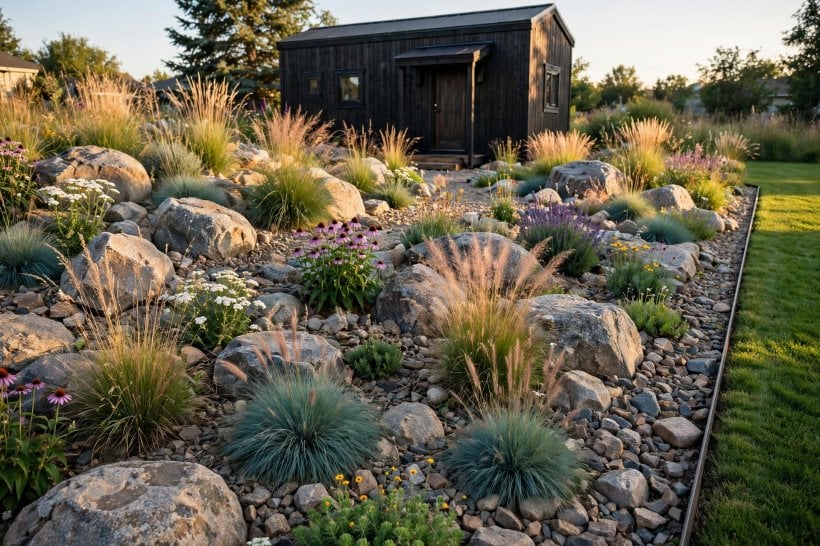
Removal offers a lazy method and a fast one. Sheet mulch — cardboard smothered under 4 inches of wood chips, left for 3 months — kills the grass with patience and no machinery. A sod cutter does it in one weekend for those who would rather pay in effort than in time. The replacement is a gravel field composed with boulder groupings and planting drifts — the meadow-in-stone look — which keeps the yard planted and alive in character while ending the irrigation entirely. For owners who still want green without the mower, buffalo grass or clover is the no-mow alternative, using 75% less water than turf. The full water-wise planting system behind that choice is set out in the guide to xeriscaping with rocks and native plants.
The transition is a detail with outsized effect: keep a crisp edge, steel edging between the new rockscape and the neighbour’s lawn. That boundary declares intention. Without it, a gravel yard reads as a dead lawn; with it, the same yard reads as a design — the line is what tells the street the change was chosen.
7. The Mailbox, House Numbers and One Sculptural Focal Point
Details are where a makeover is won at the curb, and the mailbox is the first of them. Mount the box on a stone pillar or a boulder and it becomes, in the original’s phrase, the $150 detail that anchors the curb; leave a leaning wooden post in place and it undermines the whole makeover, because the eye reads the weakest element at the property line as the truth about everything behind it.
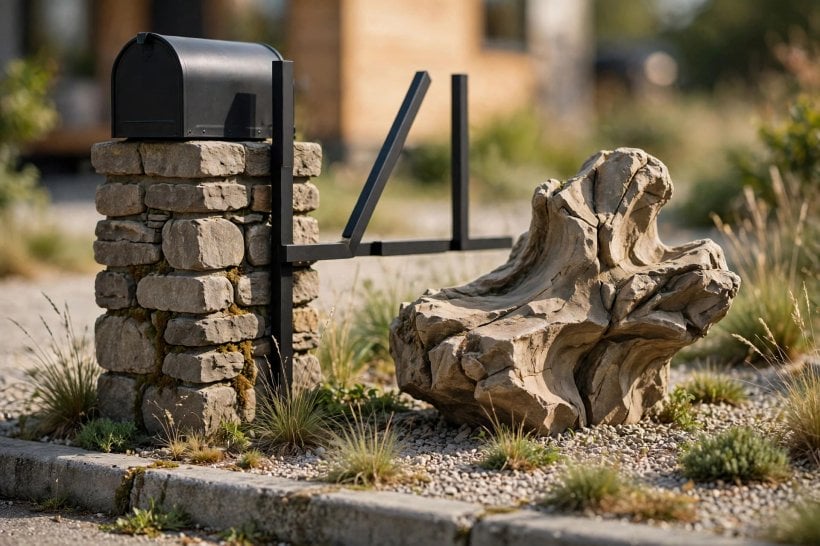
House numbers are the functional jewellery: large, modern and well-lit, visible from the street — the one ornament in the yard that also has a job to do at night. Containers carry the changeable accent: 2–3 large pots flanking the door, in corten steel or stone, give seasonal colour without committing to beds, and they can be replanted or swapped as the year turns. Setting the boulder that anchors all of this — by the mailbox, at a bed corner, beside the path — follows the placement discipline of laying out big landscape rocks, where a stone is buried and angled to look grown rather than dropped.
Art is the final detail, and its rule is restraint. Choose one sculptural element — a striking boulder, a steel sculpture, a water feature — as the exclamation point. One only: restraint is the difference between designed and cluttered, and a yard that shouts in five places is heard in none of them.
8. Lighting: Path Lights and the After-Dark Transformation
A front yard has two lives — the daytime one the audit judges, and the evening one the neighbours actually see — and lighting is what wins the second. Run low path lights every 6–8 ft along the entry path: solar LED units at $15–25 each, with no wiring to trench and no electrician to book. The original ranks the effect plainly: lighting is the #1 curb appeal multiplier after dark, the evening transformation in a single line of small glowing points.
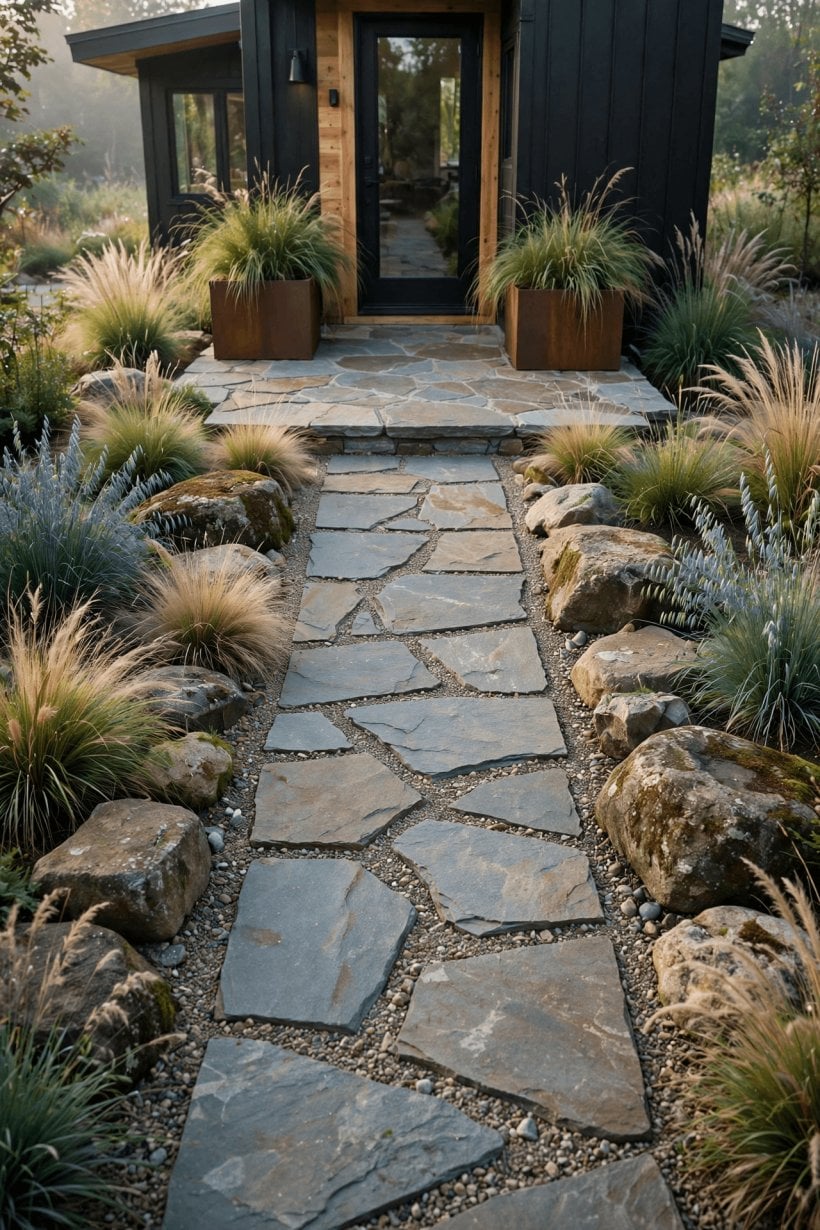
The spacing does the design work. At every 6–8 ft the lights read as a rhythm — a dotted line of welcome that pulls the eye from the curb to the door and keeps the path’s width and flanking boulders visible long after sunset. The well-lit house numbers of §7 belong to the same system: an address readable from a dark street quietly signals a cared-for house. Few elements transform so much perceived finish for so little money — and none of the others works while you sleep.
9. Edging and Mulch: The Crisp Lines That Keep It Designed
If the stones are the makeover’s vocabulary, edging is its punctuation. The crisp line between bed and lawn, or bed and gravel, is the detail that reads as “designed” — and its absence is what makes otherwise good rock work look spilled. Steel or stone edging holds that line permanently, containing the gravel, stopping the mulch migrating into the path, and giving the mower-free yard the one sharp edge its composition depends on.
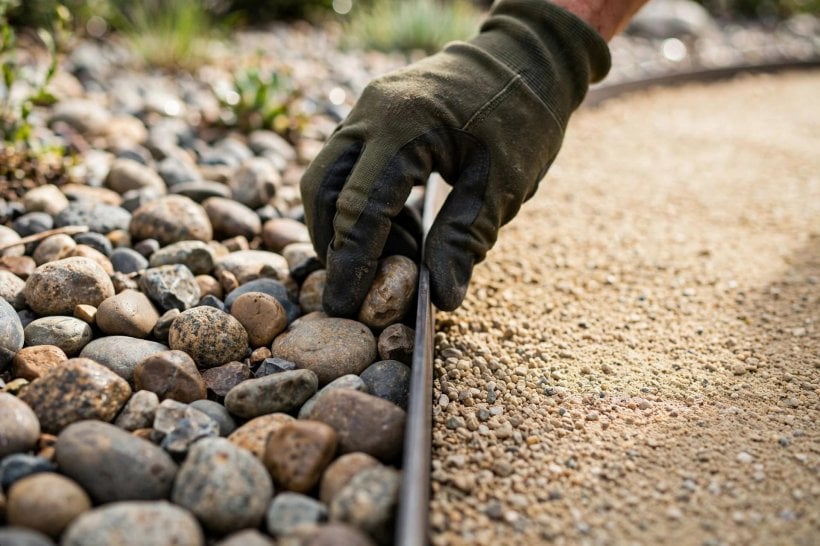
Mulch choice works with the edging. In the beds, river rock or gravel mulch is the tidy finish — it does not blow away, wash out or need annual replacement, and it keeps the stone language of the yard unbroken from path to foundation. The one organic exception is transitional: the 4 inches of wood chips in the sheet mulch of §6, which are a killing layer rather than a finish, retired once the lawn beneath them is gone. The same containment thinking scales down gracefully — the small backyard rockscaping projects use identical edging discipline in spaces even tighter than a tiny frontage, because the principle is scale-free: a held line is what separates a rockscape from a rock pile.
Maintenance of the line is the ongoing bargain: gravel creeps and chips travel, and a ten-minute tidy at the edge a few times a year keeps the whole yard reading as crisp as the week it was built. Edging is the cheapest element to install and the most expensive to omit.
10. Budget Tiers: The $500 Refresh, the $2,000 Makeover and the $5,000 Professional Build
The makeover scales across three tiers, and the tiers buy the same design at different depths. The $500 refresh is the one-weekend tier: a gravel top-up, new edging, 3 boulders, path lights and mulched beds — the 80% transformation for 20% of the cost, because it spends entirely on the elements the eye reads first. For a tiny frontage, this tier is often the whole honest answer.
The $2,000 makeover is the full front yard, DIY: a new entry path, a foundation bed rebuild, the parkway conversion, and 10–15 plants. It rebuilds every zone the audit mapped rather than refreshing their surfaces, and it assumes the labour is yours — the money goes to stone, plants and lights instead of hours. The $5,000+ professional tier buys the magazine look: a designed plan, installed stonework, irrigation and a lighting system, worth it chiefly for resale-focused flips where the yard’s finish is returned in the sale price.
One rule governs whichever tier you choose: spend on the path and the lighting first, the two highest-impact elements in the yard. Plants and boulders can phase in over seasons — a bed can gain its third boulder next spring, a drift can thicken next year — but a mean path and a dark entry cannot be apologised for in instalments. The tiers are not three different designs; they are three depths of the same one, sequenced so that the first dollar spent is always the one a stranger sees.
Final Considerations
Audit from the curb, build a generous stone entry path, frame the foundation in gravel and boulders, armour the hellstrip, kill the thirsty lawn, light it for the evening, and finish with one sculptural gesture. Rock landscaping in the front yard is not about removing nature — it is about composing it, so the first impression is the right one: intentional, water-wise and unmistakably cared for. On a tiny home, where the house cannot speak for itself, that composed strip of stone between the street and the door is the loudest statement the property makes.


2 Comments