
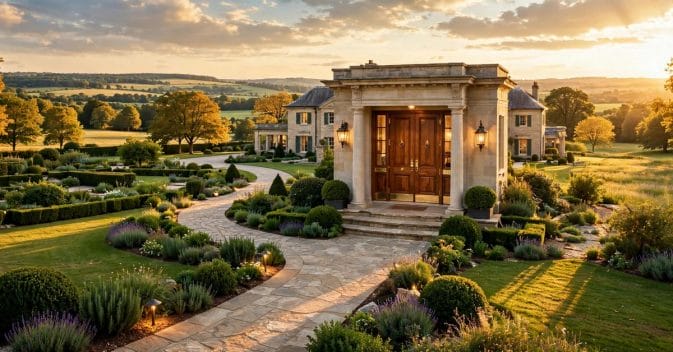
Two leaves, one welcome: a double front door turns an ordinary arrival into an occasion, every single day.
These seventy-five double front doors ideas cover configurations, materials, glass, colour, hardware, lighting and the practical checks — for houses grand enough to expect them and modest ones that simply want the width.
1. Double Front Door Ideas at a Glance
A double front door is a configuration, not a style: two leaves within one frame, one of them usually the everyday working leaf and the other bolted until the day the sofa, the piano or the wedding party needs the full width. Its gifts are presence, light — when glazed — and genuinely easier moving days; its costs are a wider opening, more hardware and more weather edge to seal. This post stays strictly with the double configuration. The broader entry-door survey lives in front door ideas, and the entry-door types and materials survey that follows later in the queue will complement it; here, everything is about the pair.
| Question | Short answer |
|---|---|
| What is a double front door? | Two door leaves in one wide frame — one active leaf for daily use, one fixed leaf released for wide loads |
| Which houses suit it? | Wide frontages naturally; narrower houses can suit a compact pair where the hall and opening allow |
| What does it cost more of? | Opening width, hardware, sealing length and installation care — see the cost drivers section |
| Is one leaf used most days? | Yes — the pair is planned around a main leaf, with the second leaf bolted top and bottom |
| What is the biggest mistake? | Ordering the doors before the opening, structure and swing have been measured and agreed |
2. Configurations: How the Pair Is Arranged
Before style comes arrangement: which leaf works, how they meet, and what stands around them. These configuration choices decide how the doors behave every day, long after their looks are chosen.
1. Equal leaves, one active and one bolted
The classic arrangement: two equal leaves, the right or left serving daily, its partner held by bolts at head and sill until the full opening is wanted.
2. A wider active leaf with a narrower partner
An unequal pair suits openings that are generous but not vast: the main leaf gets comfortable daily width while the narrower leaf completes the composition and still releases for furniture.
3. Doors that open inward, the usual welcome
Inward-opening leaves greet the hall and shelter the hinges from weather and tampering. Confirm the hall can spare the swing — a double door sweeping into a cramped lobby trades one problem for another, so measure the swing against consoles, stairs and inner doors.
4. Outward-opening pairs where the hall demands it
Where the hall is truly tight, outward-opening leaves free the inside entirely. They ask more of their weather seals and hinge protection, and suit porches that shelter them; an installer experienced with the arrangement is worth seeking out.
5. A pair framed by sidelights
Fixed glazed panels flanking the pair borrow light for the hall and widen the composition without widening the moving parts. Sidelights have their own post later in the queue; here they appear only as the double door’s frame — glass beside, never instead of, the second leaf.
6. A transom window above the pair
A glazed panel over the doors lifts light deep into the hall and gives tall entrances their proportion. Fixed or opening, plain or divided, it is the traditional completion of a wide doorway and flatters both period and modern houses.
7. Arched-head pairs for masonry openings
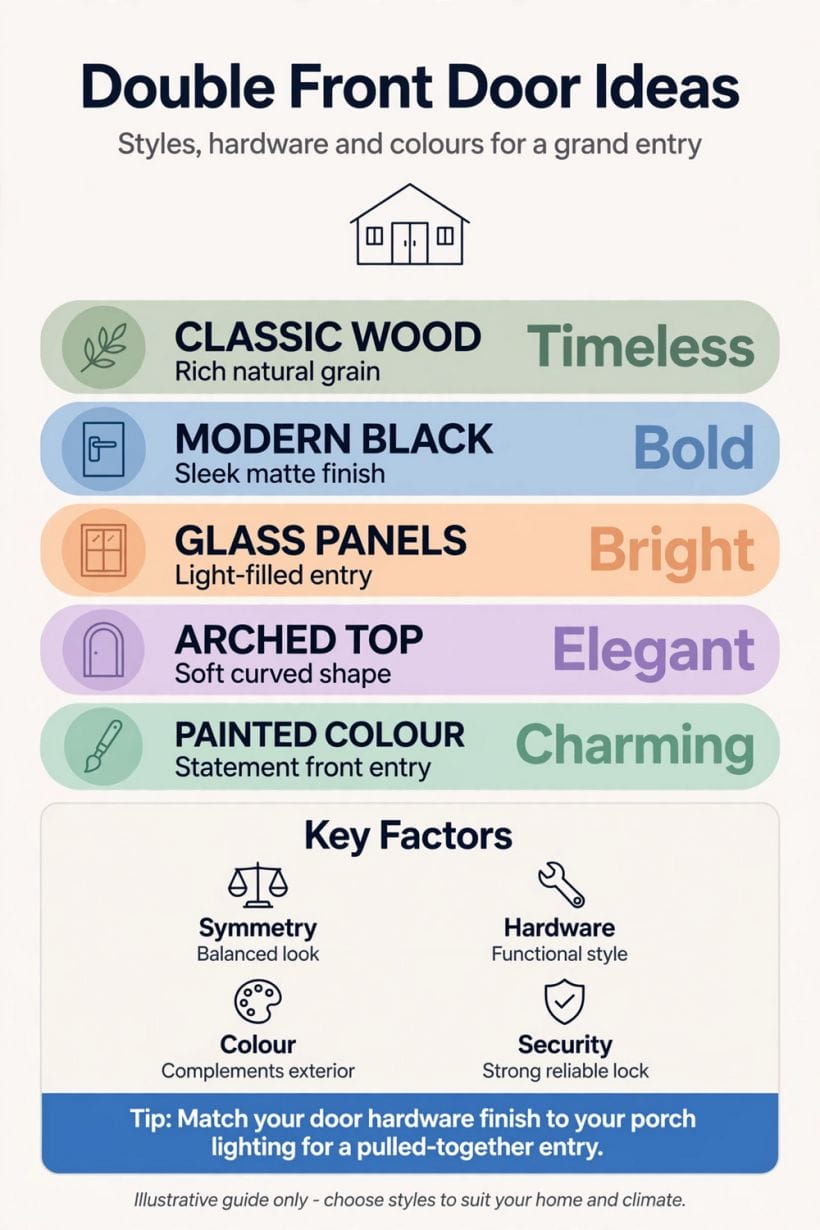
Where the opening itself is arched, leaves shaped to the arch make a memorable entrance — the infographic’s arched row in section one nods to it.
8. A centre post look without a centre post
Pairs meet at a meeting stile, not a fixed central post, so the opening clears fully when both leaves open. Where an older doorway has a fixed post, a joiner can sometimes rework the arrangement — a structural conversation to have before any doors are ordered.
9. French-style pairs with full glass
Two fully glazed leaves — the garden-room arrangement brought to the front door — flood the hall with light. Privacy, security glazing and thermal performance all need deliberate answers at this level of glass; section four takes the glass questions in full.
3. Materials and Build
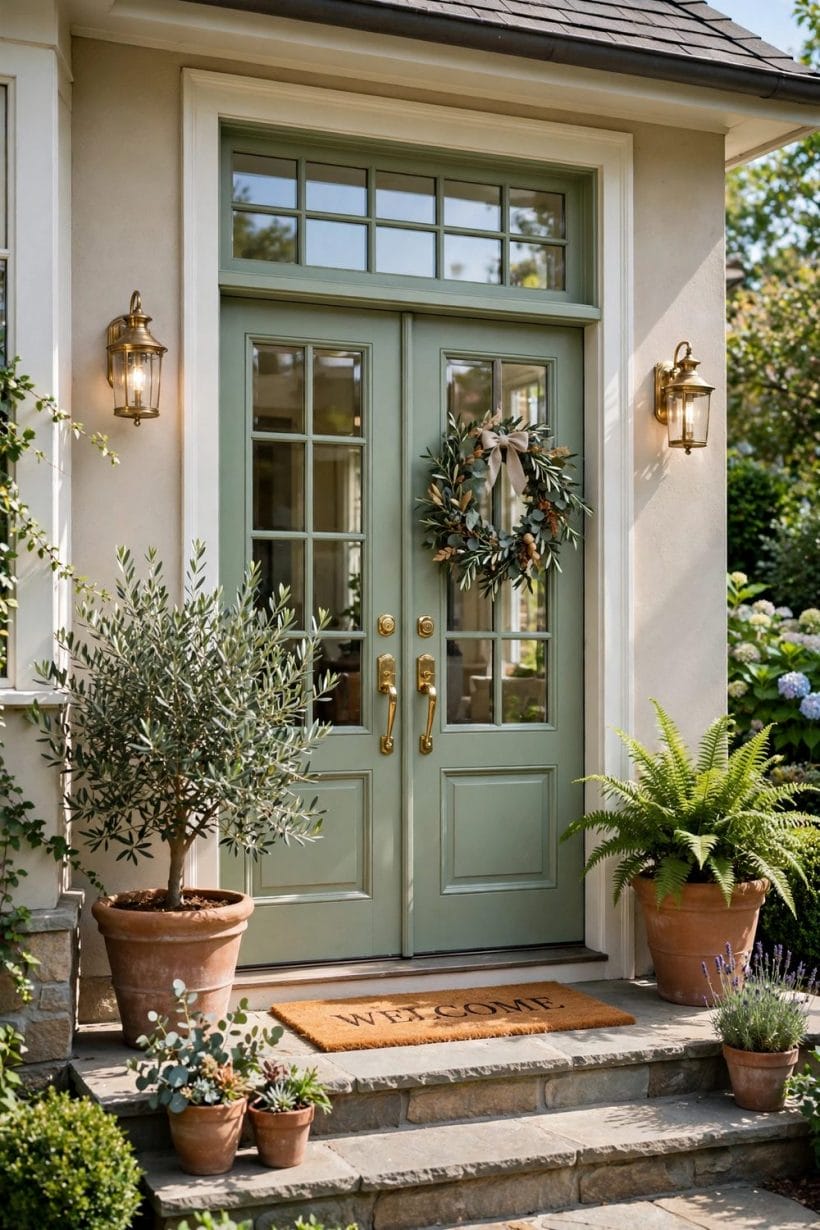
Two leaves double the material conversation: weight, movement and finish all matter twice over. These are the builds that carry a wide entrance with grace — and the checks each one asks for.
10. Solid timber, the traditional heavyweight
Solid hardwood leaves have the heft, sound and repairability a grand entrance deserves, and they can be re-finished for decades. They also move with the seasons and weigh heavily on their hinges, so engineered cores with timber faces are the modern compromise many joiners now recommend — ask yours, in writing, what they would hang in their own house.
11. Engineered timber for stability
Laminated and engineered leaves resist the warping that wide solid leaves are prone to, holding their seals and their meeting line true.
12. Fibreglass leaves with timber grain
Moulded fibreglass can carry a convincing wood grain with far less upkeep, shrugging off the sun and rain that punish exposed doors.
13. Steel leaves for slim strength
Steel suits modern pairs where slim frames and large glass are wanted, and it shrugs off knocks in busy households. Insulated cores matter for warmth, and any coating damage should be touched in promptly; your supplier’s care guidance is the authority here.
14. Aluminium pairs for wide modern openings
Aluminium frames and leaves handle width elegantly and suit contemporary houses with glazed pairs. Thermally broken sections are the specification to ask about in general terms, and powder-coated colours give the modern palette its matte black and deep grey options.
15. Panelled leaves for period houses
Raised or flat panels, arranged symmetrically across the pair, carry Georgian, Victorian and traditional frontages. Keep the panel rhythm identical on both leaves and align the rails across the meeting stile — the eye forgives many things, but not a pair whose panels disagree.
16. Plank and ledged leaves for cottages and country houses
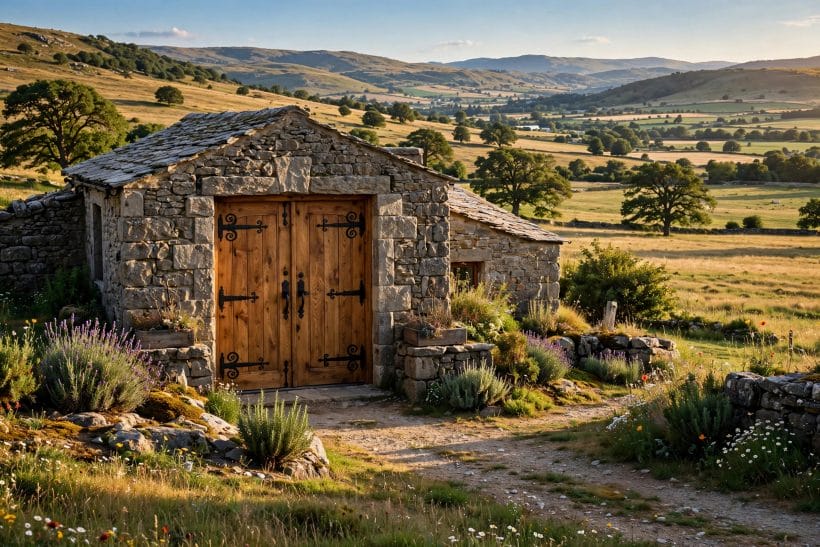
Vertical planks with horizontal ledges, in oak-look or painted timber, give smaller double doors their storybook welcome. A cottage pair is often the unequal arrangement of section two — the working leaf wider, the pair together still modest and charming.
17. Flush modern leaves, handle as the ornament
On a plain flush pair, everything rests on proportion, colour and one excellent handle set. Modern houses suit the restraint; just know the finish must be flawless, because there is no moulding anywhere to distract from a blemish.
18. Weight, hinges and the frame that carries them
Wide leaves are heavy leaves. Hinge count and quality, a frame fixed soundly to the structure, and a threshold detailed for the traffic are the unglamorous decisions the whole entrance stands on — and the ones to put in an installer’s hands, with the door maker’s guidance followed exactly.
4. Glass, Light and Privacy
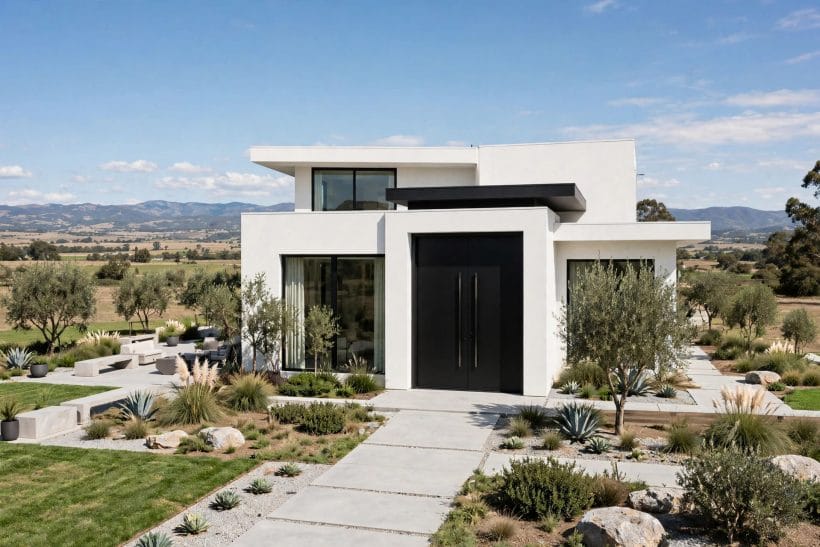
Glass decides how a double door feels from inside: a glowing hall or a goldfish bowl. This section balances light, privacy and the practical glazing questions — stated generally, with your glazier and local rules as the final word.
19. Half-glazed leaves, the balanced classic
Glazing the upper half of each leaf lights the hall while the solid lower half keeps its privacy and its kick-proof practicality.
20. Divided lights for period character
Small panes divided by glazing bars multiply the period charm and soften the view both ways. True divided panes and applied-bar systems differ in cost and cleaning; decide with samples in hand, not from photographs.
21. Frosted and reeded glass for privacy with light
Obscure glazing — frosted, reeded, or textured — admits the light and withholds the view, the standard answer for halls overlooked by the street.
22. Clear glass where the setting allows
On a private plot or a long drive, clear glass in the pair frames the garden like a picture and needs no apology.
23. Stained and coloured accents, kept small
A border, a fanlight motif or a house-number panel in coloured glass gives a pair its heirloom note. Kept to accents, colour charms; covering both leaves entirely can date a house to a single decade, so restraint is the craftsman’s advice here too.
24. Security and safety glazing, specified properly
Glazing in doors must meet safety requirements, and security laminates exist for peace of mind. This is specification territory: state your concerns to the door maker and glazier and let them name the products that meet your local standards rather than guessing from a website.
25. Thermal performance of a glazed pair
More glass and more meeting edges mean more paths for heat to leave; modern sealed units and well-fitted seals answer most of it.
26. Curtains, blinds and films as the flexible layer
Where privacy needs vary by hour, a fitted blind, a sill-length curtain or an applied film on the inner face gives control without changing the doors.
27. The house number and letterbox in glass or panel
Decide early where post and identity live: a letter plate in the mid-rail, a box beside the door, the number etched or applied on a glass fanlight.
5. Colour and Finish
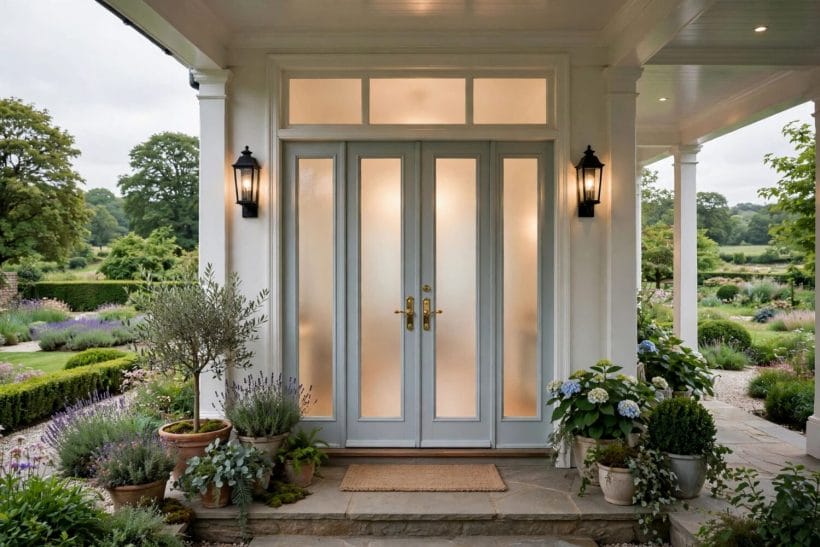
Colour is where a double door earns its kerb appeal — and where the infographic’s painted-colour row points. These ideas span the classic, the bold and the natural, all chosen against the house rather than the trend chart.
28. Classic black, the formal default
Black on both leaves, in a satin or gloss finish, is the entrance equivalent of evening dress: formal, forgiving of architecture, and endlessly re-paintable.
29. Deep green, the country classic
A deep racing or forest green suits stone, brick and planted front gardens, and pairs beautifully with brass. It is the colour the feature garden’s approach would choose — leafy, settled and quietly confident rather than loud.
30. Navy and ink blue for coastal and town houses
Deep blues carry a nautical crispness that flatters white render, pale stone and grey brick alike. On a double door the expanse of blue needs the finish to be excellent; wide leaves show brushwork and dust more honestly than narrow ones.
31. Reds: oxblood and burgundy over bright scarlet
Deep reds give traditional houses their warmth without the fairground note of a bright scarlet. On a pair, the doubled area doubles the colour’s presence, so the deeper shades almost always serve better than the vivid ones.
32. Natural timber stain, grain on show
Where the leaves are beautiful timber, a clear or lightly toned finish lets the grain be the colour. South-facing doors ask the most of any finish; your joiner’s product guidance, and a willingness to maintain, are part of the honest price of this look.
33. Soft neutrals: stone, sage and putty
Pale, muddy neutrals suit rendered cottages and calm modern schemes, letting planting and stonework lead. On wide leaves these colours show grime kindly at the bottom rail if the finish is satin rather than dead matte — a small practical mercy.
34. A bold statement colour, chosen once and committed
Mustard, teal, plum — a deliberate statement on a double door can define a whole frontage. Commit fully: repeat the colour nowhere else on the exterior except perhaps a planter, keep the furniture simple, and repaint on schedule so the statement never fades into a rumour.
35. Two-tone: exterior colour, interior calm
The outer face can carry the house’s statement while the inner face stays pale to keep the hall bright. Joiners handle the change at the meeting stiles and edges; agree exactly where the colour breaks before painting begins.
36. Matching the pair to the house’s trim family
Whatever the colour, it should belong to the same family as the windows, porch and garage — one exterior palette, spoken at different volumes. The door is the loudest voice, but it should still be singing the house’s song; the approach planting ideas in tiny house porch ideas show how greenery completes the same composition at smaller scale.
6. Hardware, Handles and Security
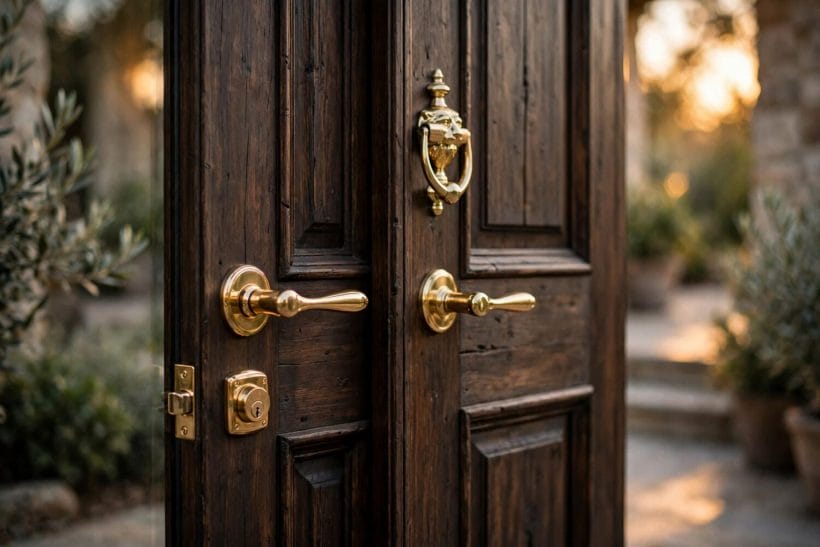
A pair needs twice the furniture and twice the thought: what the hand touches, what the eye reads, and what quietly keeps the house secure.
37. A centre knob as the pair’s full stop
A substantial knob at the meeting stile, often purely decorative on the active leaf’s pair, gives double doors their classic centrepiece. Its finish sets the tone for every other piece of furniture on the doors.
38. Ring handles and lever handles, matched across both leaves
The working leaf needs a true handle; its partner usually carries a matching dummy. Buy them as a considered set, in one finish, sized generously — undersized handles on wide leaves look like an apology and feel like one in winter gloves.
39. Long pull handles for the modern pair
On flush modern leaves, a long vertical pull on each leaf is both the ornament and the handle. Keep the pair perfectly aligned; on a wide, plain expanse, a few millimetres of disagreement is visible from the street.
40. Bolts for the passive leaf, top and bottom
The fixed leaf is held by bolts at its head and sill — flush bolts for a clean face, surface bolts where period style allows.
41. Multi-point locking on the active leaf
Modern pairs commonly lock at several points along the meeting edge, driven by one handle and key. Have the system demonstrated by the installer and keep its adjustment guidance; wide doors reward a lock that pulls the leaves home evenly.
42. Hinges sized and finished as part of the design
Heavy leaves need hinges with the strength for them — and on traditional pairs, decorative hinge fronts can be part of the look.
43. Weather seals at the meeting stile
The centre meeting is a double door’s draughtiest seam. Astragal strips, brushes and seals fitted to the meeting stiles are what make a grand entrance feel snug in January; ask the maker how theirs is sealed and how the seals are renewed.
44. A threshold that sheds water and welcomes wheels
The sill must throw rainwater clear, seal against draughts, and stay kind to prams, wheels and unsteady feet. Low-profile accessible thresholds exist within proper weathered systems — an installer who knows them is the right guide, since a leaking threshold rots quietly and expensively.
45. Door furniture in one finish, bought together
Knob, handles, letter plate, knocker, numerals, hinges and the bell push: one finish, one order, one family. The infographic’s hardware tip in section one says it in a line — match the door furniture to the porch lighting’s finish and the whole entrance reads as one thought.
7. The Entrance Around the Doors
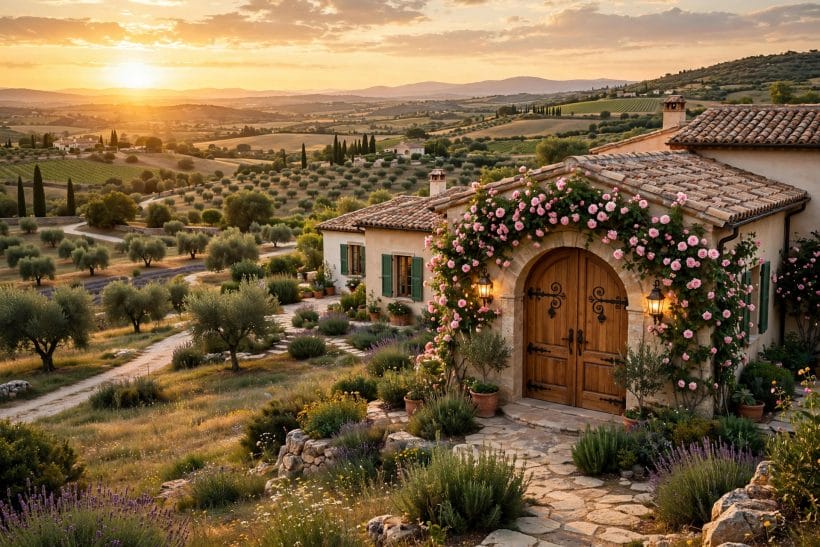
Double doors deserve a composed approach — porch, path, planting and light arranged to meet them. The feature photograph’s portico and garden path are the full orchestral version; these ideas scale the thinking to any plot.
46. A portico or canopy that shelters the pair
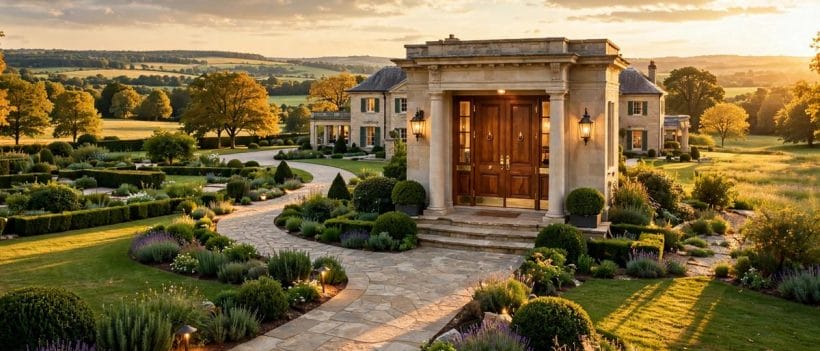
Wide doors catch wide weather. A portico, canopy or deep porch roof protects the leaves, the seals and the visitor fumbling for keys — and gives the entrance its architectural frame, as the stone portico does in this post’s photographs.
47. Steps and a landing sized to the swing
Arriving guests step back as double doors open; the landing must have room for them. Broad, shallow steps suit the grandeur and the safety alike, and a landing deep enough for a person and a parcel is the unglamorous detail everyone thanks later.
48. Lanterns flanking the pair, in the doors’ metal
Paired lights at either side balance the composition and light faces kindly at night. Match their finish to the door furniture, keep their glow warm, and put them on a sensor or timer so the welcome is lit before the key is found.
49. A path that arrives at the centre
A double door has a centre line, and the path should honour it — arriving squarely, widening at the steps, edged with planting that stays below the sightline. The gravel-and-stone approach craft in gravel path rock borders diy walkway translates directly to grander paths.
50. Planters and topiary in balanced pairs
Two planters, two clipped shapes, two small trees: the planting echoes the doors’ own symmetry. Keep them clear of the leaves’ swing and the lanterns’ light, and choose containers with the weight to stand beside wide doors without looking borrowed.
51. A house number that reads from the street
Wide entrances sit on wide frontages; the number must work at distance. Large, high-contrast numerals on the door, the fanlight or the gate pier save every delivery driver — and every guest circling in the rain — a small daily kindness.
52. A boot scraper, bell and parcel thinking
The working entrance needs its small tools: somewhere for muddy boots, a bell that can be heard, and a plan for parcels that is not the doorstep in the rain.
53. The hall side: a console, a mirror and room to arrive
Inside, the pair opens onto the hall’s own composition — a console for keys and post, a mirror for the last check, floor space to actually arrive in. Entry traditions like those in japanese genkan tiny house entryways make the same point at tiny scale: the threshold is a room, not a gap.
54. Seasonal dressing that respects the doors
A wreath on one leaf or centred between them, lanterns at the steps, planting refreshed by season — dressing should hang from proper hooks and never ask the doors to carry fixings drilled in haste.
8. Practical Checks Before You Commit
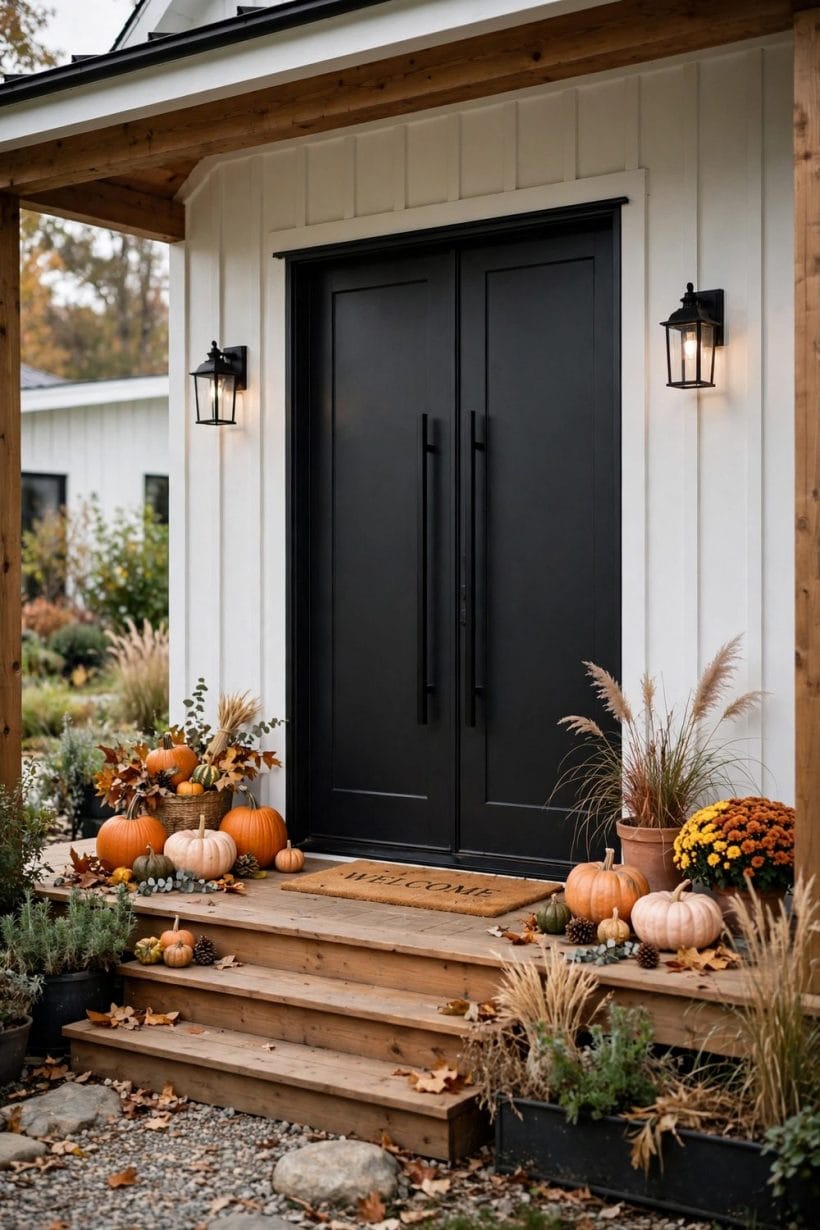
A double door is the hardest-working piece of joinery in the house and the least forgiving of wishful measuring. These checks — made before ordering, with tape, spirit level and a professional where needed — prevent the expensive surprises.
55. Measure the opening three ways, then again
Width at top, middle and bottom; height at both sides; diagonals for square. Old openings are rarely true, and the smallest measurement governs.
56. Confirm the structure above the opening
Widening an opening, or replacing a lintel, is structural work for professionals under local rules — full stop. Even a like-for-like swap deserves a look at what carries the wall above before the old frame comes out, and screened porches and additions like those in tiny house plans with screened porches make the same point: openings are structure first, decoration second.
57. Check the swings against the hall and the porch
Tape the leaves’ arcs on the floor, inside and out. Doors that strike a stair, a console or each other’s furniture will be resented daily; catching the clash on the floor plan costs nothing but a few minutes.
58. Decide the active leaf by how you actually arrive
Which hand carries the shopping, which side the path approaches from, where the car stops — the active leaf should be the one that meets your real arrival.
59. Plan the furniture move, honestly
The wide opening’s promise only holds if the hall beyond it is equally passable. Walk the route the sofa must travel — hall width, inner doorways, the turn at the stairs — before counting the double door as the moving-day solution.
60. Agree who measures, who makes, who fits
Doors fail in the gaps between trades. One contract that covers measuring, making, fitting and finishing — or a written division everyone has signed — is worth more than any single upgrade to the doors themselves.
61. Ask about adjustment after the first seasons
New timber doors settle; good makers and fitters expect a return visit to ease, adjust and re-seal. Ask at the order stage whether that visit is included — the answer tells you a great deal about the firm.
62. Keep the old doors until the new pair is proven
An opening should never stand empty overnight, and a rejected door needs somewhere to be argued about. Agree the sequence — removal, fitting, making good — before the day, and keep the old leaves safe until the new pair has swung through a rainstorm.
63. Photograph and record everything fitted
Keep the maker’s care guidance, the finish codes, the lock and hinge specifications and dated photographs of the fitted pair. Future maintenance, insurance questions and the next owner’s gratitude all run on this small folder of paper.
9. Care and Keeping the Pair True
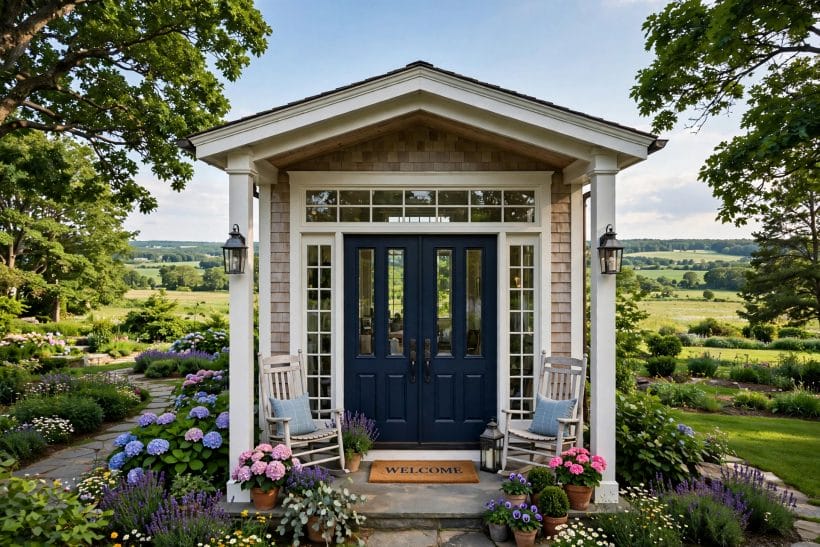
Two leaves give weather twice the edge to attack and give neglect twice the evidence. The care below is general good practice; product specifics always follow your maker’s own guidance.
64. Wash down and inspect the finish seasonally
Grit and algae shorten any finish’s life. A gentle wash, a check of the bottom rails and meeting stiles where water lingers, and prompt attention to chips keep the coating — and therefore the door — alive for years longer.
65. Keep the meeting stile seals supple and whole
Brushes flatten and rubber seals harden. Renewing them is small, cheap work that preserves the pair’s draught-proofing and the lock’s easy action, since a door fighting its own seals is a door being forced daily.
66. Oil the moving metal before it complains
Hinges, bolts and lock mechanisms all prefer a little of the right lubricant at long intervals to a flood of the wrong one in a crisis.
67. Watch the bottom rails after hard weather
The lower rails and the threshold take the weather’s worst. After storm seasons, look for finish failure, swelling or early decay at these points — caught early, they are a joiner’s small repair; ignored, they become the door’s obituary.
68. Adjust rather than slam
A leaf that starts to bind is asking for adjustment, not force. Seasonal movement is normal in timber doors; the return visit of section eight exists precisely for this, and a door eased promptly never learns the habit of sticking.
69. Touch in coating damage promptly
On steel and coated leaves, a chip left bare invites the weather under the coating. A small touch-in with the maker’s matched product, done the week it is noticed, is the difference between maintenance and refinishing.
70. Keep drainage at the threshold clear
Leaves, gravel and snow banked against the threshold hold water exactly where the door is most vulnerable. A clear path for water away from the sill is the cheapest preservation a wide entrance can be given.
71. Repaint on the finish’s schedule, not the eye’s
By the time a painted finish looks tired, the timber beneath has usually been unprotected for a while. Follow the product’s stated renewal rhythm for your aspect and exposure — south-facing pairs live harder lives and their schedules say so.
10. Costs as Drivers and Choosing Well
No honest figure can be printed here — a double door’s cost is its specification wearing a number. What can be stated plainly is what drives the total, so quotes can be compared like with like; the dedicated survey in door installation cost covers the fitting side in depth.
72. The drivers, in the order they bite
The opening work and any structural changes come first, then the leaves’ material and whether they are standard sizes or commissioned, then glass specification, hardware and locking, finishing, and the fitting itself.
73. Where the money earns its keep
Spend first on the frame, hinges and seals — the parts that decide whether the doors work — then on the leaves’ build quality, then on visible furniture.
74. Standard sizes versus commissioned joinery
Standard-size pairs in standard configurations cost less and arrive sooner; arched heads, unusual widths and true period replication are commissioned work with commissioned timelines.
75. The decision that matters most
Choose the maker and fitter before the door. A reputable firm measuring, making and standing behind the pair is the purchase; the leaves are merely what it delivers.
Final Considerations
A double front door is an entrance making a promise: that the house behind it is generous, considered and glad of your arrival.
Measure honestly, choose the maker before the model, and let the pair be the house’s handshake. Few single purchases change how a home feels from the street quite so completely.


0 Comments