

A farmhouse dining room is not decorated. It is used — daily, generously, by everyone — and its beauty is simply what daily, generous use looks like when the table is honest and the chairs forgive.
This survey collects seventy-five farmhouse dining room ideas in the farmhouse lane only — the long table, mixed seating, dressers, gentle colour and supper light — inside the wider dining room ideas collection. The sleeker modern dining lane has its own survey, linked below, and is deliberately not repeated here.
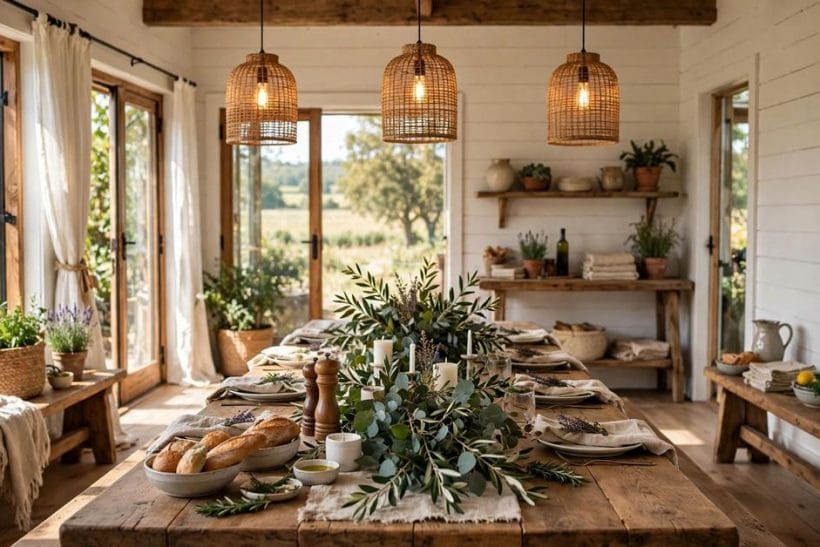
1. Farmhouse Dining Room at a Glance
A farmhouse dining room is a dining space in the rural vernacular: a substantial timber table as its centre, seating that mixes benches and chairs without anxiety, storage in dressers and open shelves that display the everyday crockery, and a palette of warm whites, worn timber, faded blues and greens, linen and iron. Its attributes split into the practical (a table sized for elbows and serving dishes at once, chairs comfortable for a long evening, surfaces that forgive heat, rings and homework) and the atmospheric (supper light kept low and warm, textiles softening the timber, and nothing in the room too precious to touch). This post owns that farmhouse character whole; the general dining survey linked above owns the room type, and the modern dining survey owns the contrasting sleek lane.
| Question | Short answer |
|---|---|
| How is farmhouse dining different from modern dining? | In temperament. The modern lane — surveyed separately in the modern dining room ideas post linked below — polishes, pares and composes. The farmhouse lane gathers, mixes and forgives: mismatched chairs are a feature, wear is a patina, and the table is set for use before it is set for show. |
| What table defines the style? | A long, substantial timber table — old if possible, honestly made if new — with a surface that takes heat, marks and years without complaint. Size serves the household plus its welcome: farmhouse tables seat the extra cousin without a meeting. |
| Must everything be old or rustic? | No. The room’s bones are vernacular — timber, linen, iron, gentle colour — but a new table built honestly, modern lighting made simply, or a contemporary chair in the right material all sit happily inside it. Farmhouse is a material honesty, not a date. |
| Does farmhouse suit a small dining space? | Beautifully, because the style’s virtues are not size: a smaller honest table, a bench against the wall, one dresser and gentle colour give a small room the whole character. The breakfast nook lane linked below serves the smallest eating corners in depth. |
2. The Table First: Timber, Size and Honest Wear
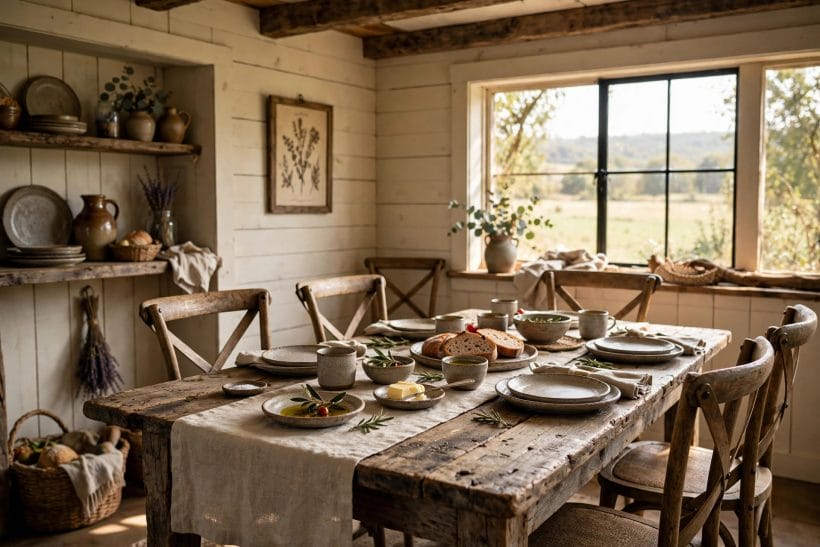
Everything in this room answers to its table, so the table is chosen first and chosen for use. The wider kitchen ideas collection makes the same argument next door: working rooms begin with the surface the work happens on.
1. Choose a table longer than the household
Farmhouse hospitality is built into the dimensions: room for the household, the extra guest, the serving dishes and the elbows, all at once. A table that seats everyone except the food has failed its only examination.
2. Let the top be timber, thick and unpretentious
A solid-feeling timber top — planks with their grain allowed, edges softened by years or by the maker’s plane — carries the style.
3. Accept marks as the table’s diary
Rings, knife scores and the pale ghost of a hot pot are this table’s honourable service record.
4. Square the ends, seat the hosts there
A rectangular table with honest end seats gives the room its gentle hierarchy: hosts at the ends, everyone else along the sides, conversation crossing easily.
5. Keep the legs out of the knees’ way
Trestle and pedestal bases free the long sides for benches and extra chairs; four corner legs ration the seating the table’s length promised. Sit at the table before buying it — knees are the strictest reviewers.
6. Size the room from the table outward
Chairs pulled out, people passing behind them, the dresser doors opening: the room is measured around its table in use, not in catalogue.
7. Let one old table carry the room
A genuinely old farmhouse table — auction, inheritance, salvage — brings a patina no finish can fake, and the room builds itself around it gratefully.
8. Build new tables honestly when old ones hide
Where no old table offers itself, a new one in solid timber, simply joined and finished in oil or wax, joins the tradition without costume. Honest new beats imitation antique in every generation of this style.
9. Keep a leaves-and-extras plan
The extending table, the folding extra and the borrowed chairs from the kitchen: the plan for the largest gathering is made in advance, calmly. Farmhouse welcome is logistics remembered kindly, not miracles performed at the door.
10. Centre the table on the light, not the room
The table sits under its pendant and in the window’s best light, even where that pulls it off the room’s geometric centre.
11. Leave the table set simply between meals
A runner, a bowl, candlesticks: the farmhouse table rests dressed but uncluttered, ready in a minute. A table that must be excavated before supper trains the household to eat elsewhere, which is the room’s quiet failure.
3. Seating That Mixes: Benches, Windsors and the Odd Chair
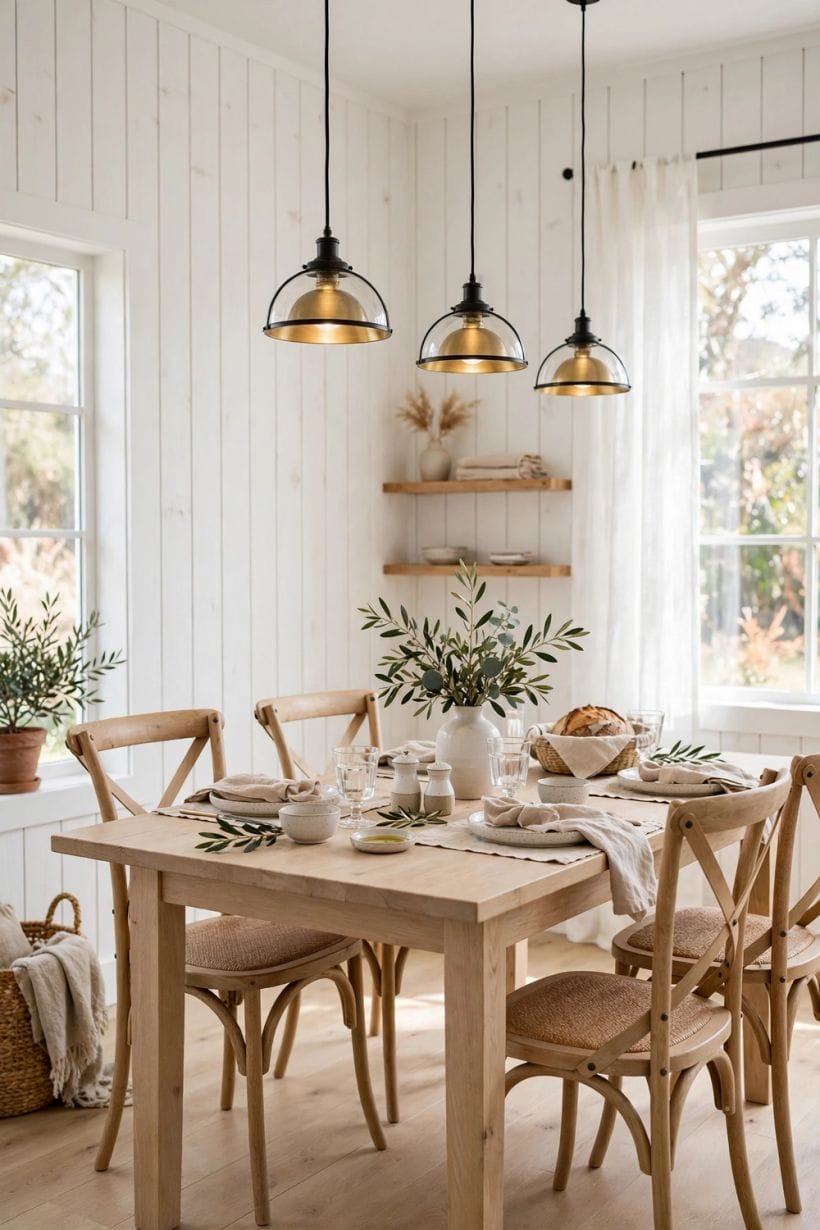
Farmhouse seating is a gathering, not a set — a bench, a row of honest chairs, a carver at each end, nothing matching except the welcome. It is the deliberate opposite of the sculptural matching sets in the modern dining room ideas survey, whose discipline is admired here and followed not at all.
12. Run a bench along one long side
The bench is the farmhouse signature: it seats three where chairs seat two, slides away under the table, and lets children arrange themselves by their own diplomacy. Cushion it thinly; benches are for supper, not for slumber.
13. Choose spindle-back chairs for the other side
Windsor-pattern and spindle-back chairs — light, strong, beautiful from behind, which is how dining chairs are mostly seen — carry the style’s chair tradition. Originals, good reproductions and honest modern versions all qualify.
14. Give the ends their carvers
A slightly grander chair at each end — arms, presence, comfort for the long evening — hosts the table without a word of instruction. The carvers are where the household’s elders gravitate, which is also tradition.
15. Welcome the odd chair that earns its place
One chair that matches nothing — a painted find, a grandfather’s chair, the rescued chapel chair — joins the set if it is sound, comfortable and the right height. Farmhouse sets are families: resemblance helps, belonging decides.
16. Test every chair for the long sit
Supper in this room runs long, so chairs are sat in for an hour before they are bought — shop chairs forgive nothing after twenty minutes.
17. Keep a cushion and throw rhythm
Simple tie-on cushions and a throw over one chair back soften timber seating through the seasons.
18. Paint some chairs, leave some bare
A mix of painted and natural timber chairs — one gentle colour, repeated on two or three — composes the gathered look deliberately. Painting every chair the same shade reintroduces the matching set by the back door.
19. Store the spares in sight, handsomely
The extra chairs for the full table hang on wall pegs, stand in the hall, or serve the desk and the bedroom between gatherings.
20. Let children belong at the whole table
A cushion raising the smallest diner, a bench end reserved for the wobblers: the farmhouse table makes its adjustments inside the gathering, because the gathering is the point. Separate children’s tables are for other houses’ philosophies.
21. Keep chair heights in one family
Gathered chairs may differ in everything except seat height and table clearance, which are checked together before the set is declared.
22. Repair chairs like the heritage they are
A reglued joint, a re-rushed seat, a tightened rung: farmhouse chairs are maintained, not replaced. A chair mended visibly and soundly carries more of the style than a new one delivered in plastic.
4. Dressers, Shelves and Storage That Shows
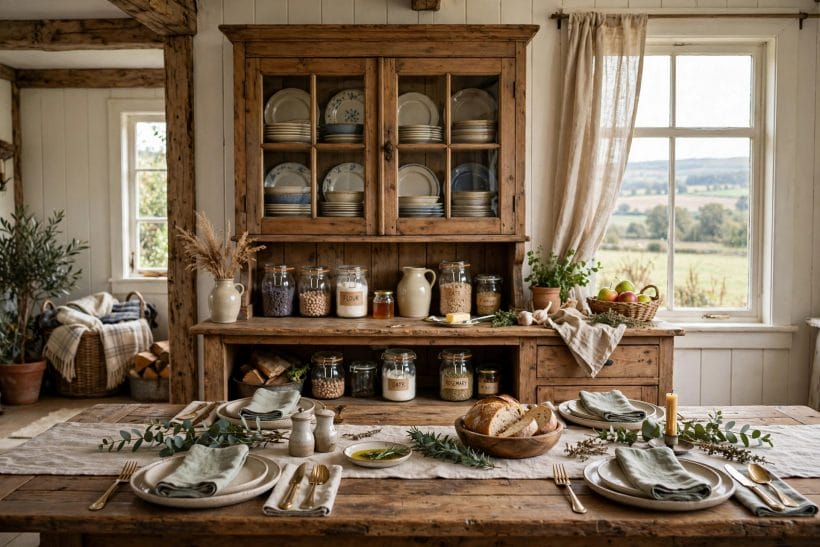
The farmhouse dresser displays the everyday and hides nothing precious: crockery in daily rotation, glasses, linen and the good jug, all in the open because all in use. The same working-display logic serves the farmhouse rooms in the farmhouse bedroom ideas survey.
23. Let a dresser carry the room’s storage
The classic dresser — cupboards below, open shelves above — holds the dining room’s whole working kit within reach of the table. It is this room’s wardrobe, pantry and display cabinet in one honest piece of furniture.
24. Display the everyday, store the occasional
Open shelves carry what hands reach for weekly: plates, bowls, glasses, the water jug. The once-a-year pieces live in the cupboards below, because display that cannot be reached becomes dust with pretensions.
25. Stack plates in the open, proudly
Plates stacked or racked on the dresser’s shelves, in the order of their use, are the farmhouse room’s easiest beauty — the pattern of their rims does the decorating.
26. Hang cups and jugs from hooks
Hooks under the dresser’s shelves carry cups and jugs by their handles, freeing shelf space and making the morning’s reach a pleasure. What hangs gets used; what gets used gets washed; the rotation keeps everything alive.
27. Keep linen in a dresser drawer, folded simply
Table linen — cloths, runners, napkins — folded in one drawer, ironed by nobody’s religion, gives the table its changes of dress. Linen slightly creased is the style’s signature, not its failure.
28. Build open shelves where no dresser fits
Two or three honest shelves on the wall brackets do the dresser’s display work in a smaller room, over a low cupboard or a bench. The principle survives the furniture: working things, shown, within reach.
29. Give glasses a home that is not the kitchen
Everyday glasses on the dresser end the meal-time migration to the kitchen, and a carafe of water on the table ends it twice.
30. Show one collection, only one
Blue-and-white plates, stoneware jugs, old glass: one collected family, displayed together, gives the room its personal note. Two collections compete; three are a shop. Choose the one the household actually loves looking at.
31. Keep the sideboard’s top a working surface
The dresser’s or sideboard’s top serves the meal — dishes land there, candles stand there — so it is styled with space left over.
32. Stand a plate rack where hands dry dishes
A rack on the dresser or the wall beside the kitchen door turns drying into display and display into storage.
33. Close the cupboards on the honest mess
The chargers, the candle ends, the games, the table’s spare leaves: cupboard doors exist so that a working room can look serene anyway. Farmhouse calm is not tidiness; it is doors that shut on the evidence.
5. Colour, Walls and Textiles: The Gentle Palette
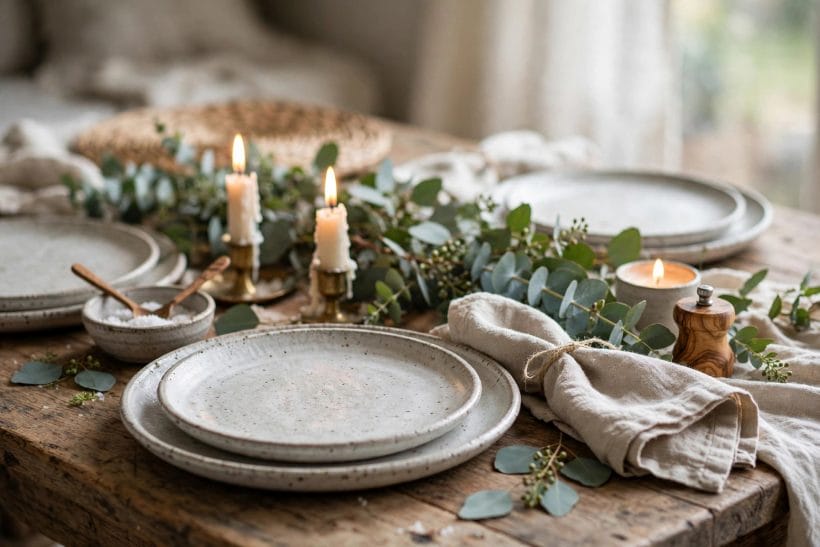
Warm white, worn timber, faded blue, sage, clay and linen: the farmhouse palette is the countryside’s own, applied with a light hand and kept gentle enough to flatter food and faces at once. Small eating spaces translate the same palette in the breakfast nook ideas survey.
34. Paint walls a warm, food-friendly white
Warm whites and the palest stone colours flatter supper, candlelight and complexions together. Cold greys and brilliant whites belong to other lanes; in this room, the wall’s job is to make the table’s company look well.
35. Let timber be the second colour
Table, dresser, floor and beams in their natural range give the room its warmth without a single paint decision. Timber tones need not match — they need to be neighbours, which in a farmhouse they naturally are.
36. Bring faded blue or sage in as the accent
One gentle colour — on chairs, a dresser’s back boards, a cupboard’s interior — carries the palette’s interest. Faded is the operative word: the countryside’s colours are weathered ones, and the room is calmer for it.
37. Hang one honest picture, or a wall of small ones
A landscape, a botanical print, a wall of small family photographs in simple frames: farmhouse walls carry the personal, not the programmatic. Art here is loved first and decorative second, and everyone can tell the difference.
38. Dress the window in linen, simply
Linen curtains, a plain blind, or bare glass over a garden: window dressing in this room filters light without performing. Heavy swags belong to formal dining’s other tradition, honoured elsewhere and unmissed here.
39. Lay a rug that forgives
A flatweave or rag rug under the table — washable, forgiving, patterned enough to hide a crumb’s evidence — warms the floor and anchors the gathering.
40. Keep textiles natural and washable, throughout
Linen, cotton and wool in the cloths, cushions and curtains; everything washable, nothing dry-cleaned by fear. The palette stays gentle partly because natural fibres take colour gently — the material and the mood are the same decision.
41. Let the floor be boards, stone or honest boards again
Worn boards, stone flags or their practical modern cousins ground the room.
42. Use black iron as the punctuation
Hinges, hooks, a pendant’s chain, candle sconces: small black iron details punctuate the pale palette like full stops. A little goes the whole way — iron everywhere turns punctuation into shouting.
43. Let flowers come from the garden, not the florist’s drama
A jug of whatever the garden or the hedgerow offers — branches in winter, herbs in summer — is the room’s native arrangement.
44. Keep the palette through the seasons
Winter adds wool and candlelight; summer adds flowers and open windows; the palette itself does not change. Seasonal rooms exhaust their households; seasonal dressing on a steady palette delights them.
6. Light for Supper: Low, Warm and Gathered
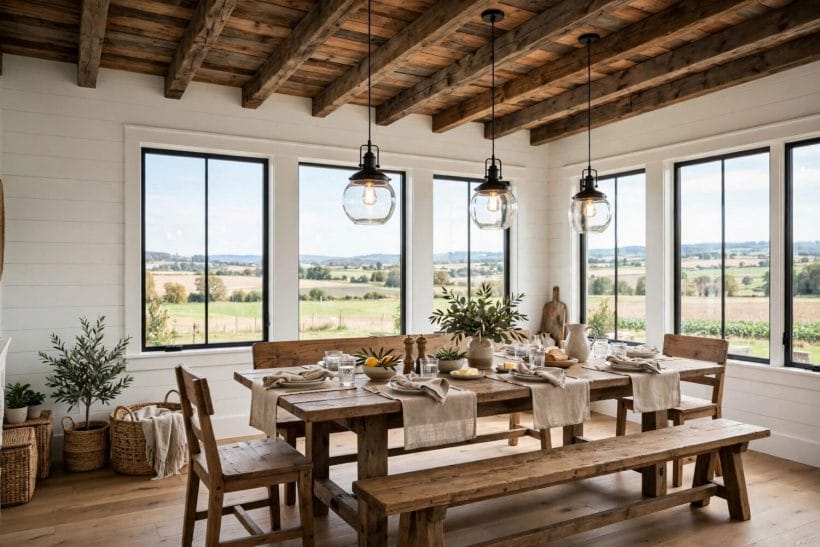
Farmhouse dining light is evening light: a pendant low over the table, candles without apology, and every source warm enough to flatter the food it was lit for.
45. Hang one pendant low over the table’s centre
A single generous pendant — enamel, timber or iron — pooled low over the table gathers the company into its light.
46. Put the pendant on a dimmer, always
Bright for homework and board games, low for supper and candles: the dimmer is this room’s hardest-working fitting. Electrical work is a qualified electrician’s, under local rules — the plan asks, the professional installs.
47. Keep candles as working light, not decoration
Candlesticks and simple jars on the table give the light faces are actually flattered by, used nightly rather than saved.
48. Add a lamp on the dresser for the room’s edges
A small lamp on the dresser or sideboard warms the room’s perimeter so the pendant’s pool does not strand the table in a dark field.
49. Let daylight be the breakfast light
By day the room asks only for its windows unobstructed and its curtains honest.
50. Choose shades that warm the light downward
Metal and enamel shades throw light where supper happens; linen shades soften it for the long evening. Exposed filament bulbs in warm tones are the style’s friends — cold, brilliant bulbs are its quiet enemies.
51. Light the dresser’s shelves for the display
A small light washing the dresser’s open shelves turns crockery into the room’s evening picture. The display was built to be seen; the night shift of lighting makes sure it is.
52. Keep the garden dark beyond the glass
Evening in this room ends at the window: the table lit, the garden a dark backdrop, faces turned inward. Lighting the garden to compete with supper is a modern lane’s pleasure, gracefully left to it.
53. Hang the pendant before the table’s final place is set
The table centres on the light once the light is fixed — electricians and gravity decide the order.
54. Keep switches and dimmers where the cook can reach
Light controlled from the doorway and the kitchen’s side of the room serves the person carrying the dishes.
55. Test the light at a real supper
Sit the household down, serve, and judge: glare, shadow, the cook’s face, the food’s colours. Lighting is finished when nobody at the table thinks about it — the only review that has ever mattered.
7. The Working Details: Serving, Storing and Daily Life
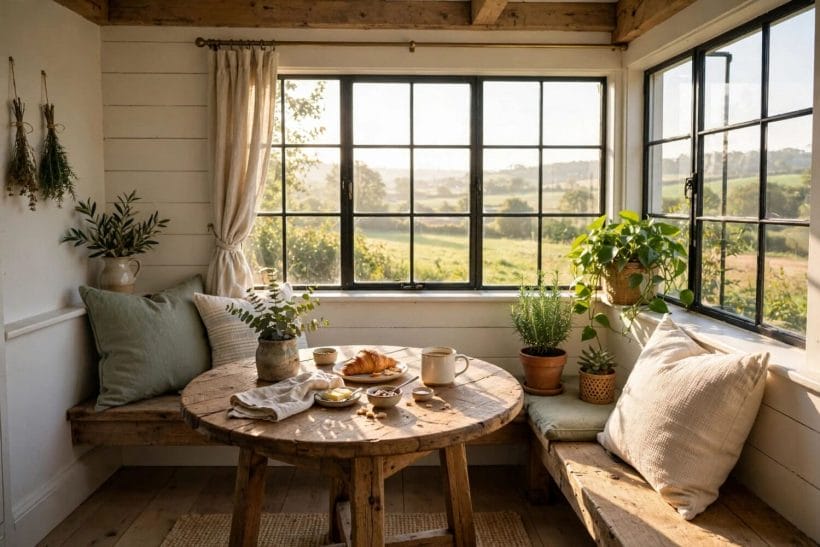
Between celebrations, this room earns its keep daily: breakfast, homework, laptops, birthdays and the Sunday roast all happen on the same forgiving surface, in the spirit of the wider home design ideas collection’s working rooms.
56. Keep a serving station by the kitchen door
A small trolley, a side table or the dresser’s end stages dishes between kitchen and table, so courses arrive without the corridor ballet. Serving logistics are hospitality’s invisible half, planned like everything else here.
57. Store the table’s leaves where the table can reach them
Leaves under the table, in the dresser’s cupboard, or behind the door — never in a loft across the house. An extension that requires an expedition extends nothing but the host’s temper.
58. Give homework and laptops their hour, then clear
The farmhouse table is the household’s best desk by day, on one condition: the day’s work clears wholly for supper.
59. Lay for breakfast the night before, sometimes
Bowls and cups set at night on a clear table is the farmhouse room’s small luxury to its morning self. Not nightly, not a regime — a kindness the room performs when the evening allows.
60. Keep a games shelf for the long evenings
Board games and cards in the dresser’s cupboard, at the table where they are played, make the room the house’s evening default. Rooms that hold their pleasures get chosen; rooms that must be fetched for do not.
61. Plan the big gatherings like a campaign of kindness
Borrowed chairs counted, leaves in, the serving station staged, the menu within the kitchen’s honest reach: the farmhouse feast is logistics wearing an apron. Guests remember ease, and ease is planned, not improvised.
62. Let the table host the making, too
Dough rolled, jam jars filled, homework glued, wreaths wired: the big honest table is the house’s workbench with the best light. A cloth protects it for the messy crafts; its own surface forgives the rest.
63. Keep cleaning as simple as the room
Crumbs swept, cloth shaken, timber wiped with nothing heroic: the room’s materials were chosen partly for this paragraph. A dining room that takes an hour to restore gets restored rarely, and used accordingly.
64. Feed the dog under nobody’s chair
The household’s animals have their own corner of the room’s floor plan — bowl station away from chair legs and the serving path.
65. End the day with the table clear
The room’s nightly reset — table cleared, chairs pushed, tomorrow’s kindness optional — takes minutes and buys the morning. A farmhouse dining room kept ready is a room the household falls into gladly, three times a day.
8. Small Rooms and Open Plans: The Lane at Every Size
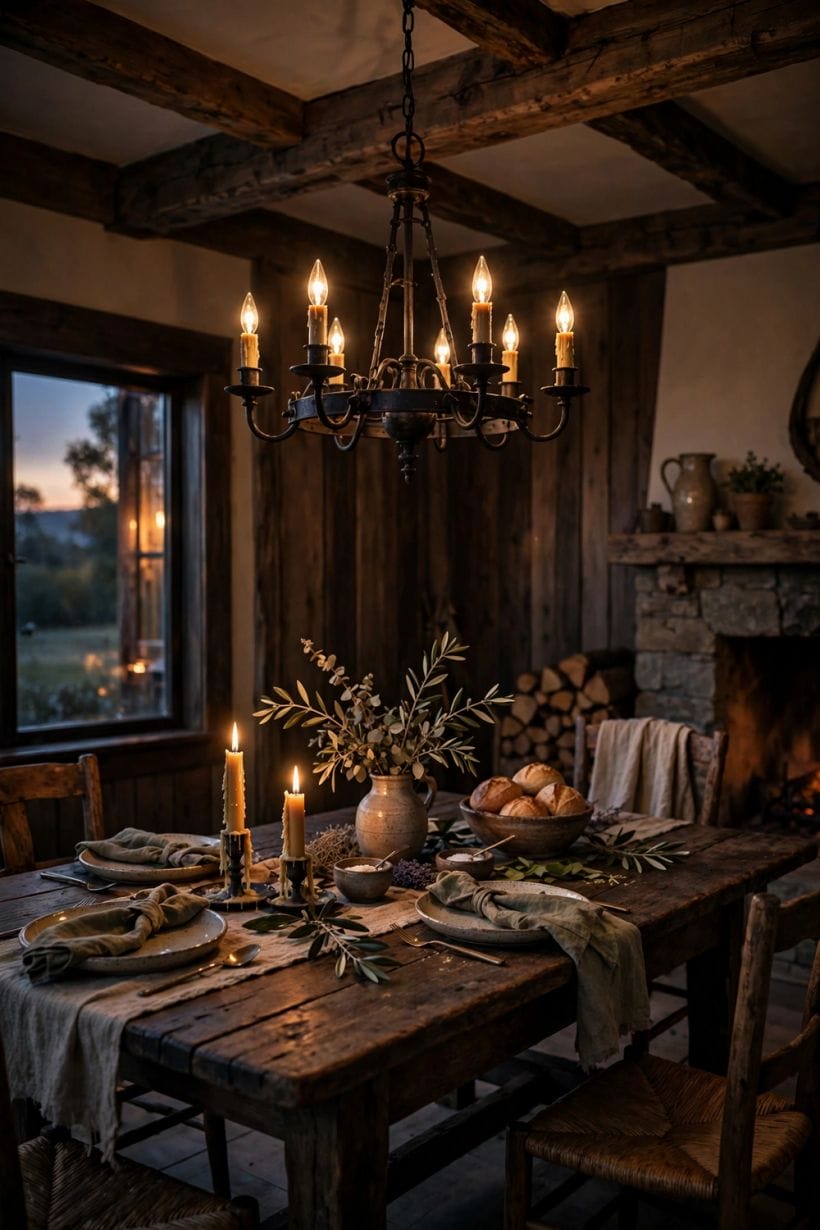
The farmhouse table does not need a farmhouse, or even a separate room. In small dining corners and open plans, the same ingredients — honest table, gathered chairs, working storage, gentle colour — mark out a dining place that feels like a room of its own.
66. Zone an open plan with the rug and the pendant
In an open room, the rug under the table and the pendant over it draw the dining room’s invisible walls.
67. Shrink the table, keep its character
A smaller solid table, honestly built and well worn, carries the whole style at apartment scale. Character lives in material and welcome, not in length — a small table set generously out-farmhouses a large one set meanly.
68. Bench the wall side in a tight room
A bench against the wall seats the table’s long side without chair-pull space behind it, buying back the room’s tightest dimension. It is the small dining room’s oldest bargain, and the farmhouse lane is its natural home.
69. Use a drop-leaf table as the daily diplomat
Leaves down for two, up for six: the drop-leaf table is the small farmhouse room’s honest answer to the calendar.
70. Let one dresser do the whole storage wall
In a room without space for both dresser and sideboard, one good dresser carries display, storage and serving surface together. Small rooms reward single, complete pieces over pairs of half-pieces every time.
71. Keep the palette paler as the room shrinks
Small dining spaces take the farmhouse palette at its palest: warm white walls, pale timber, the accent colour halved. The character survives dilution gracefully, because it was never carried by colour alone.
72. Borrow the kitchen’s farmhouse, or lend it yours
Where dining sits inside a farm kitchen, the two zones share table timber, textile and iron details so the whole reads as one working room.
73. Seat the window, always
In a small room, the table’s best position is across the light: faces lit kindly, the view shared by the long sides.
74. Keep the gathering small and the welcome large
A small farmhouse table hosts fewer people and, often, better evenings: the style’s welcome was never a headcount. The room that seats four generously beats the room that seats ten anxiously, in memory every time.
75. Finish with the same nightly reset
Small rooms and open plans feel the day’s residue fastest, so the farmhouse reset — table clear, chairs home, tomorrow possible — matters most exactly where space is least.
9. Checks and Mistakes: Before the First Purchase or the First Stone
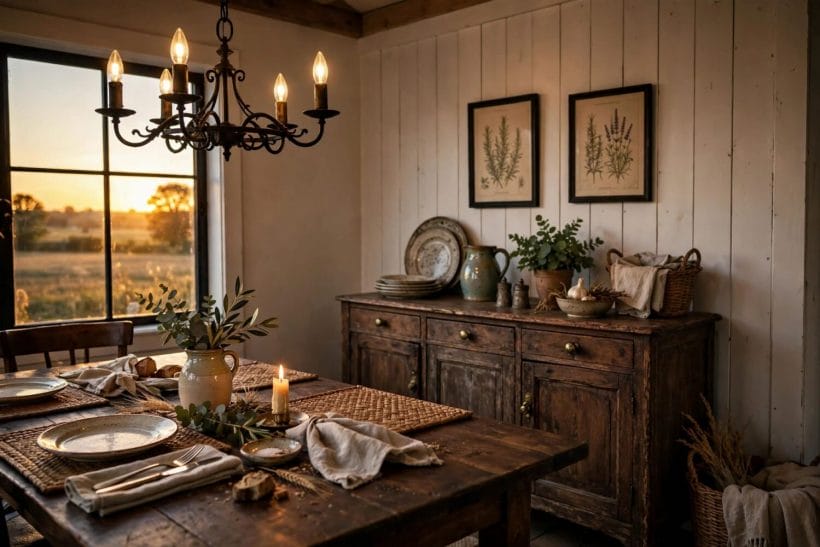
Check the room before the furniture, in the order use demands: measure the table’s footprint with chairs occupied and people passing behind them, walk the serving path from the kitchen with a tray in hand, and confirm the dresser doors and drawers open into a room that still functions. Test chairs at length, sit at any old table before buying it, and let a qualified electrician settle the pendant’s position and dimmer under local rules. Those practicalities are the room’s foundations; everything else is dressing.
The commonest mistakes are all failures to respect the room’s temperament: a table too precious to use, chairs bought as a matching set that nobody can sit in past dessert, open shelves loaded with things nobody touches, and a palette polished toward a showroom’s chill. The farmhouse remedy is subtraction and use — remove the precious, sit in the chairs, cook the supper — because this room is judged nightly, at the table, by the people eating at it.
10. Costs and Pulling It Together
Costs in this lane stay qualitative, because the honest figure belongs to a chosen table, a room’s size and a household’s appetite for auction rooms. The drivers are friendly ones: farmhouse dining is among the least expensive styles to do well, because age is an asset, mixing is the method, and paint, linen and patience do work that money does elsewhere. A single fine old table with gathered chairs around it will out-sing a costly matched suite in this register every time.
Pull the room together in its own order: table first, seating gathered second, dresser and shelves third, palette and textiles fourth, and supper light last of all, tested at a real meal. Keep a little contingency for the chairs’ repairs and the table’s refinishing, and spend first on the pieces touched daily. The result is not a look. It is a room the household uses three times a day and loves a little more each year.
Final Considerations
End at the table, where the room begins and ends: timber worn kind by use, chairs that have held everyone, crockery in the open because it is always in someone’s hand, and light low enough to make an ordinary Tuesday feel like an occasion.
Build it by gathering honestly — a good table, chairs that forgive, storage that shows its work — and then simply use it, daily and generously. A farmhouse dining room is never finished, because it is never merely decorated. It is lived in, and that is the whole design.

0 Comments