

The best seat in most houses is not the sofa. It is a small bench in a kitchen corner, where the light arrives first and the kettle is never far away.
These breakfast nook ideas build that corner properly: the seat, the table, the light and the soft layer, down to the keeping that lets it survive real mornings.
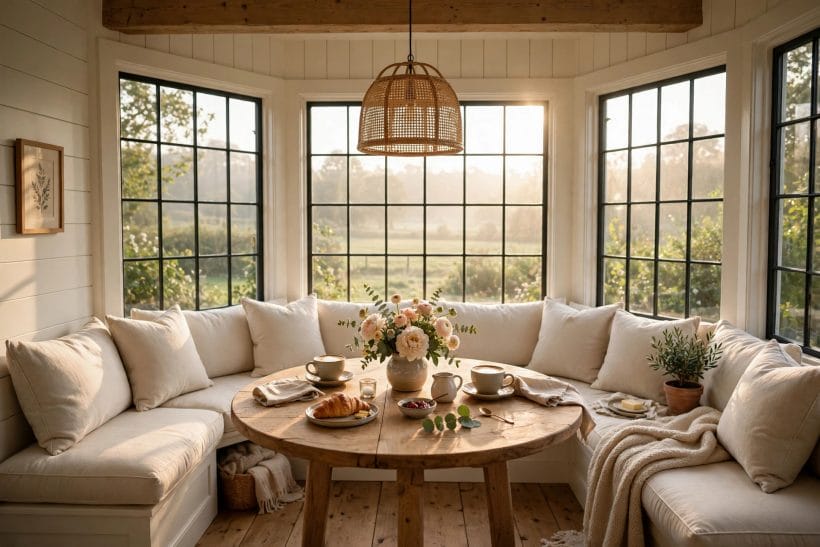
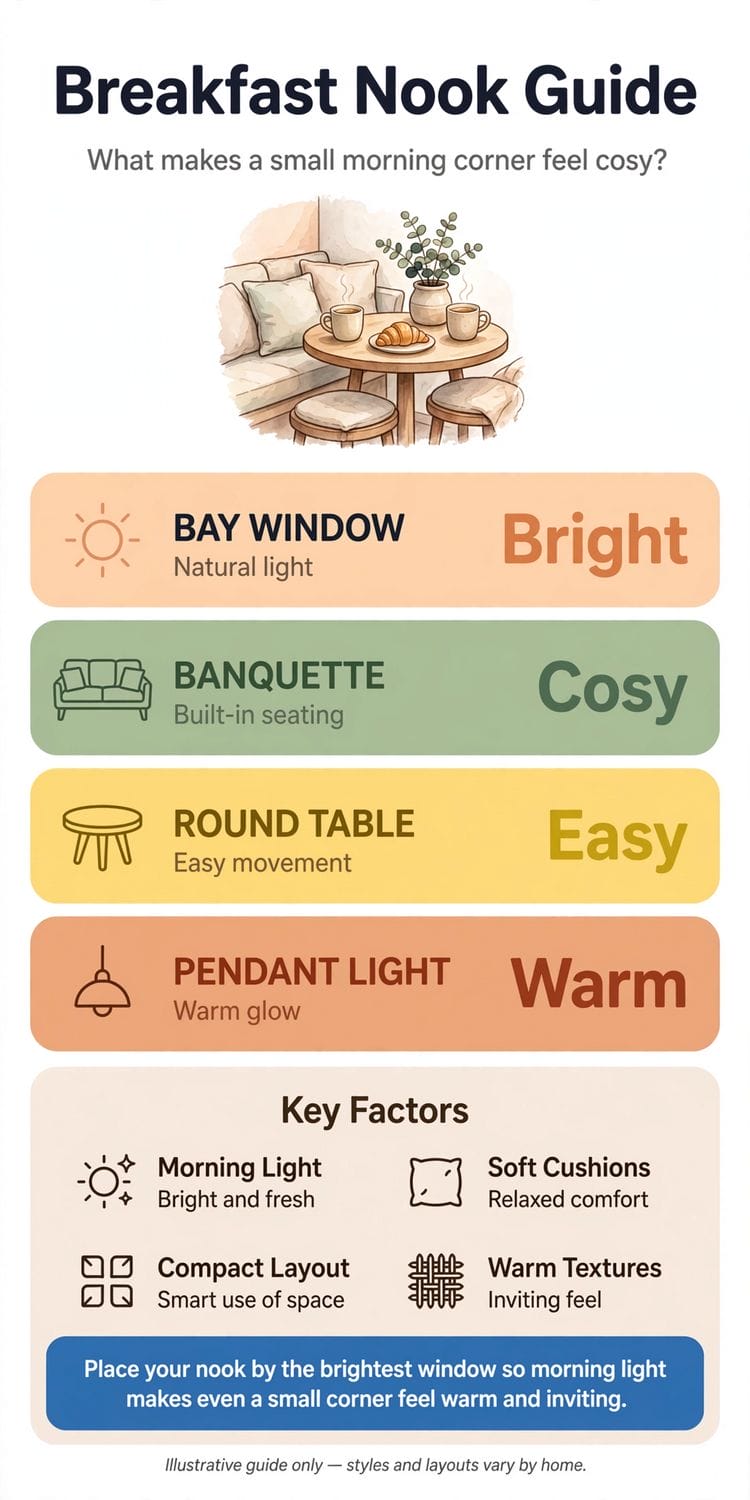
1. Breakfast Nook Ideas at a Glance
The central entity is the breakfast nook: a small, fixed eating place, usually a bench or banquette and a table set into a kitchen corner or window bay. Its attributes are the seat (built in or freestanding, backed, stored within), the table (shape, surface and the sliding room before it), the light (a window first, a pendant for dark months), the soft layer of cushions and cloth, and the daily reset that keeps a much-used corner ready. The entity itself, the nook, carries most of this post; the full phrase returns only where it names the guide’s subject directly.
| Question | Short answer |
|---|---|
| What makes a corner a nook? | A seat that stays, a table before it and light over it: fixed seating is the difference between a nook and a table that happens to stand in a corner. |
| Which seat works best? | A backed banquette with storage inside, where building in is possible; a sturdy wall bench where it is not. |
| Which table shape forgives most? | Round or oval, on a pedestal: no corners to bruise, and legs free to slide along the bench. |
| What kills a nook fastest? | A route through it, cold light over the food, and covers that cannot be washed. All three are choices, and all three can be unchosen. |
2. The Nook Itself: Seat, Table and Morning Light
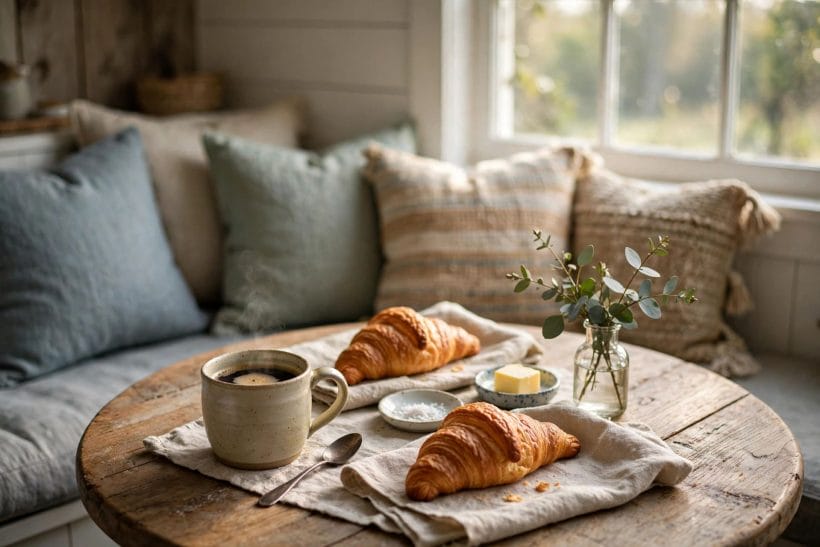
A breakfast nook is the smallest dining room a house can honestly claim: a seat, a table and a patch of morning light, arranged so the day starts sitting down. Its parent room is worked through in the dining room ideas post, and its working neighbour is the kitchen itself, surveyed in kitchen ideas; this post stays inside the nook’s own corner, on the seat, the table and the light that make it the most used place in the house.
1. Start With the Corner the Morning Already Uses
Every house has a corner where people already pause with a mug, leaning where the light is good. Build the nook there, rather than where the plan looks tidy, and it will be used from the first day.
2. Let the Seat Come Before the Table
A nook is a seat with a table in front of it, not a table with chairs pushed at it. Fix the seating first, in the corner’s best light, and let the table be chosen to serve it.
3. Keep the Nook Small on Purpose
A nook that seats the household closely is warmer than one that sprawls. Elbows near, conversation easy, the newspaper shared without shouting: smallness is the nook’s native virtue, not its compromise.
4. Face the Seats Toward the Light
People turn toward windows the way plants do. Angle the main bench to face the morning’s best view, even a modest one of rooftops or a single tree, and breakfast becomes a small daily ceremony.
5. Give the Nook a Back to Lean On
A seat with a proper back, padded or plain, invites lingering; a backless bench hurries people away. The difference between a coffee grabbed and a morning begun is usually that back.
6. Anchor the Corner With One Rug or One Mat
A flatweave rug under the table defines the nook’s territory inside a larger room and softens its sounds. Choose one that shakes out easily, because crumbs are this room’s native weather.
7. Let the Nook Borrow the Kitchen’s Warmth
The best nooks sit within the kitchen’s orbit, close enough for the kettle’s song and the toast’s smell to reach them. Nearness to the work, without being in its way, is the placement to argue for.
8. Mark the Nook With a Pendant or a Sconce
One light of its own tells the eye this corner is a place, not a leftover. A low pendant over the table or a single wall sconce does the marking kindly and cheaply.
9. Keep a Route Past, Never Through
A nook that doubles as a corridor is a nook nobody settles in. Set the seats out of the through route, even by a small shift, and the corner gains the calm that makes it loved.
10. Plan for the Newspaper, the Laptop and the Mug
Real mornings arrive with objects. A table honest about its load, a bench deep enough for a crossed leg, and somewhere for the post to land: design for the morning as it is, not as magazines stage it.
11. Let One Wall Be the Nook’s Own
A shelf, a row of hooks or a single picture on the nook’s wall gives the corner an identity inside the open room. It needs only one gesture, honestly made, to stop feeling borrowed.
3. Banquettes and Built-In Benches: The Seat That Stays
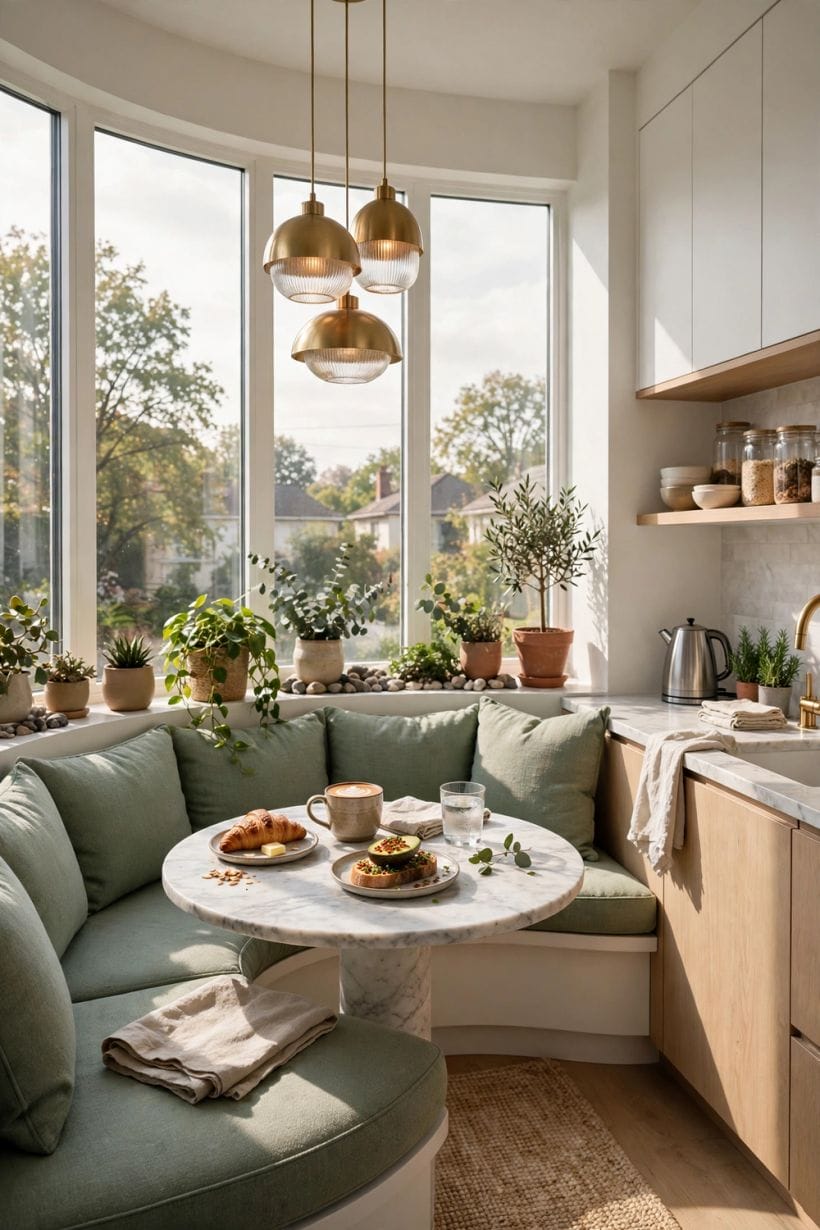
Built-in seating is the nook’s signature because it spends space the way small rooms must: the bench is furniture and architecture at once. The compact end of that thinking, where every appliance and surface is argued for, is set out in compact kitchen appliances for tiny houses; here the argument is for the bench itself, in its forms.
12. Build an L-Shaped Banquette Into the Corner
Two benches meeting in the corner use the ground no chair can reach and seat the household along two walls. The corner seat itself becomes the household’s contested prize, and rightly so.
13. Run One Straight Bench Along the Wall
A single wall bench with chairs opposite is the simplest honest nook: easy to build, easy to slide along, and kind to rooms where a full corner build would crowd the route past.
14. Wrap a Bay Window With a Curved Bench
A bay is a nook waiting to be admitted. Follow its curve with a fitted bench, keep the cushions in segments, and the window’s light becomes the seat’s upholstery.
15. Hide Storage Inside the Bench, Always
A banquette that does not open is a wasted box. Hinged seats over a clear, dry interior hold the table linen, the board games and the seasonal clutter every kitchen accumulates.
16. Raise the Bench on a Plinth for a Floating Look
A recessed plinth makes a built bench read lighter and gives toes room when people slide in. It also keeps the mop’s path honest along the bench’s foot.
17. Cushion the Seat, and Keep the Covers Washable
Breakfast is a crumbly, dripping meal served to people still half asleep. Removable, washable covers are not a compromise on elegance; they are what elegance looks like in a working nook.
18. Add a Low Back Cushion Rather Than a Tall One
Nook backs should support a lean, not swallow the sitter. Low cushions keep the window light over the seat and the sightlines across the room open and friendly.
19. Use a Freestanding Bench Where Building In Is Not Possible
Renters and the undecided can still have the nook’s manners: a sturdy bench against the wall, a table before it, chairs beyond. The arrangement teaches the same lesson as the built version.
20. Let the Bench Double as a Day Seat
A deep banquette with a throw and one good cushion becomes the house’s reading seat, homework seat and waiting-for-the-kettle seat. A nook used all day repays its ground many times over.
21. Fit a Bench Under a Window Without Blocking Its Light
Keep the bench’s back below the sill where the window allows, so the seat gains the view without stealing the glass. Where the sill is low, a backless bench set slightly forward does the same work.
22. Finish the Bench to Match the Kitchen, Not to Shout
Painted to the cabinets’ colour or timbered to the floor’s tone, a quiet bench lets the cushions and the morning carry the colour. The nook should feel discovered, not installed.
4. Tables: Shape, Size and Table Manners
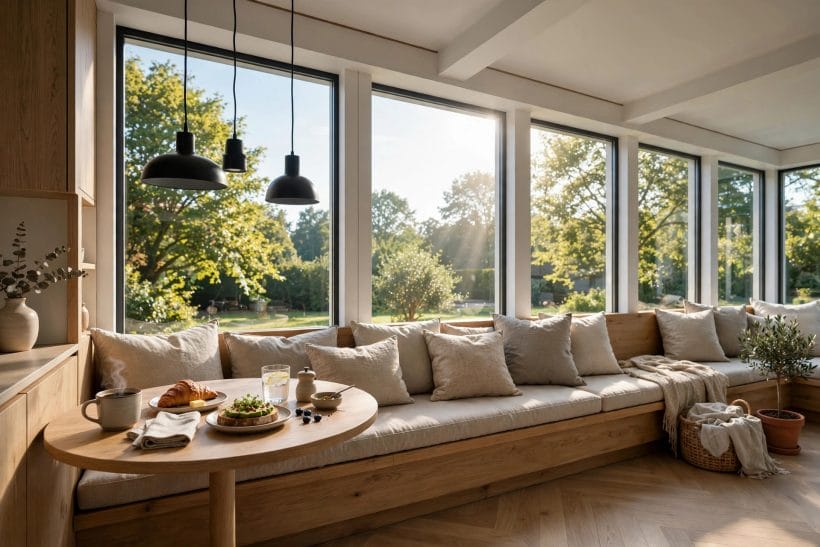
The table is the nook’s working surface, stage and occasional desk, and its shape decides how bodies fit around it. How a whole small kitchen is planned around its surfaces is laid out in tiny house kitchen design; this section keeps to the nook’s table alone.
23. Choose a Round Pedestal Table for Tight Corners
A round top has no corners to bruise hips in a small nook, and a central pedestal leaves legs and sliding room free. It is the forgiving shape, and small corners need forgiveness.
24. Use an Oval Where the Household Is Larger
An oval stretches a round table’s kindness along the wall, seating more people without adding corners. Against a banquette it is the classic answer, and classics earn their status.
25. Keep a Rectangular Table Honest and Narrow
A slim rectangle against a bench serves a line of sitters well and doubles as extra counter when cooking overflows. Width is the dimension to discipline; length is easier to forgive.
26. Let a Drop-Leaf Table Earn Its Small Days
Leaves down for the daily pair, up for the visiting crowd: a drop-leaf table lets the nook change size with the household’s week. Few pieces of furniture work so honestly at two scales.
27. Pick a Surface That Forgives Heat, Rings and Jam
Breakfast is served hot, wet and sticky to people in a hurry. Timber that can be re-oiled, stone that shrugs, laminate that wipes: choose the surface whose upkeep you will actually do.
28. Leave Room to Slide In Without a Shuffle Dance
The gap between table edge and bench is where nooks succeed or annoy. Test the slide with the household’s largest member before fixing anything, because this measurement is felt every single morning.
29. Set the Table Height to the Bench, Not the Catalogue
Built benches sit at their own heights, and the table must meet the seat that exists, not a standard. Sit, rest forearms on the top, and let comfort arbitrate before anything is ordered.
30. Use a Wall-Mounted Folding Table in the Smallest Nooks
A hinged flap that folds flat returns a tiny corner to circulation when the meal ends. In the smallest kitchens this honesty about dual use is what makes a nook possible at all.
31. Keep One Small Table Mobile for the Garden Door Days
A light side table that can carry coffee out to the step on fine mornings extends the nook’s idea beyond its corner. The ritual matters more than the furniture it rides on.
32. Avoid Glass Tops Where Mornings Are Hurried
Glass shows every crumb, rings at every mug and chills every plate. It has its rooms, and the family breakfast corner, with its honest mess, is rarely one of them.
33. Let the Table Carry One Beautiful Thing
A small jug, a plant, a bowl of fruit kept permanently on the table gives the nook a still life to sit down to. One object, chosen once, does more than a styled arrangement changed weekly.
5. Windows, Light and the View Out
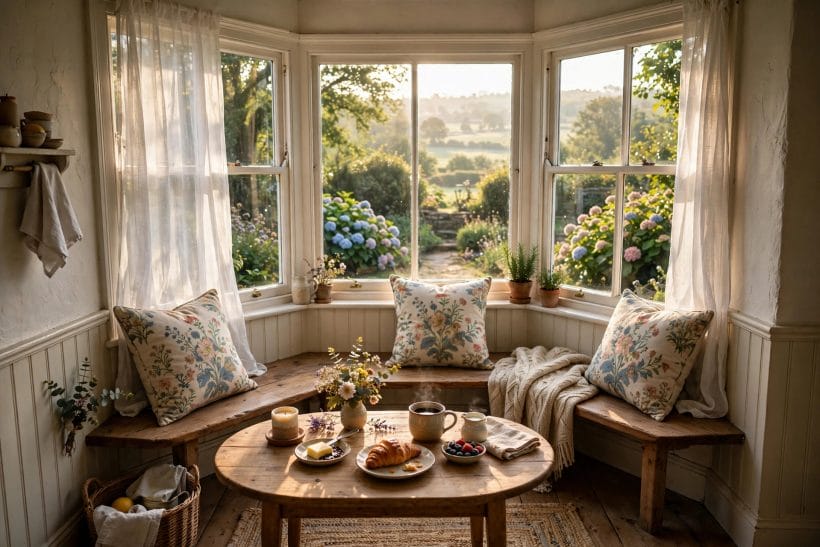
Morning light is the nook’s first ingredient, and its cheapest: no budget buys what a well-placed window gives free. The room that competes for the same light, the glassed garden room, is toured in sunroom ideas; here the light is judged at table scale.
34. Take the East Light Where the House Offers It
An east-facing nook is lit by the hour it serves. Where the plan allows a choice, give the nook the morning sun and let other rooms take the afternoon’s stronger glare.
35. Dress the Window Lightly, or Not at All
Heavy curtains in a breakfast corner gather cooking air and steal the dawn. A simple blind, a sheer, or bare glass honestly cleaned serves the meal better and the room’s mood with it.
36. Use a Mirror to Borrow Light for a Dark Corner
Where the nook’s corner is landlocked, a mirror on its wall doubles the borrowed light and the sense of a view. It is an old trick because mornings keep proving it works.
37. Keep the Sill Deep Enough for Herbs
A sill of potted herbs over the nook perfumes the meal and keeps the cook’s most-used leaves at arm’s reach. Basil by the coffee is a small luxury with a daily dividend.
38. Layer a Pendant for the Dark Months
Winter breakfasts happen before the sun reports for work. A warm pendant over the table, on its own switch, keeps the nook’s ceremony alive through the year’s dark quarter.
39. Let Sheers Soften a Harsh Outlook
Where the view is a fence or a neighbour’s wall, a sheer turns glare into glow and the outlook into a soft backdrop. The nook needs light and calm more than it needs a vista.
40. Frame One Small View Deliberately
Even a modest garden earns framing: align the bench so the best of it, a tree, a bird table, a single fine shrub, sits centred in the sitters’ sight. Attention is a design material.
41. Add a Window Seat Reading Perch Beside the Table
A cushion on a wide sill or a low bench under the glass gives the nook a second, quieter seat for the one who arrives early with the newspaper. Households treasure such perches out of all proportion.
42. Keep Glass Clean as a Standing Habit
The nook’s whole promise is light, and light dims behind a season of kitchen film. A regular wipe of the nook’s glass is maintenance of the room’s main feature, not housework vanity.
43. Use Warm Bulbs, Never Cold Ones, Over Food
Light that flatters faces and toast is warm in tone; cold light makes breakfast look like a canteen’s. This is a small choice with an outsized effect on whether people linger.
44. Let Plants Share the Light, Sparingly
One or two plants on the sill or a shelf soften the corner and prove the light is real. A jungle competes with the meal; a single green companion blesses it.
6. Colour, Cushions and the Soft Layer
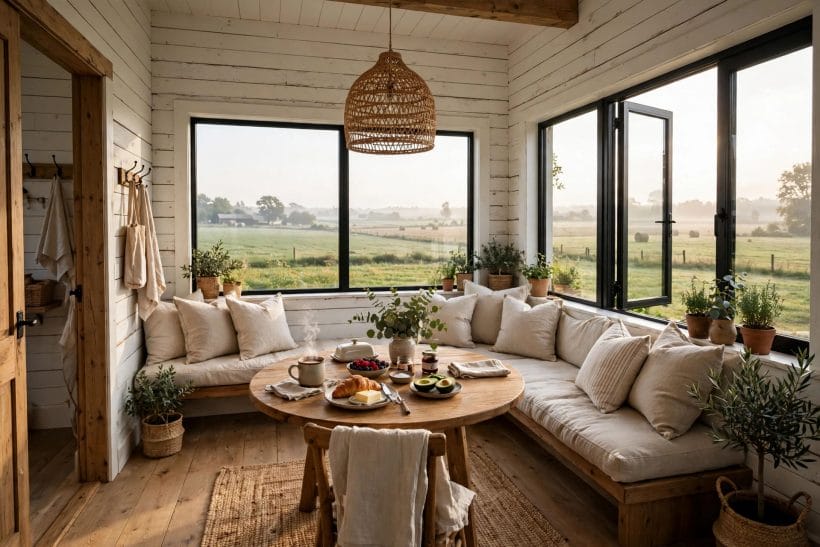
The nook’s hard architecture is kitchen-cold by trade; its soft layer is what makes people stay. The wider family room, where the same softening work is done at sofa scale, is gathered in family room ideas; this section keeps to the nook’s cushions, colours and cloth.
45. Paint the Nook a Whisker Warmer Than the Kitchen
A slightly warmer or deeper tone inside the corner tells the body it has arrived somewhere softer. The shift can be small; the feeling it buys is not.
46. Choose Cushion Fabrics That Wipe or Wash
Breakfast upholstery lives dangerously. Wipeable weaves, outdoor fabrics brought indoors, or covers that go through the wash are the honest choices for a seat that serves jam daily.
47. Layer Two Cushion Sizes and No More
A seat pad for comfort and a smaller back cushion for the lean: two layers furnish a nook completely. More becomes a daily rearrangement chore that slowly exiles the cushions to a cupboard.
48. Let One Pattern Carry the Corner
A single checked, striped or floral fabric on the cushions gives the nook its character, with plains in support. Patterns everywhere quarrel; one pattern, confidently placed, sings.
49. Keep a Throw for the Early and the Chilly
A folded throw over the bench back serves the first riser, the newspaper reader and the guest who feels the draught. It is hospitality stored in plain sight.
50. Use Colour to Borrow Warmth in a North Corner
Where the light is cool, warm cushion colours, timber tones and a brass lamp lend the sun’s manners. Colour cannot replace light, but it can apologise for its absence gracefully.
51. Match Placemats to the Day, Not the Season’s Scheme
Simple washable mats, changed when they tire, keep the table ready without ceremony. The nook is a daily room; its dress should be daily dress, easily kept.
52. Add a Small Shelf for the Morning’s Library
Cookbooks, the crossword book, a child’s current favourite: one shelf at the nook keeps its rituals stocked. Rooms that hold their own tools are rooms that get used as intended.
53. Let Art Be Small, Personal and Low
One modest picture at sitting eye height, seen daily over coffee, becomes part of the household’s inner life. The nook is no place for grand statements; it is the place for loved ones.
54. Keep the Palette Calm Where Mornings Are Rushed
In a household of hurried school runs, a calm corner lowers the morning’s temperature. Save the vivid schemes for rooms visited awake; the nook serves people still becoming so.
55. Renew the Soft Layer Before Anything Else
When a nook tires, new cushion covers and a fresh throw revive it for a fraction of any rebuild. The soft layer is where age shows first and where renewal is cheapest.
7. Small Kitchens and Borrowed Corners
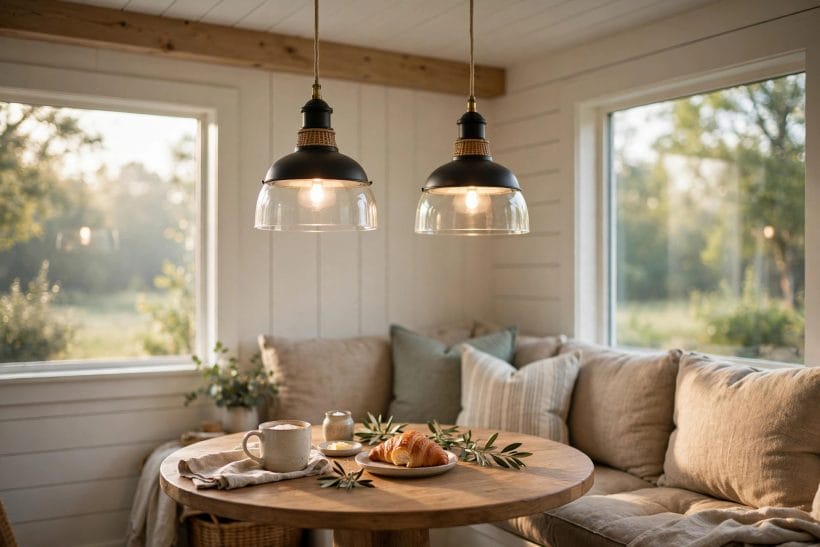
Most nooks are not planned; they are won, a corner at a time, from kitchens that seemed to have none. The whole-house survey those corners belong to is mapped in home design ideas; this section fights for the nook at the smallest scales.
56. Claim the Dead Corner Beside the Door
The corner where bags land and shoes gather is often the nook’s true site, once a bench gives it manners. Clear it, seat it, and the house gains a room where a dumping ground stood.
57. Use a Café Pair in a Corner Too Small to Build In
A tiny round table and two chairs, honestly small, make a nook by declaration. Scale the furniture to the corner instead of mourning the banquette that will not fit.
58. Share the Nook With the Island’s End
A stool or two at the island’s short end, with the light arranged kindly, serves weekday breakfasts perfectly. Not every nook needs walls; some need only a perch and a promise.
59. Fold the Nook Away in a Studio or Tiny Flat
A wall-mounted table and folding chairs let the smallest home keep the ritual without keeping the footprint. The ceremony survives; only the storage changes.
60. Let a Hallway Alcove Become the Nook
Wide halls and landing alcoves near the kitchen are borrowed rooms waiting for a bench. If the route past stays clear, an alcove nook can be the quietest seat in the house.
61. Seat Two Well Rather Than Four Badly
A small nook that truly fits its daily pair beats a cramped four-seater used in discomfort. Guests can be fed at the big table; the nook serves the household’s real mornings.
62. Use the Space Under a Stair With Courage
The under-stair triangle, benched and lit, makes a storybook nook children claim instantly. Mind heads at the low end and put the storage, not the sitters, where the ceiling falls.
63. Borrow a Slice of the Sitting Room
Where kitchen and sitting room flow together, a bench and table at the seam belong to both and serve as the nook. Zone it with its rug and light, as the earlier sections insist.
64. Keep Tiny Nooks Honest About Storage
In a small corner, the bench box and one shelf are the whole storage budget. What does not fit there must live elsewhere, or the nook becomes the clutter it was built to escape.
65. Let the Smallest Nook Still Have Its Ritual Object
Even a two-seat corner deserves its jug, its plant, its picture. Smallness excuses nothing about care; the ritual object is how a perch announces itself a place.
8. Keeping the Nook: Crumbs, Covers and the Daily Reset
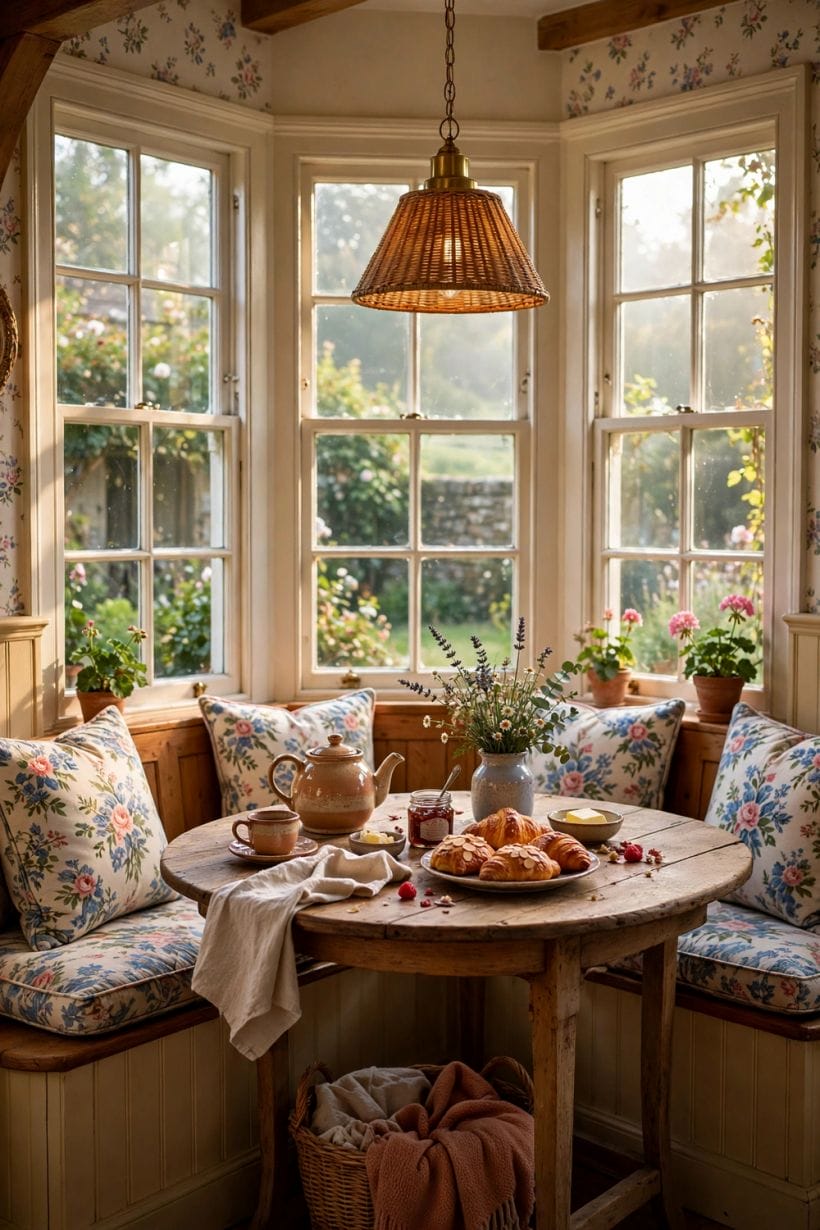
A nook’s beauty is a kept beauty: it is the most-used seat in the house and shows it fastest. This closing section is the keeping that lets the earlier ideas survive contact with real mornings.
66. Make the Reset Take Moments, Not Minutes
Cushions shaken, crumbs swept to the mat, the table wiped: a nook that resets in moments gets reset daily. Design every surface and cover choice backward from that minute of care.
67. Keep a Small Brush and Cloth Within Reach
Tools stored across the kitchen are tools unused. A brush in the bench box and a cloth on a hook at the nook make its keeping a habit instead of a project.
68. Wash Covers on a Rhythm, Not a Crisis
Covers washed regularly stay bright and honest; covers washed only after disasters carry their history. The rhythm can be gentle, but let it exist before the first spill argues for it.
69. Expect the Table to Work Between Meals
Homework, lists, laptops and the mending all colonise a good table. Accept the tenancy, keep one clear corner by custom, and clear fully at night so breakfast inherits a ready room.
70. Protect Timber From the Daily Mug Ring
A mat, a coaster habit, or a finish renewed in season keeps the table’s top honest. Choose the protection the household will actually use, which is usually the one that asks least.
71. Rotate Cushions to Even the Sun’s Work
Window seats fade where the light lands. Turning and swapping cushions in season spreads the sun’s editing evenly, and the set ages as a set instead of a patchwork.
72. Keep Spare Seat Pads for the Painting-and-Projects Days
When the nook hosts glue, paint or a dismantled appliance, spare pads or a washable cover take the risk. A working corner should not have to refuse work for fear of its cushions.
73. Let Children Own a Corner of the Keeping
A child who wipes the table and shakes the mat is learning the house’s manners at its kindest seat. Small duties at the nook are how the ritual passes to the next keeper.
74. Refresh the Corner With the Seasons, Lightly
A different throw, a bowl of the season’s fruit, the first forced bulbs: tiny changes keep the daily room from going invisible. Familiarity should breed affection, not blindness.
75. End the Day With the Nook Ready for Morning
Chairs straight, table clear, the jug waiting: the last act of the kitchen’s day sets the first act of the next. A nook left ready is a promise the morning always keeps.
9. Checks and Mistakes: Before the First Purchase or the First Stone
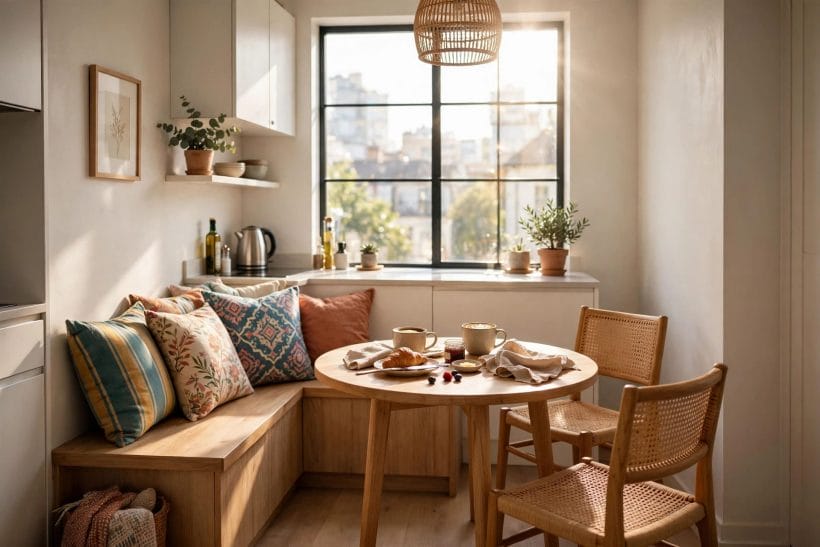
Measure the corner and the household before buying anything: the bench’s length against the wall, the slide-in gap tested by the largest sitter, and the route past walked with a laundry basket in hand. Most nook failures are measurement failures wearing prettier clothes.
Test the light at the hour the nook will serve, in the darkest month you can arrange, and be honest about what a pendant must do. A corner chosen in June’s brightness can betray breakfast in January, and the betrayal is felt daily.
Never fix a banquette so its storage cannot open, and never let a table’s pedestal stand where sliding feet must go. The two moving dramas of the nook, the lifting seat and the sliding sitter, deserve rehearsal before anything is screwed down.
10. Costs and Pulling It Together
A nook’s costs gather in three honest families: the seat (a built banquette with storage at the committed end, a freestanding bench at the modest end), the table, and the soft layer of cushions, covers and cloth. Light, where a window already exists, costs nothing; where a pendant must be added, it is a small electrical job quoted as itself. Keep every figure general and every quote itemised by family, and compare like with like rather than totals with totals.
Pull the corner together in the order this post built it: seat first, table fitted to the seat, light judged at serving hour, softness last and renewably. A breakfast nook built in that order does not need to be large or expensive to become what it reliably becomes in house after house: the seat nobody gives up, at the hour nobody wants hurried.
Final Considerations
A breakfast nook is a small promise a house makes to its mornings: that the day will begin sitting down, in the light, together or in kind solitude, before the world’s demands arrive. Keep the seat honest, the table forgiving and the reset easy, and the corner will keep that promise for years, one ordinary, unhurried breakfast at a time.


0 Comments