

A farmhouse bedroom should feel like the house exhaled — linen that wrinkles honestly, wood that has known hands, morning light arriving without asking permission. It is the calmest style in the catalogue, and the easiest to fake badly with a trolley of distressed accessories.
These 75 farmhouse bedroom ideas build the real thing: the bed as the room’s hearth, honest materials, workaday furniture with grace, and colour borrowed from fields and kitchens. The broad survey lives in the pillar bedroom ideas; this post stays in the farmhouse lane only.
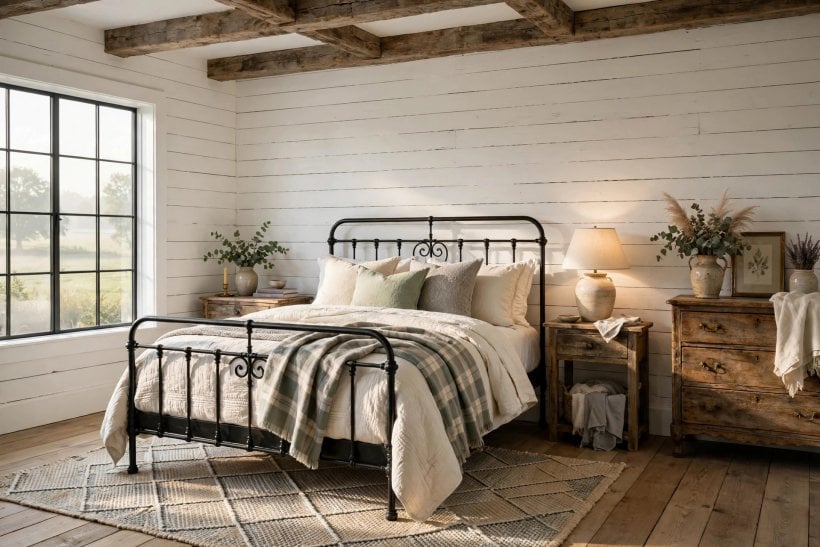
1. Farmhouse Bedroom Ideas at a Glance
The central entity is the farmhouse bedroom: a sleeping room in the rural vernacular whose attributes are its bed and bedding, its honest natural materials, its practical inherited-feeling furniture, its soft agricultural palette, and its unhurried, useful calm. It is judged by one test: whether the room feels lived-in and restful at once — worked in, never themed.
| Question | Short answer |
|---|---|
| What defines the style? | Honest materials, a generous bed, practical furniture, and restraint — comfort without polish. |
| What is the palette? | Warm whites, linen, wood tones, and quiet field colours — sage, cornflower, clay — used softly. |
| What should be bought first? | The bed and its bedding; the farmhouse bedroom is built outward from how it sleeps. |
| What is the biggest mistake? | Theme-park farmhouse: word signs, novelty roosters and distressing applied like makeup. |
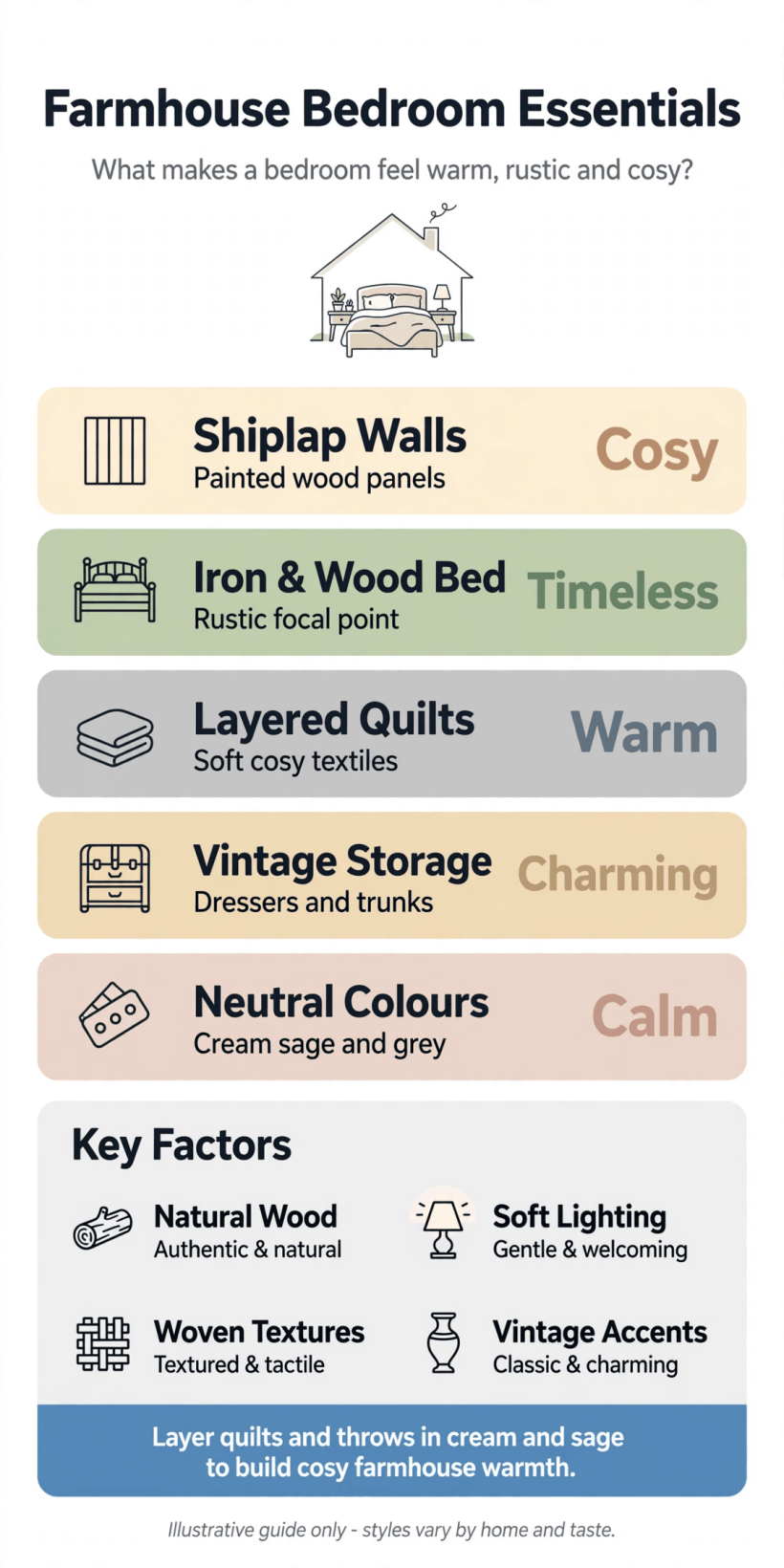
2. The Bed: The Room’s Hearth

In a farmhouse bedroom the bed is not furniture in a room; it is the room’s reason, dressed like something that has hosted a century of good sleep. Build it generously and let everything else take a lower voice, as the sleeping spaces in tiny house bedroom ideas do at smaller scale.
1. Choose a Bed Frame With Honest Bones
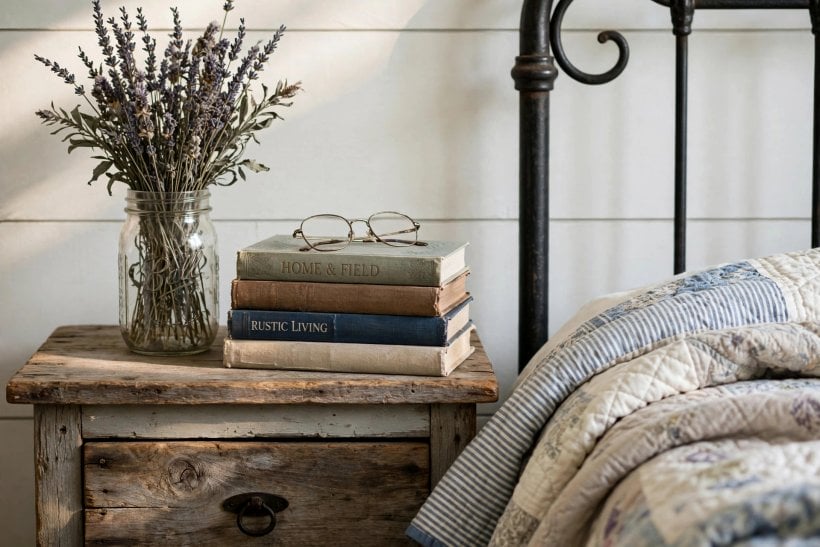
Turned wood, simple iron, or a plain upholstered frame in a natural weave: the farmhouse bed looks built, not styled. Avoid ornate reproductions; the real vernacular was always plain and well-proportioned.
2. Dress the Bed in Linen and Let It Wrinkle
Linen’s soft creases are the style’s signature texture — breathable, forgiving, and better unironed. A farmhouse bed made with hotel crispness has missed its own point.
3. Layer a Quilt With a Story or a Pattern
A quilt — new, vintage or handmade — folded at the foot or spread whole gives the bed its colour and its history in one layer. Patchwork, wholecloth and simple stripes all belong.
4. Add Wool Where Winters Are Real
A wool blanket or throw at the foot is farmhouse layering with a job to do. In summer it becomes the bed’s colour note; in winter it earns its place nightly.
5. Keep Pillows Plentiful but Unstaged
Sleeping pillows plus one or two honest cushions in ticking, grain-sack stripe or faded floral. The farmhouse bed invites use; it does not perform a pillow arrangement.
6. Let a Simple Canopy or Tester Frame the Tallest Rooms
In high-ceilinged rooms a plain four-poster or canopy in wood or iron gives the bed its architecture without curtains’ fuss. Dress it bare; the frame is the ornament.
7. Choose a Headboard That Could Survive a Barn
Plank, panelled or iron headboards with visible construction suit the style’s honesty. Upholstered headboards belong only in the softest, most neutral fabrics.
8. Give the Bed a Bench or Trunk at Its Foot
A bench, blanket chest or old trunk at the foot holds the spare quilts, takes the morning’s clothes, and completes the bed’s composition like a hearth’s fender.
9. Keep the Bed Low Enough to Feel Grounded
Farmhouse beds sit at honest heights — easy in, easy out, dogs and children considered. Towering mattress stacks belong to other styles’ photographs.
10. Let Bedding Colour Come From the Land
Flax, oatmeal, washed blue, sage, clay pink: bedding in field and kitchen colours keeps the room’s calm agricultural register without a single novelty print.
11. Make the Bed the First Thing the Door Sees
Arrange the room so the dressed bed, in its layers, is the view on entering. Farmhouse rooms are composed around rest the way kitchens are composed around the stove.
3. Materials and Texture: Honesty You Can Touch
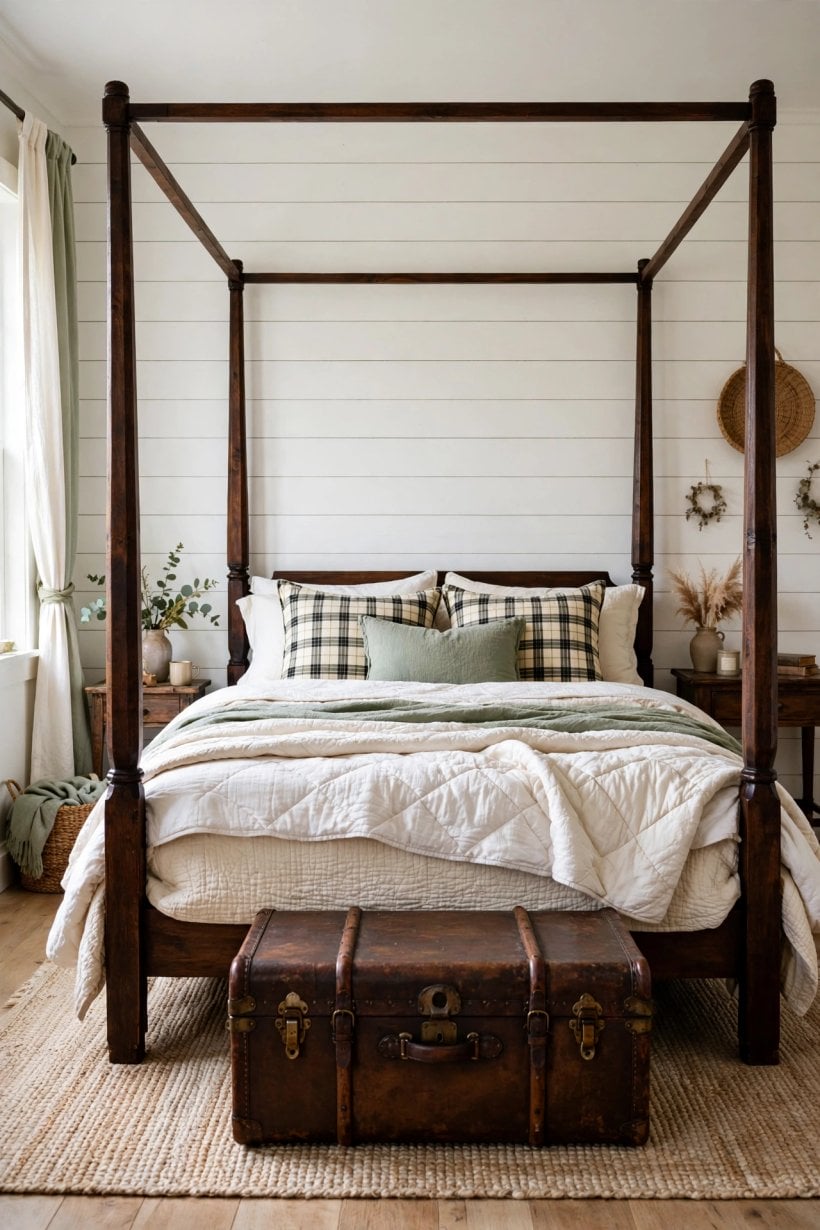
Farmhouse texture is a short list used generously: wood, linen, cotton, wool, iron, wicker and stone where the house offers it. The discipline is in what is refused — gloss, chrome, plastic shine — the same material honesty farmhouse living room ideas applies downstairs.
12. Let Wood Show Its Grain and Its Age
Unpainted or lightly finished wood — floor, beams, furniture — carries the style’s warmth. Perfect, plasticky finishes read as costume; grain and a few dings read as life.
13. Paint Woodwork in Warm, Dirty Whites
The farmhouse white is never blue-white: it is cream, chalk and old milk paint, warm against wood and kind to morning faces. Test whites at dawn before committing.
14. Use Ticking and Grain-Sack Stripes as the Pattern Language
These workaday stripes are the style’s classic pattern — on cushions, bolsters, a runner. They pattern a room without ever decorating it in the self-conscious sense.
15. Bring Wicker and Basketry in for Soft Storage
Baskets hold blankets, books, laundry and the room’s odds with a texture no plastic box can fake. A bedroom with three good baskets is a bedroom with a system.
16. Let Iron Appear in Small, Useful Doses
An iron bed detail, hooks, a lamp base, curtain rings: black metal’s quiet punctuation keeps the softness from drifting into sweetness. Small doses, repeated.
17. Choose Cotton and Linen Over Every Synthetic Sheen
Natural fibres’ matte, breathable surfaces are the style’s skin. Where synthetics must appear, keep them matte, plain and unmentioned by the eye.
18. Add a Wool or Braided Rug Beside the Bed
Bare feet meet the day on wool, jute or a braided cotton rug — warm, flat-woven, and patterned by construction rather than print. Size it to the bed’s whole side.
19. Keep One Piece Genuinely Old
A worn dresser, a grandmother quilt, a scuffed trunk: one authentic old thing anchors the room’s story and keeps new pieces honest by association.
20. Let Stone or Brick Show Where the House Has It
A chimney breast or stone wall left bare is farmhouse texture the house itself provides. Never manufacture it where it does not exist; paint and wood carry rooms without it.
21. Use Shiplap or Board Walls Sparingly and Truly
Boarded walls belong where construction explains them — a headboard wall, a porch-side room. Applied everywhere as wallpaper-with-nails, they become the theme they imitate.
22. Finish With Beeswax, Soap and Simplicity
The style’s maintenance aesthetic is part of its look: oiled wood, washed linen, aired quilts. A farmhouse bedroom should smell faintly of soap and daylight.
4. Furniture: Workaday Pieces With Grace
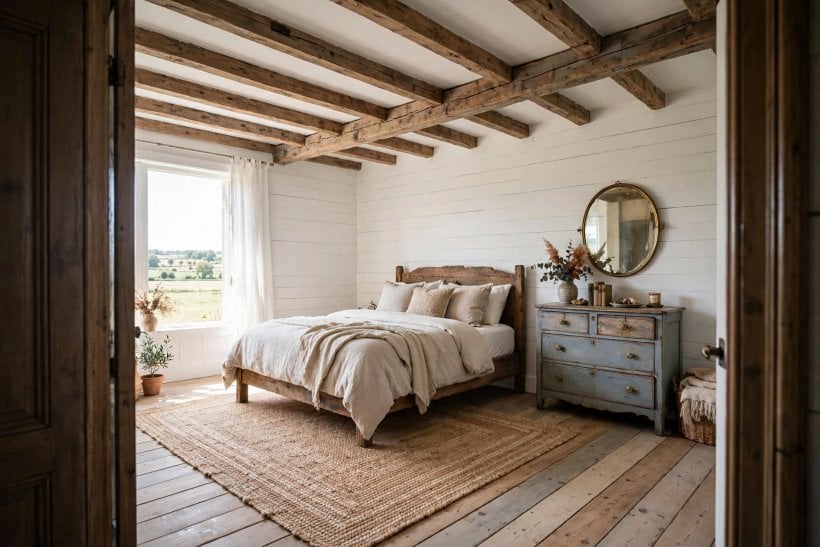
Farmhouse furniture was bought for work and kept for generations, and its bedroom descendants keep that posture: a dresser that holds everything, a chair that takes clothes and readers alike, nothing whose only job is to be looked at.
23. Choose a Dresser Deep Enough to Be the Room’s Wardrobe Heart
A wide, deep-drawered dresser does the storage heavy lifting and gives the room its display surface — kept, crucially, mostly clear. Farmhouse surfaces are used, not styled.
24. Give Each Side of the Bed a Real Nightstand
Matched or happily mismatched, nightstands need a drawer, a surface for water and a book, and height near the mattress. Farmhouse practicality begins at the bedside.
25. Keep a Ladder-Back or Windsor Chair by the Window
The bedroom chair is for morning dressing, evening reading and the honest clothes pile. A simple wooden chair with a cushion does all three with the style’s classic silhouette.
26. Add a Washstand Nod Only Where It Works
A small table with a jug and bowl is charming where it serves — plants, a carafe — and pure costume where it merely poses. Let it earn its corner or skip it.
27. Use a Wardrobe Where Built Cupboards Are Absent
A plain, capacious wardrobe in painted wood suits older houses and keeps the room’s storage furniture-scaled rather than fitted and modern. Paint it the room’s warm white.
28. Let a Blanket Ladder Hold the Quilts in View
Quilts and throws displayed on a simple ladder are the style’s storage-as-decoration at its most honest — the textiles are the art, and they are within reach on cold nights.
29. Choose a Mirror With a Plain Wood or Iron Frame
Over the dresser or on a door, a simply framed mirror does its work without gilded apology. Farmhouse mirrors are tools that happen to be handsome.
30. Keep a Small Writing or Vanity Desk Only If It Is Used
A letter, a diary, morning lists: a small desk earns a farmhouse bedroom corner in real households. Unused, it becomes the room’s most elegant dumping ground.
31. Let Children’s Farmhouse Rooms Grow, Not Theme
For children, the style means sturdy wood, washable quilts and room to change — not miniature barn doors they will outgrow by seven. Build the bones; let them supply the chapter.
32. Prefer Drawers and Shelves to Visible Hanging Everywhere
Farmhouse calm is partly concealment: clothes behind doors and in drawers, a few good pieces out. Open rails belong to other styles and other temperaments.
33. Rescue One Painted Piece in a Field Colour
A sage dresser, a cornflower cupboard, a clay-red chair: one painted piece in a soft agricultural colour gives the white-and-wood room its memorable note.
5. Colour, Light and the Morning Room
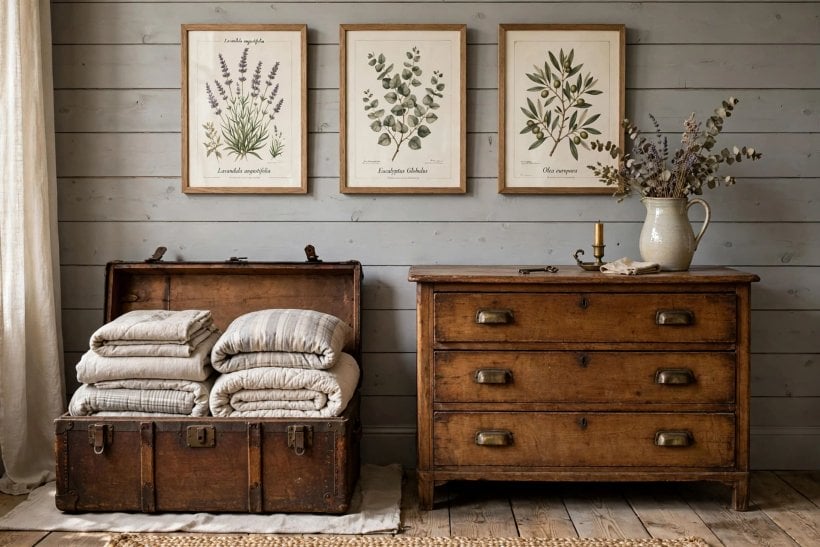
Farmhouse colour is daylight’s palette — the room is designed for mornings. Soft walls, sheers that move, and lamplight like candlelight after dark keep faith with a style invented before electricity, in the spirit of master bedroom ideas at its calmest.
34. Keep Walls in the Warm White and Cream Family
Warm whites bounce morning light softly and let wood and textiles carry the colour. One gentle exception — a sage or washed-blue wall behind the bed — is the classic variation.
35. Dress Windows in Sheers, Simple Linen or Bare Honesty
Farmhouse windows filter rather than block: sheer cotton, plain linen curtains on iron rings, or, where privacy allows, nothing but the view of the yard the style came from.
36. Let Blackout Hide Inside the Simplicity
Where sleep needs darkness, line the linen or add a plain roller behind the sheers. The look stays farmhouse; the sleep stays serious. Nobody’s style outranks rest.
37. Light the Room Like a House at Dusk
Two bedside lamps with warm bulbs and fabric shades, one gentle overhead or none: farmhouse light is pooled and golden, never ceiling-bright. Faces and pages both approve.
38. Choose Bedside Lamps in Ceramic, Iron or Wood
A pottery lamp, a turned-wood base, a simple iron stem — with a linen shade, these are the style’s jewellery. Matched pairs are optional; warm light is not.
39. Give the Room One Candle or Lantern Moment
A candle on the dresser, a hurricane lamp for power cuts and winter evenings: the farmhouse bedroom keeps a relationship with real flame that electric light cannot replace.
40. Let Colour Arrive by Season
A blue quilt for summer, a red-plaid blanket for winter, spring’s green cushion: the farmhouse room changes its small colours with the year like the fields outside it.
41. Keep Floors Pale, Matt and Barefoot-Kind
Wide boards, painted floorboards in soft tones, or honest pale wood with the bedside rug: farmhouse floors are trodden softly and cleaned simply for a century.
42. Paint the Ceiling Like Sky or Cream
A barely-blue or warm cream ceiling lifts low rooms and flatters the tall ones. It is the old porch-ceiling trick, brought to the bedroom with complete success.
43. Let One Floral Appear, Faded and Small
A faded floral on a cushion, a curtain or one quilt is the style’s garden note. Everywhere at once, florals curdle into chintz; once, they are spring.
44. Keep Patterns Mixed Like a Household, Not a Showroom
Ticking with a quilt’s patchwork, a stripe beside a faded floral: farmhouse pattern mixing looks inherited, because in the originals it was. Coordinate by colour softness, not by set.
Morning deserves its own paragraph in a farmhouse bedroom, because the style is fundamentally about how a day begins. The room should make waking easy: light that arrives gradually through sheers rather than in a glare, a chair where clothes for the day were laid out the night before, a rug warm underfoot, and a view — even a small one — of something green or growing. Households that design the first ten minutes of the day find the rest of the room’s decisions suddenly simple, because every piece can be asked the same question: does it help the morning, or does it merely decorate it?
6. Storage and the Working Details
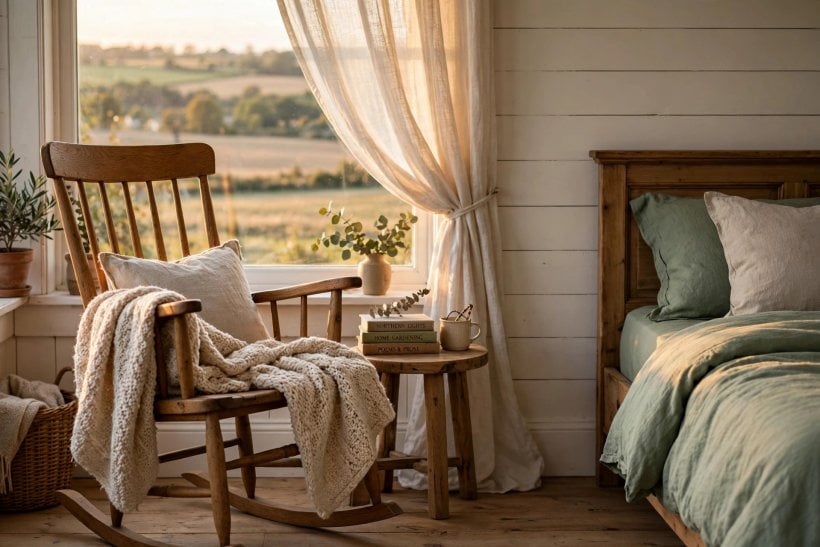
Farmhouse rooms were working rooms, and their storage shows it: everything reachable, much of it visible, nothing precious. The details below are where the style proves it is a way of living, not a filter — the practical core that modern bedroom ideas reaches by other means.
45. Store Spare Bedding in the Foot-of-Bed Chest
Quilts and blankets live where they are used. The chest at the bed’s foot ends the linen-cupboard expedition on the coldest night of the year, which is when it matters.
46. Give Boots, Hats and Work Clothes Their Own Landing
A farmhouse household arrives with outdoor things. Hooks and a boot tray near the door keep the bedroom’s calm from being trampled by the day that paid for it.
47. Keep Books, Water and Glasses at the Bedside Properly
A carafe and glass, the current book, reading glasses: the nightstand’s classic cargo, given real space. Farmhouse luxury is the right thing within reach at 2 a.m.
48. Use Under-Bed Space for the Quiet Storage
Out-of-season clothes and spare linen in boxes under the bed keep the room’s visible storage beautiful and its invisible storage useful. Label them; winter forgets.
49. Hang a Few Honest Hooks Instead of a Chair Avalanche
Hooks for tomorrow’s clothes and the dressing gown give the chair back its dignity. A short row of iron or wood pegs is the farmhouse answer to the floordrobe.
50. Let a Laundry Basket Be Part of the Furniture
A sturdy wicker hamper, lidded and placed, keeps the room’s one untidy process graceful. Farmhouse style never pretended laundry did not exist; it housed it well.
51. Keep a Small Sewing and Mending Basket
The style’s ethos in one object: quilts are mended, buttons replaced, things kept. A mending basket in the corner says the room’s calm is maintained, not purchased.
52. Give Children Hooks and Baskets at Their Height
In family rooms, storage children can reach is tidiness that actually happens. Low pegs and open baskets are farmhouse practicality scaled to its smallest farmers.
53. Keep the Room’s Air Sweet With Simplicity
An open window’s habit, aired bedding, a small vase of whatever the garden offers: farmhouse freshness is ventilation and linen, not sprays. The room should smell like morning.
54. Store Winter and Summer as a Seasonal Ritual
The great bedding swap — quilts down in spring, wool back in autumn — is the farmhouse bedroom’s calendar. Storage sized for both wardrobes makes the ritual a pleasure.
55. Leave One Surface Genuinely Empty
Amid the useful objects, one clear surface — a dresser’s end, a windowsill — rests the eye and proves the room is calm by choice, not by lack of things.
Restraint deserves one more word, because farmhouse is the style most often ruined by addition. Every object in the original rooms had survived a household economy in which nothing was kept without a reason, and that economy is visible in the result as calm. When a new piece is considered, the farmhouse question is never ‘does it match?’ but ‘what does it do, and will we still be glad of it in ten winters?’ Pieces that answer well accumulate into exactly the room these ideas describe; pieces that cannot answer are how a bedroom becomes a gift shop.
7. Decor: The Few Things That Earn Their Place
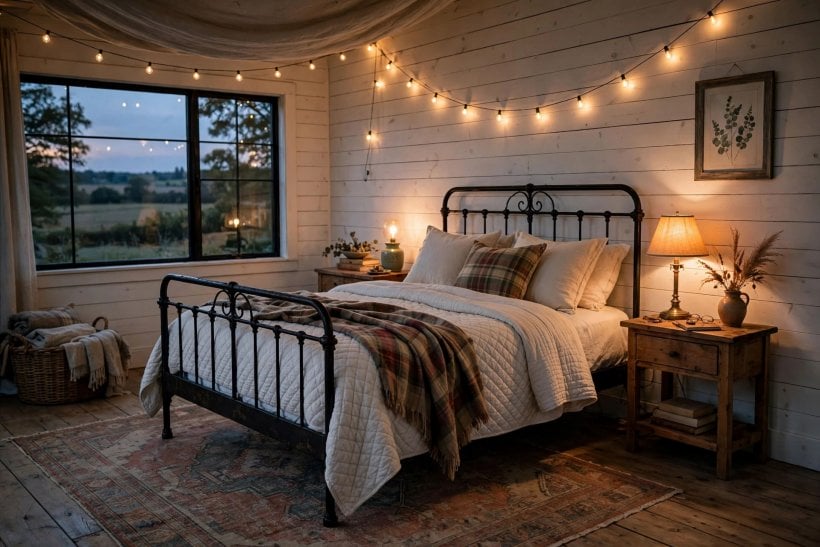
Farmhouse decor is edited by usefulness and love: a picture of the land, flowers from the garden, objects kept because they are known. The test for every piece is whether a working household would have kept it for fifty years.
56. Hang Landscapes and Botanical Prints, Simply Framed
Fields, hedgerows, a cow in honest profile: art of the agricultural world in plain frames suits the room’s subject. One large piece outranks a gallery of novelties.
57. Let Garden Flowers Be the Room’s Rotating Art
A jug of whatever is out — daisies, hydrangeas, branches in winter — is farmhouse decoration in its purest form: free, seasonal, and impossible to theme-park.
58. Display Family Photographs in Ones and Twos
A wedding portrait on the dresser, grandparents by the door: the farmhouse bedroom keeps its people near. Keep the count low and the frames plain, and they read as love, not gallery.
59. Keep a Clock That Ticks Quietly or Not at All
A simple wall or mantel clock serves the morning without a glowing face all night. The style prefers its time analogue and its sleep undisturbed by light.
60. Let a Rocking Chair Hold the Room’s Quiet Corner
Where space allows, a wooden rocker by the window is the farmhouse bedroom’s soul — for nursing, reading, mending, and watching weather arrive over the fields.
61. Use Old Books as Colour and Company
A short stack of cloth-bound books on the dresser or nightstand brings the room’s softest colours and its best company in one object. Choose books that are actually read.
62. Refuse Word Art and Novelty Farm Signs
The style’s fastest route to theme-park is lettering that announces farm life. Let the quilts, wood and light say it instead — they say it better and quieter.
63. Keep Religious or Sentimental Pieces Personal and Few
Many farmhouse households keep a verse, a cross or a keepsake in the bedroom. Kept personal, singular and unmerchandised, such pieces are the style’s genuine heritage.
64. Let a Woven or Braided Runner Warm the Floor’s Path
From door to bed, a runner in stripes or braids gives the room its route and its softest pattern. It is decor you walk on — the farmhouse kind.
65. End Decor at the Point Where Usefulness Waves Back
When every object in view is used, loved or grown, the room is finished. Anything added after that point is decoration about decoration — the moment to stop, by the style’s own law.
8. Small Farmhouse Bedrooms and Tiny Houses
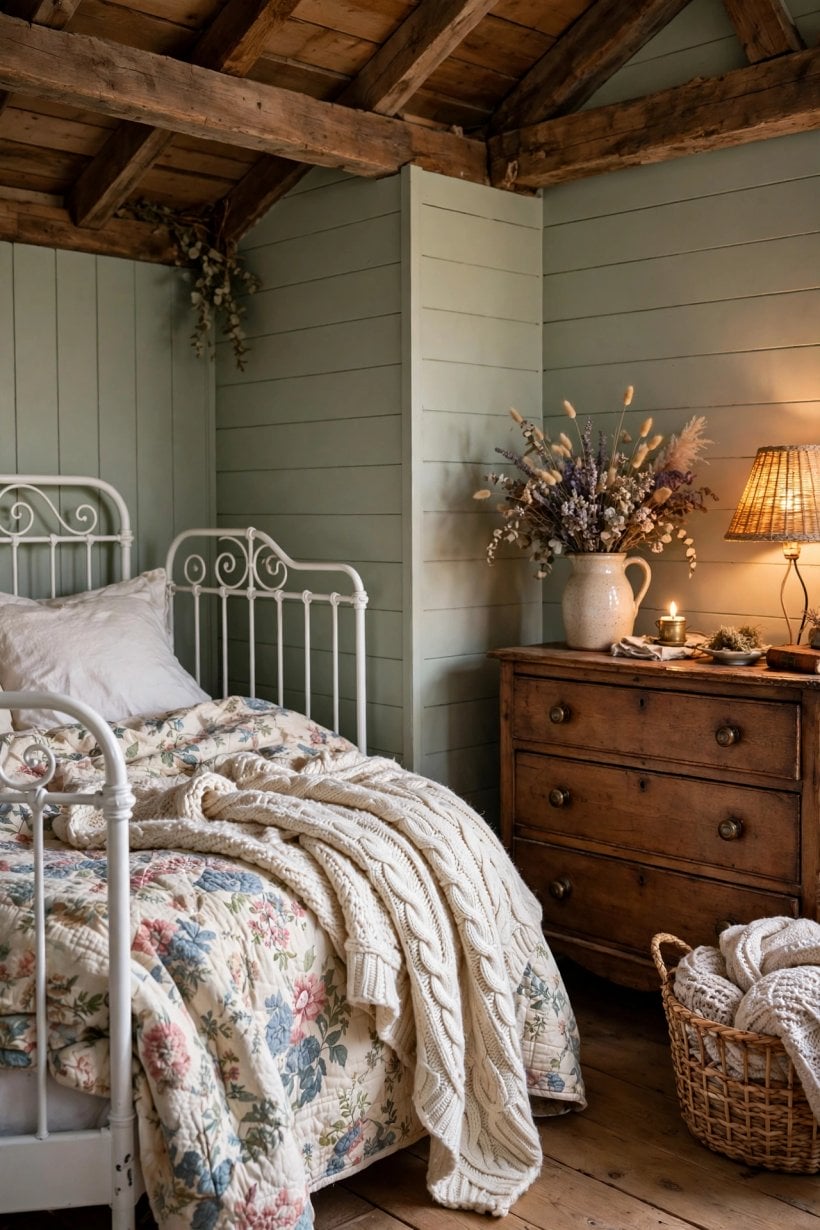
Farmhouse was always a small-house style — cottages, not manors — so it scales down beautifully. In tiny houses and small bedrooms the rules tighten: the bed’s dressing carries the whole style, furniture shrinks to the multifunctional, and every textile must work, as small bedroom interior design ideas for tiny houses demonstrates.
66. Let the Bedding Be the Whole Statement in a Tiny Room
Linen, a quilt, a wool throw: in a small room the dressed bed is nine-tenths of the picture. Spend there first and the room needs almost nothing else to read farmhouse.
67. Choose a Simple Iron Frame to Keep Small Rooms Airy
Iron’s thin lines let light and sight pass where a solid wooden frame would fill a small room. It is also the historical cottage choice — practical then, perfect now.
68. Paint Small Farmhouse Rooms One Warm White Throughout
Walls, woodwork and even the wardrobe in one warm white makes a small room feel gathered rather than chopped. Colour lives in the textiles, where it can change.
69. Use a Trunk or Ottoman as Nightstand, Store and Seat
In tight rooms each piece takes three jobs. A small trunk beside the bed holds bedding, parks a book, and seats a dressing human without complaint.
70. Hang Hooks and a Shelf Instead of a Dresser
Where a dresser will not fit, a peg rail and a deep shelf carry the farmhouse system vertically. Baskets on the shelf keep the look soft and the clothes honest.
71. Let a Dutch Door or Farmhouse Door Detail Carry the Room
A ledged door, black iron hinges, or — where the house allows — the half-door charm celebrated in Dutch doors for tiny houses gives a small room its architecture in one gesture.
72. Keep Tiny Windows Simply Dressed and Fully Used
A small window with a sheer and a plant on its sill is a farmhouse picture entire. In tiny rooms, treat every window as the art it already is.
73. Choose One Quilt With Real Presence
A single beautiful quilt — bold patchwork, rich wholecloth colour — anchors a small room the way a painting anchors a gallery. Let the rest of the room applaud quietly.
74. Store Seasonally Outside the Room Without Shame
Tiny farmhouse bedrooms keep only the season in residence; the rest lives in a hall cupboard or under-bed boxes elsewhere. Rotation is the small household’s oldest system.
75. Let the Small Room Smell, Sound and Feel Like Morning
Air, linen, wood, a bird outside the window: in the smallest farmhouse bedroom the senses carry what square metres cannot. Get those right and the room is generous at any size.
9. Checks and Mistakes: Before the First Purchase
Check the bed first — its size against the room, its frame’s honesty, whether the bedding you love is washable by your real laundry life. Check light at morning and evening, storage against the actual wardrobe, and every ‘farmhouse’ object against one question: would a working household have kept this? Then the mistakes, which are reliable: distressing new wood to fake a past; word signs doing the style’s talking; white so cold the room feels clinical; a bed dressed for photographs and impossible to sleep in; and accessories bought by the trolley before the bed, rug and lamps were right. Buy the bed, dress it honestly, light it warmly — the farmhouse follows.
10. Costs and Pulling It Together
Costs divide into the bed, the textiles and the furniture, and this style rewards patience like no other. The bed and mattress are the headline band and deserve the money. Textiles — linen, quilts, wool — form the second band, where vintage and handmade finds regularly outperform new purchases on both price and character. Furniture is the third band, and the farmhouse market’s great secret: plain, sturdy, unfashionable wooden pieces are perpetually undervalued second-hand. Pull the room together in order: bed chosen and dressed, warm white and light settled, storage furniture placed, textiles layered by season, and decor admitted last, one loved thing at a time. Built that way, a farmhouse bedroom stops being a look that was bought and becomes what its originals were — a room that has been slept in, worked in and loved for a very long time.
Final Considerations
The farmhouse bedroom’s secret is that it was never designed at all: it accumulated, around sleep and work and seasons, into the calmest room in the house. Recreate the accumulation honestly — real materials, useful furniture, textiles with lives — and the calm arrives with it.
Start with the bed, keep every later choice answerable to usefulness and morning light, and let the room gather its story slowly. That slowness is not a compromise. In this style, it is the entire point.



0 Comments