

A modern garden is not a garden with less in it. It is a garden where everything in it has been chosen — line, material, plant and shadow all pulling in one calm direction.
This survey collects seventy-five modern landscaping ideas in the modern style lane only — geometry, hard materials, massed planting, water, light and restraint — within the wider front yard landscaping ideas collection. The region-led lanes — tropical, coastal, hillside — are linked as their own surveys, not absorbed into this one.
1. Modern Landscaping at a Glance
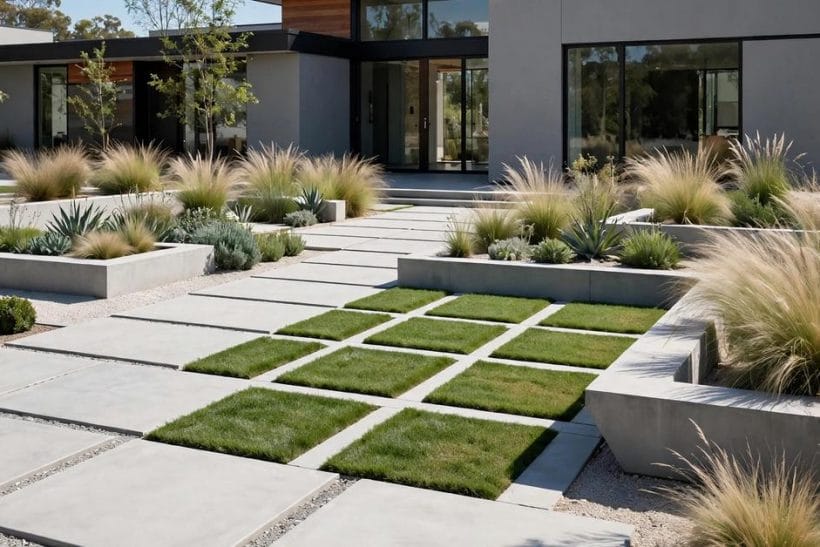
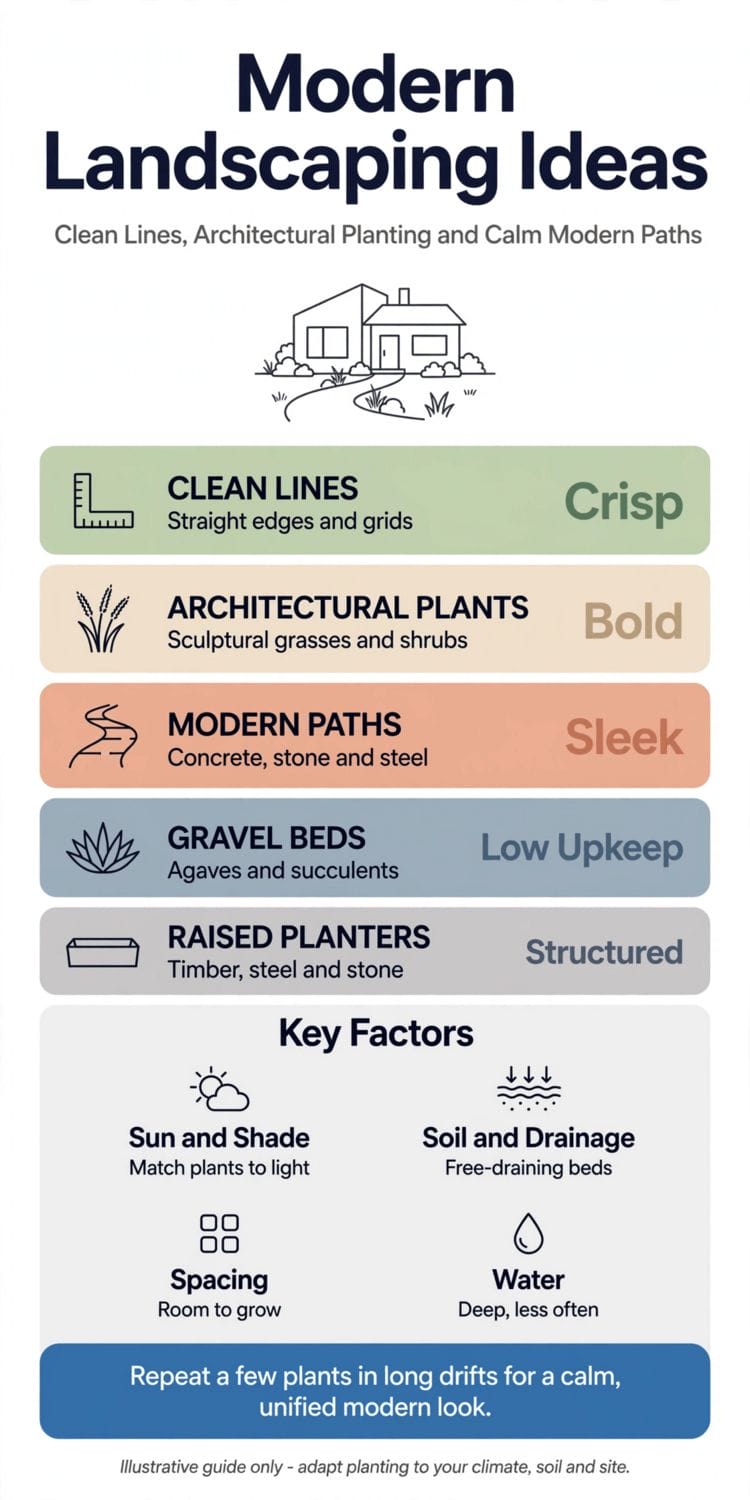
Modern landscaping is a garden style built on clear geometry, a short list of hard materials repeated with discipline, planting in bold masses rather than mixed collections, and negative space — lawn, gravel or stone left deliberately empty — treated as a design material in its own right. Its attributes split into structure (the plan’s lines, levels and sight axes), surface (paving, edging, walls and screens in a restrained palette), planting (architectural forms, grasses, clipped evergreens and a limited palette repeated), and atmosphere (water kept still or linear, fire contained, lighting low and warm). This post owns that style whole; gardens led by climate or terrain — the tropical, coastal and hillside surveys linked below — apply their own logics and are deliberately not re-taught here.
| Question | Short answer |
|---|---|
| What makes a garden read as modern? | Legible geometry and restraint: straight or boldly curved lines you can read from the door, two or three hard materials repeated, planting in masses, and empty space left empty on purpose. If the plan cannot be sketched in a few lines, it is not the modern lane. |
| Does modern mean no flowers? | No — it means flowers on the plan’s terms: drifts of one kind at a time, colour used as an event rather than a mixture. A single massed sweep of one flowering plant is more modern, and more beautiful, than twenty kinds dotted singly. |
| Is a modern garden low maintenance? | It is honest maintenance: fewer kinds of plant, each placed where it thrives, hard surfaces that sweep clean, and no fussy edges. The discipline is in the editing — a modern garden neglected for a season shows it faster than a cottage garden does. |
| Can a small or tiny-house garden be modern? | It is the style that suits small plots best, because geometry organises small spaces and restraint keeps them calm. The tiny-house landscaping lane linked below applies the same thinking at plot scale; this survey keeps the style itself. |
2. First, the Geometry: Lines the Eye Can Read
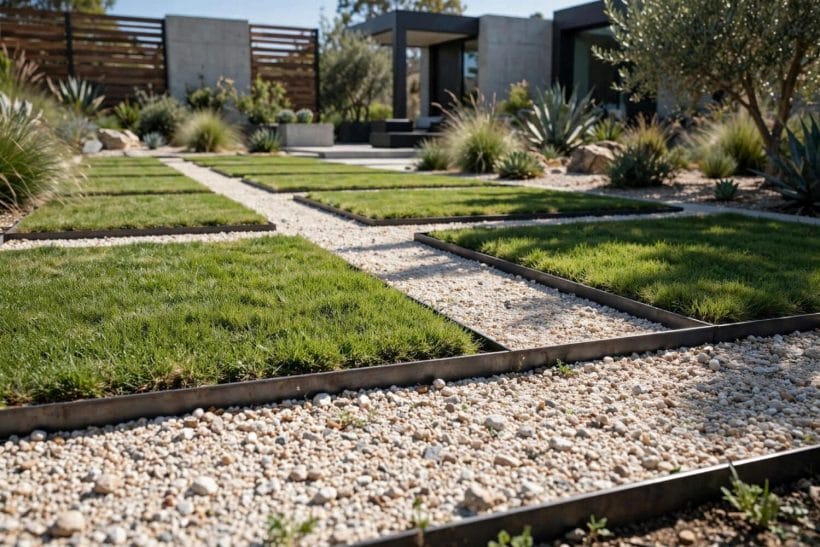
Modern landscaping begins on paper, with a plan simple enough to hold in the mind. Every later choice — stone, grass, water — serves the lines drawn here.
1. Draw the plan in a few bold lines
Paths, beds and lawn edges drawn as a small number of confident lines — straight runs, one generous curve, a clear grid.
2. Align the garden with the house
Beds and paths that answer the house’s own geometry — its walls, windows and door axis — make the garden feel inevitable.
3. Give the garden one clear axis
A single sight line — door to focal tree, terrace to water — organises everything hung from it. Two competing axes split the garden’s attention; one axis, well ended, is the modern signature.
4. Use rectangles, then soften them
Rectangular beds and lawn panels are the style’s grammar; the softening comes from planting spilling a little over their edges, never from wobbling the edges themselves. Structure strict, planting relaxed — in that order.
5. Let one curve be generous
Where a curve belongs — around a tree, a lawn’s sweep — make it wide and confident.
6. Plan levels before planting
A step, a raised bed, a sunken court: one honest level change gives a flat plot its architecture. Levels are built before a single plant is ordered, because plants cannot rescue a garden with no bones.
7. Keep the lawn a shape, not a leftover
The lawn is a panel in the composition — edged crisply, sized deliberately, sometimes replaced by gravel or stone where grass would merely survive.
8. Frame views, block none by accident
Sight lines from the house’s main windows are drawn on the plan: what each window frames, what screens the boundary, where the eye rests. Views composed on paper do not happen by luck at planting time.
9. Repeat one module through the plot
A bed width, a paving unit, a planter size repeated through front and back gardens ties a whole plot into one thought. Repetition is the modern garden’s cheapest luxury and its clearest tell.
10. Leave negative space empty on purpose
A panel of gravel with one boulder, a lawn with one tree, a court with one bench: emptiness, chosen, is the style’s confidence.
11. Walk the plan at garden speed
Before building, walk the drawn lines on the actual ground, hose or rope in hand, at the pace a garden is used.
3. Hard Materials: A Short List, Repeated Well
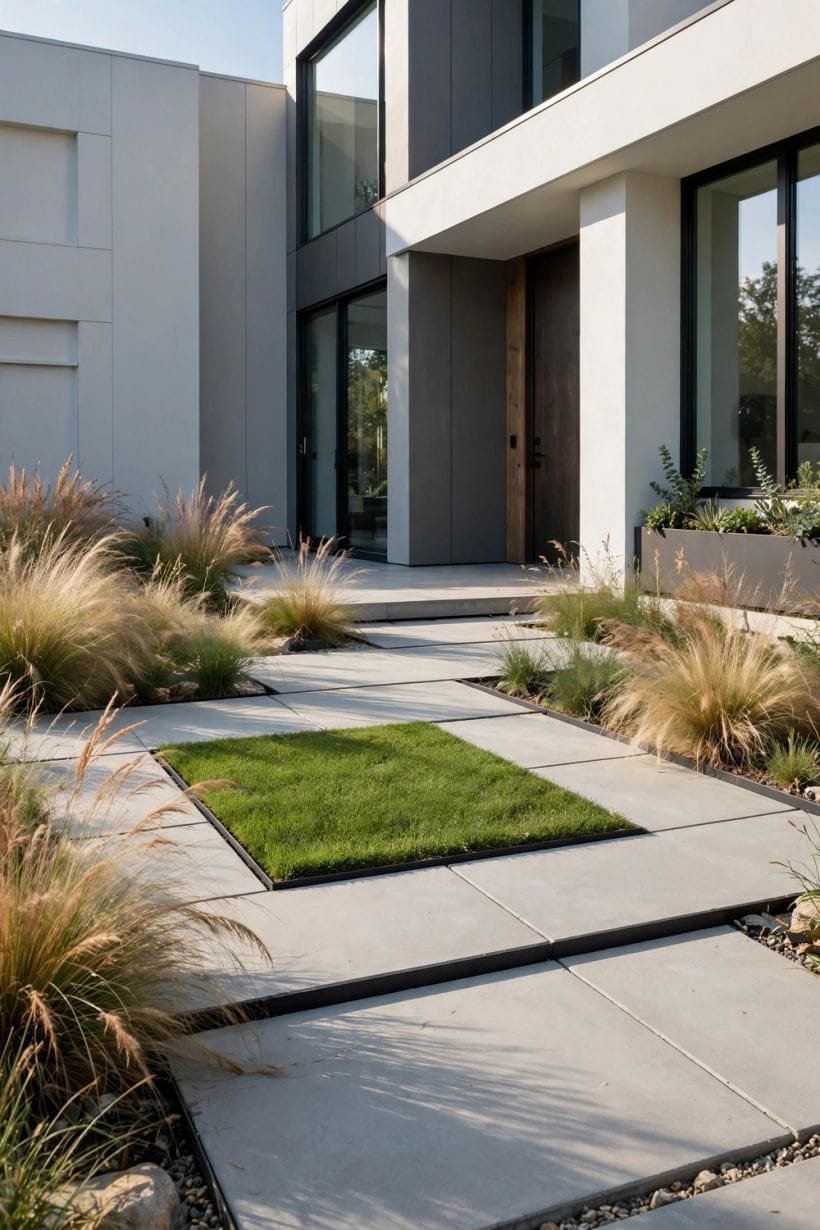
Stone, steel, timber, concrete and gravel — the modern palette is short because repetition, not variety, makes it rich. The slope-led exception proves the rule in the hillside landscaping ideas survey, where terrain dictates materials this style would never choose freely.
12. Choose two paving materials, never five
One main paving and one contrast, repeated everywhere, give the garden its calm. Every additional material must argue its way in against the two that already work — and usually loses.
13. Let pale stone carry the light
Light paving lifts a shaded modern garden and throws planting into relief. It also shows every leaf and footprint, which is a sweeping rhythm the household accepts in exchange for the light.
14. Use dark steel as the drawing line
Slim dark edging and screens draw the plan’s lines in the third dimension: bed edges that vanish visually, dividers that read as shadow. Steel’s job is punctuation, never paragraph.
15. Lay gravel as a surface, not a filler
Gravel panels — compacted, edged, raked or left smooth — are finished surfaces in this style, planted through sparingly. Gravel tipped into leftover corners is filler, and the eye can tell the difference instantly.
16. Build retaining walls as furniture-grade work
A modern retaining wall is flat, capped and honest, its top a seat or a shelf for pots. Walls built to this finish cost their care once; walls built roughly tax the garden’s calm forever.
17. Repeat the house’s own material once
Brick from the house in a garden wall, render matching its finish, stone echoing its step: one material rhyme ties house to garden.
18. Keep joints and lines obsessively straight
In a style with nowhere to hide, a wandering paving joint is a headline. Setting out is checked with strings and patience; modern surfaces forgive nothing and reward everything.
19. Choose aggregates by tone, not habit
Gravel and chippings chosen for their colour against the paving — warm against cool, pale against dark — are a design decision, not a merchant’s default.
20. Let timber weather honestly
Decking and screens in timber are chosen for how they silver, not for a stain war against the weather. A maintenance promise the household will not keep is a design flaw, however beautiful the first summer.
21. Hide the bins, the meter and the mundane
Screens in the garden’s own materials hide the working clutter every plot owns. In a restrained garden, unscreened clutter is not a detail; it is the loudest object present, and it wins every glance.
22. Light the materials, not the garden
Evening light grazes stone, washes a wall and silvers gravel — the surfaces carry the night garden. That lighting is planned with the materials, in the section below, not bolted on after them.
4. Planting in Masses: The Softening Hand
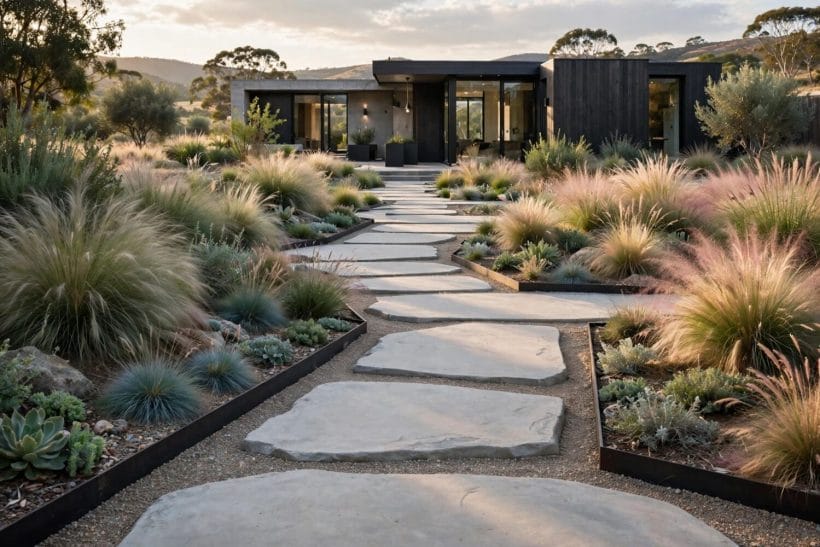
Modern planting is generous in quantity and ruthless in variety: a few kinds, planted in drifts and blocks large enough to read as single gestures. It is the opposite discipline from the lush layering of the tropical landscaping ideas lane, whose abundance is its own climate-led logic.
23. Plant one kind in a drift, not one of everything
A sweep of a single grass, a block of one shrub, a river of one ground cover: mass is what makes planting read as design.
24. Let grasses do the movement
Ornamental grasses in mass give the modern garden its seasons: fresh spears, summer haze, autumn seed heads lit low, winter skeletons in frost. Cut once a year, they earn their place in every month of it.
25. Clip evergreens into the architecture
Box alternatives, yew and other willing evergreens clipped into balls, blocks and low hedges become the garden’s permanent furniture. Their geometry holds the plan in winter when everything else has retired.
26. Choose one architectural tree, placed like sculpture
A multi-stem small tree, a sculptural pine, a single olive in a warm wall’s shelter: one tree, placed on the axis or against the emptiest panel, is the garden’s signature.
27. Repeat the palette front and back
The same grasses, the same clipped forms and the same accent plant in the front garden and the back make one garden of two plots. The household’s visitors read the repetition as confidence, which it is.
28. Keep colour an event, not a mixture
One flowering mass at a time — a drift in flower while the rest stays green — gives colour its drama. Where everything flowers together, nothing is an event; the modern calendar staggers its pleasures deliberately.
29. Plant for the winter skeleton
Seed heads left standing, bark chosen for winter light, evergreen masses holding the lines: the modern garden is designed for its hardest season first. A garden beautiful in winter is merely maintained in summer.
30. Use green as the main colour, proudly
Foliage in layered greens — glossy, matt, silvered, fine — is the palette; flowers visit it. Households that need constant flower should choose another lane honestly, because this one will not pretend.
31. Edge beds with planting that spills once
One softening spill over a hard edge — a grass leaning, a ground cover escaping — humanises the geometry. Spills everywhere dissolve the plan; the discipline is in the once.
32. Mulch as a finished surface
Bare soil in a modern bed is dressed — bark, gravel or a living ground cover — never left as a weeding subscription.
33. Give every plant its thriving place, or none
A plant sulking in the wrong soil or light breaks the style’s calm faster than an empty panel does. The modern answer to a failing plant is a different plant, thriving, or an honestly empty space.
5. Water, Fire and the Garden’s Punctuation
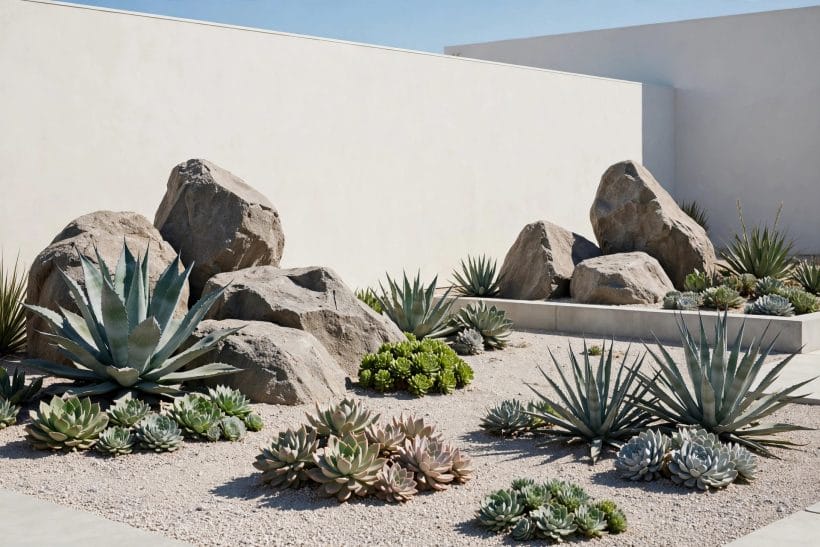
Still water, a contained flame, a single bench: the modern garden’s punctuation marks are few, placed like the full stops of a short sentence. Coastal plots take their water cues from a different teacher, as the coastal landscaping ideas survey shows.
34. Keep water still, or keep it linear
A still reflecting panel or a narrow straight rill suits the geometry; fountains and cascades belong to other grammars.
35. Mirror the sky in a dark-bottomed rill
A dark lining under shallow water turns a rill into a mirror that carries clouds and grasses down its line. It is the cheapest grandeur in the modern repertoire, and it asks only to be kept clean.
36. Contain fire in a bowl or a line
A fire bowl on the terrace axis or a linear fire set into a wall gives the evening garden its hearth.
37. Place one bench as a destination
A single, beautiful bench at the axis’s end gives the garden its reason to be walked to. Benches scattered hopefully seat nobody; a destination bench, in sun at the right hour, is used daily.
38. Let a boulder be the sculpture
One large stone, placed with the deliberation a gallery gives a sculpture, anchors an empty panel better than any ornament. Its placing is a morning’s work with bars and patience, and it is never apologised for again.
39. Use pots as the changeable element
Large pots in the garden’s own materials carry the seasonal change the fixed planting refuses: bulbs, then grasses, then winter evergreens. Everything else stays; the pots perform, which is the correct division of labour.
40. Keep ornaments at zero, then add one
The modern garden starts with no ornaments and admits pieces one at a time, each earning its panel. Most gardens of this style, honestly edited, end with fewer than their owners expected and love them more.
41. Sound: the rill’s murmur, nothing else
Where water moves, its sound is tuned low and constant. Wind chimes, water bells and novelty sounds are other styles’ pleasures; the modern garden’s soundtrack is leaves, water and birds, unassisted.
42. Hide the workings completely
Pumps, filters and fire supplies vanish into the garden’s construction. In a style built on calm surfaces, a visible pipe is not a detail — it is the only thing anyone will remember.
43. Reflect planting in the water’s edge
Grasses and one clipped form mirrored in still water double their effect for the price of none.
44. Give children their own clear territory
A modern family garden zones play honestly: a lawn panel that is theirs, hard-wearing and unembarrassed, rather than a war of attrition across every bed. Restraint for the design, freedom inside the zone, works for both.
6. Light and the Night Garden
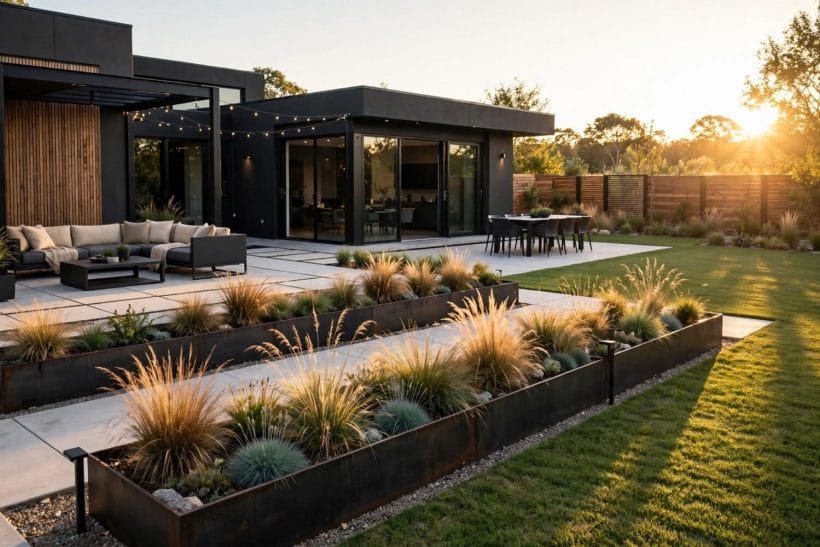
A modern garden is designed twice: once for the sun and once for the few fittings that replace it. Low, warm and aimed at surfaces, modern lighting reveals the geometry after dark and nothing it should not.
45. Wash walls, never flood the plot
Light grazed along a wall or fence shows texture and boundary without flattening the garden. Floodlighting is security’s tool; the garden’s tool is the wash, the graze and the single uplight.
46. Uplight the one tree
The signature tree lit from below becomes the night garden’s sculpture, doubling its daytime role. One lit tree is drama; every tree lit is a car park, and the difference is entirely in the restraint.
47. Mark paths with pools, not runways
Low fittings pooling light at a path’s turns and steps guide the foot without drawing a runway through the dark. Steps and edges are lit for safety first — a professional’s work where mains power is involved.
48. Keep light warm beside planting
Warm light flatters foliage and skin alike and sits kindly with firelight. Cold, blue light in a garden reads as an institution’s yard, whatever the fittings cost.
49. Light the water from within or not at all
A submerged or rim light in still water doubles the mirror into the night.
50. Put every fitting on a timer or a switch you control
The night garden appears and rests by the household’s choice, and neighbours and wildlife are spared light nobody is using. Control is not convenience here; it is part of the design’s manners.
51. Hide every fitting by day
Fittings small, dark and tucked into the planting or the construction disappear in daylight. A garden whose technology is visible by day has two designs, and the daytime one lost.
52. Borrow the house’s light deliberately
A lit window, an open door’s spill, the fire’s own glow through glass: the house lights the garden’s near ground for free. Plan the garden’s fittings for the far ground the house cannot reach.
53. Test the night garden before fixing anything
Fittings are placed on temporary leads and lived with for evenings before a single cable is buried. Night effects cannot be judged from a catalogue photograph, and buried mistakes are the expensive kind.
54. Dim rather than switch, where you can
Scenes that soften — full wash for working, low glow for sitting — let one garden hold several evenings. Dimmable, zoned light is the night version of the style’s restraint: less, chosen, rather than more, fixed.
55. Leave true dark somewhere
One corner left unlit — for the sky, for moths, for the pleasure of contrast — completes the night garden. A plot lit everywhere has no night in it at all, only a dimmer day.
7. Front Gardens, Small Plots and Tiny Houses
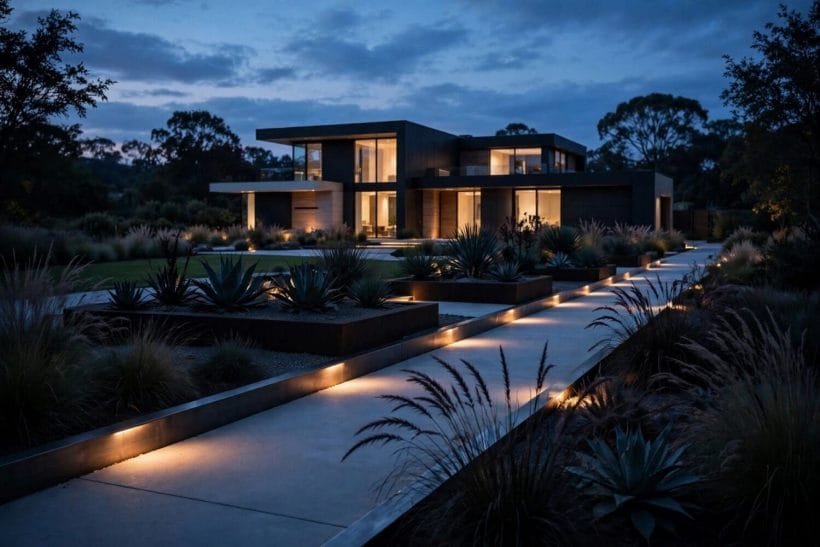
The style scales down gracefully, which is why it serves the plots this site thinks about most — including the dedicated tiny house landscaping ideas lane, whose plot-first thinking this section shares without repeating.
56. Give the front garden the same plan as the back
Front gardens in this style are not the back’s leftovers: the same geometry, materials and masses, arranged for the street. A house whose two gardens agree reads as designed from the pavement, which lifts the whole plot.
57. Replace a struggling front lawn with gravel and grasses
A shady or tiny front lawn swapped for a gravel panel, massed grasses and one small tree gains a garden and loses a chore. The street gains more beauty than the lawn ever gave it.
58. Screen the bins and the car with planting, not fencing alone
A clipped evergreen mass or a steel screen softened by grasses hides the working front garden while keeping the line. Pure fence reads as apology; screened and planted reads as design.
59. Make the path to the door the axis
In a front garden the axis is given: door to gate. Widen the path, edge it in the garden’s line, plant its flanks in masses, and the daily walk home becomes the garden’s best view.
60. Shrink the palette as the plot shrinks
The smaller the plot, the shorter the lists: two materials, three plant kinds, one tree. Small modern gardens fail by ambition, not by area — restraint is what makes a tiny plot feel generous.
61. Use the boundary as the garden’s walls
Rendered, clad or densely planted boundaries are a small garden’s architecture. Money spent on the boundary returns more beauty per panel than money spent in the middle of a small plot ever does.
62. Borrow the neighbour’s tree, frame the sky
A small plot’s composition includes what it can borrow: a neighbour’s canopy framed, a church spire or hill kept in the sight line. Planting that blocks the borrowed view is edited, however healthy it is.
63. Put seating where the sun actually lands
One bench or two chairs placed by the sun’s real timetable — observed, not assumed — make a small garden used rather than viewed. In small plots, use beats view in every honest accounting.
64. Keep a tiny-house plot’s services invisible
Tanks, hookups and storage in a tiny-house plot hide behind the garden’s own screens and masses, so the plot reads as a small modern garden that happens to hold a small modern house.
65. Finish the plot at the gate
The modern plot’s discipline runs to its last panel: gate, path edge and boundary planting resolved, because the street’s view is the garden’s first room. A garden that gives up before its gate gives up its introduction.
8. Keeping the Look: Editing as Maintenance
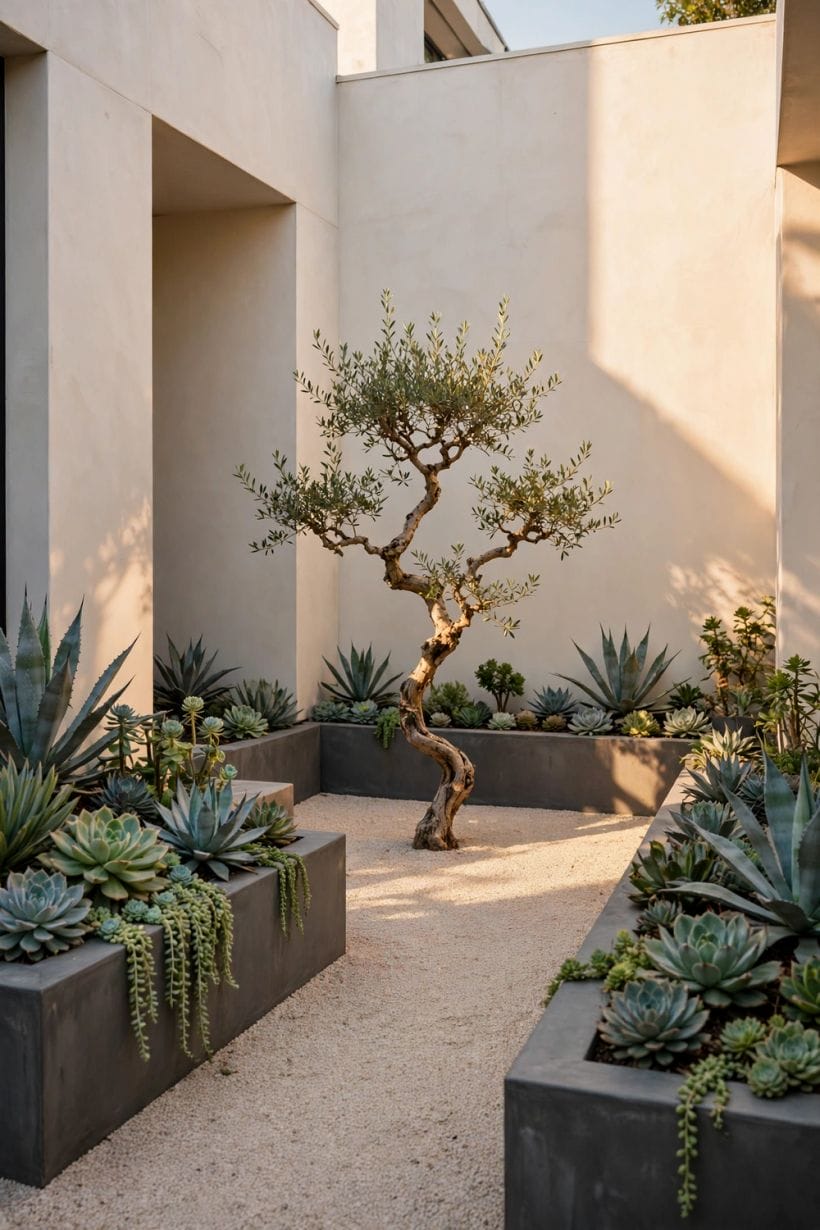
A modern garden is maintained by editing more than by labour: removing, dividing and re-stating the original few ideas as they grow. It is the cheapest style to keep and the least forgiving to abandon, as the wider home design ideas collection notes of disciplined design generally.
66. Re-state the lines every spring
Edges re-cut, gravel raked or topped, clipped forms re-shaped: the spring edit restores the plan’s drawing in a weekend. A modern garden’s spring work is short precisely because its lines are few.
67. Divide grasses before they fade in the middle
Grasses and perennials lifted, divided and replanted in their masses keep the drifts vigorous. A thinning drift is replanted boldly or removed honestly — never nursed along as a rumour of itself.
68. Replace failures with the same plant, or with space
A plant that dies is replaced like for like while the mass is young. Later, its space may simply join the negative space — the style is the rare one where a loss can become a gain.
69. Keep the hard surfaces swept and washed
Pale stone and gravel show neglect honestly; a rhythm of sweeping and an occasional wash keeps them as drawn. The style’s surfaces are its furniture, and furniture is dusted.
70. Prune for the silhouette, not the calendar
Trees and shrubs are pruned to keep their chosen shapes — the multi-stem’s crown lifted, the block’s face true. Calendar pruning that ignores silhouette slowly unmakes the composition it maintains.
71. Say no to the gifted plant
Well-meant gifts and nursery temptations are the modern garden’s erosion. A plant with no panel and no mass to join is compost for someone else’s garden, accepted with thanks and planted elsewhere — or not at all.
72. Photograph the garden in its hardest month
An annual photograph in the depths of winter audits the structure honestly: lines, evergreen masses and empty panels judged without summer’s forgiveness. The modern garden is designed, and judged, in that photograph.
73. Renew mulch and gravel before they embarrass
Dressed surfaces are topped up while they still read as surfaces, not after they read as soil.
74. Keep a one-page plan in the house file
The drawn plan, the plant list and the materials noted on one page make every future edit faithful to the original thought. Gardens drift when their plans live only in memory; modern gardens drift visibly.
75. Let maturity improve the drawing
Clipped forms fatten, the tree’s canopy spreads, grasses settle into their masses: a modern garden at its fifth year should outdraw its first.
9. Checks and Mistakes: Before the First Purchase or the First Stone
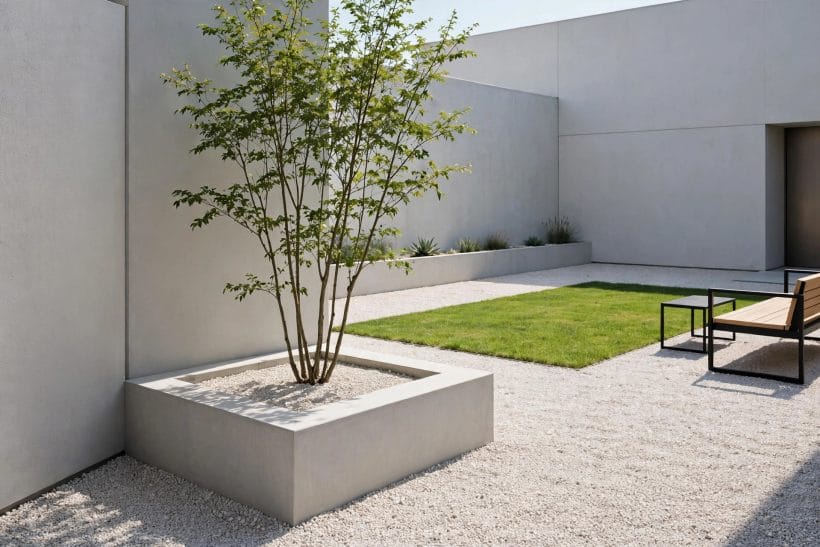
Check the plot before the plan, in the order the ground demands: sun and shade mapped across a real day, soil and drainage understood honestly, levels and boundaries surveyed, and services — water, power, tanks and access — located before a single line is drawn. Drainage especially forgives nobody: modern surfaces and still water both fail over ground that was never understood, and putting drainage right after paving is the expensive order. Those groundworks are the non-negotiables; everything above them is taste.
The commonest mistakes are failures of nerve: five materials where two would compose, twenty plant kinds dotted where three in mass would sing, a lawn left as leftover, ornaments arriving one gift at a time until the calm has quietly left. The remedy is the sketch — a plan simple enough to draw from memory, a palette short enough to list on one hand — defended kindly but defended, every spring, by the edit.
10. Costs and Pulling It Together
Costs for a modern garden stay qualitative here, because the honest figure belongs to a measured plot, chosen materials and a named landscaper’s quote. The drivers are predictable: how much hard surface replaces soft, the depth of the groundworks and drainage beneath it, walls and screens, water and lighting, and the size of the plants bought — maturity is the one luxury this style genuinely sells, in the form of larger specimens and clipped forms bought with their years included.
Pull the project together in the plan’s own order: geometry first, groundworks and levels second, hard materials third, planting in its masses fourth, and punctuation — water, fire, the bench, the boulder — last of all, when the calm can judge what it still needs. Keep the contingency for the ground’s surprises, because ground keeps them. The result should look, in the best sense, simple — which is the most expensive-looking thing a garden can be.
Final Considerations
End where the style begins: a garden that can be drawn in a few lines and remembered in one visit — geometry holding, materials repeating, planting massed, and empty space kept empty like it matters, because here it does.
Build the bones honestly, plant by the mass rather than by the specimen, and edit kindly every spring. A modern garden does not ask for more things. It asks for fewer, better ones, in the right places.

0 Comments