

A modern dining room is the calmest argument in the house: one table, honestly built; chairs that sculpt rather than stuff; light pooled exactly where the food and faces are. Nothing matches, everything belongs, and dinner is the decoration.
This survey collects seventy-five modern dining room ideas in the modern lane only — layout, table, seating, light, colour and storage — inside the wider dining room ideas collection. The farmhouse dining survey keeps its own warmer lane elsewhere in the plan and is not repeated here; the small-space eating angle belongs to the breakfast nook, linked where it belongs below.
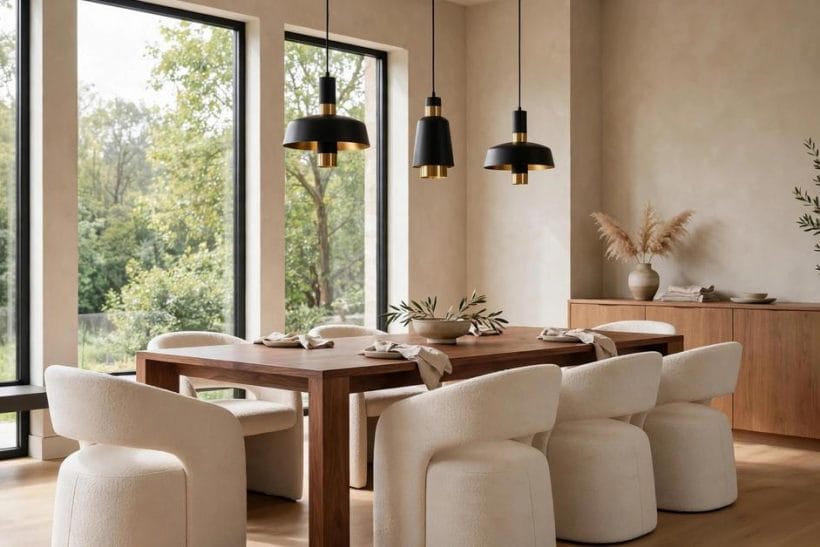
1. Modern Dining Room Ideas at a Glance
The modern dining room is a dining space in the contemporary design language: clean-lined furniture of honest materials — pale and mid-tone timbers, stone, glass, blackened and brushed metals — arranged with deliberate space around it, lit by sculptural pendants centred on the table, and coloured from a restrained palette of whites, warm greys, timber tones and one or two deep accents. Its governing attributes are proportion (the table sized to the room and the household, with circulation kept clear), contrast of material rather than of ornament, seating treated as sculpture, storage that presents as architecture, and a single focal composition — usually the table, its light and one piece of art — rather than a crowd of competing features. It differs from traditional dining by refusing formality’s matching sets, and from farmhouse dining by refusing rustic texture and vintage clutter: modern is edited, smooth and calm.
| Question | Short answer |
|---|---|
| How is modern dining different from farmhouse dining? | Material and editing. Farmhouse dining builds warmth from rustic timber, turned legs, vintage finds and layered textiles; modern dining builds it from proportion, light and smooth honest materials, with far fewer objects. The two lanes share a love of the shared table and nothing else — each keeps its own survey in this plan, and this one stays modern throughout. |
| What size should a modern dining table be? | Sized to the room first and the guest list second: the table should seat the household daily in comfort, keep clear walking space on every side it is passed, and leave the room’s proportions calm. Extensions and drop leaves answer the occasional crowd better than a daily oversized table that the room must apologise for. |
| Must modern dining chairs match? | No — modern dining was the style that retired the matching set. Chairs should agree in height, weight and material temperature, not in identity: a bench on one side, two carver-style chairs at the ends, or a deliberate pair of designs around one table are all native to the lane. |
| Where does a modern dining room put its storage? | In architecture, not in furniture crowds: a low sideboard against one wall, built-in banquette bases, or a single tall cabinet, all in the room’s own materials. The modern room’s calm depends on everything having a door to disappear behind — serving pieces, linens and the week’s paperwork alike. |
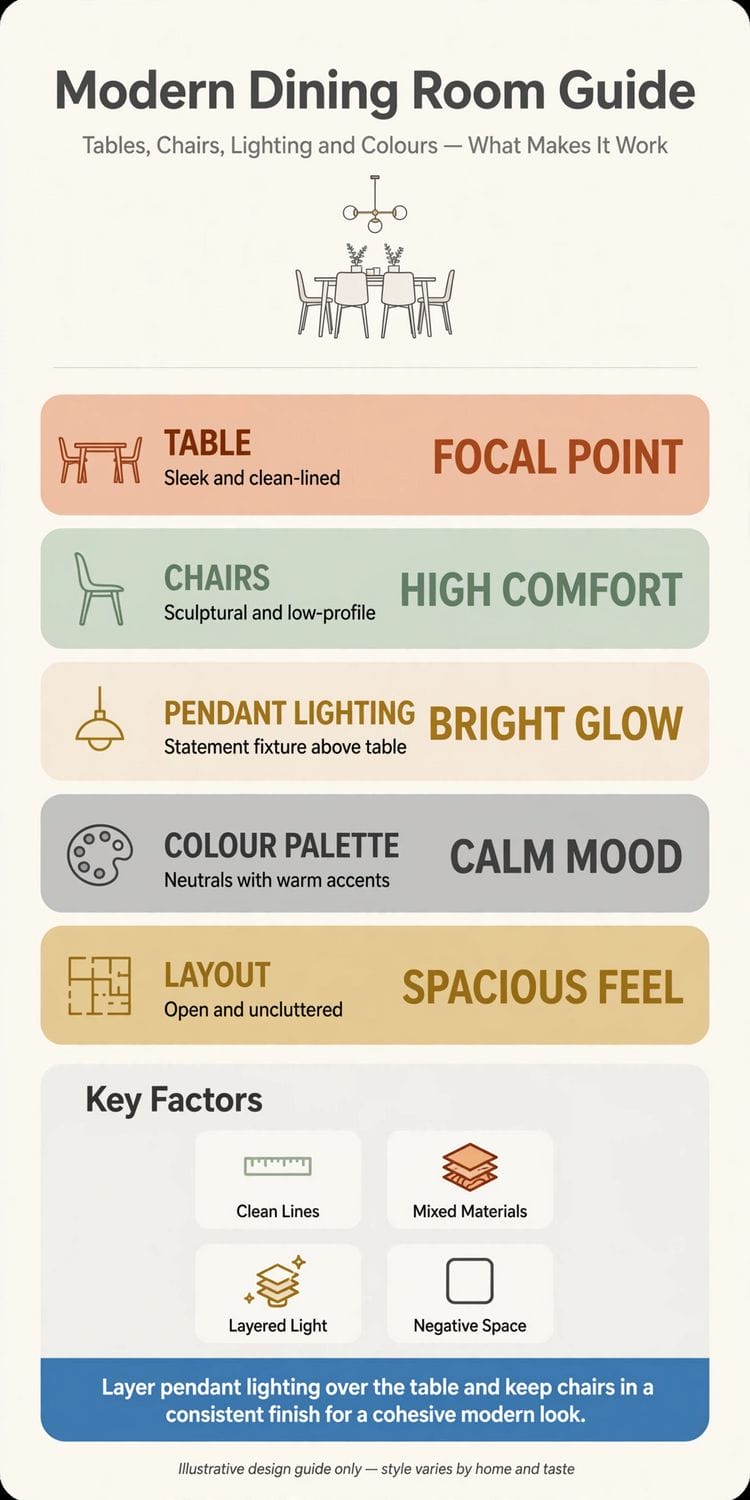
2. Layouts and Table Shapes: The Room Arranged Around One Table
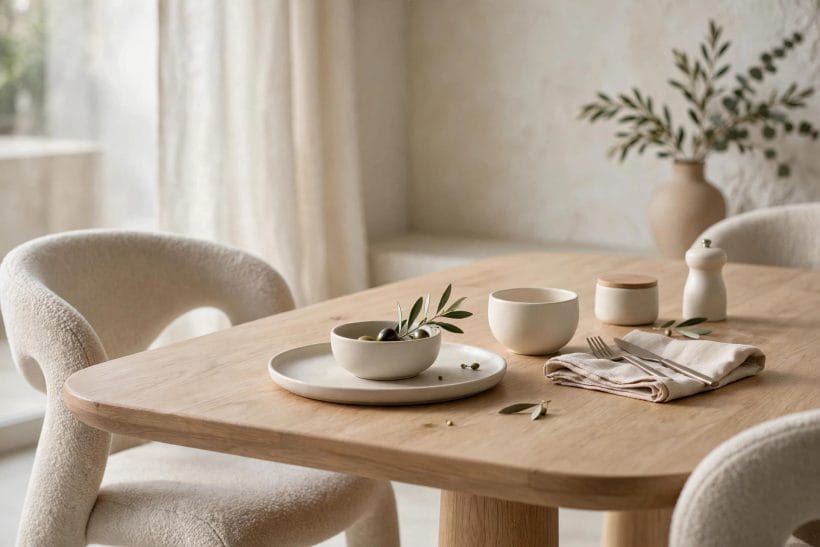
Layout is the modern room’s first discipline: one table, centred on its light and its rug or floor field, with the room’s other pieces kept to the walls. Work through these layouts before choosing anything, and borrow the small-space thinking of the breakfast nook ideas survey only where the room is genuinely nook-sized — this survey’s rooms are full dining rooms, however compact.
1. Centre the table on the pendant, not the room
Where the ceiling light and the room’s centre disagree, the table follows the light or the light moves: a pendant hanging off-centre above a centred table undoes the whole composition.
2. Keep circulation as a designed space, not a leftover
The modern room’s calm is mostly walking space kept deliberately clear: chairs that pull out without striking walls, a serving route from kitchen to table that crosses no one’s chair back.
3. Run a rectangular table parallel to the long wall
In a rectangular room, the rectangular table aligned with the room’s long axis doubles its sense of order: rug, pendant and sideboard all share the same geometry.
4. Choose a round table to soften a boxy room
A round table removes the hierarchy of ends, seats conversation equally, and lets a square room breathe.
5. Use an oval where the room is narrow and the company is large
The oval keeps the round table’s softness and restores the rectangle’s capacity, suiting long narrow rooms where corners would crowd the walls.
6. Anchor the composition with a rug sized to the chairs
A rug under a modern table should hold every chair leg even with chairs pulled out for seated guests, or be omitted entirely.
7. Build a banquette along the window wall
A built-in bench with storage beneath turns the room’s best light into its most-used seat and frees the floor opposite.
8. Float the table in an open-plan space, zoned by light
Where dining shares a floor with living and cooking, the pendant and rug are the room’s walls: table centred beneath its light, on its rug field, with the sideboard marking its far edge. The family room ideas survey works the shared-space problem from the living side; here the dining zone holds its own calm within it.
9. Leave one wall entirely quiet
In a room of table, chairs, sideboard, art and light, one bare wall is not an omission but the composition’s rest — the silence that lets the other elements sound.
10. Place the sideboard on the serving route
Storage belongs where the carrying happens: between kitchen door and table, at serving height, with its top kept clear for dishes in transit.
11. Give the host’s seat the room’s best view
One chair in every dining room faces the window, the art or the room’s long view, and it should belong to whoever cooks and serves least restfully.
3. Tables and Materials: One Honest Surface
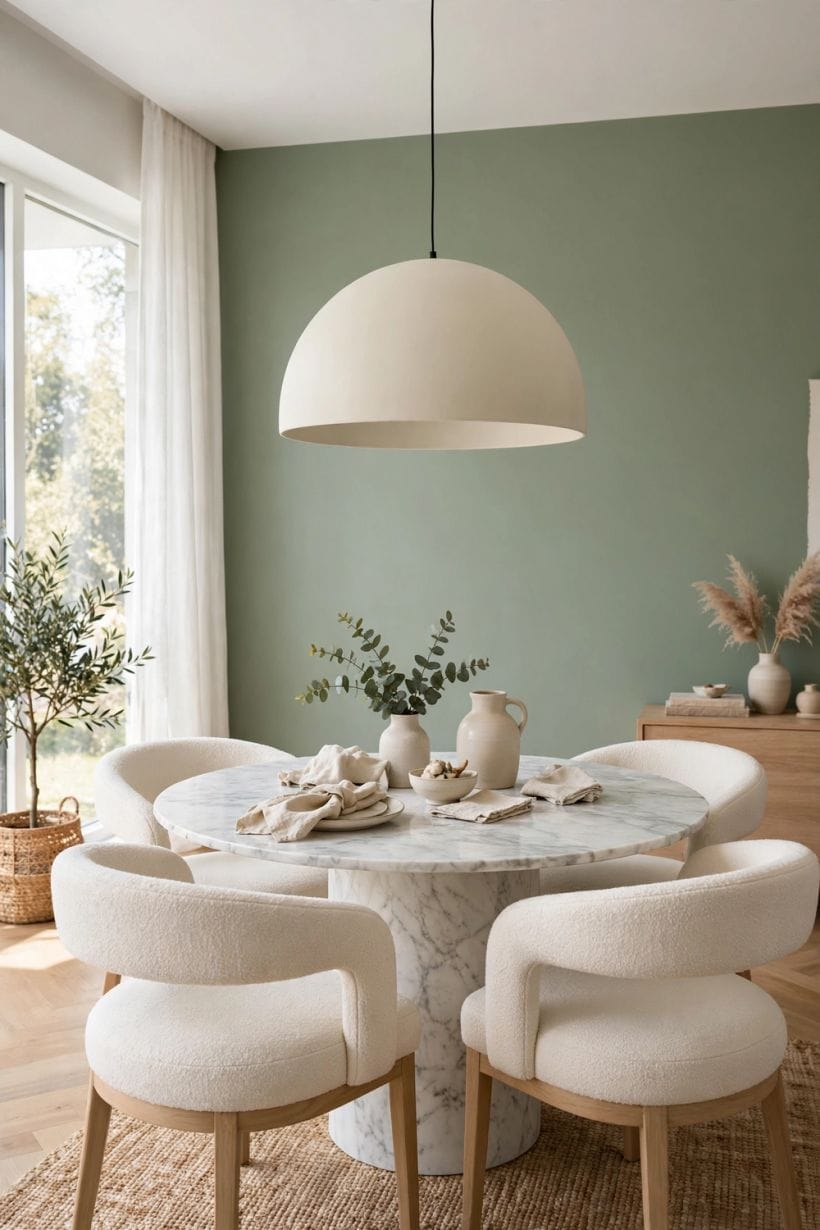
The table carries the modern room, and its material is the room’s material signature. Choose the surface your household’s real life can live on without ceremony, then let its tone set the room’s wood and metal families.
12. Let pale oak set the Scandinavian-quiet tone
Pale oak tabletops lighten a room, forgive daily wear gracefully and pair with almost every chair material.
13. Spend drama on a stone top, calmly edged
A stone or stone-look top — marble-veined, terrazzo-flecked or plain and honed — brings the room’s one geological note.
14. Choose a pedestal base for legroom and looks
A central pedestal — drum, cross or sculpted fin — frees every seat’s knees, lets chairs tuck fully under, and gives the table its sculptural moment below the sightline.
15. Let blackened metal frame a timber top
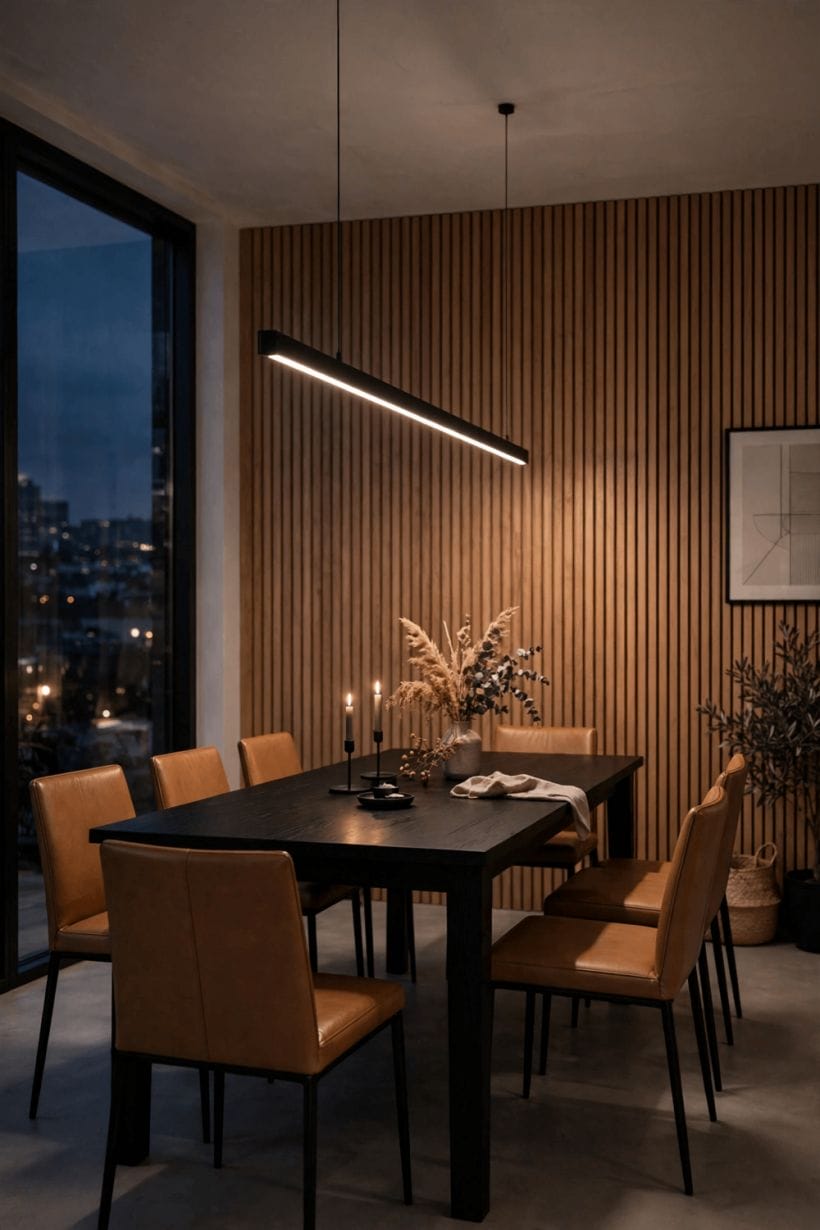
A slim black steel frame under a warm timber top is the modern room’s favourite contrast: structure drawn in line, warmth supplied by wood.
16. Pick an extending table and rehearse the extension
Occasional crowds are a mechanism problem, not a size problem.
17. Use glass only where fingerprints have a constituency
A glass top floats a small room open and shows a beautiful rug or base to advantage, and it records every touch ever laid on it.
18. Match the table’s height to the chairs, not the catalogue
Seat height and table height are a couple, not individuals: the modern room’s lower-slung chairs demand their table be checked against them with a real seated person, cushions and all.
19. Keep the top’s finish repairable
Oil, wax and matte lacquer finishes that can be spot-repaired suit real dining; mirror gloss that records every ring and can only be professionally restored suits dining as theatre.
20. Let one table edge be the room’s curve
A softened, bullnose or chamfered edge on an otherwise rectilinear table is the detail hands learn and eyes reward.
21. Size the top for elbows, not just plates
Each diner needs a place setting’s width and enough depth for serving dishes to pass through the table’s middle.
22. Anchor a long table with a centrepiece that stays
A low, permanent centre — a stone bowl, a timber board, a plant in a heavy pot — that serving dishes can orbit without being moved gives the table its dressed look on ordinary days.
4. Seating: Sculpture You Sit On
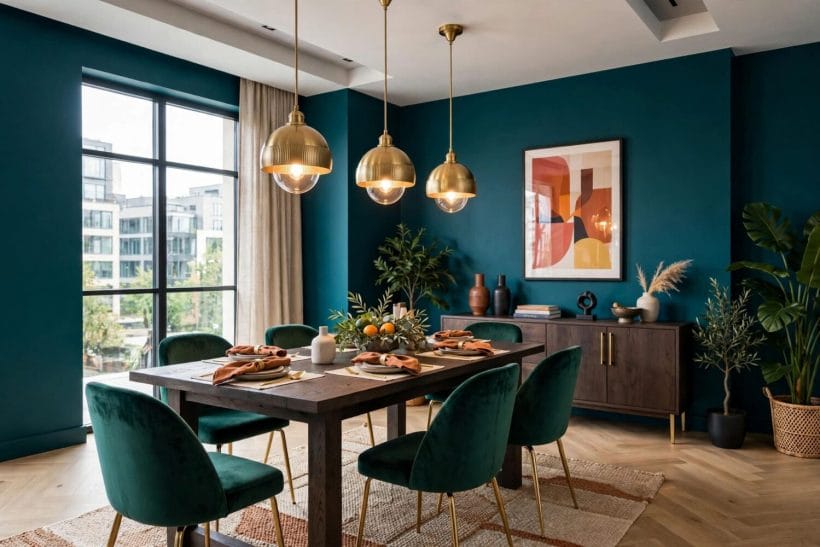
Modern dining chairs are the room’s sculpture collection, sat on nightly. Their silhouettes supply most of the room’s visual incident, so choose them as art that must also pass an evening’s sitting test.
23. Choose moulded chairs for the room’s cleanest line
Moulded plywood or composite shells give the modern table its classic companions: light, stackable or easy-moving, kind to floors and available in the palette’s every tone.
24. Mix a bench along one side
A plain bench — timber slab on slim legs, or upholstered to match the banquette — seats the flexible extra guest, slides wholly under the table, and gives the composition its asymmetry.
25. Use two different end chairs as the room’s punctuation
Slightly larger, upholstered or higher-backed chairs at the table’s ends frame the composition and seat its hosts in the comfort their work deserves.
26. Cantilevered chairs bring the spring
The tubular cantilever chair’s gentle bounce is the modern seat’s secret comfort, forgiving long dinners in a way rigid legs never do.
27. Upholster for the long dinner, plainly
Where dinners run long and often, an upholstered seat in a hard-wearing, quiet fabric earns its place at every position.
28. Keep chair backs below the window and art lines
A chair back that crosses a window’s sill line or an artwork’s lower edge breaks the room’s horizontal calm every time it is seen.
29. Let one vintage or crafted chair be the exception
A single older, handmade or otherwise characterful chair among the modern set gives the room its soul and its story, provided its height and weight agree with its neighbours.
30. Choose wipeable seats where small children dine nightly
Moulded, leather or coated seats that return to clean with one cloth are the modern room’s honest answer to family life.
31. Stack or fold the spares out of the room
Extra chairs stored in the room ‘just in case’ spend the room’s calm every day to serve it monthly.
32. Test chairs at a table, with food, for an hour
Showroom sitting is upright and brief; dining is leaned, laden and long.
33. Count the room’s legs and calm them
Table legs, chair legs, sideboard legs and pendant stems are the modern room’s forest; too many differing woods and metals at shin height turn calm into clutter.
5. Lighting: The Pendant Is the Room’s Ceiling Jewel
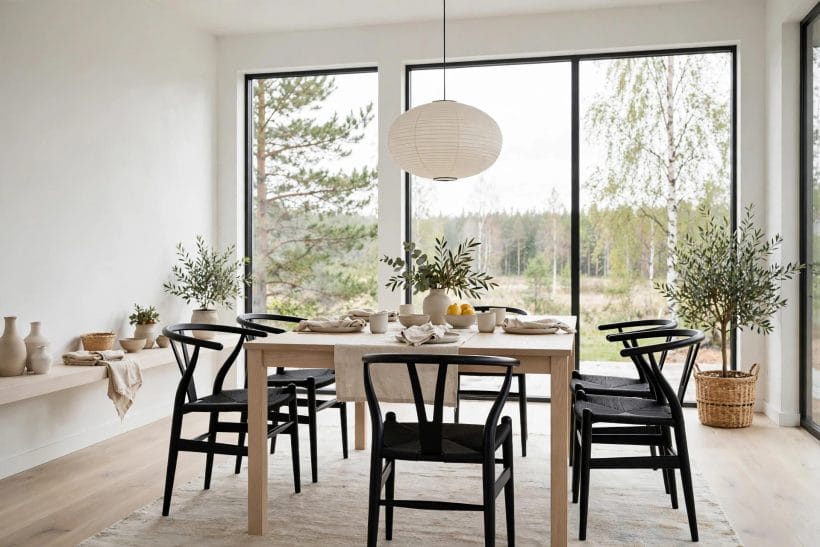
Dining light has one job — the table, the food and the faces — and modern rooms do it with a single composed gesture overhead. The fittings below are chosen as sculpture and hung with care, on circuits installed by qualified hands under local rules.
34. Hang one pendant low and centred over the table
The modern gesture: a single pendant — globe, cone, disc or sculptural cluster — centred exactly on the table and hung low enough to pool its light on the surface and faces while keeping sightlines open beneath it.
35. Choose a linear suspension for a long table
A slim linear fitting or a row of small pendants on one bar lights a long table evenly, end to end, without the dark ends a single central light leaves.
36. Dim everything, warmly
Dining light must be able to fall to candlelight’s neighbourhood without changing colour to orange or grey.
37. Add wall lights to free the ceiling in low rooms
Where ceilings are low or beams forbid a central pendant, a pair of wall lights flanking the sideboard or art washes the room from its edges and leaves the table to candles and a low table lamp’s modern cousins.
38. Let candles do the final layer honestly
Real candles on a modern table — in glass, stone or blackened metal holders, kept low and stable — supply the flicker no fitting imitates.
39. Match metals to the table’s frame, once
Pendant metal, table frame, chair legs and sideboard handles should share one or at most two metal families, chosen together.
40. Keep bulbs out of diners’ eyes
Exposed-bulb fittings belong above sightlines or behind diffusers at dining height: a bare filament at eye level across a table is glare wearing fashion’s clothes.
41. Light the art and the sideboard separately
A picture light or a small downlight over the sideboard’s composition gives the room its second glow, so the table’s pendant is not working the whole room alone.
42. Use the window as the daytime fitting
By day the modern dining room is lit by its window, and the table’s placement should harvest it: side light across the table flatters food and faces, while a diner seated facing full sun is a layout error no blind fully forgives.
43. Put the pendant’s switch where the host sits
Control belongs within the host’s reach — a dimmer by the dining door at least, and never a switch that requires leaving the table mid-dinner to adjust the room’s mood.
44. Scale the fitting to the table, not the room
A pendant is sized against the tabletop beneath it: generous enough to claim the composition, restrained enough to leave air around it.
6. Colour and Walls: A Calm Ground, One Deep Note
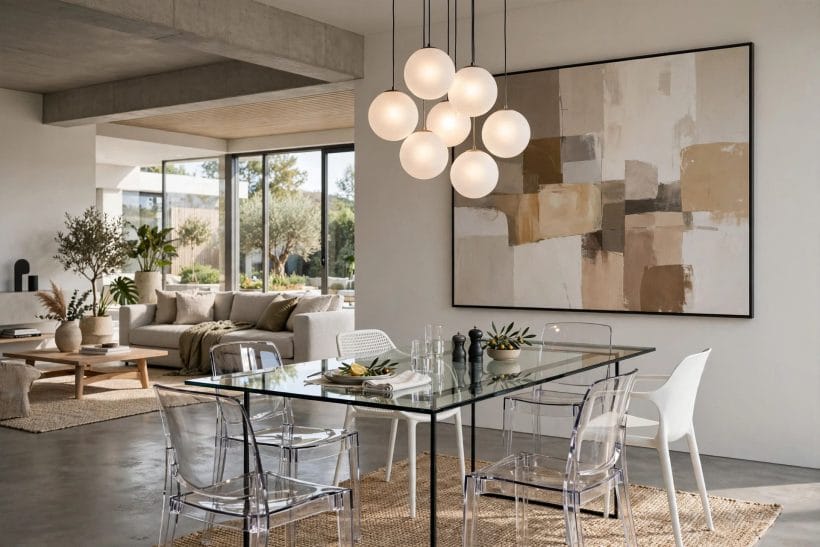
Modern dining colour is a discipline of restraint: a calm architectural ground, the timber’s warmth, and one deep note placed where the room can enjoy it daily.
45. Paint the ground in warm white or palest greige
The modern room’s default wall is a warm, light neutral that flatters food, faces and timber alike and lets art and upholstery change around it for years.
46. Give one wall the deep note — ink, forest or oxblood
A single deep wall behind the sideboard or art gives the room its evening richness and makes the table’s pale composition glow by contrast.
47. Let the ceiling disappear in the ground colour
Ceiling and walls in one light tone remove the lid line and let the pendant hang in a continuous calm.
48. Run timber as the room’s second colour
Floor, table and sideboard in agreed timber tones are the modern room’s warm colour, and they should be chosen as a palette in themselves: pale with pale, mid with mid, one dark piece allowed as the anchor.
49. Bring colour in through art, largely and singly
One large artwork — abstract, photographic or textile — is the modern dining room’s permitted colour festival, hung low over the sideboard and lit as the room’s second composition.
50. Use black as the line, not the field
Black in frames, legs, the pendant’s stem and a chair or two draws the room’s structure in ink and sharpens every pale surface beside it.
51. Keep the rug quieter than the table
A modern dining rug is texture, not picture: flat-woven, tonally varied at most, in the palette’s mid tones, chosen to forgive crumbs and chair castors.
52. Colour the chairs, calmly, in one family
Upholstery colour belongs to one family across the mixed set — all the seats in tones of one hue, or neutral with the two end chairs carrying the deep note.
53. Let plants be the room’s living green
One substantial plant — in scale with the room, in a plain heavy pot — supplies the green that paint samples promise and rarely deliver kindly.
54. Dress the window in the wall’s own tone
Curtains or blinds a half-tone from the walls keep the window’s architecture and light without adding a new colour to referee.
55. Reserve saturated colour for the tabletop’s small stage
Coloured glass, ceramics, napkins and flowers on the table itself are where saturation may sing — changed with seasons and suppers, cleared with the plates.
7. Storage and the Sideboard Wall: Everything Behind a Door
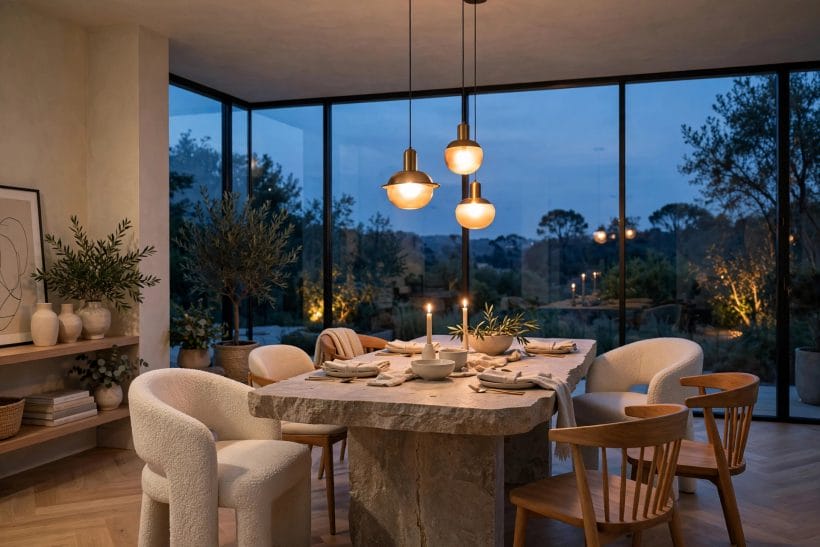
The modern dining room’s serenity is a storage achievement. One composed wall — sideboard, shelving or built-ins in the room’s own materials — swallows serving ware, linens, candles and the household’s overflow, and presents a calm face with one artwork above it. Plan it with the same care as the kitchen it serves, borrowing the serving discipline of the kitchen ideas collection at dining-room scale.
56. Stretch a low sideboard along the serving wall
The long low credenza is the modern dining room’s second anchor: storage below, a serving and display surface at standing height, and the art wall above it.
57. Build storage into the banquette and the window seat
Drawers and lift-lid boxes inside built seating hold the table leaves, the pads, the board games and the candles where they are used.
58. Keep the sideboard’s top two-thirds empty
A styled third — the lamp, the plant, the stack of art books — and two-thirds of clear serving space is the ratio that keeps the piece working rather than posing.
59. Store by the meal, not by the object family
Shelves arranged as settings — the everyday stack, the guest stack, the serving pieces with their linens beside them — make laying and clearing a table a single journey.
60. Give the bar and the coffee ritual one cabinet, closed
Drinks, glasses and the coffee things in a single closed cabinet — inside the sideboard or a slim tall unit — keep the room’s calm while serving its pleasures.
61. Hang the one artwork low, over the sideboard
Art over a sideboard should hang closer to the piece than to the ceiling, in conversation with the objects below it, lit as its own small composition.
62. Add a single tall cabinet where the wall allows
Where the sideboard wall is short, one tall, slim cabinet in the room’s materials takes the linens, the vases and the tall things a low piece cannot.
63. Keep a serving trolley as the room’s movable storage
A slim trolley in the table’s metal or timber ferries dishes, parks beside the sideboard, and wheels the whole clearing-up away in one journey.
64. Hide the household’s paperwork in the dining room, deliberately
Every home has an administrative drift, and the dining room’s closed storage is its honest harbour: one drawer or box inside the sideboard, emptied weekly.
65. Finish the wall with one mirror or none
A single mirror — plainly framed, hung to catch the window or the pendant’s light — doubles the room’s glow and its sense of space.
8. Small Rooms, Open Plans and Modern Life
The modern lane was built for contemporary life: smaller rooms, open plans, tables that work by day and dine by night. These final ideas adapt the survey’s discipline to compact and shared spaces, and to households whose dining room must earn its floor every day.
66. Choose a drop-leaf or gateleg for the genuinely small room
A table that seats two daily and six occasionally, folded against the wall between times, is the small modern room’s honest centre.
67. Run the table into the window bay
A bay or window alcove is a dining room waiting to be claimed: table in the light, banquette in the curve, pendant centred on the whole.
68. Share the kitchen’s island as the dining room’s edge
In open plans, the island’s dining end — stools one side, chairs the other, a pendant run unifying both — lets one composition serve cooking and eating. The home design ideas collection’s wider surveys work the whole open-plan question; here it is enough that the dining zone keeps its own light, rug field and calm within the shared floor.
69. Let the table work from home, beautifully
A dining table that hosts laptops by day should clear to dinner in five minutes: a cabinet or box for the day’s equipment, a cable route that does not cross place settings, and a centrepiece that stays.
70. Use the wall for the children’s dining years
A wall-mounted drop table or a bench-and-table nook at the room’s edge serves the years of early suppers and homework, then folds back into the grown-up room when the years pass.
71. Keep one chair that is also the desk chair, the spare and the favourite
In compact homes, the hardest-working chair in the house moves between table, desk and door-side duties.
72. Borrow the living room’s wall for the sideboard
Where the dining zone is a rug field in a shared room, its storage can live on the living side of the composition — the shared sideboard serving both zones, as the living room ideas survey arranges from its own side. One excellent piece, calmly shared, beats two cramped ones competing.
73. Eat outside the room’s name when the season allows
The modern dining discipline — one table, one light, edited everything — travels to the balcony, the terrace and the garden room unchanged.
74. Measure success by weeknights, not dinner parties
A modern dining room succeeds when Tuesday’s supper lands on it as happily as Saturday’s feast — chairs comfortable in pyjamas, light dimmable to tired eyes, the day’s clutter cleared in minutes.
75. Edit the room once a year, back to its composition
Modern rooms drift: a chair arrives, a plant multiplies, the sideboard’s top fills.
9. Checks and Mistakes: Before the First Purchase or the First Stone
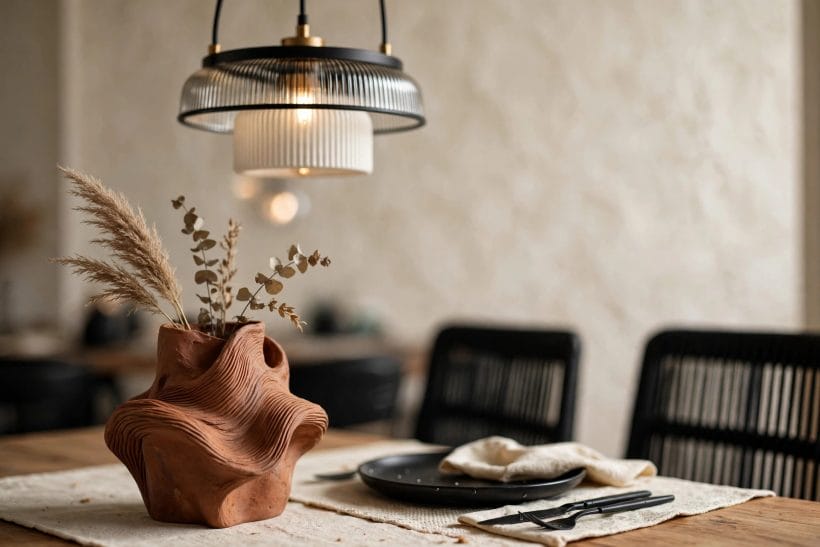
Check the table against the room before anything is bought: tape its footprint on the floor, chairs included, and walk the serving route at its busiest. Check chair and table heights together, seated, with the household’s real people. Check the pendant’s position against the table’s final place — moving a ceiling fitting is an electrician’s job, done once and done early, under local rules. Check rug size by the pulled-out chair test, timber tones against each other in the room’s own light, and storage by emptying the current dining clutter onto the table and confirming the new room has a door for every pile of it.
The mistakes repeat across modern dining rooms: the table bought for the guest list instead of the room; chairs chosen from photographs and never sat in; a pendant centred on the ceiling instead of the table; timber families mixed without a referee; storage planned as display and then overwhelmed by real life; and colour added everywhere except the one deep note that would have composed it. Every one of them is a checking failure, not a taste failure — the survey’s seventy-five ideas assume the checks, and the checks are cheap precisely because they happen before the purchases.
10. Costs and Pulling It Together
Costs in a modern dining room concentrate where they should: the table and chairs, which are touched and sat on daily for decades, carry the budget’s weight, with the pendant and the sideboard behind them. The lane’s restraint is its economy — fewer pieces, each doing more — while its false economies are consistent: chairs that fail the hour test, a rug too small, a fitting hung wrong and moved at an electrician’s second fee. Paint, plants and tabletop colour are the gentle end of the budget and the right place for the scheme’s experiments. Real rooms are priced by local quotations against chosen pieces; this survey prices none, because the honest figure is measured around your own table.
Pull the room together in order: fix the layout and the light’s position; choose the table for the room and the household’s real dinners; sit in the chairs for an hour before multiplying them; set the calm colour ground and place the one deep note; give storage its wall and its doors; hang the one artwork low; and let the tabletop carry the colour that changes. A modern dining room assembled in that order will look inevitable — which is the lane’s whole aesthetic: nothing to add, nothing to take away, and dinner at the centre of it.
Final Considerations
The dining room is the house’s most honest room, with one purpose older than any style — people eating together at one surface — and the modern lane honours it by removing everything that competes with it. The calm that results is not emptiness; it is attention, furnished.
So choose the table your life actually needs, light it like you mean it, and sit down. The seventy-five ideas here are, in the end, one idea: the best dining room is the one where the room disappears, course by course, into the company it was built for.

0 Comments