

A farmhouse staircase is the warm centre of a country home, the place where the entry, the living rooms and the upper floor meet. If you are gathering farmhouse staircase ideas, the look is easy to recognise once you know its parts: painted balusters, honest wood underfoot, a wall of shiplap or soft plaster, and one or two simple details, a woven runner, a lantern or a basket of blankets, that keep the whole flight feeling lived in rather than decorated. Nothing here shouts, and that restraint is what makes the style so welcoming. This gallery stays with the farmhouse style alone, its layouts, its colours and its practical details, in general terms, and any structural change to a stair should always be planned and fitted by a qualified professional, following local building rules.
The ideas below are grouped so you can browse by what you are actually deciding: the entry impression first, then the stair wall, the treads, the runner, the handrail, the landing, the colour palette, the small hall, the rooms a stair sits beside, and finally the light and dressing that finish it. For the wider world of stairs beyond the farmhouse style, the tiny house staircase interior design gallery shows how flights work in compact homes, while the survey of staircase railing materials covers railings as a subject of their own; here, every idea is farmhouse, and the farmhouse character is the thread that runs through all of them.
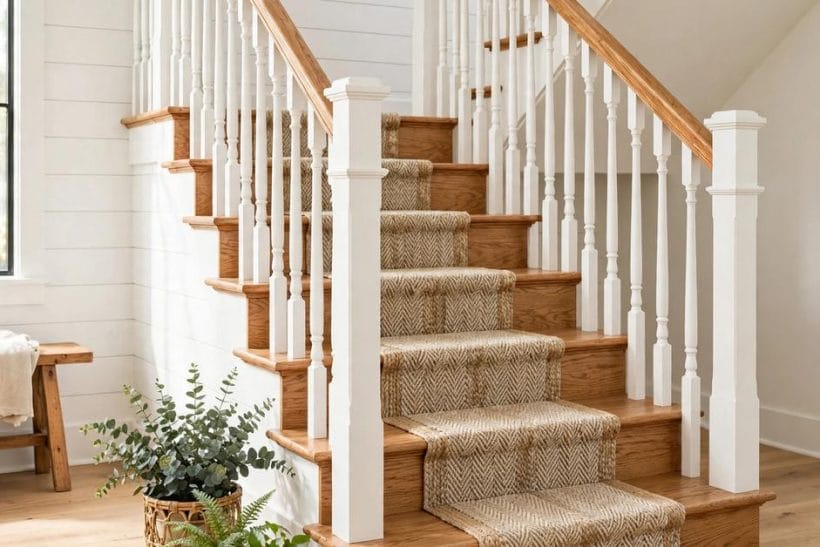
1. Classic White and Wood Entry Stairs
The entry stair sets the tone for the whole house, so the classic farmhouse formula, white painted woodwork with warm timber treads, earns its place first. It reads clean from the front door, it flatters every wall colour a farmhouse tends to use, and it lets one strong wood tone carry the warmth while the white keeps the flight feeling light. The ideas in this section are all variations on that trusted pairing, each one shifting a single detail so you can find the version that suits your own hall.
| Item | What it is |
|---|---|
| White Balusters with a Warm Oak Handrail | White balusters with a warm oak handrail are the farmhouse entry in its simplest form, and the combination works because each part does one job well. |
| Painted Risers with Natural Wood Treads | Painted risers with natural wood treads give a farmhouse stair its friendly rhythm, a stripe of clean colour followed by a stripe of honest grain on every step. |
| A Woven Runner Down the Centre | A woven runner down the centre softens both the look and the sound of a farmhouse flight, and it is one of the easiest changes to make without touching the structure. |
| Chunky Newel Posts with a Turned Detail | Chunky newel posts with a turned detail anchor a farmhouse stair the way a good fence post anchors a gate, giving the eye a solid place to rest at the foot of the flight. |
| A Bench and Basket at the Foot of the Stairs | A bench and a basket at the foot of the stairs turn the entry into a place to pause rather than a corridor to pass through. |
| Potted Greenery Flanking the Bottom Step | Potted greenery flanking the bottom step brings the farmhouse garden indoors and makes the stair feel alive from the moment you enter. |
| A Cream Entry Wall Behind a White Flight | A cream entry wall behind a white flight is quiet, but that quietness is exactly the point, because it lets the wood tones and the runner do all the talking. |
| Open Sightlines from the Front Door to the Stairs | Open sightlines from the front door to the stairs make a farmhouse feel generous the moment someone steps inside, because the stair becomes a welcome rather than a surprise around a corner. |
| Horizontal Shiplap Running Up the Flight | Horizontal shiplap running up the flight follows the rise of the stair and makes the wall feel like part of the journey rather than a flat surface beside it. |
| Vertical Board-and-Batten for a Taller Feel | Vertical board-and-batten gives a stair wall a taller feel, because the upright battens draw the eye upward along the flight. |
| A Shiplap Wall Painted Soft White | A shiplap wall painted soft white is the farmhouse default for good reason: it brightens a stairwell, it forgives uneven older walls, and it lets wood treads and a woven runner stand out against it. |
| Warm Plaster Beside White Woodwork | Warm plaster beside white woodwork offers a softer alternative to boards, with a gently uneven surface that suits older farmhouses and cottages. |
| A Picture Ledge Along the Stair Wall | A picture ledge along the stair wall lets a farmhouse family display prints and photographs without committing to a fixed arrangement. |
| Hooks and a Small Shelf on the Stair Wall | Hooks and a small shelf on the stair wall give a farmhouse hall a practical corner, somewhere for a coat, a hat or a basket to live within reach of the door. |
| Contrasting Dark Boards on One Stair Wall | Contrasting dark boards on one stair wall give a farmhouse flight a bolder character, grounding a pale hall with a single strong surface. |
| Bare Wood Panelling for a Cabin Farmhouse Feel | Bare wood panelling gives a stair wall a cabin farmhouse feel, warm, textured and unmistakably timber from floor to landing. |
| Honey Oak Treads with Crisp White Risers | Honey oak treads with crisp white risers are the farmhouse tread combination most people picture first, and the pairing earns that familiarity. |
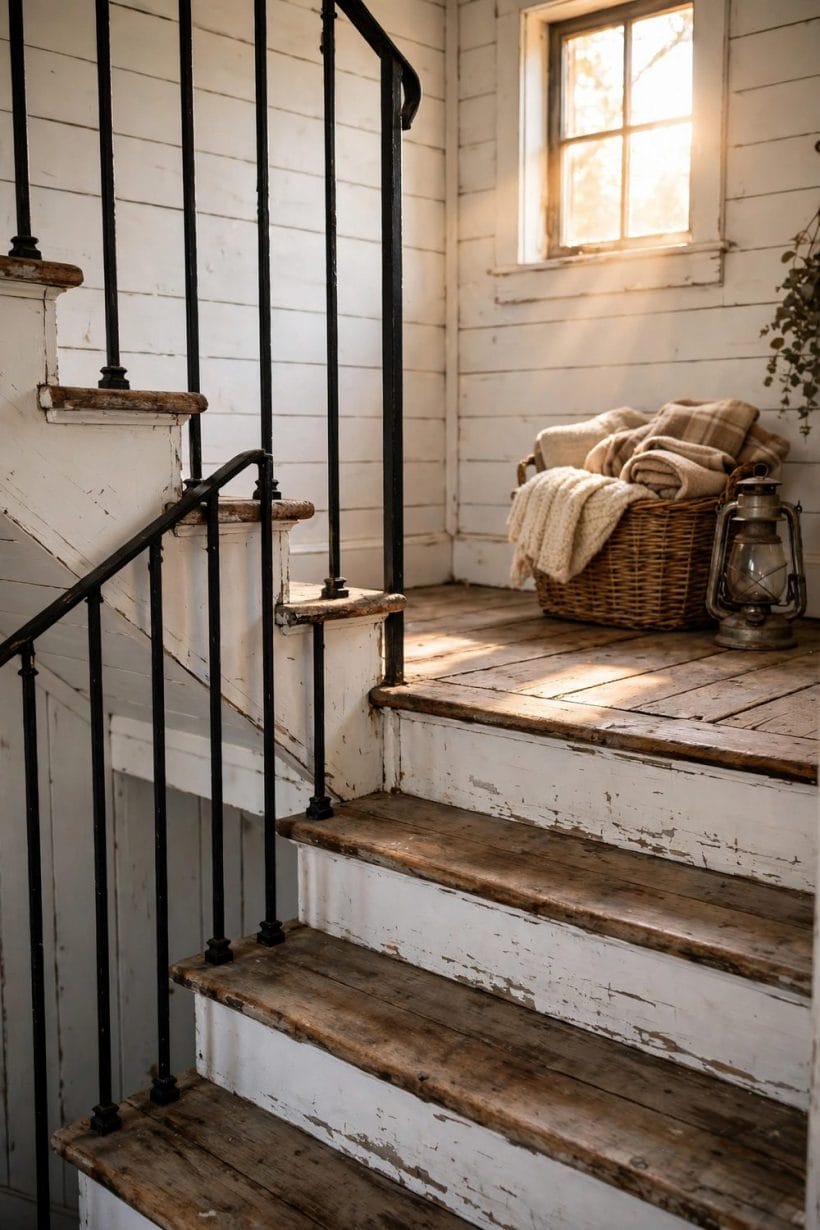
| Weathered Wood Treads for a Lived-In Look | Weathered wood treads give a farmhouse stair a lived-in look from the first day, with greyed grain and soft edges that suggest years of family footsteps. |
| Dark Stained Treads Against Pale Walls | Dark stained treads against pale walls make a farmhouse flight feel grounded and deliberate, each step standing out clearly against the lightness around it. |
| Pale Ash Treads for a Light Farmhouse | Pale ash treads suit the lighter end of the farmhouse style, where white walls, pale floors and generous daylight are the whole point. |
| Reclaimed Boards as Stair Treads | Reclaimed boards as stair treads bring real history into a farmhouse flight, with nail marks, varied grain and a depth of colour that new timber takes years to develop. |
| Painted Treads in a Soft Sage Green | Painted treads in a soft sage green are a gentle way to bring colour onto a farmhouse stair without committing the whole hall to a bold shade. |
| Checkerboard Painted Risers for a Playful Flight | Checkerboard painted risers give a farmhouse stair a playful lift, a quiet pattern that reveals itself step by step as you climb. |
| Numbered Risers as a Family Touch | Numbered risers add a family touch to a farmhouse stair, with a small painted numeral or a word on each riser turning the climb into something children love. |
| A Plain Natural Jute Runner | A plain natural jute runner is the farmhouse runner at its most honest, rough textured, warm toned and completely without pattern. |
| A Gentle Stripe Runner in Cream and Grey | A gentle stripe runner in cream and grey adds just enough pattern to guide the eye up the flight without disturbing the calm of a farmhouse hall. |
| A Bold Red Stripe for a Country Accent | A bold red stripe gives a farmhouse stair a country accent, a flash of barn red or faded brick tone running up the centre of an otherwise quiet flight. |
| A Plaid Runner for a Cosy Winter Stair | A plaid runner makes a farmhouse stair feel cosy in winter, with its woven checks bringing the warmth of a blanket onto the flight itself. |
| A Runner with a Simple Bound Edge | A runner with a simple bound edge looks finished where an unbound runner can look like a rug that wandered onto the stairs. |
| No Runner, Just Beautiful Bare Wood | No runner at all is a legitimate farmhouse choice, and sometimes the most confident one, letting beautiful bare wood speak for the whole flight. |
| A Runner That Continues onto the Landing | A runner that continues onto the landing gives a farmhouse flight a finished feel, carrying the same texture from the last step across the landing floor. |
| Stair Rods in Aged Brass or Black Iron | Stair rods in aged brass or black iron are the jewellery of a farmhouse runner, holding the cloth neatly at the back of each tread while adding a line of quiet detail. |
| A Smooth Oak Handrail with White Spindles | A smooth oak handrail with white spindles is the farmhouse handrail most hands already know, warm to grip, easy to keep clean, and perfectly matched to the white-and-wood flight below. |
| A Painted Handrail in the Wall Colour | A painted handrail in the wall colour makes a farmhouse stair feel softer and more integrated, with the rail melting into the wall beside it rather than standing out as a separate line. |
| A Dark Iron Handrail Against White Boards | A dark iron handrail against white boards gives a farmhouse stair a crisp graphic edge, a single dark line running up a pale wall. |
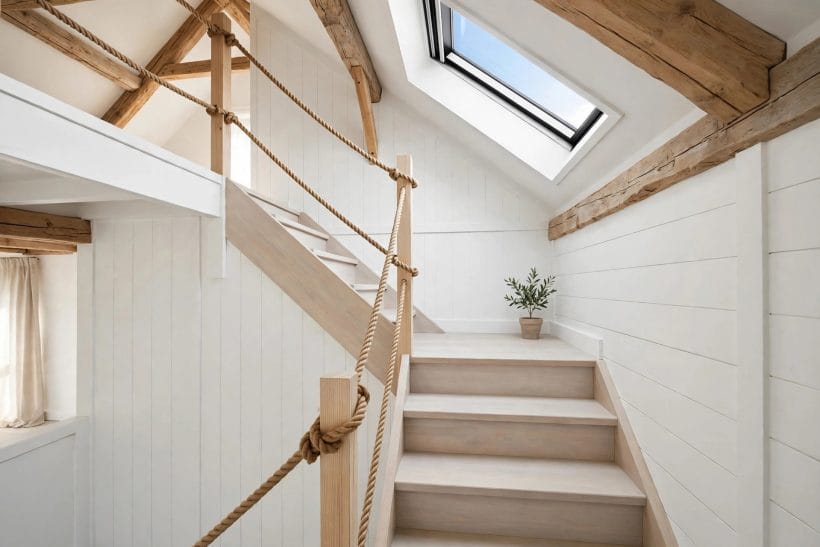
| A Rope Handrail for a Loft or Cabin Stair | A rope handrail suits a loft or cabin stair within a farmhouse, bringing a nautical, handcrafted feel that painted wood cannot match. |
| A Chunky Square Handrail in Natural Pine | A chunky square handrail in natural pine gives a farmhouse stair a sturdy, honest profile, with clean edges that suit shaker-style joinery and simple board walls. |
| A Handrail That Matches the Kitchen Beams | A handrail that matches the kitchen beams ties a farmhouse stair to the heart of the house, carrying the same wood tone from the cooking space into the hall. |
| A Continuous Handrail Around the Landing Turn | A continuous handrail around the landing turn makes a farmhouse stair feel safe and considered, with no break in the grip where the flight changes direction. |
| A Handrail Dressed with a Simple Garland | A handrail dressed with a simple garland is the farmhouse stair at its most festive, with greenery, dried oranges or plain pine cones woven along the rail for the season. |
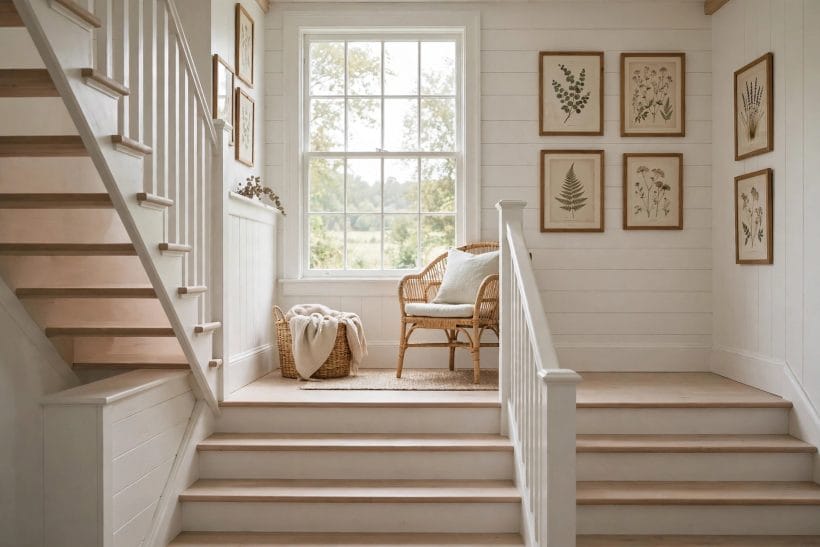
| A Landing Chair for Putting on Shoes | A landing chair for putting on shoes turns the top of a farmhouse stair into a useful pause, especially where bedrooms open straight onto the landing. |
| A Landing Window as the Stair's Lantern | A landing window acts as the stair's lantern, pouring daylight down the flight and making the whole stairwell feel taller and more open. |
| A Small Bookcase on the Landing Wall | A small bookcase on the landing wall gives a farmhouse stair a library corner, with a few shelves of books turning a passage into a place to linger. |
| Under-Stair Storage Behind Panelled Doors | Under-stair storage behind panelled doors hides the clutter of a farmhouse hall, coats, boots, cleaning things and board games, behind doors that look like part of the stair itself. |
| A Coat Nook Carved from the Stair Foot | A coat nook carved from the stair foot gives a farmhouse entry a mudroom in miniature, with hooks, a bench and a boot tray tucked into the space where the flight meets the wall. |
| A Gallery Wall Climbing with the Stairs | A gallery wall climbing with the stairs turns the flight into a family timeline, with photographs and prints rising step by step beside the handrail. |
| A Runner Turned Neatly at the Landing Corner | A runner turned neatly at the landing corner is a small detail that separates a well-finished farmhouse stair from a makeshift one. |
| A Night Light Glowing on the Landing | A night light glowing on the landing makes a farmhouse stair feel safe after dark, giving children and night-time wanderers a soft pool of light to aim for. |
| All White with Warm Wood Accents | All white with warm wood accents is the farmhouse palette at its cleanest, with white walls, white balusters and white risers broken only by oak treads and an oak handrail. |
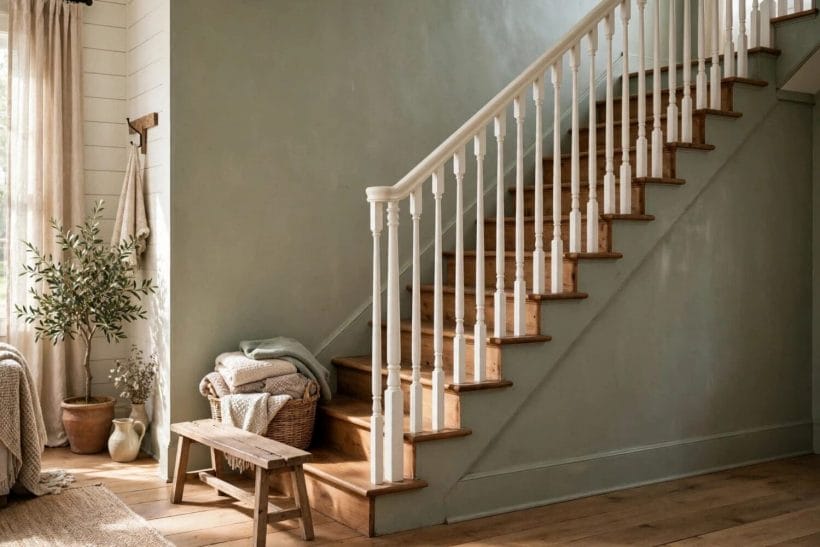
| Sage Green Walls with Cream Woodwork | Sage green walls with cream woodwork bring the garden onto the stair wall, a soft grey-green that feels calm in daylight and cosy under lamplight. |
| Soft Grey and White for a Modern Farmhouse | Soft grey and white is the palette for a modern farmhouse, where the country character stays but the colours cool down a notch. |
| Cream, Terracotta and Natural Wood | Cream, terracotta and natural wood make a farmhouse stair feel sun-warmed, with the terracotta appearing in a runner stripe, a pot on the landing or a painted riser accent. |
| Navy Accents on a White Farmhouse Flight | Navy accents on a white farmhouse flight give the stair a tailored, almost coastal-farmhouse feel, with a deep blue runner stripe, a painted newel cap or a navy door at the foot of the stairs. |
| Butter Yellow Walls for a Sunny Hall | Butter yellow walls make a farmhouse hall feel sunny even on a grey morning, with a soft buttery tone that flatters white woodwork and warm wood treads alike. |
| Black Balusters for a Bold Farmhouse Statement | Black balusters make a bold farmhouse statement, turning the railing into a graphic pattern against white risers and pale walls. |
| Muted Blue-Grey for a Coastal Farmhouse Stair | Muted blue-grey gives a farmhouse stair a coastal edge, with a soft washed tone on the stair wall that hints at the sea without turning the hall into a beach theme. |
| A Straight Flight in a Narrow Hall | A straight flight in a narrow hall is the simplest farmhouse stair of all, and its simplicity is its strength, with one clear run from door to landing and nothing to complicate the route. |
| White Everything to Open a Tight Stairwell | White everything opens a tight stairwell like nothing else, with white walls, white balusters, white risers and pale treads combining to bounce every scrap of light around. |
| A Mirror at the Foot to Double the Hall | A mirror at the foot of the stairs doubles the hall visually, reflecting the flight and the daylight back into the entry. |
| Open Risers for a Lighter Compact Flight | Open risers give a compact farmhouse flight a lighter feel, letting light and sight pass between the treads instead of stopping at each painted riser. |
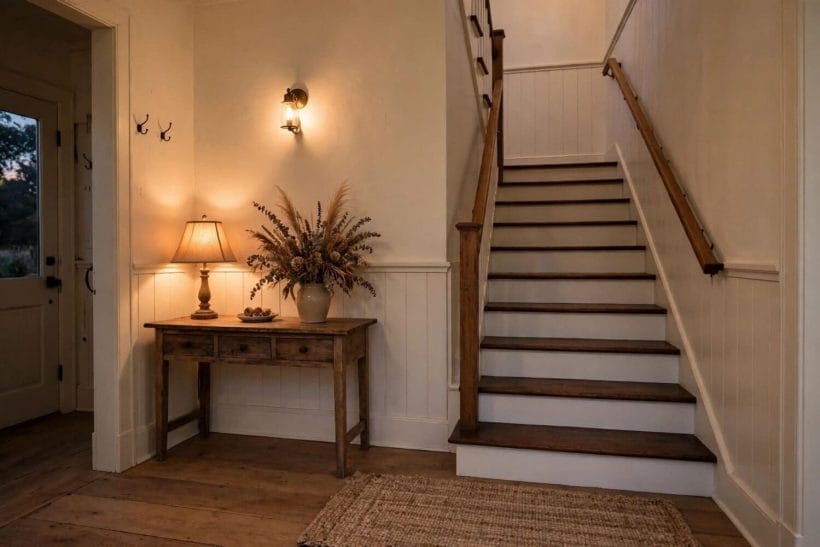
| A Single Statement Lantern in a Small Hall | A single statement lantern in a small hall gives a farmhouse stair its evening character, with one generous lantern on a console or hanging above the foot of the stairs. |
| Slim Balusters to Keep a Narrow Flight Airy | Slim balusters keep a narrow farmhouse flight feeling airy, with slender spindles that let light through and keep the railing from becoming a visual wall. |
| A Folded Blanket on Every Third Step | A folded blanket on every third step is a playful farmhouse dressing for a special occasion, with small throws arranged along the flight like a staircase of comfort. |
| A Narrow Console That Hugs the Stair Wall | A narrow console that hugs the stair wall gives a small farmhouse hall a surface without stealing its floor, holding keys, post and a small plant in a slim profile. |
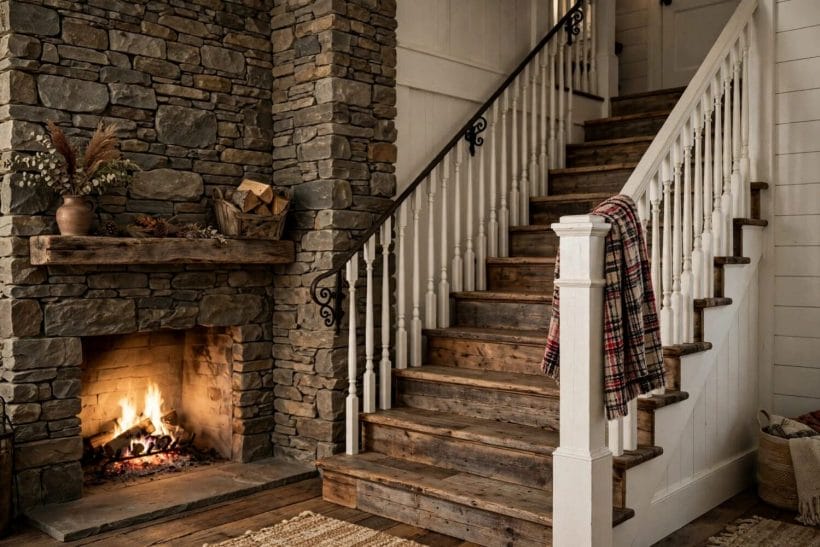
| A Stair Rising Beside a Stone Fireplace | A stair rising beside a stone fireplace is one of the great farmhouse pictures, with rough stone on one side and warm wood treads on the other. |
| A Stair Opening Straight into the Living Room | A stair opening straight into the living room makes the flight part of the main room, and the decoration should follow suit, with the stair's colours and materials matching the living room rather than the hall. |
| A Reading Nook Tucked Under the Stair Turn | A reading nook tucked under the stair turn gives a farmhouse living space a secret corner, with a small chair, a lamp and a shelf of books fitted into the space the turn creates. |
| A Stair Dressed for the Fireside in Winter | A stair dressed for the fireside in winter carries the living room's cosiness upward, with a plaid runner, a garland on the handrail and a basket of blankets on the landing. |
| Rustic Warmth Kept in Its Own Lane | Rustic warmth has a natural place in a farmhouse stair, through reclaimed wood, stone and iron details, but it is worth keeping that warmth in its own lane rather than letting it take over the flight. |
| A Stair Framed by Exposed Wooden Beams | A stair framed by exposed wooden beams gains a sense of structure and history, with the beams overhead echoing the treads underfoot. |
| Daylight from a Stairwell Window | Daylight from a stairwell window transforms a farmhouse flight, turning a passage into a bright vertical room. |
| A Trailing Plant on the Landing Rail | A trailing plant on the landing rail softens the top of a farmhouse stair, with green leaves spilling gently over the rail or from a pot on the landing itself. |
| Lanterns on the Steps for an Evening Glow | Lanterns on the steps give a farmhouse stair an evening glow for special occasions, with candlelight or battery lights flickering beside the treads. |
| Seasonal Greenery Along the Handrail | Seasonal greenery along the handrail marks the year on a farmhouse stair, with fresh foliage in spring, dried flowers in summer, autumn leaves in the fall and evergreen in winter. |
| A Bare Stair Left to Speak for Itself | A bare stair left to speak for itself is the final farmhouse idea, and in some ways the purest: white balusters, warm wood treads, a plain wall and daylight, with nothing added at all. |
1. White Balusters with a Warm Oak Handrail
White balusters with a warm oak handrail are the farmhouse entry in its simplest form, and the combination works because each part does one job well. The white keeps the flight open and bright, the oak gives the hand something warm and solid to hold, and the contrast between them draws the eye gently upward without any need for ornament. Keep the newel posts white as well, and let the oak appear once more nearby, perhaps in a bench or a console top, so the stair feels connected to the hall around it.
2. Painted Risers with Natural Wood Treads
Painted risers with natural wood treads give a farmhouse stair its friendly rhythm, a stripe of clean colour followed by a stripe of honest grain on every step. The painted riser hides scuffs and dust far better than bare wood, which matters on the most walked route in the house, while the natural tread keeps the stair feeling like timber rather than paintwork. Choose a tread tone that echoes the hall floor, and the stair will read as part of the room instead of an object dropped into it.
3. A Woven Runner Down the Centre
A woven runner down the centre softens both the look and the sound of a farmhouse flight, and it is one of the easiest changes to make without touching the structure. A flat woven texture in a natural tone suits the style better than a bold pattern, and a simple bound edge keeps the runner looking tailored rather than loose. Fix the runner properly so it cannot slip or curl at the edges, and leave a margin of wood visible on each side so the treads still show.
4. Chunky Newel Posts with a Turned Detail
Chunky newel posts with a turned detail anchor a farmhouse stair the way a good fence post anchors a gate, giving the eye a solid place to rest at the foot of the flight. The turned detail can be as simple as a gentle swelling or a rounded cap, and painted white it reads as traditional without feeling fussy. A post that looks substantial also makes the handrail feel safer to grip, which matters for children and older visitors alike.
5. A Bench and Basket at the Foot of the Stairs
A bench and a basket at the foot of the stairs turn the entry into a place to pause rather than a corridor to pass through. The bench gives somewhere to sit while shoes are changed, the basket swallows scarves, dog leads and odd gloves, and together they soften the hard lines of the flight. Keep both low and simple, in wood that matches the treads, so the arrangement feels like part of the stair rather than furniture that wandered in.
6. Potted Greenery Flanking the Bottom Step
Potted greenery flanking the bottom step brings the farmhouse garden indoors and makes the stair feel alive from the moment you enter. A pair of matching pots gives symmetry, while a single generous plant on one side feels more relaxed, and either way the green breaks up the straight lines of balusters and treads. Choose pots in clay or woven baskets rather than glossy finishes, and keep the plants clear of the walking route so nobody brushes past them on the way up.
7. A Cream Entry Wall Behind a White Flight
A cream entry wall behind a white flight is quiet, but that quietness is exactly the point, because it lets the wood tones and the runner do all the talking. Cream warms a hall in a way that stark white cannot, it forgives the marks that entry walls collect, and it sits comfortably beside both pale and dark wood. Add one framed print or a small wall hook, and the wall gains just enough interest without competing with the stair.
8. Open Sightlines from the Front Door to the Stairs
Open sightlines from the front door to the stairs make a farmhouse feel generous the moment someone steps inside, because the stair becomes a welcome rather than a surprise around a corner. Keeping the route clear matters more than any single decoration: a hall that lets you see the flight, the handrail and the landing beyond feels larger than the same hall broken up by furniture. If a console or a coat stand must sit nearby, push it flat to the wall so the view up the stair stays uninterrupted.
2. Shiplap and Board-and-Batten Stair Walls
The wall beside a farmhouse stair does more work than any other wall in the house, because it runs the full height of the flight and catches the eye on every trip up and down. Shiplap and board-and-batten are the two farmhouse treatments that suit that long vertical surface best, both giving texture without pattern, and both taking paint beautifully. The ideas here play with how those boards are laid, painted and dressed, so the wall becomes a backdrop rather than a blank.
9. Horizontal Shiplap Running Up the Flight
Horizontal shiplap running up the flight follows the rise of the stair and makes the wall feel like part of the journey rather than a flat surface beside it. The shadow lines between boards give gentle rhythm, and painted white or cream they catch daylight in a way that flat plaster never does. Keep the boards running in one direction along the whole flight, and the wall will read as a single calm surface from the bottom step to the landing.
10. Vertical Board-and-Batten for a Taller Feel
Vertical board-and-batten gives a stair wall a taller feel, because the upright battens draw the eye upward along the flight. This treatment suits halls where the stair feels cramped or low, since the vertical lines stretch the wall visually without any structural change. Painted in a soft pale tone, the battens add craft and shadow while staying firmly in farmhouse territory, and they pair well with a simple wooden handrail.
11. A Shiplap Wall Painted Soft White
A shiplap wall painted soft white is the farmhouse default for good reason: it brightens a stairwell, it forgives uneven older walls, and it lets wood treads and a woven runner stand out against it. Soft white, rather than a harsh bright white, keeps the wall feeling warm under lamplight in the evening, which is when a stairwell is often at its gloomiest. One coat of the same soft white on the balusters ties the whole flight together.
12. Warm Plaster Beside White Woodwork
Warm plaster beside white woodwork offers a softer alternative to boards, with a gently uneven surface that suits older farmhouses and cottages. The plaster texture catches light in small variations across the flight, giving the wall life without any pattern to tire of, and a warm creamy tone stops the white woodwork from feeling cold. This is a good choice where the house already has plaster walls elsewhere, since the stair wall then matches the rooms it joins.
13. A Picture Ledge Along the Stair Wall
A picture ledge along the stair wall lets a farmhouse family display prints and photographs without committing to a fixed arrangement. A narrow ledge, fitted by a professional where it must carry weight, holds frames that can be swapped with the seasons, and the ledge itself follows the slope of the stair like a quiet shelf. Keep the frames small and the colours muted, so the display reads as a personal touch rather than a gallery competing with the stair.
14. Hooks and a Small Shelf on the Stair Wall
Hooks and a small shelf on the stair wall give a farmhouse hall a practical corner, somewhere for a coat, a hat or a basket to live within reach of the door. A short run of wooden pegs, painted to match the balusters, looks intentional rather than improvised, and a small shelf above them holds a plant or a lantern. Keep the arrangement clear of the handrail and the walking route, and fix everything securely so nothing snags a sleeve on the way past.
15. Contrasting Dark Boards on One Stair Wall
Contrasting dark boards on one stair wall give a farmhouse flight a bolder character, grounding a pale hall with a single strong surface. A deep charcoal or dark green board wall works best when the opposite side stays light, so the stair does not feel enclosed, and the dark tone makes white balusters and pale treads stand out sharply. Use this idea where the hall has good daylight, since a dark wall in a windowless stairwell can feel heavy.
16. Bare Wood Panelling for a Cabin Farmhouse Feel
Bare wood panelling gives a stair wall a cabin farmhouse feel, warm, textured and unmistakably timber from floor to landing. Unpainted boards suit farmhouses with exposed beams or a wood-burning stove nearby, since the wall then echoes the rest of the house, and a natural finish lets the grain carry the decoration. Balance the wood wall with pale treads or a light runner, so the flight stays bright even where the wall is rich and dark.
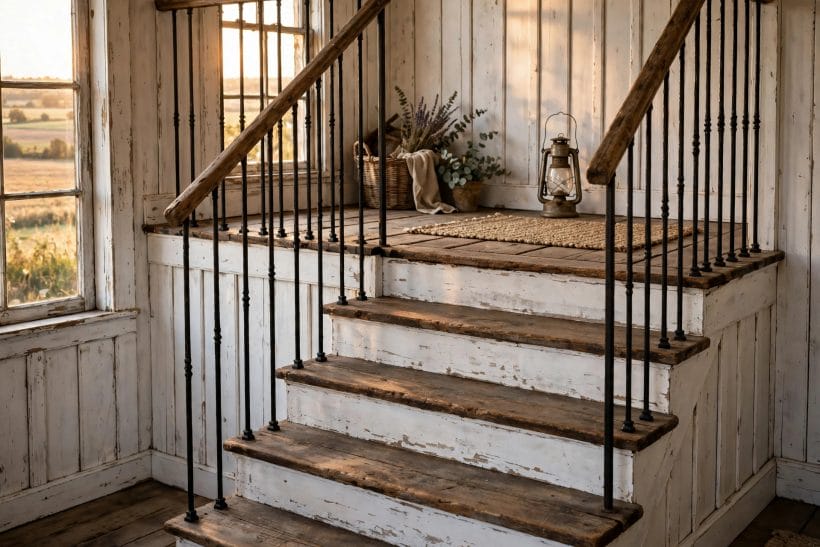
3. Warm Wood Treads and Painted Risers
Treads are the part of a farmhouse stair you actually touch with every step, so their material and finish deserve more thought than any other single detail. Warm wood, whether oak, pine or reclaimed boards, gives a tread character that painted surfaces cannot match, while a painted riser keeps the flight looking fresh between deeper cleans. The ideas in this section mix those two elements in different proportions, so you can lean toward wood, toward paint, or toward an even balance of both.
17. Honey Oak Treads with Crisp White Risers
Honey oak treads with crisp white risers are the farmhouse tread combination most people picture first, and the pairing earns that familiarity. The honey tone glows under daylight and lamplight alike, the white riser keeps each step clearly defined, and together they make a flight look cared for even when the rest of the hall is in everyday disarray. A clear protective finish on the treads helps them stand up to daily traffic while letting the grain show through.
18. Weathered Wood Treads for a Lived-In Look
Weathered wood treads give a farmhouse stair a lived-in look from the first day, with greyed grain and soft edges that suggest years of family footsteps. This finish suits farmhouses where perfection would feel out of place, beside stone floors or reclaimed beams, and it hides the small marks that daily life leaves behind. Pair weathered treads with simple white risers, and the flight keeps its brightness while the treads carry all the character.
19. Dark Stained Treads Against Pale Walls
Dark stained treads against pale walls make a farmhouse flight feel grounded and deliberate, each step standing out clearly against the lightness around it. The contrast helps everyone, especially older visitors and children, judge where one step ends and the next begins, which is a practical benefit as well as a visual one. Keep the handrail in a matching dark tone, and the dark elements will read as one considered choice rather than a collection of accidents.
20. Pale Ash Treads for a Light Farmhouse
Pale ash treads suit the lighter end of the farmhouse style, where white walls, pale floors and generous daylight are the whole point. The pale wood keeps the flight feeling airy, it reflects light down into a hall that might otherwise feel enclosed, and it pairs beautifully with sage or cream painted risers. A pale tread also shows dust more readily, so it suits households happy with a quick regular sweep as part of the routine.
21. Reclaimed Boards as Stair Treads
Reclaimed boards as stair treads bring real history into a farmhouse flight, with nail marks, varied grain and a depth of colour that new timber takes years to develop. Sourcing boards that are sound and properly prepared matters, and fitting them is work for a professional, since treads must be secure and even above all else. Once fitted, reclaimed treads give the stair a story that no catalogue finish can imitate, and they sit naturally beside other salvaged pieces in the house.
22. Painted Treads in a Soft Sage Green
Painted treads in a soft sage green are a gentle way to bring colour onto a farmhouse stair without committing the whole hall to a bold shade. Sage sits comfortably beside white risers and natural wood handrails, it reads as countryside rather than costume, and it can be repainted in a weekend if tastes change. Use a hard-wearing paint made for floors and stairs, and expect the painted surface to need touching up sooner than a natural wood tread would.
23. Checkerboard Painted Risers for a Playful Flight
Checkerboard painted risers give a farmhouse stair a playful lift, a quiet pattern that reveals itself step by step as you climb. The trick is restraint: two muted tones, perhaps cream and soft grey, in a small regular pattern, rather than a loud contrast that fights the rest of the hall. This idea suits family farmhouses and holiday cottages best, where a touch of whimsy feels at home, and it works particularly well where the treads themselves are kept plain.
24. Numbered Risers as a Family Touch
Numbered risers add a family touch to a farmhouse stair, with a small painted numeral or a word on each riser turning the climb into something children love. Words work as well as numerals, perhaps a line of a favourite saying spread across the flight, or the names of places the family has lived. Keep the lettering small, neat and in a single colour, so the idea reads as charming rather than cluttered, and let the treads stay plain so the words have room to breathe.
4. Runners That Soften a Farmhouse Flight
A runner is the farmhouse stair’s soft furnishing, and it changes the feel of a flight out of all proportion to its size. It muffles footsteps, it warms bare feet on winter mornings, and it gives a plain flight a centre stripe of colour and texture to follow upward. The ideas here cover the main runner characters, from plain natural weaves to gentle stripes, and the practical points that keep a runner looking good for years.
25. A Plain Natural Jute Runner
A plain natural jute runner is the farmhouse runner at its most honest, rough textured, warm toned and completely without pattern. Jute suits halls with stone or wood floors, since its fibre echoes the natural materials around it, and its neutral colour lets the treads and balusters stay the stars. A jute runner needs proper fixing to stay flat and safe, and it rewards regular vacuuming, which keeps the fibre looking fresh rather than dusty.
26. A Gentle Stripe Runner in Cream and Grey
A gentle stripe runner in cream and grey adds just enough pattern to guide the eye up the flight without disturbing the calm of a farmhouse hall. The stripe should stay narrow and low contrast, more of a texture than a statement, so it reads as woven cloth rather than decoration. This runner works beautifully with white risers and a pale wood handrail, and it flatters both traditional and more modern farmhouse rooms.
27. A Bold Red Stripe for a Country Accent
A bold red stripe gives a farmhouse stair a country accent, a flash of barn red or faded brick tone running up the centre of an otherwise quiet flight. The red works because farmhouses already carry red elsewhere, in brick, in gingham, in a painted door, so the runner feels like part of the house rather than an imported idea. Keep the rest of the stair plain, white risers and a natural handrail, and the red stripe will carry the whole flight.
28. A Plaid Runner for a Cosy Winter Stair
A plaid runner makes a farmhouse stair feel cosy in winter, with its woven checks bringing the warmth of a blanket onto the flight itself. A muted plaid in cream, grey and a single soft accent colour suits the style far better than a loud tartan, and the pattern hides the dust and marks that winter boots leave behind. Swap a plaid runner in for the colder months if you like, and return to a plain weave when the light returns.
29. A Runner with a Simple Bound Edge
A runner with a simple bound edge looks finished where an unbound runner can look like a rug that wandered onto the stairs. The binding, in a cotton or leather-look tape that matches or quietly contrasts with the runner, protects the cut edge from fraying and gives the whole flight a tailored outline. Choose a binding colour that echoes the handrail or the stair wall, and the runner will feel designed rather than improvised.
30. No Runner, Just Beautiful Bare Wood
No runner at all is a legitimate farmhouse choice, and sometimes the most confident one, letting beautiful bare wood speak for the whole flight. Bare treads show their grain fully, they are easy to sweep clean, and they suit farmhouses where the wood itself, reclaimed boards or rich oak, is the decoration. The trade-off is sound, since bare wood carries footsteps more loudly, so this idea suits smaller households and halls where quiet matters less.
31. A Runner That Continues onto the Landing
A runner that continues onto the landing gives a farmhouse flight a finished feel, carrying the same texture from the last step across the landing floor. The continuation stops the landing from feeling like an afterthought, and it ties the upper floor to the stair in a single gesture. Fitting a runner around a landing turn is fiddly work best left to someone experienced, since a neat mitred corner makes all the difference between tailored and makeshift.
32. Stair Rods in Aged Brass or Black Iron
Stair rods in aged brass or black iron are the jewellery of a farmhouse runner, holding the cloth neatly at the back of each tread while adding a line of quiet detail. Aged brass warms a pale flight, black iron suits a flight with dark metal balusters, and either finish should be chosen to match the other metalwork in the hall. Rods are decorative as much as functional on a properly fixed runner, so choose them for looks and let the fixing do the safety work.
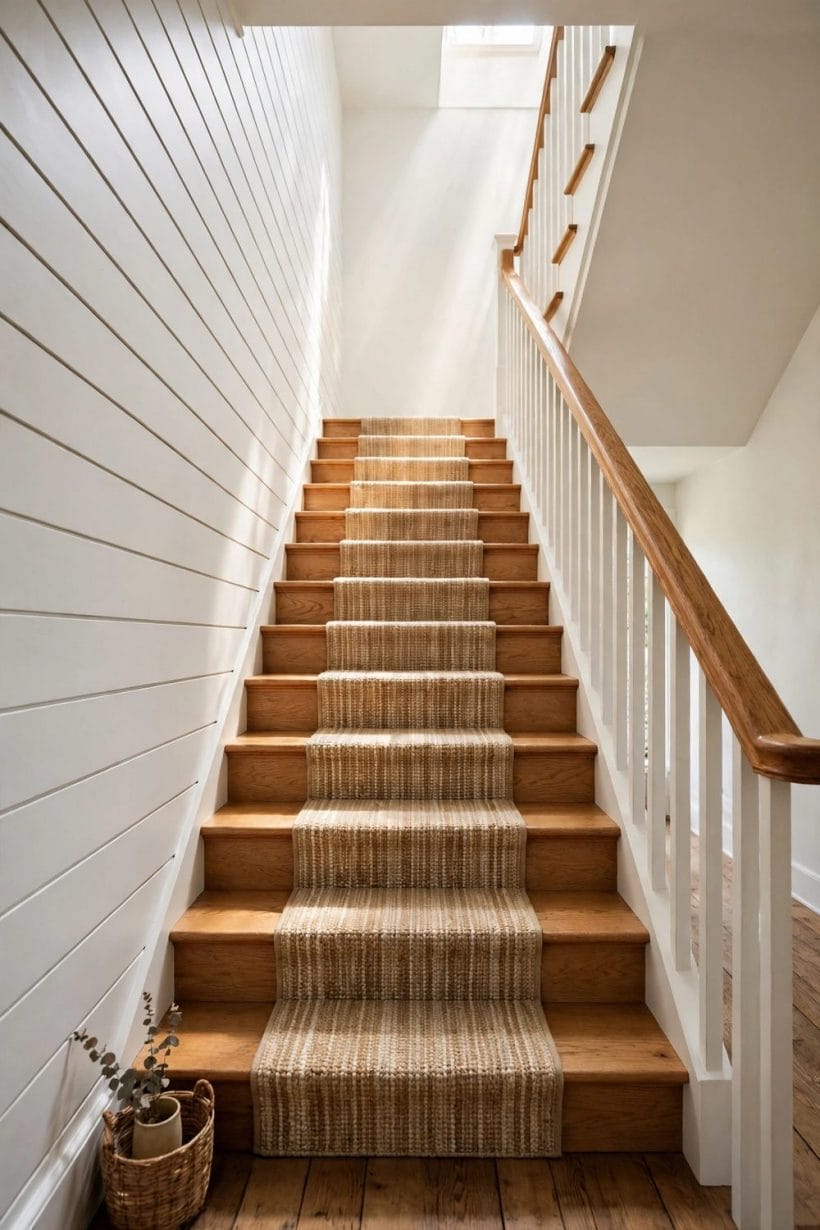
5. Handrails with a Farmhouse Feel
The handrail is the part of the stair you hold, so its shape, warmth and finish matter in a way that no photograph fully captures. A farmhouse handrail should feel good in the hand, look like it belongs with the balusters below it, and carry one consistent material story from the bottom newel to the landing. The ideas here range from classic turned wood to darker metal accents, each one keeping the farmhouse character while changing the feel under your palm. For a wider look at what rails can be made from, a survey of railing materials covers the materials themselves; this section stays with how they feel in a farmhouse home.
33. A Smooth Oak Handrail with White Spindles
A smooth oak handrail with white spindles is the farmhouse handrail most hands already know, warm to grip, easy to keep clean, and perfectly matched to the white-and-wood flight below. The oak should be sanded smooth and finished so it feels silky rather than rough, since a handrail that catches the skin is a handrail nobody wants to hold. Let the oak tone match the treads, and the whole stair will read as one piece of joinery.
34. A Painted Handrail in the Wall Colour
A painted handrail in the wall colour makes a farmhouse stair feel softer and more integrated, with the rail melting into the wall beside it rather than standing out as a separate line. This works best in pale halls, where a cream or sage rail keeps the flight feeling calm, and it suits farmhouses where the woodwork is painted throughout. The painted surface will need repainting sooner than a natural wood rail, since hands wear paint away, but a fresh coat restores it completely.
35. A Dark Iron Handrail Against White Boards
A dark iron handrail against white boards gives a farmhouse stair a crisp graphic edge, a single dark line running up a pale wall. The contrast suits farmhouses with black window frames, dark door hardware or a black range cooker nearby, since the rail then echoes details already in the house. Iron feels cool and firm in the hand, which some people prefer to wood, and it pairs well with black metal balusters for a consistent dark accent.
36. A Rope Handrail for a Loft or Cabin Stair
A rope handrail suits a loft or cabin stair within a farmhouse, bringing a nautical, handcrafted feel that painted wood cannot match. Thick natural rope, properly tensioned and securely fixed, looks relaxed while still giving a genuine grip, and it suits stairs that lead to a sleeping loft or a bunk room. Rope is a characterful choice rather than a formal one, so keep it for secondary stairs where its informal charm fits the room.
37. A Chunky Square Handrail in Natural Pine
A chunky square handrail in natural pine gives a farmhouse stair a sturdy, honest profile, with clean edges that suit shaker-style joinery and simple board walls. The square shape feels solid in the hand and looks at home beside square newel posts and plain balusters, and pine takes a clear finish beautifully, warming to a honey tone over time. This is a good choice where the farmhouse leans modern rather than ornate, since the square rail keeps everything calm and straight.
38. A Handrail That Matches the Kitchen Beams
A handrail that matches the kitchen beams ties a farmhouse stair to the heart of the house, carrying the same wood tone from the cooking space into the hall. The connection works because farmhouses are open in spirit, with rooms flowing into one another, and a shared timber tone makes that flow visible. If the beams are dark and the stair is pale, a mid-tone rail can bridge the two, giving the eye a stepping stone between them.
39. A Continuous Handrail Around the Landing Turn
A continuous handrail around the landing turn makes a farmhouse stair feel safe and considered, with no break in the grip where the flight changes direction. The smooth continuation matters most for children, older visitors and anyone carrying something up the stairs, since a gap in the rail is exactly where a hand reaches for support and finds air. Fitting a continuous rail around a turn is skilled joinery, and it is worth having it done properly rather than accepting a clumsy joint.
40. A Handrail Dressed with a Simple Garland
A handrail dressed with a simple garland is the farmhouse stair at its most festive, with greenery, dried oranges or plain pine cones woven along the rail for the season. The key is simplicity: one garland, loosely draped and secured so it cannot slip onto the treads, rather than layers of decoration that crowd the grip. Keep the hand itself clear where it naturally falls, so the garland decorates the rail without making it harder to hold.
6. Landings, Turns and Everyday Flow
A landing is where a farmhouse stair breathes, a flat pause between flights that can hold a chair, a plant or simply a view, and the way a stair turns shapes how the whole house flows. Farmhouse landings tend to be practical rather than grand, sized for everyday life rather than display, and that practicality is their charm. The ideas here treat the landing and the turn as rooms in miniature, worth furnishing lightly and lighting well. Where the turn itself is the subject, the L-shaped staircase gallery explores that form in full; here, the landing serves the farmhouse style, not the other way round.
41. A Landing Chair for Putting on Shoes
A landing chair for putting on shoes turns the top of a farmhouse stair into a useful pause, especially where bedrooms open straight onto the landing. A small wooden chair with a woven seat fits the style without crowding the space, and it gives children and older family members a safe place to sit while dressing. Keep the chair tight to the wall and clear of every doorway, so the landing stays a passage first and a seat second.
42. A Landing Window as the Stair’s Lantern
A landing window acts as the stair’s lantern, pouring daylight down the flight and making the whole stairwell feel taller and more open. A window on the landing is worth more than one at the foot of the stairs, since its light reaches both flights, and a simple white frame with plain glass suits the farmhouse style better than any elaborate treatment. Dress it with a plain linen blind if privacy matters, and let the daylight do the decorating.
43. A Small Bookcase on the Landing Wall
A small bookcase on the landing wall gives a farmhouse stair a library corner, with a few shelves of books turning a passage into a place to linger. A low bookcase, painted to match the woodwork, holds bedtime reading within reach of every bedroom, and its top makes a perch for a plant or a photograph. Keep the bookcase shallow and its contents tidy, so the landing never feels narrowed by furniture that belongs in a room.
44. Under-Stair Storage Behind Panelled Doors
Under-stair storage behind panelled doors hides the clutter of a farmhouse hall, coats, boots, cleaning things and board games, behind doors that look like part of the stair itself. Panelled doors painted to match the risers keep the arrangement invisible, and the storage they hide is often the most useful cupboard in the house. The tiny house under-stair storage gallery shows how much a small under-stair space can hold, and the same thinking scales up to a full farmhouse hall.
45. A Coat Nook Carved from the Stair Foot
A coat nook carved from the stair foot gives a farmhouse entry a mudroom in miniature, with hooks, a bench and a boot tray tucked into the space where the flight meets the wall. The nook works because it catches coats at the door, before they migrate onto stair rails and chair backs, and a beadboard back keeps it firmly in farmhouse style. Any alteration to the stair structure itself belongs to a professional, but dressing the nook around it is a simple weekend project.
46. A Gallery Wall Climbing with the Stairs
A gallery wall climbing with the stairs turns the flight into a family timeline, with photographs and prints rising step by step beside the handrail. The arrangement looks best when the frames share a finish, perhaps all natural wood or all painted white, and when the spacing follows the slope of the stair rather than a rigid grid. Hang the pictures clear of the handrail’s sweep, and keep glass out of reach of swinging bags, so the gallery survives daily traffic.
47. A Runner Turned Neatly at the Landing Corner
A runner turned neatly at the landing corner is a small detail that separates a well-finished farmhouse stair from a makeshift one. The corner should be mitred or folded flat, with no bunching and no loose edge to catch a toe, and the pattern, if any, should continue without a jarring break. This is fiddly work that rewards patience or a professional fitter, and the result is a landing that looks tailored from every angle.
48. A Night Light Glowing on the Landing
A night light glowing on the landing makes a farmhouse stair feel safe after dark, giving children and night-time wanderers a soft pool of light to aim for. A small warm-toned light, low on the landing wall and clear of bedding and curtains, is all it takes, and it stops the stairwell from feeling like a dark tunnel at night. Choose a light that can stay on all night without glare, and the whole upper floor will feel calmer for it.
7. Colour Palettes for Farmhouse Stairs
Colour is where a farmhouse stair shows its personality, and the palettes that suit the style are all drawn from the countryside: creams and whites, soft greens, gentle greys, warm woods and the occasional muted accent. The trick is to choose one palette and carry it through the treads, the risers, the wall and the runner, rather than introducing a new colour at every step. The ideas here are complete palettes, each one ready to lift whole into a farmhouse hall.
49. All White with Warm Wood Accents
All white with warm wood accents is the farmhouse palette at its cleanest, with white walls, white balusters and white risers broken only by oak treads and an oak handrail. The palette suits small halls and dark stairwells best, since every white surface bounces light around, and the wood accents stop the scheme from feeling clinical. Add a woven runner in a natural tone, and the palette gains texture without gaining colour.
50. Sage Green Walls with Cream Woodwork
Sage green walls with cream woodwork bring the garden onto the stair wall, a soft grey-green that feels calm in daylight and cosy under lamplight. Sage suits farmhouses with views of fields or gardens, since the wall colour echoes what the windows show, and cream woodwork keeps the balusters and risers from looking stark against it. Pair the palette with natural wood treads, and the stair will feel like an extension of the landscape outside.
51. Soft Grey and White for a Modern Farmhouse
Soft grey and white is the palette for a modern farmhouse, where the country character stays but the colours cool down a notch. A pale grey stair wall with white balusters and light wood treads feels contemporary without abandoning the farmhouse vocabulary, and it pairs well with black metal accents on the handrail or the balusters. Keep the grey pale and warm rather than cold, and the flight will stay welcoming rather than austere.
52. Cream, Terracotta and Natural Wood
Cream, terracotta and natural wood make a farmhouse stair feel sun-warmed, with the terracotta appearing in a runner stripe, a pot on the landing or a painted riser accent. The palette suits farmhouses with clay floors or brick details nearby, since the terracotta echoes materials already in the house, and cream walls keep the warmth from becoming heavy. Use the terracotta sparingly, as an accent rather than a main colour, and the stair will glow rather than shout.
53. Navy Accents on a White Farmhouse Flight
Navy accents on a white farmhouse flight give the stair a tailored, almost coastal-farmhouse feel, with a deep blue runner stripe, a painted newel cap or a navy door at the foot of the stairs. Navy works because it is dark enough to ground the white without the harshness of black, and it pairs beautifully with natural wood and woven textures. Keep the navy to one or two touches, and the flight will feel considered rather than themed.
54. Butter Yellow Walls for a Sunny Hall
Butter yellow walls make a farmhouse hall feel sunny even on a grey morning, with a soft buttery tone that flatters white woodwork and warm wood treads alike. Yellow suits north-facing halls and stairwells with little daylight, since it brings its own warmth to the space, and it pairs happily with sage or cream accents elsewhere in the hall. Keep the yellow pale and buttery rather than bright, and the stair will glow gently instead of glaring.
55. Black Balusters for a Bold Farmhouse Statement
Black balusters make a bold farmhouse statement, turning the railing into a graphic pattern against white risers and pale walls. The black reads as ironwork, traditional in farmhouses with forges and blacksmith details, and it suits flights where the balusters are the main decoration. Balance the black with plenty of white and warm wood elsewhere, so the railing feels like a strong accent rather than a heavy cage.
56. Muted Blue-Grey for a Coastal Farmhouse Stair
Muted blue-grey gives a farmhouse stair a coastal edge, with a soft washed tone on the stair wall that hints at the sea without turning the hall into a beach theme. The palette pairs well with white balusters, pale wood treads and a natural woven runner, and it suits farmhouses near the coast or with a light, airy interior. Keep the blue-grey muted and grey-leaning, and the stair will feel calm and coastal rather than bright and nautical.
8. Small Entry Halls and Compact Flights
Small farmhouse halls ask more of their stairs than grand ones do, since the flight must welcome, store, light and connect without swallowing the whole entry. The ideas in this section are all about making a compact flight feel generous: keeping it pale, keeping it clear, and letting every part of the stair do double duty. A small hall rewards simplicity more than any other space, and a farmhouse stair kept simple is a farmhouse stair that works.
57. A Straight Flight in a Narrow Hall
A straight flight in a narrow hall is the simplest farmhouse stair of all, and its simplicity is its strength, with one clear run from door to landing and nothing to complicate the route. Keep the walls pale, the balusters white and the runner narrow, and the narrowness becomes cosiness rather than constraint. A straight flight also makes moving furniture upstairs far easier, which is a practical blessing worth remembering when the stair is planned.
58. White Everything to Open a Tight Stairwell
White everything opens a tight stairwell like nothing else, with white walls, white balusters, white risers and pale treads combining to bounce every scrap of light around. The all-white approach suits stairwells with no window of their own, where the only light comes from the hall below and the landing above, and it stops a tight flight from feeling like a tunnel. Add warmth through a wooden handrail and a woven runner, so the whiteness feels fresh rather than bare.
59. A Mirror at the Foot to Double the Hall
A mirror at the foot of the stairs doubles the hall visually, reflecting the flight and the daylight back into the entry. A simple wooden-framed mirror, hung where it catches the stair rather than the front door, makes a small hall feel twice its size and gives a last glance before leaving the house. Keep the mirror clear of the walking route and securely fixed, since a hall mirror takes more knocks than a mirror anywhere else in the house.
60. Open Risers for a Lighter Compact Flight
Open risers give a compact farmhouse flight a lighter feel, letting light and sight pass between the treads instead of stopping at each painted riser. The openness suits small halls where a solid flight would feel like a wall, and it pairs well with a simple wooden handrail and white balusters. Open risers are a structural choice that must meet local building rules and be fitted by a professional, and they suit households without very small children, who can find the gaps unsettling.
61. A Single Statement Lantern in a Small Hall
A single statement lantern in a small hall gives a farmhouse stair its evening character, with one generous lantern on a console or hanging above the foot of the stairs. The lantern’s warm glow flatters wood treads and white balusters alike, and a single large piece suits a small hall better than several small lights competing for attention. Choose a lantern in black iron or aged brass to match the hall’s other metalwork, and keep its glass clean so the light stays clear.
62. Slim Balusters to Keep a Narrow Flight Airy
Slim balusters keep a narrow farmhouse flight feeling airy, with slender spindles that let light through and keep the railing from becoming a visual wall. The slim profile suits compact halls where chunky turned balusters would crowd the space, and it pairs well with a slim handrail in matching wood. Slim does not mean weak, and the balusters must still be properly fixed and meet local rules, which is work for a professional to confirm.
63. A Folded Blanket on Every Third Step
A folded blanket on every third step is a playful farmhouse dressing for a special occasion, with small throws arranged along the flight like a staircase of comfort. The idea suits holiday gatherings and family weekends, when the stair becomes part of the celebration, and it photographs beautifully. Keep the blankets clear of the handrail grip and remove them before the stair is used in earnest, since a dressing that looks charming can become a trip hazard in daily use.
64. A Narrow Console That Hugs the Stair Wall
A narrow console that hugs the stair wall gives a small farmhouse hall a surface without stealing its floor, holding keys, post and a small plant in a slim profile. The console should sit flat against the wall, in wood that matches the treads, and its top should stay clear enough to be useful rather than decorative. In a small hall, a console that protrudes too far is worse than no console at all, so measure the passage first and choose the slimmest piece that still works.
9. Stairs Beside Fireplaces and Living Spaces
Many farmhouse stairs sit beside the fireplace or open straight into the living room, and those stairs borrow warmth and character from the rooms around them. The fireplace wall, the sofa, the rug and the firelight all become part of the stair’s story, and the ideas here are about letting the stair join that story gracefully. A stair beside a living space should feel like furniture in the room, not a corridor passing through it, and the farmhouse details that achieve that are often the simplest ones.
65. A Stair Rising Beside a Stone Fireplace
A stair rising beside a stone fireplace is one of the great farmhouse pictures, with rough stone on one side and warm wood treads on the other. The stone gives the stair a sense of permanence, the wood gives it warmth, and the firelight in the evening makes both materials glow. Keep the balusters simple and white, so the eye can enjoy the stone without competition, and let a plaid throw on the newel post echo the cosiness of the fireside.
66. A Stair Opening Straight into the Living Room
A stair opening straight into the living room makes the flight part of the main room, and the decoration should follow suit, with the stair’s colours and materials matching the living room rather than the hall. A runner that echoes the living room rug, balusters painted the living room’s trim colour, and a handrail in the room’s wood tone all help the stair belong. The farmhouse living room gallery shows how living rooms in this style are put together, and a stair that borrows from its room will always feel more settled.
67. A Reading Nook Tucked Under the Stair Turn
A reading nook tucked under the stair turn gives a farmhouse living space a secret corner, with a small chair, a lamp and a shelf of books fitted into the space the turn creates. The nook works because the stair already shapes the space, low on one side and tall on the other, and a chair placed in the tall part feels sheltered without feeling cramped. Keep the nook’s colours in step with the stair, and it will read as part of the flight rather than furniture squeezed underneath it.
68. A Stair Dressed for the Fireside in Winter
A stair dressed for the fireside in winter carries the living room’s cosiness upward, with a plaid runner, a garland on the handrail and a basket of blankets on the landing. The dressing should stay light enough that the stair remains easy to use, with the handrail grip kept clear and nothing loose on the treads themselves. Winter dressing is at its best when it looks gathered rather than bought, greenery from the garden and blankets already in the house.
69. Rustic Warmth Kept in Its Own Lane
Rustic warmth has a natural place in a farmhouse stair, through reclaimed wood, stone and iron details, but it is worth keeping that warmth in its own lane rather than letting it take over the flight. A farmhouse stair borrows rustic textures, weathered treads or a stone wall, while keeping its painted balusters, neat runner and calm palette, which is what keeps it farmhouse rather than cabin. The rustic staircase gallery explores the rustic style in full, and this gallery borrows its warmth without re-teaching its subject.
70. A Stair Framed by Exposed Wooden Beams
A stair framed by exposed wooden beams gains a sense of structure and history, with the beams overhead echoing the treads underfoot. The beams should be left in their natural state, with their grain and colour showing, and the stair’s woodwork chosen to sit comfortably beside them rather than match them exactly. A slightly lighter tread tone stops the combination from feeling heavy, and white balusters keep the flight bright beneath the dark beams.
10. Light, Greenery and Seasonal Dressing
Light, greenery and seasonal dressing are the finishing touches that keep a farmhouse stair feeling alive through the year, and they are also the easiest ideas to change. A stair that is dressed well in every season never looks tired, because something small is always fresh: a plant, a lantern, a garland, a new runner for winter. The ideas here are all light in touch and easy to undo, which is exactly what finishing touches should be.
71. Daylight from a Stairwell Window
Daylight from a stairwell window transforms a farmhouse flight, turning a passage into a bright vertical room. A window halfway up the flight, or on the landing, throws light across the treads and the balusters, and the shadows it casts change through the day like a slow-moving picture. Keep the window dressing plain, a simple blind or a sheer curtain, so the daylight itself remains the decoration.
72. A Trailing Plant on the Landing Rail
A trailing plant on the landing rail softens the top of a farmhouse stair, with green leaves spilling gently over the rail or from a pot on the landing itself. The plant should be kept clear of the handrail grip and the walking route, and a pot that cannot tip or drip onto the treads below is essential. A trailing plant suits a landing with good daylight, where it will thrive rather than struggle, and it brings the garden into the upper floor.
73. Lanterns on the Steps for an Evening Glow
Lanterns on the steps give a farmhouse stair an evening glow for special occasions, with candlelight or battery lights flickering beside the treads. The lanterns should sit on the wide part of each tread, clear of the walking line, and real flames need care, a steady base, nothing flammable nearby, and never left unattended. Battery lanterns give the same glow without the worry, and they suit households with children or pets.
74. Seasonal Greenery Along the Handrail
Seasonal greenery along the handrail marks the year on a farmhouse stair, with fresh foliage in spring, dried flowers in summer, autumn leaves in the fall and evergreen in winter. The greenery should be secured so it cannot slip onto the treads, and the handrail grip kept clear where hands naturally fall. Changing the greenery with the seasons is a small ritual that keeps the stair feeling cared for, and it costs little more than a walk in the garden.
75. A Bare Stair Left to Speak for Itself
A bare stair left to speak for itself is the final farmhouse idea, and in some ways the purest: white balusters, warm wood treads, a plain wall and daylight, with nothing added at all. The bare stair trusts its materials and its proportions, and it suits farmhouses where the architecture is already beautiful and needs no dressing. If your stair looks good with nothing on it, leave it alone, and let the flight be the decoration. For stairs that climb to a sleeping loft, the tiny house loft gallery shows how a simple flight can serve a loft beautifully, and the same restraint applies here.
Final Considerations
Choosing among these farmhouse staircase ideas comes down to a few quiet decisions, and making them in order keeps the project calm. Start with the palette, one wall colour, one wood tone and one runner character, and carry that trio through the whole flight before adding anything else. Then decide how much dressing the stair needs: a busy family hall may want only a runner and a lantern, while a quieter house can carry a gallery wall and a landing chair. Whatever you add, keep the walking route clear, the handrail easy to grip, and the treads secure, since a stair must work safely before it can look beautiful.
Remember, too, that a stair is not a weekend decoration project in the way a wall colour is. Any change to the structure, the balusters, the handrail fixing or the tread layout should be planned and fitted by a qualified professional, following local building rules, and it is worth getting that advice before falling in love with a particular idea. With the structure sound and the palette settled, the rest is dressing, and dressing can evolve with the seasons, the family and the house itself. That is the real pleasure of a farmhouse stair: it is never quite finished, and it never needs to be, because every small change, a new runner, a plant on the landing, a garland in winter, keeps it feeling like home.

0 Comments