
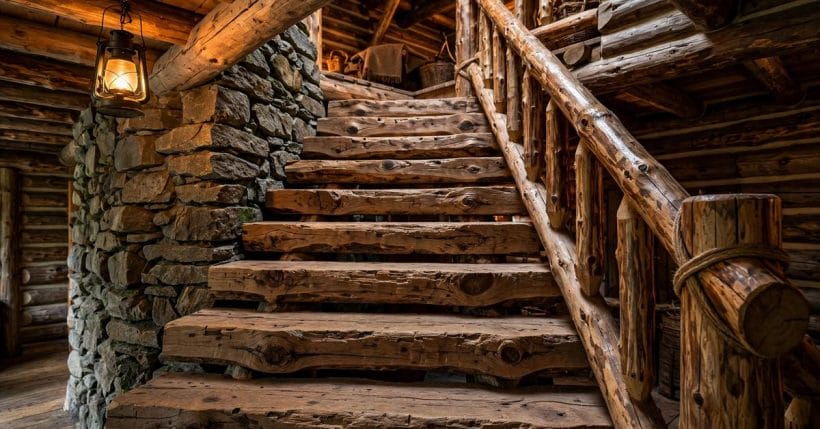
A rustic staircase is not a style applied on top of a stair. It is a stair built from materials that already look at home in a cabin, a cottage or a barn conversion: timber with grain and knots still showing, stone with uneven edges, rails made from logs rather than turned spindles. The ideas below stay with that character throughout, from rough treads and log rails to the lamplight that suits them. For the wider world of rustic tiny house interiors, the same materials appear in rooms beyond the stair, but here the stair itself is the subject.
Every idea here assumes the structure underneath is sound and properly fixed. Rustic character is a finish and a feeling, not an excuse for a loose rail or a weak tread, and any structural change, new opening or refix belongs to a professional. Read the list for character, colour and practical detail, and take the structural parts to someone qualified.
1. Rough Timber Treads
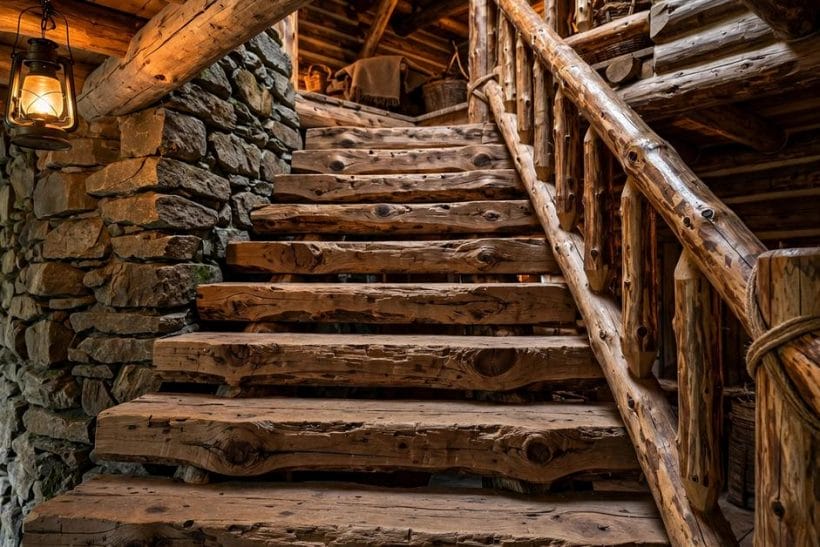
Timber gives a rustic stair its warmth, but rustic timber is a particular kind of timber: rough, honest and visibly worked by hand or by weather. The ideas in this section keep the grain, the knots and the uneven edges in view, and let the finish stay matte rather than glossy. For wooden stairs treated as a subject of their own, wooden staircase ideas cover the broader ground; here timber is always in rustic dress.
| Item | What it is |
|---|---|
| Hewn Treads With Saw Marks Left Visible | Leave the saw marks on the tread surface and the stair reads as hand-made at once. |
| Reclaimed Barn Boards With Nail Holes and Patina | Boards salvaged from an old barn carry nail holes, weathered patches and a grey-brown patina no new board can imitate. |
| Wide Pine Treads in a Honey Tone | Pine in a honey tone warms a narrow hall without darkening it, and its soft grain suits a cottage stair that gets daily use. |
| Dark Timber Treads Against Pale Plaster | Dark treads against pale plaster give a rustic stair a strong, legible rhythm, each step clearly edged as the eye climbs. |
| Mixed-Width Treads for a Hand-Made Rhythm | Treads of slightly differing widths break the machine-made look and make the stair feel built on site by hand. |
| End-Grain Blocks at the Tread Edge | A tread edged with end-grain blocks shows the rings of the timber face-on and gives the stair a crafted, workshop feel. |
| Timber Treads With a Matte Oil Finish | Matte oil keeps timber looking like timber, with depth but no shine, and it is easy to refresh on a worn tread without stripping the whole flight. |
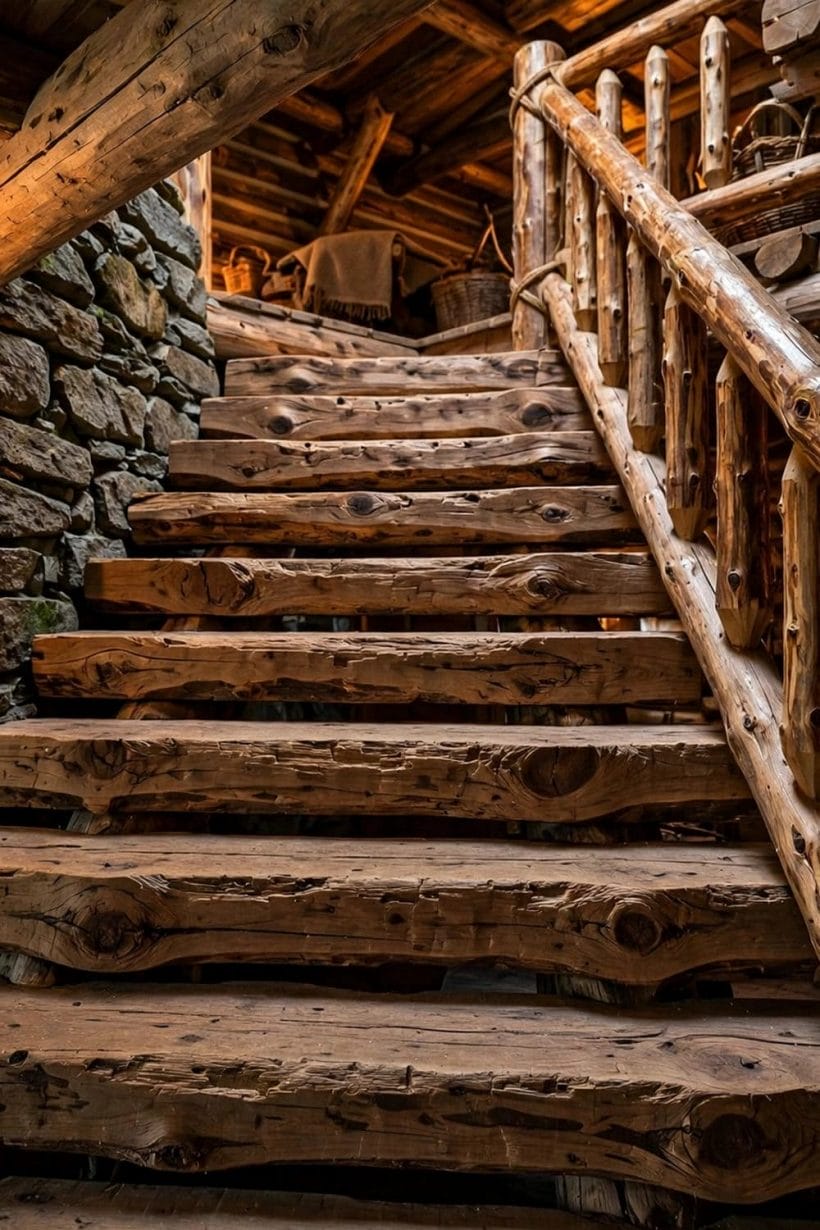
| Chunky Sleeper-Style Treads | Thick, sleeper-like treads give a rustic stair real weight and presence, as though the stair were built from the beams of the house itself. |
| Fieldstone Steps With Uneven Edges | Fieldstone steps keep their uneven edges and natural faces, so each tread looks gathered rather than manufactured. |
| Slate Treads With a Riven Surface | Riven slate splits along natural layers, giving a tread surface that is textured, dark and quietly rustic. |
| Ledge Stone Risers With Timber Treads | Stone risers with timber treads give a stair two textures in every step: cool, rough stone rising and warm timber underfoot. |
| Stone Steps Beside the Hearth | A stair that climbs beside the fireplace inherits the hearth's warmth and its stone, and the two become one feature rather than two neighbours. |
| A Stone Stairwell Wall in Warm Grey | A stairwell wall in warm grey stone turns the climb into a passage through the bones of the house. |
| River Rock Edging Along the Stair Base | A low edging of river rock along the base of a stair ties a rustic flight to the garden outside and to stone floors inside. |
| Limestone Tones in a Cottage Hall | Pale limestone tones lift a cottage hall stair without losing its rustic character, especially where the walls are plaster and the rail is timber. |
| Stone and Timber Combined on One Flight | Combining stone and timber on a single flight lets each material do what it does best: stone for solidity at the base, timber for warmth underfoot higher up. |
| A Peeled Log Handrail With Branch Balusters | A peeled log rail with balusters cut from branches gives a stair a woodland character that no turned spindle can match. |
| A Single Log Rail on a Plaster Wall | One log rail on a plain plaster wall is the simplest rustic stair statement, and its simplicity is its strength. |
| Forked Branch Newel Posts | A newel post cut from a forked branch gives the foot of a stair a natural sculpture, with the fork forming a cradle for the rail above. |
| Log Rails With Rope Lashings | Rope lashings binding a log rail to its posts add a nautical, hand-built note and hide the joint in a way that looks intentional. |
| Willow-Branch Balustrade Panels | Panels woven from willow branches fill the balustrade with a light, basket-like texture that suits a cottage stair. |
| A Chunky Log Newel With a Rounded Cap | A thick log newel with its top rounded by sanding gives the stair a friendly, hand-finished anchor at foot and landing. |
| Log and Iron Combined Rails | Log rails with simple dark iron brackets and balusters gain a quiet strength, the iron giving the rustic timber a firm, dark line. |
| Driftwood-Toned Rails for a Lakeside Cabin | Rails in a driftwood tone, grey-brown and weathered, suit a lakeside cabin where the whole house seems shaped by water and wind. |
| A Steep Loft Stair in a Pine Cabin | A steep loft stair in pine suits a cabin where space is tight and the upper level is a sleeping place rather than a full floor. |
| A Loft Stair With a Log Rail on Both Sides | Log rails on both sides of a loft stair give a climber confidence on a narrow flight and frame the climb in timber from foot to landing. |
| A Reading Nook at the Loft Stair Top | A small reading nook at the top of a loft stair turns the landing into a destination: a chair, a lamp and a shelf of books beside the rail. |
| A Loft Stair Beside a Stone Chimney | A loft stair running beside a stone chimney borrows the chimney's solidity and warmth, and the stone gives the timber stair a cool neighbour. |
| A Cabin Stair With a Quilt at the Landing | A folded quilt left on the landing rail or a bench at the top of a cabin stair signals that the upper level is a bedroom and the stair is its threshold. |
| A Loft Stair Lit by a Small Window | A small window lighting a loft stair gives the climb daylight without stealing wall space from the rooms below. |
| A Guest Loft Reached by a Rustic Stair | A guest loft reached by a rustic stair feels like an invitation rather than an afterthought, especially when the stair is dressed with a runner and the landing holds a carafe and a towel. |
| An Entry Stair With a Bench and Hooks Below | A bench and a row of hooks beneath an entry stair turn dead space into the house's welcome, a place to sit, hang a coat and kick off boots. |
| A Hall Stair With a Woven Runner | A woven runner softens a timber stair, quiets footsteps and adds pattern to a plain hall, all without hiding the timber at the tread edges. |
| Cream Walls and a Timber Stair for Farmhouse Warmth | Cream walls with a timber stair give a hall a farmhouse warmth that flatters rustic timber without turning the stair into a farmhouse feature. |
| An Entry Stair With a Basket for Boots | A basket for boots at the foot of an entry stair keeps muddy footwear off the treads and out of the hall's path. |
| A Hall Stair Framed by Exposed Beams | Exposed beams framing a hall stair tie the flight to the structure of the house and give the hall a barn-like honesty. |
| An Entry Stair With Lantern Light | Lanterns beside an entry stair give a warm, flickering welcome that suits rustic timber and stone far better than a harsh ceiling light. |
| A Mudroom Stair With Peg Rails | Peg rails beside a mudroom stair hold coats, hats and bags at the height of a hand, keeping the stair itself free of clutter. |
| Simple Dark Iron Balusters With Timber Treads | Plain dark iron balusters give a timber stair a firm, quiet line without the fuss of turned wood or bright metal. |
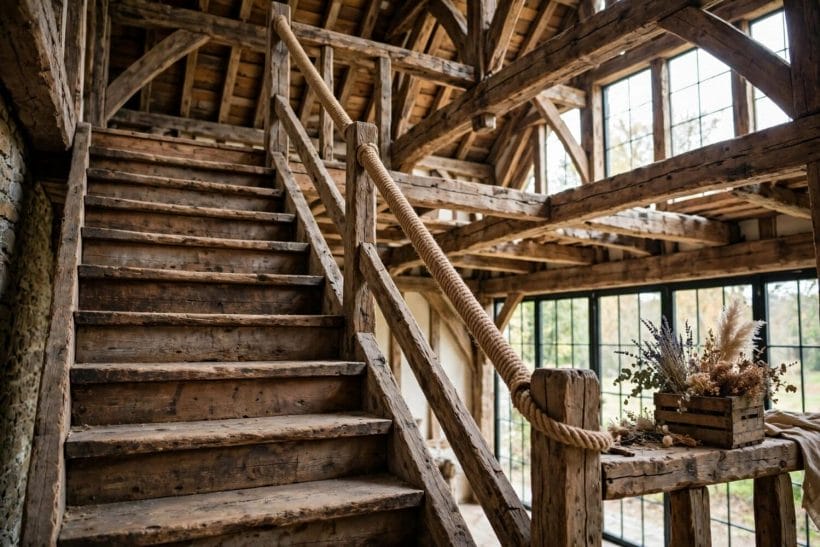
| A Rope Handrail Along a Timber Balustrade | A thick rope handrail along a timber balustrade adds a soft, grippy line to a rustic stair and suits cabins, barns and lakeside houses. |
| Leather-Wrapped Handrail Grips | Leather wrapped around a handrail grip warms the rail in the hand and adds a crafted, saddlery note to a rustic stair. |
| Iron Brackets Under Timber Treads | Dark iron brackets beneath timber treads give a rustic stair a blacksmith's detail and a visible sign of strength. |
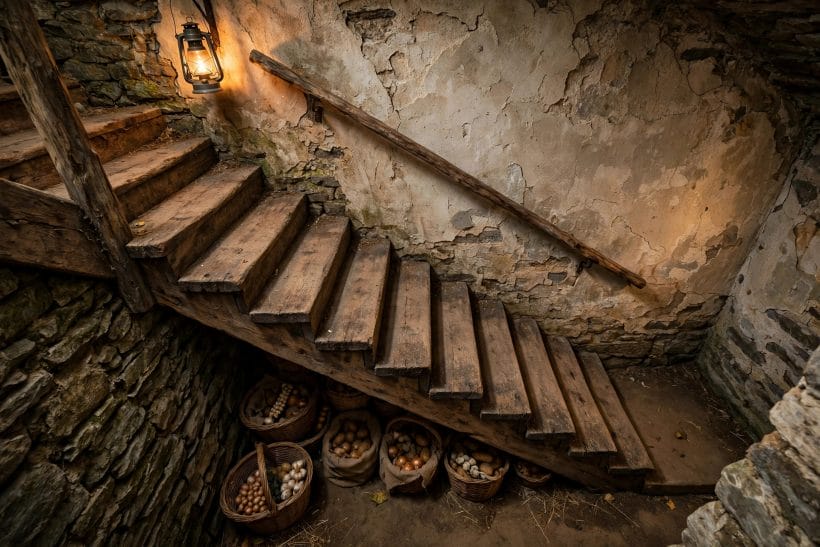
| A Wrought-Iron Lantern Beside the Stair | A wrought-iron lantern beside a rustic stair repeats the dark iron of the balusters and gives the flight a warm pool of light. |
| Rope and Log Combined Rails | Rope combined with log rails gives a stair two rustic voices at once: the solidity of the log and the softness of the rope. |
| Iron Hooks and Hardware in a Dark Finish | Dark iron hooks, hinges and screws on and around a rustic stair keep every fitting in one quiet family, so no bright metal breaks the mood. |
| Warm Lamplight on Rough Timber | Warm lamplight on rough timber brings out grain, knots and saw marks that daylight can wash out, and it makes the stair glow in the evening. |
| Daylight From a Stairwell Window | A stairwell window gives a rustic stair honest daylight and a view to rest the eye on midway up. |
| A Cream and Honey Palette for a Rustic Stair | Cream walls with honey timber give a rustic stair a light, warm palette that suits small halls and cottages. |
| Deep Green Walls With Timber Treads | Deep green walls behind timber treads give a rustic stair a woodland depth, as though the stair climbed through trees. |
| Terracotta and Timber Tones | Terracotta tones beside timber treads warm a rustic stair with an earthy, sun-baked note that suits stone cottages and south-facing halls. |
| Wool Texture on the Landing | Wool on the landing, in a throw, a cushion or a rug, softens the arrival at the top of a rustic stair and invites a pause before the next room. |
| A Braided Rug at the Stair Foot | A braided rug at the foot of a rustic stair marks the threshold of the climb and catches dust from shoes before it reaches the treads. |
| Candlelight and Lantern Glow on Stone | Candlelight and lantern glow on stone steps give a rustic stair an old, firelit character that electric light can imitate but never quite match. |
| A Landing Shelf for Books and Candles | A landing shelf for books and candles gives the turn of a stair a purpose beyond passage, a place to pause with something to read or light. |
| Baskets Stored Beneath the Stair | Baskets beneath a rustic stair turn the space under the flight into tidy, accessible storage for blankets, boots or firewood. |
| A Window Seat on the Stair Landing | A window seat on a stair landing gives the climb a resting place with a view, a cushion, a throw and daylight. |
| A Coat Nook Under the Flight | A coat nook under the flight gives coats and bags a home that keeps the hall clear, with pegs on a timber board and a boot tray below. |
| A Display Ledge for Pottery on the Landing | A display ledge for pottery on a landing lets a rustic stair show off handmade pieces against timber and plaster. |
| Firewood Stored Beside the Stair | Firewood stacked beside a rustic stair, in a log basket or a recessed nook, ties the stair to the fire it serves and gives the hall a working, lived-in feel. |
| A Landing Gallery of Framed Prints | Framed prints hung along a landing wall turn the climb into a small gallery, with the stair's slow pace giving each print its moment. |
| A Barn Conversion Stair With Trusses Overhead | A barn conversion stair climbing beneath exposed trusses gains a roof-like rhythm above it, the trusses echoing the stair's own climb. |
| A Lodge Stair With a Stone Chimney Breast | A lodge stair running beside a stone chimney breast inherits the fireplace's presence and gives the climb a solid companion. |
| A Lakeside Retreat Stair in Weathered Oak | Weathered oak treads suit a lakeside retreat stair, their grey-brown tone echoing driftwood and water-worn timber. |
| A Lodge Stair Dressed With a Woven Throw | A woven throw draped over a lodge stair's rail adds colour and softness without any permanent change, and it can be swapped with the seasons. |
| A Retreat Stair With a View to the Trees | A retreat stair that climbs toward a window looking onto trees gives the climb a living picture at its top. |
| A Barn Stair With Tall Windows and Daylight | Tall windows beside a barn stair flood the flight with daylight and show the timber's grain at its best. |
| A Hunting-Lodge Stair in Dark Timber | Dark timber treads and rails give a hunting-lodge stair a serious, masculine warmth, especially against stone walls and leather furniture. |
1. Hewn Treads With Saw Marks Left Visible
Leave the saw marks on the tread surface and the stair reads as hand-made at once. A matte oil finish protects the timber without hiding the marks, and the roughness underfoot suits a cabin hall where boots are the norm. Keep the lighting soft so the marks cast gentle shadows rather than glaring.
2. Reclaimed Barn Boards With Nail Holes and Patina
Boards salvaged from an old barn carry nail holes, weathered patches and a grey-brown patina no new board can imitate. Laid as treads, they give the stair a past before the house even wakes up. Check every board for soundness and fixings, and let a professional judge whether a board is fit to carry weight.
3. Wide Pine Treads in a Honey Tone
Pine in a honey tone warms a narrow hall without darkening it, and its soft grain suits a cottage stair that gets daily use. Pair it with cream plaster and a simple rail so the colour of the timber does the talking. A honey tone also forgives dust and scuffs better than a pale finish.
4. Dark Timber Treads Against Pale Plaster
Dark treads against pale plaster give a rustic stair a strong, legible rhythm, each step clearly edged as the eye climbs. The contrast helps in dim halls and suits houses where the stair is a feature rather than a corridor. Keep the walls plain so the dark timber stays the focus.
5. Mixed-Width Treads for a Hand-Made Rhythm
Treads of slightly differing widths break the machine-made look and make the stair feel built on site by hand. The variation should stay subtle, so the tread still feels even underfoot, and the overall flight keeps a steady, comfortable pace. This is a character detail, not a structural change.
6. End-Grain Blocks at the Tread Edge
A tread edged with end-grain blocks shows the rings of the timber face-on and gives the stair a crafted, workshop feel. The pattern suits a cabin stair where the woodwork is meant to be noticed and touched. Seal the end grain well, since it drinks in moisture faster than the face of a board.
7. Timber Treads With a Matte Oil Finish
Matte oil keeps timber looking like timber, with depth but no shine, and it is easy to refresh on a worn tread without stripping the whole flight. Re-oiling becomes part of the stair’s routine care, like waxing a table. Avoid glossy varnish if the rustic look matters, since shine reads as modern polish.
8. Chunky Sleeper-Style Treads
Thick, sleeper-like treads give a rustic stair real weight and presence, as though the stair were built from the beams of the house itself. They suit wide halls and barn conversions where the scale of the room can carry them. Their weight is a structural matter, so fixing and support belong to a professional.
2. Stone Steps and Hearthside Climbs
Stone brings a cooler, older voice to a rustic stair, and it pairs naturally with timber rails and fireplaces. The stone here is rough and irregular, never polished marble or crisp cut slabs, and the practical details are about grip, dust and the way stone holds the cold. Where a stair meets the hearth, stone feels inevitable rather than decorated.
9. Fieldstone Steps With Uneven Edges
Fieldstone steps keep their uneven edges and natural faces, so each tread looks gathered rather than manufactured. The irregularity suits a cottage stair that opens onto a stone floor, where the stair and the floor share one material language. Grip matters on stone, so a rough face is a practical virtue as well as a visual one.
10. Slate Treads With a Riven Surface
Riven slate splits along natural layers, giving a tread surface that is textured, dark and quietly rustic. It suits halls with grey stone walls and timber beams, and its dark tone grounds a pale room. Keep the surface clean and dry, since slate shows dust quickly in strong light.
11. Ledge Stone Risers With Timber Treads
Stone risers with timber treads give a stair two textures in every step: cool, rough stone rising and warm timber underfoot. The combination suits a stair that runs beside a stone wall, where the risers echo the wall and the treads echo the floors. Let the mortar lines stay visible for an honest, built feel.
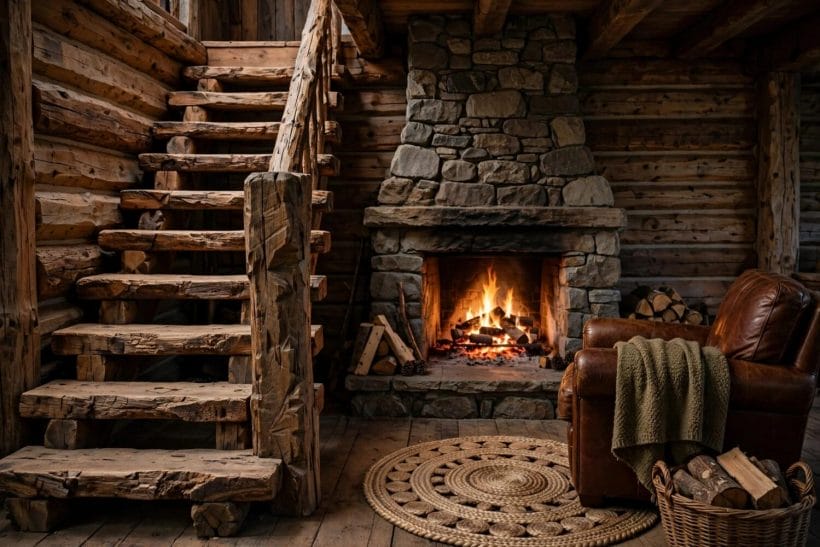
12. Stone Steps Beside the Hearth
A stair that climbs beside the fireplace inherits the hearth’s warmth and its stone, and the two become one feature rather than two neighbours. Timber rails keep the combination from feeling cold, and firelight on stone gives the stair a glow no lamp quite matches. Keep the hearth clear of clutter so the stair reads cleanly.
13. A Stone Stairwell Wall in Warm Grey
A stairwell wall in warm grey stone turns the climb into a passage through the bones of the house. Timber treads and a log rail soften the stone, and a single lantern or wall light warms the whole flight. The wall should be lit from above and below so no tread falls into shadow.
14. River Rock Edging Along the Stair Base
A low edging of river rock along the base of a stair ties a rustic flight to the garden outside and to stone floors inside. The rocks should sit clear of the walking line, as a border rather than an obstacle, and the edging works best where the stair meets a stone or timber floor. Keep the edging low and stable.
15. Limestone Tones in a Cottage Hall
Pale limestone tones lift a cottage hall stair without losing its rustic character, especially where the walls are plaster and the rail is timber. The pale stone reflects lamplight and makes a narrow hall feel wider. Dust shows on pale stone, so a quick sweep becomes part of the routine.
16. Stone and Timber Combined on One Flight
Combining stone and timber on a single flight lets each material do what it does best: stone for solidity at the base, timber for warmth underfoot higher up. The change of material can mark the turn of a stair or the step onto a landing. For a different take on hard stair surfaces, wood-look tile on stairs shows how tile can imitate timber where stone is not wanted.
3. Log Rails and Branch Balustrades
The rail is where a rustic stair shows its hand most clearly. A log rail, a branch balustrade or a rope lashing says cabin before any other detail has a chance to speak, and these rails suit hands as well as eyes: they are warm to grip and solid to lean on. Every rail here must be fixed to carry real weight, whatever its rustic appearance, so fixings are a professional matter.
17. A Peeled Log Handrail With Branch Balusters
A peeled log rail with balusters cut from branches gives a stair a woodland character that no turned spindle can match. Each branch keeps its own slight bend, so the balustrade reads as grown rather than made. Fix every baluster firmly at top and bottom, since rustic looks must never mean loose work.
18. A Single Log Rail on a Plaster Wall
One log rail on a plain plaster wall is the simplest rustic stair statement, and its simplicity is its strength. The log’s bark-free, sanded surface feels smooth in the hand, and the wall behind stays plain so the rail carries the whole look. Brackets should be sturdy and well fixed into the wall structure.
19. Forked Branch Newel Posts
A newel post cut from a forked branch gives the foot of a stair a natural sculpture, with the fork forming a cradle for the rail above. The effect suits a cabin stair where the woodwork is the decoration. Choose a fork that is sound and dry, and fix it as solidly as any square newel.
20. Log Rails With Rope Lashings
Rope lashings binding a log rail to its posts add a nautical, hand-built note and hide the joint in a way that looks intentional. The rope should be thick, natural fibre and tightly wound, and it should dress a sound joint rather than hold a weak one together. Replace rope that frays or loosens.
21. Willow-Branch Balustrade Panels
Panels woven from willow branches fill the balustrade with a light, basket-like texture that suits a cottage stair. The weave lets light through while still guarding the edge, and its softness contrasts well with chunky timber treads. Keep the weave tight and the panel frame strong.
22. A Chunky Log Newel With a Rounded Cap
A thick log newel with its top rounded by sanding gives the stair a friendly, hand-finished anchor at foot and landing. The rounded cap invites the hand and softens the silhouette of the whole flight. The newel must be rooted firmly, since it anchors the rail it serves.
23. Log and Iron Combined Rails
Log rails with simple dark iron brackets and balusters gain a quiet strength, the iron giving the rustic timber a firm, dark line. Keep the iron plain and matte so it supports rather than competes with the wood. The combination suits barn conversions where timber and iron already share the building.
24. Driftwood-Toned Rails for a Lakeside Cabin
Rails in a driftwood tone, grey-brown and weathered, suit a lakeside cabin where the whole house seems shaped by water and wind. The grey tone pairs with pale walls and stone floors, and a matte finish keeps the weathered look honest. Avoid bleaching timber to fake the tone; let grey come from real weathering or a suitable stain.
4. Cabin Lofts and Sleeping Levels
A cabin loft stair is often the steepest, simplest stair in the house, and its rustic character comes from that honesty: rough timber, log rails and a bed waiting at the top. These ideas keep the loft stair part of the cabin rather than a separate feature, with light and bedding doing as much work as the wood. For loft rooms beyond the stair, tiny house loft ideas show how small upper levels are furnished around the climb.
25. A Steep Loft Stair in a Pine Cabin
A steep loft stair in pine suits a cabin where space is tight and the upper level is a sleeping place rather than a full floor. The steepness should still feel safe and steady, with a firm rail on at least one side and treads deep enough for a sure foot. Any change to the steepness or structure belongs to a professional.
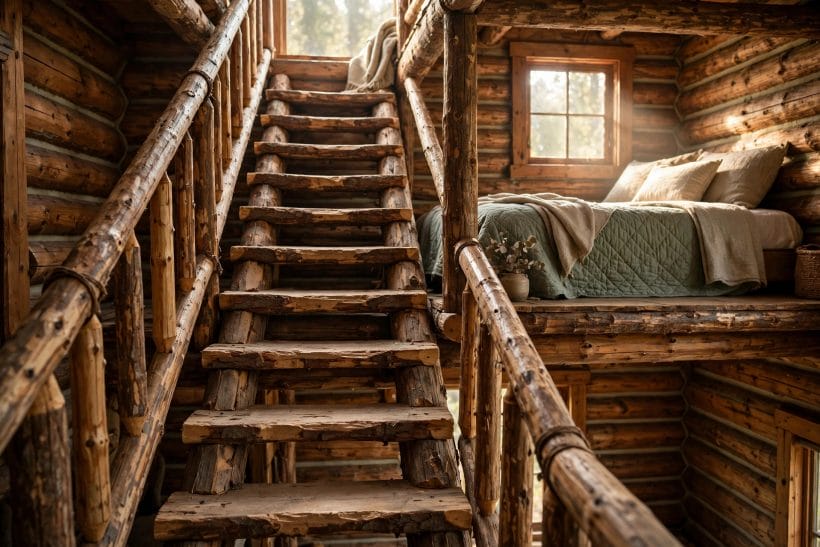
26. A Loft Stair With a Log Rail on Both Sides
Log rails on both sides of a loft stair give a climber confidence on a narrow flight and frame the climb in timber from foot to landing. The double rail suits older climbers and children alike, and the logs warm a pine interior that might otherwise feel plain. Fix both rails to carry weight, not just to look the part.
27. A Reading Nook at the Loft Stair Top
A small reading nook at the top of a loft stair turns the landing into a destination: a chair, a lamp and a shelf of books beside the rail. The nook should keep the landing clear enough to step onto safely, with the chair set back from the stair edge. Lamplight here doubles as stair lighting for the top treads.
28. A Loft Stair Beside a Stone Chimney
A loft stair running beside a stone chimney borrows the chimney’s solidity and warmth, and the stone gives the timber stair a cool neighbour. The combination suits cabins where the fire is the heart of the house and the stair climbs in its orbit. Keep the stair clear of the hearth opening and its heat.
29. A Cabin Stair With a Quilt at the Landing
A folded quilt left on the landing rail or a bench at the top of a cabin stair signals that the upper level is a bedroom and the stair is its threshold. The quilt’s pattern and colour can carry the room’s palette down the flight. Keep bedding clear of the treads themselves, where it would be a trip hazard.
30. A Loft Stair Lit by a Small Window
A small window lighting a loft stair gives the climb daylight without stealing wall space from the rooms below. The window should sit where it lights the treads rather than dazzling the climber, and a deep timber sill suits the rustic frame. At night a single wall light should take over the same job.
31. A Guest Loft Reached by a Rustic Stair
A guest loft reached by a rustic stair feels like an invitation rather than an afterthought, especially when the stair is dressed with a runner and the landing holds a carafe and a towel. Guests need the same safe rails and lighting as the household, so a guest stair deserves no less care than the main one.
5. Halls, Entries and Farmhouse Warmth
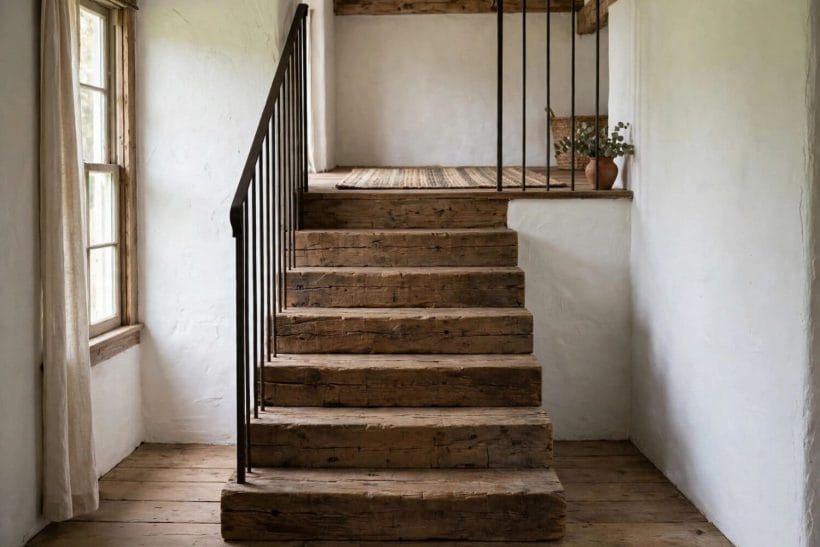
The entry hall is where a rustic stair meets visitors first, and the ideas here are about welcome: benches, baskets, hooks and lantern light around a timber flight. Farmhouse warmth appears as a neighbour here, cream walls and simple furniture, while the stair itself stays rustic in material and mood. For a grander entry form, double staircase ideas cover flights that split and sweep; the rustic entries below stay single and straightforward.
32. An Entry Stair With a Bench and Hooks Below
A bench and a row of hooks beneath an entry stair turn dead space into the house’s welcome, a place to sit, hang a coat and kick off boots. The bench should sit clear of the walking line and the hooks should hold coats without brushing the treads. Timber for the bench should match the stair’s tone rather than match it exactly.
33. A Hall Stair With a Woven Runner
A woven runner softens a timber stair, quiets footsteps and adds pattern to a plain hall, all without hiding the timber at the tread edges. Choose a runner in natural fibres and a pattern that suits the hall, and fix it firmly so it cannot slip or bunch. A runner also protects the centre of well-used treads.
34. Cream Walls and a Timber Stair for Farmhouse Warmth
Cream walls with a timber stair give a hall a farmhouse warmth that flatters rustic timber without turning the stair into a farmhouse feature. The cream reflects light and the timber provides the only strong colour, a balance that suits small entries. For living rooms in the same spirit, farmhouse living room ideas carry the palette further.
35. An Entry Stair With a Basket for Boots
A basket for boots at the foot of an entry stair keeps muddy footwear off the treads and out of the hall’s path. A sturdy woven basket suits the rustic palette and can be emptied and shaken outside. Keep the basket to one side so the first tread stays clear for every climber.
36. A Hall Stair Framed by Exposed Beams
Exposed beams framing a hall stair tie the flight to the structure of the house and give the hall a barn-like honesty. The beams should be lit so they read as a frame rather than a shadow, and the stair’s timber should sit comfortably beside them in tone. Beam work itself is structural and belongs to a professional.
37. An Entry Stair With Lantern Light
Lanterns beside an entry stair give a warm, flickering welcome that suits rustic timber and stone far better than a harsh ceiling light. Hang or set lanterns where they light the treads without blocking the handrail, and use steady, safe light sources rather than open flame near timber. Lantern light at the foot and the landing covers the whole flight.
38. A Mudroom Stair With Peg Rails
Peg rails beside a mudroom stair hold coats, hats and bags at the height of a hand, keeping the stair itself free of clutter. Wooden pegs on a timber rail suit the rustic palette and take real daily weight, so the rail must be fixed into solid wall. The mudroom stair works hardest in the house, so its rails deserve the firmest fixings.
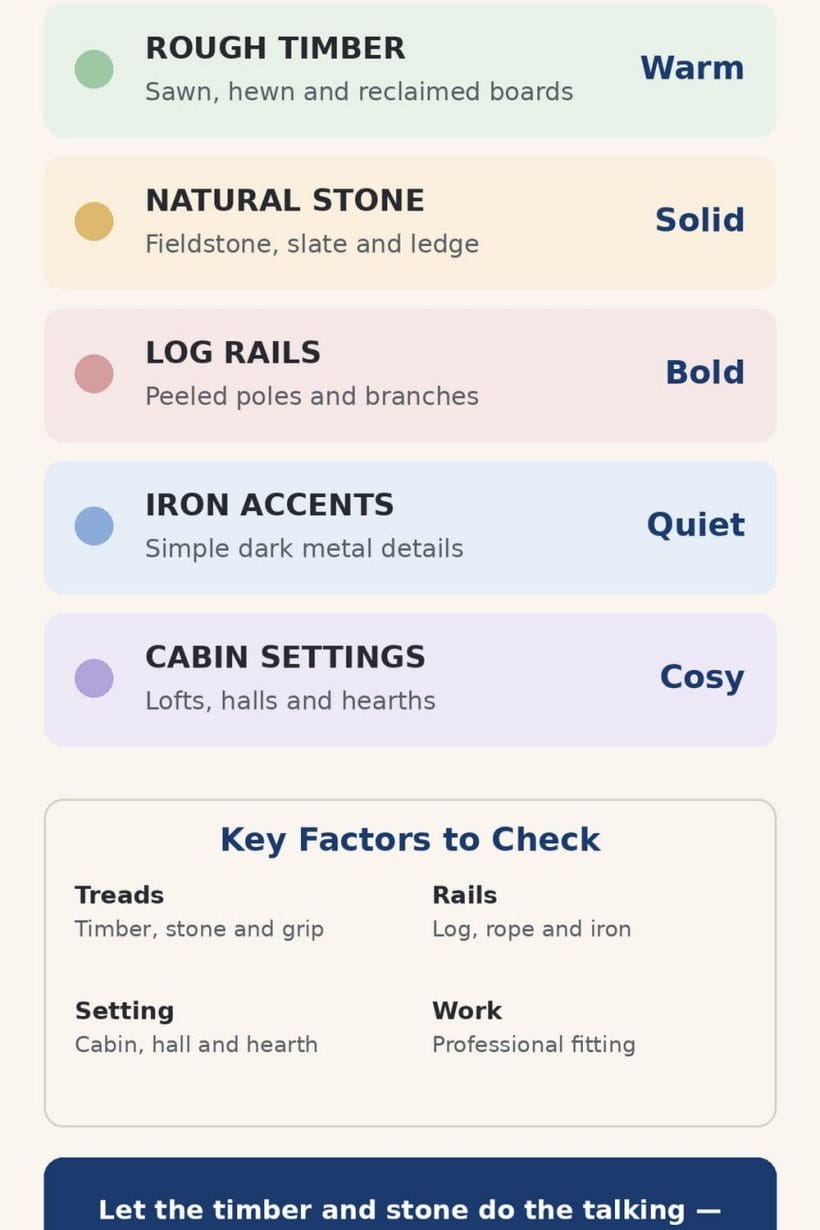
6. Iron, Rope and Leather Details
Small details finish a rustic stair: iron that is dark and plain, rope that is thick and natural, leather that softens a handrail’s grip. These details should stay quiet, supporting the timber and stone rather than competing with them, and every one of them must be fixed to work as hard as it looks. A rustic stair earns its character from materials used honestly, and these finishes are honest workhorses.
39. Simple Dark Iron Balusters With Timber Treads
Plain dark iron balusters give a timber stair a firm, quiet line without the fuss of turned wood or bright metal. Their darkness outlines each tread and suits halls where the timber is the star. Keep the iron matte and the profile simple, and fix every baluster so the balustrade is rigid along its whole length.
40. A Rope Handrail Along a Timber Balustrade
A thick rope handrail along a timber balustrade adds a soft, grippy line to a rustic stair and suits cabins, barns and lakeside houses. The rope should be natural fibre, tightly strung and well anchored at both ends, with the timber balustrade carrying the real strength beneath it. Check the rope’s tension regularly and replace it when it slackens.
41. Leather-Wrapped Handrail Grips
Leather wrapped around a handrail grip warms the rail in the hand and adds a crafted, saddlery note to a rustic stair. The wrap should cover the grip section only, leaving the rail’s ends and brackets clear, and it should be stitched or bound firmly so it cannot slide. Leather darkens with use, which suits the rustic palette.
42. Iron Brackets Under Timber Treads
Dark iron brackets beneath timber treads give a rustic stair a blacksmith’s detail and a visible sign of strength. The brackets should be plain in shape and fixed into sound structure, and they suit open-backed stairs where the underside is seen from the room below. Bracket work that carries weight is a professional matter.
43. A Wrought-Iron Lantern Beside the Stair
A wrought-iron lantern beside a rustic stair repeats the dark iron of the balusters and gives the flight a warm pool of light. Set the lantern on a bracket or a shelf where it lights the treads and cannot be knocked from its perch. Its iron frame should stay simple so the light, not the fitting, draws the eye.
44. Rope and Log Combined Rails
Rope combined with log rails gives a stair two rustic voices at once: the solidity of the log and the softness of the rope. The log should carry the structure and the rope should dress the grip, with both fixed independently so neither depends on the other. The combination suits a stair that is used with wet or cold hands, where rope grips well.
45. Iron Hooks and Hardware in a Dark Finish
Dark iron hooks, hinges and screws on and around a rustic stair keep every fitting in one quiet family, so no bright metal breaks the mood. Hooks near the stair hold lanterns, hats and baskets, and their dark finish ages gracefully with the timber. Fix hooks into solid timber or wall structure, never into plaster alone.
7. Light, Colour and Texture
Light and colour decide whether a rustic stair feels cosy or gloomy, and the balance is delicate: rough materials need enough light to show their texture, but harsh light flattens them. The ideas here keep light warm and low, colour drawn from timber, stone and wool, and texture layered rather than piled on. Where modern rooms go bright and plain, rustic stairs stay warm and touched.
46. Warm Lamplight on Rough Timber
Warm lamplight on rough timber brings out grain, knots and saw marks that daylight can wash out, and it makes the stair glow in the evening. Place lamps to graze the timber from the side rather than lighting it flat from above, so the texture casts its own gentle shadows. One lamp at the foot and one at the landing usually covers a flight.
47. Daylight From a Stairwell Window
A stairwell window gives a rustic stair honest daylight and a view to rest the eye on midway up. The window’s timber frame should match the stair’s tone, and a deep sill can hold a candle or a small plant. Daylight also shows dust on timber and stone, so a stairwell window argues for a regular sweep.
48. A Cream and Honey Palette for a Rustic Stair
Cream walls with honey timber give a rustic stair a light, warm palette that suits small halls and cottages. The cream reflects light onto the treads and the honey timber provides the warmth, a pairing that never feels dark. Keep other colours quiet so the palette stays restful rather than busy.
49. Deep Green Walls With Timber Treads
Deep green walls behind timber treads give a rustic stair a woodland depth, as though the stair climbed through trees. The green suits cabins and lodges where the outside is forest, and brass or iron details pick up the dark tone. Balance the depth with warm light, since green walls drink light quickly.
50. Terracotta and Timber Tones
Terracotta tones beside timber treads warm a rustic stair with an earthy, sun-baked note that suits stone cottages and south-facing halls. A terracotta runner or wall wash pairs with honey or dark timber alike, and the combination feels grounded rather than decorated. Keep the terracotta to one element so it accents rather than overwhelms.
51. Wool Texture on the Landing
Wool on the landing, in a throw, a cushion or a rug, softens the arrival at the top of a rustic stair and invites a pause before the next room. Natural wool in cream, grey or rust suits the palette and feels warm underfoot after timber treads. Keep wool clear of the top tread so the step off the stair stays safe.
52. A Braided Rug at the Stair Foot
A braided rug at the foot of a rustic stair marks the threshold of the climb and catches dust from shoes before it reaches the treads. The rug’s rings of colour can echo the hall’s palette, and its flat weave stays low enough not to trip. Fix the rug with a non-slip underlay on smooth floors.
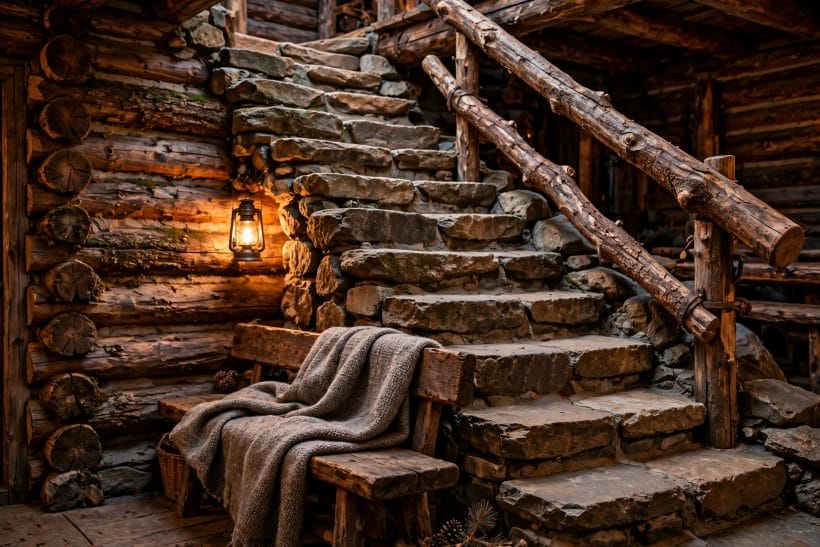
53. Candlelight and Lantern Glow on Stone
Candlelight and lantern glow on stone steps give a rustic stair an old, firelit character that electric light can imitate but never quite match. Use safe, enclosed light sources near timber and stone, and place them where they light the tread edges rather than the wall alone. Stone holds the glow beautifully, warming a cool material with light.
8. Landings, Nooks and Storage
The spaces around a rustic stair, landings, nooks and the cupboard beneath the flight, are where the stair earns its keep in a small house. These ideas treat those spaces as part of the stair’s character, dressed in the same timber and stone, and kept clear enough that the stair itself never becomes an obstacle course. Storage should serve the stair, not swallow it.
54. A Landing Shelf for Books and Candles
A landing shelf for books and candles gives the turn of a stair a purpose beyond passage, a place to pause with something to read or light. The shelf should sit above hand height from the treads so nothing overhangs the walking line, and its timber should match the stair. Keep the shelf’s load light and its candles enclosed.
55. Baskets Stored Beneath the Stair
Baskets beneath a rustic stair turn the space under the flight into tidy, accessible storage for blankets, boots or firewood. Woven baskets suit the palette and can be pulled out and carried where they are needed. Keep the baskets clear of any boiler, meter or access panel that lives under the stair.
56. A Window Seat on the Stair Landing
A window seat on a stair landing gives the climb a resting place with a view, a cushion, a throw and daylight. The seat should sit back from the stair edge with room to step onto the landing safely, and its timber base should match the stair. A landing seat suits a stair with a generous turn rather than a tight one.
57. A Coat Nook Under the Flight
A coat nook under the flight gives coats and bags a home that keeps the hall clear, with pegs on a timber board and a boot tray below. The nook should be lit so coats are found without fumbling, and its board should be fixed into solid structure. Keep the nook’s depth shallow enough that the stair above stays the dominant feature.
58. A Display Ledge for Pottery on the Landing
A display ledge for pottery on a landing lets a rustic stair show off handmade pieces against timber and plaster. The ledge should be narrow and high enough that pieces cannot be brushed by a passing shoulder, and heavier pieces belong lower. Pottery in earthy tones suits the palette better than bright glaze.
59. Firewood Stored Beside the Stair
Firewood stacked beside a rustic stair, in a log basket or a recessed nook, ties the stair to the fire it serves and gives the hall a working, lived-in feel. Keep the stack tidy, dry and clear of the walking line and the handrail, and never block the stair with logs. A small stack, refreshed often, looks better than a towering one.
60. A Landing Gallery of Framed Prints
Framed prints hung along a landing wall turn the climb into a small gallery, with the stair’s slow pace giving each print its moment. Simple timber frames suit the rustic palette, and the prints should hang above handrail height so they are seen rather than touched. Keep the gallery to a theme, such as landscapes or botanical prints, for a calm effect.
9. Rustic Stairs for Barns, Lodges and Retreats
Barns, lodges and retreats give rustic stairs the room to be at their boldest, with trusses overhead, stone chimneys beside the flight and views through tall windows. These stairs borrow scale from their buildings and give it back as character. Where modern tiny house interiors strip a stair back to plain lines, a rustic retreat dresses it in timber and stone and lets the building show.
61. A Barn Conversion Stair With Trusses Overhead
A barn conversion stair climbing beneath exposed trusses gains a roof-like rhythm above it, the trusses echoing the stair’s own climb. The stair’s timber should sit comfortably beside the trusses in tone, neither matching them exactly nor clashing. Truss work is structural, so any change near it belongs to a professional.
62. A Lodge Stair With a Stone Chimney Breast
A lodge stair running beside a stone chimney breast inherits the fireplace’s presence and gives the climb a solid companion. Timber treads and a log rail warm the stone, and firelight reaches the lower treads in the evening. Keep the stair’s rail clear of the chimney’s heat and the hearth’s clutter.
63. A Lakeside Retreat Stair in Weathered Oak
Weathered oak treads suit a lakeside retreat stair, their grey-brown tone echoing driftwood and water-worn timber. The weathered look pairs with pale walls and simple rails, and a matte finish keeps it honest. Avoid forcing a weathered tone with harsh treatments; let it come from the timber or a suitable stain.
64. A Lodge Stair Dressed With a Woven Throw
A woven throw draped over a lodge stair’s rail adds colour and softness without any permanent change, and it can be swapped with the seasons. The throw should hang on the outer rail where it cannot snag a climber’s hand on the grip side. A throw in rust, cream or deep green suits the lodge palette.
65. A Retreat Stair With a View to the Trees
A retreat stair that climbs toward a window looking onto trees gives the climb a living picture at its top. The window should light the upper treads and frame the view without dazzling, and the stair’s timber should stay plain so the view carries the moment. A seat or a sill plant at the top completes the arrival.
66. A Barn Stair With Tall Windows and Daylight
Tall windows beside a barn stair flood the flight with daylight and show the timber’s grain at its best. The windows’ frames should be simple timber, and the light should fall across the treads rather than straight down them. At night, wall lights should take over at the same positions so the stair never goes dark.
67. A Hunting-Lodge Stair in Dark Timber
Dark timber treads and rails give a hunting-lodge stair a serious, masculine warmth, especially against stone walls and leather furniture. The darkness needs warm light to avoid gloom, so lamps at foot and landing matter more here than on a pale stair. Keep the dark timber matte so it reads as wood rather than polish.
10. Care, Safety and the Professional Finish
A rustic stair is only a success if it stays safe and sound as it ages, and the last section is about that care: grip, light, cleaning, checking and knowing when to call a professional. Rustic materials age gracefully when they are looked after, and a little routine attention keeps a beautiful stair a safe one for years. Character should never be an excuse for neglect.
68. Keeping Grip on Rough Treads
Rough treads grip well by nature, but dust, polish and wear can smooth them over time, so keep treads clean and free of wax build-up. A runner or a non-slip treatment suited to the timber can restore grip on a worn flight. If a tread becomes slippery despite care, take professional advice rather than improvising a fix.
69. Lighting Every Tread Evenly
Even lighting across every tread matters more on a rustic stair than on a plain one, since rough surfaces cast shadows that can hide a tread edge. Light the flight from foot, middle and landing where possible, and check at night that no tread falls dark. Replace failed lights promptly, since a dark tread is a hazard.
70. Oiling Timber Treads Through the Seasons
Oiling timber treads through the seasons feeds the wood and refreshes its colour, especially in dry winters and humid summers. Apply oil thinly and evenly, let it soak in, and wipe away the excess so treads never feel tacky. A tread that is regularly oiled resists spills and scuffs far better than a thirsty one.
71. Cleaning Stone Steps Without Harsh Products
Stone steps clean best with gentle methods: sweeping, warm water and a soft brush, without harsh chemicals that can stain or etch the stone. Test any cleaning product on a hidden step first, and rinse well so no residue dries on the surface. Sealed stone needs less attention than raw stone, but both reward gentle care.
72. Checking Rails for Wobble
Check rails, newels and balusters for wobble at least once a season, gripping each firmly and feeling for movement. A rail that moves needs attention promptly, since rails are safety fittings first and decoration second. Tightening or refixing a rail that carries weight belongs to a professional when the fixing itself is in doubt.
73. When to Call a Professional for Structure
Call a professional for any structural question: a sagging tread, a cracked stringer, a new opening, a moved wall or a rail that will not stay fixed. Rustic character can hide structural trouble behind rough surfaces, so a stair that looks old and a stair that is failing can look alike to an untrained eye. A professional’s judgement is part of the rustic stair’s care, not a contradiction of it.
74. Matching New Timber to Old
Matching new timber to an old rustic stair takes patience: the species, the tone and the finish all need to sit comfortably beside weathered boards. Bring a sample of the old timber when choosing new, and test finishes on offcuts before committing. A near match that ages in will look better than a perfect match that is really a different timber in disguise.
75. Letting the Stair Age Gracefully
Let a rustic stair age gracefully, accepting the scuffs, the darkened treads and the softened edges that come with years of use. Rustic character improves with wear in a way polished stairs do not, and a stair that shows its history feels more like home. Care for it, repair it properly, and let its age be part of its beauty.
Final Considerations
A rustic staircase earns its place by being honest about its materials: timber that shows its grain, stone that keeps its edges, rails made from logs and rope rather than polished showpieces. The ideas above range from cabin lofts to barn conversions, but they share one rule, which is that character must never outrank safety. Light every tread, fix every rail firmly, and keep the stair clean and cared for through the seasons.
Start with the material that suits the house: rough timber for warmth, stone for solidity, log rails for cabin character, and quiet iron or rope for detail. Then let the setting do the rest, with lamplight, wool textures and the rooms the stair connects. Any change to the structure, the supports or the fixings belongs to a professional, and that advice holds for every idea in this list. A rustic stair built and kept in that spirit will age as gracefully as the house around it.

0 Comments