
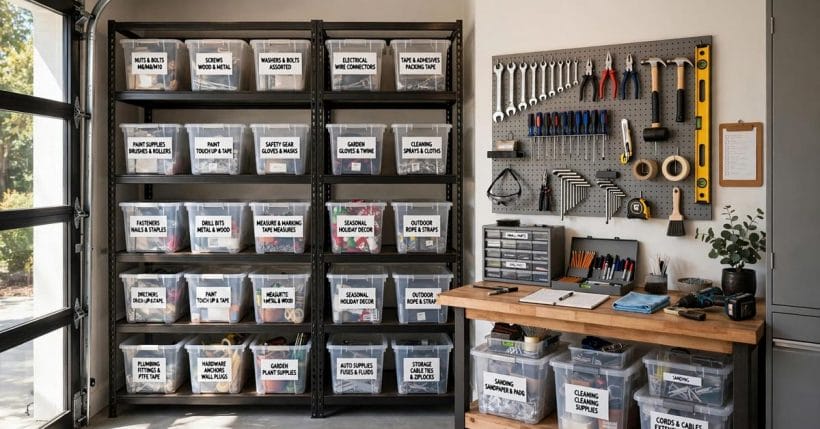
The car is on the drive, the mower is behind a paint tin, and the thing you need is always at the bottom of the pile — the unorganised garage does not lack space, it lacks a system.
These seventy-five garage organization ideas cover zones and layouts, wall systems, shelving and bins, ceiling storage, the workbench, gear and seasonal storage, and the care and cost drivers behind a garage where everything has a home.
1. Garage Organization Ideas at a Glance
A garage organised for storage is planned in zones, built upward, and labelled so thoroughly that putting things away becomes the easiest part of any job. The best garage storage ideas are boring in the same way: a place for everything, labelled, and off the floor. This post is storage and organisation only: how much garage a household needs in the first place is the measurements question answered in garage measurements, and whole garage designs for different car counts live in two-car garage ideas and three-car garage ideas. Within the wider home design ideas family, the subject here is what happens inside a garage you already have — the walls, the ceiling, the shelves and the habits that keep the floor clear for the car.
| Question | Short answer |
|---|---|
| Where does garage space go? | On the floor, in piles — the walls and ceiling of most garages stand almost empty while the floor drowns |
| What is the first move? | Zone the garage by activity — tools, garden, sport, seasonal, car care — before buying a single box |
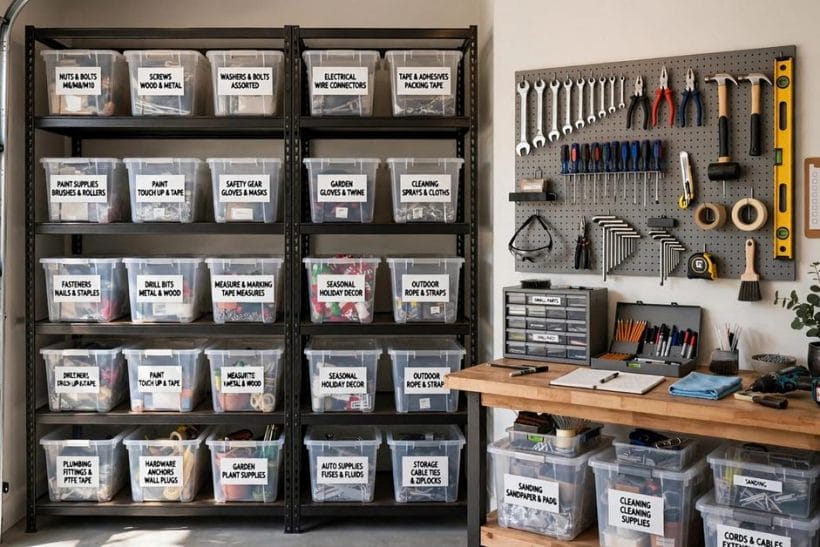
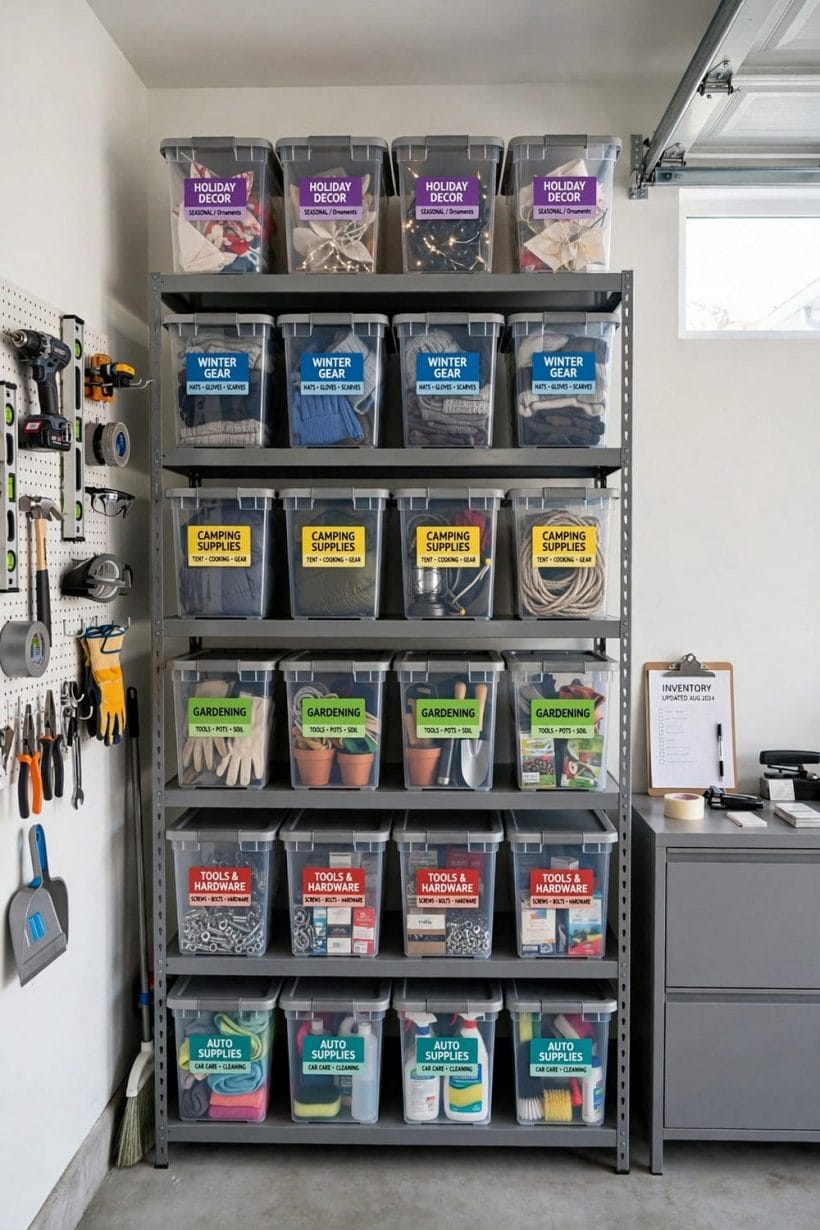
| Which storage earns most? | Full-height wall shelving with labelled bins, the system in the feature photograph |
| What stays off the floor? | Everything that can hang, stack or roll — a clear floor is the whole point of the exercise |
| How does it stay tidy? | Labels, one home per thing, and a short regular reset — organisation is a habit with furniture, not an event |
| What does it cost? | Drivers only: the length of wall fitted, the shelving material, and how much is bought versus built |
2. Zones and Layouts: Plan Before You Buy
Every successful garage organisation starts as a drawing, not a shopping trip. Zones assign each activity its own territory, so the system survives real life instead of collapsing the first time two hobbies collide.
1. Divide the garage into named zones
Tools, garden, sport, seasonal storage, car care and household overflow each get a named territory,. Zones stop the slow creep in which every new thing lands wherever there happens to be a gap.
2. Keep the car’s bay sacred
Draw the parking bay on the plan and defend it absolutely: nothing stores inside its lines, ever. The moment the bay becomes temporary storage, the car moves out and the garage becomes a shed with a very large door.
3. Put daily things by the house door
The route from house to car passes the things used daily — shoes, coats, bins, the dog lead — so a slim zone of hooks and a bench near the internal door earns its place ahead of all deeper storage.
4. Give the workbench the best light
If the garage has one window or one good light position, the bench belongs under it. Storage can live in dim corners; work cannot, and a bench exiled to the dark end becomes a dumping shelf within a month.
5. Seasonal storage goes deepest
Decorations, suitcases and the paddling pool are touched a few times a year, so they earn the far corners, the high shelves and the ceiling racks. Depth in the plan should follow frequency of use.
6. One wall for one family of things
Resist scattering: all garden on one wall, all tools on another, all sport on a third. A visitor should be able to guess where anything lives from across the room — that guessability is the sign the zoning works.
7. Leave an empty shelf on purpose
A system filled to capacity has nowhere for the next thing to go, and the next thing always comes. Leaving one shelf and one bin deliberately empty is not waste; it is the expansion joint that keeps the whole system honest.
8. Plan the floor route, not just the walls
Bins and bikes must travel from their homes to the car and the garden without moving three other things first. Draw the carrying routes on the plan — a zone you cannot reach is a zone you will stop using.
9. Measure everything before ordering anything
Wall lengths, ceiling height, the door’s swing and the car’s real footprint with its doors open: the measurements discipline behind the detached projects in detached garage ideas applies just as strictly to a shelving order.
3. Wall Storage Systems: The Vertical Harvest
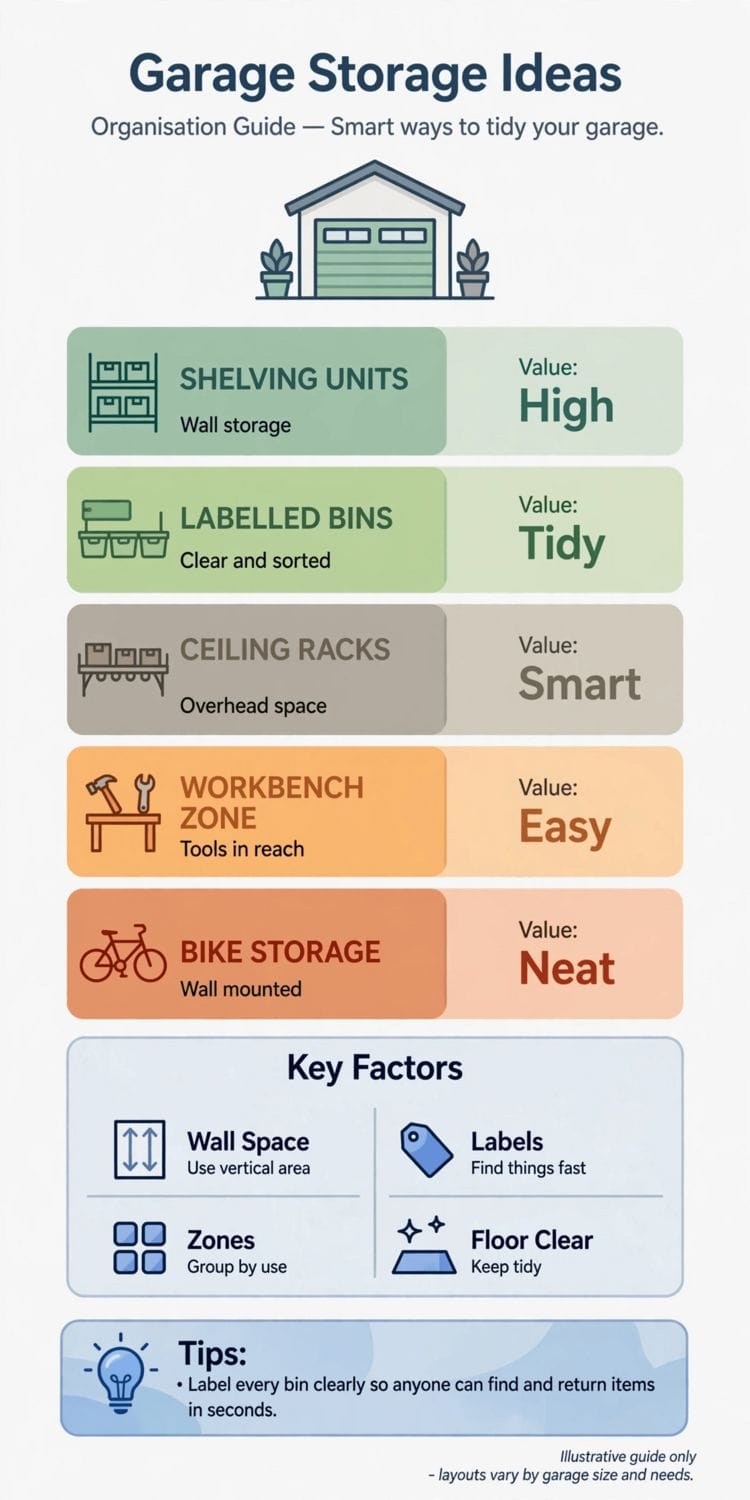
The infographic’s first row is the whole argument: walls are the garage’s unused acres. Rails, panels and hooks turn them into storage that leaves the floor — and the car — in peace.
10. Slatwall and panel systems
Grooved panels accept hooks, baskets and brackets anywhere along their length, so the wall rearranges as the household’s gear changes. They cost more than bare hooks and repay it the first time a new hobby arrives without a rebuild.
11. Rail-and-hook tracks
A horizontal rail fixed firmly to the wall’s structure carries heavy hooks for ladders, hoses, chairs and tools. Because the hooks slide, spacing adjusts in seconds.
12. The pegboard tool wall
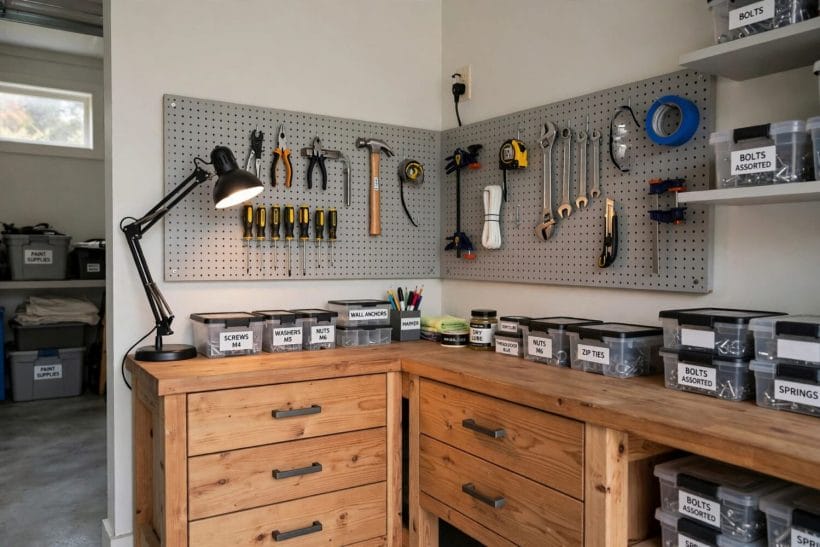
The feature photograph’s pegboard is the classic for a reason: every tool visible, outlined and in reach above the bench.
13. French cleats for rearrangeable strength
Interlocking angled battens let cabinets, racks and holders lift on and off the wall yet hang rock-solid under load.
14. Hooks matched to the load
A hook is a promise: light hooks for cords and brushes, deep doubled hooks for ladders and bikes, each fixed into structure, not plaster. The rating on the packet and the fixing behind the wall decide what may honestly hang.
15. Magnetic strips for small metal tools
A magnetic rail above the bench holds screwdrivers, bits and hand tools in a visible row, freeing drawer space and ending the rummage. Keep it for tools that are used weekly; rarely used items magnetised in the open just gather dust in formation.
16. Wall-mounted cabinets for the dust-sensitive
Enclosed cabinets protect finishes, fabrics and anything dust would ruin, and they lock — which matters for chemicals and sharp tools in a household with children. Their cost buys calm: doors close on visual chaos as well as dust.
17. Fold-down and hinged racks
Racks that fold flat against the wall when empty — for tyres, chairs or a work surface — give seasonal capacity without permanent occupation. In a small garage, storage that disappears is worth a premium over storage that merely fits.
18. Use the wall above the door and windows
The strips of wall everyone forgets — over the garage door’s sides, above windows, along the ceiling line — take slim shelves for light, rare things. Wasted vertical bands are the difference between a fitted garage and a nearly fitted one.
4. Shelving, Cabinets and Bins: The Feature System
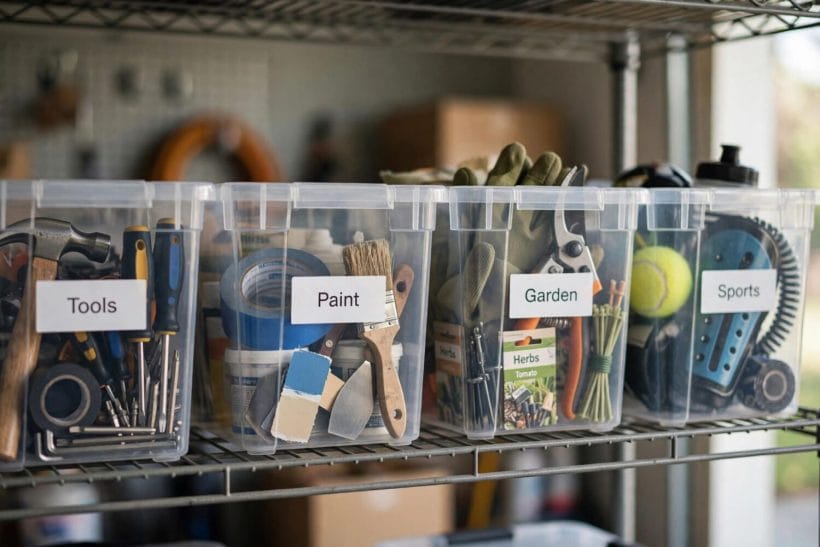
The feature photograph is the template: tall racking, clear bins, honest labels. This section builds that system properly — the right shelves, the right boxes, and labels that survive contact with real life.
19. Freestanding racking along the walls
Boltless metal racking, levelled and fixed back to the wall for safety, is the backbone of most organised garages.
20. Clear bins so contents announce themselves
Transparent boxes end the archaeology of the opaque bin: you can see the contents before the lid comes off. Pair clarity with labels anyway.
21. Labels on every bin, facing out
The infographic’s tip, and the feature photograph’s whole discipline: label every bin clearly, on the face that greets you. Labels written for a stranger — contents, not codes — are what let the whole household work the system unassisted.
22. One category per bin, sized to the category
Nuts and bolts in one, tape and adhesives in another, exactly as the photographed shelves do. Bins sized to their contents waste no shelf depth, and a category that outgrows its bin gets a second bin, never a mixed overflow.
23. Lids that stack, bins that match
A single family of bins in two or three sizes stacks safely, lids interchangeably, and replacements match years later. The rainbow of orphaned boxes from every supermarket offer is how shelving turns back into piles with lids.
24. Heavy low, light high
Paint, tools and anything dense live on the lowest shelves; light, bulky things go high. It is lifting safety, shelf safety andcommon sense combined — and it puts the daily weight at the height the back prefers.
25. A small-parts organiser for the tiny things
Screws, fuses, picture hooks and cable ties defeat bins; they want the drawer-fronted organiser that sits on the bench in the feature photograph. Small parts sorted visibly are small parts that stop being bought twice.
26. Cabinets for chemicals and sharp things
Paint, solvents and blades belong behind a closing — ideally locking — door, high or secured where children are concerned. Follow each product’s own storage guidance, keep them from heat sources, and never decant chemicals into unlabelled bottles.
27. A donations and returns shelf
One small shelf for things leaving the house — charity donations, borrowed items, returns — stops departing clutter colonising the bench. When the shelf fills, it empties into the car boot on the next trip out.
5. Ceiling and Overhead Storage
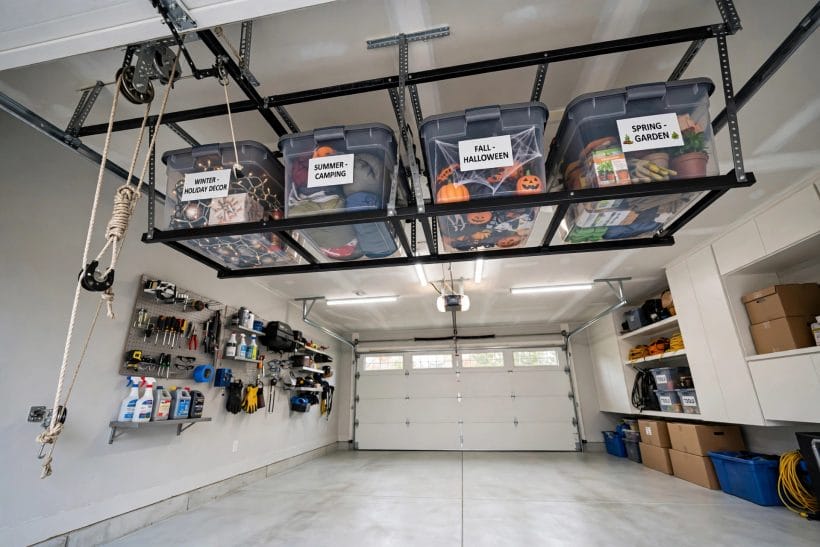
Above head height, over the parked car, lies the garage’s largest unused volume. The infographic calls ceiling racks smart; they are, provided their loads are light, rare and honestly fixed.
28. Overhead racks for the seasonal harvest
Ceiling-mounted racks take the decorations, camping gear and suitcases that are light, bulky and rarely needed.
29. Only light and rare things go overhead
The rule that keeps ceiling storage safe: if it is heavy, sharp or weekly, it does not live above a car. Gravity audits every overhead decision eventually, so make the audit boring by keeping loads gentle.
30. Pulley lifts for bikes and kayaks
A simple pulley hoist raises a bike or boat to the ceiling with modest effort and stores it flat against the joists. It suits tall garages and long objects that defeat every wall in the building.
31. Loft boards in the roof space, where structure allows
Some garages can board part of the roof void for storage; whether yours can is a structural question for a professional, not an assumption. Trussed roofs in particular are often designed to carry the roof, not a library of boxes.
32. Long things stored horizontally high
Ladders, timber lengths, skis and pipes store flat along the high wall or ceiling line on paired brackets. Horizontal and high beats vertical and leaning — leaning things fall, and they fall on cars.
33. Label the overhead bins from below
A label on the underside-facing end of each ceiling bin lets you read the rack from the floor. Seasonal storage you must ladder up to identify is seasonal storage that breeds duplicate purchases.
34. Keep the door’s travel zone clear
The garage door’s arc and tracks own their slice of ceiling absolutely. Anything stored must clear the door’s full travel with room to spare — test with the door open before the rack is loaded, not after.
35. Ventilation and damp still apply up high
Warm, damp air rises, so the ceiling is not automatically the dry zone. Cardboard degrades and fabrics mildew in a damp garage at any height; plastic bins and a ventilated building are the honest protections.
6. Tools and the Workbench Zone
A garage that stores tools well also works well: the bench zone is where organisation turns into capability. Everything here follows the feature photograph’s bench — clear top, tools on the wall, small parts in drawers.
36. A bench with a genuinely clear top
The bench’s surface is workspace, not storage; the test is whether a project can start within a minute of walking in. Everything that lives on the bench permanently should fit in one hand’s count — the rest has a home elsewhere.
37. Hand tools on the wall, outlined
Pegboard or cleats above the bench, tools hung in a fixed order, their places learned by the hands. Outlining each tool’s silhouette is an old workshop trick that makes a missing tool visible from across the room.
38. Power tools in cases, on a low shelf
Power tools live in their cases or on a dedicated low shelf near the bench, with chargers together on one strip. Cables coiled rather than knotted, batteries stored following their makers’ guidance, and nothing charging forgotten for a season.
39. A tool chest for the serious collection
When hand tools outgrow the wall, a rolling chest with shallow drawers sorts them by family and wheels to the work.
40. Task lighting over the bench
Good organisation includes light: a bright, shadow-free fitting over the bench and a portable lamp for the car’s engine bay. Work done in gloom is how screws vanish and tempers shorten; light is a storage system for patience.
41. A vice and a sacrificial bench top
A mounted vice turns the bench from table to workshop, and a replaceable top layer takes the scars of a decade’s projects. Both are cheap; both make the difference between a garage that stores and a garage that serves.
42. Consumables corralled by the bench
Sandpaper, blades, tape, glue and fixings — the consumables every project eats — live in labelled drawers at the bench, as in the feature photograph. Running out mid-project is usually just finding-out-late that the drawer was empty.
43. A reset ritual after every project
The zone stays a workshop only if every project ends with ten minutes of return-and-wipe. Tools hung, offcuts binned or racked, the top clear: the ritual is the storage system, and the furniture is merely its scenery.
7. Bikes, Sports and Outdoor Gear
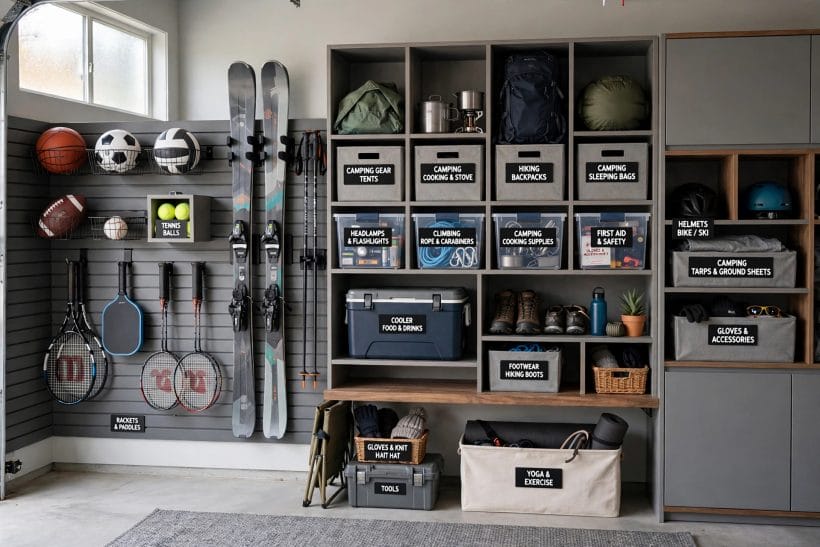
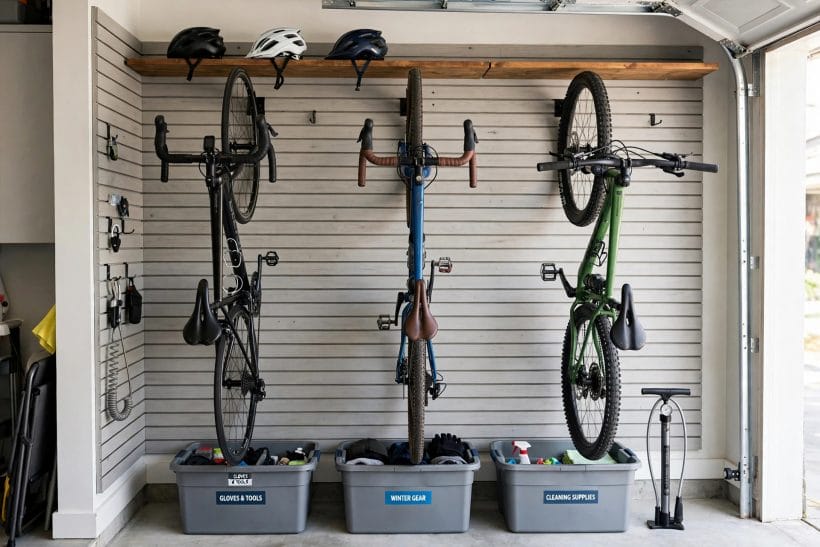
Bikes and gear are the garage’s space thieves: bulky, awkward and used in bursts. The infographic prizes bike storage neat and wall-mounted; this section gives every wheeled and seasonal thing its honest place.
44. Bikes on wall hooks, front wheel up
A sturdy hook through the front wheel stores a bike vertically against the wall in little more than its own width. Fixed into structure and spaced so handlebars clear, a row of bikes takes less floor than one bike left leaning.
45. A floor rack where walls are precious
Where walls carry shelving already, a simple floor stand that takes front wheels in slots keeps family bikes upright and ride-ready by the door. It trades a strip of floor for zero drilling — sometimes the right bargain.
46. Ceiling hoists for the rarely ridden
The tandem, the spare bike and the outgrown one belong overhead on hoists, out of the daily fleet’s way.
47. Balls, bats and rackets in a tall bin or net
Round things roll and long things slide; a tall open bin, a mesh bag on a hook or a corner rack corrals them. Sports gear stored visibly gets used; sports gear buried gets replaced.
48. Camping gear in one labelled stack
Tent, sleeping bags, stove and lanterns in one zone of matched bins, packed clean and dry, makes departure a half-hour’s loading rather than a day’s excavation. A kit list taped inside the top lid keeps the stack complete between trips.
49. Garden tools on a long-tool rack
Spades, forks and rakes hang by their handles on a rack or rail along the garden zone’s wall, blades down and edges safe. Long tools leaned in a corner are a rake-trap of legend; racked, they take a hand’s breadth of wall.
50. The mower and bulky machines in their own bay
Lawn machinery earns a floor bay against a wall, with fuel stored per its maker’s guidance and away from ignition sources. A painted line or a mat under the machine also catches the drips that announce themselves in spring.
51. Wet and muddy gear gets a drying corner
Boots on a tray, waterproofs on hooks, a mat that can be hosed: outdoor gear arrives wet and should never travel straight into closed bins. A drying corner near the door keeps the rest of the garage — and its stored fabrics — honest.
8. Cars, Floor Space and Access
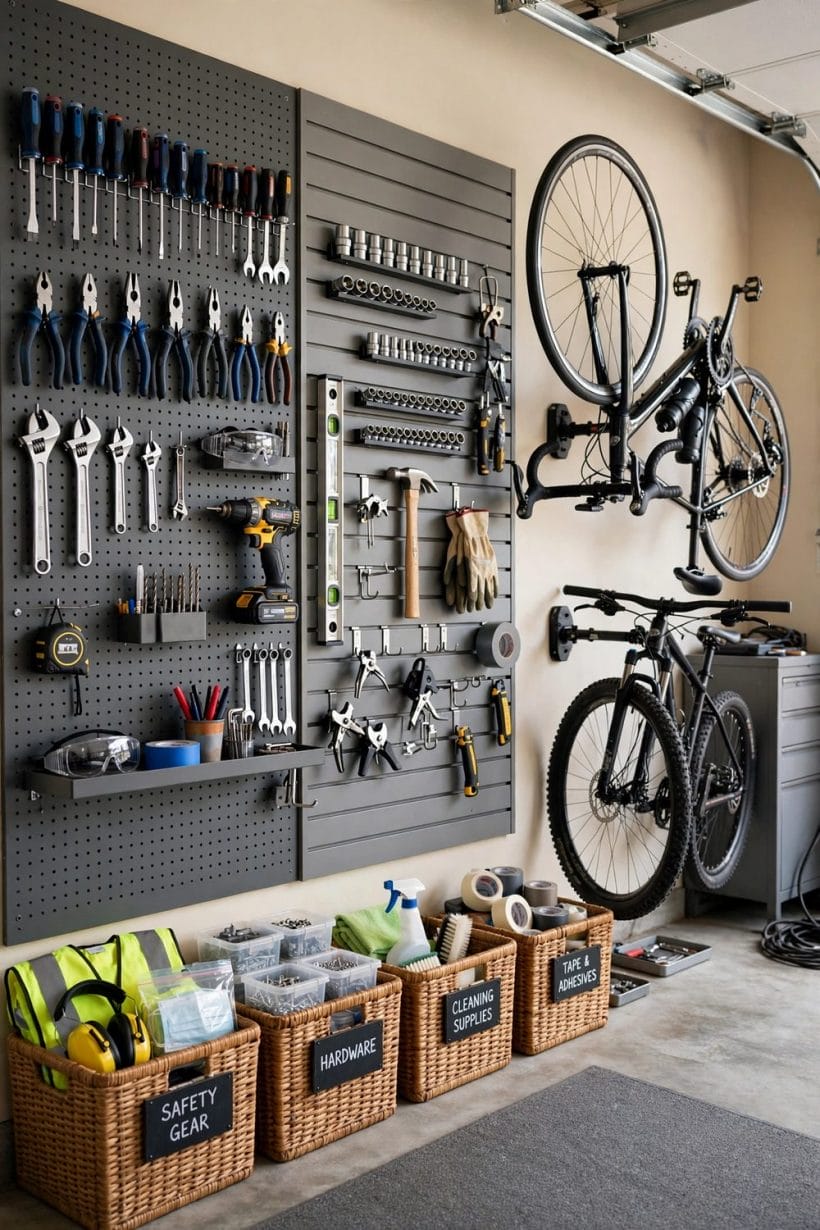
Storage exists to serve the car, not evict it. These ideas protect the parking, the door swings and the daily walk from house to driver’s seat that a successful garage must never tax.
52. Paint or tape the parking bay
A line on the floor marking the car’s footprint — and the swing of its doors — turns an intention into a boundary everyone can see. Storage creep respects visible lines far longer than it respects remembered agreements.
53. Door-swing clearance on both sides
Open every car door fully and mark where it reaches; nothing stores inside that arc. The garage that protects its doors from its own shelving is a garage whose car stays undinged by its own house.
54. Slim storage on the car’s wall
Where the parking is tight, the wall beside the car takes only shallow storage — flat panels, hooks, slim cabinets. Deep racking belongs on the walls the car does not flank; the building’s width is spent where it costs nothing.
55. A clear walkway from house door to car
One route, wide enough for a person carrying shopping, kept permanently clear. If the walk to the car involves sidling, the layout has failed at its most-tested daily task, whatever its shelf count says.
56. Bump protection where doors open
A strip of foam or a guard board on the wall at door height is an unglamorous, honourable piece of storage design. It costs almost nothing and forgives the daily inch of misjudgement forever.
57. Keep the garage door’s path sacred
Nothing stored where it can roll, lean or be knocked into the door’s opening or its tracks. The door is the garage’s largest moving part; its operating zone is a storage exclusion zone without exceptions.
58. Seasonal floor items get wheels
Tyre stacks, the pressure washer and other heavy seasonal machines live on dollies or castored bases, so the floor they occupy can be swept and they can move without a hernia. Mobility is a storage feature, not a luxury.
59. The five-minute exit test
A working garage passes this test: from deciding to leave, the car can be out within minutes, moving nothing but the door.
9. Seasonal, Hazardous and Awkward Items
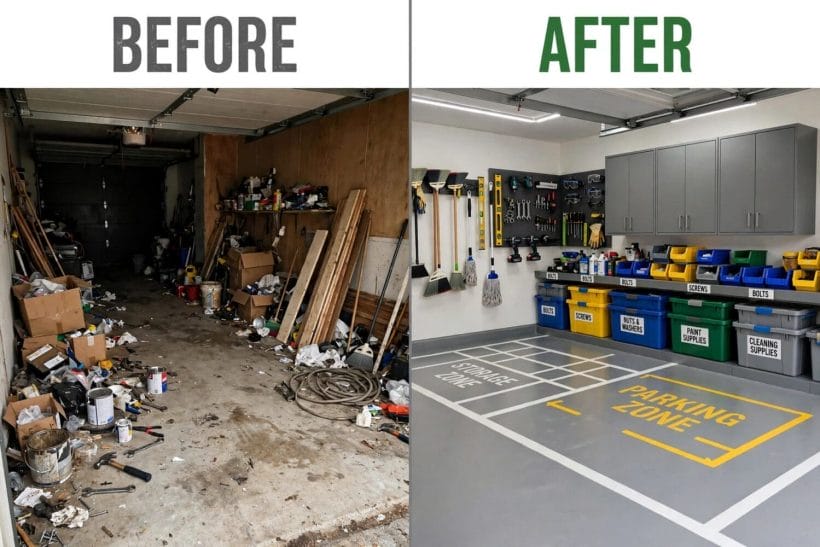
Every garage inherits the awkward squad: decorations, paint, ladders, the artificial tree. Stored deliberately they are harmless; stored casually they colonise. This section gives each its containment.
60. Decorations in sturdy, labelled bins
Holiday decorations are fragile, seasonal and strangely multiplying — rigid bins, one per occasion, labelled with contents and year of last edit. Storing them high or deep follows the frequency rule; padding them follows the fragility rule.
61. Paint stored safely and recorded
Leftover paint keeps best sealed, labelled with its room and colour, off the floor and away from frost and heat, following the maker’s guidance. A simple list inside the cabinet door ends the purchase of a third tin of the same white.
62. Chemicals high, locked and original
Garden and household chemicals stay in their original labelled containers, in a secure cabinet, never in drink bottles, never within children’s reach. Anything expired leaves through the local hazardous-waste route, not the household bin.
63. Ladders racked horizontally
A ladder stored flat on wall brackets or overhead hooks cannot fall, trip or be climbed by an unsupervised child. Its rungs also stay clean of the paint-pot duty that leaning ladders always seem to volunteer for.
64. Tyres stacked or racked, away from heat
Spare and seasonal tyres store stacked flat or on a rack, out of sunlight and away from heat sources, per the tyre maker’s guidance. A cover keeps dust off; a label keeps the rotation honest between seasons.
65. Suitcases nested and used as storage
Empty suitcases nest inside each other and can hold the soft seasonal things — ski clothes, spare bedding — that otherwise eat a shelf. Label the outer case; a suitcase is only storage if its contents are written on it.
66. Offcuts and materials on a dedicated rack
Timber lengths, pipe and board offcuts collect on one slim rack, sorted by type, with a ruthless length below which scraps are recycled rather than kept. Materials without a rack become the pile behind the door within one project.
67. The one-in, one-out rule for the awkward squad
Seasonal and bulky categories grow by stealth, so the household rule is simple: a new bulky thing’s arrival names the thing that leaves.
10. Care, Costs and Choosing
The last eight ideas are the ledger. A garage system is bought once and lived with daily, so the choosing questions are about honest capacity, fixings and upkeep — with costs stated as the drivers they are, since prices vary too widely by place and material for any figure here to be honest.
68. Cost driver: the wall length you fit
Panels, rails and racking are priced by the run, so the fitted wall’s length is the budget’s skeleton. Fitting one wall completely usually beats scattering small systems across all four — depth of system beats breadth of gesture; the cost of the building itself is a separate question, priced as drivers in the detached garage cost guide.
69. Cost driver: steel, timber or plastic shelving
Racking material sets both price and honest capacity: steel for heavy loads, timber for a workshop feel, plastic for damp-prone lightness. The maker’s load rating for each shelf — checked, not assumed — is the number that matters, whatever the material.
70. Fixings are the safety budget
Wall systems are only as strong as their fixings into the wall’s structure. Spending on proper fixings, and taking time to find studs or solid masonry, is the least visible and most important money in the whole project.
71. Buy the bins after measuring the shelves
Bin sizes should be chosen against real shelf dimensions, bought as one family, and counted before purchase. The classic error — beautiful bins that waste a hand’s breadth on every shelf — is entirely a measuring error.
72. Damp decides what may store
A garage that condenses will ruin fabrics, cardboard, photographs and tools at any level of tidiness. Ventilation, sealed bins for the vulnerable, and nothing precious in a damp building: organisation cannot fix a building problem, only respect it.
73. A seasonal reset keeps the system true
Twice a year, an hour: zones checked, labels renewed, the donations shelf emptied, the bay lines re-defended. Systems decay by inches between resets; the reset is cheaper than the reorganisation it prevents.
74. Security for what the garage holds
Tools and bikes are among a household’s most portable valuables, so the door’s locks, the window’s sightlines and what is visible from the street are part of storage design. Follow local advice on securing outbuildings; do not advertise the collection.
75. The stranger test for the whole system
Finally: could a stranger, told only the zones, find the tyre pump and put it back correctly? If yes, the garage is organised.
Final Considerations
An organised garage is not a showroom; it is a building that answers questions quickly — where is it, can the car get out, can a stranger put it back. Zone it first, build upward second, label everything third, and defend the floor as if the car pays rent, because in space it does. The cost drivers are the fitted wall’s length, the shelving’s material and the honesty of its fixings; the running cost is a short reset each season. Start with the feature photograph’s simple trio — racking, clear bins, real labels — and the rest of this post is refinement.




0 Comments