
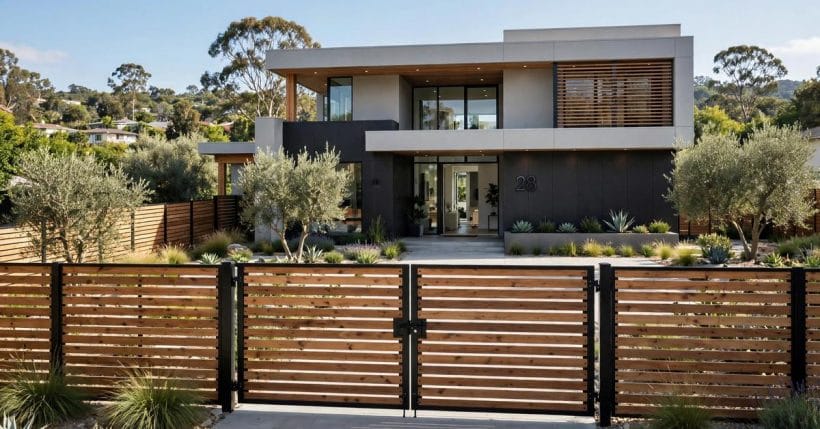
Clean lines, honest materials and a gate that glides rather than groans — the modern boundary does its security quietly and lets the architecture do the talking.
These seventy-five modern gate and fence ideas cover gate types and materials, the contemporary design language, matching fence panels, posts and hardware, automation and lighting, privacy and planting, and the care and cost drivers behind a boundary built as one composition.
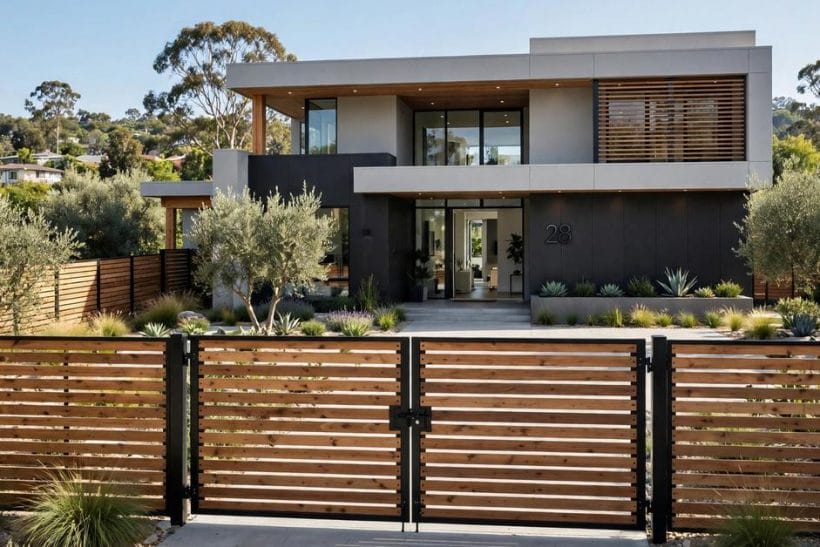
1. Modern Gates and Fences at a Glance
A modern gate is a designed object in a designed fence line: horizontal lines, flat profiles, restrained colour and hardware that works without theatre. This post is the modern style only, within the wider family gathered by the gate ideas pillar — the forged tradition is treated in wrought iron gates and the garden scale in its own post, both linked from the sections they belong to. Here, gates and their fences are specified together, because a modern gate in a tired fence is a sentence in the wrong paragraph — and that discipline of line, material and restraint is modern gate design in one sentence.
| Question | Short answer |
|---|---|
| What makes a gate modern? | Clean horizontal or vertical lines, flat profiles, minimal visible hardware, restrained colour and materials used honestly — steel, aluminium, timber slats, composite |
| Swing or sliding? | Decided by the drive’s slope and space: swings need a clear arc, sliders need a straight run of fence to retire along |
| Gate and fence together? | Always — one design, one material conversation, one colour decision across the whole boundary |
| What about safety? | Stated generally only: gates, automation and fixings follow the makers’ instructions and local rules; powered gates in particular need professional installation and their safety devices fitted and maintained |
| What does it cost? | Drivers only: the opening’s width, material, the fence run’s length, automation and groundworks |
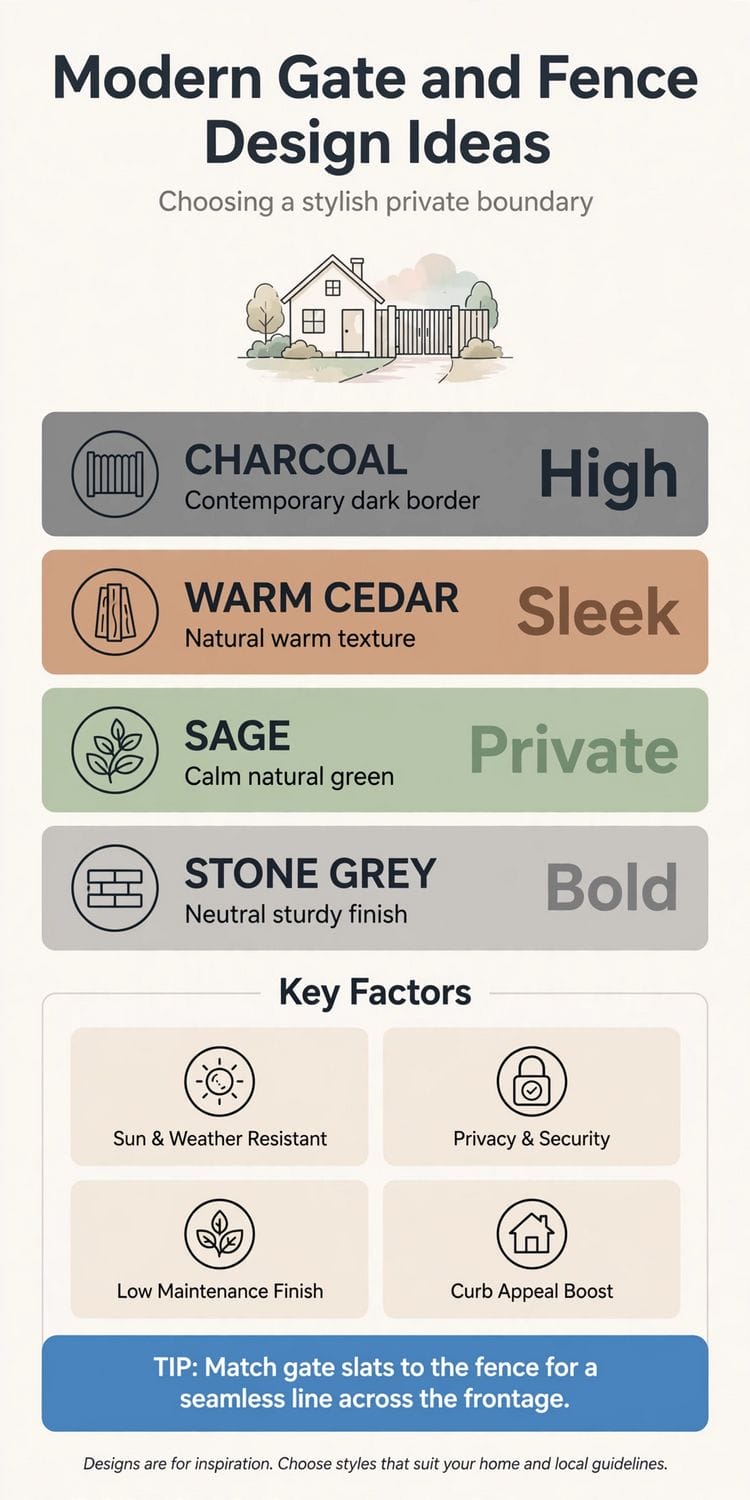
2. Gate Types: Swing, Sliding and Cantilever
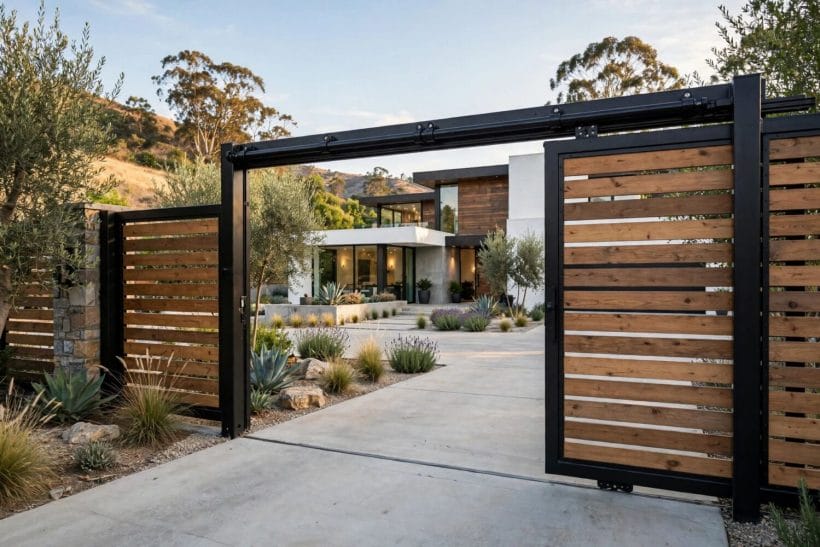
Movement is the first decision: how the gate opens decides its posts, its groundworks and half its hardware. Choose by the drive’s geometry, not by the brochure’s favourite.
1. The single swing gate, simple and honest
One leaf on two well-set posts suits modest openings on level drives. Its arc must stay clear forever — plant, park and store nothing where the leaf travels.
2. Double swing gates, the symmetrical classic
Paired leaves meet at the middle with ceremony and suit wide, level entrances. Two leaves mean two sets of hinges, stops and latches working in agreement — specify them as a system, not as two single gates.
3. The sliding gate for drives without an arc
A slider retires along the fence line, asking no arc of the drive and coping with slopes that defeat swings. It needs a straight, clear run of fence at least its own width — measure the boundary before falling for the mechanism.
4. The cantilever gate, floating over the drive
Cantilevered sliders carry their weight on posts beside the opening, with no track across the drive to clog with gravel and leaves. They suit drives where a ground track would suffer, at a higher hardware cost honestly paid.
5. The tracked slider, the economical rail
A wheel running in a ground track is the simpler sliding mechanism, asking only that the track be kept swept. On tidy paved drives it is the budget-honest slider; on gravel it is a maintenance subscription.
6. A pedestrian gate beside the vehicle gate
Walkers, post and the school run deserve their own small gate with its own latch, sparing the big leaf a hundred daily openings. Matched in design, it completes the boundary’s manners.
7. The five-bar’s modern descendants
Rural boundaries translate the field gate into flat steel or horizontal timber with contemporary detailing — same honesty, modern lines. It is the right modern gate where the lane, not the suburb, sets the tone.
8. Bi-fold and telescopic gates for short runs
Where the fence line cannot spare a slider’s full run, folding or telescoping leaves compress the mechanism into less boundary. More moving parts buy the compression; reputable makers state their systems plainly.
9. The gate that is mostly fence
On wide modern frontages, one long sliding leaf in the fence’s own slats disappears into the boundary when closed. It is the minimalist’s ideal — security that reads as architecture, not equipment.
3. Materials: Steel, Aluminium, Timber and Composite
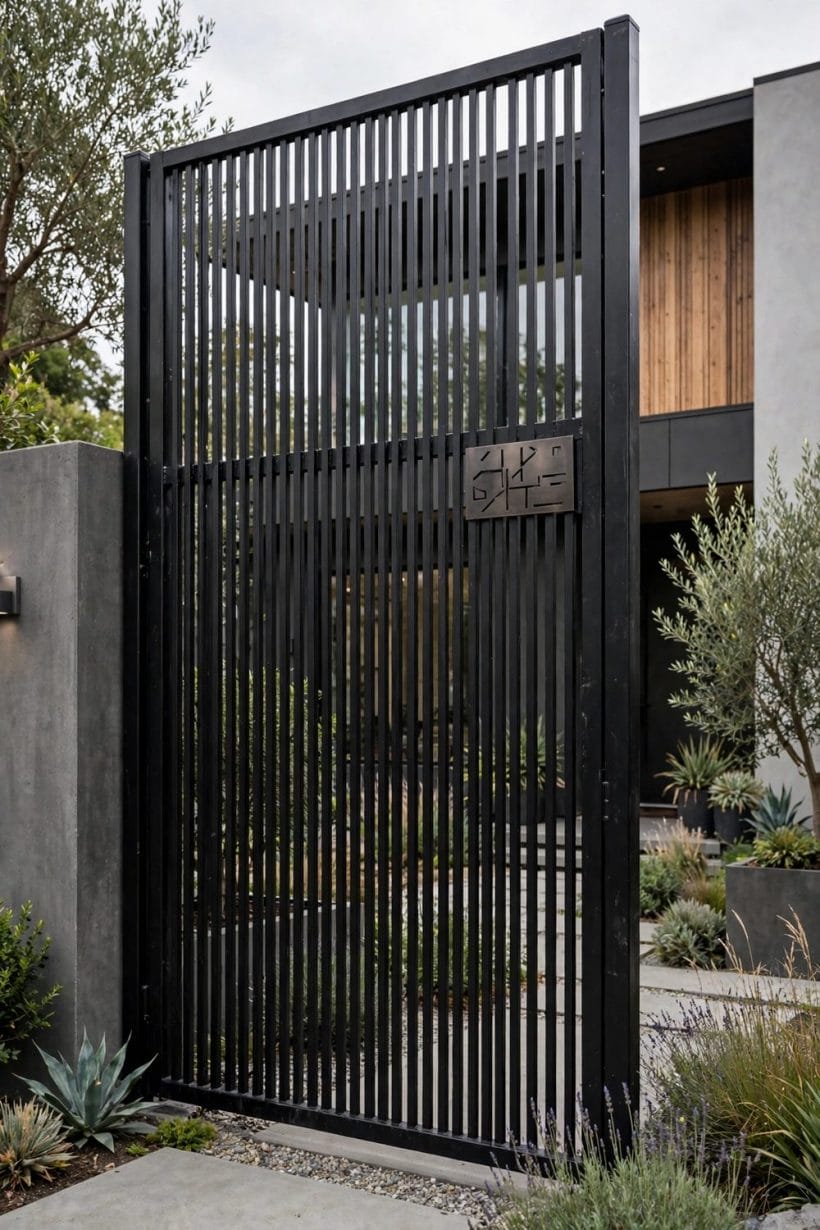
Material decides the gate’s weight, its mechanism, its upkeep and much of its price. Each modern family below is honest when specified well — the failures are usually specification failures wearing a material’s name.
10. Powder-coated steel, the strong default
Steel gives slim profiles real strength and takes a powder-coated colour beautifully. Its protection is its coating: damage touched in promptly keeps rust a rumour rather than a resident.
11. Aluminium, the light modern leaf
Aluminium slats and frames make wide gates light enough for easy manual use and gentle automation, and they shrug off coastal air. The horizontal-slat gate of the feature photograph, framed in black, is this metal’s favourite modern disguise.
12. Timber slats for warmth in the lines
Horizontal or vertical timber battens warm the modern line and pair with planting like no metal can. Timber asks for its finish maintained on schedule — accepted knowingly, it ages with grace; neglected, it advertises.
13. Composite boards that imitate timber
Composite slats offer the timber look with a fraction of the upkeep, in colours that stay put. Quality varies; established makers publish their construction and guarantees — read them as you would for a door.
14. Corten and weathering steel, the rust that protects
Weathering steel forms its own protective rust skin and suits bold, architectural boundaries in russet. It stains paving while it weathers and never stops being a statement — choose it as both, deliberately.
15. Mesh and perforated panels for light security
Modern welded mesh or perforated sheet keeps sight lines open, suits planting behind it and secures without a wall’s heaviness. The hog-wire tradition’s modern cousin — the panel fence treated in hog wire fence ideas — shares its see-through honesty.
16. Glass and the very modern boundary
Frameless or framed glass panels serve contemporary houses and pool-adjacent boundaries where rules allow, specified for safety by the maker. It is the highest-maintenance transparency — every mark shows, and its owners accept the squeegee as rent.
17. Mixed materials, composed carefully
A steel frame with timber infill, or aluminium slats between masonry piers, can be the best of both — structure from metal, warmth from wood. One mixture per boundary, repeated consistently, reads as design; three read as leftovers.
18. Ask what the finish’s life honestly is
Coatings, colours and timber treatments all carry makers’ guidance on maintenance intervals. A gate is bought for decades; the ten minutes spent reading its finish’s future is the cheapest research on the boundary.
4. The Modern Design Language: Lines, Slats and Colour
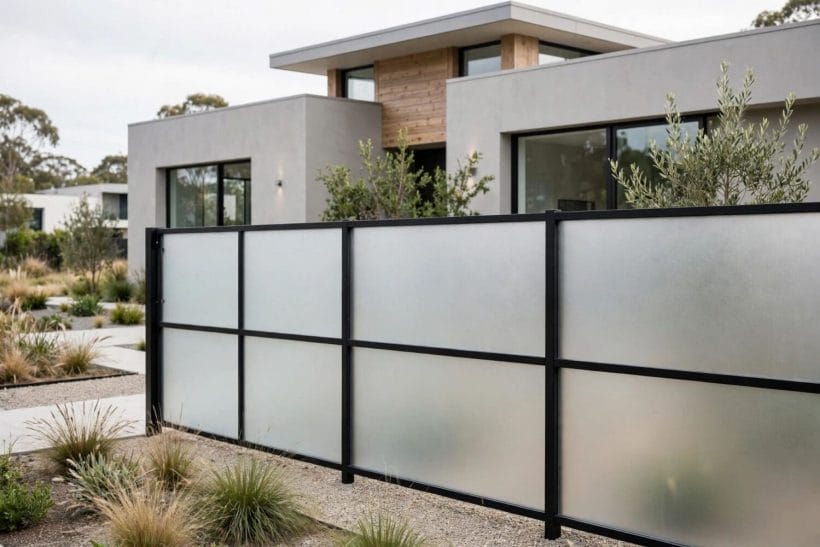
Modern boundaries speak in lines: horizontal or vertical, evenly spaced, sparingly coloured. This section is the grammar — the decisions that make a gate look designed rather than merely new.
19. Horizontal slats, the signature line
Evenly spaced horizontal boards or bars lengthen a frontage and calm a facade — the modern gate’s most recognised sentence. Spacing is the style: consistent gaps, carried through gate and fence without interruption.
20. Vertical slats for height and rhythm
Vertical battens draw the eye up, suit taller boundaries and narrower frontages, and cast a striped shadow that animates a plain wall. They also shed water and leaves off their tops less readily — a cleaning note, honestly filed.
21. Solid panels for the private frontage
Where privacy rules, flat solid panels in one restrained colour make the boundary a calm wall with a gate in it. Texture — a fine profile, a shadow gap — is what keeps solidity from becoming blankness.
22. Shadow gaps and the floating effect
A deliberate dark gap between slats or beneath a floating panel gives modern work its lightness. The gap is engineered, not accidental: consistent depth, consistent width, or the effect collapses into mere unevenness.
23. Charcoal and black, the modern defaults
Dark grey and black are the era’s boundary colours for a reason: they recede, flatter planting and forgive grime. On the gate they also make silver hardware and house numbers read like jewellery.
24. Timber tones against dark frames
Warm slats inside a charcoal frame is the modern compromise nearly everyone loves — architecture’s line, nature’s temperature. Keep the timber tone one, repeated, never a patchwork of stains.
25. White and pale boundaries, used knowingly
A pale fence brightens a shaded frontage and suits coastal and Mediterranean houses — and shows every splash of road dirt. Choose it where the setting is kind and the hose is near.
26. House numbers and hardware as the only ornament
Modern boundaries take their decoration from function: a beautiful numeral, a clean handle, a letterbox built into the fence line. Restraint is the style; these few objects carry its whole jewellery budget.
27. Repeat the fence’s line in the gate, exactly
Gate slats should continue the fence’s spacing and levels across the opening, so the closed gate reads as boundary, uninterrupted. Misaligned lines across a gate are the modern style’s most visible failure — measure the rhythm before manufacture.
5. Fence Panels That Match the Gate
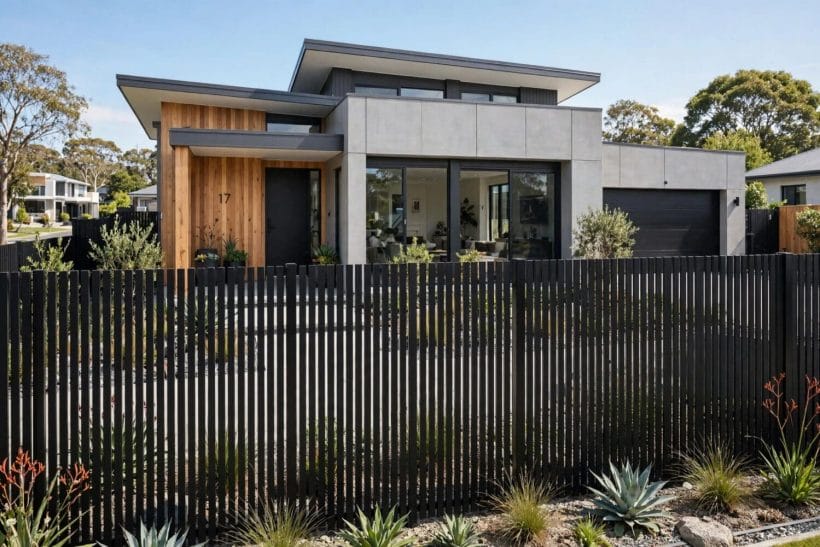
The gate is one bay of a long decision. These fence ideas keep the whole boundary in one language — the garden-scale version of the same discipline lives in the garden gates post and its fences.
28. Slatted panels continuing the gate’s spacing
The fence’s slats pick up the gate’s exact spacing and height line, running the rhythm unbroken to the boundary’s ends. From the street, gate and fence become one drawn line with a moving part in it.
29. Solid panels where the garden wants privacy
Along the private sides, solid panels in the same colour family give the garden its walls while the frontage stays slatted and open. One boundary, two manners, one palette: the transition happens at the corners, deliberately.
30. Masonry piers between modern panels
Brick, stone or rendered piers divide long modern runs into bays, lending the fence a permanence panels alone cannot. Piers also carry lights, numbers and the gate’s posts with architectural conviction.
31. A plinth or gravel board at the ground line
A low board or masonry plinth lifts timber and composite panels off the wet ground and gives the boundary a clean foot. It is the fence’s skirting board — small, structural and the difference between ten years and twenty.
32. Stepped panels on sloping ground
Slopes are answered by stepping panels level by level — the modern manner — rather than raking them into parallelograms. Steps planned with the posts keep the top line dancing evenly down the hill.
33. The return fences: sides and back in the same family
Boundaries are walked from inside too; side and back fences in the same language, even simplified, make the garden feel designed whole. The cheap back fence behind a fine front gate is a secret the garden always tells.
34. Gates within the fence: the garden gate repeated
Side and garden gates repeat the front gate’s line and colour at smaller scale — the garden gates post’s whole subject. A household of matching gates reads as one mind at work, which is the definition of a designed boundary.
35. Neighbour boundaries, handled with manners
Shared fences carry legal and neighbourly dimensions that vary by place; establish ownership and heights through local guidance before building. A beautiful fence built six inches into a dispute is neither beautiful nor, soon, a fence.
6. Posts, Foundations and Hardware
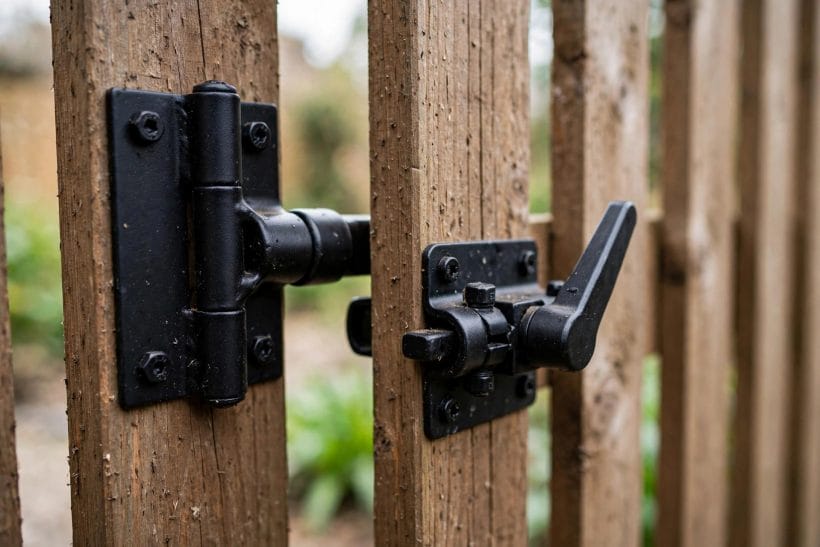
Gates fail at their posts and hinges, almost never at their panels. This section spends the budget where physics spends its forces — the unglamorous engineering under every elegant line, kin to the ironwork discipline in wrought iron railing.
36. Posts sized for the leaf they carry
A wide, solid, automated leaf is a sail with opinions; its posts and their footings are engineered for its weight and wind. Makers and installers publish requirements — the post is specified, never guessed.
37. Footings below the frost and the fuss
Concrete footings of honest depth keep posts plumb through winters and dry summers alike. A gate that drops a fraction each year is a footing confessing — set them right once, at the start.
38. Hinges with adjustment in them
Adjustable hinges let the installer true the leaf on day one and re-true it in year five as ground and gate settle. On modern minimal gates, the hinge is often the only visible hardware — choose it like jewellery that lifts weights.
39. Stops, latches and the closed position
A gate needs a definite closed position: ground stops, a latch or lock that engages without lifting and grunting. Manual gates especially live or die by the feel of their close — test display gates with your own hand.
40. Drop bolts and centre stops for double leaves
Paired leaves are secured by drop bolts into ground sockets, keeping the meeting point honest in wind. Sockets kept clear of gravel and leaves are the whole maintenance of the idea.
41. Rollers, tracks and guides for sliders
A sliding gate’s wheels, track and guide rollers are its moving skeleton, specified for the leaf’s weight by the maker. Keep the track’s line swept and the rollers inspected; sliders fail by neglect in instalments.
42. Anti-lift and security fixings, generally
Hinges and panels can be specified so leaves cannot simply be lifted off, and fixings chosen with security in mind — stated generally, detailed by your installer against local advice. The boundary’s strength is its least visible specification.
43. Galvanising and protection inside the steel
Where steel is used, its corrosion protection — galvanising beneath the colour, drainage that lets sections dry — decides the gate’s decades. Ask what protects the inside of the tube, not just the face you photograph.
7. Automation, Access and Lighting
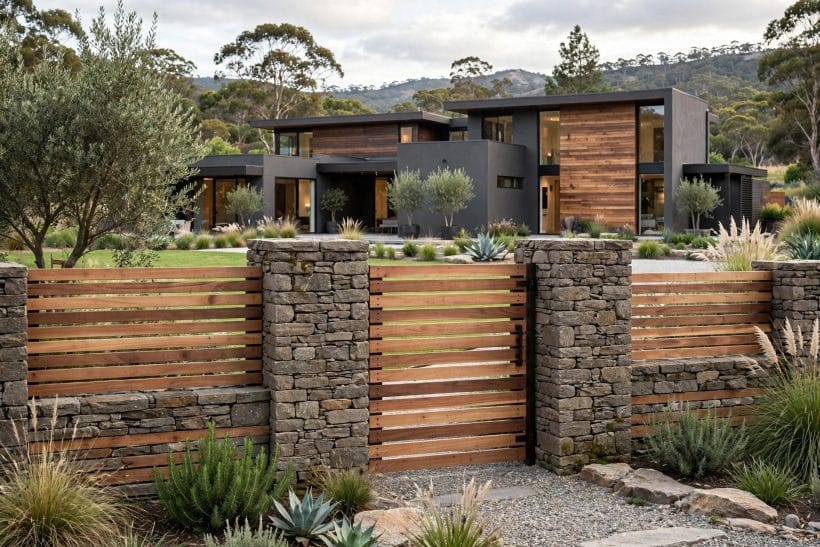
Powered gates are machinery in the garden: specified, installed and maintained as such, they are a daily pleasure. Every safety point here is stated generally — follow the makers’ instructions and local rules, and use qualified installers for powered systems.
44. Motors matched to the gate’s real weight
Automation is specified against the leaf’s actual weight, size and the site’s wind and slope, from the maker’s own ratings. An under-specified motor fails expensively; an honest one is invisible for years.
45. Safety devices fitted and maintained
Powered gates must have their safety features — as the manufacturer and local rules require — installed, tested and kept working: this is professional territory, not a weekend improvisation. Keep the installer’s documentation and test on their schedule.
46. A manual release you have actually used
Every automated gate can be opened by hand when power fails; know where the release is, keep its key findable, and practise once in daylight. The first power cut should not be the tutorial.
47. Keypads, fobs and intercoms at the post
Access control lives on a post at the gate: a keypad, a fob receiver, an intercom or camera where the household wants one. Position it for a car window’s reach and a pedestrian’s alike, sheltered from the worst rain.
48. Lighting the gate and its number
A lit house number and a soft light over the keypad serve callers, deliveries and the household’s own midnight returns. Light the task, not the whole street — the modern boundary lights like it designs, sparingly.
49. Loops, sensors and the drive’s choreography
Where fitted by professionals, ground loops and beams let gates open for the car and close behind it on schedule. Such systems are specified as a whole with the motor — additions belong to the installer, not to enthusiasm.
50. Pedestrian mode and the small opening
Many systems can open the leaf a pedestrian’s width — kinder to the mechanism than a hundred full cycles. If the household walks more than it drives, say so at specification time and the system can be tuned to its real life.
51. Battery backup and storm honesty
Backup power keeps the boundary working through cuts, sized to the gate’s appetite. In storm country, also know the manual drill and keep the track clear of the debris the weather delivers free of charge.
8. Privacy, Security and the Boundary’s Manners
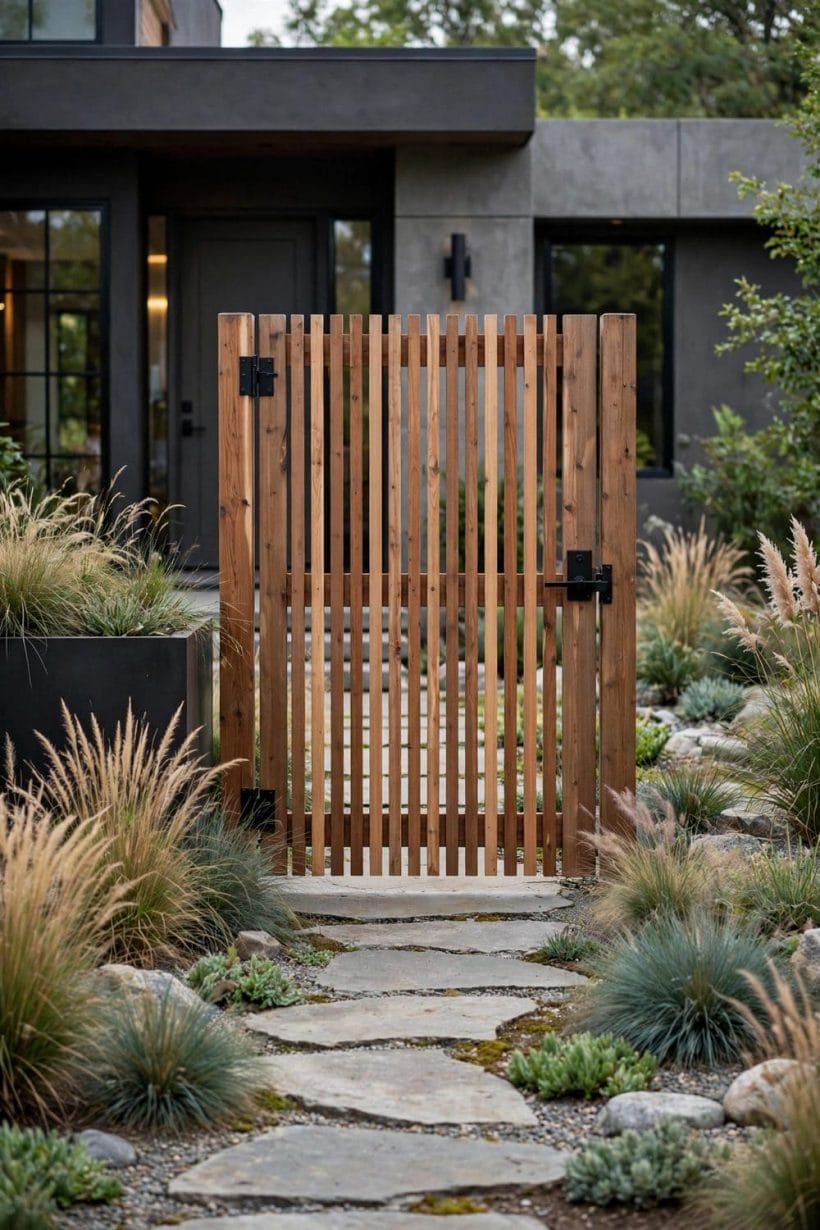
A boundary has two duties that must not quarrel: keep the household private and secure, and remain a good neighbour to the street. These ideas balance both, with security stated generally throughout.
52. Heights that follow local rules
Fence and gate heights are governed by rules that vary by place and by position on the plot. Establish the permitted envelope first, and design beautifully inside it — the tallest legal boundary is not always the wisest one.
53. See-through at the drive’s exit
Where the gate meets the road, visibility for leaving cars and passing pedestrians is a safety matter: keep planting and solid panels back from the sight lines. Local guidance governs; eyesight and patience govern daily.
54. Solid gates for private frontages
A solid modern gate gives a front garden or drive complete privacy — the house’s outdoor room gets its wall. Balance it with the street: one house’s fortress is every neighbour’s view, so let materials and planting soften the fact.
55. Slatted gates: privacy with light in it
Slats at the right spacing dissolve views at an angle while admitting light and air — privacy as a filter, not a wall. Tested from the pavement at standing eye level, the spacing proves itself or gets tightened.
56. Locks and latches from recognised ranges
Gate locks, like door locks, come from established makers with published standards, fitted to the gate’s material by people who fit them daily. The pedestrian gate, used most, deserves the same seriousness as the vehicle gate.
57. Planting as the soft security layer
Thorny or dense planting inside the boundary discourages the casual climb and pleases everyone law-abiding who looks at it. It is the oldest security planting knows — stated generally, and planted for beauty first.
58. Deliveries and the boundary’s hospitality
A parcel box, a bell that reaches the house, a gate routine for callers: security that ignores hospitality makes prisoners of the household. Design the stranger’s arrival as carefully as the stranger’s exclusion.
59. The boundary from inside: a garden wall’s duty
From the garden, the fence is a backdrop lived against daily — worth its finished face, its planting pockets and its share of the garden’s beauty budget. The front porch ideas pillar teaches the same lesson at the house’s own threshold: boundaries are rooms’ walls, seen from both sides.
9. Planting and the Streetscape
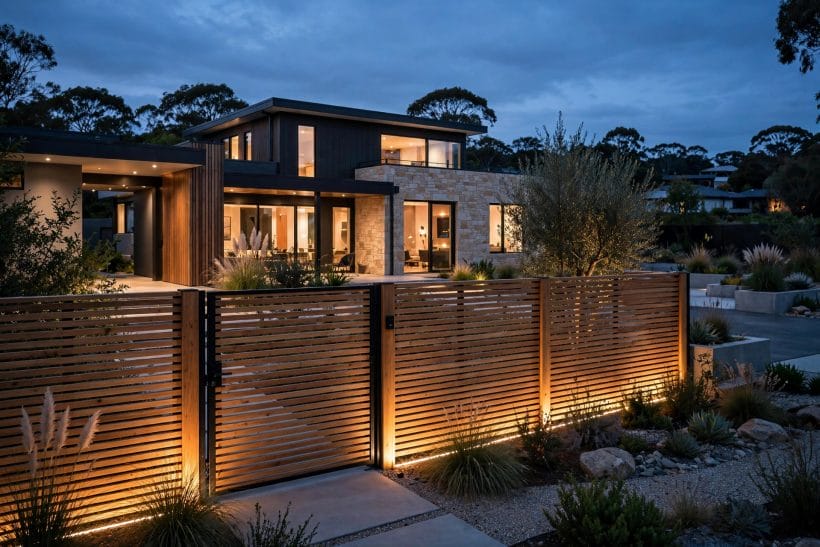
A modern boundary planted well disappears into the street’s greenery at exactly the right moments. These ideas wed the line to the landscape without letting either swallow the other.
60. Hedging in front of the fence line
A clipped hedge inside or outside the panels softens the modern line and doubles the boundary’s privacy across the seasons. Evergreen structure carries the winter; the fence carries the gaps the hedge has not grown into yet.
61. Grasses and perennials at the slats’ feet
Ornamental grasses and long-season perennials at a slatted fence’s base animate its strict geometry with movement. The contrast — drawn line above, meadow below — is the modern boundary’s favourite photograph.
62. Climbers on mesh and open panels
Where the fence is open-work, climbers can green it into a living wall across a few seasons, on supports planned for their weight. Keep growth off the gate’s moving parts and out of its track, forever and without exception.
63. Trees that frame the gate
A small tree either side of the entrance, or one specimen the gate’s line points to, gives the boundary its vertical punctuation. Root and canopy distances from posts and footings are a nursery’s and an arborist’s honest counsel.
64. The verge and the pavement’s edge
The strip between fence and road — grassed, planted or gravelled as local custom allows — is the boundary’s public face. Kept tidy, it makes the whole frontage look governed; neglected, it argues the opposite at kerbside volume.
65. Lighting planted, not floodlit
Low lights in the planting, washing the fence’s texture and marking the path, keep the night boundary elegant. The modern streetscape glows in pools and lines, never in glare.
66. Seasonal honesty in the planting plan
Choose planting that holds the design in the household’s least favourite season, not only in the brochure’s June. Evergreen bones, winter stems and spring bulbs share the year’s work like a rota.
67. Wildlife through the boundary
Hedgehog gaps at the fence’s foot, where local custom encourages them, and planting that feeds birds and pollinators make the modern boundary a good citizen of its ecosystem. Security and hospitality, it turns out, compose at garden scale too.
10. Care, Costs and Choosing
The last eight ideas are the ledger. A gate and fence are bought once and used daily for decades, so the choosing questions are about specification, groundworks and upkeep — costs stated as the drivers they are, since prices vary too widely by place, width and material for any figure here to be honest.
68. Cost driver: the opening and the run
The vehicle opening’s width sets the gate’s engineering, and the fence’s total length sets the material bill — together they are the budget’s skeleton. Measure the whole boundary honestly before pricing any part of it.
69. Cost driver: groundworks and posts
Footings, drainage, power supply for automation and making good the drive’s surface are the invisible half of most boundary budgets. Quotes that exclude groundworks are not cheaper gates; they are later invoices.
70. Cost driver: automation and access
Motor, safety devices, controls, intercom and backup power accumulate as a system. Priced at specification time they are a decision; added later they are a disruption — plan the powered life from the first drawing.
71. Care: moving parts on a rhythm
Hinges oiled, tracks swept, rollers and safety devices checked on the maker’s schedule, finishes inspected each year. Gates fail by neglected smallness — the calendar is the maintenance.
72. Care: finishes and the first scratch
Powder-coat touched in, timber refinished on schedule, composite washed: the finish is the material’s only advocate against the weather. The first scratch is the cheapest one you will ever repair.
73. Choosing the installer by their questions
Good gate installers ask about slope, wind, soil, power and use before quoting a leaf. Prefer the firm whose questions outnumber its brochures — the boundary will be standing on their answers for decades.
74. Permissions and boundaries, checked first
Heights, positions, shared boundaries and any local rules for powered gates are checked before manufacture, through local guidance. Retrospective permission is the most expensive kind, paid in both money and neighbourly warmth.
75. The decades test for the street’s edge
Finally: this boundary will be the street’s picture of your house for a generation of neighbours not yet arrived. Choose the gate and fence that will still look inevitable — clean, sound and quietly secure — when every car on the street has changed twice.
Final Considerations
A modern gate and fence succeed when they read as one quiet sentence along the street: the right movement for the drive, materials specified honestly, lines repeated exactly between gate and fence, posts and hardware engineered rather than hoped for, and automation treated as the machinery it is — professionally installed, its safety devices maintained, its manual release understood. The cost drivers are the opening, the run, the groundworks and the powered system; the running cost is a short rhythm of sweeping, oiling and inspection. Decide the whole boundary at once, and it will guard the house with the same calm it shows the street.




0 Comments