

A tiny kitchen forgives very little. Counter depth, cabinet storage, ventilation and your energy system all collide in the small space where you cook, so the stove you choose shapes far more than dinner. The propane vs induction tiny kitchen decision is really a decision about energy: do you want your cooking fuel stored in a tank that you refill on a schedule, or drawn as electricity from batteries that you have to recharge every day? Both systems cook beautifully when they are matched to the home wrapped around them, and both disappoint when they are not. This guide compares the two honestly, attribute by attribute, so you can see exactly where each one earns its place in a small home, and where each one quietly asks you to compromise.
We will work through how each hob actually makes heat, how it fits an off-grid energy budget, how precisely it controls temperature, what it does to the air inside a small and well-sealed home, what it costs to run at different fuel and electricity prices, and how safe its surface feels around children, pets and tight walkways. After that we cover cookware, installation, everyday cooking and long-term upkeep. There is no universal winner waiting at the end. A full-time off-grid household in a cold, shaded valley and a shore-powered tiny home in a mild city are solving two different problems, and by the final verdict you should know exactly which of those problems looks like yours, and which stove solves it with the least friction.
Propane vs Induction Tiny Kitchen at a Glance
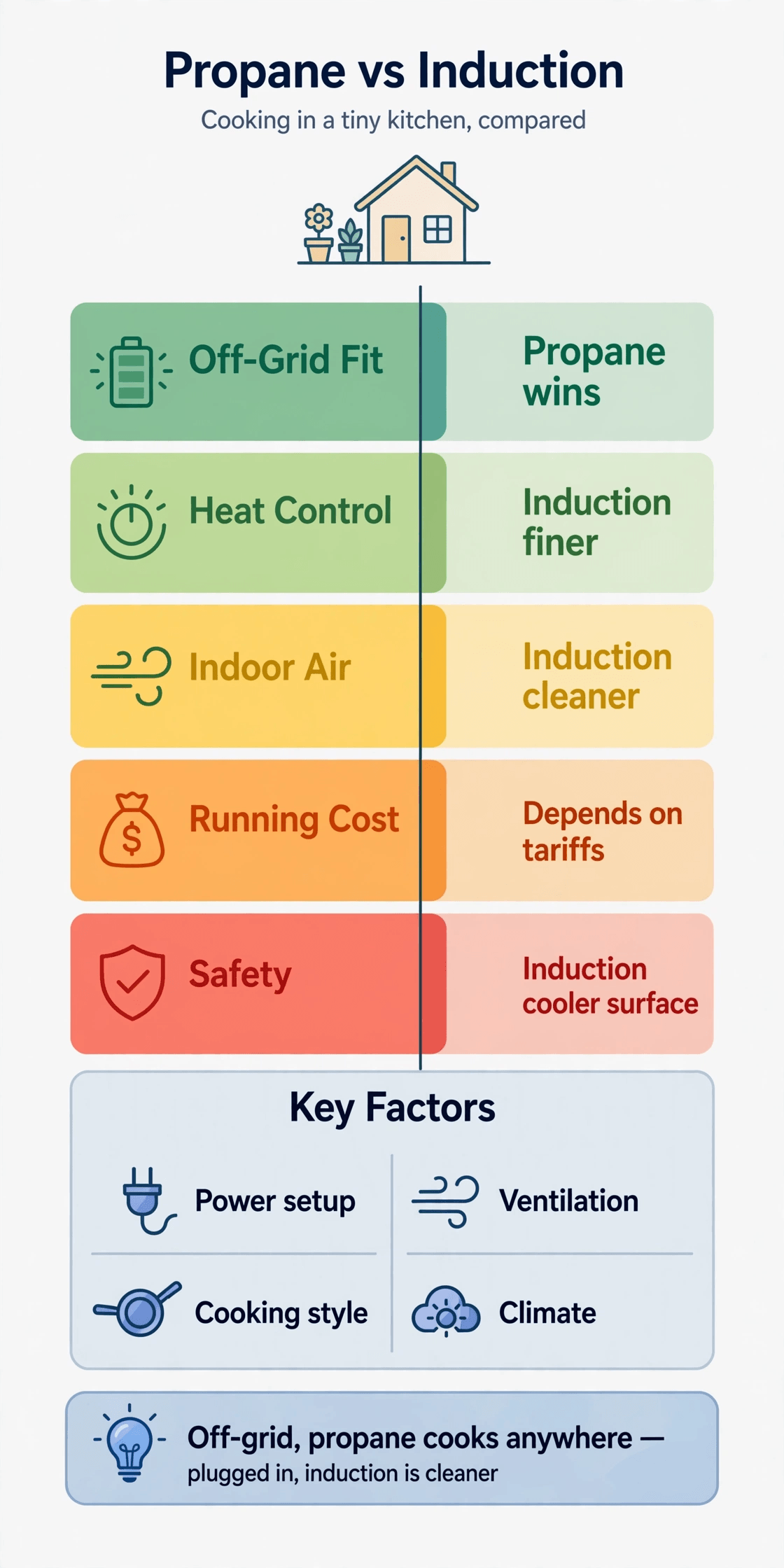
The table below compresses the whole comparison into the criteria that matter most in a small kitchen. Read it for the quick answer, then use the numbered sections that follow for the practical detail behind every row.
| Criterion | Propane | Induction |
|---|---|---|
| Energy source | Stored gas in a refillable tank | Electricity from shore power, solar or batteries |
| Off-grid fit | Excellent; cooking stays off the battery bank | Demanding; needs a large battery and inverter |
| Heat control | Instant flame you can see and judge by eye | Precise digital settings, very steady low heat |
| Indoor air quality | Burning gas adds moisture and combustion gases | No combustion at the hob; food fumes still need venting |
| Running cost | Follows local fuel prices and refill trips | Follows your electricity tariff or solar surplus |
| Surface safety | Open flame and hot grates near walkways | Glass stays comparatively cool, no flame |
| Cookware | Works with almost any pan | Needs a magnetic pan base |
| Installation | Gas line, regulator, ventilation and leak checks | Electrical circuit, adequate wiring and ventilation for steam |
| Best for | Off-grid homes, cold climates, flame cooks | Shore-powered homes, solar surplus, safety-first layouts |
1. How Each Cooking System Works in a Small Kitchen
A propane hob is a controlled open flame. Gas travels from an outdoor tank through a regulator and a flexible line to burners under a grate, and the flame heats the pan directly while hot gases wash up its sides. The system is mechanical, familiar and completely independent of your electrical setup: if the tank has fuel, you can cook, whether or not the sun shone today. Turning the knob changes the flame instantly, and generations of cooks have learned to judge that flame by eye, sound and experience rather than by a number on a display.
An induction hob never makes a flame at all. Under its glass surface, a copper coil creates a rapidly changing magnetic field, and that field generates heat inside the base of the pan itself, provided the pan is made of a magnetic metal. The glass around the pan stays far cooler than the pan, energy goes into the food rather than the room, and the hob switches off when the pan is lifted away. If you are weighing the wider fuel question for the whole home, our guide to propane vs electric in tiny houses, including tank sizing and energy demand, gives useful background before you commit to either side of this comparison.
2. Off-Grid Fit: Stored Fuel vs Battery Capacity
Propane separates cooking from your electrical budget entirely. A tank stores a large amount of cooking energy in a small outdoor footprint, releases it on demand in any weather, and does not care about short winter days or a week of cloud. For a tiny home that also runs lights, a fridge, devices and water pumping from one battery bank, keeping the biggest daily heat load off that bank is a genuine structural advantage. Your solar array can be sized for electricity alone, and a grey week becomes an inconvenience rather than a cooking emergency.
Induction folds cooking into the same budget as everything else, and cooking is hungry work. Boiling, frying and oven-style dishes on an electric hob draw heavily on the inverter and drain batteries quickly, especially at breakfast and dinner, which are exactly the hours when solar input is weakest. It can absolutely work off grid, but it has to be planned like a major appliance: a generous battery bank, an inverter that comfortably carries the load, and an array that refills what dinner used. Before choosing induction for an off-grid build, study realistic setups in our roundup of off-grid power stations from Jackery, Bluetti and EcoFlow and our planning guide to solar panel kits for tiny homes and battery bank sizing.
3. Heat Control: Visible Flame vs Digital Precision
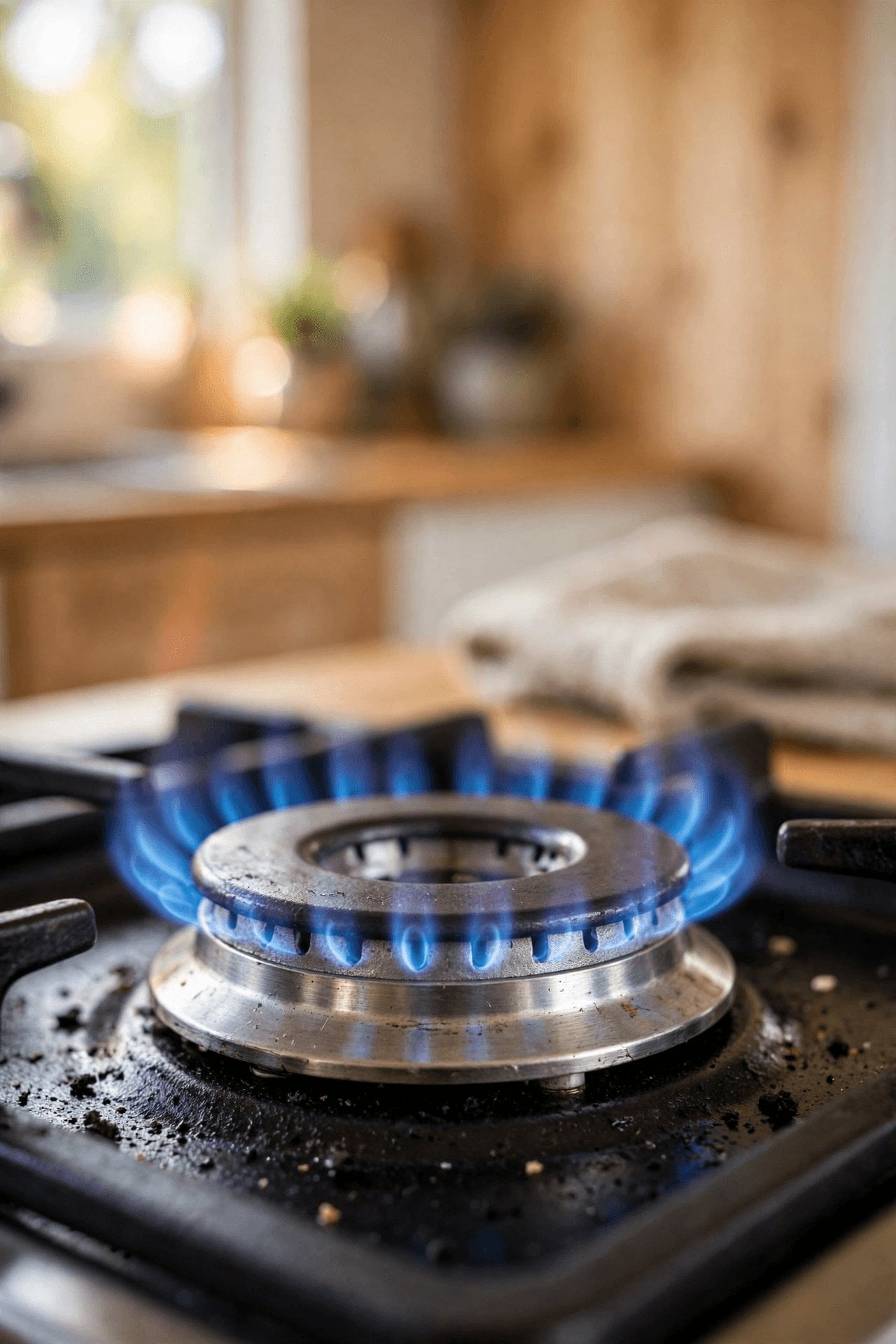
Cooks who learned on gas trust the flame because it answers instantly and honestly. Lift the pan and the heat is gone; tilt it and you can watch the flame lick or settle in real time. For fast, intuitive cooking, searing, charring peppers or working a wok-style pan in a small sink-side kitchen, that feedback loop is hard to beat. The weakness shows at the bottom end: many small propane burners struggle to hold a truly gentle simmer without flickering, creeping or going out in a draft from an open door.
Induction trades that visual feedback for repeatable precision. Numbered settings hold the same temperature today that they held yesterday, low settings melt and warm without scorching, and timers can cut the heat when you are busy elsewhere in a home where the kitchen is also the hallway. The learning curve is real but short: you cook by number and by listening to the pan rather than by watching a flame. When you are shortlisting the actual unit, the models and sizes in our guide to the best compact kitchen appliances for tiny houses show how much counter these hobs really take up.
Day to day, most people adapt to either style within a few weeks. Choose flame if you cook by instinct and adjust constantly; choose induction if you value a simmer that never needs babysitting in a home where you are often doing three things at once.
4. Indoor Air Quality: Combustion Byproducts vs Clean Electric Heat
Every gas flame burning in a small, tightly sealed home adds water vapour and combustion gases to a very limited volume of air. In a tiny kitchen that moisture shows up quickly as steamed windows and damp corners, and the gases from burning fuel are one more reason a small home needs deliberate ventilation rather than a cracked window and good intentions. None of this makes propane unsafe when it is installed properly, vented and paired with working alarms, but it does mean air quality is an active design task, not an afterthought.
Induction removes combustion from the kitchen entirely. There is no flame consuming oxygen and nothing burning while you cook, so the air burden shrinks to what the food itself produces: steam, oil aerosols and smells, which any kitchen should vent regardless of fuel. If you are planning the ventilation side of a small sealed build, our deep dive into tiny house ventilation with HRV and ERV systems explains how balanced airflow protects both your lungs and the building fabric. For households with asthma, small children or a bedroom loft directly above the kitchen, this cleaner profile is often the single strongest argument for induction.
5. Running Cost: Fuel Prices vs the Electricity Tariff
Honest cost talk for either system has to stay qualitative, because both prices are local. Propane running cost follows the fuel price in your area, the size of tank you can fit, and the hidden cost of refill trips: a household that drives an hour to swap a small cylinder pays more per meal, in money and time, than one with a larger tank filled on a delivery route. What propane does give you is predictability. A tank empties slowly, cooking is only one of its jobs if it also feeds heating or hot water, and the cost per meal stays modest in most regions.
Induction running cost follows your electricity tariff, or, off grid, the value of the solar energy it consumes. On an affordable grid tariff with off-peak rates, electric cooking can be very reasonable, and every meal cooked at midday from surplus solar is effectively cooking with energy that might otherwise go unused. On an expensive tariff, or from a battery bank charged by a generator, the same meal costs far more. The whole-home picture in our guide to tiny house utilities for power, water and off-grid sewage helps you place cooking inside your total energy budget rather than judging it in isolation.
6. Surface Safety: Open Flame vs Cool Glass
A tiny kitchen is a walkway. You squeeze past the stove carrying laundry, children reach across counters, cats patrol every warm surface, and a loose sleeve or tea towel is never far from the action. An open flame in that environment deserves respect: grates stay hot after the flame is off, pans can be knocked, and anything flammable drifting too close is a genuine hazard. Good layout, a habit of turning pan handles inward, and never leaving a lit burner unwatched manage the risk, but the risk is managed, never removed.
Induction removes the flame from that picture. The glass only becomes hot where the pan sits on it, it cools quickly once the pan is removed, many units add child locks, pan detection and automatic shut-off, and nothing can catch light from a surface that never glows. It is not risk-free: a heavy pan of hot oil is dangerous on any hob, and the glass can crack if a full cast-iron pot is dropped on it. But for households with toddlers, dogs, mobility limits or a kitchen that doubles as the entrance hall, induction offers the calmer, more forgiving surface by a clear margin.
7. Cookware: Any Pan You Own vs Magnetic Bases Only
Propane is the diplomat of this comparison. Aluminium, copper, enamel, cast iron, the thin camping kettle and the good skillet you have owned for a decade all work on a flame, and the grate forgives warped bases and rounded bottoms. In a tiny home where every stored object must justify its cupboard space, being able to keep a small, loved, multi-purpose set of pans matters more than in a big kitchen with a cookware drawer.
Induction asks one question of every pan: is your base magnetic? A simple fridge magnet gives you the answer in a second. Stainless steel with a magnetic base and cast iron pass easily; pure aluminium, glass and most copper fail unless they have a bonded induction plate. Many households find most of their kit already qualifies, but budget for replacing a favourite non-magnetic piece or two, and remember that smaller pans must still cover enough of the cooking zone for the hob to detect them. The storage maths is otherwise identical: fewer, better pans, hung on the wall where cupboards are shallow.
8. Space, Weight and Installation in a Tiny Footprint
A built-in propane hob needs more than a hole in the counter. Behind it sits a gas line run to code, a regulator, an outdoor tank on a stable base, ventilation, and clearances from walls and curtains that eat into a small kitchen’s tightest corner. Portable single and twin burner units shrink the footprint and can be stored away to free the counter, at the cost of stricter rules about indoor use and cartridge storage. The tank itself also adds weight that sits outside the home, which suits a house on a foundation better than one that must stay towable.
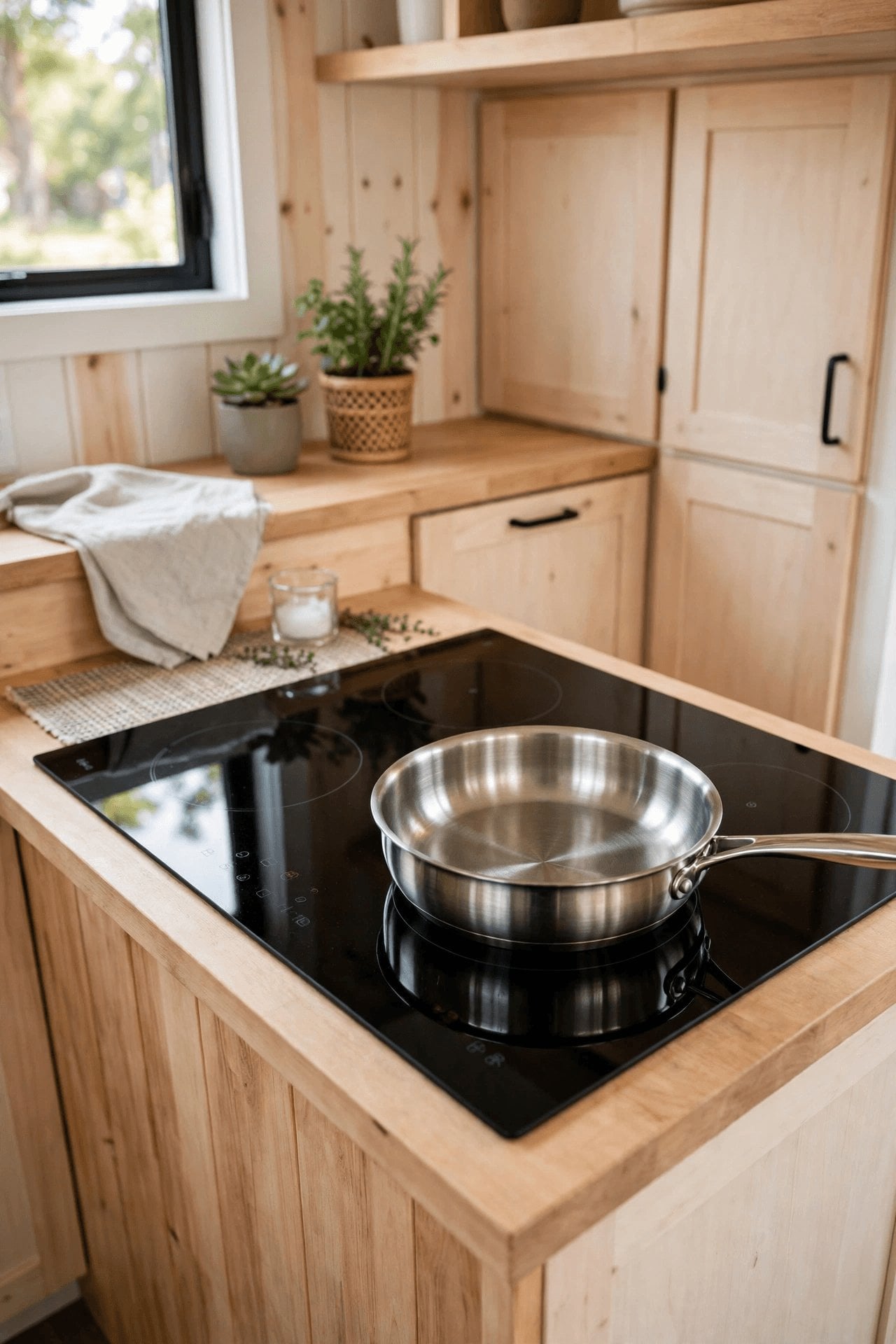
Induction installs like an electrical appliance: a suitable circuit, wiring that matches the load, and a flat cut-out or simply a portable unit that lives in a drawer and comes out at mealtimes. A portable induction plate is arguably the most space-efficient cooker a tiny kitchen can own, because the counter returns to full prep duty the moment it cools. The hidden footprint is upstream, in the battery bank, inverter and cabling sized to feed it. Propane hides its infrastructure outside in a tank; induction hides its infrastructure inside your electrical cupboard. Measure both before you decide which cupboard you can spare.
9. Everyday Cooking: Breakfasts, Boils and Slow Simmers
Real cooking is the test both systems have to pass at seven in the morning. Propane lights instantly, boils the kettle while the home is still cold, and never asks whether yesterday was sunny. It performs steadily in winter, works during a power cut, and lets you fry, boil and bake with the same fuel all day. Its everyday annoyances are small but real: the last of the tank always seems to run out mid-meal, flames blow unevenly when the door opens on a windy site, and summer cooking adds unwanted heat to a small room.
Induction’s everyday magic is speed and calm. Water comes to the boil quickly, porridge holds at a murmur without catching, and the flat glass wipes clean in seconds, which matters when the stove top is also your only chopping surface. Its annoyances are equally real: a flat battery or a tripped inverter means no hot food, some units hum or click at low settings, and touch controls can sulk at wet fingers. Neither list should scare you. Both are simply the texture of daily life with that fuel, and the right question is which set of small frictions you would rather live with.
10. Maintenance, Repairs and Lifespan
Propane upkeep is hands-on and mostly visible. Burners and grates lift off for cleaning, burner ports can clog with boil-overs and need a gentle clear-out, and hoses, regulators and connections deserve regular inspection and occasional replacement as they age. A gas system should be checked for leaks whenever a tank is changed, and any persistent smell of gas means the supply goes off and a professional comes in. The reward for that attention is longevity: a simple hob has few parts, most faults are mechanical, and a competent technician almost anywhere can service it.
Induction upkeep is lighter week to week and trickier year to year. The flat glass needs nothing more than a wipe and a non-abrasive cleaner, there are no ports to clog and no connections to check, and keeping the cooling vents dust-free is the main household task. When something does fail, it is usually electronic, which tends to mean a board replacement or a whole new unit rather than a roadside repair. For a remote off-grid home, that difference matters: the propane hob fails in ways you can often see and fix, while the induction hob mostly refuses to fail at all, until the day it needs a specialist.
Final Considerations
Pick propane if your tiny home lives off grid or moves between remote sites, if your battery bank is modest, if you cook through power cuts and cold dark winters, or if you simply love cooking over a flame you can see. Accept the ventilation, the tank refills and the basic safety habits as part of the package, and you get a cooker that asks almost nothing of your electrical system and works every single day you ask it to.
Pick induction if your home sits on shore power or carries a generous solar and battery setup, if clean indoor air and a cool, flameless surface matter to your household, and if you value a wipe-clean hob that doubles as counter space. Accept the cookware rules and the electrical planning as part of its package. Neither choice is the wrong one in a well-matched home. Match the stove to your energy system first, your cooking style second, and your kitchen will reward you at every meal.


0 Comments