

It is part bed, part porch swing, part childhood memory — a bed that hangs from ropes or chains, rocks almost imperceptibly as you settle, and makes the whole room feel like a holiday.
This guide covers the types of hanging bed, how the suspension and the structure above it actually work, comfort and safety checks, and where a hanging bed earns its place — and where it honestly does not.

1. Hanging Beds at a Glance
A hanging bed is a bed platform suspended from above — by ropes, chains or cables fixed to ceiling joists, beams or a purpose-built frame — instead of standing on legs. The defining attribute is the suspension itself: it frees the floor, introduces a gentle rocking motion, and transfers the entire load of bed, sleepers and movement into the structure overhead. That is why this guide treats the bed and the building as one system: the prettiest platform in the world is only as good as the joists it hangs from and the hardware connecting them.
| What types exist? | Four-point rope or chain suspensions are the classic; two-point and wall-assisted designs swing more freely; daybed and porch-swing formats suit sitting as much as sleeping. |
| Does it actually rock? | Yes — gently. The motion settles within moments and most sleepers find it soothing; restless sleepers and light-sleeping partners are the exceptions. |
| What holds it up? | Ceiling joists or beams, through-bolted or lag-fixed hardware rated for the load, and suspension lines kept as vertical as the design allows. |
| Is it safe? | When engineered and installed properly, yes — the load arithmetic is not difficult, but it is not optional either. This guide’s safety section is the one to read twice. |
| Where does it work best? | Porches, garden rooms, cabins, children’s rooms and calm bedrooms — anywhere the gentle motion and the freed floor are features rather than complications. |
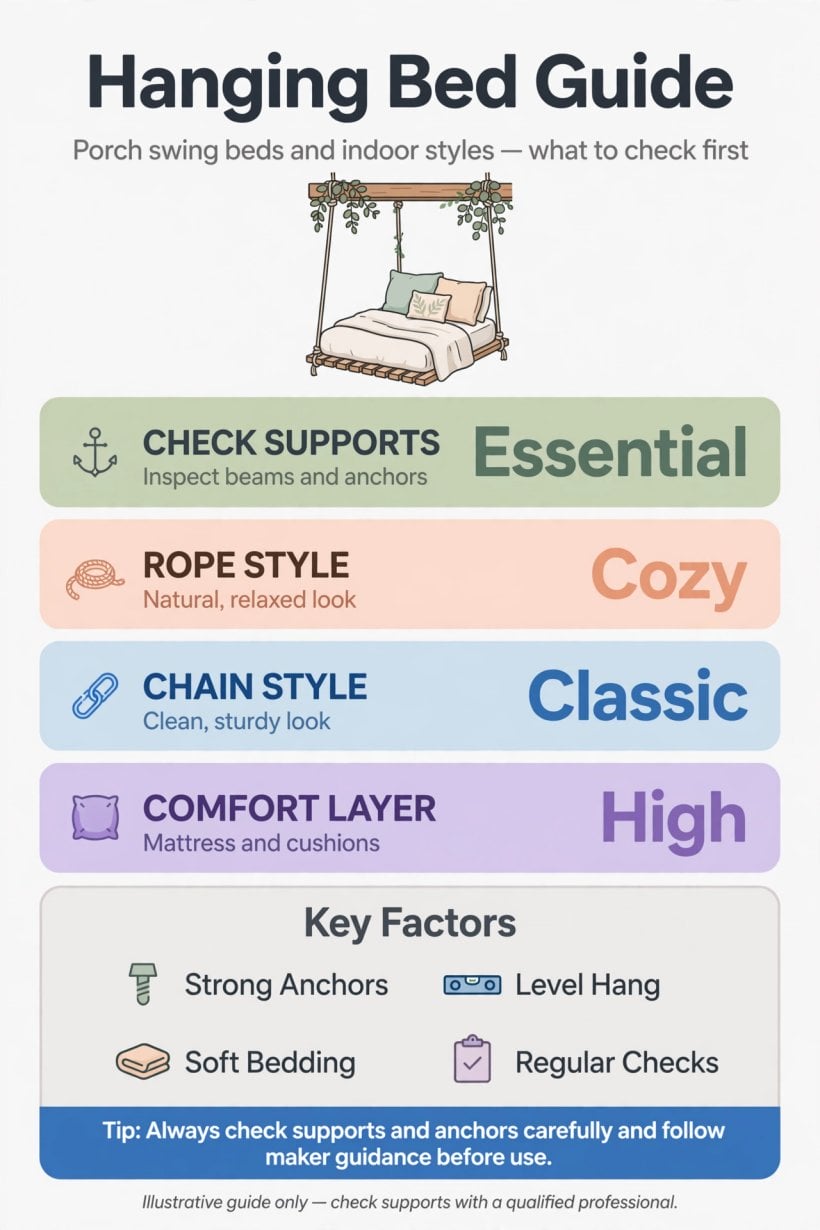
At a glance: a suspended platform, four honest fixing points, and a structure above that was checked before the first rope was tied.
2. Types of Hanging Bed
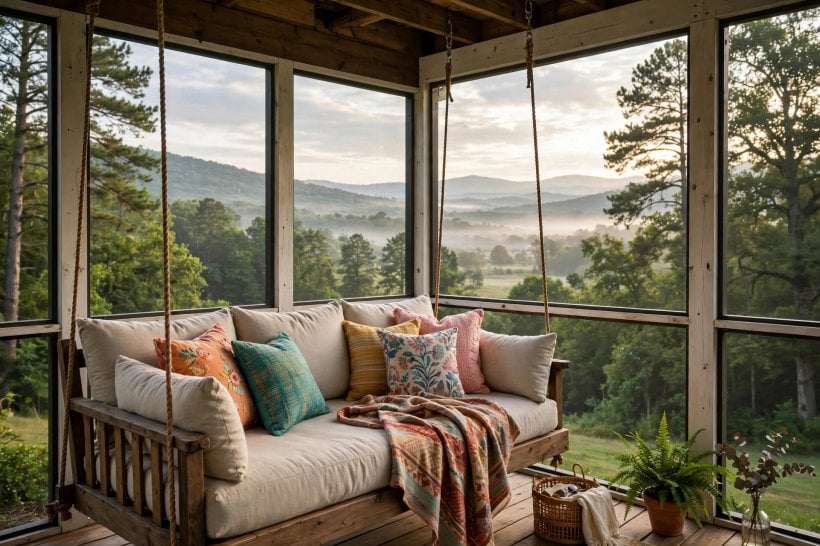
The classic is the four-point suspension: a rectangular platform hung from ropes or chains at each corner, meeting the ceiling at four fixing points roughly above the corners. It is the most stable format, the easiest to level, and the one that behaves most like a normal bed once you are in it. The porch-swing daybed is its sociable cousin — deeper like a sofa, hung on a veranda or in a garden room, dressed with cushions by day and bedding by night. Twin and single versions serve children’s rooms and narrow cabins, where the freed floor underneath is half the point.
At the expressive end sit two-point suspensions, hung like a hammock from head and foot, which swing in a long, slow arc and suit deliberate nappers more than nightly sleepers; and wall-assisted designs, where one long side is hinged or fixed to the wall and only the outer edge hangs, halving the ceiling load and the motion in one decision. Suspended loft beds — a fixed platform hung partly from the structure to remove posts from a tight room — borrow the engineering without the swing. Choosing among them is choosing how much motion you want: four-point for sleep, two-point for sway, wall-assisted for the look with the least movement of all. The small-room layouts in these tiny house bedroom ideas show how much floor a bed normally claims — which is exactly the floor a suspended design gives back.
3. Suspension: Ropes, Chains and Cables

Rope is the romantic choice and a practical one: natural manila suits the rustic look and is kind to hands, while modern synthetic ropes are stronger, smoother and indifferent to damp porch air. Rope’s honest weakness is stretch and wear — it creeps a little over its first weeks, so the bed needs re-levelling once it has settled, and it should be inspected where it passes through holes and around hardware, because that is where fibres fret. Chain is the opposite personality: no stretch, length adjusted link by link for perfect levelling, indifferent to wear, and colder in look and touch — sleeved or paired with timber, it reads industrial and deliberate. Steel cable is the minimal option, near-invisible at a distance, and the one that most demands proper swaged fittings rather than improvised clamps.
Whatever the line, the geometry matters as much as the material. Lines that hang vertically carry the load purely and swing least; lines angled outward to wider ceiling points swing less but multiply the load on each fixing, because angled lines pull sideways as well as down. The comfortable middle most builders choose is near-vertical lines with fixings at or slightly inside the platform’s corners. Turnbuckles or adjustable links in each line make levelling a five-minute job instead of an afternoon of re-tying, and every connection should be metal-to-metal with the rope or chain properly terminated — knots alone, however beautifully tied, are not a termination method for a bed people sleep in.
4. The Structure Above: Joists, Beams and Load Paths

Everything the bed weighs — platform, mattress, sleepers, and the extra forces of movement and of someone sitting down hard on the edge — travels up the lines and into whatever the fixings are attached to. Ceiling joists in most homes are sized to carry a ceiling, not a swinging bed, which is why fixings must land in joists or beams themselves, never in plasterboard, and why spreading the load matters: fixing two lines into the same joist concentrates everything that joist was never asked to hold. Where joists run the wrong way or are too slight, the standard solutions are a timber or steel spreader beam fixed across several joists, or blocking fitted between joists to give each fixing solid, shared timber.
The fixing hardware itself should be through-bolted where access allows, or heavy lag eyes into the heart of the timber where it does not — screwed into the side grain of a joist, never up into end grain or into a ceiling’s decorative layer. This is the section where honesty is cheapest: if you cannot identify the structure above your ceiling, that is a question for a builder or engineer before it is a shopping trip, and older homes, conversions and anything with a questionable ceiling deserve that conversation most. The load principles are the same ones that govern the framing in this guide to framing a tiny house loft — spans, load paths and fixings decide what a structure may carry, and the arithmetic always comes before the aesthetics.
5. Frames, Platforms and Mattresses
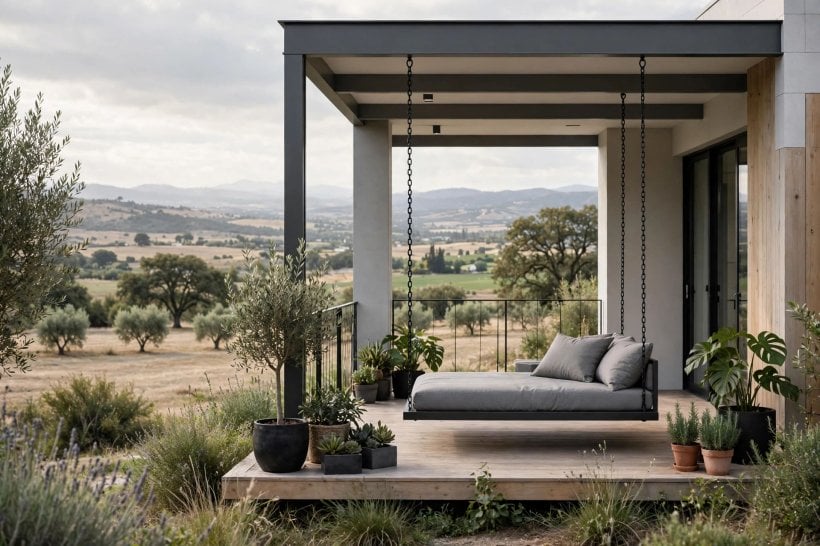
The platform is a raft: a rigid frame, usually timber, with slats or a solid deck to carry the mattress. Rigidity is its whole job — a frame that flexes twists its four lines unevenly and creaks its protest all night, so corners are braced, rails are deep enough to resist sag across the span, and the suspension points are reinforced where the lines attach. A slatted base breathes beneath the mattress and is the better choice in humid rooms and porches; a solid deck suits thin mattresses and futon-style bedding, which many hanging beds use because a deep, heavy sprung mattress adds weight the structure must carry and movement the sleeper may not want.
Weight discipline runs through every choice here. Mattress, bedding and platform all count against the same load budget as the sleepers, so the featherweight frame with a medium mattress is usually the wiser build than the monumental frame with a luxury mattress on top. Headboards are optional and often omitted — a wall-side cushion rail or a row of pillows does the job without the mass. Guard rails deserve a mention for children’s versions and high platforms: a low rail on the open sides is a small addition that parents, in particular, stop worrying about at roughly the moment it is fitted. In cabins and compact rooms, the platform’s clean underside is the visual dividend — the room reads larger because the floor runs unbroken beneath the bed, a trick the layouts in these small bedroom interior design ideas achieve by other means.
6. Where a Hanging Bed Works
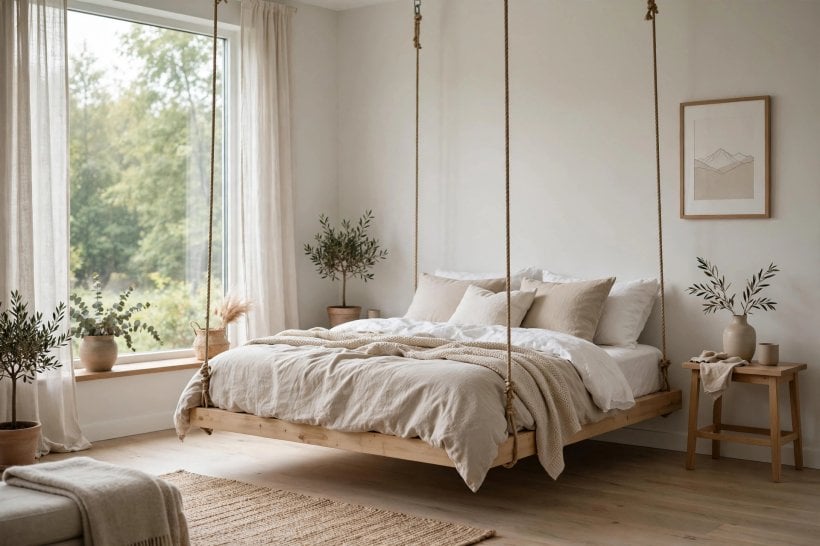
The porch is the format’s ancestral home: a swinging daybed on a veranda is an afternoon institution in warm climates, and the structure there — exposed beams, honest timber — usually makes the engineering easier to see and to trust. Garden rooms, sunrooms and summer houses follow naturally. Indoors, the strongest cases are rooms where the freed floor changes the room’s life: a child’s bedroom that gains a play floor by day, a cabin bunk room where the floor below becomes storage or a second low bed, a studio where the bed floats over a reading corner.
The honest counter-list matters as much. Rooms with low or unknown ceilings, rented rooms where structural fixings are not yours to make, and bedrooms of light sleepers sharing with restless partners are all poor candidates, and no amount of styling fixes a structural or human mismatch. Guest rooms are the sly success case: guests remember a hanging bed for years, and the occasional-use pattern suits a format whose motion is a pleasure for a few nights and a personality test for a few hundred. Placement within the room follows the swing: the bed needs clearance on all sides for its gentle arc, pushed items and nearby furniture must sit outside the swing’s reach, and the wall behind the head needs the same respect as a headboard’s wall — pillows will find it nightly.
7. Comfort and Motion: Sleeping on a Swing
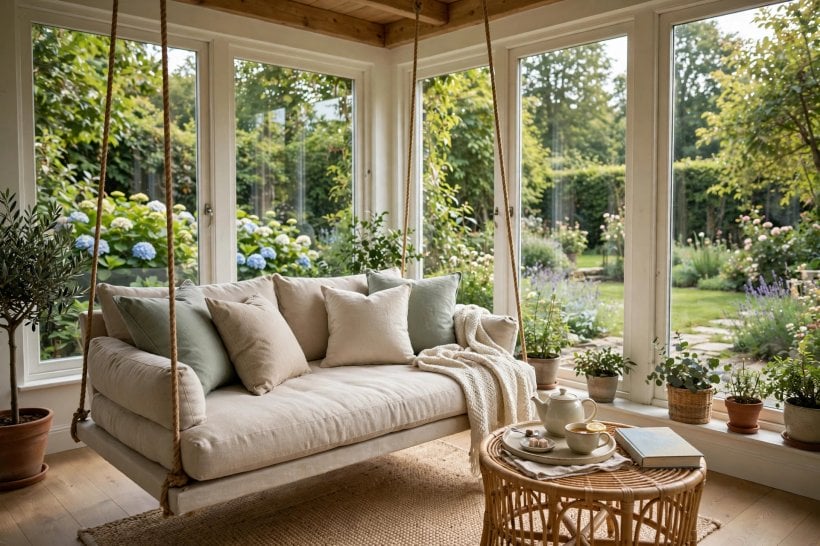
The motion is smaller than visitors expect. A four-point bed settles into a slow, short sway when you climb in, damps itself within moments through the lines and the bedding, and then moves only when you do — turning over sets it gently rocking rather than jolting. Most sleepers report the rocking as the pleasure of the thing, the grown-up version of being rocked to sleep, and many find they fall asleep faster in the first weeks. The exceptions are real: people prone to motion sickness can find even this too much, and two sleepers of very different weights or restlessness share one motion whether they like it or not — one partner’s every turn becomes the other’s small wave.
Practical comfort has its own checklist. Getting in and out is a small skill — sit on the edge, let the bed take you, swing your legs up — and it is genuinely harder for anyone with limited mobility, which is a deciding factor, not a detail. Bed-making is slower on a platform that gives under your knees, and fitted sheets earn their keep. Reading in bed works if the pillows are arranged against a cushion rail; working on a laptop works less well, because the platform answers every keystroke. None of this is hidden cost so much as honest character: a hanging bed trades a little convenience for a great deal of feeling, and the households that love theirs are the ones who priced that trade before they drilled the ceiling. The styling layer that makes it inviting is covered in these tiny house bedroom decor ideas — soft, layered and unprecious is the register that suits a bed with a sense of humour.
8. Styling and Bedding
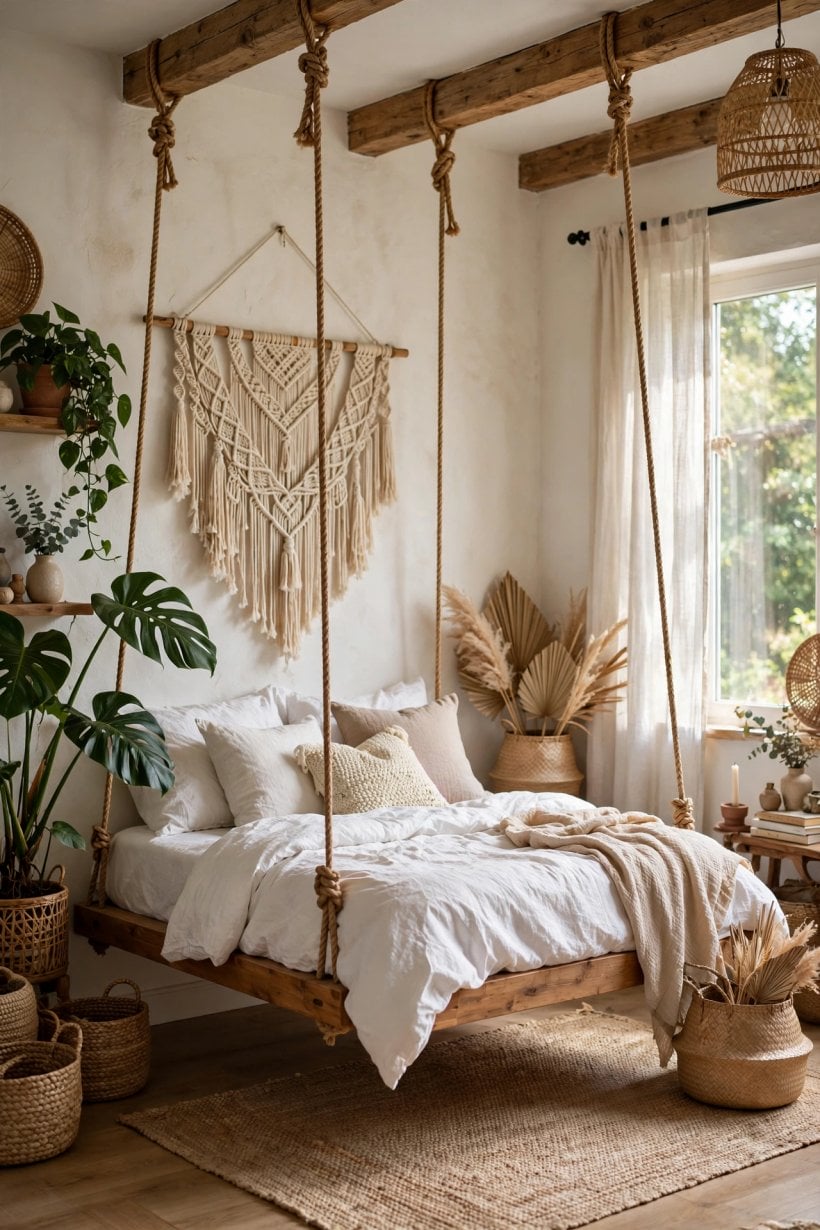
The styling rule is softness against structure. The platform and lines are architectural — straight timber, honest hardware — so the dressing should be the opposite: rumpled linen, layered throws, cushions in depth, nothing too tailored to survive contact with a swinging bed. Light colours and natural fibres suit the porch and garden versions; in bedrooms, the bed takes the room’s full palette because it is unavoidably the room’s centrepiece — there is no wall it can be pushed against and forgotten. Rope sleeving, chain covers and timber wraps at hand height soften the lines where people brush past, and they mark the lines visually, which matters at night.
Lighting and surroundings finish the scene. Reading lights should be wall-mounted or on stands, never on the bed itself; a rug beneath defines the zone and gives bare feet a kind landing, and it must sit inside the swing’s footprint or well outside it, never half under. Under-bed space is the format’s gift — keep it empty and swept so the float reads clearly, or use it for one low, deliberate thing like a trundle, baskets or a dog bed, rather than the usual under-bed drift. Ceiling treatment above the fixings can be left honest: many owners stain or paint the spreader beam to match the platform, turning the engineering into the room’s crown detail. The composed results sit happily among the rooms in these modern tiny house bedroom ideas — calm palettes, natural materials, and one confident idea per room.
9. Safety Checks and Who Should Skip It

The safety regime is short, specific and non-negotiable. Every component in the load path — fixings, shackles, chain, rope, frame attachments — must be rated comfortably above the total load it will ever see, including the dynamic forces of climbing in, children bouncing and the heaviest plausible combination of sleepers. Fixings go into verified structure, installed to the hardware maker’s instructions, and the whole system is load-tested progressively — platform, then weight, then people, in daylight, with someone watching the fixings — before the first night’s sleep. Clearances are checked with the bed loaded and swinging: head, walls, furniture and lights all outside the arc.
Then the living checks: an inspection rhythm — lines for fray where they pass through holes, chain and shackles for wear and slack, fixings for any sign of movement in the timber, the frame’s corners for working joints — run a few times a year and after any unusual load. Children treat a hanging bed as playground equipment unless the household rules arrive first, and bunk-style climbing on the lines themselves is the habit to stop early. Who should skip the format entirely: anyone whose ceiling structure cannot be verified, anyone whose sleepers cannot manage the climb in and out, and anyone who knows, honestly, that inspections will not happen. A bed is the wrong object for optimistic engineering — a conventional bed in a beautiful room beats a suspended one in a worried household, every time.
10. Costs and DIY vs Bought
Costs split into three lines: the platform and mattress, the suspension hardware, and — the one buyers forget — the structural work above the ceiling, which ranges from nothing on an exposed-beam porch to a builder’s day rate where spreader beams or blocking are needed. Ready-made hanging beds and porch swings price the platform and hardware together and sometimes include rated fixings; bespoke joinery prices the platform as furniture. DIY is genuinely feasible for the platform — it is a rigid raft, well within competent woodworking — and genuinely unforgiving in the fixings, which is where the money for rated hardware and, if needed, professional verification should go first.
Judge quotes and kits by asking what is in the load path and what each component is rated for; a seller who answers precisely is selling engineering, and one who talks only about the timber is selling a photograph. The running costs after installation are inspection time and the occasional rope renewal — modest, provided the first installation was honest. Set against the alternatives — a fine conventional bed, a quality sofa bed for the same guests — a hanging bed is a mid-range purchase that returns an outsized amount of delight per night in the rooms it suits. In high-ceilinged rooms it can even stack the plan vertically, as the layouts in these tiny house plans with high ceilings suggest: where the air above a room is generous, a bed that floats uses the room’s whole volume, not just its floor.
Final Considerations
A hanging bed is a simple idea with an engineer’s footnote: a beautiful platform, hung from verified structure, through rated hardware, with clearances respected and inspections kept. Inside those conditions it is safe, deeply comfortable, and the most memorable bed most households will ever own.
Choose the format for a room where the swing is the point — a porch, a cabin, a child’s room, a calm bedroom — and build it in the order this guide insists on: structure first, suspension second, styling last. The rocking is free.


0 Comments