
Every season brings a fresh list of what our homes are supposed to want — and most of it is forgotten by the time the paint dries. Yet a few directions quietly refuse to leave, because they were never really fashion: they are good answers to permanent questions.
This article is a which-trends-last explainer: five home design directions that endure, examined in general terms and in the present tense — what makes each one last, what dates instead, and how to test a direction in your own rooms before committing to it.
1. Home Design Trends at a Glance
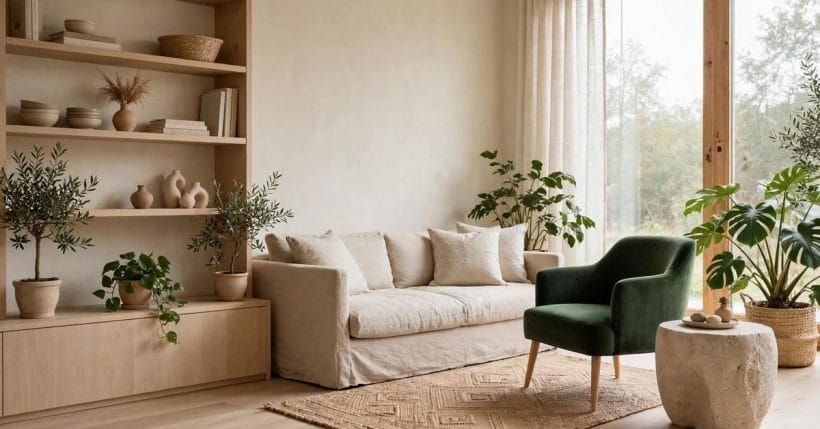
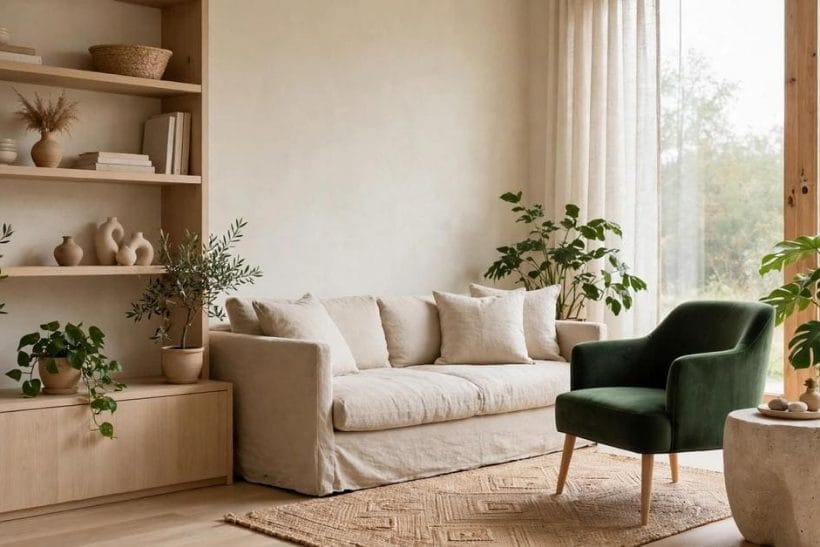
The central entity is the enduring design direction: a way of furnishing and finishing rooms that keeps working because it answers something permanent — light, material honesty, comfort, flexibility — rather than something seasonal. This article keeps one slice of the design family: how directions endure or date. The whole house read as one traditional composition lives in traditional home design; the modern rustic version of the same instincts is in modern barn house; and the colour-confident tropical reading is in tropical interior design. Here the subject is time itself: why some rooms age into character while others age into a date stamp. The feature photograph is the argument in one frame — pale oak, linen, stone, one deep-green chair and living plants; nothing in it belongs to a single season, and that is precisely its freshness.
| Question | Short answer |
|---|---|
| What makes a design direction last? | It solves a permanent problem — light, wear, storage, comfort — with honest materials; fads decorate a moment, directions furnish a life |
| Which directions are enduring? | Natural materials, warm minimalism, quiet committed colour, flexible rooms, and craft with repair — the five surveyed in this article |
| What dates a room fastest? | Anything applied everywhere at once: a single theme, a single finish, a single novelty shape repeated until the room becomes a catalogue page |
| How do I test a direction safely? | In one corner or one room first, with movable pieces, through a full season of living — the directions worth keeping survive ordinary life |
| Do enduring directions cost more? | The honest drivers are material quality and workmanship, not novelty; a smaller room done in lasting pieces usually outlasts a larger one done in fast pieces |
2. Direction One: Natural Materials, Honestly Used
1. Wood, stone, wool and clay outlast every finish applied to imitate them
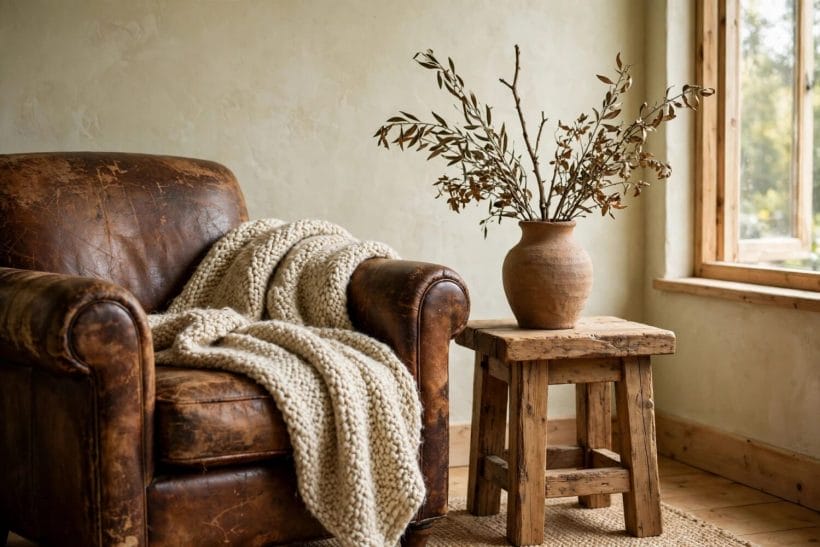
The first enduring direction is the oldest: rooms built from materials that are what they appear to be. Solid timber takes knocks and can be refinished; stone shrugs off heat and water; wool and linen soften light and sound; clay and plaster give walls a depth no flat paint matches. The gallery corner makes the case quietly — a leather chair improving with wear, a timber table, a woven throw. These materials last because time is an ingredient in them: they patina rather than perish, so a room furnished in them looks better settled than it did new. The test when buying is simple to state and hard to fake: the material should feel like itself, age like itself, and be repairable as itself.
The direction also has a shopping discipline: buy the material, not the photograph of the material. A timber sample that can be sanded, oiled and sanded again is a different purchase from a printed surface that chips to reveal its disguise. Stone that is stone all the way through takes a hot pan and a decade of knives’ handles with the same indifference. Where the budget forces a choice, put the honest material where hands and eyes land most — the table, the floor, the worktop — and let the quieter corners be simple rather than imitation.
3. Direction Two: Warm Minimalism
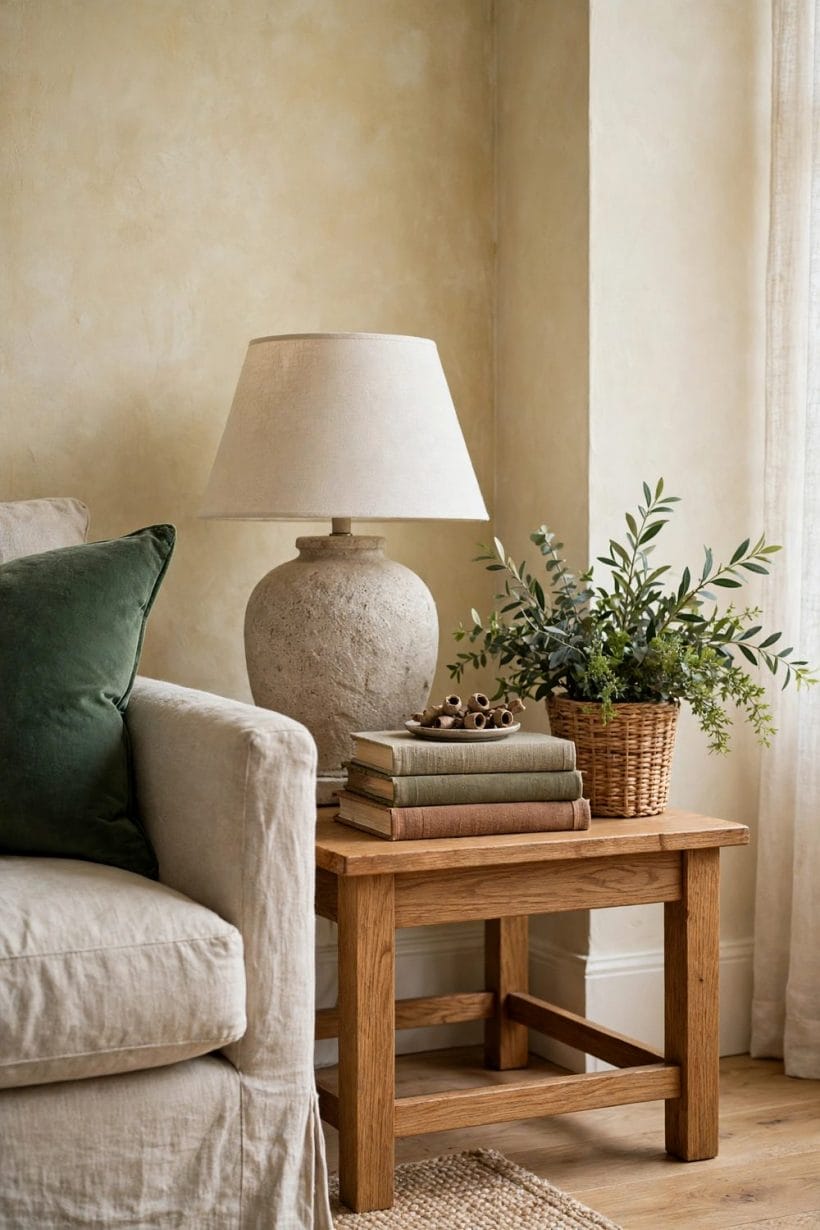
2. Fewer pieces, softer edges, nothing shouting
Minimalism in its cold form dated quickly — empty rooms photograph well and live badly. The version that endures keeps the discipline and restores the warmth: fewer pieces, each chosen; clear surfaces, but soft ones; storage that hides the machinery of life so the room can be calm without being bare. The pin photograph shows the register — linen, a single deep cushion colour, a stone lamp, books meant to be read. Warm minimalism lasts because it is a habit rather than a look: it asks what a room needs, furnishes exactly that, and lets light and material supply the decoration. Rooms arranged this way also absorb change gracefully, which is the practical meaning of timeless.
Its hidden machinery is storage. Warm minimalism fails in homes where life has nowhere to go, so the direction quietly depends on cupboards, boxes and one honest place for the unsorted. With the machinery provided for, the visible room can stay spare without becoming a performance — the calm is real because the clutter has a home, not because the household owns nothing. That is why the look survives children, hobbies and work arriving in the room, where the colder version of minimalism simply broke.
4. Direction Three: Quiet, Committed Colour
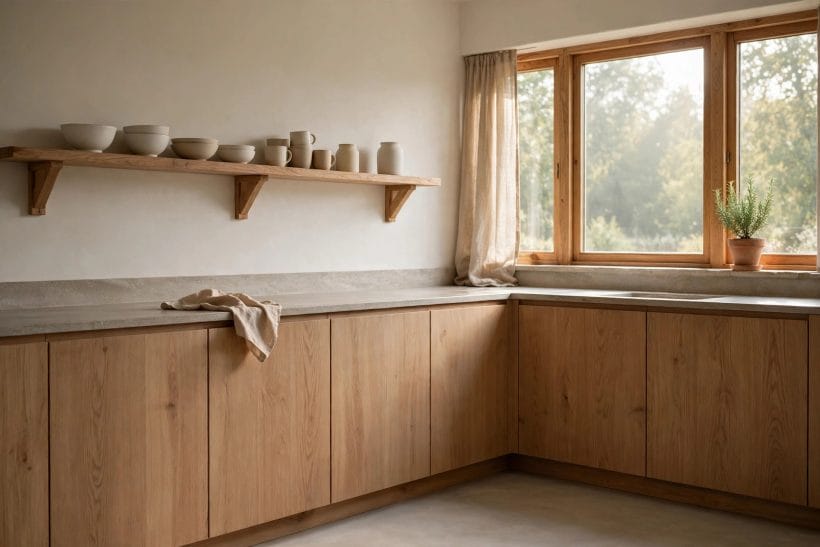
3. Deep shades chosen once, used calmly
Colour fashions churn fastest of all, yet the colour direction that endures is recognisable: deep, slightly muted shades — forest, ink, oxblood, clay — committed to properly on walls, joinery or one generous piece of furniture, then left alone. The gallery kitchen pairs its quiet oak with honed stone and a single plant; imagine its cabinetry in a deep green and nothing about its calm changes. Quiet colour lasts because it behaves like a material rather than a statement: it backgrounds books, faces, food and lamplight. What dates is never the depth but the restlessness — colour applied in novelty patterns, changed with the seasons, or spread so thin it reads as indecision.
The same commitment discipline governs the colour-lane posts in this family: the yellow carried through yellow bedroom ideas works for exactly the reason a deep green works here — one shade, chosen properly, given the whole room to be itself in. Whether the shade is bright or brooding matters far less than whether it was committed to or merely sampled across scatter cushions. Rooms can smell indecision, and they date by it.
5. Direction Four: Rooms That Flex
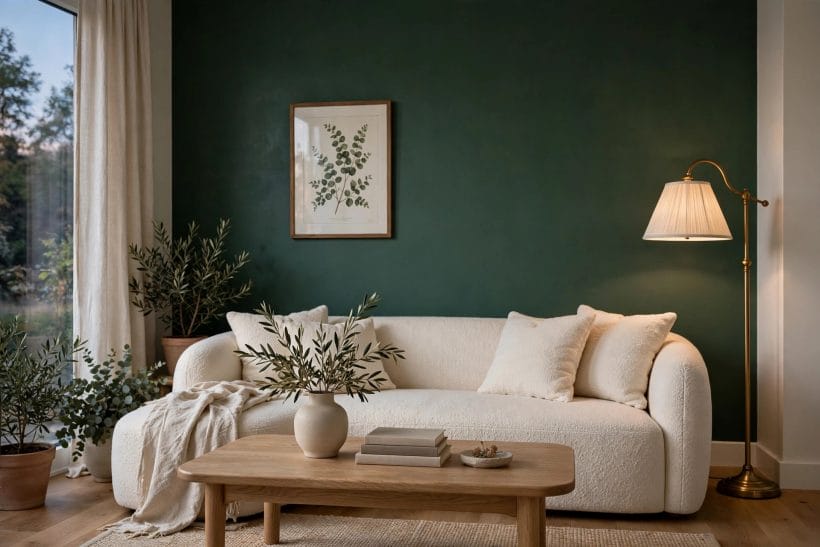
4. Spaces that change their job without changing their furniture
Homes are asked to be offices, gyms, guest rooms and classrooms in the same week, and the direction that answers this — flexible rooms — has the permanence of a real need behind it. Its furniture is light enough to move, low enough to divide without enclosing, and honest enough to serve twice: the bookshelf that zones a room, the sofa bed that hosts, the table that works and dines. The gallery photograph shows the evening half of the idea — a sitting room composed for rest that could clear its centre in minutes. Flexible rooms last because lives change faster than houses do; a room that can be re-decided is a room that never needs to be re-done.
The honest way to build flexibility is in stages. Start with one movable divider or one dual-purpose piece and live with the arrangement before building anything in; the corner that actually gets used as a desk is rarely the corner first imagined. Wheels, handles and lightness are the unglamorous attributes that decide whether a flexible room is ever actually flexed — a divider too heavy to move is just a wall with pretensions. The full-room survey of layouts that have to work this hard lives with the living room ideas pillar.
6. Direction Five: Craft, Repair and the Second-Hand Mix
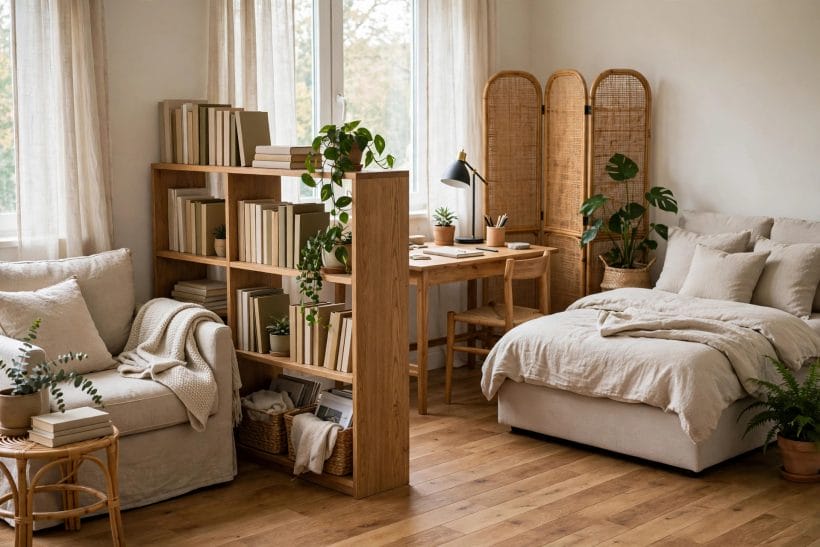
5. Made well, mended openly, mixed without apology
The fifth direction is a sourcing philosophy: buy the made-well thing, keep it, mend it visibly, and let second-hand pieces with character stand beside new ones. A repaired chair carries its history as patina; a vintage table anchors a room of newer pieces and stops the whole from reading as a delivery. This direction endures because it is anti-fragile — every year adds provenance instead of obsolescence — and because it is personal in a way no coordinated range can be. The discipline it asks is patience: one good piece at a time, chosen for the room it will actually live in.
It has honest limits, and naming them keeps the direction credible: soft furnishings and anything whose history cannot be known deserve a careful eye before they join a home, and some pieces are better new. The mix works when the old pieces are the structure — table, chairs, cabinet, lamp bases — and the new pieces are the comfort. Get that order right and a room can be assembled over years without ever looking assembled at all, which is the deepest form the trend-proofing takes.
7. What Dates a Room: The Fast Fads
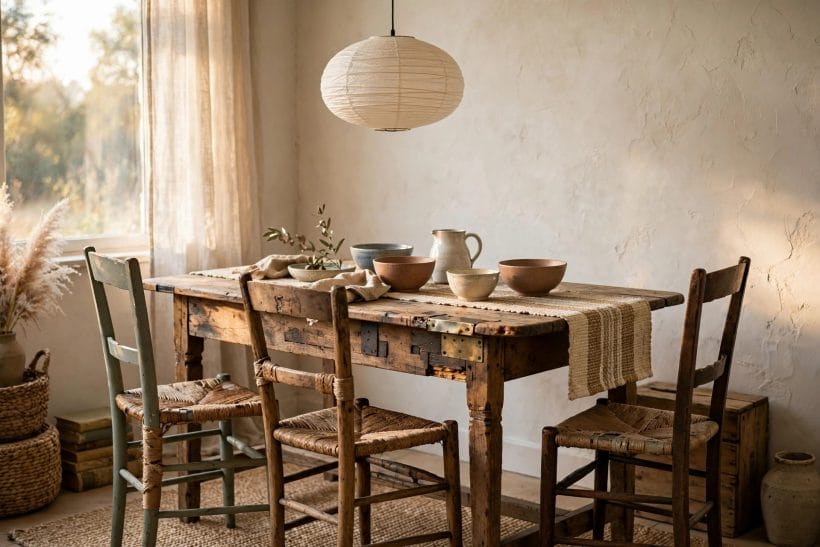
Against the five directions, the dating patterns are just as recognisable. The single-theme room — every object recruited into one idea — dates as a set. The novelty shape repeated everywhere dates by saturation: when a curve, a finish or a motif appears on every object in the room, the room becomes a timestamp. Grey-on-grey total schemes date by coldness; they furnished a decade’s rentals and feel like them. Matchy furniture suites date by their completeness. And anything bought mainly to be photographed dates fastest of all, because its purpose expires with the post. The common thread is not any particular colour or shape — it is total commitment to a moment. The dining corner in the gallery avoids every trap at once: old and new mixed, nothing matched, everything usable.
None of this means avoiding strong choices. It means locating the strength in the permanent layers — materials, colour, craft — and letting the seasonal layer be the cheap, movable one: cushions, throws, a lamp, a print. Rooms date from the bottom layer up; furnish them in that order and the fads can visit without moving in.
A quick self-test separates the two piles in any photograph that tempts you: point at each element and ask whether it would still earn its place if nobody ever saw the room but the people who live in it. The elements that survive the question are directions; the ones that exist for an audience are fads, and they are always recognisable in hindsight by how completely they were adopted. Adopt partially, in the cheap layers, and hindsight has nothing to accuse you of.
8. How to Test a Direction Before You Commit
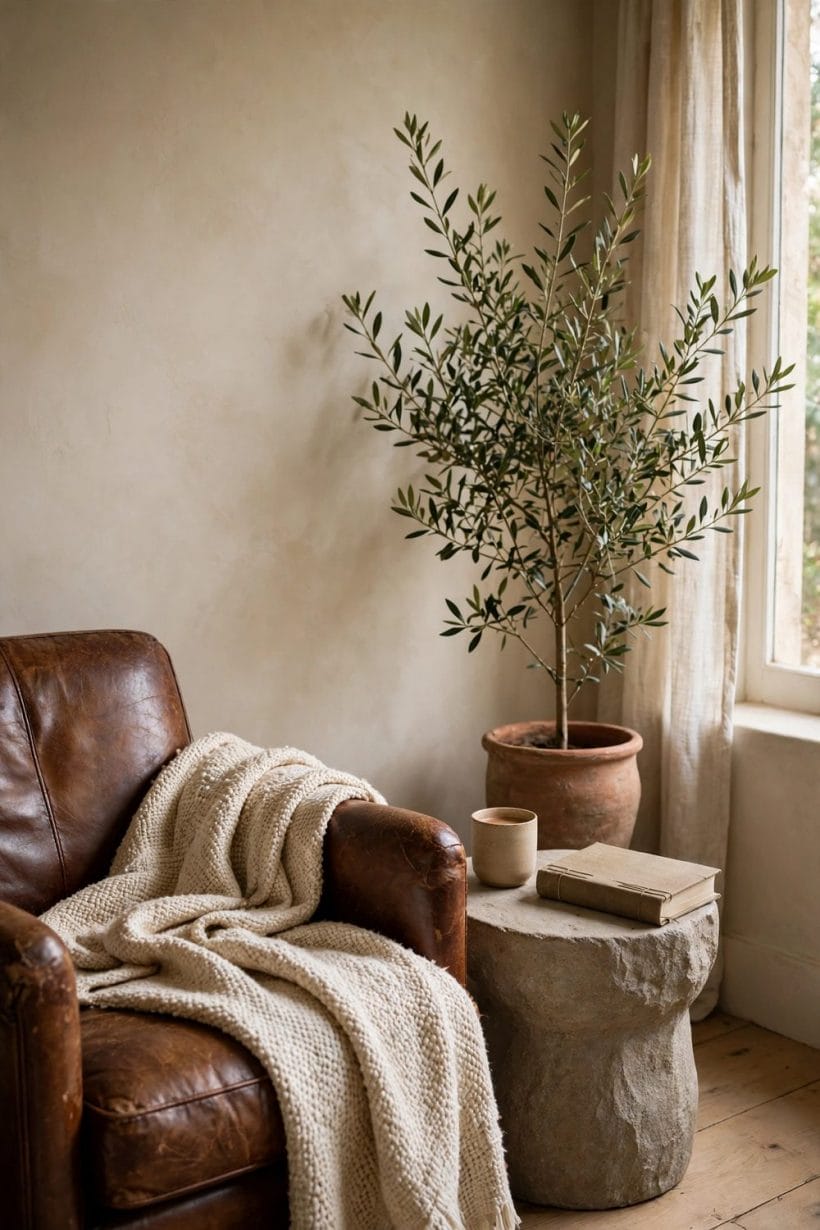
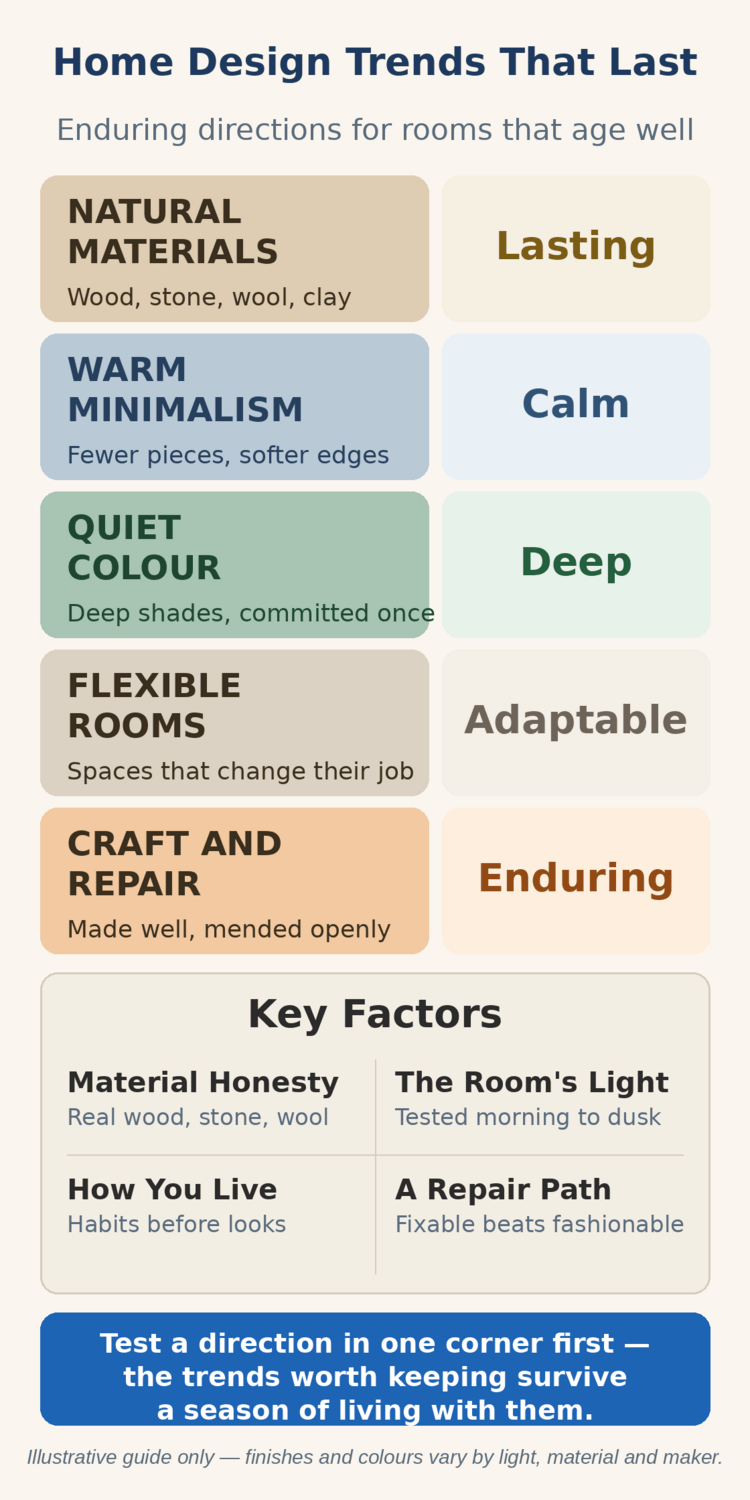
The infographic’s tip is the method in one line: test a direction in one corner first. Choose the smallest honest trial — a single wall before a room, a chair before a suite, a material sample lived with rather than glanced at. Live with the trial through ordinary weeks: bright mornings, grey afternoons, lamplight, guests, clutter. The pin photograph is a trial corner done well — one chair, one table, books, a plant; a whole direction tested in a square metre. Then ask the only question that separates directions from fads: is this solving something in how the room lives, or only changing how it photographs? Directions answer needs; fads answer feeds. If the corner still pleases when it is dusty, crowded and lamplit, it has earned its expansion to the room.
9. Where to Spend, Where to Save
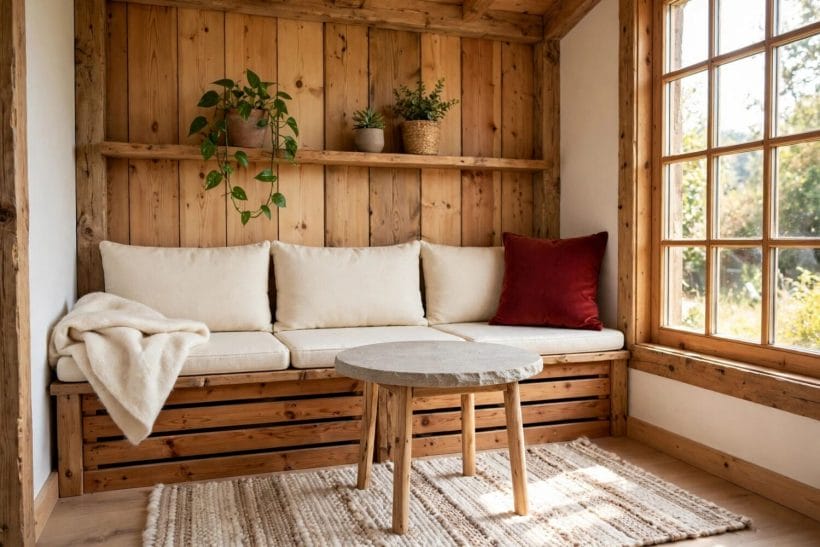
The enduring budget follows the layers. Spend on what hands touch daily and what cannot be changed cheaply later: the sofa’s frame and filling, the floor’s material, the table’s timber, the chair that will be re-covered rather than replaced. Save on the seasonal layer — cushions, throws, prints, small lamps — where change is the point. The compact room in the gallery shows the allocation working at small scale: built-in timber seating and a stone-topped table carry the permanence; a single deep-red cushion carries the season. Stated generally, the drivers are always the same honest ones — material quality, workmanship, and how much of the room the piece governs — never the novelty of the moment it was bought in.
10. Enduring Directions in Tiny and Small Homes
Small homes feel every fashion harder: there is no spare room to absorb a mistake, and every piece is always on view. The five directions scale down gracefully because none of them depends on quantity. Natural materials make a small room feel crafted rather than cramped; warm minimalism is small-space discipline by another name; one deep colour, committed to once, gives a tiny room its architecture; flexible furniture is the tiny house’s founding idea; and the second-hand mix suits small budgets and small footprints alike. The small-space versions of these instincts run through the tiny house collection — start with the tiny house living room interior design post for the room where most of them meet, and the gathered fireplace ideas for tiny houses for material honesty at its most literal. In a small home, choose directions, not moments: the room has nowhere to hide a fad.
Final Considerations
Walk through the home you are planning and sort every choice into two piles: the permanent layer and the visiting layer. If the permanent pile is made of honest materials, quiet colour, flexible bones and repairable craft, the room will age into character whatever the visiting layer does — and the visiting layer can stay as playful as the season asks.
Trends are not the enemy; they are how good directions first announce themselves. The skill is telling the announcement from the answer — testing in a corner, in real light, through real weeks, and committing only where a direction solves something permanent. Keep the survey in present terms, the materials honest and the splits clean, and the rooms that result will not need a date to explain them.

0 Comments