

Some rooms are decorated. A tropical living room is weather — sunlight moving through shutters, a fan turning slowly, green leaves doing the work of wallpaper.
These seventy-five tropical living room ideas cover layouts and sofas, coral-and-turquoise colour, rattan and bamboo, the indoor canopy of plants, layered lighting, and the care and cost drivers of a style built on breeze.
1. Tropical Living Room Ideas at a Glance
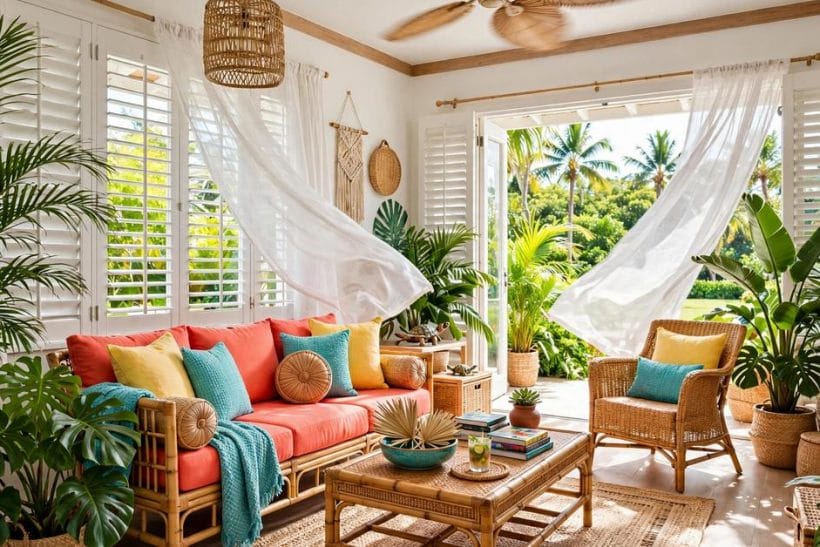
The central entity is the tropical living room: a sitting room whose attributes are its openness to air and garden, its natural woven materials, its leafy planting, its bright warm colour, and light filtered the way foliage filters it. The feature photograph is the whole argument in one frame — a coral rattan sofa, turquoise and yellow cushions, palms and monstera in woven baskets, shutters and sheer curtains breathing in the same breeze, and a ceiling fan turning above it all. This post is the tropical slice of the living-room family: the full survey lives in the living room ideas pillar, and the whole-house survey in home design ideas. Tropical here is a discipline, not a theme park: real plants, real fibre, colour with confidence, and nothing plastic pretending to be a palm.
| Question | Short answer |
|---|---|
| What makes a room read as tropical? | Greenery first, natural woven materials second, bright warm colour third — over a calm, pale, airy base |
| Does it need a hot climate? | No: the look is built from plants, fibre and colour, and adapts to any home willing to give plants real light |
| What is the biggest mistake? | Novelty clutter — flamingo kitsch and plastic leaves date instantly; the enduring version is a garden room, not a souvenir shop |
| Where does the money go? | Drivers only: the sofa and woven furniture, plants at scale, window dressings and fans, and lighting — priced locally, staged easily |
2. Layouts: A Room Open to the Garden
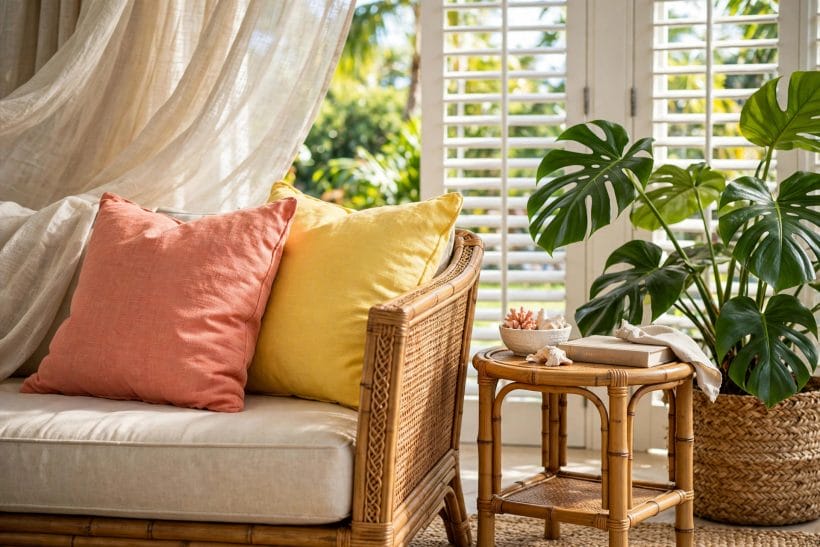
Tropical layout is about flow — of air, of people, of the eye travelling from sofa to garden without meeting a barrier. The gallery photograph’s corner, sofa angled between shutters and greenery, shows the arrangement instinct these ideas formalise.
1. Face the seating to the green
In a tropical room the view — garden, balcony, or the room’s own planted corner — is the fireplace. Angle the sofa toward it and the layout has its gravity; everything else orbits the green.
2. Keep the middle of the room breathing
Tropical rooms feel generous when the centre stays open: furniture at the edges, a woven rug defining the conversation, air moving through the middle the way it moves through a veranda.
3. Use the shutter line as the room’s edge
Where windows carry shutters or louvres, treat that wall as the room’s permeable skin — seating set just inside it, plants silhouetted against it, nothing heavy parked across the light.
4. A veranda arrangement indoors
Borrow the veranda’s furniture plan: a sofa, two loose chairs, a low table, nothing matching too hard. The gallery rooms all share it — sociable, movable, and ready for someone to carry a chair toward the evening sun.
5. Zone a reading corner by the plants
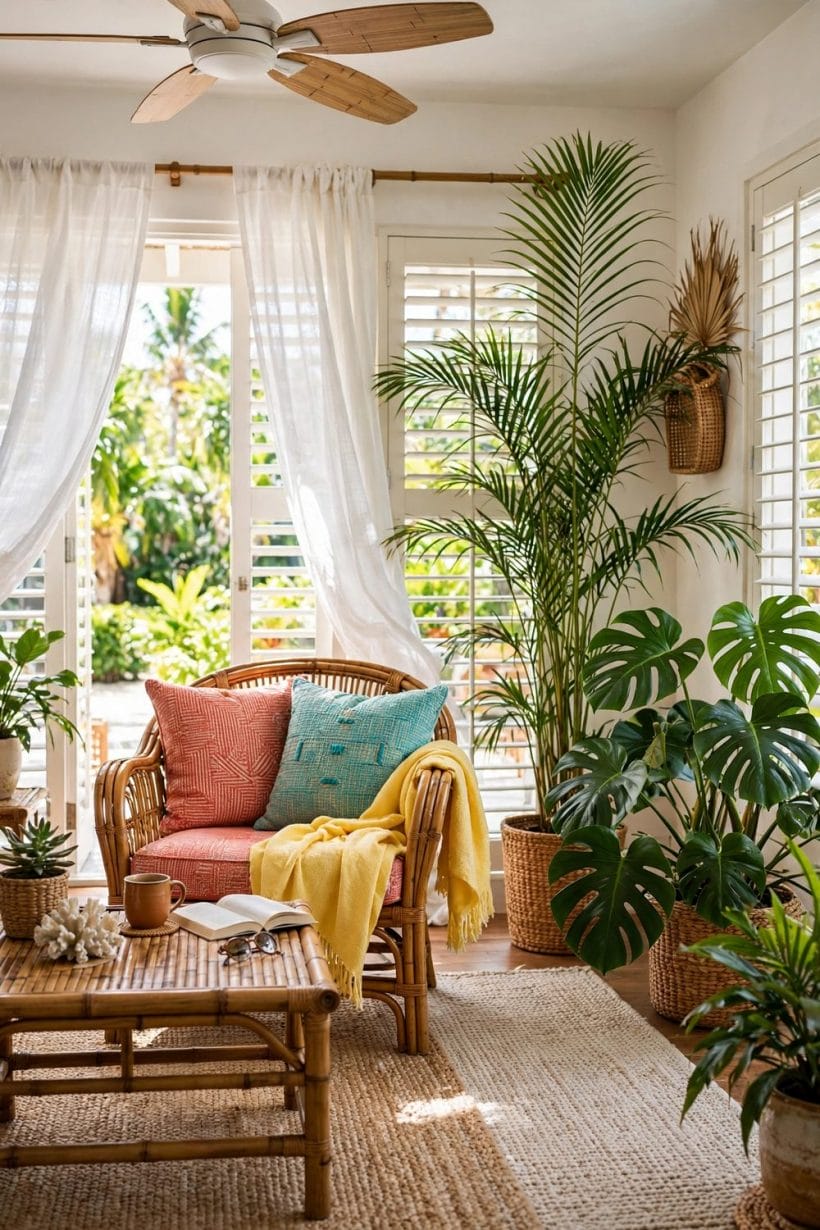
One chair in the greenest corner, a small table, a lamp for after dark: the pin photograph’s reading nook is the tropical room’s quietest luxury and its easiest to copy at any size.
6. Let doors open, plan for it
If the room opens to a terrace, arrange furniture so the open doors complete the room rather than interrupt it — the feature photograph’s billowing sheers work because nothing blocks their swing or their theatre.
7. Low furniture, high ceilings of leaf
Keep the furniture profile low and let the height come from palms and the fan above. The proportions — grounded seating, airy vertical green — are what make guests exhale on entry.
8. A long room gets two garden moments
In a rectangular room, plant both ends and seat the middle: the eye travels leaf to leaf, and the room reads as a clearing in greenery rather than a corridor with a sofa in it.
9. Small rooms: one palm, one chair, conviction
The tropical method scales down to a single large plant, a woven chair and a coral cushion, provided each is full-sized and unapologetic. Miniature versions of everything is the only true failure mode.
3. Sofas and Seating: Rattan Frames, Bright Cushions
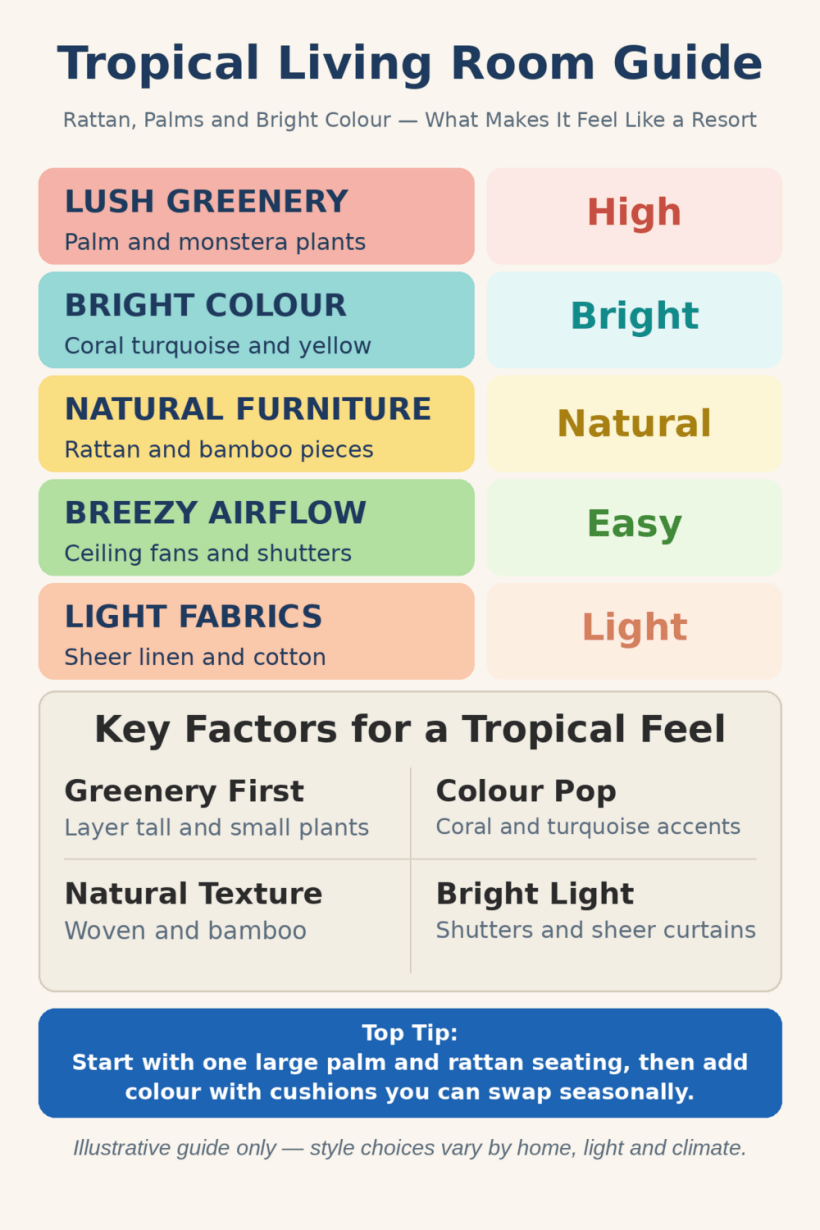
The tropical sofa is a frame of woven or timber craft wearing loose, bright, washable colour. These ideas build the seating the infographic promises — natural furniture first, colour carried by cushions that can change with the season or the laundry.
10. The rattan-framed sofa as anchor
A rattan or bamboo frame, like the feature sofa, gives the room its craft skeleton — light, strong, and visibly handmade. Its loose cushions, not the frame, carry the colour, which keeps the anchor timeless.
11. Coral: the signature upholstery accent
Coral is tropical’s warm handshake — the feature sofa’s cushions, echoed in the gallery rooms — flattering to skin, to timber and to green. Use it on the big soft surfaces and let it lead the palette.
12. Deep seats for slow sitting
Tropical seating is for lingering: deep cushions, a bolster to lean on, an ottoman for feet. Choose comfort with the seriousness other styles give to silhouette; nobody remembers a chic sofa that hurt.
13. A peacock chair as the room’s portrait
The gallery’s woven peacock chair is the style’s throne — one sculptural chair that photographs like a painting and seats like a nest. One per room is the ration; two is a shop.
14. Loose chairs that travel
Lightweight woven armchairs move with the day — to the window for morning light, into the group for guests, onto the veranda for dusk. In tropical rooms, furniture that cannot be carried by one person is furniture in the wrong style.
15. Washable everything, honestly
Sun, humidity, wet swimwear and plant watering all visit tropical seating. Removable, washable covers in cotton and outdoor-grade fabrics are not a compromise; they are the style’s founding practicality.
16. A daybed along the shutter wall
Where the room allows, a daybed under the windows is the tropical room’s masterpiece — siesta infrastructure, guest bed, reading deck — dressed in white and one bright throw.
17. Mix the weave, match the tone
Rattan, cane, bamboo and seagrass combine happily when their tones agree. The gallery rooms mix weaves freely; the discipline is colour temperature, not material matching.
18. Cushion maths: bright, brighter, leaf
Work cushions in families — a warm bright, a cool bright, a leaf print — as the feature sofa’s coral, turquoise and yellow demonstrate. Three families, varied sizes, endless rearrangement.
4. Colour: Coral, Turquoise and Leaf Green
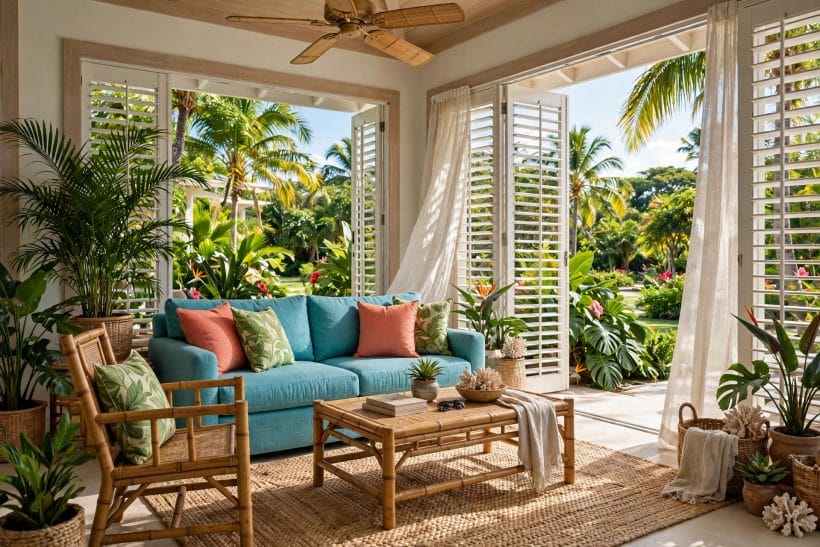
Tropical colour is sunlight translated: leaf greens as the ground, flower brights as the events, white and woven neutral as the air between. The gallery’s turquoise sofa room shows the palette at full confidence.
19. Start from leaf green, not from paint
The palette’s foundation is the plants themselves — a dozen greens no paint chart matches. Choose hard colours after the plants are in, and the room’s colour story writes itself in chlorophyll.
20. Turquoise: the water note
Turquoise cushions, a painted side table, a bowl — the colour of shallow water over sand. The gallery sofa wears it as upholstery; in smaller doses it cools every warm scheme it touches.
21. Yellow for the sunlight hours
A clear, warm yellow — cushions, a throw, a lamp’s shade — stores sunshine in the room for grey days. Keep it flower-fresh rather than mustard; tropical yellow is a morning colour.
22. White and cream as the breeze
Pale walls, white sheers and cream upholstery are the palette’s airflow — the feature room’s white shutters and curtains let every bright sit brighter. Skipping the pale ground is how tropical turns garish.
23. Timber tones are colours too
Honey rattan, mid-tone teak, dark woven accents — the natural materials bring the palette’s browns, and they should be counted in the scheme like paint. Too many timber tones fight; two in conversation sing.
24. One wall of colour, if any
A single coral or deep green wall can anchor a room — the pin photograph’s coral wall glows behind its pendants — but the classic tropical room keeps walls pale and spends its colour on things that move: cushions, art, fruit, flowers.
25. Prints: leaf before novelty
Botanical prints — palm, monstera, banana leaf — are the pattern library, at cushion and curtain scale. One print family per room, generously sized; small ditzy patterns belong to other styles.
26. Fruit and flowers as rotating colour
A bowl of mangoes, a vase of garden flowers, a branch in a jar: the cheapest colour in the room is the kind that changes weekly and wilts honestly. Tropical rooms are styled by the season, not the store.
27. Test brights in daylight and lamplight
Warm brights shift after dark — coral deepens, turquoise cools. Live with cushion covers through a full day before multiplying them; the room performs at both ends of the light.
5. Natural Materials: Rattan, Bamboo and Woven Texture
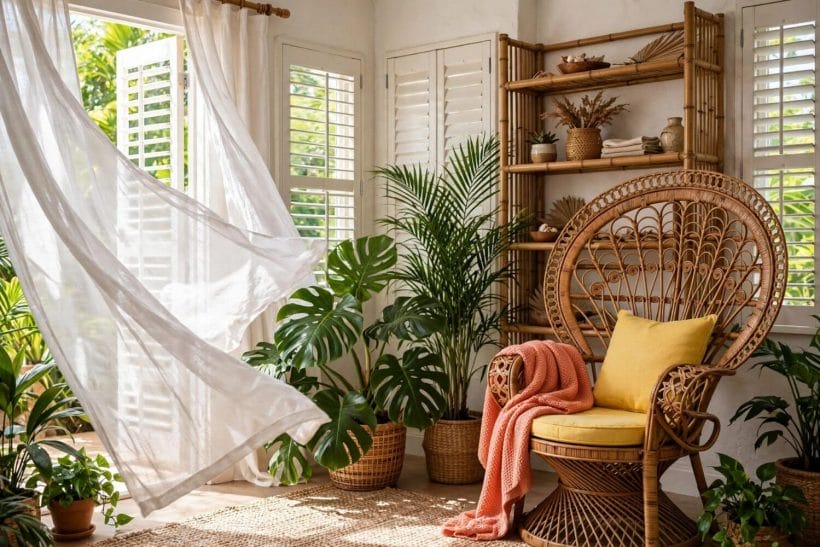
If colour is the style’s voice, woven fibre is its accent — the visible handwork of rattan, cane, bamboo and seagrass. The gallery’s peacock chair and shelving show the material family at full stretch.
28. Rattan: bent, woven, structural
Rattan’s gift is strength in curves — frames that flex a little and forgive a lot. It carries sofas and chairs with a fraction of timber’s weight, which is why tropical furniture moves so gracefully through the day.
29. Cane webbing for light panels
Open cane on chair backs, cabinet doors and screens passes air and light while giving pattern — the material the colonial veranda perfected and the modern room has reclaimed.
30. Bamboo for the straight lines
Where rattan curves, bamboo stands straight: poles, blinds, table frames and lamp stems. Its ringed rhythm is the style’s quiet metronome, best in small, repeated doses.
31. Seagrass and jute underfoot
The woven rug is the tropical floor’s default — flat, cool, forgiving of sand and spills, and texturally the room’s ground note. Layer a smaller patterned rug over it when the seating group needs defining.
32. Baskets do the storage
Plants in woven baskets, throws in woven baskets, the remote control in a woven basket: the style’s storage is one material repeated, which is why tropical rooms tidy so photogenically.
33. Timber where hands land
Coffee tables, side tables and the arms of chairs reward solid timber — the gallery’s bamboo-framed tables wear it as tops. Wood where the hand lands, fibre where the eye rests.
34. Care for natural fibre honestly
Woven materials like dry shade and gentle dusting; damp and fierce sun shorten their patience. Indoors they last for years of daily use — the care is a brush, a vacuum’s soft head, and keeping plant watering tidy.
35. Vintage woven pieces carry the soul
A market-found rattan chair or an inherited cane screen brings age the new room cannot fake. Mix one storied piece among the new and the whole scheme gains a past.
6. Plants: The Indoor Canopy
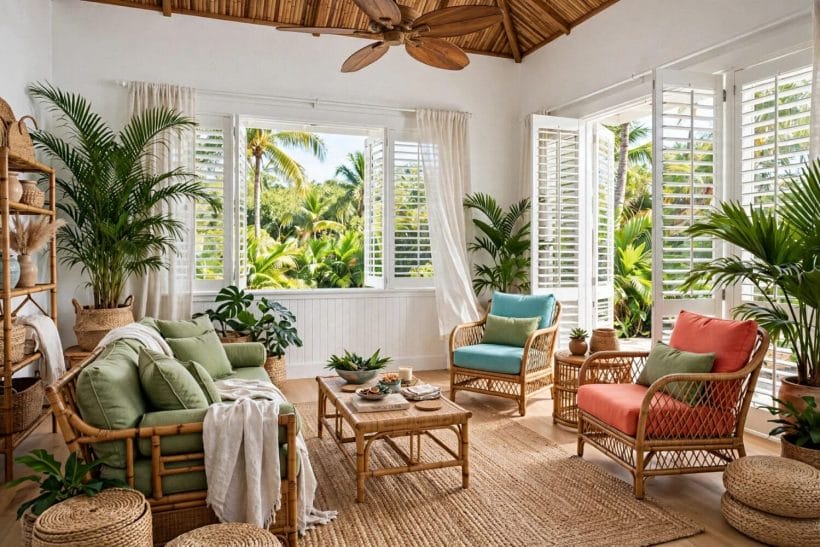
The infographic puts greenery first, and this section keeps it there. A tropical living room is a garden that happens to hold a sofa — these ideas build the canopy in layers, from the statement palm to the shelf-top trailer.
36. One large palm, placed like furniture
The infographic’s top tip is the section’s law: begin with one genuinely large palm where a piece of furniture would go — corner, window flank, behind the sofa. Its scale is the room’s tropical credential; everything smaller is supporting cast.
37. Layer heights like a real canopy
Tall palm, mid monstera, low fern, trailing pothos from a shelf: four storeys of leaf make a planting read as a place rather than a collection. The gallery rooms all plant in storeys.
38. Monstera: the graphic leaf
No leaf signifies tropical faster, and a healthy monstera in a woven basket is sculpture that waters itself into new shapes monthly. Give it light and room; it returns architecture.
39. Group plants, never scatter singles
Single pots dotted around a room read as errands; plants massed in corners and along the shutter line read as planting. Group in odd numbers, vary the pots’ heights with stands and upturned baskets.
40. The window is the greenhouse
Most tropical houseplants want the brightest spot the room has. Arrange the canopy toward the light, rotate pots so growth stays even, and let the seating enjoy the shade the plants cast — the arrangement serves both species.
41. Herbs and flowering plants for scent
A jasmine, a gardenia, flowering orchids on the table — scent is the invisible layer visitors remember. One fragrant plant near the seating outperforms a shelf of scented products.
42. Faux only where real cannot live
A dark corner far from windows may take one good artificial stem without shame — but the room’s headline plants must be alive, because the style’s whole claim is that this is a garden, tended and breathing.
43. Watering is a ritual, design for it
Cans that live in a basket, saucers that protect the rug, a weekly round that takes ten unhurried minutes: plant care succeeds when the room is arranged to make it pleasant. Design the ritual and the canopy thrives.
7. Light and Airflow: Shutters, Sheers and Fans
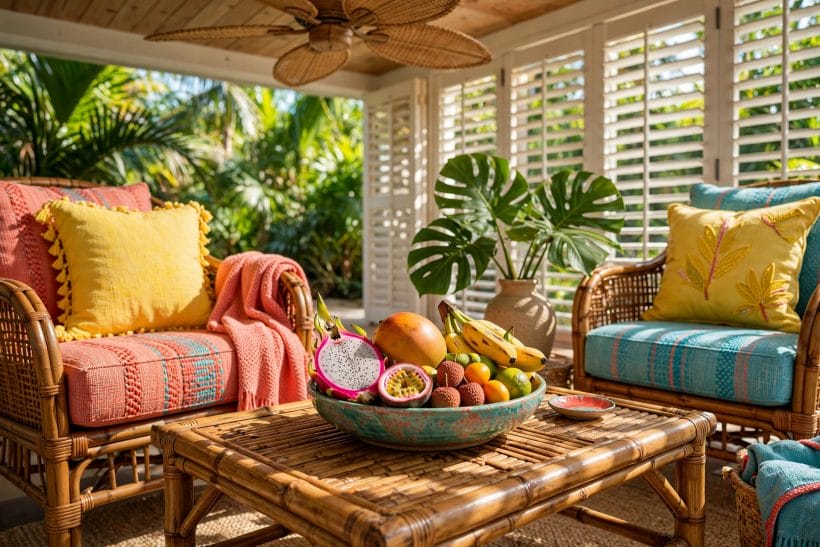
Tropical rooms are engineered for moving air and filtered sun — the gallery’s veranda-style seating sits inside that engineering. This section covers the window dressings, fans and airflow habits that make the style comfortable rather than merely picturesque.
44. Shutters: the style’s signature window
Plantation shutters do three tropical jobs at once — shade you can aim, privacy you can tilt, and airflow that continues after both. The feature room’s shuttered walls are the look and the mechanism in one.
45. Sheer curtains for the billow
White sheers are the style’s theatre: they make the breeze visible, soften the sun’s edge and photograph like a holiday. Hang them generously wide so the folds stay deep, and let them move.
46. A ceiling fan is furniture
The fan is the tropical ceiling’s centrepiece, chosen like a light fitting — woven or timber blades, a scale that suits the room — and used daily. Still air is the one thing a tropical room cannot be.
47. Cross-breeze by arrangement
Openings on two sides make moving air; furniture that blocks the path between them stops it. Keep the breeze’s corridor clear in the layout and the room cools itself with manners.
48. Shade the glass, keep the glow
Bamboo blinds behind sheers, deep veranda shade outside, or shutters angled at noon: the method matters less than the result — light that arrives filtered, like light through leaves, never as a glare.
49. Evening air: open the room’s lungs
The daily habit — windows and doors open when the day cools — is free climate control and the room’s reset button. Tropical living is partly a schedule, and the house that breathes on time feels degrees kinder.
50. Insect sense, stated simply
Screens where insects are a fact, a fan’s downdraught where they are a nuisance, and plants that earn their place by more than looks: comfort in the tropics is designed, not endured. Local solutions rule — ask what works on your own street.
51. When the climate is not tropical
Northern rooms borrow the system in part: sheers and shutters for summer glare, the fan for still days, plants forgiving the heating season. The style adapts by degree; only the plastic version refuses to.
8. Pattern, Art and Finishing Touches
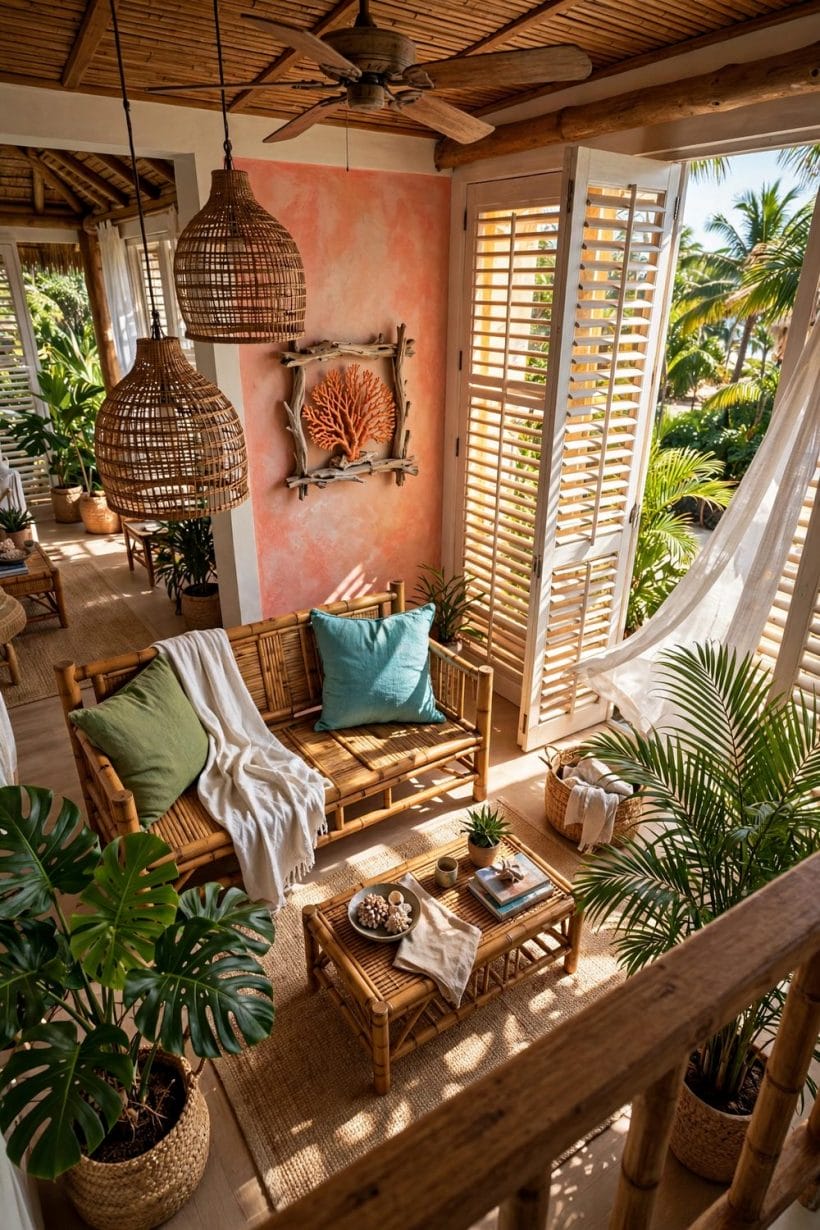
The last layer is the personal one — art, objects and textiles that say whose tropics these are. The second pin’s coral wall, framed coral and woven pendants show how finished a tropical room can look while still breathing.
52. Botanical art, generously framed
Large leaf studies, vintage plant plates or the household’s own garden photography, framed simply and hung at calm intervals — art is the canopy’s winter store, green when the plants rest.
53. A coral or shell specimen as sculpture
One natural specimen — coral form, a great shell, a piece of driftwood — on the shelf or table is the style’s permitted cabinet of curiosities. Chosen once and kept sparse, it reads as treasure.
54. Travel objects with real miles
A basket from a market you actually visited, a textile from a coast you actually swam: tropical rooms absorb travel honestly. Souvenirs with provenance are decor; without it, they are stage props.
55. Books in bright bindings
The coffee table’s stack — garden books, cookery, the atlas — in the palette’s brights is decoration that also gets read. The gallery rooms all keep a small, colourful library within reach of the sofa.
56. Throws in the cool brights
A turquoise throw, a yellow cushion’s twin: textiles rotate the room’s accent without touching a paint tin. Keep two sets — wet season and dry, or bright and brighter — and swap with the calendar.
57. The fruit bowl as centrepiece
Mangoes, citrus, a pineapple in its brief glory: the tropical table’s centrepiece is edible, sculptural and self-renewing. It is also the style’s honesty test — real fruit, eaten, replaced.
58. Woven wall pieces over paint
A woven fan, a basket wall, a macramé hanging — the feature room wears them — give walls texture that flat art cannot, and they weigh nothing where a shelf of objects would crowd.
59. Stop one object early
Every tropical room in this post is full — and every one stopped before the next thing. The finishing touch is a refusal: the shelf left half-empty, the corner left to the palm. Abundance, edited, is the style.
9. Layered Lighting: From Glare to Glow
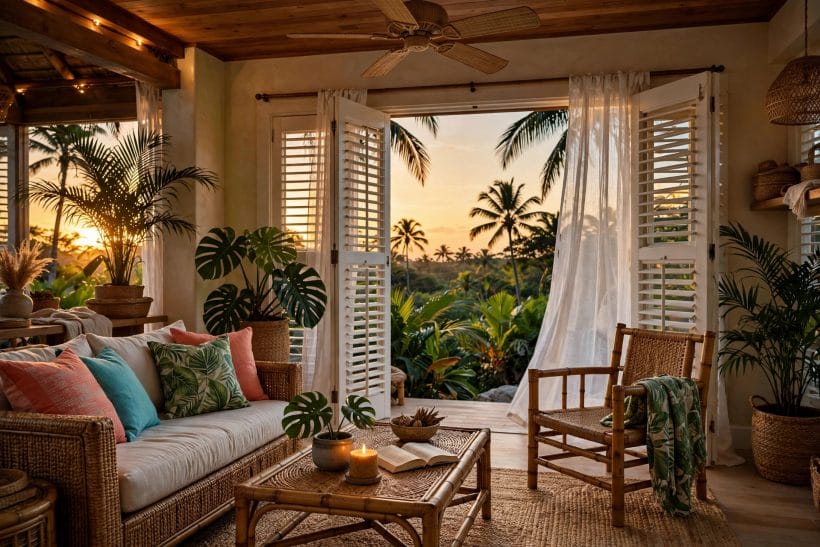
Daylight does the tropical room’s day shift; lighting must do the evening’s without breaking the spell. The gallery’s sunset room — lamps lit as the garden darkens — is the handover moment these ideas choreograph.
60. Woven pendants over the table
Rattan and bamboo pendants — the pin photograph’s pair — cast patterned light and carry the material story to the ceiling. Their glow is dappled, like the shade they imitate.
61. Lamps at sitting height
Table lamps beside the sofa, a floor lamp at the reading chair: light at the height of faces flatters everyone and keeps the ceiling fan’s stage clear. The tropical evening is lit low and warm.
62. Dim the bright down
Overhead glare is the enemy of the style’s evening self. Warm bulbs, dimmers where fitted, and more sources at lower power beat one heroic ceiling light every night of the week.
63. Candlelight for the veranda hours
Enclosed lanterns and jar candles on the table bring the flicker the style was born under. Attended, sheltered from the sheers, and out before bed — the standing rule that keeps them romance instead of risk.
64. Light the plants, gently
One uplight beneath the big palm turns the canopy into evening architecture — leaves as a lampshade the size of the room. It is the single most atmospheric trick in this post.
65. A lit path to the garden
If the room opens outside, a low light at the threshold lets the evening expand into the garden instead of ending at the glass. The room and the night garden become one sitting.
66. Fairy lights with restraint
A single strand along a shelf or through the monstera can charm; a room netted in them turns novelty. Tropical restraint applies to sparkle as to everything else — one constellation per room.
67. Match the hardware to the weave
Lamp bases in timber, ceramic or woven fibre keep the material family unbroken after dark. Metal belongs to other rooms in this house; here, even the light wears natural dress.
10. Costs, Care and Keeping the Breeze
Tropical spending divides happily: the woven furniture and sofa are the investment, plants and cushions the affordable theatre, and care a weekly pleasure rather than a chore list. Costs stay drivers-only here, as everywhere on Togaze.
68. Spend on the frame, save on the colour
Buy the best rattan and sofa frames the budget allows; cushions, throws and covers refresh cheaply for years. It is the same inversion as the steel-railing post next door in the staircase family — structure first, surface second.
69. Plants at scale, bought young
Large plants price by their years; young ones, given the light this style insists on, become large on a forgiving schedule. Buy the palm at the size the corner needs and let the rest grow into their storeys.
70. Shutters and fans are joinery, priced locally
Shutters, fans and any electrical work are quoted by local trades against your actual windows and ceilings — drivers include the number of openings, ceiling height and existing wiring. Measure first; figures follow locally.
71. The ceiling is a design surface here
Few living-room styles spend on the ceiling, but this one lives under a fan — the treatment of the ceiling plane itself, explored in ceiling designs for living room, belongs in the tropical budget conversation early.
72. Humidity is the maintenance headline
In genuinely humid homes, ventilation and mould vigilance are the care regime — fabrics aired, woven pieces dusted and sunned, plants’ soil kept honest. In dry climates the enemy reverses: mist the leaves, group the pots, humidify the corner.
73. A media corner, tropical-mannered
Screens join the style when they wear its manners — a television on a woven-fronted stand, cables hidden in baskets — the practical diplomacy worked out in media wall living room ideas.
74. The cottage cousin
Read across to cottage interior ideas and the family resemblance shows: natural fibre, gathered furniture, colour with a garden accent. Tropical is the cottage that moved somewhere warm and opened all its windows.
75. Brick, if the room brings it
Some tropical rooms inherit brick — and brick wall living room ideas shows the material limewashed pale or left warm behind the green. Either way the canopy wins: leaf against brick is one of the great texture pairings.
Final Considerations
A tropical living room is a climate you build indoors: green in layers, fibre you can feel, colour like fruit and sea, air that moves and light that filters. Build it on the honest version — living plants, real weave, washable brights, shutters and sheers doing real work — and it will never date the way themed rooms date, because a garden room is not a fashion. It is a way of sitting in a house as if the house were glad to be in its landscape. Start with the palm and the rattan chair, as the infographic counsels, and let the canopy grow.
One caution travels with the style wherever it moves: a tropical room is alive, and living rooms — in every sense — ask for tending. Plants drink, fibre gathers dust, cushions fade a little in the sun they celebrate. Budget the tending as part of the pleasure, the way a gardener budgets weeding, and the room will keep its resort calm for years. Neglect is the only climate this style cannot survive; give it a weekly hour of care and it will give back a permanent holiday, four seasons a year, at the end of your own hallway.

0 Comments